Hubbry Logo
Laccadive SeaLaccadive SeaMain
Open search
Laccadive Sea
Community hub
Laccadive Sea
logo
8 pages, 0 posts
0 subscribers
Be the first to start a discussion here.
Contribute something
Laccadive Sea
Laccadive Sea
from Wikipedia

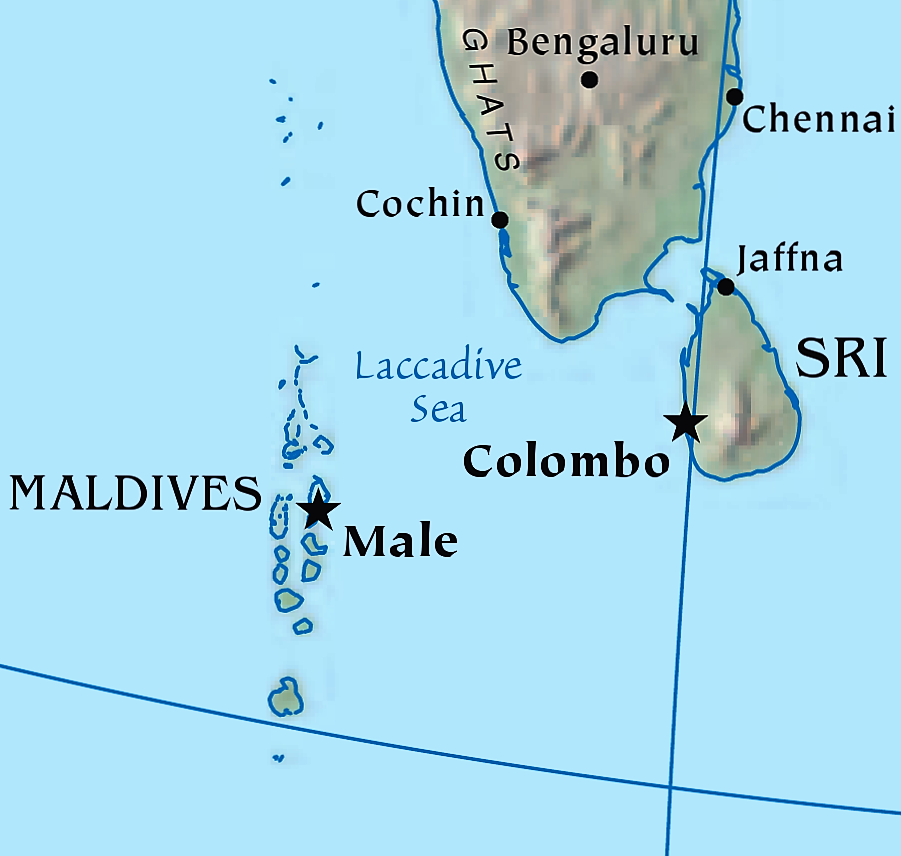
The Laccadive Sea (/ˈlɑːkədv, ˈlækə-/ LAH-kə-deev, LAK-ə-), also known as the Lakshadweep Sea, is a body of water bordering India (including its Lakshadweep islands), the Maldives, and Sri Lanka. It is located to the southwest of Karnataka, to the west of Kerala and to the south of Tamil Nadu. This warm sea has a stable water temperature through the year and is rich in marine life, the Gulf of Mannar alone hosting about 3,600 species. Mangaluru, Kasaragod, Kannur, Kozhikode, Ponnani, Kochi, Alappuzha, Kollam, Thiruvananthapuram, Tuticorin, Colombo, Negombo and Malé are the major cities on the shore of the Laccadive Sea. Kanyakumari, the southernmost tip of peninsular India, also borders this sea.[2] It is named for the Laccadive Islands located in the northwest portion of the sea.

Key Information

Geography

[edit]
A view of the Laccadive Sea from Villingili

The International Hydrographic Organization defines the limits of the Laccadive Sea as follows:[3]

Laccadive seashore at Muzhappilangad, where also the longest Drive-in beach of Asia locates
Laccadive seashore at Kollam Beach

On the West. A line running from Sadashivgad Lt. on West Coast of India (14°48′N 74°07′E / 14.800°N 74.117°E / 14.800; 74.117) to Corah Divh (13°42′N 72°10′E / 13.700°N 72.167°E / 13.700; 72.167) and thence down the West side of the Laccadive and Maldive Archipelagos to the most Southerly point of Addu Atoll in the Maldives.

On the South. A line running from Dondra Head in Sri Lanka to the most Southerly point of Addu Atoll.

On the East. The West coasts of Sri Lanka and India.

On the Northeast. Adams Bridge (between India and Sri Lanka).

Water temperature is rather constant through the year, averaging 26–28 °C in summer and 25 °C in winter. Salinity is 34‰ (parts per thousand) in the center and northern part and up to 35.5‰ in the south. The coasts are sandy and the deeper parts covered in silt. There are numerous coral reefs in the sea, such as the Lakshadweep islands which are made up of atolls and contain 105 coral species.[1][4][5]

Ecology

[edit]

With about 3,600 species of flora and fauna, the Gulf of Mannar is regarded as one of the richest marine biological resources in the world. Of these 3,600 species, 44 are protected, 117 are corals, 79 crustaceans, 108 sponges, 260 mollusks, 441 fin fishes, 147 seaweeds and 17 mangroves.[6] In 1986, a group of 21 islands and nearby waters with a total area of 560 km2 were declared as the Gulf of Mannar Marine National Park. The park and its buffer zone were designated as a Biosphere Reserve in 1989. The Gulf of Mannar Biosphere Reserve covers an area of 10,500 km2 of ocean, islands and the adjoining coastline, and is the largest such reserve in India. Most of its area is restricted for outsiders and the access of boats is subject to strict rules,[7] but local people continue fishing activities which they crucially depend on.

About 150,000 people live in the buffer zone, and more than 70% of them depend on the coastal marine resources. There are about 125 fishing villages with 35,000 active fishers and 25,000 divers for sea cucumbers in the area, about 5,000 women collect seaweed.[8][9] About 106,000 tonnes of fish were produced in the gulf in 2006, mostly oil sardines (Sardinella longiceps), lesser sardines(Sardinella spp.), ponyfish (Letognathus sp.), mackerel, penaeid shrimp, perches, squid (Sepioteuthis arctipinni), deep-sea lobster (Puerulus sewelli), crab (Varuna littorata), skates and sting rays.[10][11] The seaweed collection aims at shallow-water species Gelidiella acerosa (marikozhundu passi), Gracilaria edulis (Agarophytes, Kanchi passi), Sargassum spp. (kattakorai), Turbinaria (Alginophyte, Pakoda passi) and Ulva lactuca, and is conducted between October and March. Because of National Park related restrictions, the production of seaweeds declined from 5,800 tonnes (dry weight) in 1978 to 3,250 tonnes in 2003.[12]

Economy

[edit]
Pearl fishing in the Gulf of Mannar, ca. 1926

The Gulf of Mannar is known for its pearl banks of Pinctada radiata and Pinctada fucata for at least two thousand years. Pliny the Elder (23–79) praised the pearl fishery of the gulf as the most productive in the world.[13][14] Although extraction of natural pearls is considered too expensive in most parts of the world, it is still conducted in the gulf.[15][16] Also collected in large numbers are Shankha mollusks (Xancus pyrum)[15] whose shells are used as a ritual and religious object. Other mollusks of the sea[17] are either too scarce or not popular in Indian society and therefore have no commercial value.[10]

Another traditional occupation in the Laccadive Sea is fishing. The annual fish catch is 2,000 to 5,000 tonnes from the Lakshadweep islands, which is mostly constituted by tuna (about 70%) and shark. Perches, halfbeaks, Carangidae, needlefish and rays are also caught near the reefs. Shrimp, Achelata[1] and small fish, such as Sprattus, Pomacentridae and Apogonidae are widely used as a bait by the Laccadive islanders.[18]

Channels

[edit]

The Laccadive Sea contains several important channels between island groups and the Indian mainland:

Major channels in the Laccadive Sea
Channel Location Width (km) Depth (m) Connects Notes
Eight Degree Channel Between Minicoy and Maldives ~150 ~500 Laccadive Sea to Arabian Sea Named for its latitude (8°N)
Nine Degree Channel Between Lakshadweep islands and Minicoy ~200 ~600 Laccadive Sea proper to northern Arabian Sea Named for its latitude (9°N)
One and Half Degree Channel Southernmost Lakshadweep ~100 ~300 Laccadive Sea to equatorial Indian Ocean Named for its latitude (1.5°N)
Maldive Channel Between Lakshadweep and Maldives ~250 ~1000 Laccadive Sea to Central Indian Ocean Major shipping route
Palk Strait (western end) Between India and Sri Lanka 55-85 ~10 Laccadive Sea to Bay of Bengal Very shallow, limits ship traffic

See also

[edit]

References

[edit]

Bibliography

[edit]
Revisions and contributorsEdit on WikipediaRead on Wikipedia
from Grokipedia
The Laccadive Sea, also known as the , is a marginal sea of the situated off the southwestern coast of , encompassing the archipelago, the , and the southwestern shores of . It forms a distinct marine region characterized by atolls, warm tropical waters, and significant ecological and economic importance for fisheries and . Defined by the , its boundaries include a western limit running from Sadashivgad Light on India's coast (14°48′N, 74°01′E) southward along the western edges of the Laccadive and archipelagos to the southern extremity of Addu Atoll in the , a southern boundary from Dondra Head in to Addu Atoll, an eastern boundary along the western coasts of and , and a northeastern limit at between and . Spanning approximately 786,000 square kilometers, the Laccadive Sea has an average depth of 1,929 meters and reaches a maximum depth of 4,131 meters, with its influenced by the underlying Laccadive-Chagos that rises from depths exceeding 1,500 meters. The sea's waters maintain consistently warm surface temperatures between 26°C and 32°C throughout the year, fostering a stable tropical environment with low seasonal variability. Ecologically, the Laccadive Sea is renowned for its vibrant systems, which support high marine including over 600 species of fish, diverse corals, sea turtles, and other , making it a critical in the . These reefs, particularly around the and atolls, are vital for services such as coastal protection and serve as nurseries for commercially important species. The region sustains significant fisheries, especially pole-and-line fishing, which has been practiced sustainably for decades to preserve and support local livelihoods.

Physical Geography

Location and Boundaries

The Laccadive Sea, also known as the Sea, is a marginal sea of the situated between the of southwestern and the island chain to the west, extending southward toward the . It is defined by the (IHO) as a distinct body of water with precise geographical limits, encompassing the region between the Indian mainland and to the east and the archipelagos to the west. The sea's approximate center lies at 8°N 75°E, reflecting its position in the northeastern . According to IHO boundaries established in 1953, the western limit runs from Sadashivgad Light on India's west coast (14°48'N, 74°01'E) to Corah Divh in the Lakshadweep (13°42'N, 72°10'E), then follows the western sides of the Laccadive and Maldive archipelagos southward to the southernmost point of Addu Atoll in the Maldives. The southern boundary connects Dondra Head on Sri Lanka's southern tip to the southern extremity of Addu Atoll, while the eastern limit follows the west coasts of Sri Lanka and India, with the northeastern boundary marked by Adam's Bridge between India and Sri Lanka, adjacent to the Gulf of Mannar and Palk Bay. To the north, it interfaces with the Arabian Sea along the Malabar Coast, delineating its separation from broader Indian Ocean waters. These boundaries highlight the sea's role as a transitional zone between continental margins and island barriers. The Lakshadweep islands, which form a key part of the western boundary, consist of 36 islands grouped into three subgroups: the northern Amindivi Islands, the central , and the southern , spanning a total land area of about 32 km². These coral-based islands, including atolls and reefs, help enclose the and influence its geographical extent. The Laccadive Sea covers a surface area of approximately 786,000 km², significantly smaller than the adjacent Arabian Sea's roughly 3.86 million km², underscoring its status as a relatively confined marginal within the larger basin.

Bathymetry and Geology

The Laccadive Sea exhibits a varied , with an average depth of 1,929 meters and a maximum depth of 4,131 meters recorded in its southeastern basin. This relatively shallow profile compared to the broader is shaped by prominent underwater features, including a extending from India's southwest coast, where depths reach up to 500 meters before descending into steeper slopes. These slopes lead to the Chagos-Laccadive Ridge, an aseismic volcanic ridge that rises to less than 1,000 meters in places, and beyond which lie expansive abyssal plains at depths exceeding 3,000 meters. Geologically, the Laccadive Sea's formation is tied to the breakup of the supercontinent approximately 100 million years ago during the , when the Indian plate began separating from and , initiating the opening of the . The sea overlies the northern extension of the Chagos-Laccadive Ridge, a chain of submarine volcanoes formed by the —a that also contributed to the flood basalts around 66 million years ago. This hotspot activity emplaced volcanic material on the oceanic as the Indian plate drifted northward, resulting in the ridge's asymmetrical structure with steeper eastern slopes and localized crustal thickening up to 27 kilometers beneath the Maldive segment. Sediment composition in the Laccadive Sea transitions from sandy deposits in coastal and shelf areas, derived primarily from riverine inputs and erosion, to finer silty sediments on the continental slopes. In deeper waters, particularly along the Chagos-Laccadive Ridge and abyssal plains, oozes predominate, formed from the accumulation of biogenic tests from planktonic and coccolithophores, with intercalated silty and sandy layers in some cores reaching thicknesses of up to 2,400 meters on the eastern flank.

Climate and Oceanography

Water Characteristics

The waters of the Laccadive Sea, also known as the Lakshadweep Sea, exhibit stable warm temperatures year-round, typically ranging from 25-27 °C in winter to 29-31 °C in summer, with an annual mean around 28 °C (increasing in recent decades due to climate warming). This thermal stability supports a consistent marine environment, though occasional peaks above 30 °C occur during pre-monsoon warming in May, and as of 2025, sea surface temperatures have shown a warming trend of approximately 0.3 °C per decade, contributing to enhanced stratification. Salinity levels average 34–35.5 psu (practical salinity units), occasionally reaching higher values up to 38 psu in surface waters influenced by intense and minimal freshwater influx from surrounding landmasses. Water transparency in the Laccadive Sea is notably high, attributed to low loads from the absence of major riverine inputs, allowing light penetration that supports to depths of up to 100 m in the euphotic zone. Dissolved oxygen concentrations are generally 4–5 mg/L at the surface, ranging from 3.2 to 7.7 mg/L, reflecting well-oxygenated conditions maintained by mixing and . The sea's pH is slightly alkaline, typically 8.0–8.3, with variations linked to biological processes and minor coastal influences. profiles remain low overall, with levels at 0.3–14 µmol/L, at 0.3–2 µmol/L, and at 4–19 µmol/L, due to limited compared to the nutrient-rich zones of the adjacent ; this oligotrophic state promotes clear waters but constrains primary productivity. These characteristics contribute to favorable conditions for growth in the region.

Currents and Seasonal Patterns

The Laccadive Sea experiences seasonal reversals in its major surface currents, primarily driven by the alternating winds of the north . During the northeast (November to February), the region is influenced by the westward-flowing Winter Monsoon Current (WMC), an extension of the (NEC), which directs low-salinity waters from the toward the at speeds typically ranging from 0.2 to 0.3 m/s (approximately 0.4–0.6 s). This flow is modulated by the prominent Laccadive High, an anticyclonic gyre centered north of the islands, featuring swirl velocities around 30 cm/s and a transport of about 15 Sverdrups. In contrast, the southwest (May to ) reverses the circulation, with the eastward-flowing Summer Monsoon Current (SMC) dominating, carrying higher-salinity waters from the toward the at similar speeds of 0.2–0.5 m/s (0.4–1 ), often enhanced by the Laccadive Low anticyclonic feature. Tidal patterns in the Laccadive Sea are characterized by a mixed semi-diurnal regime, where two high and two low occur daily with unequal heights, resulting in a micro-tidal range of 0.5–1.4 m. These are primarily driven by the and S2 semi-diurnal constituents, with amplification observed in the narrow channels between the atolls due to frictional effects and resonance, leading to localized current speeds up to 0.5 m/s. Seasonal variations are pronounced, with the southwest promoting along the northeastern margins of the Laccadive Sea, where and coastal winds draw nutrient-rich subsurface waters to the surface, resulting in cooler sea surface temperatures by 1–2°C compared to non- periods. This is often anomalous in intensity during strong years, extending into the post- season and influencing regional heat budgets. The region also faces 1–2 tropical cyclones annually from the basin, with paths typically curving northward and generating storm surges and enhanced mixing, though intensification trends have increased their frequency to about 2–3 events in recent decades. Wave dynamics are dominated by swells originating from the southern , propagating northward and interacting with winds to produce significant wave heights of 2–3 m on average, peaking at 3–5.5 m during the southwest due to fetch extension and wind speeds exceeding 10 m/s. These waves exhibit directional shifts, from southeasterly during summer to northeasterly in winter, contributing to around the atolls and occasional coastal inundation during passages.

Ecology and Biodiversity

Marine Habitats

The marine habitats of the Laccadive Sea are characterized by a diverse array of underwater ecosystems, primarily shaped by the archipelago's formations and surrounding open waters. Fringing reefs encircle the islands of , forming narrow bands along the coastlines and covering approximately 934 square kilometers—a small fraction (about 0.12%) of the sea's total 786,000 square kilometer area—yet serving as critical hotspots due to their structural complexity and nutrient-rich environments. These reefs, supported by the underlying Laccadive-Chagos Ridge, provide shelter and breeding grounds for a wide range of . systems, such as the expansive 30.6 square kilometer in , offer protected, shallow waters with calm conditions that foster sediment deposition and algal growth. Additionally, beds thrive in the shallower bays and nearshore lagoons, particularly around islands like and Agatti, where species such as Halophila ovalis and Cymodocea serrulata dominate, stabilizing sediments and supporting herbivorous communities. Coral reef structures in the Laccadive Sea predominantly consist of atolls and patch reefs, with the archipelago featuring 12 atolls, three reefs, and five submerged banks. These formations host around 133 coral species across 44 genera, including prominent table corals (Acropora spp.) and branching forms like Pocillopora damicornis, which contribute to the reefs' three-dimensional architecture and wave resistance. The reefs exhibit varied morphologies, from wide platforms (200–400 meters) on the windward sides to narrower fringes on leeward edges, with live coral cover historically ranging from 7% to 14% across islands like Kadmat and Minicoy. However, these structures face significant vulnerability to bleaching events, driven by elevated sea surface temperatures; notable episodes occurred in 1998, 2010, 2016, and most recently from 2023 onward, with the 2023-2024 event affecting approximately 84.6% of coral reefs in Lakshadweep, resulting in up to 50% declines in live coral cover over the past 24 years in some areas. Beyond the reefs, the Laccadive Sea encompasses and that extend across its open waters and deeper basins. The , comprising the from surface to about 200 meters, supports migratory species through its nutrient influenced by monsoon-driven currents, while the features silty sediments in depths exceeding 1,000 meters that harbor infaunal communities such as polychaetes and adapted to low-oxygen conditions. Marine zonation in the region transitions from shallow coastal mangroves—limited to swampy areas on islands like Kiltan, where they trap sediments and buffer against erosion—to fringing reefs at depths of 10–30 meters, followed by steep drop-offs reaching 200 meters or more, beyond which the seafloor slopes into the broader basin. These gradients, punctuated by submerged terraces at 21–36 meters, create distinct ecological niches influenced by light penetration and substrate type.

Flora and Fauna

The Laccadive Sea, encompassing the waters around the archipelago, supports a rich array of , with hotspots centered on reefs, lagoons, and beds that foster unique ecological niches. These habitats host diverse and , including endemic reef fish species adapted to the oligotrophic conditions of the region. The associated , connected via broader currents, contributes to high in the Laccadive Sea ecosystem, with the gulf alone hosting about 3,600 marine species. Fish diversity in the Laccadive Sea is particularly notable, with over 856 finfish species recorded across 144 families, many inhabiting the extensive systems. Commercially significant species include (Katsuwonus pelamis), which dominates catches alongside sardines ( spp.) and ( kanagurta), with tuna comprising approximately 80% of total fish landings in waters. These pelagic and reef-associated fishes contribute to the sea's ecological balance, with endemics such as certain (Pomacentridae) restricted to the archipelago's isolated atolls. Invertebrate communities are equally diverse, featuring 172 coral species that form the foundation of reef ecosystems, including genera like and Porites. Notable invertebrates include pearl oysters ( spp.), valued for their production, and the sacred chank shell (), culturally significant in regional rituals and found in shallow coastal zones. These species, alongside sponges and mollusks, enhance the structural complexity of the sea's benthic habitats. Marine mammals and reptiles add to the sea's , with (Dugong dugon) inhabiting meadows for foraging, though populations are vulnerable due to . Cetaceans such as spinner dolphins (Stenella longirostris) frequent the pelagic waters, often observed in pods near island fringes. Three species nest on beaches: (Chelonia mydas), hawksbill (Eretmochelys imbricata), and olive ridley (Lepidochelys olivacea) turtles, which utilize the reefs for foraging. Whale sharks (Rhincodon typus), the world's largest , are occasional visitors to these nutrient-rich zones.

Human Interactions

Historical Overview

The Laccadive Sea, encompassing the archipelago and adjacent waters, features in ancient maritime records as a key node in networks. The earliest known reference to the region's islands appears in the , a 1st-century CE Greek navigational guide, which describes small islands off the —likely the Laccadives—as sources of tortoise shells used in commerce with the Roman world. By the , Arab traders had established regular voyages to the central , documenting the export of shells from the and nearby Laccadive atolls, which served as currency in African and Asian markets; spices such as pepper and cardamom from the were also transshipped through these routes, enhancing the sea's role in monsoon-driven exchanges. Adjacent to the Laccadive Sea, pearl diving in the dates back over 2,000 years, with evidence of organized fisheries by the BCE involving local divers harvesting oysters for trade with Persian Gulf merchants. During the medieval period, the Laccadive Sea solidified as a vital maritime corridor for diverse powers. Arab dhows continued to dominate early trade, linking the to via seasonal winds, while Portuguese explorers arrived in 1498 under , seeking to monopolize spice routes; they briefly influenced the islands by constructing a fort on to control rope production, a key export for ship rigging. The later challenged Portuguese hegemony in the , establishing trading posts along the and engaging in and spice exchanges that extended into Laccadive waters, though their direct presence remained limited compared to mainland . These interactions underscored the sea's strategic position, facilitating the flow of goods like coconuts, shells, and textiles between the , , and . The colonial era marked a shift toward European administration, profoundly shaping the region's boundaries and governance. Following the defeat of Tipu Sultan in the Fourth Anglo-Mysore War, the British East India Company annexed the Amindivi Islands (northern Lakshadweep) in 1799, integrating them into the Madras Presidency while allowing limited local rule under Arakkal Muslim chiefs until full control in 1877. The southern Minicoy group remained under Kannur's administration until 1917. Post-Indian independence in 1947, the Lakshadweep islands were organized as a union territory in 1956, formalizing their separation from Madras State. The Maldives, encompassing much of the Laccadive Sea's southern expanse, gained independence from British protection in 1965, redefining maritime boundaries and introducing new jurisdictional dynamics in the region. In the 20th and 21st centuries, the Laccadive Sea has witnessed natural and geopolitical challenges. The 2004 , triggered by a magnitude 9.1 earthquake off , caused minimal direct impacts on due to the protective barrier of surrounding atolls and reefs, with no fatalities reported despite minor and disruptions to . More recently, as of 2025, escalating geopolitical tensions involving have heightened scrutiny of the sea, with Beijing's "" strategy—establishing ports and bases in the , including influence over the —prompting to bolster naval patrols and infrastructure in to counter potential encirclement.

Economic Activities

The Laccadive Sea supports a vital fisheries sector, primarily centered on the islands, where annual fish production reached 16,891 metric tonnes in 2024-25, reflecting steady growth from 500 tonnes in the . This output represents about 21% of the estimated potential yield for the region, with comprising approximately 70% of the catch, primarily skipjack and yellowfin varieties. Sustainable methods like pole-and-line are widely employed, minimizing and supporting long-term resource viability in the sea's waters. Tourism has emerged as a key economic driver, fueled by eco-tourism and attractions around the atolls and the nearby . In the , tourism contributed about 21% to GDP in 2025, bolstered by record arrivals exceeding 2 million tourists in 2024 and continued growth into the following year. 's sector is expanding under strict regulations, including India's entry permit system to protect fragile ecosystems and limit environmental strain. This growth has positioned tourism as a complementary source to fisheries, with investments allocated for infrastructure development in the 2025-26 budget. Other marine resources include historical pearl and shell collection, now conducted on a limited modern scale due to concerns. Emerging opportunities encompass offshore wind energy assessments and initiatives; for instance, (OTEC) powers a plant on Island, producing 100 cubic meters of fresh water daily to address . These sectors collectively sustain employment for approximately 14,000 people in Lakshadweep's fisheries and a growing number in nascent operations, while in the , alone employs around 25,000 people and fisheries support an additional 18,000, amid broader regional challenges like and climate-induced .

Major Channels

The major navigational channels in the Laccadive Sea facilitate connectivity between the islands, the , and adjacent waters of the and . These passages are critical for maritime traffic, with depths and widths varying based on underlying geological features such as ridges that influence . The Eight Degree Channel, approximately 150 km wide and reaching depths of about 500 m, separates the group of the islands from the main chain to the north and connects directly to the . This channel serves as a key between and the , handling significant shipping traffic of 30-40 vessels daily. Further north, the , around 200 km wide and up to 600 m deep, lies between the main (such as Kalpeni and Suheli Par) and the , providing a vital link to the central . Recognized as one of the busiest shipping routes in the region, it supports essential navigation between the archipelago and southern waters. Other notable passages include narrower inter-island channels within the atolls that enable local vessel movement despite their restricted widths and shallower profiles. These internal channels are shaped by formations and support limited but essential intra-archipelago navigation.

Maritime Significance

The Laccadive Sea functions as a critical conduit within the broader shipping network, connecting the to the central and supporting substantial volumes of international . The Laccadive Sea forms part of the 's key shipping routes, through which approximately 30% of global containerised cargo transits annually, including vital oil and hydrocarbon transport from the to and . Key ports such as in and in the serve as essential hubs for , , and regional logistics, facilitating the movement of goods through these lanes. Strategically, the Laccadive Sea holds immense geopolitical value due to its position astride key . The maintains bases in the islands, including facilities like INS Kadmatt, to monitor and secure maritime traffic amid regional rivalries. In 2025, escalating tensions arose from China's "" strategy, which involves expanding influence in the through infrastructure projects, prompting to bolster its presence to safeguard these routes. Navigation in the Laccadive Sea presents environmental challenges, primarily from seasonal monsoons that generate high winds and swells, disrupting vessel schedules and increasing collision risks. Coral reefs surrounding the and archipelagos pose additional hazards, necessitating precise charting to avoid grounding. The (IHO) originally defined the sea's limits in 1953, with ongoing revisions to nautical charts in the 2020s incorporating modern surveys for improved accuracy under IHO standards. Looking ahead, infrastructure expansions are enhancing the sea's connectivity, including the development of deep-sea facilities in to support and starting in 2025. Submarine cable projects, such as the Kochi-Lakshadweep Islands Cable, are also expanding to boost bandwidth across , linking remote islands to mainland networks for improved digital access.

References

Add your contribution
Related Hubs
Contribute something
User Avatar
No comments yet.