


Recent from talks
Knowledge base stats:
Talk channels stats:
Members stats:
Inhomogeneous electromagnetic wave equation
In electromagnetism and applications, an inhomogeneous electromagnetic wave equation, or nonhomogeneous electromagnetic wave equation, is one of a set of wave equations describing the propagation of electromagnetic waves generated by nonzero source charges and currents. The source terms in the wave equations make the partial differential equations inhomogeneous, if the source terms are zero the equations reduce to the homogeneous electromagnetic wave equations, which follow from Maxwell's equations.
For reference, Maxwell's equations are summarized below in SI units and Gaussian units. They govern the electric field E and magnetic field B due to a source charge density ρ and current density J:
where ε0 is the vacuum permittivity and μ0 is the vacuum permeability. Throughout, the relation is also used.

Maxwell's equations can directly give inhomogeneous wave equations for the electric field E and magnetic field B. Substituting Gauss's law for electricity and Ampère's law into the curl of Faraday's law of induction, and using the curl of the curl identity ∇ × (∇ × X) = ∇(∇ ⋅ X) − ∇2X (The last term in the right side is the vector Laplacian, not Laplacian applied on scalar functions.) gives the wave equation for the electric field E:

Similarly substituting Gauss's law for magnetism into the curl of Ampère's circuital law (with Maxwell's additional time-dependent term), and using the curl of the curl identity, gives the wave equation for the magnetic field B:
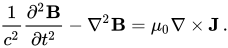
The left hand sides of each equation correspond to wave motion (the D'Alembert operator acting on the fields), while the right hand sides are the wave sources. The equations imply that EM waves are generated if there are gradients in charge density ρ, circulations in current density J, time-varying current density, or any mixture of these.
The above equation for the electric field can be transformed to a homogeneous wave equation with a so called damping term if we study a problem where Ohm's law in differential form holds (we assume that is we are dealing with homogeneous conductors that have relative permeability and permittivity around 1), and by substituting from the differential form of Gauss's law and .


The final homogeneous equation with only the unknown electric field and its partial derivatives is The solutions for the above homogeneous equation for the electric field are infinitely many and we must specify boundary conditions for the electric field in order to find specific solutions.

Hub AI
Inhomogeneous electromagnetic wave equation AI simulator
(@Inhomogeneous electromagnetic wave equation_simulator)
Inhomogeneous electromagnetic wave equation
In electromagnetism and applications, an inhomogeneous electromagnetic wave equation, or nonhomogeneous electromagnetic wave equation, is one of a set of wave equations describing the propagation of electromagnetic waves generated by nonzero source charges and currents. The source terms in the wave equations make the partial differential equations inhomogeneous, if the source terms are zero the equations reduce to the homogeneous electromagnetic wave equations, which follow from Maxwell's equations.
For reference, Maxwell's equations are summarized below in SI units and Gaussian units. They govern the electric field E and magnetic field B due to a source charge density ρ and current density J:
where ε0 is the vacuum permittivity and μ0 is the vacuum permeability. Throughout, the relation is also used.
Maxwell's equations can directly give inhomogeneous wave equations for the electric field E and magnetic field B. Substituting Gauss's law for electricity and Ampère's law into the curl of Faraday's law of induction, and using the curl of the curl identity ∇ × (∇ × X) = ∇(∇ ⋅ X) − ∇2X (The last term in the right side is the vector Laplacian, not Laplacian applied on scalar functions.) gives the wave equation for the electric field E:
Similarly substituting Gauss's law for magnetism into the curl of Ampère's circuital law (with Maxwell's additional time-dependent term), and using the curl of the curl identity, gives the wave equation for the magnetic field B:
The left hand sides of each equation correspond to wave motion (the D'Alembert operator acting on the fields), while the right hand sides are the wave sources. The equations imply that EM waves are generated if there are gradients in charge density ρ, circulations in current density J, time-varying current density, or any mixture of these.
The above equation for the electric field can be transformed to a homogeneous wave equation with a so called damping term if we study a problem where Ohm's law in differential form holds (we assume that is we are dealing with homogeneous conductors that have relative permeability and permittivity around 1), and by substituting from the differential form of Gauss's law and .
The final homogeneous equation with only the unknown electric field and its partial derivatives is The solutions for the above homogeneous equation for the electric field are infinitely many and we must specify boundary conditions for the electric field in order to find specific solutions.