Hubbry Logo
Vector calculus identitiesVector calculus identitiesMain
Open search
Vector calculus identities
Community hub
Vector calculus identities
logo
7 pages, 0 posts
0 subscribers
Be the first to start a discussion here.
Vector calculus identities
from Wikipedia

The following are important identities involving derivatives and integrals in vector calculus.

Operator notation

[edit]

Gradient

[edit]

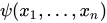
For a function in three-dimensional Cartesian coordinate variables, the gradient is the vector field: where i, j, k are the standard unit vectors for the x, y, z-axes. More generally, for a function of n variables , also called a scalar field, the gradient is the vector field: where are mutually orthogonal unit vectors.


As the name implies, the gradient is proportional to, and points in the direction of, the function's most rapid (positive) change.

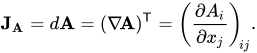
For a vector field , also called a tensor field of order 1, the gradient or total derivative is the n × n Jacobian matrix:[1]

For a tensor field of any order k, the gradient is a tensor field of order k + 1.

For a tensor field of order k > 0, the tensor field of order k + 1 is defined by the recursive relation where is an arbitrary constant vector.


Divergence

[edit]

In Cartesian coordinates, the divergence of a continuously differentiable vector field is the scalar-valued function:

As the name implies, the divergence is a (local) measure of the degree to which vectors in the field diverge.

The divergence of a tensor field of non-zero order k is written as , a contraction of a tensor field of order k − 1. Specifically, the divergence of a vector is a scalar. The divergence of a higher-order tensor field may be found by decomposing the tensor field into a sum of outer products and using the identity, where is the directional derivative in the direction of multiplied by its magnitude. Specifically, for the outer product of two vectors,[2]

For a tensor field of order k > 1, the tensor field of order k − 1 is defined by the recursive relation where is an arbitrary constant vector.

Curl

[edit]

In Cartesian coordinates, for the curl is the vector field: where i, j, and k are the unit vectors for the x-, y-, and z-axes, respectively.

As the name implies the curl is a measure of how much nearby vectors tend in a circular direction.

In Einstein notation, the vector field has curl given by: where = ±1 or 0 is the Levi-Civita parity symbol.

For a tensor field of order k > 1, the tensor field of order k is defined by the recursive relation where is an arbitrary constant vector.

A tensor field of order greater than one may be decomposed into a sum of outer products, and then the following identity may be used: Specifically, for the outer product of two vectors,[3]

Laplacian

[edit]

In Cartesian coordinates, the Laplacian of a function is

The Laplacian is a measure of how much a function is changing over a small sphere centered at the point.

When the Laplacian is equal to 0, the function is called a harmonic function. That is,

For a tensor field, , the Laplacian is generally written as: and is a tensor field of the same order.

For a tensor field of order k > 0, the tensor field of order k is defined by the recursive relation where is an arbitrary constant vector.

Special notations

[edit]

In Feynman subscript notation, where the notation ∇B means the subscripted gradient operates on only the factor B.[4][5][6]

More general but similar is the Hestenes overdot notation in geometric algebra.[7][8] The above identity is then expressed as: where overdots define the scope of the vector derivative. The dotted vector, in this case B, is differentiated, while the (undotted) A is held constant.

The utility of the Feynman subscript notation lies in its use in the derivation of vector and tensor derivative identities, as in the following example which uses the algebraic identity C⋅(A×B) = (C×A)⋅B:

An alternative method is to use the Cartesian components of the del operator as follows (with implicit summation over the index i):

Another method of deriving vector and tensor derivative identities is to replace all occurrences of a vector in an algebraic identity by the del operator, provided that no variable occurs both inside and outside the scope of an operator or both inside the scope of one operator in a term and outside the scope of another operator in the same term (i.e., the operators must be nested). The validity of this rule follows from the validity of the Feynman method, for one may always substitute a subscripted del and then immediately drop the subscript under the condition of the rule. For example, from the identity A⋅(B×C) = (A×B)⋅C we may derive A⋅(∇×C) = (A×∇)⋅C but not ∇⋅(B×C) = (∇×B)⋅C, nor from A⋅(B×A) = 0 may we derive A⋅(∇×A) = 0. On the other hand, a subscripted del operates on all occurrences of the subscript in the term, so that A⋅(∇A×A) = ∇A⋅(A×A) = ∇⋅(A×A) = 0. Also, from A×(A×C) = A(AC) − (AA)C we may derive ∇×(∇×C) = ∇(∇⋅C) − ∇2C, but from (Aψ)⋅(Aφ) = (AA)(ψφ) we may not derive (∇ψ)⋅(∇φ) = ∇2(ψφ).

A subscript c on a quantity indicates that it is temporarily considered to be a constant. Since a constant is not a variable, when the substitution rule (see the preceding paragraph) is used it, unlike a variable, may be moved into or out of the scope of a del operator, as in the following example:[9]

Another way to indicate that a quantity is a constant is to affix it as a subscript to the scope of a del operator, as follows:[10]

For the remainder of this article, Feynman subscript notation will be used where appropriate.

First derivative identities

[edit]

For scalar fields , and vector fields , , we have the following derivative identities.

Distributive properties

[edit]

First derivative associative properties

[edit]

Product rule for multiplication by a scalar

[edit]

We have the following generalizations of the product rule in single-variable calculus.

Quotient rule for division by a scalar

[edit]

Chain rule

[edit]

Let be a one-variable function from scalars to scalars, a parametrized curve, a function from vectors to scalars, and a vector field. We have the following special cases of the multi-variable chain rule.

For a vector transformation we have:

Here we take the trace of the dot product of two second-order tensors, which corresponds to the product of their matrices.

Dot product rule

[edit]

where denotes the Jacobian matrix of the vector field .

Alternatively, using Feynman subscript notation,

See these notes.[11]

As a special case, when A = B,

The generalization of the dot product formula to Riemannian manifolds is a defining property of a Riemannian connection, which differentiates a vector field to give a vector-valued 1-form.

Cross product rule

[edit]

Note that the matrix is antisymmetric.

Second derivative identities

[edit]

Divergence of curl is zero

[edit]

The divergence of the curl of any continuously twice-differentiable vector field A is always zero:

This is a special case of the vanishing of the square of the exterior derivative in the De Rham chain complex.

Divergence of gradient is Laplacian

[edit]

The Laplacian of a scalar field is the divergence of its gradient: The result is a scalar quantity.

Divergence of divergence is not defined

[edit]

The divergence of a vector field A is a scalar, and the divergence of a scalar quantity is undefined. Therefore,

Curl of gradient is zero

[edit]

The curl of the gradient of any continuously twice-differentiable scalar field (i.e., differentiability class ) is always the zero vector:

It can be easily proved by expressing in a Cartesian coordinate system with Schwarz's theorem (also called Clairaut's theorem on equality of mixed partials). This result is a special case of the vanishing of the square of the exterior derivative in the De Rham chain complex.

Curl of curl

[edit]

Here ∇2 is the vector Laplacian operating on the vector field A.

Curl of divergence is not defined

[edit]

The divergence of a vector field A is a scalar, and the curl of a scalar quantity is undefined. Therefore,

Second derivative associative properties

[edit]
DCG chart: Some rules for second derivatives.

A mnemonic

[edit]

The figure to the right is a mnemonic for some of these identities. The abbreviations used are:

  • D: divergence,
  • C: curl,
  • G: gradient,
  • L: Laplacian,
  • CC: curl of curl.

Each arrow is labeled with the result of an identity, specifically, the result of applying the operator at the arrow's tail to the operator at its head. The blue circle in the middle means curl of curl exists, whereas the other two red circles (dashed) mean that DD and GG do not exist.

Summary of important identities

[edit]

Differentiation

[edit]

Gradient

[edit]

Divergence

[edit]

Curl

[edit]
  • [12]

Vector-dot-Del Operator

[edit]
  • [13]

Second derivatives

[edit]
  • (scalar Laplacian)
  • (vector Laplacian)
  • (Green's vector identity)

Third derivatives

[edit]

Integration

[edit]

Below, the curly symbol ∂ means "boundary of" a surface or solid.

Surface–volume integrals

[edit]

In the following surface–volume integral theorems, V denotes a three-dimensional volume with a corresponding two-dimensional boundary S = ∂V (a closed surface):

  • \oiint
  • \oiint (divergence theorem)
  • \oiint
  • \oiint (Green's first identity)
  • \oiint \oiint (Green's second identity)
  • \oiint (integration by parts)
  • \oiint (integration by parts)
  • \oiint (integration by parts)
  • \oiint [14]
  • \oiint [15]

Curve–surface integrals

[edit]

In the following curve–surface integral theorems, S denotes a 2d open surface with a corresponding 1d boundary C = ∂S (a closed curve):

  • (Stokes' theorem)
  • [16]
  • [17]

Integration around a closed curve in the clockwise sense is the negative of the same line integral in the counterclockwise sense (analogous to interchanging the limits in a definite integral):

\ointclockwise \ointctrclockwise

Endpoint-curve integrals

[edit]

In the following endpoint–curve integral theorems, P denotes a 1d open path with signed 0d boundary points and integration along P is from to :

  • (gradient theorem)

Tensor integrals

[edit]

A tensor form of a vector integral theorem may be obtained by replacing the vector (or one of them) by a tensor, provided that the vector is first made to appear only as the right-most vector of each integrand. For example, Stokes' theorem becomes[18]

.

A scalar field may also be treated as a vector and replaced by a vector or tensor. For example, Green's first identity becomes

\oiint .

Similar rules apply to algebraic and differentiation formulas. For algebraic formulas one may alternatively use the left-most vector position.

See also

[edit]

References

[edit]

Further reading

[edit]
Revisions and contributorsEdit on WikipediaRead on Wikipedia
from Grokipedia
Vector calculus identities encompass a set of fundamental mathematical relations involving the differential operators of , , curl, and Laplacian applied to scalar and vector fields in . These identities, which include algebraic rules for products and compositions of operators as well as theorems linking differential forms to their global counterparts, form the cornerstone of vector analysis and enable the manipulation of expressions describing physical fields. Among the most notable are the vector product rules, such as the gradient of a dot product or the divergence of a cross product, which facilitate derivations in . For instance, the curl of the gradient of any scalar function is identically zero (∇ × (∇u) = 0), indicating that gradient fields are irrotational, while the divergence of the curl of any vector field is zero (∇ · (∇ × A) = 0), implying solenoidality for curl fields. Integral identities like the , which equates the volume integral of a divergence to the surface integral of the flux, and , relating the surface integral of a curl to the line integral around its boundary, are pivotal for converting local differential properties into global integral evaluations. These identities are indispensable in and physics, underpinning the formulation of in , Navier-Stokes equations in , and conservation laws in . By providing tools to simplify computations and reveal intrinsic properties of vector fields, they bridge pointwise behaviors with macroscopic phenomena, influencing fields from to .

Notation and Operators

Gradient

The gradient of a scalar field ff, denoted f\nabla f or gradf\mathrm{grad}\, f, is a that points in the direction of the greatest rate of increase of ff and whose magnitude equals that maximum rate of change. This operator transforms a into a vector, assuming familiarity with partial derivatives as prerequisites. The of ff in the direction of a u\mathbf{u} is given by the fu\nabla f \cdot \mathbf{u}, which reaches its maximum value when u\mathbf{u} aligns with f\nabla f. In Cartesian coordinates, the components of the gradient are the partial derivatives of ff with respect to each variable: f=(fx,fy,fz).\nabla f = \left( \frac{\partial f}{\partial x}, \frac{\partial f}{\partial y}, \frac{\partial f}{\partial z} \right). This expression holds in three-dimensional and extends analogously to other coordinate systems, though the focus here is on the standard rectangular form. The gradient's magnitude f|\nabla f| quantifies the steepness of ff at a point, while its direction indicates the path of steepest ascent. Geometrically, f\nabla f at any point is normal to the level surface (or isosurface) of ff passing through that point, serving as the direction perpendicular to contours of constant value. This property underscores its role in applications like optimization and surface analysis. In physics, conservative vector fields—such as those arising from gravitational or electrostatic potentials—are precisely the gradients of functions, ensuring path-independent work.

Divergence

The divergence of a A=Axi+Ayj+Azk\mathbf{A} = A_x \mathbf{i} + A_y \mathbf{j} + A_z \mathbf{k} is a scalar-valued operator denoted A\nabla \cdot \mathbf{A}, which quantifies the local expansion or contraction of the field at a point. In Cartesian coordinates, it is explicitly computed as A=Axx+Ayy+Azz.\nabla \cdot \mathbf{A} = \frac{\partial A_x}{\partial x} + \frac{\partial A_y}{\partial y} + \frac{\partial A_z}{\partial z}. This expression arises from the limit of the net through the faces of an infinitesimal cube divided by its volume, providing a measure of . Physically, the divergence interprets the vector field as representing a flow, such as in a or flux lines in ; a positive divergence at a point signifies a source from which the is emanating (e.g., expanding outward), while a negative divergence indicates a where the is converging (e.g., compressing inward). A divergence of zero implies no net creation or destruction of the , characteristic of incompressible flows or divergence-free (solenoidal) fields. This interpretation aligns with the field's behavior in conservation laws, where divergence tracks the imbalance between inflow and outflow. A representative example is the radial vector field of the electric field due to a point charge at the origin, E=q4πϵ0r2r^\mathbf{E} = \frac{q}{4\pi \epsilon_0 r^2} \hat{r}, where rr is the distance from the origin and r^\hat{r} is the unit radial vector. Away from the origin, E=0\nabla \cdot \mathbf{E} = 0, indicating no sources or sinks in empty space, but at the origin, the divergence is singular (proportional to a times the ), capturing the point source of the field. The gravitational field from a point mass exhibits analogous behavior, with g=4πGρ\nabla \cdot \mathbf{g} = -4\pi G \rho at the mass location via Poisson's equation, highlighting divergence's role in identifying concentrated sources.

Curl

The curl of a vector field A\mathbf{A}, denoted ×A\nabla \times \mathbf{A}, is a vector operator that quantifies the infinitesimal circulation or of the field in three-dimensional . The direction of ×A\nabla \times \mathbf{A} aligns with the axis of according to the , while its magnitude corresponds to the angular speed of the at that point. This operator arises naturally in the context of differential forms and exterior derivatives but is fundamentally a measure of how much the "twists" locally. In Cartesian coordinates, where A=(Ax,Ay,Az)\mathbf{A} = (A_x, A_y, A_z), the components of the curl are given explicitly by: ×A=(AzyAyz,AxzAzx,AyxAxy).\nabla \times \mathbf{A} = \left( \frac{\partial A_z}{\partial y} - \frac{\partial A_y}{\partial z}, \, \frac{\partial A_x}{\partial z} - \frac{\partial A_z}{\partial x}, \, \frac{\partial A_y}{\partial x} - \frac{\partial A_x}{\partial y} \right). This expression highlights the antisymmetric differences in partial derivatives, reflecting the rotational character of the field. Physically, the curl finds prominent application in , where it describes the of a flow: for a velocity field v\mathbf{v}, ×v\nabla \times \mathbf{v} measures the local spinning motion of fluid elements, with its magnitude indicating the rotation rate and direction specifying the axis. This concept relates to the circulation of the field around small closed loops, providing insight into phenomena like eddies and . The operator exhibits antisymmetry under negation, satisfying ×(A)=×A\nabla \times (-\mathbf{A}) = -\nabla \times \mathbf{A}, which follows directly from the and the skew-symmetric of the .

Laplacian

The Laplacian is a second-order in that applies to scalar fields, defined as the of the of a scalar function ff, expressed as 2f=(f)\nabla^2 f = \nabla \cdot (\nabla f). This formulation captures the operator's role in measuring the local variation or "diffusivity" of the function, quantifying how the value at a point deviates from the average values in its immediate neighborhood, which relates to concepts of concavity for the function's graph. In Cartesian coordinates, the Laplacian of a scalar function f(x,y,z)f(x, y, z) takes the explicit form 2f=2fx2+2fy2+2fz2,\nabla^2 f = \frac{\partial^2 f}{\partial x^2} + \frac{\partial^2 f}{\partial y^2} + \frac{\partial^2 f}{\partial z^2}, providing a straightforward computational expression for three-dimensional Euclidean space. The Laplacian plays a central role in several fundamental partial differential equations. In the heat equation, ut=α2u\frac{\partial u}{\partial t} = \alpha \nabla^2 u, it governs the diffusion of heat through a medium, where α\alpha is the thermal diffusivity and uu represents temperature; positive Laplacian values indicate regions where heat flows inward, promoting equalization. Similarly, Poisson's equation, 2ϕ=f\nabla^2 \phi = -f, arises in the study of gravitational and electrostatic potentials, with ff representing a source term such as mass density or charge density, enabling the determination of potential fields in equilibrium configurations. Functions satisfying 2f=0\nabla^2 f = 0, known as functions, exhibit the mean value property: the value of ff at any point equals the of its values over the surface of any (or in higher dimensions) centered at that point, provided the domain is sufficiently smooth. This property underscores the smoothing effect of harmonicity and has profound implications for uniqueness and stability in solutions to boundary value problems involving the Laplacian.

Additional Notations

In , the \nabla, also known as the operator, is a vector represented as =(x,y,z)\nabla = \left( \frac{\partial}{\partial x}, \frac{\partial}{\partial y}, \frac{\partial}{\partial z} \right) in Cartesian coordinates, used to define , , curl, and other operations. This notation facilitates compact expressions for vector derivatives and is standard in three-dimensional . The of a scalar function ff in the direction of a u\mathbf{u} is fu\nabla f \cdot \mathbf{u}, or equivalently (u)f(\mathbf{u} \cdot \nabla) f. For a non-unit vector A\mathbf{A}, (A)f=A(A^f)(\mathbf{A} \cdot \nabla) f = |\mathbf{A}| (\hat{\mathbf{A}} \cdot \nabla f), measuring the rate of change scaled by the magnitude of A\mathbf{A}. This operator applies the operator projected onto A\mathbf{A}, yielding a scalar that generalizes the to arbitrary directions. For vector fields, the vector Laplacian 2A\nabla^2 \mathbf{A} extends the scalar Laplacian and is expressed using the del operator as 2A=(A)×(×A)\nabla^2 \mathbf{A} = \nabla (\nabla \cdot \mathbf{A}) - \nabla \times (\nabla \times \mathbf{A}), providing a second-order differential operator that decomposes into gradient and curl terms. This identity holds in Cartesian coordinates and is fundamental for manipulations involving vector potentials in physics. In the context of vector-valued functions, the represents the first-order partial derivatives arranged as J=[Fx]\mathbf{J} = \left[ \frac{\partial \mathbf{F}}{\partial \mathbf{x}} \right], where F\mathbf{F} is the vector function and x\mathbf{x} the input vector, serving as a to the function near a point. Similarly, for scalar functions, the captures second-order derivatives as H=[2fxixj]\mathbf{H} = \left[ \frac{\partial^2 f}{\partial x_i \partial x_j} \right], which is the of the vector. Comma notation, common in tensor analysis relevant to vector fields, denotes partial derivatives by subscripting with a comma, such as Ai,j=AixjA_{i,j} = \frac{\partial A_i}{\partial x_j}, simplifying index-based expressions for gradients and higher derivatives in multi-dimensional settings. In two-dimensional , circular notation often refers to polar coordinate representations using unit vectors r^\hat{r} and θ^\hat{\theta}, where operators like the are expressed as f=frr^+1rfθθ^\nabla f = \frac{\partial f}{\partial r} \hat{r} + \frac{1}{r} \frac{\partial f}{\partial \theta} \hat{\theta}, adapting Cartesian forms to curvilinear geometries.

Linearity Properties

Distributivity

The distributivity property, also known as additivity or the over , is a core feature of the vector differential operators in . It states that these operators—, , and curl—apply linearly to sums of scalar or vector fields, meaning the operator applied to a sum equals the sum of the operators applied to each field individually. This property follows directly from the of partial differentiation and is essential for simplifying computations involving composite fields. For scalar fields ff and gg, the operator distributes as follows: (f+g)=f+g.\nabla (f + g) = \nabla f + \nabla g. This identity holds because the components are partial derivatives, which are linear: in Cartesian coordinates, the xx-component is (f+g)x=fx+gx\frac{\partial (f + g)}{\partial x} = \frac{\partial f}{\partial x} + \frac{\partial g}{\partial x}, and similarly for the other components. The same reasoning applies in other orthogonal coordinate systems, where the expression involves linear combinations of partial derivatives scaled by scale factors. For vector fields A\mathbf{A} and B\mathbf{B}, the divergence operator satisfies: (A+B)=A+B.\nabla \cdot (\mathbf{A} + \mathbf{B}) = \nabla \cdot \mathbf{A} + \nabla \cdot \mathbf{B}. The proof in Cartesian coordinates relies on the definition A=Axx+Ayy+Azz\nabla \cdot \mathbf{A} = \frac{\partial A_x}{\partial x} + \frac{\partial A_y}{\partial y} + \frac{\partial A_z}{\partial z}; adding the components of A+B\mathbf{A} + \mathbf{B} and applying the partial derivatives yields the sum of the individual s due to linearity. Likewise, the curl operator distributes over vector addition: ×(A+B)=×A+×B.\nabla \times (\mathbf{A} + \mathbf{B}) = \nabla \times \mathbf{A} + \nabla \times \mathbf{B}. In components, the curl is given by the form or explicitly as (BzyByz,)\left( \frac{\partial B_z}{\partial y} - \frac{\partial B_y}{\partial z}, \dots \right) for B\mathbf{B}; the linearity of partials ensures each component of the curl of the sum is the sum of the curls' components. This holds in general coordinates, though the explicit form varies. These distributive properties enable the in physical applications, such as , where the total E\mathbf{E} from multiple charges is the vector sum E=Ei\mathbf{E} = \sum \mathbf{E}_i, and similarly for , allowing solutions to for complex sources by adding solutions for simpler ones. The extension of linearity to scalar multiples by constants is addressed separately.

Scalar Multiplication

The scalar multiplication identities in vector calculus highlight the homogeneity of the core differential operators—gradient, divergence, curl, and Laplacian—with respect to constant scalar multipliers applied to their inputs. These properties arise from the inherent of the operators, which ensures that scaling the input field by a constant cc results in the output scaling by the same factor. Such homogeneity simplifies computations in fields like and , where fields often involve scaled versions of base functions./04%3A_Integral_Theorems/4.01%3A_Gradient_Divergence_and_Curl) For a scalar field ff and constant scalar cc, the operator satisfies (cf)=cf.\nabla (c f) = c \nabla f. This relation follows from the component-wise definition of the in Cartesian coordinates, where each xi(cf)=cfxi\frac{\partial}{\partial x_i}(c f) = c \frac{\partial f}{\partial x_i}, preserving the vector structure. Similarly, the of a A\mathbf{A} obeys (cA)=cA,\nabla \cdot (c \mathbf{A}) = c \nabla \cdot \mathbf{A}, as the divergence sums the scaled partial derivatives of the components: ixi(cAi)=ciAixi\sum_i \frac{\partial}{\partial x_i} (c A_i) = c \sum_i \frac{\partial A_i}{\partial x_i}. The curl, being a vector whose components are determinants of partial derivatives, likewise scales uniformly: ×(cA)=c×A.\nabla \times (c \mathbf{A}) = c \nabla \times \mathbf{A}. Each entry in the curl's cross-product form inherits the linearity of differentiation./04%3A_Integral_Theorems/4.01%3A_Gradient_Divergence_and_Curl) The Laplacian operator 2\nabla^2, applied to a scalar field as (f)\nabla \cdot (\nabla f), inherits these properties through composition of linear operators: 2(cf)=c2f.\nabla^2 (c f) = c \nabla^2 f. This holds because the intermediate gradient scales by cc, and the subsequent divergence scales it again by cc, yielding the overall factor. These constant-scalar cases form the homogeneity aspect of operator linearity, complementing additivity; for variable scalars, the identities transition to product rules involving additional terms.

Product and Quotient Rules

Scalar-Vector Products

In vector calculus, the product rules for scalar-vector multiplication generalize the Leibniz rule to differential operators acting on the product of a scalar field ff and a vector field A\mathbf{A}. These identities facilitate the analysis of fields in physics and engineering by allowing the separation of the scalar and vector contributions to derivatives. The divergence of the product fAf \mathbf{A} is expressed as (fA)=f(A)+Af.\nabla \cdot (f \mathbf{A}) = f (\nabla \cdot \mathbf{A}) + \mathbf{A} \cdot \nabla f. This relation holds in Cartesian coordinates, where the divergence operator expands componentwise: (fA)=ii(fAi)\nabla \cdot (f \mathbf{A}) = \sum_i \partial_i (f A_i). Applying the product rule for partial derivatives yields i(fAi)=fiAi+Aiif\partial_i (f A_i) = f \partial_i A_i + A_i \partial_i f, and summing over indices gives the identity. Similarly, the curl of fAf \mathbf{A} satisfies ×(fA)=f(×A)+(f)×A.\nabla \times (f \mathbf{A}) = f (\nabla \times \mathbf{A}) + (\nabla f) \times \mathbf{A}. The derivation follows from the determinant form of the curl in coordinates: the jj-component involves k,lϵjklk(fAl)=k,lϵjkl(fkAl+Alkf)\sum_{k,l} \epsilon_{jkl} \partial_k (f A_l) = \sum_{k,l} \epsilon_{jkl} (f \partial_k A_l + A_l \partial_k f), where the first term reconstructs f(×A)f (\nabla \times \mathbf{A}) and the second the cross product term, using the antisymmetry of the Levi-Civita symbol. For the product of two scalar fields ff and gg, the identity is (fg)=fg+gf.\nabla (f g) = f \nabla g + g \nabla f. This arises directly from the componentwise : i(fg)=fig+gif\partial_i (f g) = f \partial_i g + g \partial_i f, forming the ii-th component of the vector. These rules underpin key physical applications. In , the tρ+(ρv)=0\partial_t \rho + \nabla \cdot (\rho \mathbf{v}) = 0 for mass conservation uses the identity with scalar ρ\rho and v\mathbf{v}, yielding tρ+ρ(v)+vρ=0\partial_t \rho + \rho (\nabla \cdot \mathbf{v}) + \mathbf{v} \cdot \nabla \rho = 0. In , incorporate similar forms, such as D=ρf\nabla \cdot \mathbf{D} = \rho_f where D=ϵE\mathbf{D} = \epsilon \mathbf{E} for position-dependent ϵ\epsilon, applying the rule to relate ρf\rho_f to the E\mathbf{E}.

Vector-Vector Dot Products

The of the of two vector fields A\mathbf{A} and B\mathbf{B}, denoted (AB)\nabla (\mathbf{A} \cdot \mathbf{B}), is a fundamental identity in that expands the operation into terms involving directional derivatives and curls. The identity is given by (AB)=(A)B+(B)A+A×(×B)+B×(×A).\nabla (\mathbf{A} \cdot \mathbf{B}) = (\mathbf{A} \cdot \nabla) \mathbf{B} + (\mathbf{B} \cdot \nabla) \mathbf{A} + \mathbf{A} \times (\nabla \times \mathbf{B}) + \mathbf{B} \times (\nabla \times \mathbf{A}). This formula arises from applying the to the scalar AB\mathbf{A} \cdot \mathbf{B} in component form and rearranging using . The terms (A)B+(B)A(\mathbf{A} \cdot \nabla) \mathbf{B} + (\mathbf{B} \cdot \nabla) \mathbf{A} capture the symmetric contributions from the or directional variation of each field along the direction of the other, reflecting how changes in one field influence the in a mutually reciprocal manner. In contrast, the terms A×(×B)+B×(×A)\mathbf{A} \times (\nabla \times \mathbf{B}) + \mathbf{B} \times (\nabla \times \mathbf{A}) incorporate the antisymmetric, components introduced by the curls of the fields, accounting for effects like that do not symmetrize under interchange of A\mathbf{A} and B\mathbf{B}. Together, these parts ensure the identity respects the vector nature of the while decomposing the interaction into deformable (symmetric) and rigid-body rotation (antisymmetric) influences, analogous to decompositions in . This identity finds application in the analysis of energy gradients and mechanical stress in physical systems. For instance, in , setting A=B=v\mathbf{A} = \mathbf{B} = \mathbf{v} (the velocity field) yields (v2/2)=(v)v+v×(×v)\nabla (v^2/2) = (\mathbf{v} \cdot \nabla) \mathbf{v} + \mathbf{v} \times (\nabla \times \mathbf{v}), which isolates the convective term in the Navier-Stokes equations and facilitates derivations of the balance by revealing how nonlinear contributes to energy transport without spurious rotational artifacts. In , the identity aids in computing the of work rates involving stress tensors, where the of stress with displacement gradients informs the spatial variation of dissipation in deformable media. To verify the identity, consider its expansion in Cartesian coordinates, where =(x,y,z)\nabla = (\partial_x, \partial_y, \partial_z) and fields are A=(Ax,Ay,Az)\mathbf{A} = (A_x, A_y, A_z), B=(Bx,By,Bz)\mathbf{B} = (B_x, B_y, B_z). The xx-component of (AB)\nabla (\mathbf{A} \cdot \mathbf{B}) is x(AxBx+AyBy+AzBz)=BxxAx+AxxBx+ByxAy+AyxBy+BzxAz+AzxBz\partial_x (A_x B_x + A_y B_y + A_z B_z) = B_x \partial_x A_x + A_x \partial_x B_x + B_y \partial_x A_y + A_y \partial_x B_y + B_z \partial_x A_z + A_z \partial_x B_z. The right-hand side's xx-component includes contributions from (A)Bx=AxxBx+AyyBx+AzzBx(\mathbf{A} \cdot \nabla) B_x = A_x \partial_x B_x + A_y \partial_y B_x + A_z \partial_z B_x, (B)Ax=BxxAx+ByyAx+BzzAx(\mathbf{B} \cdot \nabla) A_x = B_x \partial_x A_x + B_y \partial_y A_x + B_z \partial_z A_x, and the xx-components of the cross products: [A×(×B)]x=Ay(zBxxBz)Az(yBxxBy)[ \mathbf{A} \times (\nabla \times \mathbf{B}) ]_x = A_y (\partial_z B_x - \partial_x B_z) - A_z (\partial_y B_x - \partial_x B_y) plus the symmetric term from B×(×A)\mathbf{B} \times (\nabla \times \mathbf{A}). Collecting all terms matches the left-hand side after accounting for the full curl definitions, confirming the identity holds without coordinate singularities in orthogonal systems.

Vector-Vector Cross Products

The curl of the cross product of two vector fields A\mathbf{A} and B\mathbf{B} is a key identity in vector calculus, expressing the rotational behavior of their vector product. This identity states that ×(A×B)=A(B)B(A)+(B)A(A)B.\nabla \times (\mathbf{A} \times \mathbf{B}) = \mathbf{A} (\nabla \cdot \mathbf{B}) - \mathbf{B} (\nabla \cdot \mathbf{A}) + (\mathbf{B} \cdot \nabla)\mathbf{A} - (\mathbf{A} \cdot \nabla)\mathbf{B}. The right-hand side combines divergence terms with directional derivatives, highlighting how the curl captures both expansion effects and advective transport along the fields. This formula arises naturally in three-dimensional and assumes Cartesian coordinates for its standard derivation, though it generalizes to other orthogonal systems with appropriate adjustments. A mnemonic device for recalling related expansions, such as those underlying proofs of this identity, is the BAC-CAB rule for the vector triple product: A×(B×C)=B(AC)C(AB)\mathbf{A} \times (\mathbf{B} \times \mathbf{C}) = \mathbf{B}(\mathbf{A} \cdot \mathbf{C}) - \mathbf{C}(\mathbf{A} \cdot \mathbf{B}). This rule, named for its rearranged form resembling "back of the cab," facilitates component-wise verification without explicit indices. To derive the identity, expand in Cartesian components using the ϵijk\epsilon_{ijk}. The ii-th component of ×(A×B)\nabla \times (\mathbf{A} \times \mathbf{B}) is ϵijkj(ϵklmAlBm)\epsilon_{ijk} \partial_j ( \epsilon_{klm} A_l B_m ), where summation over repeated indices is implied. Applying the gives ϵijkϵklm[(jAl)Bm+Al(jBm)]\epsilon_{ijk} \epsilon_{klm} [ (\partial_j A_l) B_m + A_l (\partial_j B_m) ]. Using the identity ϵijkϵklm=δilδjmδimδjl\epsilon_{ijk} \epsilon_{klm} = \delta_{il} \delta_{jm} - \delta_{im} \delta_{jl}, this simplifies to (iAk)Bk+Ak(iBk)(kAk)BiAi(kBk)+Bj(jAi)Aj(jBi)(\partial_i A_k) B_k + A_k (\partial_i B_k) - (\partial_k A_k) B_i - A_i (\partial_k B_k) + B_j (\partial_j A_i) - A_j (\partial_j B_i), which rearranges to the vector form after relabeling and collecting terms. This component proof confirms the identity holds for smooth fields. In applications, this identity is essential in for manipulating , such as deriving the equation for the A\mathbf{A} where ×B=μ0J+μ0ϵ0tE\nabla \times \mathbf{B} = \mu_0 \mathbf{J} + \mu_0 \epsilon_0 \partial_t \mathbf{E} and B=×A\mathbf{B} = \nabla \times \mathbf{A}, leading to ×(×A)=μ0(J+ϵ0tE)=2A\nabla \times (\nabla \times \mathbf{A}) = \mu_0 (\mathbf{J} + \epsilon_0 \partial_t \mathbf{E}) = - \nabla^2 \mathbf{A} in the Coulomb gauge. Similarly, in and , it supports proofs of angular momentum conservation by relating the time derivative of the angular momentum density r×(ρv)\mathbf{r} \times (\rho \mathbf{v}) to terms via the curl of velocity-stress products in the Navier-Stokes momentum equation.

Quotient Rules

In vector calculus, the quotient rules describe the differential operators applied to a vector field A\mathbf{A} divided by a nonzero scalar function ff, denoted A/f\mathbf{A}/f. These identities are derived from the corresponding product rules by expressing the quotient as A(1/f)\mathbf{A} \cdot (1/f) and applying the chain rule to the scalar 1/f1/f, whose gradient is (1/f)=(f)/f2\nabla (1/f) = -(\nabla f)/f^2 . The resulting expressions are essential for manipulating fields in curvilinear coordinates and avoiding direct computation in component form. The full derivative of the quotient field, in tensor notation, is given by the Jacobian matrix: (Af)=fAAff2,\nabla \left( \frac{\mathbf{A}}{f} \right) = \frac{f \nabla \mathbf{A} - \mathbf{A} \otimes \nabla f}{f^2}, where A\nabla \mathbf{A} is the Jacobian of A\mathbf{A} and \otimes denotes the outer (dyadic) product. This form simplifies for specific operators; for instance, the divergence follows by contracting indices or tracing the tensor, yielding (Af)=fAAff2.\nabla \cdot \left( \frac{\mathbf{A}}{f} \right) = \frac{f \nabla \cdot \mathbf{A} - \mathbf{A} \cdot \nabla f}{f^2}. Similarly, the curl is obtained as the antisymmetric part: ×(Af)=f×A(f)×Af2.\nabla \times \left( \frac{\mathbf{A}}{f} \right) = \frac{f \nabla \times \mathbf{A} - (\nabla f) \times \mathbf{A}}{f^2}. These formulas assume ff is differentiable and nonzero in the domain of interest . These quotient rules find applications in normalizing vector fields, such as obtaining unit vectors from position-dependent magnitudes, which is common in spherical or cylindrical coordinates for electromagnetic and fluid problems. For example, the radial unit vector r^=r/r\hat{\mathbf{r}} = \mathbf{r}/r (where r=rr = |\mathbf{r}|) requires these identities to compute its divergence and curl, aiding in the expansion of potentials . Care must be taken near singularities where f=0f = 0, as the expressions become undefined and may introduce delta-function-like behaviors in distributions, necessitating separate treatment in integrals or limits.

Composition Rules

Chain Rule

The in extends the single-variable to compositions involving s and vector fields, allowing differentiation of functions where the inner function is a vector-valued expression. For a scalar-valued function ϕ\phi composed with a f(r)f(\mathbf{r}), where ϕ:RR\phi: \mathbb{R} \to \mathbb{R} is differentiable and f:R3Rf: \mathbb{R}^3 \to \mathbb{R} is a , the gradient of the composition ϕ(f(r))\phi(f(\mathbf{r})) is given by [ϕ(f)]=ϕ(f)f.\nabla [\phi(f)] = \phi'(f) \nabla f. This formula follows directly from the multivariable chain rule applied componentwise, treating the partial derivatives of ff as the inner derivatives scaled by the outer derivative ϕ\phi'. In the more general case of multivariable composition, consider a scalar function ϕ(g(r))\phi(\mathbf{g}(\mathbf{r})), where g:R3Rm\mathbf{g}: \mathbb{R}^3 \to \mathbb{R}^m is a vector-valued function and ϕ:RmR\phi: \mathbb{R}^m \to \mathbb{R} is differentiable. The gradient is then [ϕ(g)]=Jϕ(g)g,\nabla [\phi(\mathbf{g})] = J_{\phi}(\mathbf{g}) \cdot \nabla \mathbf{g}, where JϕJ_{\phi} is the Jacobian matrix of ϕ\phi (a row vector, equivalent to ϕ\nabla \phi), and g\nabla \mathbf{g} is the Jacobian matrix of g\mathbf{g}, whose columns are the gradients of the component functions of g\mathbf{g}. In vector notation, this is often expressed as [ϕ(g)]=(ϕJg)T\nabla [\phi(\mathbf{g})] = (\nabla \phi \cdot J_{\mathbf{g}})^T, emphasizing the transpose for the resulting column vector gradient. This form arises from the general multivariable chain rule, where the derivative of the composition is the product of the Jacobians. For the divergence operator applied to a composition, consider a vector-valued function F(A(r))\mathbf{F}(\mathbf{A}(\mathbf{r})), where A:R3R3\mathbf{A}: \mathbb{R}^3 \to \mathbb{R}^3 is a and F:R3R3\mathbf{F}: \mathbb{R}^3 \to \mathbb{R}^3 is differentiable. The is F(A)=i=13j=13FiAjAjxi=trace(JF(A)A),\nabla \cdot \mathbf{F}(\mathbf{A}) = \sum_{i=1}^3 \sum_{j=1}^3 \frac{\partial F_i}{\partial A_j} \frac{\partial A_j}{\partial x_i} = \operatorname{trace} \left( J_{\mathbf{F}}(\mathbf{A}) \cdot \nabla \mathbf{A} \right), where JFJ_{\mathbf{F}} is the Jacobian matrix of F\mathbf{F} and A\nabla \mathbf{A} is the Jacobian matrix of A\mathbf{A}. This expression results from applying the chain rule to each component of the divergence, summing the partial derivatives via the trace of the matrix product of the Jacobians. In component form, it highlights the partials (f)(A/xi)(\nabla f) \cdot (\partial \mathbf{A} / \partial x_i) for each direction ii. These identities find applications in for scalar potentials, such as expressing the of a radial potential V(r)V(r) where r=rr = |\mathbf{r}|, yielding V=V(r)r^\nabla V = V'(r) \hat{\mathbf{r}} through the chain rule on r(r)r(\mathbf{r}). In partial differential equations (PDEs), they facilitate composition in solutions, like deriving transport equations for fields dependent on advected quantities. The involvement extends naturally to coordinate transformations in vector analysis.

Higher-Order Compositions

Higher-order compositions in generalize the basic for scalar fields to scenarios involving vector fields that depend on other vector or scalar fields, enabling the analysis of nonlinear expressions common in physics and . These identities are essential for deriving and simplifying terms in partial differential equations (PDEs) where operators like and curl act on composed functions, such as A(B(x)) where A and B are vector fields. Unlike the simple scalar , which states that the of a composed scalar satisfies ∇(f(g)) = (∇g) (df/dg), vector compositions involve tensorial structures like Jacobians to account for the multi-dimensional nature of the fields. A key identity for the divergence of a composed vector field A(B(x)), where A is a of the vector B, is given by A(B)=trace(JA(B)B),\nabla \cdot \mathbf{A}(\mathbf{B}) = \operatorname{trace}\left( J_{\mathbf{A}}(\mathbf{B}) \cdot \nabla \mathbf{B} \right), where JAJ_{\mathbf{A}} is the Jacobian matrix of A evaluated at B, and B\nabla \mathbf{B} is the Jacobian of B. This formula arises from applying the multivariable component-wise: in coordinates, A(B)=ikAiBk(B)Bkxi\nabla \cdot \mathbf{A}(\mathbf{B}) = \sum_i \sum_k \frac{\partial A_i}{\partial B_k}(\mathbf{B}) \frac{\partial B_k}{\partial x_i}, which is the trace of the product of the Jacobians. This identity is crucial for handling nonlinear transport in fields like and . For the curl of a scalar times a vector field, the identity is ×(fA)=f(×A)+(f)×A,\nabla \times (f \mathbf{A}) = f (\nabla \times \mathbf{A}) + (\nabla f) \times \mathbf{A}, which extends the product rule to rotational derivatives, accounting for how the gradient of the scalar interacts with the vector via the cross product. This can be derived by expanding in Cartesian components, where each component of the curl involves differences of derivatives that distribute over the scalar multiplication, yielding the additional term from differentiating f. Such compositions appear in derivations of Maxwell's equations and vorticity transport. In advection-dominated problems, commutators of vector operators provide insight into nonlinear interactions; for instance, the commutator [,A][\nabla, \mathbf{A} \cdot \nabla] applied to a vector field captures deviations from simple transport, often simplifying to terms involving the curl of A, as [,A]ϕ=(×A)ϕ+A(ϕ)(Aϕ)[\nabla, \mathbf{A} \cdot \nabla] \phi = (\nabla \times \mathbf{A}) \cdot \nabla \phi + \mathbf{A} \cdot \nabla (\nabla \phi) - \nabla (\mathbf{A} \cdot \nabla \phi) for scalars, but extended to vectors via Lie brackets in fluid contexts. These arise in expanding the material derivative or convective acceleration. A prominent application is in the Navier-Stokes equations, where the nonlinear advection term (v)v(\mathbf{v} \cdot \nabla) \mathbf{v} is rewritten using the vector identity (v)v=(12v2)v×(×v)(\mathbf{v} \cdot \nabla) \mathbf{v} = \nabla \left( \frac{1}{2} v^2 \right) - \mathbf{v} \times (\nabla \times \mathbf{v}), facilitating numerical stability and physical interpretation of pressure and vorticity contributions. This decomposition relies on higher-order composition rules to balance inertial forces. However, these identities exhibit limitations in curvilinear coordinates, where non-commutativity emerges due to the position-dependent scale factors and basis vectors; for example, the simple Cartesian form of the chain rule must incorporate for covariant derivatives, altering the trace terms and requiring explicit adjustments to maintain invariance. This complicates applications in spherical or cylindrical systems, such as geophysical flows, demanding coordinate-specific expressions.

Second-Order Identities

Irrotational and Solenoidal Fields

In vector calculus, two fundamental second-order identities characterize the behavior of mixed differential operators applied to scalar and vector fields. The first identity states that the curl of the gradient of any sufficiently smooth scalar field ff is the zero vector: ×(f)=0\nabla \times (\nabla f) = \mathbf{0}. This result holds because the components of the curl involve differences of second partial derivatives of ff, such as 2fyz2fzy\frac{\partial^2 f}{\partial y \partial z} - \frac{\partial^2 f}{\partial z \partial y} for the xx-component, which vanish due to the equality of mixed partial derivatives (Clairaut's theorem) under the assumption of sufficient smoothness. In Cartesian coordinates, this antisymmetry in the curl operator ensures complete cancellation across all components. A vector field V\mathbf{V} satisfying ×V=0\nabla \times \mathbf{V} = \mathbf{0} everywhere in a simply connected domain is termed irrotational (or conservative). The identity ×(f)=0\nabla \times (\nabla f) = \mathbf{0} implies that any field is irrotational, and conversely, under appropriate topological conditions, an irrotational field V\mathbf{V} can be expressed as the gradient of a function ϕ\phi, so V=ϕ\mathbf{V} = \nabla \phi. This potential is unique up to an additive constant and simplifies line integrals of V\mathbf{V} along paths, as they depend only on the endpoints. The second identity asserts that the divergence of the curl of any sufficiently smooth vector field A\mathbf{A} is zero: (×A)=0\nabla \cdot (\nabla \times \mathbf{A}) = 0. In Cartesian coordinates, expanding the expression reveals that each term involves a of an antisymmetric combination from the curl, leading to telescoping sums that cancel out, akin to a vanishing over the domain. This identity underscores the conservation-like property of the curl operator. A vector field V\mathbf{V} with V=0\nabla \cdot \mathbf{V} = 0 is called solenoidal (or divergence-free). The identity (×A)=0\nabla \cdot (\nabla \times \mathbf{A}) = 0 shows that any curl field is solenoidal, and in suitable domains (e.g., R3\mathbb{R}^3 with decay at infinity), a solenoidal field V\mathbf{V} admits a A\mathbf{A} such that V=×A\mathbf{V} = \nabla \times \mathbf{A}. The is unique up to the gradient of a scalar, reflecting gauge freedom in formulations like electromagnetism. These identities underpin the , which states that any sufficiently smooth in R3\mathbb{R}^3 with appropriate decay can be uniquely decomposed (up to boundary conditions) as the sum of an irrotational field and a solenoidal field: V=ϕ+×A\mathbf{V} = \nabla \phi + \nabla \times \mathbf{A}. This orthogonal splitting, valid under conditions like square-integrability, facilitates analysis in fields such as and by separating potential (irrotational) and rotational (solenoidal) contributions.

Curl of Curl

The curl of the curl of a sufficiently smooth A\mathbf{A}, denoted ×(×A)\nabla \times (\nabla \times \mathbf{A}), represents a second-order vector operator that decomposes the field's rotational behavior into contributions from its and diffusive properties. This identity is fundamental in vector analysis, linking higher-order derivatives and enabling simplifications in physical models. In Cartesian coordinates, it takes the form ×(×A)=(A)2A,\nabla \times (\nabla \times \mathbf{A}) = \nabla (\nabla \cdot \mathbf{A}) - \nabla^2 \mathbf{A}, where 2A\nabla^2 \mathbf{A} denotes the vector Laplacian, defined component-wise as 2A=(2Ax,2Ay,2Az)\nabla^2 \mathbf{A} = (\nabla^2 A_x, \nabla^2 A_y, \nabla^2 A_z) with 2\nabla^2 being the scalar Laplacian. To verify this identity, consider the component-wise expansion in Cartesian coordinates, assuming A=(Ax,Ay,Az)\mathbf{A} = (A_x, A_y, A_z) with continuous second partial derivatives. The curl ×A\nabla \times \mathbf{A} has components (AzyAyz,AxzAzx,AyxAxy)\left( \frac{\partial A_z}{\partial y} - \frac{\partial A_y}{\partial z}, \frac{\partial A_x}{\partial z} - \frac{\partial A_z}{\partial x}, \frac{\partial A_y}{\partial x} - \frac{\partial A_x}{\partial y} \right). Applying the curl operator again yields, for the xx-component, [×(×A)]x=2Ayxy2Axy22Axz2+2Azxz.\left[ \nabla \times (\nabla \times \mathbf{A}) \right]_x = \frac{\partial^2 A_y}{\partial x \partial y} - \frac{\partial^2 A_x}{\partial y^2} - \frac{\partial^2 A_x}{\partial z^2} + \frac{\partial^2 A_z}{\partial x \partial z}. The right-hand side expands similarly: the xx-component of (A)\nabla (\nabla \cdot \mathbf{A}) is 2Axx2+2Ayxy+2Azxz\frac{\partial^2 A_x}{\partial x^2} + \frac{\partial^2 A_y}{\partial x \partial y} + \frac{\partial^2 A_z}{\partial x \partial z}, and subtracting the xx-component of 2A\nabla^2 \mathbf{A} gives 2Ayxy+2Azxz2Axy22Axz2\frac{\partial^2 A_y}{\partial x \partial y} + \frac{\partial^2 A_z}{\partial x \partial z} - \frac{\partial^2 A_x}{\partial y^2} - \frac{\partial^2 A_x}{\partial z^2}, matching after invoking the equality of mixed partials. Analogous calculations hold for the yy- and zz-components. This identity finds key applications in and . In for vacuum, taking the curl of Faraday's law ×E=Bt\nabla \times \mathbf{E} = -\frac{\partial \mathbf{B}}{\partial t} and using B=0\nabla \cdot \mathbf{B} = 0 yields the wave equation 2E=1c22Et2\nabla^2 \mathbf{E} = \frac{1}{c^2} \frac{\partial^2 \mathbf{E}}{\partial t^2} via the identity, demonstrating electromagnetic propagation. Similarly, in , the ω=×u\boldsymbol{\omega} = \nabla \times \mathbf{u} satisfies a transport equation derived by applying the curl to the Navier-Stokes equations, where the identity simplifies the nonlinear term (ω)u(u)ω(\boldsymbol{\omega} \cdot \nabla) \mathbf{u} - (\mathbf{u} \cdot \nabla) \boldsymbol{\omega} for incompressible flows. For harmonic vector fields where 2A=0\nabla^2 \mathbf{A} = \mathbf{0}, the identity simplifies to ×(×A)=(A)\nabla \times (\nabla \times \mathbf{A}) = \nabla (\nabla \cdot \mathbf{A}), implying that the double curl reduces to a pure , which is useful in and Helmholtz decompositions.

Other Second Derivatives

The divergence of the of a ff yields the Laplacian operator applied to ff: (f)=2f.\nabla \cdot (\nabla f) = \nabla^2 f. This identity demonstrates that the Laplacian, a scalar second-order differential operator, arises naturally from composing the divergence and gradient. It is essential in partial differential equations governing phenomena like diffusion and wave propagation, where 2f=0\nabla^2 f = 0 describes harmonic functions. The gradient of the divergence of a vector field A\mathbf{A} produces a vector field (A)\nabla (\nabla \cdot \mathbf{A}), representing the directional variation of the field's source strength. This operator features prominently in the vector Laplacian formula: 2A=(A)×(×A),\nabla^2 \mathbf{A} = \nabla (\nabla \cdot \mathbf{A}) - \nabla \times (\nabla \times \mathbf{A}), which decomposes the second derivative into compressible and rotational components. In applications such as linear elasticity, this term contributes to stress-strain relations and higher-order equations like the biharmonic system 4u=0\nabla^4 \mathbf{u} = 0 for plate bending, where u\mathbf{u} is the displacement vector. The curl of the divergence, ×(A)\nabla \times (\nabla \cdot \mathbf{A}), is not defined in standard vector calculus because the divergence A\nabla \cdot \mathbf{A} outputs a scalar, while the curl operator requires a vector input. Applying curl to a scalar lacks meaning, as it involves an incompatible type mismatch between operators and their domains. Similarly, the divergence of the divergence, (A)\nabla \cdot (\nabla \cdot \mathbf{A}), is undefined, since the inner divergence yields a scalar that cannot serve as input to the divergence operator, which acts solely on vectors. This restriction stems from the fundamental type signatures: divergence reduces vector to scalar, precluding further scalar-to-scalar application via divergence. To recall valid and invalid second-order combinations, consider the operator types: gradient (scalar to vector), divergence (vector to scalar), and curl (vector to vector). Mnemonics highlight that compositions like divergence of curl or curl of gradient vanish identically due to antisymmetry, while only divergence of gradient, gradient of divergence, and curl of curl are well-defined; the others, involving scalar inputs to curl or divergence, fail. This pattern aids in navigating the five possible second-derivative pairings without computation.

Integration Identities

Volume-Surface Relations

The , also known as Gauss's theorem, states that for a A\mathbf{A} that is continuously differentiable in a volume VV bounded by an oriented piecewise smooth surface SS, the volume integral of the of A\mathbf{A} equals the surface integral of the of A\mathbf{A} through SS: V(A)dV=SAndS,\int_V (\nabla \cdot \mathbf{A}) \, dV = \oint_S \mathbf{A} \cdot \mathbf{n} \, dS, where n\mathbf{n} is the outward-pointing unit normal to SS. This identity, first formulated by Carl Friedrich Gauss in 1813, relates the internal sources or sinks of the field within the volume to the net flux across its boundary. A standard proof proceeds by applying the fundamental theorem of calculus in each coordinate direction, assuming the region VV can be described in Cartesian coordinates. For the xx-component, consider VAxxdV\int_V \frac{\partial A_x}{\partial x} \, dV; by Fubini's theorem, this integrates to a difference of surface integrals over the faces perpendicular to the xx-axis, which simplifies to SAxnxdS\oint_S A_x n_x \, dS. Repeating for the yy- and zz-components yields the full theorem. This coordinate-based approach extends to more general regions by partitioning into simple subvolumes where the theorem holds locally. The generalizes to higher-rank tensors, where the of a T\mathbf{T} (a rank-2 object) satisfies V(T)dV=STndS\int_V (\nabla \cdot \mathbf{T}) \, dV = \oint_S \mathbf{T} \cdot \mathbf{n} \, dS, with T\nabla \cdot \mathbf{T} denoting the tensor . In anisotropic media, such as crystals or composites where material properties vary directionally, the applies to tensorial densities, enabling analysis of non-uniform or conduction; for instance, in , the q=KT\mathbf{q} = -\mathbf{K} \nabla T involves an anisotropic conductivity tensor K\mathbf{K}. Key applications include , where the theorem derives : for the E\mathbf{E}, SEndS=Qϵ0\oint_S \mathbf{E} \cdot \mathbf{n} \, dS = \frac{Q}{\epsilon_0}, linking surface flux to enclosed charge QQ via E=ρ/ϵ0\nabla \cdot \mathbf{E} = \rho / \epsilon_0. In , combined with the , it expresses : the rate of increase of mass inside plus the mass flux out equals the total sources: ddtVρdV+SρvndS=VsdV\frac{d}{dt} \int_V \rho \, dV + \oint_S \rho \mathbf{v} \cdot \mathbf{n} \, dS = \int_V s \, dV, where ρ\rho is , v\mathbf{v} is , and ss represents sources or sinks per unit volume. Green's first identity, a variant derived from the divergence theorem, relates integrals involving scalar functions ϕ\phi and ψ\psi: Vϕ2ψdV=Sϕ(ψn)dSVϕψdV.\int_V \phi \nabla^2 \psi \, dV = \oint_S \phi (\nabla \psi \cdot \mathbf{n}) \, dS - \int_V \nabla \phi \cdot \nabla \psi \, dV. This follows by applying the to (ϕψ)=ϕψ+ϕ2ψ\nabla \cdot (\phi \nabla \psi) = \nabla \phi \cdot \nabla \psi + \phi \nabla^2 \psi. It is fundamental in boundary value problems for elliptic PDEs, such as , by facilitating in multiple dimensions.

Surface-Curve Relations

establishes a fundamental relation in between the surface of the curl of a over an oriented surface and the of the field around the boundary curve of that surface. Formally, for a vector field A\mathbf{A} that is continuously differentiable on an oriented piecewise-smooth surface SS with boundary curve CC, the theorem states S(×A)dS=CAdr,\iint_S (\nabla \times \mathbf{A}) \cdot d\mathbf{S} = \oint_C \mathbf{A} \cdot d\mathbf{r}, where dS=ndSd\mathbf{S} = \mathbf{n} \, dS is the vector surface element with unit normal n\mathbf{n}, and the line integral is taken in the positive direction relative to the surface orientation. This identity, first posed as an examination question by George Gabriel Stokes in 1854 at Cambridge University, generalizes Green's theorem from the plane to three-dimensional space and serves as a cornerstone for integrating differential forms over manifolds. The theorem requires consistent orientation between the surface SS and its boundary CC, governed by the : if the fingers of the right hand curl in the direction of the positive traversal of CC, the thumb points in the direction of the positive normal n\mathbf{n} to SS. This ensures the integrals align such that the circulation around the boundary matches the flux of the curl through the surface. A standard proof proceeds by parametrizing the surface locally with coordinates and applying the two-dimensional to each coordinate patch, summing over a partition of SS to yield the global result; alternatively, for simply connected domains, the theorem can be derived using the existence of a whose curl recovers the field, though this approach relies on the theorem itself for construction. In applications, Stokes' theorem underpins Ampère's law in , where the circulation of the B\mathbf{B} around a closed loop equals μ0\mu_0 times the current through any surface bounded by the loop, directly following from applying the theorem to ×B=μ0J\nabla \times \mathbf{B} = \mu_0 \mathbf{J}. In , it quantifies circulation as the of the velocity field around a , equating it to the surface integral of the (curl of velocity), enabling analysis of rotational flow patterns such as vortices in incompressible fluids. The Kelvin-Stokes theorem extends this to oriented manifolds, formulating the relation for differential forms on a compact oriented manifold MM with boundary M\partial M as Mdω=Mω\int_M d\omega = \int_{\partial M} \omega, where ω\omega is an (n1)(n-1)-form on an nn-manifold; in vector terms, this recovers the classical statement when MM is a surface in R3\mathbb{R}^3. This variant, articulated by (William Thomson) in correspondence with Stokes around 1850, emphasizes the topological consistency of orientations on manifolds without boundary.

Line Integrals and Potentials

Line integrals of vector fields play a central role in vector calculus, particularly when the field is conservative, meaning it can be expressed as the gradient of a scalar potential function F=ϕ\mathbf{F} = \nabla \phi. A vector field F\mathbf{F} is conservative if its line integral CFdr\int_C \mathbf{F} \cdot d\mathbf{r} between two points depends only on the endpoints and not on the specific path CC connecting them. This property holds in simply connected domains where ×F=0\nabla \times \mathbf{F} = \mathbf{0}, the irrotational condition. The fundamental theorem for line integrals states that for a conservative vector field F=ϕ\mathbf{F} = \nabla \phi, CFdr=ϕ(b)ϕ(a),\int_C \mathbf{F} \cdot d\mathbf{r} = \phi(\mathbf{b}) - \phi(\mathbf{a}), where a\mathbf{a} and b\mathbf{b} are the initial and terminal points of the curve CC. This result generalizes the one-dimensional fundamental theorem of calculus to vector fields, reducing the line integral to an evaluation of the potential at the endpoints. For a closed curve CC where a=b\mathbf{a} = \mathbf{b}, the integral vanishes: CFdr=0\oint_C \mathbf{F} \cdot d\mathbf{r} = 0. In physics, this theorem has significant applications, such as calculating the work done by a conservative force field, which equals the negative change in and is independent of the path taken. Examples include gravitational and electrostatic fields, where the ϕ\phi corresponds to potential energy per unit mass or charge. The concept also relates to exact differentials in , where dϕ=Fdrd\phi = \mathbf{F} \cdot d\mathbf{r} ensures path independence for state functions like . A key tool for evaluating of two-dimensional conservative fields is , which equates the around a simple closed curve CC to a double over the enclosed region DD: C(Pdx+Qdy)=D(QxPy)dA,\oint_C (P \, dx + Q \, dy) = \iint_D \left( \frac{\partial Q}{\partial x} - \frac{\partial P}{\partial y} \right) dA, where F=Pi+Qj\mathbf{F} = P \mathbf{i} + Q \mathbf{j}. For conservative fields, Qx=Py\frac{\partial Q}{\partial x} = \frac{\partial P}{\partial y}, so the right-hand side is zero, confirming the closed-loop result. This theorem, originally derived in the context of electricity and magnetism, provides an alternative computational approach by converting to area .

References

Add your contribution
Related Hubs
User Avatar
No comments yet.