Recent from talks
Nothing was collected or created yet.
The Ink Spots
View on Wikipedia
Key Information
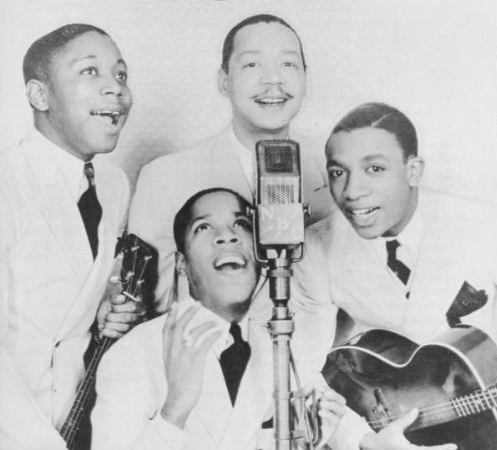
The Ink Spots were an American vocal pop group who gained international fame in the 1930s and 1940s. Their unique musical style predated the rhythm and blues and rock and roll musical genres, and the subgenre doo-wop. The Ink Spots were widely accepted in both the white and black communities, largely due to the ballad style introduced to the group by lead singer Bill Kenny.
In 1989, the Ink Spots (Bill Kenny, Charlie Fuqua, Deek Watson, Jerry Daniels, and Orville Jones) were inducted into the Rock and Roll Hall of Fame,[1] and in 1999 they were inducted into the Vocal Group Hall of Fame. Since the Ink Spots disbanded in 1954, there have been well over a hundred vocal groups calling themselves "The Ink Spots", with and without any original members of the group. It has often been the case that these groups claimed to be "second generation" or "third generation" Ink Spots.[2][3]
1930s
[edit]Early background of founding members
[edit]Daniels and Fuqua formed a vocal duo called "Jerry and Charlie" and performed in the Indianapolis area around 1931. About the same time, Jones and Watson were part of a quartet, "The Four Riff Brothers" with Mifflin James "Miff" Campbell and Elmer Oliver aka Slim Green,[4] who appeared regularly on radio station WLW in Cincinnati, Ohio. In 1933, that group disbanded, and Watson, Daniels and Fuqua got together to form a new vocal, instrumental, and comedy group initially called "King, Jack, and Jester". They continued to appear regularly on radio in Ohio and became a quartet when Jones joined the following year.
In July 1934, they accepted a booking at the Apollo Theater, New York, supporting jazz bandleader Tiny Bradshaw. At this point they had changed their name to "The 4 Ink Spots". Later that year, the Ink Spots achieved international success touring the UK with Jack Hylton's Orchestra, one review in the Melody Maker stating:
The sensation of the programme is the coloured quartette, the Four Ink Spots. They sing in a style something between the Mills Brothers and the Three Keys and accompany themselves on three tenor guitars and a cello — which is not bowed, but picked and slapped like a double bass. Their natural instinct for hot rhythm is exemplified in their terrific single-string solo work and their beautifully balanced and exquisitely phrased vocalisms. They exploit all kinds of rhythmic vocalisms — straight solos, concerted, scat, and instrumental imitations. They even throw in a bit of dancing to conclude their act, and the leading guitarist simultaneously plays and juggles with his instrument.[5]
They first recorded for Victor Records in 1935. Their early recordings included such songs as "Swingin' on the Strings", "Your Feet's Too Big", "Don't 'Low No Swingin' in Here" and "Swing, Gate, Swing". Despite their rising popularity as performers, their early records were not commercially successful.
Bill Kenny joins
[edit]In 1936, Daniels was replaced by a 21-year-old singer from Baltimore, Bill Kenny, who signed on with the Ink Spots after winning first place in an amateur contest at Harlem's Savoy Ballroom. Three years later, Kenny was credited for bringing the group to global success with his unusual high tenor ballad singing.[6]
In 1938, after being in the group for two years, Kenny started to introduce the group to a new format that he called "Top & Bottom". This format was used primarily for ballads rather than the uptempo "jive" songs the group was used to performing. This format called for the tenor (Kenny or Watson) to sing the lead for one chorus followed by a chorus performed by bass singer Jones reciting the lyrics rather than singing them. After a chorus of the "talking bass" the lead tenor sang the rest of the song until the end. The earliest example of their "Top & Bottom" format is from a radio broadcast from 1938. The song, titled "Tune In on My Heart", features Kenny taking the lead and Jones performing the talking bass.[7]
Also in 1938, Kenny took his first feature solo in Decca studios. His feature was on a song titled "I Wish You the Best of Everything". Although not in the "Top & Bottom" format, it was a ballad and used the signature Ink Spots guitar intro. Even though it got a good response, it was not very successful in terms of record sales and did not reach the pop chart.[8]
"If I Didn't Care" and the late 1930s
[edit]On January 12, 1939, the Ink Spots entered Decca studios to record a ballad written by a young songwriter named Jack Lawrence. This ballad, "If I Didn't Care", was to be one of their biggest hits, selling over 19 million copies and becoming the 8th-best-selling single of all time. This is the first studio recorded example of the Ink Spots "Top & Bottom" format with Kenny singing lead and Jones performing the "talking bass". For this recording, each member was paid $37.50; after the record sold 200,000 copies, however, Decca destroyed the original contract and the group was paid an additional $3,750. This was the recording that brought the group to global fame and established the "Top & Bottom" format as the Ink Spots "trademark". From 1939 until the group's disbanding in 1954, many of their songs employed this format. The year 1939 also saw the Ink Spots enjoy commercial success with five other recordings that featured Kenny in the "Top & Bottom" format. Their most successful hit of 1939 was the Lombardo, Marks & Hill ballad, "Address Unknown". Other successful hits from 1939 and early 1940 included "My Prayer",[9] "Bless You", "Memories of You", and "I'm Gettin' Sentimental Over You".[2]
1940s
[edit]Recordings
[edit]Between the years 1940 and 1949 the Ink Spots landed well over 30 hits on the US Pop Charts with 18 of them on the top 10. The group's first Billboard No. 1 hit came in 1944, when they teamed up with Ella Fitzgerald to record "I'm Making Believe".[10] This recording featured Bill Kenny. In 1946, the Ink Spots earned another No. 1 spot on the US Pop Charts with "To Each His Own". The Billy Reid composition "The Gypsy" was the Ink Spots' biggest chart success, staying at the No. 1 position on the Billboard Best Sellers chart for 10 straight weeks in 1946.
Other hits for the Ink Spots in the 1940s included "When the Swallows Come Back to Capistrano", "Maybe", "We Three", "I Don't Want to Set the World on Fire", "Don't Get Around Much Anymore", "A Lovely Way to Spend an Evening", "Into Each Life Some Rain Must Fall", and "I'm Beginning to See the Light".[11]
Films
[edit]In 1941, the Ink Spots were featured in The Great American Broadcast starring John Payne and Alice Faye. In the film, the Ink Spots play Pullman porters who sing during their breaks and ultimately "make it big time" and sing live on the radio during a national broadcast. The group sings a short segment of "If I Didn't Care", "Alabamy Bound", and "I've Got a Bone to Pick with You". They also provide background vocals to Faye and Payne on a ballad entitled "Where You Are".
The following year, the Ink Spots were featured in an Abbott and Costello film, Pardon My Sarong. In this film, the Ink Spots play singing waiters in a nightclub. They sing the ballad "Do I Worry?" and the swing song "Shout Brother Shout".[2]
Line-up changes
[edit]
In 1943, Ink Spots baritone singer and guitarist Fuqua was drafted into the US Army. He chose his friend Bernie Mackey to be his temporary replacement until he returned to the group. After being with the group for two years, Mackey was replaced by Huey Long in March 1945. Long completed the role as a "fill in" until Fuqua finally returned in October 1945.
Jones died in October 1944, after collapsing on stage at the Cafe Zanzibar in New York City, near the height of the Ink Spots' popularity. He had been having cerebral hemorrhages for a year and had fallen ill from the condition in June 1944.[12] Jones was temporarily replaced by Cliff Givens, who filled in from October 1944 to March 1945, before a permanent replacement was found in Bill Kenny's brother (and fraternal twin) Herb Kenny. Herb Kenny sang with the group from 1945 to 1951, when he began a career as a solo artist. The last bass singer in the Ink Spots was Adriel McDonald, who was with the group from 1951 to 1954. McDonald was previously the Ink Spots' personal valet, a job given to him by Herb Kenny, with whom he had sung in a group called "The Cabineers" in the early 1940s.
Due to personality clashes between Bill Kenny and Watson after Jones' death, Kenny decided he would rather carry on as the leader of the group and bought Watson's share of the group for $10,000, which gave him the power to kick Watson out of the group. Watson went on to form a group similar in style to the Ink Spots called the Brown Dots (which later became the Four Tunes), and his place was filled by Billy "Butterball" Bowen, who sang with the Ink Spots from 1944 to 1952.
1950s
[edit]Final years
[edit]In 1952, Fuqua left the group to form his own vocal group using the name "Ink Spots". At this time, Kenny and Fuqua each owned 50% of the Ink Spots, and it was decided by court ruling that Kenny's group was to continue on as the original "Ink Spots", while Fuqua's group was to use the name "Charlie Fuqua's New Ink Spots". Defying the court ruling, Fuqua instead called his group the "Original" Ink Spots.
Fuqua was replaced in the Ink Spots by popular jazz and R&B guitarist Everett Barksdale, so the group now consisted of Bill Kenny (lead tenor), Teddy Williams (second tenor), who had replaced Bowen, Everett Barksdale (baritone and guitar), and McDonald (bass). After being with the group for only a few months, Williams was replaced by Ernie Brown. Barksdale stayed with the group for about a year before being replaced by baritone vocalist and guitar player Jimmy Cannady. This line-up of Kenny (lead tenor), Brown (second tenor), Cannady (baritone and guitar), and McDonald (bass) lasted until 1954, when the final change of lineup was made.
In April 1954, Brown was replaced by Henry Braswell, who sang with the Ink Spots for their final three months. Kenny officially disbanded the Ink Spots in July 1954, after an appearance at the Bolero Bar in Wildwood, New Jersey.[2]
Members
[edit]Inducted into the Rock and Roll Hall of Fame
- Hoppy Jones (born as Orville Jones, February 17, 1905, Chicago, Illinois – d. October 18, 1944, New York City) sang bass and did spoken word. He played a small cello in the manner of a stand up bass.[13]
- Deek Watson (born as Ivory Jones, July 18, 1909 (some sources say 1913), Mounds, Illinois – d. November 4, 1969, Washington, D.C.) sang tenor and played tenor guitar.[14]
- Jerry Daniels (b. December 14, 1915 – d. November 7, 1995, Indianapolis, Indiana) sang tenor and played guitar and ukulele.[15]
- Charlie Fuqua (b. October 20, 1910 – d. c. 1970, New Haven, Connecticut)[16] had a baritone voice and played guitar and tenor guitar.
- Bill Kenny (b. June 12, 1914, Philadelphia, Pennsylvania, U.S. – d. March 23, 1978, New Westminster, Canada) sang lead tenor.
Timeline
[edit]
Non-original Ink Spots groups
[edit]Disputes over the rights to use the Ink Spots name began in the late 1940s, resulting in many court cases. Starting in 1954, groups calling themselves "The Ink Spots" sprang up all around the United States. Some groups contained original members Fuqua, McDonald, Bowen, or Watson, but most had no ties to the original group whatsoever. Many groups claimed to have the rights to the name, but no one did. Still, lawsuits were filed between various groups and there was great confusion as to who owned the naming rights. Some groups avoided lawsuits by naming themselves "The Fabulous Ink Spots", "The Famous Ink Spots", "The Amazing Ink Spots", "The Sensational Ink Spots", "The Dynamic Ink Spots", and more.
According to writer Marv Goldberg: "The original group was a partnership, not a corporation, and that influenced judge Isidor Wasservogel to say, in 1955, that when Hoppy Jones died in 1944, it effectively served to terminate the partnership and that no one could truthfully use the name after that."[17] From 1954 to the present, more than 100 groups have used the name "The Ink Spots".[18] In 1967 US federal judge Emmet C. Choate ruled that since so many groups had been using the name "Ink Spots" it had become "public domain" and was free for anyone to use.[19]
Charlie Fuqua's Ink Spots
[edit]In 1952, Fuqua left the original Ink Spots led by Kenny to form his own Ink Spots group. Fuqua recorded dozens of singles with his group for King Records as well as releasing two LP (long play) albums for Verve Records. In 1963 Fuqua's group also recorded one 45 RPM record for Ford Records. Fuqua led and was a member of various vocal groups calling themselves "The Ink Spots" until his death in 1971.
Deek Watson's Ink Spots
[edit]Watson, who had been forced out of the original Ink Spots in 1944 and briefly sang with Charlie Fuqua's Ink Spots in 1952–1953, started his own vocal group using the name "The Ink Spots" in 1954. Watson made numerous recordings with his "Ink Spots" groups in the 1950s and 1960s. Many of the recordings Watson made with his groups were released and re-released on various low budget labels. Watson led various groups until his death in 1969.
Legitimate members of the Ink Spots
[edit]Legitimate members of the Ink Spots included Bill Kenny, Jerry Daniels, Deek Watson, Charlie Fuqua, Hoppy Jones, Bernie Mackey, Huey Long, Cliff Givens, Billy Bowen, Herb Kenny, Adriel McDonald, Jimmy Cannady, Ernie Brown, Henry Braswell, Teddy Williams and Everett Barksdale. Pianists and arrangers included Bob Benson, Asa "Ace" Harris, Ken Bryan, Mort Howard (arranger), Bill Doggett, Ray Tunia, Harold Francis and Fletcher Smith. Some singers have tenuous ties to Deek Watson's or Charlie Fuqua's offshoot groups; many, with no credentials whatsoever, claim to be original members.[2]
Deaths
[edit]- Orville "Hoppy" Jones (born February 17, 1905, in Chicago, Illinois) (Ink Spots member from 1931 to 1944) died on October 18, 1944, after collapsing at the Cafe Zanzibar in New York City aged 39.[20]
- Bob Benson (born December 20, 1908, in Mercer County, West Virginia) (Ink Spots pianist for a time) died on September 7, 1945, in Detroit, Michigan aged 36.[21]
- Asa "Ace" Harris (born April 1, 1910, in New York) (Ink Spots pianist and arranger from 1940 to 1942) died June 11, 1964, in Chicago aged 54.[22] He is not to be confused with a man named John Harris who toured with a fake Ink Spots group and used the "Ace" nickname and pretended to be Ace Harris before his death in 2000.
- Deek Watson (born as Ivory Jones, July 18, 1909, in Mounds, Illinois) (Ink Spots member from 1931 to 1944) died from a stroke on November 4, 1969, in Washington, D.C..[23][24][25][26]
- Charlie Fuqua (born October 20, 1910, in West Virginia) (Ink Spots member from 1931 to 1942 / 1945 to 1951) died December 21, 1971, in West Haven, Connecticut aged 61.[27]
- Harold Francis (born Harold L. Francis, July 26, 1918, in New York) (Ink Spots pianist for a time) died February 4, 1975, aged 56.[21]
- Bill Kenny (born June 12, 1914, in Philadelphia, Pennsylvania) (Ink Spots member from 1936 to 1954) died from a respiratory illness on March 23, 1978, in New Westminster, Canada aged 63.[28]
- Bernie Mackey (born July 12, 1909, in The Bahamas) (Ink Spots member from 1943 to 1945) died in Miami, Florida from cancer on March 12, 1980, aged 70.[29]
- Billy Bowen (born January 3, 1909, in Birmingham, Alabama) (Ink Spots member from 1944 to 1951) died from a short illness on September 27, 1982, in New York City aged 73.[30]
- Ernie Brown (born September 28, 1925, in Lakeland, Minnesota) (Ink Spots member from 1952 to 1954) died on July 1, 1983, in Hyattsville, Maryland aged 57.[21]
- Ray Tunia (born May 10, 1916, in Atlantic City, New Jersey) (Ink Spots pianist for a time) died August 16, 1983, in Manhattan aged 67.[21]
- Jimmy Canady (born May 30, 1914, in St. Louis, Missouri) (Ink Spots gutiarist for a time) died February 1, 1984, in Hempstead, New York aged 69.[21]
- Everett Barksdale (born April 28, 1910, in Detroit, Michigan) (Ink Spots member in 1952) died on January 29, 1986, in Inglewood, California aged 75.[21][31]
- Adriel McDonald (born May 10, 1905, in Virgin Islands) (Ink Spots member from 1951 to 1954) died on September 1, 1987, in Manhattan aged 82.[21]
- Cliff Givens (born January 17, 1918, in Newark, New Jersey) (Ink Spots member from 1944 to 1945) died June 6, 1989, in Los Angeles, California aged 71.[21][32]
- Herb Kenny (born Herbert C. Kenny June 12, 1914, in Philadelphia, Pennsylvania) (Ink Spots member from 1945 to 1950) died from cancer on July 11, 1992, aged 78.[33][34][35]
- Fletcher Smith (born September 22, 1913, in Lincoln, Nebraska) (Ink Spots pianist for a time) died on August 15, 1993, in Los Angeles, California aged 79.[21]
- Jerry Daniels (born December 14, 1915) (Ink Spots member from 1931 to 1935) died on November 7, 1995, in Indianapolis, Indiana aged 79.[36][37]
- Bill Doggett (born February 16, 1916) (Ink Spots pianist and arranger from 1942 to 1944[38]) died from cancer in New York on November 13, 1996, aged 80.[39]
- Huey Long (born April 25, 1904, in Sealy, Texas) (Ink Spots member in 1945) died on June 10, 2009, in Houston aged 105.[40][41][42]
- Henry Braswell (born September 15, 1929, in Halifax, North Carolina) (Ink Spots member in 1954) died on October 7, 2016, in Camden, New Jersey aged 87.[21]
It is unknown if Teddy Williams (born June 20, 1927, in Manhattan) (Ink Spots member in 1952) is still alive or not as there are no types of certificates (e.g. Marriage, death) matching his details from 1952 onwards.[21][43] Marv Goldberg, who wrote an article about Williams published in 2025, stated: "There was never another word about Teddy Williams, not even a record of his death. I don't know if he ever married or had any children. There's even a slim chance that he's still alive."[43] If still alive, Williams will be 98 as of 2025.
Additional deaths:
- Slim Green (born Elmer Oliver, birthdate unknown) (member of pre-Ink Spots group "The Four Riff Brothers) died on April 30, 1938, after suffering from pneumonia.[21]
- Miff Campbell (born Mifflin James Campbell, January 22, 1906, in Indianapolis, Indiana) (member of pre-Ink Spots group "The Four Riff Brothers") died on April 2, 1995, in Indianapolis aged 89.[44]
Legacy and honors
[edit]- 1946 Cashbox award for making "The Gypsy" the biggest money making song of the year.
- 1948 awarded a plaque from the Negro Actors Guild for their efforts in "breaking down the walls of racial prejudice".
- 1989, the Ink Spots were inducted into the Rock and Roll Hall of Fame as "early influences" by Bobby McFerrin; the members were listed as Bill Kenny, Charlie Fuqua, Deek Watson, Jerry Daniels, and Orville Jones.[1]
- 1989, the Ink Spots' 1939 recording of "If I Didn't Care" was inducted into the Grammy Hall of Fame
- 1999, the Ink Spots were inducted into the Vocal Group Hall of Fame.
The Ink Spots in popular culture
[edit]This section needs additional citations for verification. (November 2025) |
Television appearances
[edit]The Ink Spots were television pioneers when, on November 6, 1936, they were the first musical group to perform live on television, during an NBC test broadcast held at the NBC/RCA Building for the press.[45]
In 1948, they were the first black performers to appear on The Ed Sullivan Show.[46]
In 2025, The Ink Spots' version of "We'll Meet Again" was featured on the fifth episode of the show Alien: Earth.[47]
In 2025, The Ink Spots' version of "If I Didn't Care" was used at the end of the South Park episode "The Woman in the Hat".
Other homages and references
[edit]In Glenn Miller's 1942 song "Jukebox Saturday Night", The Ink Spots are directly mentioned and an homage is done.
In 1945, Spike Jones recorded a parody cover of "You Always Hurt the One You Love" in an Ink Spots impression. The original song was recorded by a group they were often compared to, The Mills Brothers, just a year prior to Jones' cover.
The Beatles, at the time known as The Quarrymen, attempted to imitate The Ink Spots in the song "You'll Be Mine". It was only ever recorded as a demo. Paul McCartney sang in a deep baritone and John Lennon sang backing vocals in falsetto.
"I Don't Want to Set the World on Fire" is briefly played at the beginning of Megadeth's "Set the World Afire".
"If I Didn't Care" is played during the opening of the film The Shawshank Redemption.
Selected discography
[edit]Compilation albums
[edit]- Ink Spots (1946)
- If I Didn't Care (1979)
Select Singles
[edit]| Year | Single | Chart positions | |
|---|---|---|---|
| US [48][nb 1] |
US R&B | ||
| 1939 | "If I Didn't Care" | 2 | — |
| "You Bring Me Down" | 14 | — | |
| "Address Unknown" | 1 | — | |
| "It's Funny to Everyone but Me" | — | — | |
| "My Prayer" | 3 | — | |
| "Bless You for Being an Angel" | 15 | — | |
| 1940 | "Memories of You" | 29 | — |
| "I'm Gettin' Sentimental Over You" | 26 | — | |
| "When the Swallows Come Back to Capistrano" | 4 | — | |
| "Whispering Grass (Don't Tell the Trees)" | 10 | — | |
| "Maybe" | 2 | — | |
| "Stop Pretending" | 16 | — | |
| "You're Breaking My Heart All Over Again" | 17 | — | |
| "We Three (My Echo, My Shadow and Me)" | 1 | — | |
| "My Greatest Mistake" | 12 | — | |
| "Java Jive" | 15 | — | |
| 1941 | "Please Take a Letter, Miss Brown" | 25 | — |
| "Do I Worry?" | 8 | — | |
| "I'm Still Without a Sweetheart ('Cause I'm Still in Love with You)" | 19 | — | |
| "So Sorry" | 24 | — | |
| "Until the Real Thing Comes Along" | 24 | — | |
| "I Don't Want to Set the World on Fire" | 4 | — | |
| "Someone's Rocking My Dreamboat" | 17 | — | |
| 1942 | "Ev'ry Night About This Time" | 17 | 6 |
| "This Is Worth Fighting For" | — | 9 | |
| "Just as Though You Were Here" | — | 10 | |
| 1943 | "Don't Get Around Much Anymore" | 2 | 1 |
| "If I Cared a Little Bit Less" | 20 | 10 | |
| "I'll Never Make the Same Mistake Again" | 19 | — | |
| "I Can't Stand Losing You" | — | 1 | |
| 1944 | "Don't Believe Everything You Dream" | 14 | 6 |
| "Cow Cow Boogie (Cuma-Ti-Yi-Yi-Ay)" (with Ella Fitzgerald) | 10 | 1 | |
| "A Lovely Way to Spend an Evening" | 2 | — | |
| "I'll Get By (As Long as I Have You)" | 7 | 4 | |
| "Someday I'll Meet You Again" | 14 | — | |
| "I'm Making Believe" (with Ella Fitzgerald) | 1 | 2 | |
| "Into Each Life Some Rain Must Fall" (with Ella Fitzgerald) | 1 | 1 | |
| 1945 | "I'm Beginning to See the Light" (with Ella Fitzgerald) | 5 | — |
| 1946 | "The Gypsy" | 1 | 1 |
| "Prisoner of Love" | 9 | 5 | |
| "To Each His Own" | 1 | 3 | |
| 1947 | "You Can't See the Sun When You're Crying" | 19 | — |
| "Ask Anyone Who Knows" | 17 | 5 | |
| 1948 | "The Best Things in Life Are Free" | — | 10 |
| "Say Something Sweet to Your Sweetheart" | 22 | — | |
| "You Were Only Fooling (While I Was Falling in Love)" | 8 | 15 | |
| 1949 | "You're Breaking My Heart" | 9 | — |
| "Who Do You Know in Heaven (That Made You the Angel You Are?)" | 21 | — | |
| 1950 | "Echoes" | 24 | — |
| "Sometime" | 26 | — | |
| 1951 | "If" | 23 | — |
| "It Is No Secret" (Bill Kenny solo) | 18 | — | |
| 1952 | "(That's Just My Way of) Forgetting You" (Bill Kenny solo) | 23 | — |
Notes
[edit]- ^ Joel Whitburn's methodology for creating pre-1940s chart placings has been criticised,[49] and therefore should not be taken as definitive.
See also
[edit]References
[edit]- ^ a b "The Ink Spots – Rock & Roll Hall of Fame". Retrieved November 22, 2019.
- ^ a b c d e Goldberg, Marv (1998). More Than Words Can Say: The Ink Spots And Their Music. Scarecrow Press
- ^ Howard Perspectives, Dwight Burrill, Herb Kenny, Howard University, 1992
- ^ "FOUR RIFF BROTHERS". www.uncamarvy.com. Retrieved July 31, 2025.
- ^ "Original Ink Spots Activities By Date – Vol". Inkspots.ca. November 6, 1936. Retrieved April 13, 2012.
- ^ "The Ink Spots | Rhino". Rhino.com. Retrieved September 12, 2018.
- ^ Chicago Defender, July 12, 1952
- ^ Indianapolis Recorder, Indianapolis, Marion County, July 7, 1945, page 13.
- ^ Gilliland 1994, tape 2, side B.
- ^ Gilliland, John (1994). Pop Chronicles the 40s: The Lively Story of Pop Music in the 40s (audiobook). ISBN 978-1-55935-147-8. OCLC 31611854. Tape 1, side B.
- ^ Tyler, Don (2007). Hit Songs, 1900–1955: American Popular Music of the Pre-Rock Era. McFarland. p. 251. ISBN 978-0-7864-2946-2.
- ^ "The Ink Spots". Rockabilly.nl. Retrieved March 23, 2018.
- ^ "Orville "Hoppy" Jones of the Ink Spots". Retrieved June 2, 2009.
- ^ "Ivory (Deek) Watson, 60, Dead; Tenor Sang With the Ink Spots". The New York Times. November 10, 1969. ISSN 0362-4331. Retrieved November 28, 2023.
- ^ "Jerry Franklin Daniels, Ink Spots Member, 79". The New York Times. November 11, 1995. ISSN 0362-4331. Retrieved November 28, 2023.
- ^ Warner, Jay (2006). American Singing Groups: A History from 1940s to Today. Hal Leonard Corporation. ISBN 978-0-634-09978-6.
- ^ Paul J. Macarthur. "The Imposters". Houston Press. Retrieved July 15, 2015.
- ^ "Family Tree Page". Inkspotsevolution.com. Retrieved December 13, 2012.
- ^ The Oregonian, September 1, 1967, p. 29
- ^ "***HOPPY JONES the INK SPOTS***". www.uncamarvy.com. Retrieved July 30, 2025.
- ^ a b c d e f g h i j k l "Ink Spots Errata". www.uncamarvy.com. Retrieved July 30, 2025.
- ^ "ACE HARRIS". tims.blackcat.nl. Retrieved July 30, 2025.
- ^ "***DEEK WATSON of the INK SPOTS***". www.uncamarvy.com. Retrieved July 30, 2025.
- ^ "Artist: Deek Watson | SecondHandSongs". secondhandsongs.com. Retrieved July 30, 2025.
- ^ "Deek Watson Songs, Albums, Reviews, Bio & More..." AllMusic. Retrieved July 30, 2025.
- ^ "Ivory (Deek) Watson, 60, Dead; Tenor Sang With the Ink Spots (Published 1969)". November 10, 1969. Retrieved July 30, 2025.
- ^ "***Charlie Fuqua of the INK SPOTS***". www.uncamarvy.com. Retrieved July 30, 2025.
- ^ "The Calgary Herald - Google News Archive Search". news.google.com. Retrieved July 30, 2025.
- ^ Garcia, Elizabeth (March 18, 2021). "Remembering Miami's music man pioneer, Bernie Mackey, part 7". Caplin News. Retrieved July 30, 2025.
- ^ "Billy Bowen, 73, the last of the original Ink... - UPI Archives". UPI. Retrieved July 30, 2025.
- ^ "Everett Barksdale Songs, Albums, Reviews, Bio ..." AllMusic. Retrieved July 30, 2025.
- ^ "Cliff Givens Songs, Albums, Reviews, Bio & Mor..." AllMusic. Retrieved July 30, 2025.
- ^ "Herbert Kenny, last of original Ink Spots, dies - UPI Archives". UPI. Retrieved July 30, 2025.
- ^ "Herbert C. Kenny, 78, Sang With Ink Spots (Published 1992)". July 15, 1992. Retrieved July 30, 2025.
- ^ "HERBERT KENNY DIES". The Washington Post. July 14, 1992. ISSN 0190-8286. Retrieved July 30, 2025.
- ^ "Jerry Franklin Daniels, Ink Spots Member, 79 (Published 1995)". November 11, 1995. Retrieved July 30, 2025.
- ^ Archives, L. A. Times (November 11, 1995). "Jerry Franklin Daniels; Member of Ink Spots". Los Angeles Times. Retrieved July 30, 2025.
- ^ The Virgin Encyclopedia of Popular Music - Colin Larkin 1997 - page 384 - ISBN 1-85227-745-9.
- ^ "The Dead Rock Stars Club 1996 - 1997". thedeadrockstarsclub.com. Retrieved July 30, 2025.
- ^ "Huey Long: Singer and guitarist who found fame with the Ink Spots". The Independent. Archived from the original on November 30, 2024. Retrieved July 30, 2025.
- ^ "Huey Long, Guitarist for Ink Spots, Dies at 105 (Published 2009)". June 13, 2009. Retrieved July 30, 2025.
- ^ Association, Texas State Historical. "Huey Long: Jazz Guitarist, Banjoist, and Music Teacher". Texas State Historical Association. Retrieved July 30, 2025.
- ^ a b "Marv Goldberg's R&B Notebooks - TEDDY WILLIAMS". www.uncamarvy.com. Retrieved July 30, 2025.
- ^ "Miff Campbell, 89, Member of Ink Spots (Published 1995)". April 8, 1995. Retrieved July 31, 2025.
- ^ Edgerton, Gary R. (2007). The Columbia history of American television. Columbia histories of modern American life. New York: Columbia University Press. ISBN 978-0-231-12164-4.
- ^ Pilapil, Annette (June 3, 2024). "Celebrating Black Music Month: The Legacy of The Ink Spots". Ed Sullivan Show. Retrieved July 15, 2024.
- ^ https://consequence.net/2025/08/alien-earth-season-1-soundtrack-every-song/
- ^ Whitburn, Joel (1986). Pop Memories 1890–1954: The History of American Popular Music. Menomonee Falls, Wisconsin: Record Research, Inc. pp. 223–224. ISBN 0-89820-083-0.
- ^ "Joel Whitburn criticism: chart fabrication, misrepresentation of sources, cherry picking", Songbook1.wordpress.com
External links
[edit]The Ink Spots
View on GrokipediaOrigins and Early Career
Founding and Initial Lineup
The Ink Spots originated in Indianapolis, Indiana, in 1932, when Orville "Hoppy" Jones, Charlie Fuqua, Deek Watson, and Jerry Daniels formed a vocal group initially known as King, Jack, and the Jesters.[2] Influenced by close-harmony ensembles like the Mills Brothers, the members performed locally in the Midwest, drawing on their instrumental and vocal skills—Jones on bass and spoken introductions, Fuqua on guitar and baritone, Watson on tenor and baritone, and Daniels on lead tenor.[4] This quartet configuration marked the group's foundational structure amid the era's competitive African American music circuits.[5] In late 1933, the group relocated to New York City seeking broader opportunities in the vibrant Harlem entertainment scene.[2] Upon arrival, they encountered a naming dispute with bandleader Paul Whiteman's group, the King's Jesters, prompting a change to the Ink Spots to secure performances without legal hindrance.[6] The rebranded act hustled for modest bookings at venues like the Apollo Theater and radio spots, navigating stiff urban competition through persistent auditions and amateur contests.[7] By early 1936, internal vocal dynamics led to the departure of original tenor Jerry Daniels, who was replaced by Bill Kenny, a 21-year-old singer from Baltimore discovered via a Savoy Ballroom contest.[8] [5] Kenny's smoother, higher tenor range provided greater stability and range for the group's harmonies, solidifying the classic lineup of Kenny, Watson, Fuqua, and Jones that would define their early sound.[9] This adjustment occurred amid ongoing small-scale engagements, reflecting the self-reliant adaptation typical of emerging acts in pre-swing era New York.[10]Breakthrough with "If I Didn't Care"
The Ink Spots recorded "If I Didn't Care" on January 12, 1939, at Decca Records studios in New York. Written by Jack Lawrence in 1938, the track highlighted Bill Kenny's smooth tenor lead vocals over the group's harmonious backing, introduced by Orville "Hoppy" Jones's spoken bass interjection.[11][12][13] This release represented a decisive career inflection point, transitioning the group from vaudeville novelty routines toward specialization in sentimental ballads and elevating them to mainstream recognition. The single topped Billboard charts, sustained popularity through radio exposure on networks like NBC, and amassed over 19 million copies sold across reissues and covers, ranking among the highest-selling records ever.[11][14][15] As the inaugural major pop chart breakthrough for a Black vocal ensemble, "If I Didn't Care" facilitated broad crossover appeal, driven by its emotive delivery that fused barbershop-style close harmonies with subtle swing influences, an arrangement predating codified rhythm and blues conventions.[16][11]Peak Popularity and World War II Influence
Major Hits and Recording Success
The Ink Spots produced a series of chart-topping singles in the 1940s, including "I Don't Want to Set the World on Fire," which reached number one on the Billboard Best Sellers chart in July 1941.[17] Subsequent hits included "To Each His Own" in 1946 and "The Gypsy" later that year, both attaining the top position on the Billboard charts.[17] These successes contributed to a catalog of over 20 top-10 singles and approximately 30 entries in the Billboard top 100 during their peak recording years.[18] The group recorded extensively for Decca Records from 1939 onward, issuing more than 200 sides that encompassed ballads and novelty tunes tailored to wartime audiences.[19] Their output aligned with heightened demand during World War II, as selections like "If I Didn't Care" and others were adapted for the V-Disc program, which distributed over eight million durable records to U.S. troops overseas to bolster morale through familiar pop music.[20] This military distribution amplified domestic sales, with at least 16 of their singles certified as million-sellers by industry standards of the era.[21] Overall record sales exceeded tens of millions of units, driven by empirical dominance in pre-rock pop charts where vocal harmony groups rarely sustained such volume.[21] Unlike many contemporary Black artists facing predatory contracts with flat fees and no residuals, the Ink Spots leveraged hit-driven leverage to secure revised payments post-release, as evidenced by Decca's adjustment after initial low advances for breakout tracks sold in high volumes.[22] This approach yielded sustained revenue from catalog depth rather than one-off sessions common in the industry.Film and Radio Appearances
The Ink Spots appeared in Hollywood feature films during the early 1940s, providing visual exposure to their harmonious style amid U.S. theater segregation that limited integrated live viewings but allowed wider dissemination through distributed prints. In the 1941 musical comedy The Great American Broadcast, directed by Archie Mayo, the group portrayed Pullman porters performing "I've Got a Bone to Pick with You," a segment that showcased their vocal interplay to mainstream audiences.[23] The following year, in the 1942 Abbott and Costello vehicle Pardon My Sarong, they featured as singing waiters delivering "Do I Worry," integrating their sound into comedic escapism viewed by millions via national release.[24] These roles, while stereotypical, marked early crossover opportunities for a Black ensemble in white-dominated cinema, prioritizing artistic merit over contemporaneous advocacy for desegregation.[25] Radio broadcasts amplified their reach, particularly through WWII-era programs aired domestically and to troops overseas, where mixed audiences contrasted segregated U.S. venues. The group guested on Command Performance, the Armed Forces Radio Service's flagship variety show, including a January 2, 1943, episode hosted by Linda Darnell featuring their rendition of "Java Jive" alongside Cab Calloway, broadcast to millions of servicemen via shortwave.[26] Their recordings dominated airplay on Your Hit Parade, with tracks like "Address Unknown" peaking at number 1 in 1939 and others sustaining top rankings into the 1940s, embedding their appeal in weekly national countdowns.[27] Live theater broadcasts, such as a November 7, 1941, airing from Pittsburgh's Stanley Theatre, further extended their presence to regional listeners, underscoring commercial viability over ideological pursuits.[28] These media vectors exposed their music to an estimated tens of millions, fostering global fandom independent of domestic racial barriers.[2]Lineup Evolution Amid Success
Orville "Hoppy" Jones, the group's bass vocalist and spoken-word introducer, died on October 18, 1944, at age 39 from a cerebral hemorrhage during a performance at the Cafe Zanzibar in New York City.[1] His role was initially filled temporarily by Cliff Givens, a former Golden Gate Quartet member, before Bill Kenny's fraternal twin brother, Herb Kenny, joined permanently as bass singer in early 1945, adapting to the group's formula of deep bass lines and spoken intros.[10][29] In September 1944, founding tenor and guitarist Ivory "Deek" Watson left amid ongoing tensions with Bill Kenny, including disputes over finances and creative direction.[30][1] Watson, who soon formed the rival Brown Dots, was replaced by Billy Bowen as baritone, whose energetic style complemented the harmonic blend without altering the quintet's core sound.[31] Guitarist Charlie Fuqua took a brief leave in 1945 for personal reasons, substituted by Huey Long for about nine months, ensuring continuity in rhythm guitar and backing vocals before Fuqua's return.[32] Throughout these transitions, Bill Kenny's falsetto lead vocals anchored performances, with new members trained to replicate established arrangements. These 1940s shifts caused negligible interruption to output, as evidenced by sustained chart success: "The Gypsy" reached number one in 1946, followed by "To Each His Own" also topping charts that year, reflecting preserved stylistic fidelity amid personnel flux.[33]Decline and Internal Conflicts
Post-War Challenges and Final Tours
Following World War II, the Ink Spots faced diminishing domestic popularity amid market saturation from numerous vocal harmony groups and evolving musical preferences favoring faster-paced styles like bebop and early rhythm and blues, which overshadowed their ballad-oriented sound. Their chart performance tapered sharply after 1946, with the final number-one hits—"The Gypsy" and "To Each His Own"—marking the end of peak recording success, as no subsequent releases achieved comparable Billboard rankings.[34][35] Despite waning U.S. appeal, the group sustained operations through live performances, including steady engagements on the college circuit into the early 1950s, which provided residual income as radio play and new recordings declined.[2] Financial pressures exacerbated challenges, stemming from unfavorable management arrangements where promoter Moe Gale retained 60% of earnings while the quartet divided the remainder equally, alongside disputes over unpaid royalties tied to earlier partnership structures following Orville "Hoppy" Jones's 1944 death.[32] These strains contributed to internal tensions peaking in 1951–1952, though tours and select venues like the Tiffany Club in July 1953 offered temporary stability.[36] The group's final Decca recording sessions occurred in the early 1950s, with tracks like those captured on January 22, 1951 (Decca 27493, released April 1951), representing the close of their original formula under the label that had defined their hits since 1936.[37] By 1953, the Decca-affiliated Ink Spots performed their last official concert, signaling the effective end of the core lineup's cohesive era amid these compounding economic and stylistic hurdles.[2]Key Departures and Group Dissolution
Charlie Fuqua, the original guitarist, left the Ink Spots in August 1952 after their final performances with the group at The Frolics nightclub in Salisbury Beach, Massachusetts, to form his own ensemble.[38] [39] Bill Kenny, the lead tenor who had been the group's de facto voice since the late 1930s, then took complete control of the act, incorporating replacements such as guitarist Everett Barksdale.[40] [21] Under Kenny's leadership, the Ink Spots persisted with a revolving lineup including members like Adriel McDonald on bass and Jimmy Cannady on guitar, but persistent instability eroded cohesion.[21] The ensemble's final major booking occurred in June 1954 on The Ed Sullivan Show, after which Kenny disbanded the group in July amid these internal fractures and the members' advancing age, which limited their capacity for rigorous touring.[7] [21] By this point, shifting audience preferences toward emerging genres like rock and roll had rendered their ballad style increasingly marginal, with performances confined to modest venues rather than the grand halls of their wartime peak.[1] Original members made no efforts to reconstitute the Ink Spots post-dissolution, reflecting the irreversible toll of personal fatigue and market evolution over any reversible disputes.[21] Kenny pursued a solo career thereafter, but the core quartet's operational end in 1954 closed a chapter defined by cumulative personnel attrition rather than abrupt external forces.[37]Musical Style and Technique
Signature Vocal and Instrumental Approach
The Ink Spots employed a distinctive "top and bottom" vocal structure, in which lead tenor Bill Kenny delivered the primary melody in a high, plaintive, and emotive tone, typically singing the verse and chorus straight through before transitioning to a spoken recitation of the bridge by bassist Orville "Hoppy" Jones.[11] [1] This technique, devised by Kenny, contrasted the soaring tenor lead—often with a subtle quivering vibrato—with Jones's deep, improvisational bass narration, creating a dynamic interplay that heightened lyrical intimacy and narrative flow.[11] [6] Supporting Kenny's lead were tight four-part harmonies from the full quartet, blending the tenors and baritone in close-knit intervals that emphasized purity and precision over elaborate embellishment.[1] [41] The group's vocal approach drew on jazz-inflected phrasing and spiritual-derived resonance but integrated these into straightforward pop frameworks, maintaining lyrical clarity without reliance on non-semantic syllables or scat elements common in later styles.[6] This harmonic discipline, achieved through rehearsed blending rather than overdubbed layers, relied on live ensemble cohesion to project a unified, resonant texture.[1] Instrumentally, the ensemble maintained minimalism to foreground vocals, with Charlie Fuqua's guitar providing rhythmic strumming and brief two- to four-bar introductions that set a gentle, unadorned tempo.[41] [6] Fuqua occasionally incorporated ukulele or banjo for texture in early configurations, while Jones doubled on standup bass (adapted from a re-tuned cello), but these elements served solely as subtle anchors, eschewing dense orchestration or solos to preserve the recordings' emotional directness and vocal prominence.[1] The overall sparseness of arrangements—often limited to guitar, bass, and occasional piano—facilitated unprocessed intimacy, particularly through close-miked ensemble capture that captured the natural warmth and breath of the harmonies without artificial enhancement.[6] [41]Innovations in Harmony and Arrangement
The Ink Spots pioneered the "talking bass" technique, in which bassist Orville "Hoppy" Jones delivered spoken-word recitations of lyrics over fading instrumental sections, serving as a structural hook that enhanced narrative flow in ballads and redefined the bassist's role beyond mere harmonic support.[1][42] This innovation, first prominently featured in recordings like "If I Didn't Care" released February 1939, created a "top-and-bottom" dynamic with Bill Kenny's high tenor lead transitioning to Jones's resonant spoken bridge, allowing for emotional emphasis and extended song duration without additional verses.[21][43] Jones's approach, often improvised, emulated by later groups such as the Ravens' Jimmy Ricks, influenced vocal quartet standards by prioritizing lyrical recitation as a climactic element.[1] Drawing from barbershop quartet traditions of close-harmony singing, the group self-arranged their vocal parts, emphasizing tight triadic harmonies that simulated instrumental textures while minimizing accompaniment to spotlight the voices.[43] Charlie Fuqua's simple guitar introductions and rhythmic strumming provided sparse backing, often limited to a single instrument alongside occasional cello tuned as bass by Jones, which maintained focus on the quartet's interplay and accessibility for radio broadcast.[38] This lean arrangement style, evident in Decca sessions from 1939 onward, avoided heavy orchestration common in swing ensembles, enabling the harmonies' clarity and contributing to their crossover appeal.[44] In adapting to the swing era, the Ink Spots integrated subtle rhythmic swings into their ballad frameworks without excess instrumentation, preserving vocal purity while broadening quartet recording norms for subsequent rhythm-and-blues acts.[43] Their method of harmonizing standards like "My Prayer" (1940) set precedents for peer emulations, as groups adopted similar self-reliant vocal layering and minimalism to achieve comparable intimacy and commercial viability.[1]Members and Personnel
Original Core Members
The Ink Spots originated in Indianapolis during the early 1930s, with the initial lineup comprising Orville "Hoppy" Jones on bass, Charlie Fuqua on guitar and baritone vocals, Ivory "Deek" Watson on tenor and baritone vocals, and Jerry Daniels on tenor and guitar.[2] [6] [45] This core group established the band's foundational harmony style before Bill Kenny joined as lead tenor in 1936, replacing Daniels and solidifying the classic quartet configuration.[40] [46] Bill Kenny, whose high tenor lead vocals drove the group's commercial appeal, introduced their "top-and-bottom" formula where his soaring melody was complemented by bass elements below.[45] [37] His range and smooth delivery proved pivotal to hits like "If I Didn't Care," enabling crossover success.[41] Orville "Hoppy" Jones (February 17, 1905 – October 18, 1944) specialized in deep bass singing and signature spoken-word recitations, often delivering lyrical bridges in a rhythmic, tongue-in-cheek style that became a hallmark of their recordings.[6] [41] Charlie Fuqua (c. 1911 – 1971) provided rhythmic guitar accompaniment and baritone support, contributing to the group's tight ensemble sound rooted in their Indianapolis street-performing beginnings.[33] Ivory "Deek" Watson (July 18, 1909 – November 4, 1969) handled versatile tenor and baritone parts, serving as an early lead voice and arranger before shifts in the lineup.[10] [47] Jerry Daniels, the original tenor and guitarist, performed with the group from its formation until 1936, laying groundwork for their vocal-guitar blend prior to Kenny's arrival.[40] [33]Membership Timeline and Replacements
The Ink Spots formed in Indianapolis circa 1932 with an initial lineup of tenor lead Jerry Daniels, bass Orville "Hoppy" Jones, tenor Ivory "Deek" Watson, and guitarist/baritone Charlie Fuqua.[2] This configuration persisted until 1936, when Daniels departed and was replaced by tenor Bill Kenny prior to the group's first Decca Records session on May 12, 1936.[21] Kenny's arrival marked the start of the quartet's most stable and commercially successful era, comprising Kenny (lead tenor), Watson (second tenor), Jones (bass and bass vocal), and Fuqua (guitar, baritone, and occasional recitation).[40]| Period | Core Members | Key Changes and Replacements |
|---|---|---|
| 1936–1944 | Bill Kenny (lead tenor), Deek Watson (tenor), Hoppy Jones (bass), Charlie Fuqua (guitar/baritone) | Fuqua temporarily left for military service in 1943; interim guitarist Huey Long filled in briefly before Fuqua's return. No permanent changes until Jones's death on October 18, 1944, from a cerebral hemorrhage, after which his brother Herb Kenny joined as permanent bass vocalist in late 1944.[48] [40] |
| 1945–1952 | Bill Kenny (lead tenor), Charlie Fuqua (guitar/baritone), Herb Kenny (bass), Billy Bowen (baritone/tenor) | Watson was dismissed in July 1945 following a dispute during a performance; Billy Bowen replaced him as baritone and second tenor, maintaining continuity with Kenny and Fuqua as original-era holdovers.[31] [32] Fuqua departed again in 1952, with short-term replacements including Ernie Reed on guitar. |
| 1952–1954 | Bill Kenny (lead tenor), Herb Kenny (bass), Billy Bowen (baritone/tenor), rotating guitarists | Kenny-led iterations featured transient members like Shorty Anderson and Jim Wylie on guitar and tenor, but relied on Kenny as the sole continuous original-era figure; the group effectively disbanded by 1954 upon Kenny's retirement from touring.[7] [13] |
Legal Disputes Over Name and Authenticity
Origins of Splinter Groups
The fragmentation of the Ink Spots began with internal departures driven by personal and financial disputes, setting the stage for rival formations. In late 1944, founding member Ivory "Deek" Watson exited the group following a falling out with lead singer Bill Kenny over creative and leadership differences, promptly forming The Brown Dots as a competing vocal quartet.[49] This early splinter capitalized on Watson's prior Ink Spots experience, recording similar harmony-driven material and occasionally invoking the original group's style to attract audiences seeking nostalgic performances.[30] A more direct rival emerged in 1952 when guitarist and baritone Charlie Fuqua, another original member, departed amid growing tensions, including disputes over earnings and touring commitments, to assemble his own iteration of the Ink Spots.[38] Fuqua's group featured new personnel but retained core elements of the Ink Spots' balladry and instrumentation, touring under the established name to leverage the quartet's wartime popularity and capitalize on live performance revenues.[1] These exits exemplified the financial incentives propelling offshoots, as departing members sought independent control over bookings and royalties in an era of booming nostalgia for 1940s hits. The absence of formal trademark protections for the Ink Spots name exacerbated this splintering, enabling groups with minimal ties—often just one ex-member—to claim authenticity for regional and international tours throughout the 1950s and 1960s.[50] Post-World War II demand, particularly in Europe where the originals had toured extensively, fostered unauthorized copycat ensembles that diluted the brand through unverified performances mimicking the signature spoken intros and guitar-piano backing.[1] By the 2020s, this unchecked proliferation had resulted in over 100 such entities exploiting the group's enduring recognition, primarily for profit via revival circuits rather than innovation.[13]Court Battles and Authentic Membership Criteria
In the late 1940s, the original Ink Spots members initiated lawsuits against imitation groups appropriating their name and style, aiming to protect their trademark amid rising popularity of splinter acts.[2] These early actions established precedents for challenging unauthorized uses but highlighted the challenges of enforcing rights without formal corporate structure.[32] A pivotal 1952 court ruling favored Bill Kenny's lineup, recognizing it as the continuation of the original group and permitting its use of "The Ink Spots" name, while directing Charlie Fuqua's competing ensemble to operate as "Charlie Fuqua's New Ink Spots."[13] Fuqua disregarded the order, adopting "The Original Ink Spots" instead, which fueled further confusion and litigation.[13] This decision underscored temporary priority for groups retaining core personnel from the 1930s-1940s era, including Kenny as lead vocalist alongside survivors of the founding quartet: Orville "Hoppy" Jones (deceased 1944), Fuqua, Deek Watson, and early tenor Jerry Daniels.[13] Subsequent rulings in the 1950s and 1960s eroded exclusive claims. A 1955 judgment declared the original partnership dissolved upon Jones's death in 1944, nullifying perpetual name rights for any post-dissolution configuration and emphasizing that no ensemble could exclusively embody the "original" Ink Spots thereafter.[13] By 1967, a federal decision placed "The Ink Spots" in the public domain due to prolific unauthorized usage by over 100 rival groups, rendering the name freely available absent original member involvement.[13] Disputes persisted into the 1980s, exemplified by a 1985 suit from one self-proclaimed Ink Spots incarnation against regional imitators in Florida, though outcomes reinforced the lack of enforceable monopoly post-public domain entry.[51] Authenticity criteria, as articulated in these judgments, hinged on verifiable ties to the five key originals—Jones, Daniels, Watson, Fuqua, and Kenny—excluding later replacements or unrelated performers.[13] Impostor groups without such lineage were deemed illegitimate, yet the proliferation of variants diluted enforcement. As of 2025, with all originals deceased and no intact original lineup possible, analyses affirm that unchecked splintering compromised the group's legacy by commoditizing its signature sound without preserving historical fidelity.[13]Legacy and Cultural Impact
Influence on Rhythm and Blues and Rock
The Ink Spots' vocal technique, featuring a high tenor lead supported by tight harmonies, a deep bass spoken recitation, and minimal guitar accompaniment, predated the emergence of rhythm and blues as a distinct genre in the late 1940s and established foundational elements for R&B ensemble singing.[1] Their approach emphasized emotional delivery and structural innovation, directly impacting the development of R&B by prioritizing vocal interplay over instrumental dominance, a shift that subsequent groups adopted to convey intimacy and narrative depth.[3] As one of the earliest Black ensembles to achieve widespread radio play and live performance acceptance across racial lines in the 1930s and 1940s, their breakthrough relied on superior musicianship rather than concessions to prevailing segregation, providing a template for Black artists to penetrate mainstream markets through merit alone.[1] In rock and roll's formation during the 1950s, the Ink Spots served as forerunners, with their ballad style and harmonic precision echoed in early rock vocalism. Elvis Presley's 1957 recording of their 1941 track "That's When Your Heartaches Begin"—which peaked at number 58 on the Billboard Hot 100 as the B-side to "All Shook Up"—demonstrates this lineage, as Presley adapted their slow-tempo arrangement and vocal phrasing to blend with emerging rock energy.[52] Doo-wop ensembles, a bridge between prewar vocal harmony and postwar rock, emulated the Ink Spots' format of lead-verse-harmony refrains, as seen in groups like the Platters whose polished ballads mirrored the Spots' pop-oriented structure while amplifying rhythmic elements.[53] The Beatles, too, incorporated Ink Spots-inspired wordless backing harmonies and spoken narrative touches in early compositions, reflecting a causal debt to their blend of swing-era polish and blues-inflected storytelling.[54] This influence extended empirically through sales precedents: the Ink Spots amassed 46 chart hits from 1939 to 1948, outpacing contemporaries like the Mills Brothers in certain crossover metrics despite similar stylistic roots, by leveraging radio-friendly intimacy that R&B and rock acts later commercialized for mass appeal.[1] Their model underscored causal realism in genre evolution—talent-driven innovation propelled Black vocal groups beyond niche audiences, countering narratives of dependency on external validation by proving market viability through unadulterated artistry.[3]Honors, Covers, and Media Usage
The Ink Spots were inducted into the Rock & Roll Hall of Fame in 1989 as early influences, recognizing their role in shaping vocal harmony styles that preceded rhythm and blues.[3] Their recording of "If I Didn't Care" was inducted into the Grammy Hall of Fame in 1987, honoring its historical and artistic significance as a 1939 Decca single.[55] The group also received induction into the [Vocal Group Hall of Fame](/page/Vocal Group Hall of Fame) and the Apollo Theater Hall of Fame in 1993.[1][2] Numerous artists have covered Ink Spots songs, demonstrating their stylistic reach across genres. Frank Sinatra and Bob Dylan included renditions in their catalogs, while James Brown and His Famous Flames covered "Prisoner of Love."[56] Other notable versions include Johnny Thunder's take on "I Don't Want to Set the World on Fire."[57] The group's music has seen extensive use in media, often evoking nostalgia or irony in dystopian or dramatic contexts. Songs like "I Don't Want to Set the World on Fire" and "We'll Meet Again" feature prominently in the Fallout video game series, including Fallout: New Vegas and the 2024 television adaptation, where the track topped Billboard's Top TV Songs chart following its synch.[58][59] "The Gypsy" and others appear in films and series such as Sphere (1998) and Better Call Saul.[60][61] Posthumous streaming data underscores their lasting appeal, with "I Don't Want to Set the World on Fire" accumulating over 162 million plays on Spotify alone, alongside tens of millions for tracks like "Into Each Life Some Rain Must Fall" (53 million) and "Maybe" (32 million).[62] Proliferating splinter groups using the Ink Spots name after the original lineup's dissolution diluted public perception of authenticity, though the core recordings' quality and sales—such as "If I Didn't Care" exceeding 19 million copies—remain undisputed markers of their original impact.[63]Discography
Key Singles and Chart Performance
The Ink Spots' breakthrough single, "If I Didn't Care" (Decca 2321), released in February 1939, peaked at number 2 on Billboard's charts and remained on the charts for 9 weeks, selling over one million copies and establishing their ballad formula with Bill Kenny's lead vocals and Orville Jones's spoken interlude.[27][1] Their follow-up hits included "Address Unknown" (Decca 2478, 1939, peaking at number 3) and "My Prayer" (Decca 2526, 1939, also number 3), both reinforcing their commercial momentum with sales exceeding 500,000 units each.[17] In 1940, "We Three (My Echo, My Shadow and Me)" (Decca 3103) reached number 1 on Billboard charts in October, charting for 15 weeks total and marking one of their earliest sustained #1 performances across retail and airplay metrics.[27] "Java Jive" (Decca 3432), another 1940 release, peaked at number 15 on pop charts, notable for its novelty appeal but lower commercial impact compared to ballads.[15] Post-1940 successes escalated, with "The Gypsy" (Decca 18806, 1946) topping Billboard's Best Sellers chart for 10 weeks and Juke Box chart for 13 weeks, their longest-running #1 and a million-seller amid wartime demand.[64] "To Each His Own" (Decca 18795, 1946, with Freddy Martin) hit number 1, while earlier wartime entries like "Don't Get Around Much Anymore" (Decca 18379, 1943) reached number 4 on pop charts and number 1 on R&B.[17] Overall, their Decca-era singles from 1939–1946 amassed multiple #1s and top-10 entries, equivalent to over 20 million units sold through sheet music, records, and jukebox plays, per aggregated historical sales data.[17]| Single | Year | Peak (Billboard Pop) | Notable Chart Duration | Decca Catalog |
|---|---|---|---|---|
| If I Didn't Care | 1939 | #2 | 9 weeks total | 2321 |
| We Three (My Echo, My Shadow and Me) | 1940 | #1 | 15 weeks total | 3103 |
| The Gypsy | 1946 | #1 | 10 weeks Best Sellers; 13 weeks Juke Box | 18806 |
| To Each His Own | 1946 | #1 | Multiple weeks across charts | 18795 |
| Don't Get Around Much Anymore | 1943 | #4 | #1 R&B | 18379 |
