Hubbry Logo
Inner automorphismInner automorphismMain
Open search
Inner automorphism
Community hub
Inner automorphism
logo
7 pages, 0 posts
0 subscribers
Be the first to start a discussion here.
Inner automorphism
Inner automorphism
from Wikipedia

In abstract algebra, an inner automorphism is an automorphism of a group, ring, or algebra given by the conjugation action of a fixed element, called the conjugating element. They can be realized via operations from within the group itself, hence the adjective "inner". These inner automorphisms form a subgroup of the automorphism group, and the quotient of the automorphism group by this subgroup is defined as the outer automorphism group.

Definition

[edit]

If G is a group and g is an element of G (alternatively, if G is a ring, and g is a unit), then the function
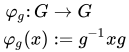
is called (right) conjugation by g (see also conjugacy class). This function is an endomorphism of G: for all


where the second equality is given by the insertion of the identity between and Furthermore, it has a left and right inverse, namely Thus, is both an monomorphism and epimorphism, and so an isomorphism of G with itself, i.e. an automorphism. An inner automorphism is any automorphism that arises from conjugation.[1]

General relationship between various group homomorphisms.

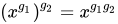
When discussing right conjugation, the expression is often denoted exponentially by This notation is used because composition of conjugations satisfies the identity: for all This shows that right conjugation gives a right action of G on itself.

A common example is as follows:[2][3]

Relationship of morphisms and elements

Describe a homomorphism for which the image, , is a normal subgroup of inner automorphisms of a group ; alternatively, describe a natural homomorphism of which the kernel of is the center of (all for which conjugating by them returns the trivial automorphism), in other words, . There is always a natural homomorphism , which associates to every an (inner) automorphism in . Put identically, .

Let as defined above. This requires demonstrating that (1) is a homomorphism, (2) is also a bijection, (3) is a homomorphism.

  1. The condition for bijectivity may be verified by simply presenting an inverse such that we can return to from . In this case it is conjugation by denoted as .
  2. and

Inner and outer automorphism groups

[edit]

The composition of two inner automorphisms is again an inner automorphism, and with this operation, the collection of all inner automorphisms of G is a group, the inner automorphism group of G denoted Inn(G).

Inn(G) is a normal subgroup of the full automorphism group Aut(G) of G. The outer automorphism group, Out(G) is the quotient group

The outer automorphism group measures, in a sense, how many automorphisms of G are not inner. Every non-inner automorphism yields a non-trivial element of Out(G), but different non-inner automorphisms may yield the same element of Out(G).

Saying that conjugation of x by a leaves x unchanged is equivalent to saying that a and x commute:

Therefore the existence and number of inner automorphisms that are not the identity mapping is a kind of measure of the failure of the commutative law in the group (or ring).

An automorphism of a group G is inner if and only if it extends to every group containing G.[4]

By associating the element aG with the inner automorphism f(x) = xa in Inn(G) as above, one obtains an isomorphism between the quotient group G / Z(G) (where Z(G) is the center of G) and the inner automorphism group:

This is a consequence of the first isomorphism theorem, because Z(G) is precisely the set of those elements of G that give the identity mapping as corresponding inner automorphism (conjugation changes nothing).

Non-inner automorphisms of finite p-groups

[edit]

A result of Wolfgang Gaschütz says that if G is a finite non-abelian p-group, then G has an automorphism of p-power order which is not inner.

It is an open problem whether every non-abelian p-group G has an automorphism of order p. The latter question has positive answer whenever G has one of the following conditions:

  1. G is nilpotent of class 2
  2. G is a regular p-group
  3. G / Z(G) is a powerful p-group
  4. The centralizer in G, CG, of the center, Z, of the Frattini subgroup, Φ, of G, CGZ ∘ Φ(G), is not equal to Φ(G)

Types of groups

[edit]

The inner automorphism group of a group G, Inn(G), is trivial (i.e., consists only of the identity element) if and only if G is abelian.

The group Inn(G) is cyclic only when it is trivial.

At the opposite end of the spectrum, the inner automorphisms may exhaust the entire automorphism group; a group whose automorphisms are all inner and whose center is trivial is called complete. This is the case for all of the symmetric groups on n elements when n is not 2 or 6. When n = 6, the symmetric group has a unique non-trivial class of non-inner automorphisms, and when n = 2, the symmetric group, despite having no non-inner automorphisms, is abelian, giving a non-trivial center, disqualifying it from being complete.

If the inner automorphism group of a perfect group G is simple, then G is called quasisimple.

Lie algebra case

[edit]

An automorphism of a Lie algebra 𝔊 is called an inner automorphism if it is of the form Adg, where Ad is the adjoint map and g is an element of a Lie group whose Lie algebra is 𝔊. The notion of inner automorphism for Lie algebras is compatible with the notion for groups in the sense that an inner automorphism of a Lie group induces a unique inner automorphism of the corresponding Lie algebra.

Extension

[edit]

If G is the group of units of a ring, A, then an inner automorphism on G can be extended to a mapping on the projective line over A by the group of units of the matrix ring, M2(A). In particular, the inner automorphisms of the classical groups can be extended in that way.

References

[edit]

Further reading

[edit]
Revisions and contributorsEdit on WikipediaRead on Wikipedia
from Grokipedia
In group theory, an inner automorphism of a group GG is an ϕgAut(G)\phi_g \in \operatorname{Aut}(G) defined by conjugation with a fixed element gGg \in G, specifically ϕg(h)=ghg1\phi_g(h) = g h g^{-1} for all hGh \in G. The set of all such inner automorphisms forms the inner automorphism group Inn(G)\operatorname{Inn}(G), which is a of the full Aut(G)\operatorname{Aut}(G). The inner automorphism group Inn(G)\operatorname{Inn}(G) is isomorphic to the quotient group G/Z(G)G / Z(G), where Z(G)Z(G) denotes of GG, consisting of all elements that commute with every element of GG. This isomorphism arises from the homomorphism ψ:GAut(G)\psi: G \to \operatorname{Aut}(G) given by ψ(g)=ϕg\psi(g) = \phi_g, whose kernel is precisely Z(G)Z(G) and whose image is Inn(G)\operatorname{Inn}(G). Consequently, Inn(G)\operatorname{Inn}(G) is trivial (i.e., consists only of the identity automorphism) if and only if GG is abelian. Inn(G)\operatorname{Inn}(G) is always a normal subgroup of Aut(G)\operatorname{Aut}(G), and the quotient group Out(G)=Aut(G)/Inn(G)\operatorname{Out}(G) = \operatorname{Aut}(G) / \operatorname{Inn}(G) is called the outer automorphism group, which captures the automorphisms of GG that cannot be realized by conjugation. Inner automorphisms play a fundamental role in classifying group structures, as they reveal symmetries inherent to the group's own elements and help distinguish abelian from non-abelian groups, while outer automorphisms highlight additional, "exotic" symmetries beyond conjugation.

Definition and Basics

Formal Definition

An automorphism of a group GG is an from GG to itself, that is, a bijective ϕ:GG\phi: G \to G satisfying ϕ(xy)=ϕ(x)ϕ(y)\phi(xy) = \phi(x)\phi(y) for all x,yGx, y \in G. An of a group GG is a group automorphism ϕg:GG\phi_g: G \to G defined by conjugation with a fixed element gGg \in G, given by ϕg(x)=gxg1\phi_g(x) = gxg^{-1} for all xGx \in G. This map is a because ϕg(xy)=g(xy)g1=(gxg1)(gyg1)=ϕg(x)ϕg(y)\phi_g(xy) = g(xy)g^{-1} = (gxg^{-1})(gyg^{-1}) = \phi_g(x)\phi_g(y) for all x,yGx, y \in G, and it is bijective with inverse ϕg1\phi_{g^{-1}}, since ϕgϕg1=idG=ϕg1ϕg\phi_g \circ \phi_{g^{-1}} = \mathrm{id}_G = \phi_{g^{-1}} \circ \phi_g. The set of all inner automorphisms of GG, denoted Inn(G)\mathrm{Inn}(G), forms a subgroup of the automorphism group Aut(G)\mathrm{Aut}(G) under composition. It contains the identity automorphism ϕe=idG\phi_e = \mathrm{id}_G, where ee is the of GG; it is closed under composition because ϕgϕh=ϕgh\phi_g \circ \phi_h = \phi_{gh} for all g,hGg, h \in G; and it is closed under inverses because the inverse of ϕg\phi_g is ϕg1\phi_{g^{-1}}.

Initial Examples

To illustrate inner automorphisms, consider the conjugation map in a group GG, defined by ϕg(h)=ghg1\phi_g(h) = g h g^{-1} for g,hGg, h \in G. The assignment gϕgg \mapsto \phi_g defines a from GG to \Aut(G)\Aut(G), the automorphism group of GG, whose image consists of all inner automorphisms and whose kernel is precisely Z(G)Z(G) of GG. A concrete example arises in the S3S_3, which consists of all permutations of three elements and has order 6. Conjugation by the transposition (1 2)(1\ 2) sends the transposition (1 3)(1\ 3) to (2 3)(2\ 3), since (1 2)(1 3)(1 2)1=(2 3)(1\ 2)(1\ 3)(1\ 2)^{-1} = (2\ 3). This relabeling of elements demonstrates a non-trivial inner automorphism, as it permutes the three transpositions in S3S_3 while preserving the group structure. In contrast, the V4=Z/2Z×Z/2ZV_4 = \mathbb{Z}/2\mathbb{Z} \times \mathbb{Z}/2\mathbb{Z}, with elements {e,a,b,c}\{e, a, b, c\} where each non-identity element has order 2 and the product of any two distinct non-identity elements is the third, is abelian. Thus, its is the entire group Z(V4)=V4Z(V_4) = V_4, making the kernel of the conjugation equal to V4V_4 and all inner automorphisms trivial. The Q8={±1,±i,±j,±k}Q_8 = \{\pm 1, \pm i, \pm j, \pm k\} with relations i2=j2=k2=1i^2 = j^2 = k^2 = -1, ij=kij = k, jk=ijk = i, and ki=jki = j provides another example where inner automorphisms are non-trivial. Here, the is Z(Q8)={±1}Z(Q_8) = \{\pm 1\}, and the inner automorphism group \Inn(Q8)\Inn(Q_8) is isomorphic to V4V_4, capturing the action of conjugation by elements outside the on the non-central elements.

Automorphism Groups

Inner Automorphism Group

The inner automorphism group [Inn](/page/Inn)(G)\operatorname{[Inn](/page/Inn)}(G) of a group GG is isomorphic to the G/Z(G)G/Z(G), where Z(G)={zGzg=gz for all gG}Z(G) = \{ z \in G \mid zg = gz \text{ for all } g \in G \} denotes the center of GG. This isomorphism follows from the conjugation homomorphism ϕ:G[Aut](/page/Automorphism)(G)\phi: G \to \operatorname{[Aut](/page/Automorphism)}(G) defined by ϕ(g)(h)=ghg1\phi(g)(h) = ghg^{-1} for all g,hGg, h \in G. The image of ϕ\phi is precisely [Inn](/page/Inn)(G)\operatorname{[Inn](/page/Inn)}(G), and the kernel is Z(G)Z(G). By the first isomorphism theorem for groups, G/ker(ϕ)im(ϕ)G / \ker(\phi) \cong \operatorname{im}(\phi), so G/Z(G)[Inn](/page/Inn)(G)G/Z(G) \cong \operatorname{[Inn](/page/Inn)}(G). Inn(G)\operatorname{Inn}(G) forms a normal subgroup of the full Aut(G)\operatorname{Aut}(G). To see this, consider any αAut(G)\alpha \in \operatorname{Aut}(G) and inner automorphism ϕgInn(G)\phi_g \in \operatorname{Inn}(G) given by conjugation by gGg \in G. Then αϕgα1=ϕα(g)\alpha \circ \phi_g \circ \alpha^{-1} = \phi_{\alpha(g)}, which is again an inner automorphism. Thus, Inn(G)\operatorname{Inn}(G) is invariant under conjugation by elements of Aut(G)\operatorname{Aut}(G). The Aut(G)/Inn(G)\operatorname{Aut}(G)/\operatorname{Inn}(G) is called the outer automorphism group and denoted Out(G)\operatorname{Out}(G). Since Inn(G)G/Z(G)\operatorname{Inn}(G) \cong G/Z(G), it inherits key properties from this quotient: for instance, Inn(G)\operatorname{Inn}(G) is abelian if and only if G/Z(G)G/Z(G) is abelian. For a GG, the order satisfies Inn(G)=G/Z(G)|\operatorname{Inn}(G)| = |G| / |Z(G)|.

Outer Automorphism Group

The outer automorphism group of a group GG, denoted Out(G)\operatorname{Out}(G), is defined as the Aut(G)/Inn(G)\operatorname{Aut}(G) / \operatorname{Inn}(G), where Aut(G)\operatorname{Aut}(G) denotes the full of GG and Inn(G)\operatorname{Inn}(G) is the normal consisting of all inner automorphisms. This construction identifies automorphisms that differ only by composition with an inner automorphism, so elements of Out(G)\operatorname{Out}(G) are cosets ϕInn(G)\phi \operatorname{Inn}(G) for ϕAut(G)\phi \in \operatorname{Aut}(G), representing equivalence classes of automorphisms up to conjugation by elements of GG. The group operation on these cosets is induced by composition of automorphisms, making Out(G)\operatorname{Out}(G) a group that captures the "outer" symmetries of GG. A concrete example illustrates this definition for the S3S_3, which has order 6 and consists of all permutations of three elements. The Aut(S3)\operatorname{Aut}(S_3) is isomorphic to S3S_3 itself, as any automorphism must permute the three transpositions (the generators of order 2) while preserving the group relations. Since S3S_3 has trivial , Inn(S3)S3/Z(S3)S3\operatorname{Inn}(S_3) \cong S_3 / Z(S_3) \cong S_3, and thus the Out(S3)\operatorname{Out}(S_3) is the . This computation shows that all automorphisms of S3S_3 arise from inner ones, reflecting the complete symmetry captured by conjugation within the group. The significance of Out(G)\operatorname{Out}(G) lies in its role as a measure of symmetries beyond those induced by the group's own elements via conjugation; a non-trivial Out(G)\operatorname{Out}(G) signals additional structural features, such as embeddings into larger groups or unexpected isomorphisms, that reveal deeper properties of GG. For instance, in the , the solvability of outer automorphism groups provides key constraints on possible group structures. Moreover, Out(G)\operatorname{Out}(G) acts naturally on the set of conjugacy classes of GG, since inner automorphisms preserve these classes and any maps conjugacy classes to conjugacy classes of the same size; this action is well-defined on the and often permutes classes in ways that inner automorphisms cannot.

Structural Relations

Connection to Center

The center Z(G)Z(G) of a group GG, consisting of all elements that commute with every element of GG, serves as the kernel of the natural conjugation homomorphism α:G\Aut(G)\alpha: G \to \Aut(G) defined by α(g)(h)=ghg1\alpha(g)(h) = g h g^{-1} for all g,hGg, h \in G. This map embeds GG into its automorphism group via inner automorphisms, with elements of Z(G)Z(G) inducing the identity automorphism. If Z(G)=GZ(G) = G, then GG is abelian, and the conjugation map is trivial, implying that the inner automorphism group \Inn(G)\Inn(G) is also trivial. Conversely, if Z(G)={e}Z(G) = \{e\}, the group is centerless, and the conjugation map yields an isomorphism G\Inn(G)G \cong \Inn(G). In general, \Inn(G)G/Z(G)\Inn(G) \cong G / Z(G). Inner automorphisms preserve the center setwise and, in fact, fix it pointwise: for any gGg \in G and zZ(G)z \in Z(G), the inner automorphism ϕg(z)=gzg1=z\phi_g(z) = g z g^{-1} = z, since zz commutes with gg. A concrete illustration occurs in extraspecial pp-groups, which are non-abelian pp-groups of order p2m+1p^{2m+1} with center Z(G)Z(G) cyclic of order pp; here, \Inn(G)G/Z(G)\Inn(G) \cong G / Z(G) has order p2mp^{2m}.

Relation to Conjugacy Classes

Inner automorphisms act on the group GG by evaluation, meaning that for ϕInn(G)\phi \in \operatorname{Inn}(G) and gGg \in G, the action is ϕg=ϕ(g)\phi \cdot g = \phi(g). The of an element xGx \in G is precisely the of xx under this action, consisting of all elements ϕ(x)\phi(x) for ϕInn(G)\phi \in \operatorname{Inn}(G). This partitions GG into , each corresponding to the where two elements are conjugate if one is the image of the other under some inner automorphism. The size of the of xx, denoted cl(x)\operatorname{cl}(x), is given by the index of the centralizer CG(x)={gGgx=xg}C_G(x) = \{ g \in G \mid gx = xg \} in GG: cl(x)=[G:CG(x)].|\operatorname{cl}(x)| = [G : C_G(x)]. This formula arises because CG(x)C_G(x) is the stabilizer of xx under the conjugation action, and by the orbit-stabilizer theorem, the orbit size equals the index of the stabilizer. A subgroup NGN \leq G is normal if and only if it is preserved setwise by every inner automorphism, meaning ϕ(N)=N\phi(N) = N for all ϕInn(G)\phi \in \operatorname{Inn}(G). Equivalently, NN is a union of conjugacy classes, ensuring invariance under conjugation by elements of GG. For finite groups, the number of conjugacy classes equals the number of irreducible complex representations, a consequence of in .

Special Cases in Groups

Finite p-Groups

In finite p-groups of order greater than 1, the center Z(G)Z(G) is non-trivial, ensuring that the inner automorphism group Inn(G)G/Z(G)\operatorname{Inn}(G) \cong G/Z(G) is a proper quotient of GG. For non-abelian finite p-groups, the derived subgroup GG' is likewise non-trivial. Moreover, inner automorphisms act trivially on the abelianization G/GG/G', since G/GG/G' is abelian. These features distinguish inner automorphisms from the broader automorphism group, often leading to non-trivial outer automorphisms that act non-trivially on Z(G)Z(G) or GG'. A fundamental structural theorem is due to Gaschütz, which asserts that every non-abelian finite admits outer automorphisms of p-power order; more broadly, for any finite GG not isomorphic to the of order p, the order of the Out(G)\operatorname{Out}(G) is divisible by p. This guarantees the existence of non-inner automorphisms whenever G>p|G| > p, highlighting cases where Out(G)\operatorname{Out}(G) is non-trivial and contributes additional p-power structure to Aut(G)\operatorname{Aut}(G). For non-abelian examples, Aut(G)|\operatorname{Aut}(G)| is divisible by p (in fact, by higher powers), as is Inn(G)|\operatorname{Inn}(G)|, with the outer component providing the extra factors. Representative examples illustrate when Out(G)Zp\operatorname{Out}(G) \cong \mathbb{Z}_p. The D4D_4 of order 8 (with p=2p=2) has Aut(D4)D4\operatorname{Aut}(D_4) \cong D_4 of order 8 and Inn(D4)Z2×Z2\operatorname{Inn}(D_4) \cong \mathbb{Z}_2 \times \mathbb{Z}_2 of order 4, yielding Out(D4)Z2\operatorname{Out}(D_4) \cong \mathbb{Z}_2. This outer automorphism corresponds to an inversion that swaps the two conjugacy classes of reflections while fixing rotations, demonstrating a minimal non-trivial outer action in a small non-abelian 2-group.

Non-Abelian Simple Groups

Non-abelian simple groups possess no nontrivial normal subgroups and are non-commutative, which forces their Z(G)Z(G) to be trivial. As a result, the conjugation action yields an GInn(G)G \cong \operatorname{Inn}(G), since the kernel of the GAut(G)G \to \operatorname{Aut}(G) given by gcgg \mapsto c_g (where cg(h)=ghg1c_g(h) = ghg^{-1}) is precisely Z(G)={e}Z(G) = \{e\}. The full Aut(G)\operatorname{Aut}(G) fits into the short 1Inn(G)Aut(G)Out(G)11 \to \operatorname{Inn}(G) \to \operatorname{Aut}(G) \to \operatorname{Out}(G) \to 1, where Out(G)\operatorname{Out}(G) denotes the outer automorphism group. For many non-abelian simple groups, this sequence splits, yielding Aut(G)Inn(G)Out(G)\operatorname{Aut}(G) \cong \operatorname{Inn}(G) \rtimes \operatorname{Out}(G). A prominent example is the A5A_5, the smallest non-abelian of order 60, whose outer is Out(A5)Z2\operatorname{Out}(A_5) \cong \mathbb{Z}_2. This nontrivial outer automorphism is exceptional, stemming from the embedding A5S5A_5 \trianglelefteq S_5 and interchanging two conjugacy classes of elements of order 5. In stark contrast, the MM, the largest of the 26 sporadic s with order approximately 8×10538 \times 10^{53}, has trivial outer , so Aut(M)=Inn(M)M\operatorname{Aut}(M) = \operatorname{Inn}(M) \cong M. This completeness property underscores the Monster's role as a "rigid" structure in the . The classification of finite simple groups reveals that outer automorphisms of sporadic groups frequently connect to symmetries of underlying geometric or combinatorial objects, such as graphs; for instance, in the fourth Fischer group Fi24\mathrm{Fi}_{24}', graph automorphisms influence the structure of centralizers within its automorphism group.

Generalizations

Lie Algebras

In the context of Lie algebras, the notion of inner automorphisms from group theory generalizes to inner derivations, which arise from the Lie bracket in a manner analogous to conjugation by group elements. For a Lie algebra L\mathcal{L} over a field kk of characteristic zero, an inner derivation is defined via the adjoint map adx:LL\mathrm{ad}_x: \mathcal{L} \to \mathcal{L} given by adx(y)=[x,y]\mathrm{ad}_x(y) = [x, y] for all x,yLx, y \in \mathcal{L}, where [,][ \cdot, \cdot ] denotes the Lie bracket. This map is a derivation because it satisfies the Leibniz rule adx([y,z])=[adx(y),z]+[y,adx(z)]\mathrm{ad}_x([y, z]) = [\mathrm{ad}_x(y), z] + [y, \mathrm{ad}_x(z)], which follows directly from the Jacobi identity. The collection Inn(L)={adxxL}\mathrm{Inn}(\mathcal{L}) = \{ \mathrm{ad}_x \mid x \in \mathcal{L} \} forms a Lie subalgebra of the full derivation algebra Der(L)\mathrm{Der}(\mathcal{L}), consisting of all kk-linear endomorphisms D:LLD: \mathcal{L} \to \mathcal{L} that preserve the bracket via D([y,z])=[D(y),z]+[y,D(z)]D([y, z]) = [D(y), z] + [y, D(z)]. The structure of Inn(L)\mathrm{Inn}(\mathcal{L}) is closely tied to the center of L\mathcal{L}, defined as Z(L)={zL[z,y]=0 yL}.Z(\mathcal{L}) = \{ z \in \mathcal{L} \mid [z, y] = 0 \ \forall \, y \in \mathcal{L} \}. The adjoint representation ad:Lgl(L)\mathrm{ad}: \mathcal{L} \to \mathrm{gl}(\mathcal{L}) has kernel precisely Z(L)Z(\mathcal{L}), and its image is Inn(L)\mathrm{Inn}(\mathcal{L}) as a Lie subalgebra of Der(L)\mathrm{Der}(\mathcal{L}). Thus, there is a Lie algebra isomorphism Inn(L)L/Z(L),\mathrm{Inn}(\mathcal{L}) \cong \mathcal{L} / Z(\mathcal{L}), reflecting how central elements act trivially via the adjoint action. This quotient captures the "effective" inner derivations modulo the center. A concrete example is the Lie algebra sl(2,R)\mathfrak{sl}(2, \mathbb{R}) of 2×22 \times 2 real matrices with trace zero, equipped with the commutator bracket. This algebra has trivial center Z(sl(2,R))={0}Z(\mathfrak{sl}(2, \mathbb{R})) = \{ 0 \}, as any element commuting with the standard basis {h=(1001),x=(0100),y=(0010)}\{ h = \begin{pmatrix} 1 & 0 \\ 0 & -1 \end{pmatrix}, x = \begin{pmatrix} 0 & 1 \\ 0 & 0 \end{pmatrix}, y = \begin{pmatrix} 0 & 0 \\ 1 & 0 \end{pmatrix} \} must be scalar, but trace zero forces it to be zero. Consequently, the adjoint map is injective, yielding Inn(sl(2,R))sl(2,R)\mathrm{Inn}(\mathfrak{sl}(2, \mathbb{R})) \cong \mathfrak{sl}(2, \mathbb{R}). For semisimple algebras, inner derivations exhaust all derivations: Der(L)=Inn(L)\mathrm{Der}(\mathcal{L}) = \mathrm{Inn}(\mathcal{L}). This follows from the nondegeneracy of the Killing form and the absence of nonzero abelian ideals, implying no outer derivations exist and the outer derivation algebra is trivial. Semisimple algebras, direct sums of simple ones, thus have rigid derivation structures determined entirely by their own elements.

Other Algebraic Structures

In , an inner automorphism of an associative unital ring RR is defined as conjugation by a unit uR×u \in R^\times, given by ϕu(r)=uru1\phi_u(r) = u r u^{-1} for all rRr \in R. The set of all such maps forms the inner automorphism group Inn(R)\operatorname{Inn}(R), which is isomorphic to the quotient R×/Z(R×)R^\times / Z(R^\times), where Z(R×)Z(R^\times) denotes of the unit group. These automorphisms fix the center Z(R)Z(R) pointwise and play a key role in understanding the structure of the full automorphism group Aut(R)\operatorname{Aut}(R). A representative example occurs in the matrix ring Mn(k)M_n(k) over a field kk. Here, the inner automorphisms are precisely the conjugations by invertible matrices, and Inn(Mn(k))\operatorname{Inn}(M_n(k)) is isomorphic to the projective PGLn(k)=GLn(k)/k×\operatorname{PGL}_n(k) = \operatorname{GL}_n(k)/k^\times. In fact, all kk-algebra automorphisms of Mn(k)M_n(k) are inner. In the context of modules, the notion of inner automorphisms extends analogously through the endomorphism ring EndR(M)\operatorname{End}_R(M) of an RR-module MM. Inner automorphisms of EndR(M)\operatorname{End}_R(M) are induced by conjugation by automorphisms of MM, reflecting the symmetries of the module structure. For categories, particularly , inner automorphisms are captured by natural arising from conjugation . Specifically, an inner automorphism of a G\mathcal{G} is induced by conjugation by an object or , yielding a natural between the identity and a conjugation , generalizing the group case categorically. For division rings, the outer automorphism group Out(R)=Aut(R)/Inn(R)\operatorname{Out}(R) = \operatorname{Aut}(R)/\operatorname{Inn}(R) can be non-trivial; for instance, in quaternion algebras over number fields with non-trivial Galois groups, field automorphisms of may extend to the , producing outer automorphisms.

References

Add your contribution
Related Hubs
User Avatar
No comments yet.