Hubbry Logo
Supraesophageal ganglionSupraesophageal ganglionMain
Open search
Supraesophageal ganglion
Community hub
Supraesophageal ganglion
logo
8 pages, 0 posts
0 subscribers
Be the first to start a discussion here.
Contribute something
Supraesophageal ganglion
from Wikipedia

The supraesophageal ganglion (also supraoesophageal ganglion, arthropod brain, or microbrain[1]) generally consists of a set of three fused pairs of ganglia, which constitute the brain in most insect species and in some other closely related arthropods, such as myriapods and crustaceans. It receives and processes information from the first, second, and third metameres. The supraesophageal ganglion lies dorsal to the esophagus and consists of three parts, each a pair of ganglia that may be more or less pronounced, reduced, or fused depending on the genus:

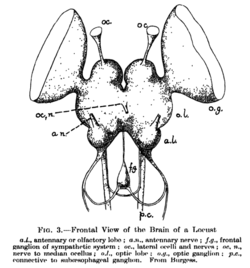
Locust brain
Supraesophageal ganglion (5), Subesophageal ganglion (31)

The subesophageal ganglion continues the nervous system and lies ventral to the esophagus. Finally, the segmental ganglia of the ventral nerve cord are found in each body segment as a fused ganglion; they provide the segments with some autonomous control.

See also

[edit]

References

[edit]

Further reading

[edit]
[edit]
Revisions and contributorsEdit on WikipediaRead on Wikipedia
from Grokipedia
The supraesophageal ganglion is the principal structure in and other arthropods, comprising a fused complex of three neuromeres—the protocerebrum, deutocerebrum, and tritocerebrum—positioned dorsal to the within the head capsule. This ganglion serves as the central integrative center for and motor coordination, housing specialized neuropils that handle inputs from visual, olfactory, and mechanosensory systems while enabling higher-order functions such as learning and spatial . In contrast to the ventral nerve cord's segmental ganglia, it represents an anterior fusion of embryonic neuromeres, reflecting the evolutionary consolidation of cephalic neural elements in arthropods. Structurally, the supraesophageal ganglion is enveloped by a neural sheath, with the passing centrally through the structure in many species. The protocerebrum, the largest and most anterior neuromere, encompasses the optic lobes (including the lamina, medulla, and lobula) for visual processing, as well as the for associative learning and the central complex for locomotion and orientation. The deutocerebrum primarily features the antennal lobes, glomerular structures dedicated to olfactory relay and integration of chemosensory signals from the antennae. The tritocerebrum, often partially encircling the , connects to the subesophageal ganglion via the circumesophageal connectives and manages inputs from the labrum and frontal ganglion, contributing to feeding and neuroendocrine regulation. These neuromeres are interconnected by commissures and tracts, facilitating bidirectional communication across the . Functionally, the supraesophageal ganglion orchestrates sensory-motor integration essential for survival behaviors in arthropods. For instance, the protocerebrum's optic lobes process retinotopic maps of visual stimuli, enabling optomotor responses and object tracking, while mushroom body Kenyon cells support odor-driven memory formation. In the deutocerebrum, projection neurons from antennal lobes convey and general cues to higher centers like the lateral horn and , critical for and . The tritocerebrum coordinates with the subesophageal ganglion to regulate mouthpart movements and hormonal release from the corpora cardiaca and allata, influencing molting and . Across diversity, from to chelicerates, variations in size and connectivity reflect adaptations to ecological niches, such as enhanced visual centers in diurnal flies versus expanded olfactory regions in nocturnal moths.

Anatomy

Location and Overall Structure

The supraesophageal ganglion constitutes the primary brain mass in arthropods, including chelicerates, , crustaceans, and myriapods, and arises from the fusion of three anterior neuromeres corresponding to the protocerebrum, deutocerebrum, and tritocerebrum. This fusion results in a centralized structure that integrates sensory and for the head region. Positioned dorsally to the —hence its nomenclature—it lies anteriorly in the head capsule or , depending on the , and is connected posteriorly to the subesophageal by a pair of circumesophageal connectives that encircle the . These connectives facilitate neural communication between the supraesophageal and subesophageal regions while accommodating the passage of the . In terms of gross morphology, the exhibits bilateral , with a peripheral rind of neuronal cell bodies surrounding a central core of where synaptic processing occurs, all encased within a protective perineurial sheath that also contributes to the blood-brain barrier. Variations in size, degree of fusion, and overall configuration exist across arthropod taxa, reflecting adaptations to diverse head morphologies and lifestyles; for instance, the ganglion is typically more compact and tightly integrated within the rigid head capsule of insects, whereas it appears relatively more elongated and less fused in certain crustaceans such as malacostracans, allowing for greater flexibility in cephalothorax movement. In myriapods, the structure shows intermediate fusion levels, with a less pronounced centralization compared to pancrustaceans. These morphological differences underscore the ganglion's evolutionary plasticity while maintaining its core tripartite organization.

Major Components

The supraesophageal , or , in arthropods is divided into three primary neuromeres: the protocerebrum, deutocerebrum, and tritocerebrum. These divisions form a syncerebrum that encircles the dorsal aspect of the , with the protocerebrum positioned anteriorly, the deutocerebrum centrally, and the tritocerebrum posteriorly. Interconnections between these components, such as commissures and tracts, facilitate integrated neural processing across the ganglion. The protocerebrum constitutes the anterior-most division, encompassing the optic lobes, central complex, and . The optic lobes are nested structures including the lamina, medulla, and lobula, which together can comprise a significant portion of the protocerebrum volume in visual species. The central complex is an unpaired midline composed of the protocerebral bridge—a V-shaped structure—and the central body, a spindle-shaped region extending across the midline with layered organization. are paired, lobed neuropils featuring calyces (cup-like dendritic regions), a pedunculus (stalk-like axonal tract often subdivided into laminae), and lobes (vertical and medial extensions, sometimes further divided into α, β, and γ regions). The deutocerebrum lies posterior to the protocerebrum and primarily includes the antennal lobes, which are glomerular structures for sensory integration. These lobes consist of discrete, spherical glomeruli—typically numbering in the dozens to hundreds depending on the species—arranged radially within the . Additional deutocerebral regions, such as the lateral and median antennal neuropils, process mechanosensory inputs and connect via commissural fibers to the protocerebrum. The tritocerebrum forms the posterior division, positioned ventrally around the esophageal canal and linked to the subesophageal ganglion via commissures. It features striate and columnar neuropils that receive inputs primarily from the labrum in or from the second antennae/antennules in crustaceans and equivalent structures in other arthropods, with at least two commissures traversing the . In some arthropods, the tritocerebrum partially fuses with the subesophageal ganglion, contributing to the overall cephalic neuromere organization. Key interconnections among these divisions include the central complex's protocerebral bridge, which links bilateral protocerebral regions, and peduncles of the that extend axons between calyces and lobes while receiving multimodal inputs from adjacent neuropils. The olfactory globular tract and deutocerebral commissures further bridge the deutocerebrum to the protocerebrum, forming chiasmata for cross-midline communication. At the cellular level, the supraesophageal ganglion comprises dense clusters of neurons and supporting glia. Neuron somata are organized into clusters, such as those in the mushroom bodies where Kenyon cells—intrinsic neurons with parallel axons numbering hundreds of thousands to millions—form the core structure. Glial cells envelop neuropils and neuronal processes, providing structural support, while additional neuron types like projection populate glomerular regions in the antennal lobes and tritocerebral columns. Immunoreactivity patterns, such as for synapsin in synaptic zones, highlight the layered cellular architecture throughout these components. These components vary across taxa; for example, mushroom bodies are prominent in but analogous hemiellipsoid bodies occur in crustaceans, while chelicerates lack equivalent olfactory glomeruli structures.

Function

Sensory Processing

The supraesophageal ganglion integrates sensory inputs from various modalities through specialized neuropils in its protocerebral, deutocerebral, and tritocerebral divisions. Visual information from the compound eyes is primarily processed in the optic lobes of the protocerebrum, which consist of three main layered neuropils: the lamina, medulla, and lobula (including the lobula plate in flies). Photoreceptor axons from the project topographically to the lamina, where initial motion and contrast detection occur via cartridges of neurons; subsequent in the medulla involves feature extraction such as edge orientation and color, while the lobula handles higher-order tasks like and wide-field motion analysis. Olfactory signals from the antennae are relayed to the antennal lobes in the deutocerebrum, where sensory neurons converge onto approximately 50-150 spherical depending on the species, enabling parallel processing of odorants and pheromones. Each receives input from neurons tuned to specific molecular features, with local facilitating and gain control to sharpen odor representations; projection neurons then relay this glomerular output via antennal lobe tracts to higher brain centers like the lateral horn and . Mechanosensory and gustatory inputs are handled through tritocerebral-linked structures, such as the antennules in crustaceans or mouthparts in , where sensory afferents project to dedicated neuropils for tactile and taste discrimination. In , gustatory receptor neurons from palps and labella target tritocerebral regions, integrating chemical cues like sugars or with mechanosensory feedback from proprioceptors to assess . Multimodal integration occurs in central protocerebral regions, notably the , which fuse olfactory, visual, and mechanosensory inputs to support learning and context-dependent . Kenyon cells in the mushroom body calyces receive sparse, combinatorial codes from projection neurons across modalities, enabling associative memory formation, such as linking odors to visual landmarks during foraging. Neural circuits linking these sensory lobes to higher centers rely on projection neurons, as exemplified in Drosophila studies where uniglomerular olfactory projection neurons carry odor-specific signals from the antennal lobe to the lateral horn and , while visual projection neurons from the lobula convey feature-tuned information to the central complex and protocerebrum. These pathways exhibit precise wiring, with inhibitory motifs like parallel inhibition refining sensory representations before integration.

Motor and Behavioral Control

The supraesophageal ganglion, particularly its protocerebral region, serves as a key for initiating and coordinating locomotion in arthropods, integrating sensory to generate motor outputs that control posture and walking patterns. In insects such as , the central complex within the protocerebrum acts as a higher-order , directing descending signals to thoracic ganglia to modulate leg motor neurons and facilitate behaviors like straight walking or turning. This structure enables precise control over and orientation, with specific neurons in the central complex projecting to ventral cord circuits to adjust stride length and direction based on environmental cues. Mushroom bodies in the supraesophageal ganglion play a crucial role in behavioral modulation by linking sensory inputs to memory-associated actions, such as and navigation in . These structures process olfactory and visual to form associative memories, influencing circuits that drive goal-oriented movements like approaching sources. In honeybees, for instance, mushroom body output neurons connect to premotor areas, enabling learned behaviors that alter motor responses during resource-seeking activities. Motor commands from the supraesophageal ganglion are transmitted via descending neurons that project to the subesophageal ganglion and ventral nerve cord, controlling head, appendage, and body movements across arthropods. These pathways allow for coordinated actions, such as steering during locomotion in fruit flies, where bilateral descending neurons asymmetrically activate thoracic motor pools. In crustaceans like , similar descending projections regulate appendage positioning and escape responses. Specific examples highlight the ganglion's influence on rhythmic behaviors; in , protocerebral clock neurons within the supraesophageal ganglion regulate circadian locomotor activity, synchronizing daily activity peaks through signaling to motor circuits. In crustaceans, circuits in the supraesophageal ganglion promote fighting postures and attacks, with serotonergic neurons enhancing motivational states that escalate confrontational behaviors. Neuromodulation within the supraesophageal ganglion fine-tunes motor patterns, particularly through hormones like serotonin, which alters neuronal excitability to adapt behaviors to context. In and crustaceans, serotonin release in protocerebral regions increases the gain of motor outputs, facilitating transitions between rest and activity states. This modulation ensures flexible responses, such as heightened or sustained locomotion, by reshaping synaptic strengths in descending pathways.

Development

Embryonic Formation

The embryonic formation of the supraesophageal ganglion, or , in arthropods such as begins during early embryogenesis through in the procephalic . Neuroblasts from this region starting around stages 8–11, when the blastoderm anlage establishes the initial patterning via head gap genes like orthodenticle, empty spiracles, and buttonhead, along with the proneural gene lethal of scute. These neuroblasts, numbering approximately 75–80 in total across the procephalic segments, arise in a spatiotemporal pattern, with 9–10 per hemineuromere initially increasing to 32 by late stage 11 through five waves of spanning stages 8–11. This process generates about 2,000–3,000 neurons and over roughly one day of development. The supraesophageal ganglion emerges from the fusion of three anterior neuromeres: the protocerebrum, deutocerebrum, and tritocerebrum. The protocerebrum develops from around 160 neuroblasts, the deutocerebrum from 42 (including 18 homologous to ventral nerve cord segments), and the tritocerebrum from 26 (with 20 ventral nerve cord homologs). These neuromeres delaminate from the procephalic between stages 8–11 and condense dorsally around the embryonic , forming a tripartite structure through minimal migration that preserves their relative positions. Initial axonal scaffolds establish longitudinal connectives to the subesophageal by late embryogenesis, with approximately 69% of axons crossing the midline via anterior and posterior commissures to integrate the with ventral regions. Genetic regulation patterns these events along the anterior-posterior and dorsoventral axes, involving segment polarity genes such as engrailed (en) and hedgehog (hh), which define neuroblast identity in posterior clusters, and pair-rule genes like even-skipped that influence intrasegmental formation. These genes, expressed from stages 8–11, ensure proper segmentation and neuromere boundaries through a conserved cascade that specifies neuroectodermal domains. Neuroblasts and their progeny undergo limited dorsal migration to form brain hemispheres, while programmed cell death refines the structure, eliminating 25–30% of neurons via genes like reaper, grim, and sickle, influenced by Hox factors such as abdominal-A. The core formation is largely complete by mid-embryogenesis (stage 12), with ongoing divisions until stage 15 and neuropile consolidation by stage 17. In other arthropods, such as crustaceans, similar neuroblast delamination occurs but with variations in neuromere fusion timing and Hox gene expression patterns.

Post-Embryonic Maturation

In holometabolous insects such as , the supraesophageal ganglion undergoes significant neuronal proliferation during larval stages, particularly in the , where dedicated neuroblasts continue to generate Kenyon cells between molts. This postembryonic expands the intrinsic population, enabling the integration of new sensory information as the grows and encounters diverse environments. Studies in have shown that these neuroblasts, originating from embryonic precursors, exhibit asymmetric divisions that produce clusters of neurons, with proliferation rates peaking in early larval instars to support the developing olfactory and visual processing centers. During metamorphosis in endopterygotes, the supraesophageal ganglion experiences extensive remodeling, driven by pulses of the ecdysone, which orchestrates the pruning of larval-specific connections and the elaboration of adult circuitry in structures like the optic and antennal lobes. In , ecdysone signaling via the EcR-B isoform initiates and retraction in projection neurons of the antennal lobe during early pupation, followed by regrowth to form glomeruli that match the expanded adult inputs. Similarly, the optic lobes undergo profound reconfiguration, including a 90-degree rotation of neuropils and the integration of new photoreceptor axons, transforming the compact larval into the multilayered adult medulla, lobula, and lobula plate. This hormone-mediated process ensures the ganglion's adaptation to the demands of adult locomotion and sensory acuity. In the adult stage, components of the supraesophageal ganglion exhibit sexual dimorphism, particularly in the pars intercerebralis, where neuron populations differ between sexes to support reproductive behaviors. In Drosophila, specific pars intercerebralis neurons show sexually dimorphic expression patterns influenced by transformer gene activity, leading to male-biased circuitry that promotes courtship initiation and female-specific responses to pheromones. This differentiation arises post-metamorphosis through hormonal modulation, enhancing the ganglion's role in sex-specific neuroendocrine control without altering overall volume significantly. Experience-dependent plasticity further refines the supraesophageal ganglion in adults, with odor learning inducing structural changes such as increased volume in the antennal lobe's olfactory glomeruli. In honeybees, early olfactory exposure during critical periods leads to glomerulus-specific expansion, correlating with enhanced synaptic density and improved odor discrimination, as observed through volumetric imaging. In , similar activity-driven adjustments occur, where repeated odor stimulation modulates projection neuron arborization, supporting associative learning without requiring de novo neurogenesis. Aging in arthropods is associated with degenerative changes in the supraesophageal ganglion, including reduced density due to synaptic loss and glial alterations. In , older flies display vacuolization and decreased presynaptic densities in brain , contributing to impaired and locomotion, though numbers remain relatively stable. Comparative studies in reveal a progressive shrinkage of optic lobe with age, linked to depleted synaptic vesicles and , underscoring the ganglion's vulnerability to cumulative environmental insults.

Evolutionary and Comparative Aspects

Origins in Arthropods

The supraesophageal ganglion in arthropods traces its phylogenetic origins to the segmented ancestors of the panarthropods, a clade encompassing arthropods, onychophorans, and tardigrades, which shared a common bilaterian heritage with worm-like body plans and ventral nerve cords. This structure evolved through the fusion and specialization of anterior neuromeres, forming a tripartite brain comprising the protocerebrum, deutocerebrum, and tritocerebrum, a configuration conserved across extant arthropods and evident in early fossils. Cambrian representatives, such as the euarthropod Fuxianhuia protensa from the Chengjiang biota (~520 million years ago), preserve a tripartite pre-stomodeal brain with nested optic neuropils, mirroring the organization in modern pancrustaceans like insects and malacostracans, indicating that this fundamental architecture predates the diversification of major arthropod lineages. Fossil evidence further illuminates the early dominance of the protocerebrum within the supraesophageal ganglion, particularly in trilobites, which represent one of the earliest radiating euarthropod groups during the . These preserved neural traces demonstrate that the supraesophageal ganglion's modular design, with a dominant protocerebrum flanked by smaller deutocerebral and tritocerebral components, was established by the early (~520–518 million years ago). Genetic mechanisms underlying neuromere identity in the supraesophageal ganglion exhibit deep homology across arthropods, mediated by conserved expression patterns that pattern the anterior-posterior axis of the . such as labial, proboscipedia, and Deformed demarcate boundaries between protocerebral, deutocerebral, and tritocerebral domains, ensuring segment-specific neuronal differentiation and connectivity, as seen in and other where misexpression leads to homeotic transformations of regions. This regulatory framework is shared with crustaceans and chelicerates, where Hox paralogs like Ubx and Antp influence the identity and wiring of anterior ganglia, linking genetic control to the evolutionary stabilization of the tripartite . Adaptations of the supraesophageal ganglion reflect clade-specific evolutionary pressures, particularly in sensory modalities tied to ecological niches. In flying insects, such as Diptera and , the protocerebral visual centers—including the optic lobes and medulla—have undergone significant expansion to process high-speed motion and , supporting aerial and behaviors. Conversely, in crustaceans like decapods, the deutocerebrum emphasizes antennal through enlarged olfactory glomeruli, adapting the ganglion for chemosensory detection in aquatic environments where visual cues are limited. Recent studies (as of 2025) on head patterning reveal conserved genetic mechanisms in chelicerate pre-cheliceral regions, enhancing understanding of neurosecretory evolution in arthropods. These modifications highlight how the conserved tripartite framework permitted modular elaboration without disrupting core neural architecture. The -to-Ordovician radiation (~635–443 million years ago) marked a pivotal phase in supraesophageal ganglion , coinciding with the emergence of complex sensory specializations that fueled diversification. Molecular clocks place the panarthropod- divergence in the , with fossil traces of neural structures appearing by the early , linking to innovations like compound eyes and antenniform appendages that enhanced environmental sensing during this interval of ecological expansion. This period's selective pressures, including rising oxygen levels and predation dynamics, drove the integration of multimodal sensory inputs into the supraesophageal ganglion, establishing its role as a central hub for adaptive radiations across clades.

Comparisons with Other Invertebrates

The supraesophageal ganglion in , a fused dorsal brain structure encircling the via its protocerebral, deutocerebral, and tritocerebral divisions, contrasts with the molluscan , which forms a ring of distinct ganglia that fully encircles the . In cephalopods such as octopuses, this ring is highly centralized with prominent supraesophageal lobes for advanced sensory integration, while in gastropods, the system is more distributed with separate pedal, pleural, and visceral ganglia connected by commissures. This molluscan configuration emphasizes a tetraneurial with paired longitudinal neurite bundles, differing from the arthropod syncerebrum's tripartite fusion and concentration of associative centers like . In annelids, the supraesophageal ganglion consists of paired dorsal cerebral ganglia in the prostomium, connected ventrally by circumesophageal connectives to a subesophageal ganglion and a segmented ventral nerve cord, without the complete esophageal enclosure characteristic of arthropods. This rope-ladder arrangement features less fusion than the arthropod brain, with neuropil compartments and occasional midline structures, reflecting a primitively metameric design. Annelid brains often include rudimentary mushroom body-like neuropils in polychaetes, but lack the extensive tritocerebral integration seen in arthropods. Nematode nervous systems present a simpler alternative, featuring a circumpharyngeal nerve ring of uniform thickness surrounding the anterior , without the distinct protocerebral complexity or fused divisions of the supraesophageal ganglion. This ring connects to longitudinal cords along the body, supporting basic sensory-motor functions with serially arranged neurons, but no centralized equivalent to structures. Functionally, the vertical lobe exhibits analogies to in supporting associative learning and memory, such as spatial navigation and , through dense networks receiving multimodal inputs. However, these structures diverge architecturally: the vertical lobe comprises layered amacrine and projection neurons in a striated pattern, contrasting with the globuli cell-based, calyx-input design of . This convergence highlights independent evolutionary paths to in lophotrochozoan and ecdysozoan lineages. Evolutionarily, the supraesophageal ganglion represents a derived condition from annelid-like ancestors, involving greater fusion of anterior neuromeres into a compact dorsal while retaining a ventral cord, though segmentation may have arisen convergently between the groups. Shared features, such as the dorsal position and circumesophageal connectives, suggest a ground pattern, but innovations include enhanced and specialized lobes absent in basal annelids.

References

Add your contribution
Related Hubs
Contribute something
User Avatar
No comments yet.