Hubbry Logo
LinebackerLinebackerMain
Open search
Linebacker
Community hub
Linebacker
logo
8 pages, 0 posts
0 subscribers
Be the first to start a discussion here.
Linebacker
Linebacker
from Wikipedia

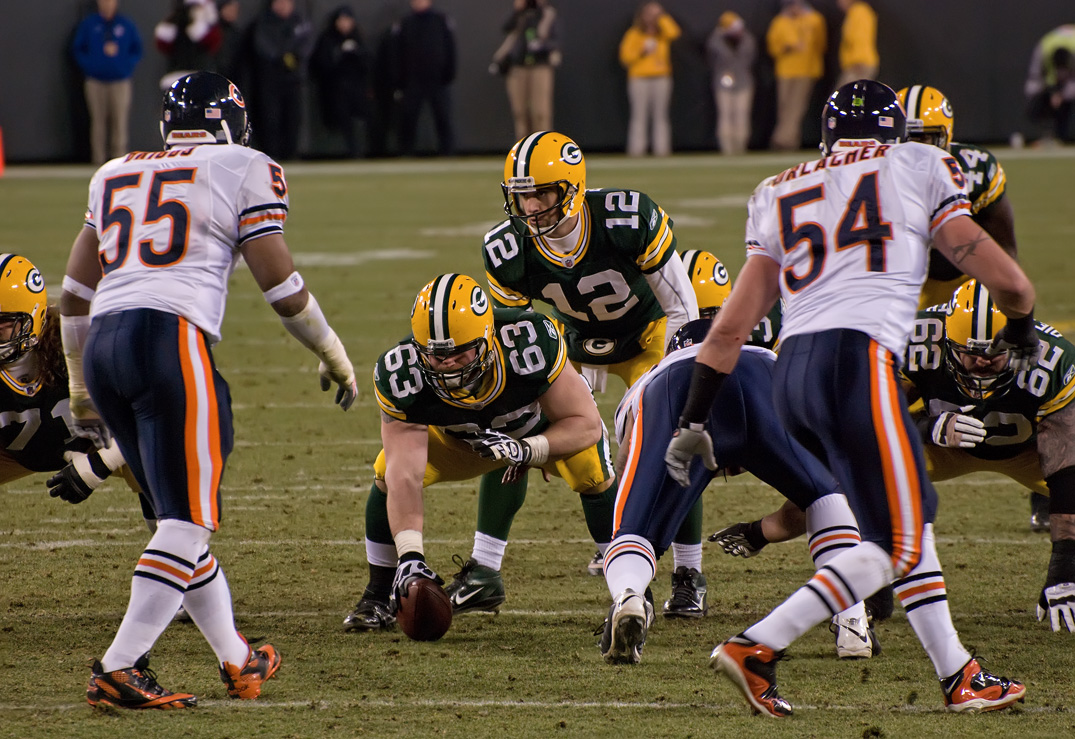
In white jerseys, Lance Briggs (#55) and Brian Urlacher (#54) of the Chicago Bears, are positioned as linebackers on Lambeau Field in 2011

A Linebacker (LB) is a playing position in gridiron football. Linebackers are members of the defensive team, and typically line up three to five yards behind the line of scrimmage and so back up the defensive linemen.[1] They play closer to the line of scrimmage than the defensive backs (secondary).

As such, linebackers play a hybrid role and are often the most versatile players on the defensive side of the ball; they can be asked to play roles similar to either a defensive lineman (such as stopping the runner on a running play) or a defensive back (such as dropping back into pass coverage). How linebackers play their positions depends on the defensive alignment, the philosophy of the coaching staff, and the particular play the offense may call.

Linebackers are divided into middle linebackers, sometimes called inside linebackers, and outside linebackers. The middle linebacker is frequently the "quarterback of the defense". His central role on the field means he is in the best position to call defensive plays and direct shifts and changes based on what the offense is doing. Outside linebackers are often in a position to blitz, a defensive maneuver where the player rushes into the offensive backfield to disrupt a running play or sack the quarterback on passing plays.

Historically, some of the most impactful defensive players, such as Pro Football Hall of Fame members Chuck Bednarik, Dick Butkus, Jack Lambert, Ray Lewis, Ray Nitschke, Mike Singletary, Brian Urlacher, and Lawrence Taylor, were linebackers.

Formations

[edit]

The number of linebackers is dependent upon the formation called for in the play; formations can call for as few as none, or as many as seven. Most defensive schemes call for three or four, which are generally named for the number of linemen, followed by the number of linebackers (with the 46 defense being an exception). For example, the 4–3 defense has four defensive linemen and three linebackers; conversely, the 3–4 defense has three linemen and four linebackers.

4–3 defense

[edit]

In the 4–3 defense there are four down linemen and three linebackers.[2] On pass plays, the linebackers' responsibilities vary based upon whether a man or zone coverage is called. In zone coverage, the linebackers will generally drop into hook zones[clarification needed] across the middle of the field. However, some zones will send the outside linebackers into the flats (area directly to the left and right of the hash marks, extending 4–5 yards downfield). In a man-to-man call, the "Sam" will often cover the tight end with help from a safety over the top, while at other times, the "Sam" and "Will" will be responsible for the first man out of the backfield on their side of the center, with the "Mike" covering if a second man exits on that side of the field.

In the "Tampa 2" zone defense, the middle linebacker is required to drop quickly into a deep middle zone pass coverage thus requiring a quick player at this position.

3–4 defense

[edit]
A base 3–4 defense

In the 3–4 defense three linemen play the line of scrimmage and four linebackers back them up, typically two outside linebackers and two inside linebackers.[3]

The idea behind the 3–4 defense is to disguise where the fourth rusher will come from. Instead of the standard four down-linemen in the 4–3, only three players are clearly attacking nearly every play. The focus of the 3–4 defensive line is to occupy offensive linemen thus freeing the linebackers to tackle the running back or to rush the passer or otherwise drop into pass coverage.

The outside linebackers in a 3–4 defense line in front of the tackles like true defensive ends. The outside linebackers in a 3–4 defense must be very skilled at rushing the quarterback, and would be playing defensive end in a 4–3 defense. Among inside linebackers, one is generally a run-stuffer who is better able to handle offensive linemen and stop running backs, while the other is often a smaller, faster player who excels in pass coverage. However, the smaller or cover LB should also be able to scrape and plug running lanes decently.

The design concept of the 3–4 defense is to confuse the offensive line in their blocking assignments, particularly in pass blocking, and to create a more complex read for the quarterback. Many 3–4 defenses have the ability to quickly morph into a 4–3 on the field.

46 defense

[edit]

In the 46 defense, there are four linemen, three linebackers and a safety who is moved up behind the line of scrimmage. Thus, it appears as if there are four linebackers, but it is really three linebackers with one safety playing up with the other linebackers.

Three of the defensive linemen are over both of the offensive guards and the center, thereby making it difficult to double-team any one of the three interior defensive linemen. This can also take away the ability of the offense to pull the guards on a running play, because this would leave one of the defenders unblocked, or, at best, give another lineman a very difficult block to make on one of the defenders. The safety, like the linebacker, can blitz, play man-on-man, play zone, or drop back into deep coverage like a normal safety would do. The 46 is used in heavy run situations to stop the run, when a team wants to apply much pressure, or merely to confuse the quarterback and offensive line.

4–4 defense

[edit]

This defense is effective at run-stopping but is weaker than a 4–3 defense at pass coverage because it uses only three defensive backs. This defensive scheme is often played with two inside line backers and two outside line backers. The names of the two inside line backers are often called Sam and Mike and these two are lined up about four yards from the line of scrimmage and are lined up with the offensive guard. The inside line backers are often more of a run player so they will defend the run before they will the pass. These line backers will be reading the offensive guard so they know what to do, so if the guard sets up to pass block the line backers know to get into their zone in order to cover the pass. If the guard come out for a run play they know that they need to fill the gap that they are supposed to so that they can make a play if it comes to them. Also, these inside line backers are often called on a blitz which is when no matter what the offense does, as soon as that ball is snapped they are shooting their gap and trying to get into the back field to make a play as fast as possible. Outside line backers sometimes are considered to be pass players before they are run players. But that depends on where they are lined up, if they are outside of the box of the defense then they will be pass first players, but if they play inside the box lined up behind the defensive end then they are typically a run player. One of the outside linebackers is usually called into either blitz or pass coverage to make up for the missing defensive back. In the NFL and college football, this alignment is used mainly in short yardage situations or near the goal line. It is commonly used in high school football.

Types

[edit]

Middle linebacker

[edit]
A base 4–3 defense with the middle linebacker in blue

The middle linebacker (MLB), sometimes called the "Mike" or "Mac",[4] is often referred to as the "quarterback of the defense".[5] Often it is the middle linebacker who receives the defensive play calls from the sideline and relays that play to the rest of the team, and in the NFL he is usually the defensive player with the electronic sideline communicator. Middle linebackers commonly lead the team in tackles.

A jack-of-all-trades, the middle linebacker can be asked to blitz (though they often blitz less than the outside linebacker), cover, spy the quarterback, or even have a deep middle-of-the-field responsibility in the Tampa 2 defense.

Outside linebacker

[edit]

The outside linebacker (OLB) is usually responsible for outside containment. This includes the strongside and weakside designations below. They are also responsible for blitzing the quarterback. They also have to perform pass coverage in the flats – sometimes called a drop. Outside linebackers pass coverages covers quick slants outside, curls, and flat routes.

Strongside linebacker

[edit]

The strongside linebacker (SLB) is often nicknamed the "Sam" for purposes of calling a blitz. Since the strong side of the offensive team is the side on which the tight end lines up, or whichever side contains the most personnel, the strongside linebacker usually lines up across from the tight end. Often the strongside linebacker will be called upon to tackle the running back on a play because the back will be following the tight end's block. He is most often the strongest linebacker; at the least he possesses the ability to withstand, shed, and fight off blocks from a tight end or fullback blocking the backside of a pass play. The linebacker should also have strong safety abilities in pass situation to cover the tight end in man on man situations. He should also have considerable quickness to read and get into coverage in zone situations.

Weakside linebacker

[edit]

The weakside linebacker (WLB), or the "Will" in 4–3 defense must be the fastest of the three, because he is often the one called into pass coverage. He is also usually chasing the play from the backside, so the ability to maneuver through traffic is a necessity for the Will. The Will usually aligns off the line of scrimmage at the same depth as Mike. Because of his position on the weakside, the Will does not often have to face large interior linemen one on one unless one is pulling. In coverage, the Will often covers the back that attacks his side of the field first in man coverage, while covering the weak flat in Texas Loop or hooks/curl areas in zone coverage.

Inside linebacker

[edit]

The terms middle and inside linebacker (ILB) are often used interchangeably;[6] they are also used to distinguish between a single middle linebacker playing in a 4–3 defense, and two inside linebackers playing in a 3–4 defense.[7] In a 3–4 defense, the larger, more run-stopping-oriented linebacker is usually still called "Mike", while the smaller, more pass protection/route coverage-oriented player is called "Will".[8] "Mikes" usually line up towards the strong side or on the side the offense is more likely to run on (based on personnel matchups) while "Wills" may line up on the other side or even a little further back between the defensive line and the secondary.[8]

Buck

[edit]

In a 3–4 defense, the weakside linebacker sometimes plays a hybrid role as a pass rushing, defensive end who stands up. He is sometimes called the backside linebacker, or "Buck", as well as other names like Joker, Jack or Bandit.[4] A notable player in this role was Kevin Greene.

History

[edit]
The University of Michigan is credited with creating the linebacker position, which was first played by Germany Schulz

Before the advent of the two-platoon system with separate units for offense and defense, the player who was the team's center on offense was often, though not always, the team's linebacker on defense.[9] Hence, in contemporary football, one usually sees four defensive linemen to the offense's five or more. Most sources claim coach Fielding H. Yost and center Germany Schulz of the Michigan Wolverines invented the position.[10][11][12][13][14] Schulz was Yost's first linebacker in 1904 when he stood up from his usual position on the line. Yost was horrified at first, but came to see the wisdom in Schulz's innovation.[15] William Dunn of Penn State was another Western Conference linebacker soon after Schulz.

However, there are various historical claims tied to the linebacker position, including some before 1904. For example, Percy Given of Georgetown is another center with a claim to the title "first linebacker," supposedly standing up behind the line well before Schulz in a game against Navy in 1902.[16] The first linebacker in the South was Frank Juhan, who played at Sewanee during 1908–1910.[17]

Chuck Bednarik of the Philadelphia Eagles

In the East, Ernest Cozens of Penn was "one of the first of the roving centers,"[18] another archaic term for the position, supposedly coined by Hank Ketcham of Yale.[19] Walter E. Bachman of Lafayette was said to be "the developer of the 'roving center' concept".[20] Edgar Garbisch of Army was credited with developing the "roving center method" of playing defensive football in 1921.[21]

In professional football, Cal Hubbard is credited with pioneering the linebacker position. He starred as a tackle and end, playing off the line in a style similar to that of a modern linebacker.[22] The New York Giants' John Alexander is considered the first person to have played outside linebacker in the NFL.[citation needed]

The Chuck Bednarik Award is awarded annually by the Maxwell Football Club to the best defensive player in college football.[23] Chuck Bednarik was selected with the first overall pick of the 1949 NFL draft by the Philadelphia Eagles. He is considered one of the hardest hitting and best linebackers in NFL history. On November 20, 1960, Bednarik knocked New York Giants star halfback Frank Gifford unconscious with a tackle that was called "professional football's most notorious concussion". Bednarik's career-altering tackle of the Giants' star is remembered in football lore as "The Hit".[24]

Ray Nitschke

Detroit Lions linebacker Joe Schmidt was selected NFL's most valuable defensive player in 1960 and 1963. Ray Nitschke anchored the defense of Vince Lombardi's Green Bay Packers. He played without his four front teeth. Kansas City Chiefs linebacker Bobby Bell was one of the first black outside linebackers in professional football.[25][26]

Modern Super Bowl era

[edit]

On January 15, 1967, the Chiefs lost Super Bowl I to Vince Lombardi's Green Bay Packers by a 35–10 score, forcing head coach Hank Stram to look for defensive players in the upcoming draft. Stram picked Willie Lanier.

Chicago Bears linebacker Dick Butkus is viewed as the "gold standard by which other middle linebackers are measured".[27] In 2009, the NFL Network named Butkus the most feared tackler of all time.

Ray Lewis

Jack Lambert and Jack Ham played behind the Steel Curtain of the 1970s, and Lambert was recognized by the Pro Football Hall of Fame in 1990 as "the greatest linebacker of his era." Colts and Raiders linebacker Ted Hendricks won 4 Super Bowls and in 2019 the NFL Football Journal named him the best punt and kick blocker of all time.

Bears linebacker Mike Singletary was known as "the Heart of the Defense" for their Monsters of the Midway defense in the mid-1980s. New York Giants linebacker Lawrence Taylor is almost universally regarded as the greatest defensive player of all time.[28]

Baltimore Ravens linebacker Ray Lewis is considered one of the greatest linebackers of all time.[29] Lewis has the most Pro Bowl selections by a linebacker with 13. With 12 is former Chargers linebacker Junior Seau, and with 11 is former Tampa Bay Buccaneers linebacker Derrick Brooks.

Bears linebacker Brian Urlacher led his team in sacks in 2000, and led his team in interceptions in 2007.[30] In 2013, Panthers linebacker Luke Kuechly became the youngest recipient of the AP NFL Defensive Player of the Year Award in its history.

References

[edit]
Revisions and contributorsEdit on WikipediaRead on Wikipedia
from Grokipedia
A linebacker (LB or LBK) is a defensive position in , where players line up 3 to 5 yards behind the defensive linemen on the . These versatile athletes primarily support the defensive line by stopping running plays, dropping into pass coverage to defend receivers or tight ends, and occasionally blitzing the to disrupt passing plays. Linebackers are crucial to the defense's flexibility, often serving as the tactical leaders who read offensive formations and direct alignments. Linebackers are categorized by their alignment and responsibilities relative to the offensive formation. The middle linebacker (often called "Mike") positions in the center, relaying play calls from the sideline and directing the defensive unit's positioning before each snap. The strong-side linebacker ("Sam") aligns on the side of the offense with the , focusing on covering that tight end, blocking assignments, or pursuing runs to that flank. The weak-side linebacker ("Will") operates on the opposite side, emphasizing speed to chase plays across the field, contain edge runs, or provide additional pass support. In common defensive schemes like the 4-3 alignment (four defensive linemen and three linebackers), these players form the core of run defense; however, in pass-heavy situations, a linebacker may be substituted for a fifth in "" packages. The position originated in the early 20th century, credited to coach and center Germany Schulz in 1904, when Schulz innovated by dropping back from the line after snapping the ball to roam and intercept plays, effectively creating the roving linebacker role. Initially focused on run-stopping in single-platoon eras where players handled both offense and defense, the role evolved with the introduction of two-platoon football in 1946, allowing specialization. By the mid-20th century, figures like ' Bill George pioneered the modern middle linebacker in the 1950s, emphasizing coverage and leadership. In recent decades, the rise of spread offenses has demanded faster, more athletic linebackers capable of covering in space, leading teams to employ hybrid players transitioning from safety roles for enhanced versatility against pass-oriented attacks.

Overview

Definition and Position

In , a linebacker is a defensive player positioned behind the defensive line and ahead of the secondary, primarily responsible for stopping running plays by tackling ball carriers and contributing to pass defense by covering receivers or rushing the . Typically, linebackers align 3 to 5 yards off the , situated between the linemen—who engage blockers directly at the line—and the defensive backs, allowing them to read offensive formations and react to developing plays. The term "linebacker" originated in the early , reflecting the player's role in backing up the defensive line in emerging formations. It is credited to coach and his center Germany Schulz, who pioneered the position in 1904 by having Schulz stand upright after snapping the ball to roam freely and disrupt plays, marking a shift from traditional stationary centers. Linebackers differ from defensive linemen, who line up directly on the scrimmage line to generate pressure and occupy blockers, as linebackers' deeper positioning enables greater mobility for play diagnosis. Compared to safeties in the secondary, who operate 10 to 15 yards deeper and emphasize preventing long pass completions, linebackers maintain a stronger focus on run support while still providing intermediate pass coverage.

Role and Responsibilities

Linebackers serve as the versatile backbone of a defensive unit in , balancing responsibilities in run defense, pass coverage, and pressure on the . Their primary duties in stopping the run involve filling gaps in the defensive line, tackling ball carriers to prevent yardage gains, and shedding blocks from offensive linemen to maintain positioning. This run-stopping role requires them to read offensive formations quickly and react to plays developing behind the , often serving as the second wave of defenders after the linemen engage blockers. In pass defense, linebackers frequently drop into coverage zones to intercept or deflect passes, while also reading the 's movements to anticipate routes by receivers, tight ends, or running backs. They must cover short to intermediate areas of the field, adjusting to man or zone schemes as dictated by the defensive call, which demands and to avoid being beaten in space. Additionally, linebackers contribute to disrupting passing plays through blitzing, where they rush the from or interior to generate sacks or hurried throws, adding unpredictability to the defense. Essential skills for linebackers include high football IQ for play recognition, precise tackling technique to wrap up and drive ball carriers to the ground, and optimal pursuit angles to close distances efficiently during chases across the field. These abilities enable them to diagnose pre-snap alignments and post-snap developments, often positioning them as the defensive signal-caller who relays adjustments to teammates. Over time, the linebacker role has evolved from a primary run-stuffer focused on physicality at the point of attack to a more versatile athlete capable of matching modern passing offenses, driven by the rise of spread schemes and increased aerial attacks that demand coverage skills and speed. While general responsibilities apply across the position, roles vary by type—for instance, the middle linebacker often emphasizes run defense more than others.

Physical Attributes

Size and Build

Linebackers in the () typically range from 6 feet to 6 feet 4 inches in height and 230 to 260 pounds in weight, providing a balance of size and mobility essential for their versatile roles. As of 2025, the average linebacker height is approximately 6 feet 2 inches and weight around 240 pounds. At the level, aspiring players often measure slightly smaller, around 6 feet 2 inches and 220 pounds, reflecting developmental stages before professional bulking. The ideal build emphasizes a muscular upper body to resist blocks from offensive linemen, paired with powerful legs for explosive speed bursts during pursuits. This construction supports and balance, enabling quick changes in direction while maintaining leverage against runners. Differences exist among subtypes: outside linebackers tend to be leaner and faster, weighing to pounds to prioritize coverage and edge rushing, while middle linebackers are heavier, often exceeding pounds, to against the run. These variations optimize , as greater mass aids in run stopping but can hinder lateral . Size impacts effectiveness through inherent trade-offs: heavier builds enhance power for disrupting runs but may reduce speed for pass coverage, whereas lighter frames improve at the cost of blocking resistance. As of 2025, pass-heavy offenses continue to drive a trend toward leaner, more athletic physiques, with average weights around 240 pounds, allowing better matching of receivers and exploitation of spread schemes.

Skills and Training

Linebackers require a combination of athletic skills to excel in their versatile role, including exceptional lateral quickness to pursue ball carriers across the field, hand-eye coordination to shed blocks from offensive linemen, and cardiovascular endurance to maintain throughout a full game. These attributes enable linebackers to react swiftly to plays, disengage from blockers effectively, and cover extensive ground without fatigue, tying into the strength demands of their typical build. Training regimens for linebackers emphasize building these foundational skills through structured programs that include to enhance overall strength and power, agility drills such as cone patterns to improve change-of-direction speed, and extensive film study to develop anticipation and read pre-snap formations. routines often focus on compound lifts like squats and deadlifts to support explosive movements, while agility work hones the quick feet needed for evasion, and sharpens cognitive processing under pressure. Position-specific workouts further refine linebacker capabilities, incorporating tackling circuits to practice form and wrap techniques in simulated run scenarios, where NFL linebackers are trained to close gaps explosively and use techniques like forearm shivers or wraps to stop ball carriers, route-running recognition drills for pass coverage to identify receiver patterns, and speed training like 40-yard dash preparations to boost acceleration for blitzes or pursuits. These sessions, often conducted in team practices, simulate game-like intensity to build for shedding blocks, dropping into zones, and closing on the ball carrier efficiently. Injury prevention is a core component of linebacker training, with targeted exercises for neck strengthening—such as isometric holds and resistance band work—to reduce the risk of concussions from high-impact collisions, alongside flexibility routines like dynamic stretching to mitigate strains in the shoulders and hips. These protocols address common vulnerabilities in the position, where repeated tackling exposes players to head and neck trauma, promoting resilience through progressive loading and recovery-focused mobility work. By 2025, modern advancements have integrated (VR) for immersive play simulation in training, allowing players including linebackers to practice reads and reactions in virtual game environments without physical contact. Data analytics platforms deliver personalized training plans based on performance metrics and injury risk assessments. Tools like VR headsets replicate offensive schemes for cognitive drills, while AI-driven analytics from practice data optimize workloads to prevent overuse injuries and tailor skill development.

Types

Middle Linebacker

The middle linebacker, often designated as the "Mike" in defensive schemes, typically aligns 3-5 yards behind the defensive line, directly behind the nose tackle or , to anchor the interior of the defense. In a 4-3 defense, this positioning places the middle linebacker behind the two defensive tackles as part of the central "middle triangle," while in a 3-4 defense, they operate as one of two inside linebackers behind the nose tackle, emphasizing run disruption. As the defensive leader, the middle linebacker's key duties revolve around calling alignments and relaying play calls from the sideline to ensure proper positioning across . They excel at filling interior gaps to stop running plays, using physicality to shed blockers and pursue ball carriers, while also handling short-zone coverage responsibilities, such as defending against tight ends and running backs on passing downs. Archetypal middle linebackers possess a high football IQ to rapidly diagnose offensive intentions post-snap, vocal to communicate adjustments and motivate teammates, and robust physicality to engage linemen and deliver tackles in . These traits enable them to serve as the on-field of the defense, maintaining structural integrity against varied threats. Historically, the middle linebacker role originated as a signal-caller focused on run defense in early 20th-century schemes, but it has evolved in modern offenses to demand greater versatility, including enhanced pass coverage and athleticism to counter increased passing volume. Iconic examples include , whose intense leadership and tackling prowess as the ' middle linebacker earned him two Defensive Player of the Year awards and cemented his status as one of the position's all-time greats.

Outside Linebacker

The outside linebacker position encompasses the flank defenders on the edges of the defensive formation, typically consisting of the strongside and weakside variants, who prioritize edge containment and versatile playmaking to counter both run and pass threats. These players operate outside the interior linebackers, focusing on perimeter responsibilities that demand a balance of physicality and agility to disrupt offensive schemes. The strongside linebacker, known as the Sam, aligns on the strong side of the formation—usually near the —to provide robust run support and disrupt plays at the point of attack. In contrast, the weakside linebacker, or Will, positions on the opposite side, exploiting speed to pursue ball carriers and cover developing plays in or across the field. Key duties for both include setting against rushing attacks to force plays back inside, dropping into man or zone pass coverage to shadow receivers or tight ends, and occasionally blitzing from the outside to pressure the . The Sam emphasizes power in blocking tight ends and short-area coverage, while the Will focuses on rapid pursuit angles and preventing weak-side breakthroughs. Ideal traits for outside linebackers prioritize speed and athleticism over sheer bulk, enabling quick reactions in coverage and evasion of blockers during rushes. This build allows them to mirror tight ends or slot receivers effectively, with quickness in short bursts—such as 10-yard splits—being more critical than straight-line speed for shedding blocks and maintaining leverage. The strongside role often suits players with greater power for edge-setting confrontations, whereas the weakside demands superior pursuit speed and awareness to chase plays from the backside. In modern defenses, outside linebackers have evolved into hybrid roles within packages, blending edge defense with expanded coverage duties to adapt to spread offenses and frequent passing situations. This versatility replaces a traditional weakside linebacker with an additional in sub-packages, allowing outside linebackers to shift fluidly between run-stopping and pass-defending tasks for greater schematic flexibility.

Inside Linebacker

The inside linebacker, often positioned as one of the two interior linebackers in a 3-4 defensive scheme alongside the middle linebacker, typically aligns stacked inside the offensive tackles, approximately 3-5 yards off the . This placement allows them to operate in the A and B gaps between the defensive linemen and offensive guards, providing support in multiple-inside setups where they pair with the middle linebacker to form a robust interior front. In such alignments, the inside linebacker may shift to a 20- or 30-technique position behind a 3-technique , enabling quick penetration into the backfield. Primary duties of the inside linebacker center on run defense through gap control, where they plug interior holes created by the offensive line to halt advances by ball carriers. They must shed blocks from guards and fullbacks to maintain gap integrity, particularly against inside runs, draws, and screens that target the second level of the defense. Additionally, inside linebackers assist in short-zone coverage, dropping into flats or hooks to defend against check-down passes to running backs or tight ends, while providing support against misdirection plays like draws that pull defenders out of position. Ideal traits for inside linebackers emphasize a balance of size and quickness, typically ranging from 5'10" to 6'5" in and 215-255 pounds in weight, with a lean-muscular build to facilitate rapid acceleration and block shedding without sacrificing power. They require and vision to read plays pre-snap, combined with strength for engaging blockers, but place less emphasis on vocal compared to the middle linebacker, prioritizing instinctive execution on the field. Unlike the middle linebacker, who often serves as the defensive signal-caller and primary anchor with broader responsibilities for alignments and adjustments, the inside linebacker is more interchangeable in certain schemes, focusing on tactical execution such as gap assignments and support rather than orchestrating the unit. This allows for fluid rotations between the two interior roles in 3-4 defenses, where the inside linebacker handles specific weak-side or strong-side duties without the same communicative burden. In hybrid defenses that blend 3-4 and 4-3 elements to counter spread offenses, inside linebackers adapt by leveraging added mobility to cover more ground in pass defense or pursue outside runs, creating versatility against no-huddle attacks that exploit traditional gaps. This evolution enables them to occasionally blitz from interior positions or match up against speedy slot receivers, enhancing the defense's flexibility without compromising run support.

Buck Linebacker

The buck linebacker is a specialized hybrid position in defenses, functioning as a stand-up who blends the responsibilities of a and an outside linebacker. This role emerged prominently in 3-4 defensive schemes, where the buck aligns on the to attack the , with the term "buck" gaining particular usage in the defensive nomenclature of , which employs it for an explosive edge defender in their hybrid fronts. The position emphasizes pass disruption over broader coverage duties, distinguishing it as a rush-first hybrid in base personnel. Key duties of the buck linebacker include serving as the primary pass rusher from , using speed to the while setting the contain against outside runs to force plays back inside. They must also handle occasional short-zone coverage assignments, particularly against tight ends or backs releasing into flats, though their focus remains on generating sacks and pressures rather than extensive dropping. In run defense, the buck sets by maintaining leverage on offensive tackles, preventing spillovers, and pursuing ball carriers laterally. Ideal traits for a buck linebacker include explosive burst off the line, elite get-off speed to beat blockers, and refined hand-fighting techniques to shed offensive linemen, allowing them to navigate tight gaps effectively. Physically, these players often feature a leaner, athletic build compared to interior linemen, typically weighing 230-260 pounds with heights around 6-foot-2 to 6-foot-5, prioritizing agility and power over sheer mass to excel in both rushing and pursuit. In the NFL, the buck position is a staple in 3-4 defenses run by teams like the and , but it has evolved into a more versatile "edge" archetype in hybrid schemes, where players shift between stand-up and hand-down alignments to counter modern spread offenses. This adaptability has made the role essential for generating third-down pressures in sub-packages. Notable examples include , who thrived as a buck-style for the , amassing 139 sacks over his career through dominant pass-rushing prowess, and DeMarcus Ware, whose explosive traits led to 138.5 sacks primarily from the weak-side edge in Dallas's 3-4 system.

Defensive Formations

4–3 Defense

The features a front of four down linemen—typically two defensive tackles and two defensive ends—positioned ahead of three linebackers, providing a balanced alignment that occupies key gaps along the offensive line. This structure assigns each defender a specific gap responsibility, with the linebackers operating in the second level to react to plays developing behind the initial rush. In this formation, the middle linebacker primarily fills the A and B gaps, situated between the center and guards, to stop interior runs and pursue ball carriers penetrating the line. The two outside linebackers, often aligned on either flank, cover the C and D gaps—between the guards and tackles, and along the edges—to contain outside runs, set the edge against sweeps, and drop into pass coverage when needed. The 4–3 offers versatility by effectively countering both run and pass plays through its even front, allowing linebackers to blitz, cover, or fill gaps without overcommitting to one style. This balance has made it a standard base defense for numerous teams, enabling quick adjustments to offensive personnel. The formation gained prominence in the during the 1950s, with the pioneering its use in 1951 under coach , marking an early shift from the dominant 5–3 alignment. further refined and popularized the 4–3 as for the , introducing gap-control techniques that influenced its widespread adoption across the league by the decade's end. To adapt against pass-heavy offenses, teams employing the 4–3 often shift to sub-packages, such as the nickel formation, which replaces one linebacker with an additional to enhance coverage while maintaining pressure from the front four. These adjustments prioritize speed in the secondary over linebacker depth, allowing defenses to match modern spread concepts without sacrificing core gap integrity.

3–4 Defense

The employs three defensive linemen and four linebackers, with the linebackers comprising two inside linebackers (including the middle linebacker) and two outside linebackers, often with one serving as a buck or rush specialist positioned to enhance versatility. This formation places greater emphasis on the linebackers to handle both run defense and pass rushing duties, as the reduced number of linemen shifts more responsibility to the linebacker corps for gap control and pursuit. In this scheme, the two inside linebackers aggressively plug gaps against the run, reading offensive blocks and filling lanes to disrupt ball carriers, while the outside linebackers focus primarily on rushing the passer from , using speed to quarterbacks. The buck linebacker, in particular, serves as a hybrid edge defender capable of dropping into coverage if needed, adding flexibility to the unit. Key advantages of the 3–4 include its ability to confuse offenses through linebacker versatility, allowing pre-snap shifts that disguise blitzes and coverage schemes, which complicates reads and blocking assignments. It also excels against the run by deploying four athletic linebackers to swarm plays and pursue laterally, providing superior numbers in the second level of the defense compared to schemes with fewer linebackers. The 3–4 gained prominence in the NFL with its adoption by the Pittsburgh Steelers in 1982 as their primary front, marking the first team to fully commit to it league-wide and leading to defensive success in subsequent seasons under coordinators like Dick LeBeau. Modern teams such as the Green Bay Packers and Arizona Cardinals continue to utilize the 3–4 effectively, adapting it to personnel strengths for consistent pressure and run-stopping capabilities. Variations in the 3–4 often involve multiple fronts, such as slanting the linemen or repositioning linebackers to create different gap looks, which further disguises blitz packages and forces offenses to adjust protections on the fly. These adjustments enable coordinated rushes from unexpected angles, enhancing the scheme's disruptive potential without altering the base personnel.

46 Defense

The is an aggressive variant of the 4-3 alignment that emphasizes run-stopping and pressure by crowding the with additional personnel from the secondary. It features four defensive linemen, typically with three aligned over the center and guards to neutralize interior blocking, and a fourth positioned outside the offensive tackle to create one-on-one matchups. This setup effectively incorporates six players near the line—four linemen plus two linebackers—while the remaining defensive backs provide coverage, resulting in eight players in the box overall. In the 46 defense, traditional linebacker numbers are reduced to two primary players on the strong side (near the ), with the third linebacker often shifting to support blitz packages or coverage; a is repositioned as a fourth linebacker directly on the in a rushing or run-support role. These linebackers focus on interior blitzing to exploit gaps created by the overloaded front, pursuing outside runs, and providing short-zone coverage to disrupt quick passes over the middle, allowing them to operate in a more specialized, high-impact capacity rather than traditional sideline-to-sideline responsibilities. The repositioned enhances this by adding versatility, often blitzing alongside linebackers to overwhelm the offensive line. The formation's advantages lie in its ability to overload the offensive line, limiting pulling guards and traps while generating consistent without frequent simulated blitzes, which effectively shuts down interior runs and forces quarterbacks into hurried throws that the defensive can intercept or deflect. This aggressive structure confuses offenses through multiple pre-snap looks and rapid personnel shifts, particularly excelling against power-run schemes by creating a dense point of attack in the box. The was innovated by for the , first implemented in 1979 but reaching its peak in 1985 when it propelled the team to a 15-1 regular-season record and a dominant 46-10 victory in . Ryan named it after safety Doug Plank's jersey number 46, as Plank was the first to frequently align in the hybrid linebacker-safety role that defined the scheme. The Bears' implementation featured elite linebackers like Mike Singletary and , who thrived in the blitz-heavy environment, allowing the defense to lead the in points allowed (12.4 per game) and sacks (64). By 2025, the sees limited use in the , primarily as a situational package against run-heavy offenses due to its vulnerabilities against spread passing attacks that exploit the reduced deep coverage; modern teams instead favor hybrid schemes influenced by Ryan's pressure principles, such as those employed by his son in earlier defenses.

4–4 Defense

The 4–4 defense is a base alignment in consisting of four defensive linemen—typically two tackles and two ends—and four linebackers, backed by a secondary of two cornerbacks and one free safety, emphasizing a balanced front without dedicated additional defensive backs in the box. This structure places eight players near the to "stack the box," prioritizing run defense over pass coverage. The formation relies on the athleticism and speed of the linebackers rather than sheer size, allowing for quick adjustments against ground attacks. Linebackers in the 4–4 play a central role in heavy run support, with two inside linebackers—often called the Mike and Buck—positioned to fill the B gaps between the tackles and ends, reading plays through the line and pursuing ball carriers with inside-out leverage to counter cutbacks. The two outside linebackers, such as the Sam and Rover (or Bandit), align wider to set the edge on runs, contain sweeps, and provide outside leverage, mirroring their general responsibilities in edge setting while also offering flexibility to blitz or drop into short zones. This setup demands versatile, intelligent players who can diagnose plays rapidly and contribute to both stopping the run and disrupting short passes. The advantages of the 4–4 include its simplicity, which facilitates teaching and execution in and high school programs, and its power against rushing offenses by overwhelming the point of attack with multiple athletic defenders. It is particularly common in smaller and high school programs where developing versatile linebackers is key to building foundational skills for higher levels of play. Historically, the formation has been prevalent in and scholastic football for its emphasis on player development and run-stopping efficacy, though it has been adapted sparingly at the professional level due to evolving offensive complexities. A key limitation of the 4–4 is its vulnerability to passing attacks, as the heavy emphasis on the front seven can leave the secondary exposed if the linebackers are pulled out of position or if offensive blocks create mismatches against speedy receivers. To mitigate this, coaches often require adjustments like shifting to packages or relying on the outside linebackers' coverage skills, though these changes can dilute the formation's run-stopping strength.

History

Early Development

The linebacker position emerged in the late 19th and early 20th centuries amid the evolution of from its rugby roots, initially manifesting as "roving" backs positioned behind seven-man defensive lines to counter run-oriented plays. In , this role took shape around 1904 at the , where coach instructed center Germany Schulz to drop back from the line after snapping the ball, allowing him to patrol gaps and pursue ball carriers as a mobile defender—the precursor to the modern linebacker. Schulz's innovation, combined with his invention of the spiral snap, addressed the limitations of static seven-man fronts common in the era, where defenses emphasized stopping mass plays and short gains in a game dominated by ground attacks. As professional football organized in the 1920s, early players adapted versatile roles across both sides of the ball, with figures like exemplifying the fluidity required in pro leagues. , a pioneering African American halfback and , contributed defensively in an era when two-way play was standard, helping to refine backfield coverage against unbalanced offenses while facing racial barriers in the . Defenses typically featured six- or seven-man lines with roving backs behind them, but the position remained informal, with centers like George Trafton of the beginning to specialize as mobile defenders who bolstered run support. The 1930s brought key innovations driven by the single-wing offense's rise, which unbalanced the line and emphasized deceptive runs, necessitating dedicated "backers" positioned just behind the defensive front to read keys and pursue laterally. This led to formational shifts, particularly the transition from the run-focused 6-2-3 alignment—common in the 1920s—to the 5-3-3 defense by the late 1930s, which reduced linemen and created three linebacker slots for better gap control and early pass awareness following 1933 rule changes legalizing throws from anywhere behind the line. Coaches like Steve Owen of the pioneered the 5-3 in response to potent offenses such as the ', formalizing linebackers as tactical hubs. Prior to , the linebacker role grappled with its undefined status in a run-only era, where forward passes were infrequent and limited by strict rules until , confining defenders to primarily stopping ground plays without specialized pass coverage. Two-way players dominated rosters due to substitution restrictions, leading to fluid assignments where linebackers like of the Giants functioned as roving centers on defense, analyzing plays and tackling but lacking the dedicated focus that postwar specialization would bring. This era's challenges highlighted the position's nascent stage, reliant on individual versatility amid evolving but rudimentary schemes.

Mid-20th Century Evolution

Following , the linebacker position underwent significant refinement in both college and professional football during the 1940s and 1950s, transitioning from a more static role in traditional defenses to a dynamic component integrated into evolving schemes like the 4-3 alignment. Coaches such as played a pivotal role in this integration, developing defensive fronts like the 5-3-3 in the late 1940s with the and , which emphasized linebackers' mobility for run support and early pass defense adjustments. By the mid-1950s, these concepts contributed to the widespread adoption of the 4-3 defense, first used as a base scheme by with the in 1956, where linebackers like operated behind four down linemen to handle both rushing lanes and short passes. This period marked a shift toward structured linebacker responsibilities, with professional teams experimenting to counter the increasing sophistication of offenses. The rise of the T-formation in the late 1940s and early 1950s necessitated an expansion of the linebacker's role, particularly in pass coverage, as offenses exploited quick slants and hooks that exposed traditional defenses. Linebackers, previously focused primarily on stopping the run, began dropping into zones or man coverage more frequently, with players like of the demonstrating this versatility by intercepting passes from his middle guard position starting in 1946. In , innovations included multiple defensive fronts to adapt to varied offensive threats, such as the flexible alignments used by programs like under , which allowed linebackers to shift between gap responsibilities and coverage. Professionally, teams like the adopted the 4-3 by the mid-1950s, employing it effectively in high-stakes games, including their 1958 NFL Championship victory over the Giants, where linebackers Don Joyce and Dick Modzelewski exemplified the position's growing tactical importance. Player archetypes evolved to emphasize versatility, with the emergence of the "monster" or hybrid linebacker capable of multifaceted duties, foreshadowing modern usage; Bill George of the is credited as the first true middle linebacker in history, pioneering immediate pass drops and leading the league in interceptions from his position in 1954. George's innovations highlighted the position's command role in coordinating fronts. The cultural impact of linebackers surged in the and early alongside the explosion of television broadcasts, which brought the position's hard-hitting plays and strategic contributions to a national audience, elevating figures like George and Huff to household names. NFL telecasts, expanding from local to network coverage by , showcased defensive heroics in iconic games, contributing to the league's popularity boom and cementing linebackers as symbols of aggressive, blue-collar football.

Modern Super Bowl Era

Following the AFL-NFL merger in 1970, the linebacker position solidified its central role in professional defenses, exemplified by the Pittsburgh Steelers' "Steel Curtain" unit, which operated primarily in a 4-3 alignment during the 1970s. This era saw middle linebacker Jack Lambert emerge as a cornerstone, drafted in 1974 and anchoring the Steelers for 11 seasons with his relentless tackling and coverage skills. Lambert earned Defensive Rookie of the Year honors in 1974, two Defensive Player of the Year awards (1976, 1979), nine Pro Bowls, and eight All-Pro selections, while contributing to four Super Bowl victories (IX, X, XIII, XIV), including a pivotal interception in Super Bowl XIV. His 28 career interceptions and 17 fumble recoveries underscored the position's versatility in run support and pass defense within the merger-era's evolving schemes. The 1980s marked the rise of the 3-4 defense across the NFL, enhancing linebackers' hybrid responsibilities in pass rushing and coverage, with the New York Giants' adoption under Bill Parcells highlighting this shift. Outside linebacker Lawrence Taylor revolutionized the role from 1981 to 1993, combining speed and power to record 132.5 sacks—more than any other player at the time—while forcing 33 fumbles and intercepting nine passes over 184 games. Taylor's aggressive style, which earned him NFL MVP honors in 1986 (the first for a defender since 1971), 10 Pro Bowls, and nine first-team All-Pro nods, forced offenses to alter protections and schemes, influencing the 46 defense's hybrid blitz packages popularized by Buddy Ryan's Chicago Bears in 1985. His contributions helped the Giants secure two Super Bowl titles (XXI, XXV), cementing linebackers as disruptive forces beyond traditional run-stopping. Entering the 2010s, and rule changes favoring passing—such as stricter roughing-the-passer penalties and defensive enforcement—reduced the use of eight-man stacked boxes, compelling linebackers to adapt with greater versatility in coverage and edge rushing. Players like of the embodied this evolution, amassing 950 tackles, 20.5 sacks, and eight interceptions across eight seasons (2007-2014), earning Defensive Rookie of the Year (2007), seven Pro Bowls, and six selections before his 2024 Hall of Fame induction. Similarly, , an outside linebacker for the , , , and through 2025, tallied 133.5 sacks and 2 interceptions as of November 2025, highlighted by his MVP performance with 2.5 sacks in a 24-10 victory, contributing to two championships overall (50, LVI) and eight Pro Bowls. These athletes leveraged data-driven insights to excel in multifaceted roles, prioritizing speed and spatial awareness over sheer physicality. In the 2020s, the trend toward positionless defenses has further blurred traditional boundaries, with linebackers increasingly deployed in man and zone coverage to counter spread offenses, as teams shift to nickel packages over base alignments. The NFL's 2024 ban on the hip-drop tackle—a technique involving dropping the hips to unweight while wrapping the runner—has directly impacted linebackers, imposing 15-yard penalties and potential ejections to prioritize safety, with enforcement as of November 2025 leading to fines for repeat offenders like Washington Commanders' Frankie Luvu, whose initial suspension was reduced to a fine, prompting widespread adjustments in tackling techniques to reduce lower-leg injuries. This rule, unanimously approved by owners, aims to curb lower-leg injuries common in pursuit tackles, forcing linebackers to refine wrapping and driving techniques amid a league-wide emphasis on versatile, coverage-capable athletes and ongoing monitoring of injury rates in the 2025 season. The Modern Super Bowl Era has produced numerous Hall of Famers whose linebacker prowess drove championship success, including Jack Lambert (inducted 1990, four s), (1999, two s), (2006, two s), (2009), (2015), (2018, two s), and (2024). These inductees, alongside Super Bowl contributors like Mike Singletary (three titles, inducted 1998) and James Harrison (two titles, 84.5 sacks), illustrate the position's enduring legacy in defining elite defenses and securing 20-plus Lombardi Trophies since 1970.

References

Add your contribution
Related Hubs
User Avatar
No comments yet.