Hubbry Logo
Rex RyanRex RyanMain
Open search
Rex Ryan
Community hub
Rex Ryan
logo
8 pages, 0 posts
0 subscribers
Be the first to start a discussion here.
Contribute something
Rex Ryan
Rex Ryan
from Wikipedia

Rex Ashley Ryan[1] (born December 13, 1962) is an American former football coach and analyst. Ryan was formerly the head coach of the New York Jets and Buffalo Bills of the National Football League (NFL), and also held various coaching positions with seven other NFL and college teams.

Key Information

He and his fraternal twin brother Rob Ryan are sons of former head coach Buddy Ryan. From a young age, Ryan aspired to follow in his father's footsteps and become a professional football coach. After spending the majority of his youth in Canada, he returned to the United States as a teenager where he attended college at Southwestern Oklahoma State University. Upon graduating, Ryan spent the next 22 years serving as an assistant coach on different teams at both the college and professional level.

At the behest of their head coach Brian Billick, Ryan joined the Baltimore Ravens in 1999 and spent ten years there. In 2005, he became the defensive coordinator, and later was promoted to be the team's assistant head coach in 2008. Ryan later accepted a contract offer from the Jets for their vacant head coaching position for the 2009 season. During his tenure, Ryan became well known throughout the league for his outspoken manner, boisterous attitude, and initial success with the Jets. In his first two seasons as the Jets' head coach, he led the team to back-to-back AFC Championship Game appearances.[2][3] Ryan's subsequent tenure was a period of struggles, as the Jets were unable to finish with a record above a .500 winning percentage. After a career worst 4–12 record at the conclusion of the 2014 season, Ryan was fired as the team's head coach. Shortly after his firing from the Jets, Ryan was hired to be the Bills' head coach, where he lasted two years with the team before being fired at the end of the 2016 season. Afterwards, he was hired by ESPN, where he currently serves as an analyst, including on Sunday NFL Countdown.

Early life

[edit]

Rex Ryan and his fraternal twin, Rob, were born in Ardmore, Oklahoma, on December 13, 1962, to Doris and Buddy Ryan.[4][5] When the boys were aged two, their parents amicably divorced.[6] Following the divorce, their mother attended the University of Chicago to earn her doctorate. Rex, Rob, and their older brother Jim moved with her to Toronto, Ontario, Canada, where she secured an administrative position at the University of Toronto.[2] During the course of his upbringing, Rex wanted to follow in the footsteps of his father, a defensive pioneer in the NFL known for developing the 46 defense, and by the age of six, Rex and Rob knew they wanted to pursue coaching careers.[7]

In Canada, there was little emphasis on football, much to the disappointment of Rex.[8] By the time Rex was a teenager, Doris realized he and his brothers were too much to handle for a single mother trying to advance her career.[6] She decided it was in the best interest of the brothers to send them to live with their father, who was the defensive line coach for the Minnesota Vikings at the time. The reasons behind this were to keep them out of trouble and to help them expand their knowledge of the game of football where it was more prevalent.[8]

In 1978, when Buddy was hired by the Chicago Bears as their defensive coordinator, Rex, Rob, and Jim followed their father to Illinois where the family settled in Lincolnshire, Illinois.[9] The brothers attended Stevenson High School in Lincolnshire.[9]

Rex went on to attend Southwestern Oklahoma State University in Weatherford, Oklahoma, alongside Rob,[10] and played for the football team as a defensive end.[6] He graduated from Southwestern Oklahoma in 1986,[10] and in 2011 was inducted into the university's Hall of Fame.[11]

Collegiate coaching

[edit]

Upon graduating from Southwestern in 1986, with the help of his father, Ryan secured a job as a graduate assistant on the Division I-AA (now Division I FCS) Eastern Kentucky Colonels football team. At Eastern Kentucky, he had a multitude of responsibilities which ranged from making copies of game plans to picking players up at the airport.[12] The Colonels won the Ohio Valley Conference title in the two years Ryan served as an assistant.[13] At the age of 26, Ryan became the assistant head coach and defensive coordinator at Division II New Mexico Highlands for a year, during which the team led the league in defensive turnovers.[12] After his stint with New Mexico Highlands, Ryan joined Division I Morehead State as the defensive coordinator, where he remained for four years.[12] During his tenure, the defense was ranked among the highest in the nation.[13]

After working for his father for two years with the NFL's Arizona Cardinals, Ryan returned to college coaching as the defensive coordinator for the Cincinnati Bearcats.[13] The Bearcats won the first Humanitarian Bowl over Utah State in Ryan's final year, marking the team's first bowl appearance in fifty years.[13] Ryan was the Oklahoma Sooners' defensive coordinator for a year in which the defense was ranked sixth in the nation.[13] However, head coach John Blake failed to achieve a winning record for a third straight year and subsequently, the entire staff was fired.[14] Ryan served as defensive coordinator at Kansas State for a month in 1999 under head coach Bill Snyder.[15]

National Football League

[edit]

Assistant coach

[edit]
Ryan as the Ravens' defensive coordinator, August 2008

When his father was hired as the head coach of the Arizona Cardinals in 1994, he offered Rex his first job in the NFL as a defensive assistant, working with the team's linebackers and defensive linemen.[16] After nine straight losing seasons prior to Buddy's arrival, the Cardinals produced an 8–8 record in Buddy's first year as head coach.[17] However, in his second season, the team went 4–12 and subsequently, the entire staff was fired despite the positive performance of the defense.[16][17]

Ryan went on to coach at three different colleges following his tenure with the Cardinals, though by the time he joined Kansas State in 1999, he was hopeful of a return to the NFL.[14] Ryan received a call from newly named head coach Brian Billick of the Baltimore Ravens, who wanted to interview him for the defensive line coaching position.[18] Having visited a class Ryan was teaching earlier in his career, Billick had been so impressed by Ryan's passion for the game of football that he decided to hire Ryan if he ever attained a head coaching position.[18] When offered the position, Ryan accepted.[18]

In his first year, the defense was ranked second overall in the NFL and second in rushing yards allowed.[13] By his second year, in 2000, the Ravens' defense set NFL records for fewest rushing yards allowed.[19] The defense allowed a combined 23 points in four playoff games en route to a Super Bowl XXXV victory, Ryan's only Super Bowl ring, over the New York Giants.[19] The defense consistently performed well in the following years. As a result, Ryan was promoted to defensive coordinator in 2005 following the departure of Mike Nolan, who became the head coach of the San Francisco 49ers.[20][21] In 2006, Ryan received Assistant Coach of the Year awards from Pro Football Weekly and the Pro Football Writers Association.[13]

Upon the conclusion of the Ravens' 5–11 performance in 2007, the entire staff was dismissed on New Year's Eve.[22] Ryan was one of the candidates interviewed by the Ravens for their head coaching vacancy;[23] however, the Ravens chose to name John Harbaugh as the team's new head coach.[24] Ryan also interviewed with Miami[23] and Atlanta[25] about filling their head coaching vacancies, but the offers went to Tony Sparano and Mike Smith respectively.[26]

Ryan was disappointed by his failure to obtain a head coaching job, but he agreed to return to Baltimore under the direction of Harbaugh, who retained Ryan as defensive coordinator and promoted him to assistant head coach.[27] In 2008, Ryan's final year with the team, the defense was ranked second overall in the NFL.[28] The Ravens lost by a score of 23–14 in the AFC Championship Game against the Pittsburgh Steelers. Ryan's nine-year tenure with the Ravens, during which the defense never ranked lower than sixth overall in the NFL, concluded an hour later when he accepted the head coaching position with the New York Jets.[13][29]

New York Jets

[edit]
Ryan as head coach, conducting a June 2009 New York Jets mini-camp at their Florham Park, New Jersey training center

Following a late season collapse in which the Jets missed the playoffs after losing four of their final five games, the team fired head coach Eric Mangini on December 29, 2008.[30] The team interviewed a host of candidates, including Ryan, Jeff Jagodzinski, Russ Grimm, Bill Callahan, and Brian Schottenheimer; however, the contract, which was valued at approximately $11.5 million over the course of four years, was ultimately offered to Ryan.[31]

Accepting the offer on January 19, 2009, Ryan immediately began to carry out a plan of action that he had outlined for the franchise's future.[32] He planned to remove the players from distractions on and off the field and allow them get to know one another to build team chemistry. Thus, training camp was moved to the campus of SUNY Cortland, where the team would be relatively secluded from the media and any other distractions.[32] Ryan and general manager Mike Tannenbaum were also determined to draft a quarterback who could lead and be the face of the franchise.[33] As a result, the team traded up to select Mark Sanchez of USC in the first round with the fifth overall pick in the 2009 NFL draft.[34]

2009 season

[edit]

The Jets opened their season against the Houston Texans.[35] Ryan began his head coaching career with a 24–7 victory over the Texans in which the Jets' defense shut out their opponents' offense. Houston's lone score came on a fumble return for a touchdown.[35] The following week, the defense did not allow a touchdown against the New England Patriots in a 16–9 victory at home, marking the Jets' first home victory over New England since 2000.[36] Ryan and the Jets went on to defeat the Tennessee Titans in Week 3, marking the first time the Jets opened the season at 3–0 since 2004.[37] The victory also allowed Ryan to become the Jets' first rookie head coach to win his first three games since Al Groh did so in 2000.[37] Despite their hot start, New York went on to lose six of their next seven games save for a shutout victory over the Oakland Raiders, 38–0.[38]

The team eventually recovered and won five of their final six games despite Ryan mistakenly stating the Jets had been eliminated from playoff contention following a loss to the Atlanta Falcons.[39] The Jets defeated a previously unbeaten Indianapolis Colts—a game not without controversy following Jim Caldwell's decision to pull Indianapolis' starters with the Colts leading.[40] The Colts, who had already clinched a playoff berth, had little to play for aside from a perfect record.[40] In the final game of the season, the Jets defeated the Cincinnati Bengals 37–0 at Giants Stadium, the final sporting event to be held at the venue, as the defense held Cincinnati to 72 total rushing yards, and 0 total yards passing.[41] The victory secured the Jets' playoff berth as a wild card team.[41] Under Ryan, the Jets finished the regular season ranked first overall in the NFL in rushing yards and total defense.[42] New York defeated Cincinnati again the following week, this time at Paul Brown Stadium, in the AFC Wild Card playoff round by a score of 24–14.[43] On January 17, 2010, Ryan coached the Jets in an upset over the San Diego Chargers, 17–14, on their way to the AFC Championship Game.[44] The Jets subsequently lost to the Colts, 30–17, after leading in the first half of the game.[45] Ryan became embroiled in controversy a few days later when he made an obscene gesture towards heckling Dolphins fans who spat on him during a Strikeforce mixed martial arts event at BankAtlantic Center in Sunrise, Florida.[46][47] Ryan apologized for his action, stating that it was "stupid and inappropriate."[47] Ryan was fined $50,000 by the Jets.[48]

2010 season

[edit]

As Ryan headed into his second year as the team's head coach, the club announced he had been given a two-year contract extension.[49] Ryan continued to exude confidence in the team, writing on ESPN's training camp tour bus "Soon To Be Champs" in August, referencing that the Jets would make it to the Super Bowl and become the eventual champions.[50] Ryan had been asked to sign the Jets' logo on the back of the bus but included the message with his signature.[51] The prediction was met with some criticism while others praised his brashness, something that was felt to be lacking in the NFL at the time.[50][52] When the team appeared on the television series Hard Knocks that same month, Ryan was criticized, particularly by former head coach Tony Dungy, for his use of foul language.[53] Dungy and Ryan later met in person to reconcile their differences.[53] Ryan's championship claims were nearly proven correct as the Jets opened the season with the best record in the NFL at 9–2.[54] This set the stage for a Monday Night Football matchup with their division rival, the Patriots, who were also 9–2.[54] The Patriots, behind the strong performance of quarterback Tom Brady, defeated the Jets 45–3.[55] However, the Jets finished the season with an 11–5 record and qualified as a wild card team in the playoffs. The Jets were one win short of tying the franchise record in wins set by the 1998 team led by Bill Parcells.[56][57]

Ryan in 2011

In the wild-card round, the sixth-seeded Jets beat the AFC South champion and third-seeded Colts 17–16 on January 8, 2011, at the Colts' home field, Lucas Oil Stadium, to qualify for the Divisional Playoffs.[58] The following week, on January 16, they defeated the AFC East champion and first-seeded Patriots 28–21, ending New England's eight-game winning streak.[59] The victory made the Jets the first team to win back-to-back road playoff games in consecutive seasons, and qualified them to advance to the AFC Championship Game for the second consecutive season, where they lost on the road to the AFC North champion Pittsburgh Steelers 24–19.[60]

2011 season

[edit]

The Jets opened their 2011 campaign with a 2–3 record, leading to discontent within their clubhouse. The team had begun to stray from its philosophy of consistently running the ball and began to pass more often, but the offense struggled with this adjustment.[61] Wide receivers Plaxico Burress, Santonio Holmes, and Derrick Mason reportedly approached coach Ryan to question offensive coordinator Brian Schottenheimer's system.[62] Ryan, meanwhile, had begun to isolate himself from the rest of the team as he became less "hands-on" and opted to have his assistants coach the players at their respective positions.[63] Ryan attracted further attention to the team during a Sunday Night Football game against the New England Patriots when he responded to a heckling fan with an obscene remark and was fined $75,000 by the league.[64] Despite struggling to an 8–7 record, the Jets still had the ability to attain a playoff berth if they won their regular season finale against the Miami Dolphins in combination with the outcome of three other games played that day.[62]

However, the discontent within the locker room and the team's overall struggles culminated with Holmes criticizing and arguing with teammates in the huddle against Miami. Holmes was benched in the fourth quarter while the Jets subsequently lost 19–17, ending their postseason pursuit.[62] After the Jets finished the season with a disappointing 8–8 record, Ryan admitted to having lost the pulse of the team.[65] Then free agent running back LaDainian Tomlinson remarked that Ryan's Super Bowl predictions had an adverse effect on the locker room by placing undue pressure on the players. Ryan conceded this point and announced that he would refrain from making such statements publicly in the future.[66]

2012 season

[edit]

Through 11 weeks in 2012, the Jets struggled to a 4–7 record.[67] The presence of quarterback Tim Tebow created a controversy as the media and fans called for Ryan to bench the inconsistent Mark Sanchez in favor of Tebow.[68] Ryan was criticized for his decision to keep Tebow activated during the Jets' Thanksgiving Day contest against the New England Patriots despite Tebow playing with two broken ribs, leading to questions about his job security.[69] With Tebow inactive for the Jets' following contest against the Arizona Cardinals, Ryan made the decision to bench Sanchez, who threw three interceptions, in favor of Greg McElroy. McElroy threw a touchdown pass to tight end Jeff Cumberland to score the team's only points in a 7–6 victory over Arizona.[70]

Ryan renamed Sanchez the starting quarterback the following Wednesday after seeking out multiple opinions within the organization.[71] In a must win game against the Tennessee Titans to remain in playoff contention, Sanchez struggled; he completed 13 of his 28 passes for 131 yards while throwing four interceptions and fumbling the ball in Titans territory in the closing minutes of the Jets' 14–10 defeat.[72] A day later, Ryan announced McElroy would start.[73] Sanchez started the final game of the season after McElroy suffered a concussion in his lone start.[74] Sanchez's struggles continued as the Jets fell to the Buffalo Bills and ended their year with a 6–10 record, their first losing season under Rex Ryan.[75] On December 31, 2012, the Jets fired general manager Mike Tannenbaum, but announced that Ryan would return for the 2013 season.[76]

2013 season

[edit]
Ryan while coach of the Jets in June 2013

For the 2013 campaign, Ryan overhauled his coaching staff, promoting Dennis Thurman to defensive coordinator[77] while adding several new coaches including offensive coordinator Marty Mornhinweg.[78] Newly hired general manager John Idzik emphasized there would be competition at all positions including quarterback.[79] The Jets drafted Geno Smith in the second round of the 2013 NFL draft to compete with Sanchez.[80] Ryan was widely criticized for his decision to insert Sanchez late in a preseason game against the New York Giants after Sanchez suffered a season-ending shoulder injury[81] which led to Smith being named the starter.[82]

Through their first nine games of the year, the Jets went 5–4 and earned Ryan some early Coach of the Year consideration.[83] The team proceeded to lose their next three contests as the rookie Smith committed eight turnovers while failing to score during that stretch.[84][85][86] This prompted speculation by analysts as to whether or not Ryan would be fired.[87] The Jets broke their losing streak with a 37–27 win over the Raiders that kept them in playoff contention.[88] The following week, the Jets played the Carolina Panthers and trailed by three points heading into the fourth quarter. In the span of five minutes, the Panthers scored twice and the Jets were unable to complete a comeback attempt, losing 20–30.[89] The loss eliminated the Jets from playoff contention.[89]

New York played the Cleveland Browns a week later. In a meeting before the game, Ryan told his players that he expected to be fired at the end of the year.[90] The Jets defeated Cleveland, 24–13, and despite the uncertainty, the players and coaches were in high spirits.[91] Several players including Antonio Cromartie, Calvin Pace, and Willie Colon went on to publicly express their support for Ryan to return as coach.[92] In the season finale, the Jets defeated the Miami Dolphins 20–7, eliminating them from playoff contention.[93] In the locker room after the game, owner Woody Johnson and Idzik announced Ryan would return for the 2014 season much to the delight of the players.[93] Ryan was praised for keeping his team competitive after being eliminated from playoff contention and keeping their spirits high throughout the year despite their inconsistency.[94]

2014 season

[edit]

The Jets opened the 2014 season with a 19–14 win over the Oakland Raiders but proceeded to lose their next eight games.[95] Geno Smith, who started the year at quarterback, was replaced by veteran Michael Vick midway through the season.[96] Vick helped to snap the losing streak in a Week 10 win over the Pittsburgh Steelers.[97] Despite the victory, Ryan was seen cursing at an unidentified person and was subsequently fined $100,000 by the league.[98] The team continued to struggle with Smith eventually being reinserted into the lineup.[99] The Jets went on to win two of their last three games to finish with a 4–12 record, their worst finish under Ryan.[100] Despite players again expressing their desire for Ryan to remain the coach, he was dismissed on December 29, 2014.[100][101]

Buffalo Bills

[edit]
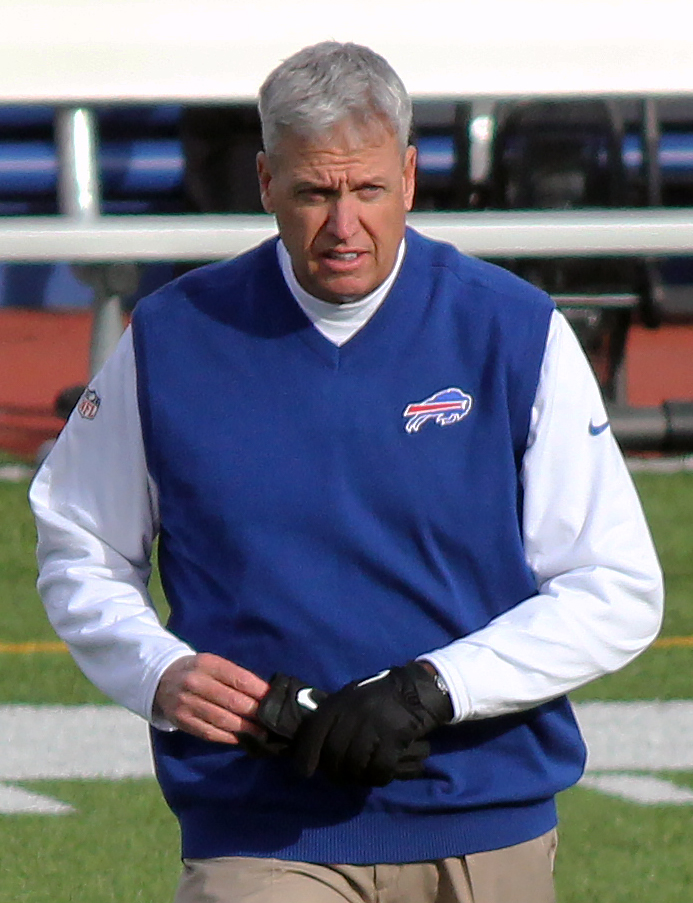
Ryan at Bills training camp in August 2015

Ryan was hired as the 18th head coach of the Buffalo Bills on January 12, 2015, agreeing to a five-year, $27.5 million contract.[102]

2015 season

[edit]

The Bills opened the 2015 season with a 27–14 win over the Indianapolis Colts.[103] Frustrated by the Bills leading the NFL in penalties heading into their Week 5 game against the Tennessee Titans, Ryan gave the entire team wristbands with the message "Yes sir". These were the only words he wanted his players to use with officials if they were flagged. After being flagged 17 times in Week 4 loss against the New York Giants, the Bills were penalized only seven times in their 14–13 victory over the Titans.[104] The Bills entered their bye week with a 3–4 record after losing in London to the Jacksonville Jaguars.[105]

Ryan gave the whole team the week off during the bye, and he himself found a secluded beach to "get away and focus". The Bills came out of their bye week and defeated the Miami Dolphins by a score of 33–17, improving their season record to 4–4. Ryan is now 2–5 all time following a bye week.[106] Ryan returned to MetLife Stadium in Week 10 for a much anticipated Thursday Night Football game against the Jets. The Bills won the game by a score of 22–17, and improved to 5–4 on the season.[107] Ryan faced questions before and after the game about his decision to name IK Enemkpali, who had been released by the Jets in preseason after breaking quarterback Geno Smith's jaw in an altercation, as Buffalo's captain for the game.[108]

The Bills were unable to make the playoffs in their first season with Ryan as coach, as they were eliminated in Week 15 with a 35–25 loss to the Washington Redskins on December 20, extending their drought to 16 seasons, the NFL's longest active drought. They finished the season with an 8–8 record.[109][110]

2016 season

[edit]

On January 10, 2016, it was announced that Ryan had hired his twin brother, Rob, to the Bills coaching staff.[111] Rob served as an assistant head coach and also worked with the defense. Three days later, Ryan hired former NFL standout Ed Reed to be an assistant defensive backs coach.[112]

The Bills opened the 2016 season with a 13–7 loss against the Baltimore Ravens.[113] On September 16, 2016, less than 24 hours after losing 37–31 to the Jets in their home opener and falling to 0–2, Ryan fired offensive coordinator Greg Roman and promoted running backs coach Anthony Lynn to offensive coordinator.[114][115]

On December 27, after a Christmas Eve loss to the Miami Dolphins in Week 16 that eliminated the team from playoff contention, Ryan was relieved of his duties as head coach, and offensive coordinator Anthony Lynn was named as interim head coach for the final game of the season. Rob Ryan was dismissed as well.[116][117] Many players were unable to thrive under Ryan's defensive scheme, which was described as complicated. The Bills' defense finished the 2016 season 15th in points allowed and 24th in rushing yards allowed.[118] Following the season, Ryan went on a profane tirade against the team for allegedly quitting on him.[119]

Ryan was replaced on a full-time basis by Sean McDermott in Buffalo, who proceeded to lead the Bills to the postseason in his first season in 2017.

Television career

[edit]

Following his dismissal by the Bills In 2016, Ryan signed an agreement with ESPN to provide analysis for the network's Super Bowl LI pregame and postgame shows. The one-game agreement, in which ESPN beat out game rightsholder Fox (as well as CBS and NFL Network), left the possibility open for Ryan to continue with ESPN through the 2017 season.[120] In April, it was announced that Ryan would officially join ESPN's Sunday NFL Countdown as an analyst.[121] In 2022, Ryan competed on the thirty-fourth season of the CBS reality competition show The Amazing Race, where he was eliminated in the second leg.[122]

Coaching philosophy

[edit]

Ryan stresses that coaches are essentially supposed to be open and communicative with the players and management, who in turn will reciprocate the same attitude. By connecting with his associates, Ryan states, it's "valuable when it comes to figuring out how to motivate somebody (...) because I want that guy to fight for me, just like I want to fight for him."[123] Fullback Tony Richardson, in an interview, stated Ryan "loves his football team, loves his players" and does as much as he possibly can to ensure their success.[124] Despite his boisterous and brash comments that have caused increased media coverage of the team, Ryan has taken the attention and has managed to "[put] it on himself" so the players can focus on their tasks.[124] Ryan has also stressed that the teaching process is an important one, particularly when it comes to providing a player information and building chemistry. However, there has to be flexibility as the process must also be insightful and positive.[125] Ryan states that coaches are responsible for providing players with information that is vitally important otherwise "if you emphasize everything, you've emphasized nothing."[125]

Coaching strategy

[edit]

With extensive knowledge regarding the intricacies of the defense, Ryan has been criticized for not devoting similar time and effort into coaching the offense.[126] Ryan refuted this, stating his goal is to implement a proficient running game, citing a desire to "get after" the opponent through running the ball.[127] Ryan has also stated that passing the ball is important but should not be used incessantly as there should be a balance between both aspects of the offense.[127] In 2009 and 2010, the Jets were ranked first and fourth overall in the league in rushing which coincided with their two playoff appearances.[128] In 2011, the Jets attempted to convert to a more pass-oriented offense, which have become more widely used in the NFL, however, the team struggled with this adjustment and reverted to their former run-oriented offense by the middle of the season.[128] His defensive strategy, in contrast, tends to be more elaborate taking into consideration his experience in the field. There are six different defensive formations utilized in football, but the two commonly used formations are the 3–4 formation, with three defensive lineman and four linebackers, and the 4–3 formation, with four defensive lineman and three linebackers.[2] The Jets utilized the former of the two popular formations; however, Ryan tended to employ all six formations in varying forms.[2] Furthermore, he often calls audibles that have the defense line up in one formation and switch to another so as to cloak their intentions and confuse and pressure the opponent.[2]

As a testament to this philosophy, Ryan is often willing to defer the coin toss to the opponent so his team can begin the game playing on defense in order to "set the tone" and generate turnovers.[129][130] This concept has been criticized by ESPN reporter John Clayton, who has found the method to be ineffective league-wide.[130] Mark Kriegel, an analyst for the NFL Network, found that between 2005 and 2012, during his tenure with both the Ravens and Jets, Ryan's defenses have never been ranked lower than sixth overall in the NFL and have allowed an average of 281 yards per game from scrimmage, second to Dick LeBeau's 277.4 yards per game. LeBeau is generally regarded as one of the best defensive coordinators in the history of the NFL.[131][132]

Personal life

[edit]

Ryan and his wife, Michelle, met at Southwestern Oklahoma State.[133] When Rex accepted his position as a graduate assistant at Eastern Kentucky, he proposed to Michelle by phone;[133] she accepted and they were married in 1987.[134] They have two sons, Seth,[134] an assistant for the Detroit Lions, and Payton.[135] Ryan earned a Bachelor of Science and a Master's degree in physical education from Eastern Kentucky University.[13] He resided in Summit, New Jersey, during his tenure with the Jets.[136]

Health

[edit]

Ryan publicly announced in 2009 that he had been battling dyslexia for his entire life. During his early years, Ryan struggled to read and write in school; however, he was not formally diagnosed until testing confirmed he had the disorder in 2007.[137] Ryan utilizes color-coded playbooks and game plans when coaching on the sidelines to aid his comprehension.[137]

Ryan underwent lap-band surgery at NYU Medical Center in March 2010 in an effort to battle his obesity.[138] Ryan also had a hernia repaired during the procedure.[138] He was able to return to his home that same day to recover.[138] Following a three-week period, he had lost 40 pounds[139] and as of July 2012, Ryan had lost 106 pounds.[140]

On September 13, 2016, it was revealed that Ryan underwent a procedure to remove the lap band. He lost a total of 120 pounds during the 6-year span since he had the surgery.[141]

Car crash

[edit]

Ryan was involved in a three-car crash in eastern Pennsylvania on January 14, 2013.[142] A witness said Ryan ran his Ford Mustang through a red light and collided with another driver which caused the unidentified driver to hit a third car. Ryan was issued a warning, but no citation.[142]

Media

[edit]

Ryan released Play Like You Mean It, an autobiography and a conversational about football strategy.[143][144] The book, which was published by Doubleday in the spring of 2011, was co-written by Don Yaeger, a former Sports Illustrated editor who has co-authored the autobiographies of former NFL players Walter Payton and Warren Moon.[144]

Ryan played a lawyer in Adam Sandler's film That's My Boy, which was released on June 15, 2012.[145]

Internet video

[edit]

In late 2010 as the Jets were preparing for the playoffs, a foot fetish video of a woman appearing to be Ryan's wife Michelle surfaced on various internet outlets. Judging by the video background, it appears to have been taken at the teachers parking lot at Whippany Park High School in New Jersey. The video features a clothed Michelle having her bare feet handled and commented on by an unseen camera operator with a voice similar to Rex's. The Jets released a press statement saying that Ryan and the organization considered the situation a private matter and would provide no comment. Multiple media reports soon linked the Ryans to a user profile named "ihaveprettyfeet"[146] on a site for alternative sexual lifestyles,[147] and more videos of Michelle emerged in the following months. In September 2015, a photo of Ryan surfaced showing him sitting at his desk with a framed photo of a person's feet behind him.[148]

Sports allegiances

[edit]

Ryan is an avid hockey fan and developed a notoriety of being a bandwagon jumper. Ryan admitted to being a fan of the Toronto Maple Leafs, as a result of growing up in the city, but upon taking the Jets head coaching job, he was often seen cheering for all three of the New York metropolitan area franchises.[149] During the New Jersey Devils run to the 2012 Stanley Cup Finals, Ryan was seen sporting the team's attire,[150] and he was seen donning the attire of the New York Rangers two years later, during their run to the Stanley Cup Finals.[151] Outside of the playoff runs, Ryan performed a ceremonial puck drop at Nassau Veterans Memorial Coliseum on October 9, 2010,[152] wearing a vintage New York Islanders Billy Smith jersey.[153]

Ryan was known for a notorious incident at a Carolina Hurricanes game, as he attended the matchup with the Florida Panthers wearing a throwback Philadelphia Flyers jersey. Upon being recognized by the fans at the arena, the team's cheerleaders approached him with a Hurricanes alternate jersey sported by the team. The incident was noted as he was seen taking off the jersey and baring his chest for the crowd to see.[154]

Upon taking the Buffalo Bills head coaching job, Ryan changed his allegiance to the Buffalo Sabres, and he was often seen at the team's home games and sporting the team's attire.[155] Months after being fired by the Bills, Ryan would later be seen during the Nashville Predators run to the 2017 Stanley Cup Finals, wearing the team's jersey.[156]

Political views

[edit]

On April 18, 2016, Ryan introduced Republican presidential candidate front-runner Donald Trump at one of his rallies held at the First Niagara Center in Buffalo. Ryan had told the Associated Press he was supporting Chris Christie for the nomination, but when Christie dropped out of the race, Ryan endorsed Trump.[157][158] During the rally, Ryan praised Trump's 'courage' to "say what's on his mind."[159]

In September 2017, Ryan stated on ESPN that President Trump's comments about how NFL owners should fire players who kneel during the national anthem were "appalling to almost any citizen in our country, it should be. You know, calling our players, SOBs and all that kind of stuff, that's not the–that's not the men that I know. The men that I know in the locker room I'm proud of. I'm proud to be associated with those people. I apologized for being pissed off but guess what? That's it, because right away I'm associated with what Donald Trump stands for and all that because I introduced him. I never signed up for that, I never wanted that. That doesn't mean I support 100 percent of the things he says."[160][161]

The Amazing Race

[edit]

In 2022, Ryan competed on the 34th season of The Amazing Race with his golf buddy, Tim Mann. His team was the second to be eliminated in Innsbruck, Austria, and finished in 11th place.[162]

Head coaching record

[edit]
Team Year Regular season Postseason
Won Lost Ties Win % Finish Won Lost Win % Result
NYJ 2009 9 7 0 .563 2nd in AFC East 2 1 .667 Lost to Indianapolis Colts in AFC Championship Game
NYJ 2010 11 5 0 .688 2nd in AFC East 2 1 .667 Lost to Pittsburgh Steelers in AFC Championship Game
NYJ 2011 8 8 0 .500 2nd in AFC East
NYJ 2012 6 10 0 .375 3rd in AFC East
NYJ 2013 8 8 0 .500 2nd in AFC East
NYJ 2014 4 12 0 .250 4th in AFC East
NYJ total 46 50 0 .479 4 2 .667
BUF 2015 8 8 0 .500 3rd in AFC East
BUF 2016 7 8 0 .467 Fired
BUF total 15 16 0 .484 0 0 .000
Total 61 66 0 .480 4 2 .667

References

[edit]

Bibliography

[edit]
[edit]
Revisions and contributorsEdit on WikipediaRead on Wikipedia
from Grokipedia
Rex Ashley Ryan (born December 13, 1962) is an American former (NFL) coach and current television analyst, best known for his tenure as a and emphasizing aggressive, physical defenses. The son of longtime NFL defensive coach , he began his professional coaching career in college before joining the NFL with the in 1999, rising to in 2005 and contributing to the team's victory in 2001 with a historically elite defense during his early years there. As of the from 2009 to 2014, Ryan posted a 46–50 regular-season record and guided the team to the in each of his first two seasons, achieving a 4–2 postseason mark overall, though subsequent years saw declining performance amid instability and internal conflicts. He then coached the from 2015 to 2016, compiling a 15–16 record before being fired, ending his head coaching career with a total regular-season mark of 61–66. Ryan's bombastic style, including public guarantees of success and trash-talking opponents, drew both fan enthusiasm and fines from the league for conduct like gesturing offensively at spectators, but his defensive schemes consistently ranked among the league's top units under his direction. Post-coaching, he transitioned to broadcasting, providing analysis for while occasionally stirring debate with candid critiques of players and teams.

Early life and playing career

Childhood and family background

Rex Ryan was born on December 13, 1962, in , to , a prominent defensive coach in college and professional football, and Doris Ryan. He has two brothers: an older brother, Jim, and a fraternal twin, , born five minutes after him. Ryan's parents divorced when he and his twin were approximately two years old, after which Doris primarily raised the boys, initially in —where Buddy had been recruiting for the University of Buffalo at the time of their birth—and later in , , until they reached junior high school. The family then relocated to the Chicago area to be closer to Buddy, who had become the for the . Despite the separation, Buddy's career profoundly shaped Ryan's early exposure to football; the twins often served as ball boys for their father's teams and absorbed defensive strategies through observation and direct involvement. The Ryan brothers' childhood was marked by close sibling bonds and a shared passion for the sport, influenced by Buddy's unorthodox "" innovations, which the twins emulated in backyard games and informal play. Anecdotes from their upbringing, including competitive antics between Rex and Rob, highlight a boisterous dynamic centered on football immersion, though details often stem from the brothers' own recollections in interviews. From an early age, Ryan expressed aspirations to emulate his father's coaching path, fostering a lifelong commitment to defensive schemes.

College football experience

Ryan attended Southwestern Oklahoma State University (SWOSU) in , where he played as a defensive end for the Bulldogs from 1981 to 1982, alongside his identical twin brother Rob. The Ryan brothers, sons of longtime NFL defensive line coach , joined the program after high school and contributed to the team during their two seasons before transitioning toward coaching pursuits. SWOSU's football program competed at the NAIA level, providing a smaller-scale collegiate environment compared to FBS institutions. Ryan earned a from SWOSU in 1987, majoring in an unspecified field while balancing academics with football. Specific performance statistics from his playing tenure, such as tackles or sacks, are not prominently documented in available records, reflecting the program's limited national visibility at the time. His experience at SWOSU laid foundational knowledge in defensive schemes, influenced by his father's professional background, though Ryan himself did not pursue a professional playing career post-college. In recognition of his later coaching accomplishments and contributions as a player, Ryan was inducted into the SWOSU Athletic Hall of Fame in 2012, alongside his brother . This honor underscores his enduring ties to the institution, where he and remain figures celebrated for elevating the program's legacy through their successes.

Initial coaching roles

Collegiate positions

Ryan began his coaching career as a graduate assistant at from 1987 to 1988, shortly after graduating from Southwestern Oklahoma State University. In 1989, he served as assistant head coach and defensive coordinator at , where the team's defense showed notable improvement under his guidance. From 1990 to 1993, Ryan held the position of defensive coordinator at , focusing on developing aggressive defensive schemes during his tenure at the FCS level. After two seasons as defensive line coach with the NFL's (1994–1995), Ryan returned to collegiate football as at the for the 1996 and 1997 seasons. He then moved to the as in 1998, followed by a one-year stint in the same role at in 1999. These later college positions emphasized his expertise in coordinating defenses, paving the way for his transition to NFL assistant roles.

Transition to professional football

Ryan's entry into professional football occurred in 1994, when his father, , was hired as of the and brought him on as defensive line coach. The Cardinals recorded 5-11 finishes in both the 1994 and 1995 seasons under , who was dismissed following the latter campaign. Rex Ryan then returned to collegiate coaching for several years, including a brief stint as at in early 1999. In 1999, Ryan rejoined the ranks with the as defensive line coach under new , marking a more sustained transition to professional football. He remained with the through 2008, progressing to linebackers coach in 2003, defensive in 2005, and assistant head coach in 2008, during which the team advanced to the in six of those ten seasons and won after the 2000 campaign. This period established Ryan's reputation for aggressive, pressure-oriented defensive schemes influenced by his father's "" philosophy.

NFL assistant coaching

Early NFL assignments

Ryan's initial entry into NFL coaching occurred in 1994, when he joined the ' staff under his father, , the team's defensive coordinator, serving primarily as linebackers coach while also assisting with the defensive line through the 1995 season. This brief professional stint followed years of collegiate experience and preceded a return to college ranks, marking his first exposure to NFL-level schemes rooted in the aggressive, blitz-heavy defenses his father pioneered. In 1999, Ryan transitioned back to the NFL with the , hired by head coach as defensive line coach—a role he held through the 2004 season. During this period, he coached a formidable front featuring players like and Rob Burnett, contributing to the ' league-leading defenses that culminated in a victory after the 2000 season, where Baltimore's unit allowed just 165 points over 16 regular-season games. Ryan's emphasis on physical, gap-control techniques helped establish the team's 4-3 base alignment, setting the foundation for sustained defensive excellence under coordinator . By 2004, Ryan had developed a reputation for player development, with his defensive linemen ranking among the NFL's best in run-stopping efficiency, as evidenced by Baltimore's consistent top-10 finishes in rushing yards allowed per game from 1999 to 2003. This tenure solidified his understanding of professional talent evaluation and scheme adaptation, though he occasionally clashed with personnel decisions amid the team's evolving roster needs post-Super Bowl.

Baltimore Ravens defensive coordinator era

Ryan was appointed defensive coordinator of the on January 11, 2005, succeeding under . In his first season, the Ravens finished 6–10 amid offensive struggles and injuries, but the defense ranked fifth in the in points allowed at 20.8 per game and sixth in total yards allowed at 299.9 per game. Ryan emphasized an aggressive 3–4 base scheme inherited from prior coordinators, incorporating heavy blitz packages and versatile linebackers like and to generate pressure, resulting in 41 sacks (seventh in the league). The 2006 season marked a pinnacle, with the Ravens achieving a 13–3 record and the NFL's top-ranked defense in points allowed (16.9 per game) and total takeaways (35, tied for second). Ryan's unit permitted just 270 points overall, forcing 20 interceptions and limiting opponents to a league-low 4.6 yards per play; the defense's 49 sacks ranked third. This performance earned Ryan the NFL Assistant Coach of the Year award. In the , as the AFC's second seed, defeated the 24–10 in the divisional round before falling 15–6 to the in the , where the defense held New England to 188 total yards. The 2007 campaign saw regression to a 5–11 record due to key injuries, including to Lewis and , yet the defense remained sixth in points allowed (19.0 per game) and produced 42 sacks (fourth overall). Ryan adapted by increasing blitz frequency to compensate for personnel losses, though the unit allowed more explosive plays as a result. Following Billick's dismissal after the 2007 season, new rehired Ryan on January 28, 2008, promoting him to assistant while retaining defensive coordinator duties. The 2008 Ravens posted an 11–5 mark, with the defense ranking second in points allowed (19.3 per game) and first in rushing yards allowed (87.3 per game), amassing 44 sacks (tied for fourth). In the postseason, Baltimore upset the top-seeded 13–10 in the divisional round and defeated the second-seeded 23–14 in the before losing 27–23 to the , where Ryan's blitzes pressured into two interceptions. Ryan departed after the season, hired as of the on January 20, 2009.

Head coaching tenures

New York Jets (2009–2014)

Rex Ryan was hired as the 18th head coach in franchise history on January 19, , following the dismissal of . Over six seasons, Ryan posted a regular-season record of 46–50 (.479 winning percentage), with the team qualifying for the in his first two years and achieving a 4–2 postseason mark, including appearances in consecutive AFC Championship Games. His defenses excelled early, ranking first in the in points allowed (236) during the season and sixth (304 points) in 2010, underscoring Ryan's reputation for aggressive, physical schemes inherited from his tenure. However, offensive inconsistencies, particularly at with as the primary starter, contributed to later struggles, as the team failed to sustain success beyond 2010.

2009–2010: Playoff successes and defensive dominance

In Ryan's debut 2009 season, the Jets finished 9–7, earning the AFC's No. 5 wild-card seed despite a middling offense that scored 348 points (17th in the league). The defense, anchored by players like linebacker and safety , forced 39 turnovers and limited opponents to 14.8 points per game. In the playoffs, New York upset the 24–14 in the wild-card round on January 9, 2010, followed by a 17–14 divisional victory over the on January 17, propelled by a late safety and interception. The run ended in the with a 30–17 loss to the on January 24, where threw for 377 yards and three touchdowns. The 2010 campaign saw improvement to an 11–5 record, again securing the No. 5 seed after a late-season surge that included a 10-game winning streak in their final 11 contests. Ryan publicly guaranteed a victory before the season, reflecting confidence in his revamped roster, including the acquisition of quarterback and LaDainian Tomlinson. The Jets dispatched the 17–16 in the wild-card round, then stunned the top-seeded 28–21 in the divisional round on January 16, 2011, with Sanchez throwing for 246 yards and the defense sacking five times. Their postseason concluded with a 24–19 defeat to the in the on January 23, hampered by offensive penalties and a fumble returned for a touchdown. These back-to-back deep playoff runs marked the Jets' most sustained contention since 1998, driven by Ryan's defensive preparations that held high-powered offenses in check.

2011–2014: Declining performance and dismissal

From 2011 onward, the Jets regressed, posting records of 8–8 in 2011, 6–10 in , 8–8 in , and a franchise-worst 4–12 in 2014 under Ryan. No further playoff berths materialized, as offensive woes persisted amid quarterback instability—Sanchez's inaccuracy, the ill-fated experiment in , and rookie Geno Smith's turnovers in –2014—coupled with front-office tensions between Ryan and general manager John Idzik. Defenses remained competitive but could not compensate for scoring averages that ranked 27th or worse in three of the four seasons. Ryan was fired on December 29, 2014, alongside Idzik, by owner , who cited dissatisfaction with the team's direction and inability to overcome inconsistent quarterback play despite defensive strengths. Internal reports highlighted a "toxic" environment marked by media leaks, player distractions, and power struggles, eroding cohesion. Ryan's tenure, while launching initial promise through bold guarantees and gritty defenses, ultimately faltered due to failure to build a balanced roster capable of consistent contention.

2009–2010: Playoff successes and defensive dominance

In his inaugural season as head coach, Rex Ryan led the New York Jets to a 9–7 regular season record, earning a wild card spot in the AFC playoffs. The team's defense, implemented from Ryan's Baltimore Ravens scheme emphasizing aggressive pressure and coverage, ranked first in the NFL in points allowed at 236, averaging 14.8 per game. This marked a significant improvement from the prior year's 26th ranking in scoring defense, showcasing Ryan's ability to instill a dominant unit featuring players like cornerback Darrelle Revis and linebacker Bart Scott. The Jets advanced in the postseason by defeating the 24–14 in the wild card round on January 9, 2010, at Paul Brown Stadium, where the defense limited the opponents to 281 total yards. In the divisional round on , they upset the 17–14 at Qualcomm Stadium, holding a high-powered offense to 14 points despite a late-game rally. The run ended in the on January 24, with a 30–17 loss to the at , though the Jets' defense sacked four times. Building on the momentum, the 2010 Jets improved to an 11–5 record, again clinching a wild card berth behind a defense that ranked sixth in points allowed with 304, or 19.0 per game. Ryan's units continued to excel in situational play, forcing turnovers and disrupting passing attacks, which propelled the team deep into the for the second consecutive year. In the wild card game on January 8, 2011, the Jets edged the 17–16 on the road at , with the defense sealing the victory by blocking an extra point attempt. They followed with a 28–21 divisional win over the top-seeded on January 16 at , sacking five times—a franchise postseason record—and intercepting him twice. The season concluded with a 24–19 defeat to the in the AFC Championship on January 23 at Heinz Field, where the Jets outgained Pittsburgh but faltered on key drives. These back-to-back conference title appearances highlighted the defensive foundation Ryan established, though offensive inconsistencies prevented a Super Bowl berth.

2011–2014: Declining performance and dismissal

The New York Jets under Rex Ryan posted an 8-8 record in the 2011 season, finishing second in the AFC East but missing the playoffs for the first time during his tenure. The team's defense ranked 20th in points allowed at 363, a decline from prior years, while the offense scored 377 points, placing 13th. Quarterback Mark Sanchez threw for 2,883 yards and 13 touchdowns but also 18 interceptions, contributing to inconsistent performance amid reported internal tensions. In 2012, the Jets regressed to a 6-10 record, third in the , with offensive struggles epitomized by the lowest points scored in the league at 281. Ryan's decision to acquire and shift to a run-heavy scheme under Tony Sparano failed to ignite the attack, as Sanchez was benched mid-season. The defense allowed 375 points, ranking 22nd, marking further erosion from Ryan's early defensive dominance. The 2013 season yielded another 8-8 finish, again second in the division but out of postseason contention. Rookie quarterback , drafted in the second round, started after a preseason competition with Sanchez, who suffered a shoulder injury early; Smith threw 21 interceptions against 12 touchdowns. Offense ranked 29th in points at 290, while defense conceded 387, 19th overall. Ryan retained his position despite the mediocrity, with owner citing encouraging signs in late-season play. The Jets collapsed to 4-12 in 2014, last in the AFC East, prompting Ryan's dismissal on December 29 alongside general manager John Idzik. Persistent quarterback instability, conservative personnel decisions by Idzik, and offensive deficiencies—exacerbated by Ryan's defensive focus—undermined the team, as inconsistent play at the position proved a recurring knock on his resume. Johnson expressed dissatisfaction with the franchise's direction, leading to a clean-house overhaul despite Ryan's overall Jets tenure record of 46-50 in the regular season.
SeasonRecordAFC East FinishPlayoffsOffensive Rank (Points)Defensive Rank (Points Allowed)
20118-82ndNo13th (377)20th (363)
20126-103rdNo28th (281)22nd (375)
20138-82ndNo29th (290)19th (387)
20144-124thNo--

Buffalo Bills (2015–2016)

On January 12, 2015, the hired Rex Ryan as on a five-year, $27.5 million contract, following his dismissal from the . Ryan inherited a Bills defense that ranked fourth in points allowed per drive the prior season, with expectations that his expertise would elevate the unit to elite status amid the team's 16-year playoff drought. In the 2015 season, the Bills compiled an 8–8 record, finishing third in the and missing the playoffs. The offense scored 379 points (23.7 per game, 12th in the ), but the defense regressed, allowing more points than anticipated despite Ryan's reputation; he later attributed this to attempting a hybrid scheme that complicated implementation. Key free-agent signings like Charles Mann and safety aimed to bolster the unit, yet it failed to replicate prior dominance, ranking outside the top tier in sacks and takeaways. To address defensive shortcomings, Ryan hired his brother as assistant head coach/ for , promising a pure implementation of the Ryan scheme without prior merging. The Bills started 0–2 before improving to 7–8, but a 34–31 overtime loss to the on December 24 eliminated playoff hopes, extending the drought to 17 seasons. The defense ranked 15th in points allowed and 24th against the rush, underperforming relative to roster investments and expectations. On December 27, 2016, owner fired Ryan in an executive decision via conference call, one game before season's end, citing the overall 15–16 record in 31 games. Analysts noted failures including inability to defeat winning teams, wasted high-value contracts on underproductive players like , and internal dysfunction partly linked to Rob Ryan's influence.

Post-coaching professional activities

Broadcasting career at ESPN

Following his dismissal as head coach of the on December 13, 2016, Ryan transitioned to broadcasting by signing a multi-year with in April 2017 to serve as an NFL analyst, primarily appearing on . His role included providing defensive insights drawn from his coaching experience, with ESPN selecting him for his reputation as a "defensive guru" despite the Bills' defensive regression in 2016. Ryan debuted on the show during the 2017 preseason and contributed to other ESPN programming, such as and segments. In September 2017, Ryan briefly served as a in the Monday Night Football booth alongside play-by-play announcer and analyst for the season opener between the and Minnesota Vikings on September 11. His performance drew criticism for lacking polish, with viewers and media noting awkward phrasing, excessive tangents on personal anecdotes, and difficulty meshing with the broadcast team, leading to low approval ratings and his removal from the booth after one game. ESPN did not renew him for regular MNF duties, redirecting his focus to studio analysis where his coaching breakdowns were deemed more suitable. Ryan remained a staple on through subsequent seasons, offering commentary on defensive schemes, player evaluations, and game predictions, often highlighting aggressive tactics aligned with his 3-4 base defense philosophy. In December 2018, he publicly stated intentions to depart after the 2018 season to pursue NFL coaching opportunities, citing dissatisfaction with studio work and a desire to return to the sidelines. However, no head coaching or coordinator positions materialized, and he continued with into 2019 and beyond, appearing regularly on the program and occasionally on Get Up. As of October 2025, Ryan maintains his role as an ESPN NFL analyst, providing weekly insights on Sunday NFL Countdown and emerging as a candidate for defensive coordinator vacancies amid renewed interest in his expertise. His tenure at ESPN has been marked by steady employment despite intermittent coaching rumors, with the network valuing his candid, coach's-eye perspectives over more conventional punditry. The Bills' contract offset clause reduced their payout obligations by the amount of Ryan's ESPN earnings, estimated at several million annually under the multi-year deal.

Recent coaching interest and commentary (2017–present)

Following his termination by the Buffalo Bills after the 2016 season, Ryan transitioned to broadcasting, joining ESPN in April 2017 as an NFL analyst and contributing to Sunday NFL Countdown. Ryan has repeatedly voiced interest in resuming a head coaching role, emphasizing his belief in his defensive expertise and motivational style. In November 2024, he publicly campaigned for a return to the New York Jets, asserting that "nobody is better than me" for the position amid the team's struggles. On January 6, 2025, following an interview for the Jets' vacancy, Ryan stated on ESPN New York radio that he was "convinced" the team would hire him as head coach. Despite this, he did not secure the job, later expressing disappointment in March 2025 over missing the opportunity. Speculation persisted into late 2025, with Ryan, then 62, emerging as a candidate for open head coaching positions, including reports of consideration for the amid their midseason coaching uncertainty. His overall head coaching record stands at 61-66 across stints with the Jets (2009–2014) and Bills (2015–2016), with two AFC Championship appearances but no victory. In his ESPN role, Ryan has delivered candid commentary, often critiquing quarterback decisions and coaching staffs. For instance, after Week 1 of the 2025 season, he called for benching quarterback in favor of , arguing Wilson "can't play anymore." He has also lambasted head coach as a "nerd boy" lacking player respect, while praising teams like the for dominant wins and ranking the atop the NFC early in the season. These takes reflect his signature blunt style, drawing from his defensive background to highlight schematic and leadership flaws.

Coaching philosophy and strategies

Defensive innovations and tactics

Rex Ryan's defensive philosophy drew heavily from his father Buddy Ryan's pioneering , which overloaded the with six players to disrupt passing attacks and was instrumental in the ' 46-10 victory over the in on January 26, 1986. Rex adapted these principles into a flexible 3-4 base scheme, incorporating elements of the 46 to emphasize pre-snap alignment deception and aggressive personnel deployment, allowing defenses to flood the box against both run and pass plays. This adaptation prioritized versatility, enabling frequent shifts between odd and even fronts to counter modern spread offenses. Central to Ryan's tactics was an unrelenting blitz-heavy approach, designed to generate chaos in the quarterback's pocket through simulated pressures and multi-angle rushes. His schemes often featured "fire zone" blitzes—dropping linemen into coverage while sending linebackers and safeties on delayed or disguised rushes—to exploit protection breakdowns, as seen in the ' 2010 defense that led the with 41 sacks. Ryan stressed man-to-man coverage behind these pressures to enable athletic defenders like cornerbacks to play aggressively, reducing underneath cushions and forcing quarterbacks into hurried decisions. This aggressive posture extended to run defense, where he advocated loading the line to stuff gaps, contrasting with zone-heavy "bend-don't-break" systems prevalent in the era. Ryan's innovations included heavy pre-snap disguises, where safeties and linebackers feigned coverage responsibilities before rotating into blitz paths, a tactic that peaked during his coordinator tenure from 2005 to 2008, culminating in a appearance. These deceptions aimed to mask intentions until the snap, compelling offenses to declare protections prematurely and exposing blindside vulnerabilities. While effective against rhythm-based passing games—evidenced by the Jets' No. 1-ranked defense in points allowed (19.4 per game) during the season—his schemes demanded elite athleticism and could falter against mobile quarterbacks or quick releases due to the inherent risks of man coverage and depleted secondary drops. Ryan's emphasis on physicality and unpredictability influenced subsequent defenses, promoting a shift toward hybrid fronts that blend 46 overloads with 3-4 mobility.

Leadership approach and player management

Rex Ryan's leadership was characterized by a confident, outgoing demeanor that emphasized motivation through bold rhetoric and public defenses of his players. He frequently employed psychological tactics in team meetings, such as criticizing media detractors to rally the group, as during a January 8, 2011, address to the where he bashed skeptics to boost morale ahead of the . Ryan positioned himself as a "player's coach," focusing on leveraging individual strengths rather than dwelling on weaknesses, advising coaches to prioritize what players could execute effectively. This approach fostered loyalty, with players appreciating his impassioned support, but it also drew criticism for being overly permissive, contributing to perceptions of lax oversight. In player management, Ryan balanced team-wide accountability with personalized motivation, yet struggles with enforcing discipline became evident, particularly during his Buffalo Bills tenure. Bills running back LeSean McCoy and wide receiver Sammy Watkins publicly attributed the team's 2016 shortcomings to insufficient discipline under Ryan, noting players needed greater personal responsibility amid loose standards. The Bills ranked second in the NFL in penalties during Ryan's two seasons (2015–2016), reflecting organizational lapses that undermined performance despite talent on the roster. Earlier with the Jets, similar issues surfaced, including a 2014 incident where tight end Jace Amaro missed a flight to a game due to a time zone error but faced no reduction in playing time or formal punishment, prompting Ryan to later defend his accountability methods amid backlash. His shift toward a more "laid-back" style in Buffalo, as described by McCoy compared to prior coaches, contrasted with the fiery, rah-rah intensity of his Jets era, highlighting adaptability challenges that eroded team structure over time. Ryan's brash public , while energizing in short bursts, often amplified external pressures, as his over-the-top style was voted the league's most overrated by peers in a 2012 Sporting News poll, with critics noting excessive showmanship detracted from on-field command. Despite early successes in building defensive cohesion through unfiltered motivation, the lack of consistent discipline—evident in rising penalties and player admissions of gaps—undermined sustained results, contributing to his dismissals from both franchises.

Legacy and evaluations

Key achievements and contributions

Ryan's tenure as defensive coordinator for the Baltimore Ravens from 2005 to 2008 featured consistently elite units, including a 2006 defense that ranked second in the NFL in points allowed per game (16.1) and first in rushing yards allowed (88.1 per game), contributing to an AFC North title and divisional playoff berth. His schemes emphasized aggressive blitz packages and coverage disguises, often described as "organized chaos," which pressured quarterbacks into hurried throws and forced turnovers at high rates—such as the Ravens' 29 interceptions in 2006, tied for the league lead. This approach built on principles inherited from his father, Buddy Ryan, prioritizing attacking offenses on the coordinator's terms rather than reacting to theirs, and laid foundational elements for the Ravens' sustained defensive success post-Ryan. As of the from 2009 to 2014, Ryan engineered an immediate turnaround, guiding a 9-7 squad to the playoffs via wild-card berth and three consecutive road upsets: over the (on January 9, 2010), (January 17, 2010), and (January 24, 2010) to reach the . The following year, his 11-5 Jets again advanced to the AFC title game, albeit falling to the (January 23, 2011), yielding a career playoff mark of 4-2 that remains the most postseason victories by any Jets . Under Ryan, Jets defenses topped the in points allowed in 2009 (19.4 per game) and ranked top-five in total defense twice, leveraging stars like through heavy man-coverage and simulated pressures that disrupted passing attacks. Ryan's broader contributions to NFL defensive strategy include pioneering widespread adoption of multifaceted blitz looks and pre-snap disguises, influencing a generation of coordinators—such as former Jets assistants and —who carried elements of his "attack-first" ethos into modern schemes prioritizing quarterback disruption over conservative coverage. His , spanning over 20 assistants who advanced to coordinator or higher roles, underscores this dissemination, with Ryan's emphasis on player empowerment through clear communication and fostering resilient units capable of exceeding talent expectations. Though his head-coaching win percentage hovered around .500 (61-66 regular season), these tactical innovations and early Jets successes cemented his reputation as a defensive savant whose methods adapted to era-specific passing threats.

Criticisms, failures, and overrated perceptions

Ryan's tenure with the began with promise but devolved into consistent underperformance, marked by a to capitalize on early playoff appearances. After leading the Jets to consecutive AFC Championship Games in and despite lacking a marquee , the team posted losing records in three of the next four seasons, culminating in a 6-10 finish in that led to his dismissal. Critics attributed the decline to Ryan's neglect of offensive line development, poor grooming under —who regressed amid interceptions and turnovers—and an inability to adapt schemes as the roster aged and key veterans like departed. His brash guarantees of contention, including pre-season boasts in and , amplified perceptions of when the team faltered against in both title games, fostering a narrative of unfulfilled bravado over substantive results. In Buffalo, Ryan's two-year stint (2015–2016) yielded identical 8-8 records, failing to end the Bills' 17-year playoff drought despite assembling a defense with top-tier talent like defensive ends and . The unit ranked poorly in key metrics, allowing 24.5 points per game in 2016—worse than his Jets defenses—and surrendered high yardage totals, undermining his reputation as a defensive guru. Organizational dysfunction exacerbated failures, including reports of Ryan granting his brother unchecked influence over defensive preparations, leading to staff infighting and poor execution; the Bills ranked second in penalties under Ryan, signaling lapses in . Post-firing on December 13, 2016, Ryan publicly lambasted players for quitting, highlighting eroded locker-room authority. Perceptions of Ryan as overrated stem from inflated expectations driven by his familial coaching pedigree—son of —and early Jets hype, which masked middling head-coaching acumen. An poll labeled him the league's most overrated coach during his Jets peak, citing motivational tactics that yielded short-term energy but long-term stagnation against superior teams (0-4 in AFC Championships). Analysts noted tactical shortcomings, such as suboptimal and conservative late-game decisions, which contrasted with his aggressive persona; in Buffalo, the Bills lost five games by one score despite roster investments exceeding $100 million in defensive free agents. His overall .500 regular-season record (61-69) belies the underachievement relative to talent levels, positioning him as a coordinator elevated beyond his strategic depth rather than a franchise-builder.

Personal life

Family dynamics and relationships

Rex Ryan and his fraternal twin brother were born on December 13, 1962, to , a pioneering defensive known for inventing the , and his wife Doris. The family environment was intensely football-oriented, with Rex and Rob serving as ballboys for the during Buddy's tenure as defensive coordinator in the late 1960s and 1970s, immersing them early in professional football culture. Buddy's demanding personality, passion for aggressive defense, and unfiltered demeanor shaped his sons' philosophies and public styles, with Rex often crediting his father as the primary influence on his career aspirations and . Following Buddy's death on June 28, 2016, at age 82, Rex and Rob publicly honored his legacy, emphasizing their lifelong adoration and commitment to upholding his defensive innovations. The twin brothers shared an unbreakable bond marked by fierce loyalty, physical roughhousing, and professional collaboration, having spent their lives "playing, laughing, loving and fighting" as inseparable siblings born five minutes apart. Their upbringing featured legendary tales of and mutual support, fostering a dynamic where they frequently teamed up in coaching roles, such as Rob serving as under Rex with the in 2015. This closeness extended to family traditions, including pregame visits with their father, and reflected a Ryan family ethos of all-out intensity in both personal and professional pursuits. Rex married Michelle Goeringer in 1987 after meeting her while serving as a at the , where she was a . The couple raised two sons, and Payton, both of whom engaged with football through family connections, including working as a ballboy during Rex's Jets tenure. Michelle, who maintained a low public profile, supported Rex's high-pressure career and attributed his relentless drive to lessons from . Rex publicly defended their relationship amid 2010 media scrutiny over leaked personal videos, emphasizing unwavering commitment, and as recently as March 2025, referenced their 37-year in a lighthearted about marital dynamics. The family prioritized privacy amid Rex's fame, with no verified reports of dissolution despite occasional separation rumors in unconfirmed outlets.

Health issues and personal challenges

Ryan has long battled , which prompted him to undergo laparoscopic adjustable gastric banding (lap-band) on March 13, 2010, at NYU Medical Center to mitigate associated health risks. The procedure, a form of , aimed to restrict food intake and promote sustained weight reduction; Ryan cited concerns over potential , , and as primary motivators, emphasizing long-term health preservation over immediate aesthetics. Following the surgery, Ryan achieved significant weight loss, shedding over 100 pounds and reaching approximately 242 pounds by mid-2012, with a target of 250 pounds within two years. However, post-operative indigestion episodes, such as one in November 2011 after a game, highlighted adjustment challenges common to lap-band patients. In September 2016, Ryan elected to have the band removed in solidarity with his twin brother Rob, who experienced severe complications from his own device, resulting in substantial weight regain—about 30 pounds initially noted, with most of the prior loss reversed. Ryan was diagnosed with in adulthood, a condition that contributed to academic struggles and during his youth, fostering a lifelong mentality that he credits for fueling his resilience. Despite not recognizing the until recent years, he adapted by emphasizing visual and problem-solving strengths, viewing it as a catalyst rather than a barrier to professional success.

Notable incidents and public controversies

In December 2010, videos surfaced on purporting to show Ryan's wife, , engaging in foot fetish activities, with one clip allegedly featuring Ryan himself; Ryan declined to comment on the report, which drew media scrutiny but did not result in disciplinary action from the . Ryan's bold preseason guarantees of a victory drew significant controversy, particularly after the 2010 loss to the on January 23, 2011, when he reiterated the pledge for the following season; he later admitted in February 2012 that the guarantee placed undue pressure on the team, contributing to an 8-8 record and playoff miss, and described it as a "huge mistake" that backfired in motivating players. On November 9, 2014, following a 19-6 win over the , Ryan directed toward a heckling fan in a postgame , leading to a $100,000 fine from the for ; the outburst, captured on video, highlighted Ryan's history of candid and heated public interactions. In June 2017, Nashville police launched an investigation into a complaint against Ryan and his brother stemming from an altercation at a bar on June 3, where the complainant alleged physical contact during a dispute; no charges were filed, and the brothers denied wrongdoing, attributing the incident to a misunderstanding amid reports of verbal exchanges escalating.

Political views and allegiances

Rex Ryan has publicly aligned himself primarily with Republican figures, most notably through his endorsement of during the 2016 presidential campaign. On April 18, 2016, Ryan introduced Trump at a campaign rally held at the First Niagara Center in , where he praised Trump's "courage" to speak candidly and highlighted Trump's prior $1 billion bid to purchase the in 2014 as evidence of commitment to the city and team. This appearance was interpreted as a direct endorsement of Trump's candidacy and agenda, despite Ryan's prefatory remark that he was "just a football coach" unfamiliar with politics. Ryan's support for Trump drew internal friction within the Buffalo Bills organization during the 2016 season, with some players expressing discomfort over the coach's stance, viewing Trump as antagonistic toward people of color and altering their perception of Ryan accordingly. Ryan dismissed concerns about locker room divisions, stating he was untroubled by differing political opinions among players and emphasizing unity on the field. In July 2017, after Trump's , Ryan reiterated his allegiance, declaring on a radio appearance that opposition to the president equated to opposition to the itself and affirming pride in knowing and supporting Trump. However, Ryan publicly withdrew his support in September 2017 following Trump's criticism of players kneeling during the , describing the president's remarks as "appalling" and expressing regret over his prior endorsement. In an interview, he stated, "I'm pissed off... I supported ... But I'm reading his comments, and it's appalling. I never signed up for that," indicating a specific disillusionment with Trump's rhetoric on the protests rather than broader disagreements. No subsequent public endorsements or detailed positions on other political issues, such as or social matters, have been prominently documented from Ryan, who has consistently framed himself as apolitical beyond these episodes.

Head coaching record

NFL regular season and playoff statistics

Ryan served as head coach of the from 2009 to 2014 and the from 2015 to 2016, compiling a regular season record of 61 wins, 66 losses, and 0 ties across 127 games, for a .480 . His teams qualified for the twice, both with the Jets, achieving a postseason record of 4 wins and 2 losses in 6 games, with a .667 .
YearTeamGamesWinsLossesTiesWinning Pct.
2009NYJ16970.563
2010NYJ161150.688
2011NYJ16880.500
2012NYJ166100.375
2013NYJ164120.250
2014NYJ16880.500
2015BUF16880.500
2016BUF15780.467
The Jets under Ryan reached the AFC Championship Game in both playoff appearances. In 2009, as the #5 seed with a 9–7 regular season record, they defeated the Cincinnati Bengals 24–14 in the wild card round and the San Diego Chargers 17–14 in the divisional round before losing 30–17 to the Indianapolis Colts in the conference championship. In 2010, as the #4 seed with an 11–5 record, they upset the Indianapolis Colts 17–16 in the wild card round, then beat the New England Patriots 28–21 in the divisional round, falling 24–19 to the Pittsburgh Steelers in the AFC Championship. Ryan's Bills teams did not qualify for the postseason, finishing 8–8 in 2015 and going 7–8 in 2016 before he was relieved of duties prior to the final regular season game.

References

Add your contribution
Related Hubs
Contribute something
User Avatar
No comments yet.