Hubbry Logo
Edge rusherEdge rusherMain
Open search
Edge rusher
Community hub
Edge rusher
logo
8 pages, 0 posts
0 subscribers
Be the first to start a discussion here.
Edge rusher
Edge rusher
from Wikipedia
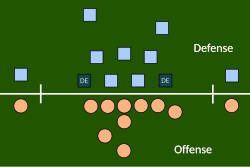
Defensive ends ("DE") in a 4–3 defense
Outside linebackers ("OLB") in a 3–4 defense

Edge rusher, also called an edge defender or simply edge, is a position in gridiron football. The position is used as an alternate term for a pass rushing defensive end or outside linebacker and is sometimes considered its own position entirely.[1]

Definition

[edit]

Players considered to be edge rushers are usually 4–3 defensive ends or 3–4 outside linebackers. Note that 3–4 outside linebackers often act as an extension of the defensive line, in that they will attack the offensive tackles or blocking tight ends on the majority of their snaps under a majority of 3–4 schemes, though it is not uncommon to see them drop back and play a more traditional 4–3 linebacker role as well.[2]

One reason the word "edge" is used in the term "edge rusher" is that edge often refers to the area outside of offensive tackles, but within a couple of yards of the line of scrimmage. While other positions will rarely be referred to as edge rushers, other than 4–3 defensive ends and 3–4 outside linebackers.

References

[edit]
Revisions and contributorsEdit on WikipediaRead on Wikipedia
from Grokipedia
An edge rusher, also known as an EDGE defender, is a defensive position in characterized by players who align on the outer edges of the defensive formation to disrupt the quarterback on passing plays and contain ball carriers on running plays. These athletes, often a hybrid of speed and power, are crucial for generating pressure on the offensive line, leading the league in metrics like sacks and quarterback hurries. In a 4-3 defensive scheme, edge rushers typically play as defensive ends, positioned directly across from offensive tackles to exploit one-on-one matchups. Conversely, in a 3-4 alignment, they function as outside linebackers, standing upright and offering versatility to drop into coverage or blitz from various angles. This flexibility has become essential in modern and college defenses, where hybrid roles allow teams to adapt to diverse offensive strategies. The position demands elite athletic traits, including explosive speed off the line, bend to navigate around blockers, and strength to set against runs. Edge rushers are among the most valuable defensive players due to their ability to alter game plans, with top performers often commanding high draft selections and contracts; for instance, the 's sack leader frequently emerges from this role.

Definition and Role

Definition

An edge rusher is a defensive player in , typically classified as a in a 4-3 defensive scheme or an outside linebacker in a 3-4 scheme, who aligns on the outer edge of the defensive line with the primary objective of pressuring the during passing situations. This positioning allows the player to exploit the perimeter of the offensive line, using a blend of speed, , and power to disrupt plays. Unlike interior linemen such as defensive tackles, who primarily occupy blockers and stop runs through the middle of the line, or secondary players like safeties who specialize in pass coverage, edge rushers focus on generating from the flanks through direct confrontations with offensive tackles. Their role emphasizes explosive movement to the rather than sustained engagement in the run game or deep-field patrolling. The terminology "edge rusher" or "edge defender" serves as an umbrella term for these perimeter pass specialists, distinct from more coverage-oriented outside linebackers in certain schemes, and has become prevalent to describe hybrid athletes who rush from regardless of traditional positional labels.

Primary Responsibilities

The primary responsibilities of an edge rusher revolve around disrupting offensive plays, particularly by pressuring the on passing downs while maintaining containment against the run. On passing plays, edge rushers aim to penetrate the offensive line, often engaging offensive tackles or tight ends one-on-one, to collapse the and force hurried throws, sacks, or incomplete passes. This disruption is crucial for limiting the 's time to read the defense and execute throws accurately. Against running plays, edge rushers are tasked with setting the edge, which involves controlling the outside gap—typically the D-gap or C-gap—to prevent ball carriers from breaking contain and gaining yards to the perimeter. By forcing runners back inside toward the rest of the defense, they channel plays into congested areas where additional tacklers can converge, reducing big gains and supporting the overall run defense. Occasionally, edge rushers may drop into short-zone coverage, such as flats or hooks, to intercept short passes or screen plays, adding versatility to defensive schemes. The strategic value of edge rushers lies in their ability to generate chaos without requiring additional , thereby preserving coverage integrity while elevating the defense's effectiveness. Success is primarily measured by metrics such as pressure rate—the percentage of pass-rush resulting in —and total sacks, which quantify their impact on disrupting plays; for instance, elite performers often achieve pressure rates above 15% and double-digit sacks per season. These contributions not only lead to negative plays but also indirectly boost turnover rates by inducing errors under duress. Alignment variations allow edge rushers to adapt to different defensive fronts and game situations, enhancing their tactical role. In a 4-3 base defense, they typically align as defensive ends outside the tackles, while in a 3-4 scheme, they function as stand-up outside linebackers closer to the line for added rush potential. In aggressive pass-rush packages, such as those employing the wide 9 technique, edge rushers position themselves several yards outside the tight end or tackle to leverage speed and create separation, prioritizing pocket collapse over immediate run support.

Historical Development

Origins in Early Football

The concept of the edge rusher emerged in the late 19th century as evolved from rugby influences, with the "end rusher" denoting the defensive player at the line's edge tasked with containing outside runs and pursuing the ball carrier or quarterback. , a foundational figure in the sport, outlined in his 1891 treatise that the end rusher required exceptional conditioning to break through interference and disrupt plays, emphasizing speed and positioning to counter the era's emphasis on mass plays around the flanks. This rudimentary role laid the groundwork for specialized edge defense, as early formations like the prioritized lateral movement that demanded vigilant perimeter containment. Pre-NFL developments in during the and amplified the need for effective edge rushers through innovative offensive tactics. , the first African American All-American at in 1916, revolutionized edge play as a halfback with blistering speed and elusiveness, frequently exploiting the flanks with sweeping runs that forced opponents to assign dedicated rushers to shadow his movements and prevent breakaways. His versatility as a runner and passer highlighted the threats at the edge, influencing college schemes where perimeter defenders had to anticipate quick cuts and outside pitches. In the professional game of the 1920s and 1930s, the single-wing offense—popularized by coaches like —dominated with its unbalanced line and emphasis on end sweeps, compelling teams to rely on agile end rushers to bottleneck mobile quarterbacks and backs. Iconic offensive threats like , the University of Illinois star who joined the in 1925, epitomized this challenge; his signature runs around the edge in the T-formation variant required defenders to crash from the flanks to halt his explosive gains, as seen in his 402-yard performance against in 1924. These matchups underscored the end rusher's critical function in early pro football, where containing the wingback's sweeps was essential to defensive success. The 1933 rule changes further entrenched the edge rusher's importance by liberalizing the forward pass to allow throws from any point behind the , building on the single-wing's run-heavy foundation to enable hybrid edge threats like rollouts and sweeps. Prompted by Bronko Nagurski's controversial near-line pass in the 1932 championship game, this adjustment—alongside hash mark repositioning to 10 yards from the sidelines—widened offensive options for perimeter attacks, necessitating specialized edge defenders to pursue quarterbacks and seal off outside runs more aggressively.

Evolution in the Modern NFL

The adoption of the 4-3 defensive alignment in the marked a pivotal shift in the edge rusher's role, transforming defensive ends into specialized pass-rushing threats positioned on the edges of the line. Pioneered by coaches like with the , this scheme placed four linemen across from the offense's five, allowing ends like of the to focus on speed and agility to disrupt quarterbacks rather than purely occupying blockers. Marchetti, a dominant force in this era, recorded numerous sacks while excelling in run defense, exemplifying how the 4-3 elevated edge players as versatile specialists in an increasingly pass-oriented league. The 1970s and 1980s brought further innovations with the proliferation of the 3-4 defense, which repositioned edge rushers as stand-up outside linebackers capable of versatile blitzing schemes. Popularized by teams like the and later the , this alignment gained traction for its ability to generate pressure through linebacker mobility, with emerging as its archetype after his 1981 debut. Taylor's explosive speed and power redefined the position, forcing offenses to allocate premium blockers like left tackles to counter him, and he amassed 132.5 sacks over his career while altering defensive strategies league-wide. Complementing this was the 1977 rule changes, which banned the head slap—a technique defensive linemen used to stun blockers—and permitted offensive linemen to extend their arms fully, compelling edge rushers to prioritize quickness and technique over raw power to penetrate pockets. In the 2000s and beyond, the edge rusher role has evolved into hybrid positions within packages, adapting to pass-heavy offenses that deploy 11 personnel (one back, one , three wide receivers) on over 65% of snaps. This shift, driven by the rise of spread concepts and formations, has teams substituting a fifth for a linebacker or lineman on more than 65% of plays, creating sub-package roles where edge rushers must excel in both pass rushing and coverage drops. data illustrates this trend through metrics like pass-rush win rates, which have climbed for elite edge defenders amid increased dropbacks—reaching highs like 25.6% for players such as in 2022—while overall sack rates per attempt have stabilized around 6-7% due to better offensive protection schemes. These adaptations underscore the edge rusher's centrality in modern defenses, where athletic versatility counters the league's aerial emphasis.

Physical and Technical Requirements

Ideal Physical Attributes

The ideal physical attributes for an NFL edge rusher emphasize a frame that combines linear speed, explosive power, and leverage to disrupt plays from the defensive line's edge. Prototypical height ranges from 6 feet 3 inches to 6 feet 6 inches, enabling effective alignment against offensive tackles while maintaining a low center of gravity for quick bends around the corner. Weight typically falls between 240 and 270 pounds, striking a balance that supports both pass-rushing agility and run defense without sacrificing mobility. This build correlates with a 40-yard dash time of 4.6 to 4.8 seconds, crucial for closing gaps on scrambling quarterbacks, and bench press performance exceeding 20 repetitions at 225 pounds to demonstrate upper-body strength against blockers. Key measurable traits further define success at the position, with arm length of at least 32 inches—ideally 33 inches or more—providing critical leverage to keep offensive linemen at bay during engagements. Hand size measuring 10 inches or larger enhances the ability to control and shed blocks effectively. Burst metrics, such as the 20-yard short shuttle time under 4.3 seconds, highlight the initial quickness needed for explosive get-offs off the line. Defensive scheme influences these attributes, with 3-4 outside linebackers favoring lighter, faster builds around 240 to 260 pounds to facilitate coverage drops and speed rushes, compared to heavier 4-3 defensive ends at 260 to 280 pounds for greater run-stuffing power.

Key Skills and Techniques

Edge rushers rely on a combination of speed, power, and finesse in their pass rush fundamentals to disrupt quarterbacks. The speed rush, often executed along the outside arc, involves exploding off the line with maximum acceleration to force the offensive tackle to overextend, then dipping the inside shoulder and ripping the arm underneath the tackle's armpit to create separation and bend toward the quarterback. This technique demands precise timing with the snap count and leverages the rusher's burst to exploit the tackle's lateral movement. In contrast, the power rush, commonly known as the bull move, focuses on driving straight ahead with violent hand strikes into the tackle's chest plate to off-balance and displace the blocker backward into the pocket, converting linear momentum into pressure on the quarterback. Counter moves enhance these base techniques; the swim involves gaining initial upfield leverage before pulling the tackle's outside shoulder down and swimming the arm over the top to disengage inside, while the rip counters by uppercutting the tackle's near arm and ripping through low to maintain speed around the edge. These counters are applied situationally based on the tackle's set, allowing rushers to chain moves for continued pressure if the initial attack is neutralized. Against the run, edge rushers employ techniques to control the edge and disrupt plays at the point of attack. Stack-and-shed blocking begins with absorbing the block using hands inside the offensive lineman's frame to control leverage, then violently shedding the blocker by disengaging the hands and hips to pursue the ball carrier. Pursuit angles require defenders to take curved paths that intersect the ball carrier's route, maintaining outside leverage to string the play wider or force it inside toward pursuit support from linebackers. Edge setting involves aligning in a wide-nine or seven-technique to seal the outside perimeter, using anchor strength to prevent spill runs and funnel ball carriers back into the defense's interior for gang tackling. Training drills are essential for honing these skills, emphasizing repetition and mental preparation. Bag drills focus on hand usage and quickness, where rushers strike and disengage from padded bags simulating blockers to refine punch placement, rip paths, and swim motions in controlled bursts. Sled pushes build power for bull rushes and edge setting, with loads of 75-100% body weight over 10-25 yards in 4-6 sets to develop explosive drive and lower-body strength without full contact. Film study is critical for anticipating offensive tendencies, as edge rushers review opponent protections, tackle sets, and running schemes to identify exploitable patterns and adjust their rush plans pre-snap. Versatility in zone coverage drops further enhances effectiveness, requiring rushers to backpedal into flats or hooks while reading the quarterback's eyes and reacting to routes, a skill practiced in coverage progression drills to support blitz packages and prevent big plays. These elements combine to create well-rounded edge rushers capable of impacting both pass and run defenses.

Notable Players and Impact

Legendary Edge Rushers

David "Deacon" Jones, a for the from 1961 to 1971, is widely regarded as one of the pioneers of the edge rusher position, credited with inventing the term "sack" to describe tackling a behind the . Over his 14-year career, which also included stints with the and Washington , Jones amassed an unofficial 173.5 sacks, including a league-high 26 in 1967. His dominance in the pre-sack tracking era was amplified by his signature head-slap technique, an aggressive move that stunned offensive linemen and gave him an explosive initial burst on pass rushes, allowing him to terrorize quarterbacks during the Rams' "Fearsome Foursome" defensive line era. Jones was inducted into the in 1980, where his innovative style influenced generations of pass rushers and helped define the physicality of defensive fronts in professional football. Lawrence Taylor, known as "LT," revolutionized the outside linebacker role as an edge rusher for the from 1981 to 1993, earning 10 selections and three Defensive Player of the Year awards. In 1986, Taylor's exceptional season—featuring 20.5 sacks and 105 tackles—culminated in him becoming the first defensive player since 1971 to win MVP honors, a testament to his disruptive impact on offenses. His speed, power, and versatility were pivotal in the Giants' victories in XXI (1986) and XXV (1990), where he often lined up on the edge to pressure quarterbacks and force turnovers. Taylor's legacy extends to transforming defensive schemes, inspiring "LT" blitz packages that emphasized athletic linebackers rushing from the edge, prompting offenses to adjust protections and game plans around elite pass rushers; he was enshrined in the in 1999. Reggie White, dubbed the "Minister of Defense," transitioned from the USFL's Memphis Showboats—where he recorded 23.5 sacks over two seasons—to the Philadelphia Eagles in 1985, immediately establishing himself as an elite edge rusher with 13 sacks in his rookie NFL year. Across a 15-year NFL career with the Eagles, Green Bay Packers, and Carolina Panthers, White accumulated 198 sacks, retiring as the league's all-time leader, and earned 13 Pro Bowl nods along with two Defensive Player of the Year awards in 1987 and 1998. His blend of size (6'5", 300 pounds), quickness, and relentless motor powered the Eagles' defenses in the late 1980s and propelled the Packers to Super Bowl XXXI victory in 1997, where he contributed three sacks in the title game. White's induction into the Pro Football Hall of Fame in 2006 cemented his enduring influence on edge rushing techniques, including his signature club-rip move, and his selection to the NFL's All-Decade teams of the 1980s and 1990s underscores his role in elevating the position's prominence in pass-oriented offenses.

Contemporary Stars and Game Influence

In the , edge rushers have become pivotal figures in the , with players like exemplifying dominance through a blend of power and technique. Watt, who played from 2011 to 2022, amassed 114.5 sacks over his career, leading the in sacks from his rookie year through retirement, and earned three Defensive Player of the Year awards in 2012, 2014, and 2015. His ability to disrupt quarterbacks single-handedly forced offenses to allocate multiple blockers to his side, altering game plans and elevating the Houston Texans' defense. Similarly, has sustained elite production since entering the league in 2011, highlighted by his MVP performance where he recorded 2.5 sacks and six tackles in the ' victory. Miller's career includes two wins and consistent double-digit sack seasons, underscoring his role as a clutch performer in high-stakes matchups. Focusing on pure edge rushers, has emerged as a transformative force for the since 2017, leading the in sacks three times and accumulating 114 career sacks as of the 2025 season, the second-fastest to 100 sacks in league history. His 2021 Defensive Player of the Year award and league-leading 22.5 sacks that season demonstrated how modern edge rushers can anchor defenses and force turnovers, with Watt's pressures contributing to the Steelers' playoff contention. These players have not only set individual benchmarks but also influenced team strategies, as offenses increasingly employ chip blocks—quick assists from tight ends or running backs on the edge—to neutralize their speed and power before releasing into routes. This adaptation highlights the premium placed on elite edge talent, where a single dominant rusher can dictate protections and limit passing windows. The influence of contemporary edge rushers extends to overall game outcomes, with teams boasting top-five sack units showing a strong to success; for instance, five of the last ten winners ranked in the top five league-wide in sacks during the regular season. Elite pass rushers drive this impact by generating pressures that disrupt rhythm, even if not always resulting in sacks, thereby elevating win probabilities through hurried throws and stalled drives. In the , statistical evaluation has shifted toward pressures as a key metric over sacks alone, as NFL rule changes—such as stricter roughing-the-passer penalties introduced in —have protected quarterbacks from forceful finishes, reducing sack rates while pressures have risen to 30.1% of dropbacks in recent seasons. This evolution underscores the value of versatile rushers who excel in creating chaos, reflected in soaring contract averages; top talents now command over $40 million in annual value, as seen with Myles Garrett's $40 million AAV extension in 2025, far exceeding the $20 million mark of early-decade deals.

References

Add your contribution
Related Hubs
User Avatar
No comments yet.