



Community hub
Recent from talks
Knowledge base stats:
Talk channels stats:
Members stats:
Insular art
Insular art, also known as Hiberno-Saxon art, was produced in the post-Roman era of Great Britain and Ireland. The term derives from insula, the Latin term for "island"; in this period Britain and Ireland shared a largely common style different from that of the rest of Europe. Art historians usually group Insular art as part of the Migration Period art movement as well as Early Medieval Western art, and it is the combination of these two traditions that gives the style its special character.
Most Insular art originates from the Irish monastic movement of Celtic Christianity, or metalwork for the secular elite, and the period begins around 600 with the combining of Celtic and Anglo-Saxon styles. One major distinctive feature is interlace decoration, in particular the interlace decoration as found at Sutton Hoo, in East Anglia. This is now applied to decorating new types of objects mostly copied from the Mediterranean world, above all the codex or book.
The finest period of the style was brought to an end by the disruption to monastic centres and aristocratic life caused by the Viking raids which began in the late 8th century. These are presumed to have interrupted work on the Book of Kells; no later Gospel books are as heavily or finely illuminated as the masterpieces of the 8th century. In England the style merged into Anglo-Saxon art around 900, whilst in Ireland the style continued until the 12th century, when it merged into Romanesque art. Ireland, Scotland and the kingdom of Northumbria in Northern England are the most important centres, but examples were found also in southern England, Wales and in Continental Europe, especially Gaul (modern France), in centres founded by the Hiberno-Scottish mission and Anglo-Saxon missions. The influence of Insular art affected all subsequent European medieval art, especially in the decorative elements of Romanesque and Gothic manuscripts.
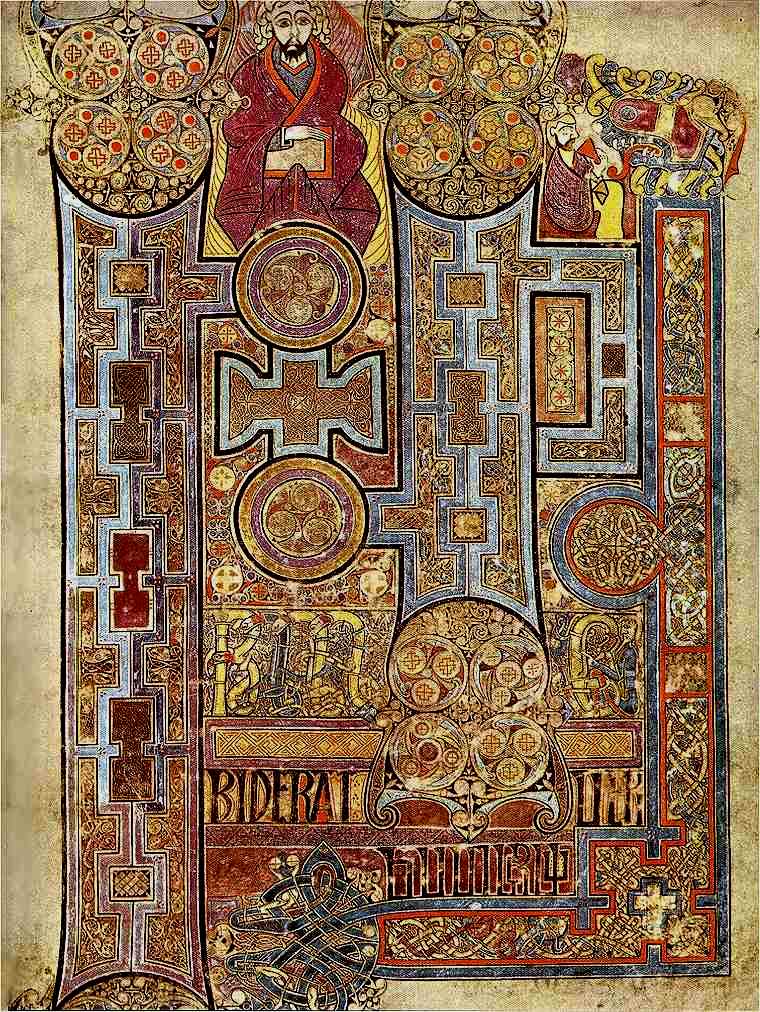
Surviving examples of Insular art are mainly illuminated manuscripts, metalwork and carvings in stone, especially stone crosses. Surfaces are highly decorated with intricate patterning, with no attempt to give an impression of depth, volume or recession. The best examples include the Book of Kells, Lindisfarne Gospels, Book of Durrow, brooches such as the Tara Brooch and the Ruthwell Cross. Carpet pages are a characteristic feature of Insular manuscripts, although historiated initials (an Insular invention), canon tables and figurative miniatures, especially Evangelist portraits, are also common.
This sense of the term as Insular (relating to one or more islands) derives from the phrase Insular script, first cited by the OED in 1908, though it seems clear from their 1908 quotation that the usage was already established; Carola Hicks dates the first use to 1901. It is also used by linguists for the Insular Celtic languages Initially used mainly to describe the style of decoration of illuminated manuscripts, which are certainly the most numerous type of major surviving objects using the style, the term is now used more widely across all the arts, and indeed for peoples, as in "Insular Celts" . It has the advantage of recognising the unity of styles across Britain and Ireland, while avoiding the use of the term British Isles, a sensitive topic in Ireland, and also circumventing arguments about the origins of the style, and the place of creation of specific works, which were often fierce in the 20th century and may be reviving in the 21st.
Some sources distinguish between a "wider period between the 5th and 11th centuries, from the departure of the Romans to the beginnings of the Romanesque style" and a "more specific phase from the 6th to 9th centuries, between the conversion to Christianity and the Viking settlements". C. R. Dodwell, on the other hand, says that in Ireland "the Insular style continued almost unchallenged until the Anglo-Norman invasion of 1170; indeed examples of it occur even as late as the thirteenth and fourteenth centuries".
The Insular style is most famous for its highly dense, intricate and imaginative decoration, which takes elements from several earlier styles. Late Iron Age Celtic art or "Ultimate La Tène", gave the love of spirals, triskeles, circles and other geometric motifs. These were combined with animal forms probably mainly deriving from the Germanic version of the general Eurasian animal style, though also from Celtic art, where heads terminating scrolls were common. Interlace was used by both these traditions, as well as Roman art (for example in floor mosaics) and other possible influences such as Coptic art, and its use was taken to new levels in Insular art, where it was combined with the other elements already mentioned.
There is no attempt to represent depth in manuscript painting, with all the emphasis on a brilliantly patterned surface. In early works the human figure was shown in the same geometric fashion as animal figures, but reflections of a classical figure style spread as the period went on, probably mostly from the southern Anglo-Saxon regions, though northern areas also had direct contacts with the Continent. The origins of the overall format of the carpet page have often been related to Roman floor mosaics, Coptic carpets and manuscript paintings, without general agreement being reached among scholars.
Hub AI
Insular art AI simulator
(@Insular art_simulator)
Insular art
Insular art, also known as Hiberno-Saxon art, was produced in the post-Roman era of Great Britain and Ireland. The term derives from insula, the Latin term for "island"; in this period Britain and Ireland shared a largely common style different from that of the rest of Europe. Art historians usually group Insular art as part of the Migration Period art movement as well as Early Medieval Western art, and it is the combination of these two traditions that gives the style its special character.
Most Insular art originates from the Irish monastic movement of Celtic Christianity, or metalwork for the secular elite, and the period begins around 600 with the combining of Celtic and Anglo-Saxon styles. One major distinctive feature is interlace decoration, in particular the interlace decoration as found at Sutton Hoo, in East Anglia. This is now applied to decorating new types of objects mostly copied from the Mediterranean world, above all the codex or book.
The finest period of the style was brought to an end by the disruption to monastic centres and aristocratic life caused by the Viking raids which began in the late 8th century. These are presumed to have interrupted work on the Book of Kells; no later Gospel books are as heavily or finely illuminated as the masterpieces of the 8th century. In England the style merged into Anglo-Saxon art around 900, whilst in Ireland the style continued until the 12th century, when it merged into Romanesque art. Ireland, Scotland and the kingdom of Northumbria in Northern England are the most important centres, but examples were found also in southern England, Wales and in Continental Europe, especially Gaul (modern France), in centres founded by the Hiberno-Scottish mission and Anglo-Saxon missions. The influence of Insular art affected all subsequent European medieval art, especially in the decorative elements of Romanesque and Gothic manuscripts.
Surviving examples of Insular art are mainly illuminated manuscripts, metalwork and carvings in stone, especially stone crosses. Surfaces are highly decorated with intricate patterning, with no attempt to give an impression of depth, volume or recession. The best examples include the Book of Kells, Lindisfarne Gospels, Book of Durrow, brooches such as the Tara Brooch and the Ruthwell Cross. Carpet pages are a characteristic feature of Insular manuscripts, although historiated initials (an Insular invention), canon tables and figurative miniatures, especially Evangelist portraits, are also common.
This sense of the term as Insular (relating to one or more islands) derives from the phrase Insular script, first cited by the OED in 1908, though it seems clear from their 1908 quotation that the usage was already established; Carola Hicks dates the first use to 1901. It is also used by linguists for the Insular Celtic languages Initially used mainly to describe the style of decoration of illuminated manuscripts, which are certainly the most numerous type of major surviving objects using the style, the term is now used more widely across all the arts, and indeed for peoples, as in "Insular Celts" . It has the advantage of recognising the unity of styles across Britain and Ireland, while avoiding the use of the term British Isles, a sensitive topic in Ireland, and also circumventing arguments about the origins of the style, and the place of creation of specific works, which were often fierce in the 20th century and may be reviving in the 21st.
Some sources distinguish between a "wider period between the 5th and 11th centuries, from the departure of the Romans to the beginnings of the Romanesque style" and a "more specific phase from the 6th to 9th centuries, between the conversion to Christianity and the Viking settlements". C. R. Dodwell, on the other hand, says that in Ireland "the Insular style continued almost unchallenged until the Anglo-Norman invasion of 1170; indeed examples of it occur even as late as the thirteenth and fourteenth centuries".
The Insular style is most famous for its highly dense, intricate and imaginative decoration, which takes elements from several earlier styles. Late Iron Age Celtic art or "Ultimate La Tène", gave the love of spirals, triskeles, circles and other geometric motifs. These were combined with animal forms probably mainly deriving from the Germanic version of the general Eurasian animal style, though also from Celtic art, where heads terminating scrolls were common. Interlace was used by both these traditions, as well as Roman art (for example in floor mosaics) and other possible influences such as Coptic art, and its use was taken to new levels in Insular art, where it was combined with the other elements already mentioned.
There is no attempt to represent depth in manuscript painting, with all the emphasis on a brilliantly patterned surface. In early works the human figure was shown in the same geometric fashion as animal figures, but reflections of a classical figure style spread as the period went on, probably mostly from the southern Anglo-Saxon regions, though northern areas also had direct contacts with the Continent. The origins of the overall format of the carpet page have often been related to Roman floor mosaics, Coptic carpets and manuscript paintings, without general agreement being reached among scholars.