Hubbry Logo
search
logo

Integral element

logo
Community Hub0 Subscribers
Read side by side
from Wikipedia

In commutative algebra, an element b of a commutative ring B is said to be integral over a subring A of B if b is a root of some monic polynomial over A.[1]

If A, B are fields, then the notions of "integral over" and of an "integral extension" are precisely "algebraic over" and "algebraic extensions" in field theory (since the root of any polynomial is the root of a monic polynomial).

The case of greatest interest in number theory is that of complex numbers integral over Z (e.g., or ); in this context, the integral elements are usually called algebraic integers. The algebraic integers in a finite extension field k of the rationals Q form a subring of k, called the ring of integers of k, a central object of study in algebraic number theory.

In this article, the term ring will be understood to mean commutative ring with a multiplicative identity.

Definition

[edit]

Let be a ring and let be a subring of An element of is said to be integral over if for some there exists in such that

The set of elements of that are integral over is called the integral closure of in The integral closure of any subring in is, itself, a subring of and contains If every element of is integral over then we say that is integral over , or equivalently is an integral extension of

Examples

[edit]

Integral closure in algebraic number theory

[edit]

There are many examples of integral closure which can be found in algebraic number theory since it is fundamental for defining the ring of integers for an algebraic field extension (or ).

Integral closure of integers in rationals

[edit]

Integers are the only elements of Q that are integral over Z. In other words, Z is the integral closure of Z in Q.

Quadratic extensions

[edit]

The Gaussian integers are the complex numbers of the form , and are integral over Z. is then the integral closure of Z in . Typically this ring is denoted .

The integral closure of Z in is the ring

This example and the previous one are examples of quadratic integers. The integral closure of a quadratic extension can be found by constructing the minimal polynomial of an arbitrary element and finding number-theoretic criterion for the polynomial to have integral coefficients. This analysis can be found in the quadratic extensions article.

Roots of unity

[edit]

Let ζ be a root of unity. Then the integral closure of Z in the cyclotomic field Q(ζ) is Z[ζ].[2] This can be found by using the minimal polynomial and using Eisenstein's criterion.

Ring of algebraic integers

[edit]

The integral closure of Z in the field of complex numbers C, or the algebraic closure is called the ring of algebraic integers.

Other

[edit]

The roots of unity, nilpotent elements and idempotent elements in any ring are integral over Z.

Integral closure in algebraic geometry

[edit]

In geometry, integral closure is closely related with normalization and normal schemes. It is the first step in resolution of singularities since it gives a process for resolving singularities of codimension 1.

  • For example, the integral closure of is the ring since geometrically, the first ring corresponds to the -plane unioned with the -plane. They have a codimension 1 singularity along the -axis where they intersect.
  • Let a finite group G act on a ring A. Then A is integral over AG, the set of elements fixed by G; see Ring of invariants.
  • Let R be a ring and u a unit in a ring containing R. Then[3]
  1. u−1 is integral over R if and only if u−1R[u].
  2. is integral over R.
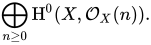
  3. The integral closure of the homogeneous coordinate ring of a normal projective variety X is the ring of sections[4]

Integrality in algebra

[edit]
  • If is an algebraic closure of a field k, then is integral over
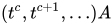
  • The integral closure of C[[x]] in a finite extension of C((x)) is of the form (cf. Puiseux series)[citation needed]

Equivalent definitions

[edit]

Let B be a ring, and let A be a subring of B. Given an element b in B, the following conditions are equivalent:

(i) b is integral over A;
(ii) the subring A[b] of B generated by A and b is a finitely generated A-module;
(iii) there exists a subring C of B containing A[b] and which is a finitely generated A-module;
(iv) there exists a faithful A[b]-module M such that M is finitely generated as an A-module.

The usual proof of this uses the following variant of the Cayley–Hamilton theorem on determinants:

Theorem Let u be an endomorphism of an A-module M generated by n elements and I an ideal of A such that . Then there is a relation:


This theorem (with I = A and u multiplication by b) gives (iv) ⇒ (i) and the rest is easy. Coincidentally, Nakayama's lemma is also an immediate consequence of this theorem.

Elementary properties

[edit]

Integral closure forms a ring

[edit]

It follows from the above four equivalent statements that the set of elements of that are integral over forms a subring of containing . (Proof: If x, y are elements of that are integral over , then are integral over since they stabilize , which is a finitely generated module over and is annihilated only by zero.)[5] This ring is called the integral closure of in .

Transitivity of integrality

[edit]

Another consequence of the above equivalence is that "integrality" is transitive, in the following sense. Let be a ring containing and . If is integral over and integral over , then is integral over . In particular, if is itself integral over and is integral over , then is also integral over .

Integral closed in fraction field

[edit]

If happens to be the integral closure of in , then A is said to be integrally closed in . If is the total ring of fractions of , (e.g., the field of fractions when is an integral domain), then one sometimes drops the qualification "in " and simply says "integral closure of " and " is integrally closed."[6] For example, the ring of integers is integrally closed in the field .

Transitivity of integral closure with integrally closed domains

[edit]

Let A be an integral domain with the field of fractions K and A' the integral closure of A in an algebraic field extension L of K. Then the field of fractions of A' is L. In particular, A' is an integrally closed domain.

Transitivity in algebraic number theory
[edit]

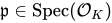
This situation is applicable in algebraic number theory when relating the ring of integers and a field extension. In particular, given a field extension the integral closure of in is the ring of integers .

Remarks

[edit]

Note that transitivity of integrality above implies that if is integral over , then is a union (equivalently an inductive limit) of subrings that are finitely generated -modules.

If is noetherian, transitivity of integrality can be weakened to the statement:

There exists a finitely generated -submodule of that contains .

Relation with finiteness conditions

[edit]

Finally, the assumption that be a subring of can be modified a bit. If is a ring homomorphism, then one says is integral if is integral over . In the same way one says is finite ( finitely generated -module) or of finite type ( finitely generated -algebra). In this viewpoint, one has that

is finite if and only if is integral and of finite type.

Or more explicitly,

is a finitely generated -module if and only if is generated as an -algebra by a finite number of elements integral over .

Integral extensions

[edit]

Cohen-Seidenberg theorems

[edit]

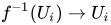
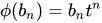
An integral extension A ⊆ B has the going-up property, the lying over property, and the incomparability property (Cohen–Seidenberg theorems). Explicitly, given a chain of prime ideals in A there exists a in B with (going-up and lying over) and two distinct prime ideals with inclusion relation cannot contract to the same prime ideal (incomparability). In particular, the Krull dimensions of A and B are the same. Furthermore, if A is an integrally closed domain, then the going-down holds (see below).

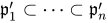
In general, the going-up implies the lying-over.[7] Thus, in the below, we simply say the "going-up" to mean "going-up" and "lying-over".

When A, B are domains such that B is integral over A, A is a field if and only if B is a field. As a corollary, one has: given a prime ideal of B, is a maximal ideal of B if and only if is a maximal ideal of A. Another corollary: if L/K is an algebraic extension, then any subring of L containing K is a field.

Applications

[edit]

Let B be a ring that is integral over a subring A and k an algebraically closed field. If is a homomorphism, then f extends to a homomorphism Bk.[8] This follows from the going-up.

Geometric interpretation of going-up

[edit]

Let be an integral extension of rings. Then the induced map
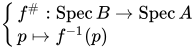
is a closed map; in fact, for any ideal I and is surjective if f is injective. This is a geometric interpretation of the going-up.

Geometric interpretation of integral extensions

[edit]

Let B be a ring and A a subring that is a noetherian integrally closed domain (i.e., is a normal scheme). If B is integral over A, then is submersive; i.e., the topology of is the quotient topology.[9] The proof uses the notion of constructible sets. (See also: Torsor (algebraic geometry).)


Integrality, base-change, universally-closed, and geometry

[edit]

If is integral over , then is integral over R for any A-algebra R.[10] In particular, is closed; i.e., the integral extension induces a "universally closed" map. This leads to a geometric characterization of integral extension. Namely, let B be a ring with only finitely many minimal prime ideals (e.g., integral domain or noetherian ring). Then B is integral over a (subring) A if and only if is closed for any A-algebra R.[11] In particular, every proper map is universally closed.[12]


Galois actions on integral extensions of integrally closed domains

[edit]
Proposition. Let A be an integrally closed domain with the field of fractions K, L a finite normal extension of K, B the integral closure of A in L. Then the group acts transitively on each fiber of .

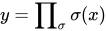
Proof. Suppose for any in G. Then, by prime avoidance, there is an element x in such that for any . G fixes the element and thus y is purely inseparable over K. Then some power belongs to K; since A is integrally closed we have: Thus, we found is in but not in ; i.e., .

Application to algebraic number theory

[edit]

The Galois group then acts on all of the prime ideals lying over a fixed prime ideal .[13] That is, if


then there is a Galois action on the set . This is called the Splitting of prime ideals in Galois extensions.

Remarks

[edit]

The same idea in the proof shows that if is a purely inseparable extension (need not be normal), then is bijective.

Let A, K, etc. as before but assume L is only a finite field extension of K. Then

(i) has finite fibers.
(ii) the going-down holds between A and B: given , there exists that contracts to it.

Indeed, in both statements, by enlarging L, we can assume L is a normal extension. Then (i) is immediate. As for (ii), by the going-up, we can find a chain that contracts to . By transitivity, there is such that and then are the desired chain.

Integral closure

[edit]

Let AB be rings and A' the integral closure of A in B. (See above for the definition.)

Integral closures behave nicely under various constructions. Specifically, for a multiplicatively closed subset S of A, the localization S−1A' is the integral closure of S−1A in S−1B, and is the integral closure of in .[14] If are subrings of rings , then the integral closure of in is where are the integral closures of in .[15]

The integral closure of a local ring A in, say, B, need not be local. (If this is the case, the ring is called unibranch.) This is the case for example when A is Henselian and B is a field extension of the field of fractions of A.

If A is a subring of a field K, then the integral closure of A in K is the intersection of all valuation rings of K containing A.

Let A be an -graded subring of an -graded ring B. Then the integral closure of A in B is an -graded subring of B.[16]

There is also a concept of the integral closure of an ideal. The integral closure of an ideal , usually denoted by , is the set of all elements such that there exists a monic polynomial

with with as a root.[17][18] The radical of an ideal is integrally closed.[19][20]

For noetherian rings, there are alternate definitions as well.

  • if there exists a not contained in any minimal prime, such that for all .
  • if in the normalized blow-up of I, the pull back of r is contained in the inverse image of I. The blow-up of an ideal is an operation of schemes which replaces the given ideal with a principal ideal. The normalization of a scheme is simply the scheme corresponding to the integral closure of all of its rings.

The notion of integral closure of an ideal is used in some proofs of the going-down theorem.

Conductor

[edit]

Let B be a ring and A a subring of B such that B is integral over A. Then the annihilator of the A-module B/A is called the conductor of A in B. Because the notion has origin in algebraic number theory, the conductor is denoted by . Explicitly, consists of elements a in A such that . (cf. idealizer in abstract algebra.) It is the largest ideal of A that is also an ideal of B.[21] If S is a multiplicatively closed subset of A, then

.

If B is a subring of the total ring of fractions of A, then we may identify

.

Example: Let k be a field and let (i.e., A is the coordinate ring of the affine curve ). B is the integral closure of A in . The conductor of A in B is the ideal . More generally, the conductor of , a, b relatively prime, is with .[22]

Suppose B is the integral closure of an integral domain A in the field of fractions of A such that the A-module is finitely generated. Then the conductor of A is an ideal defining the support of ; thus, A coincides with B in the complement of in . In particular, the set , the complement of , is an open set.

Finiteness of integral closure

[edit]

An important but difficult question is on the finiteness of the integral closure of a finitely generated algebra. There are several known results.

The integral closure of a Dedekind domain in a finite extension of the field of fractions is a Dedekind domain; in particular, a noetherian ring. This is a consequence of the Krull–Akizuki theorem. In general, the integral closure of a noetherian domain of dimension at most 2 is noetherian; Nagata gave an example of dimension 3 noetherian domain whose integral closure is not noetherian.[23] A nicer statement is this: the integral closure of a noetherian domain is a Krull domain (Mori–Nagata theorem). Nagata also gave an example of dimension 1 noetherian local domain such that the integral closure is not finite over that domain.[citation needed]

Let A be a noetherian integrally closed domain with field of fractions K. If L/K is a finite separable extension, then the integral closure of A in L is a finitely generated A-module.[24] This is easy and standard (uses the fact that the trace defines a non-degenerate bilinear form).

Let A be a finitely generated algebra over a field k that is an integral domain with field of fractions K. If L is a finite extension of K, then the integral closure of A in L is a finitely generated A-module and is also a finitely generated k-algebra.[25] The result is due to Noether and can be shown using the Noether normalization lemma as follows. It is clear that it is enough to show the assertion when L/K is either separable or purely inseparable. The separable case is noted above, so assume L/K is purely inseparable. By the normalization lemma, A is integral over the polynomial ring . Since L/K is a finite purely inseparable extension, there is a power q of a prime number such that every element of L is a q-th root of an element in K. Let be a finite extension of k containing all q-th roots of coefficients of finitely many rational functions that generate L. Then we have: The ring on the right is the field of fractions of , which is the integral closure of S; thus, contains . Hence, is finite over S; a fortiori, over A. The result remains true if we replace k by Z.

The integral closure of a complete local noetherian domain A in a finite extension of the field of fractions of A is finite over A.[26] More precisely, for a local noetherian ring R, we have the following chains of implications:[27]

(i) A complete A is a Nagata ring
(ii) A is a Nagata domain A analytically unramified the integral closure of the completion is finite over the integral closure of A is finite over A.

Noether's normalization lemma

[edit]

Noether's normalisation lemma is a theorem in commutative algebra. Given a field K and a finitely generated K-algebra A, the theorem says it is possible to find elements y1, y2, ..., ym in A that are algebraically independent over K such that A is finite (and hence integral) over B = K[y1,..., ym]. Thus the extension KA can be written as a composite KBA where KB is a purely transcendental extension and BA is finite.[28]

Integral morphisms

[edit]

In algebraic geometry, a morphism of schemes is integral if it is affine and if for some (equivalently, every) affine open cover of Y, every map is of the form where A is an integral B-algebra. The class of integral morphisms is more general than the class of finite morphisms because there are integral extensions that are not finite, such as, in many cases, the algebraic closure of a field over the field.

Absolute integral closure

[edit]

Let A be an integral domain and L (some) algebraic closure of the field of fractions of A. Then the integral closure of A in L is called the absolute integral closure of A.[29] It is unique up to a non-canonical isomorphism. The ring of all algebraic integers is an example (and thus is typically not noetherian).

See also

[edit]

Notes

[edit]

References

[edit]

Further reading

[edit]
Revisions and contributorsEdit on WikipediaRead on Wikipedia
from Grokipedia
In commutative algebra, an integral element of an extension ring $ S $ over a commutative ring with unity $ R $ is an element $ s \in S $ that satisfies a monic polynomial equation $ s^n + r_{n-1} s^{n-1} + \dots + r_1 s + r_0 = 0 $ with coefficients $ r_i \in R $.[1] This concept generalizes the notion of algebraic integers, where elements of algebraic number fields that are roots of monic polynomials over $ \mathbb{Z} $ are precisely the integers of those fields.[2] The collection of all elements in $ S $ that are integral over $ R $ forms a subring of $ S $ containing $ R $, known as the integral closure of $ R $ in $ S $.[2] A ring extension $ S/R $ is called integral if every element of $ S $ is integral over $ R $; in such cases, $ S $ is finitely generated as an $ R $-module whenever it is finitely generated as an $ R $-algebra.[3] Integral elements satisfy key closure properties: if $ \alpha $ and $ \beta $ are integral over $ R $, then so are their sum and product.[2] Integral extensions preserve significant structural features of rings, such as the lying-over theorem, which ensures that prime ideals in $ R $ extend to prime ideals in $ S $ in a surjective manner on the spectra.[3] They are foundational in algebraic geometry for studying morphisms of schemes and in number theory for analyzing Dedekind domains and unique factorization.[2] For instance, the ring of integers in a number field is the integral closure of $ \mathbb{Z} $ in that field, highlighting the role of integrality in arithmetic.[2]

Definitions and Equivalents

Definition

In commutative algebra, let RR be a commutative ring with identity and AA an RR-algebra; although AA need not be commutative in general, the notion of an integral element is typically studied when AA is commutative. An element αA\alpha \in A is integral over RR if there exists a positive integer nn and elements r0,r1,,rn1Rr_0, r_1, \dots, r_{n-1} \in R such that
αn+rn1αn1++r1α+r0=0. \alpha^n + r_{n-1} \alpha^{n-1} + \dots + r_1 \alpha + r_0 = 0.
[3] This equation means that α\alpha satisfies a monic polynomial of degree nn with coefficients in RR, i.e., f(x)=xn+rn1xn1++r0R[x]f(x) = x^n + r_{n-1} x^{n-1} + \dots + r_0 \in R[x] such that f(α)=0f(\alpha) = 0.[4]
The requirement that the polynomial be monic, with leading coefficient 11, ensures the definition captures elements that generate RR-submodules of finite type in a normalized way, independent of scaling by units in RR; a non-monic polynomial with leading coefficient in RR would not suffice if that coefficient is not a unit, potentially failing to preserve ring-like properties over RR.[3] This condition generalizes the classical notion of algebraic integers, where roots of monic polynomials over Z\mathbb{Z} form the integers of number fields. The concept of an integral element was introduced by Richard Dedekind in the context of algebraic integers during the 1870s, particularly in his supplements to Dirichlet's Vorlesungen über Zahlentheorie.[5]

Equivalent Definitions

An element αA\alpha \in A, where RR is a subring of the commutative ring AA, is integral over RR if and only if the subring R[α]R[\alpha] is finitely generated as an RR-module.[6] This equivalence holds because the monic polynomial condition implies that higher powers of α\alpha can be reduced, making {1,α,,αn1}\{1, \alpha, \dots, \alpha^{n-1}\} an RR-module basis for R[α]R[\alpha] where nn is the degree of the polynomial, and conversely, module-finiteness allows construction of a monic relation via linear algebra.[6] More precisely, R[α]R[\alpha] being finitely generated as an RR-module is equivalent to the existence of elements β1,,βmA\beta_1, \dots, \beta_m \in A such that
{1,α,α2,,αm1}j=1mRβj, \{1, \alpha, \alpha^2, \dots, \alpha^{m-1}\} \subseteq \sum_{j=1}^m R \beta_j,
meaning there exist rijRr_{ij} \in R satisfying αj=i=1mrijβi\alpha^j = \sum_{i=1}^m r_{ij} \beta_i for 0j<m0 \leq j < m.[6] This spanning condition captures the finite dependence of powers of α\alpha over RR. Since R[α]R[\alpha] is generated as a ring by adjoining α\alpha to RR, α\alpha is integral over RR if and only if the subring R[α]R[\alpha] is an integral extension of RR.[6] To see the equivalence between the monic polynomial condition and module-finiteness, suppose R[α]R[\alpha] is generated as an RR-module by β1,,βm\beta_1, \dots, \beta_m. Multiplication by α\alpha defines an RR-linear endomorphism of the RR-module spanned by the βj\beta_j, represented by a matrix T=(aij)T = (a_{ij}) with entries in RR such that αβj=iaijβi\alpha \beta_j = \sum_i a_{ij} \beta_i. The characteristic polynomial χ(T;X)=det(XIT)\chi(T; X) = \det(XI - T) is monic of degree mm with coefficients in RR. By the Cayley-Hamilton theorem, χ(T;α)=0\chi(T; \alpha) = 0, so α\alpha satisfies the monic polynomial χ(T;X)\chi(T; X), proving integrality. The converse direction follows directly from the polynomial reducing higher powers.[6] Another characterization, particularly useful in number-theoretic settings, involves traces: in a Dedekind domain RR with quotient field KK and finite-dimensional KK-algebra LL containing αL\alpha \in L, if the traces TrL/K(αi)\operatorname{Tr}_{L/K}(\alpha^i) lie in RR for nn consecutive powers ii starting from a sufficiently large exponent aa (with aa bounded above by O(nlogn)O(n \log n), where n=[L:K]n = [L:K]), then α\alpha is integral over RR. This condition ensures the ideal generated by such traces contains the unit ideal, aligning with integrality in these contexts.[7]

Fundamental Properties

Integral Closure as a Ring

The integral closure R\overline{R} of a subring RR in an RR-algebra AA is the set of all elements in AA that are integral over RR, where an element αA\alpha \in A is integral over RR if it satisfies a monic polynomial equation with coefficients in RR: αn+an1αn1++a0=0\alpha^n + a_{n-1} \alpha^{n-1} + \cdots + a_0 = 0 for some n1n \geq 1 and aiRa_i \in R.[8][9] This set R\overline{R} forms a subring of AA containing RR, and moreover, R\overline{R} is an R\overline{R}-algebra under the natural structure inherited from AA.[10][8] To establish that R\overline{R} is a ring, it suffices to verify closure under addition and multiplication, along with the presence of additive inverses and the multiplicative identity. First, RRR \subseteq \overline{R}, since every element of RR satisfies the monic polynomial xr=0x - r = 0 for rRr \in R. The multiplicative identity 1AA1_A \in A is integral over RR via the polynomial x1=0x - 1 = 0, so 1AR1_A \in \overline{R}. For additive inverses, if αR\alpha \in \overline{R} satisfies αn+an1αn1++a0=0\alpha^n + a_{n-1} \alpha^{n-1} + \cdots + a_0 = 0, then α-\alpha satisfies the same equation after multiplying by (1)n(-1)^n, confirming αR-\alpha \in \overline{R}.[9][10] The key properties are closure under sums and products. Suppose α,βR\alpha, \beta \in \overline{R}. Then R[α]R[\alpha] and R[β]R[\beta] are finitely generated as RR-modules, since integrality is equivalent to R[α]R[\alpha] being a finite RR-module. Thus, R[α,β]=R[α][β]R[\alpha, \beta] = R[\alpha][\beta] is also a finitely generated RR-module. Now consider γ=α+β\gamma = \alpha + \beta. The ring R[γ]R[\gamma] embeds into R[α,β]R[\alpha, \beta], and R[α,β]R[\alpha, \beta] is a faithful R[γ]R[\gamma]-module (as it contains 11). By the Cayley-Hamilton theorem applied to the regular representation of γ\gamma over this module, γ\gamma satisfies a monic polynomial over RR, so γR\gamma \in \overline{R}. Similarly, for δ=αβ\delta = \alpha \beta, R[δ]R[\delta] embeds into R[α,β]R[\alpha, \beta], which is faithful as an R[δ]R[\delta]-module, yielding the same conclusion via Cayley-Hamilton. This module-finiteness approach shows both the sum and product are integral over RR.[9][10][8] Furthermore, if α,βR\alpha, \beta \in \overline{R} and 1+β1 + \beta is a unit in AA, then α/(1+β)\alpha / (1 + \beta) is integral over RR. This follows because 1+β1 + \beta is integral over RR, its inverse is also integral over RR (as the inverse of an integral unit is integral), and the product of integral elements is integral.[2] In general, R\overline{R} properly contains RR unless AA is already integral over RR, in which case R=A\overline{R} = A. For instance, if AA is not integral over RR, elements outside RR but integral over it populate R\overline{R}, making it a strict extension. As an R\overline{R}-algebra, the multiplication in AA restricts to make R\overline{R} closed under the operations, preserving the ring structure.[9][8]

Transitivity of Integrality

One key property of integral elements is their transitivity across ring extensions. Specifically, if $ R \subseteq S \subseteq A $ are commutative rings and an element $ \alpha \in A $ is integral over $ S $, while $ S $ is an integral extension of $ R $ (meaning every element of $ S $ is integral over $ R $), then $ \alpha $ is integral over $ R $. This theorem ensures that integrality composes, allowing properties to propagate through chains of extensions.[11][12] The proof relies on the equivalent characterization of integrality in terms of module finiteness: $ \alpha $ is integral over $ S $ if and only if $ S[\alpha] $ is finitely generated as an $ S $-module. Since $ S $ is integral over $ R $, it is finitely generated as an $ R $-module, say by elements $ s_1, \dots, s_m $. Similarly, $ S[\alpha] $ is finitely generated as an $ S $-module by elements $ t_1, \dots, t_n $. To show $ S[\alpha] $ is finitely generated as an $ R $-module, consider the set of products $ { s_i t_j \mid 1 \leq i \leq m, 1 \leq j \leq n } $; any element of $ S[\alpha] $ can be expressed as an $ R $-linear combination of these products, establishing finite generation over $ R $. Thus, $ \alpha $ is integral over $ R $.[11] This transitivity has important implications for towers of ring extensions. In a tower $ R = R_0 \subseteq R_1 \subseteq \cdots \subseteq R_k = A $, if each consecutive pair $ R_i \subseteq R_{i+1} $ is integral, then the entire tower is an integral extension of $ R $ over $ A $, preserving integrality throughout the chain. Such towers arise frequently in algebraic number theory and geometry, facilitating the study of global properties from local ones.[11][12]

Integral Closedness in Fraction Fields

An integral domain $ R $ with fraction field $ K $ is integrally closed (or normal) if it equals its integral closure in $ K $, meaning every element of $ K $ that satisfies a monic polynomial equation with coefficients in $ R $ actually lies in $ R $.[13] This property holds for principal ideal domains, as any fraction $ a/b $ in reduced form that is integral over the domain must have $ b $ a unit, placing it in the domain itself.[13] More broadly, unique factorization domains are integrally closed, since factorization properties ensure that integral elements over the domain remain within it.[6] Not all domains exhibit this closedness; for example, the ring $ \mathbb{Z}[\sqrt{5}] $ is not integrally closed in its fraction field $ \mathbb{Q}(\sqrt{5}) $, as $ \frac{1 + \sqrt{5}}{2} $ satisfies the monic equation $ X^2 - X - 1 = 0 $ but does not belong to $ \mathbb{Z}[\sqrt{5}] $.[6] A significant transitivity result characterizes integral closedness in this setting: if $ R $ is an integrally closed domain with fraction field $ K $, and $ S $ is a subring of $ K $ containing $ R $ that is integral over $ R $, then the integral closure $ T $ of $ R $ in $ S $ is integrally closed in $ K $ (hence also in $ \mathrm{Frac}(S) $). To see this, suppose $ y \in K $ is integral over $ T $. By the transitivity of integrality, $ y $ is integral over $ R $. Since $ R $ is integrally closed in $ K $, it follows that $ y \in R \subseteq T $. Thus, $ T $ contains all elements of $ K $ integral over it.[14] The integral closure of a domain in its fraction field, often called its normalization, is always an integrally closed domain by the idempotence of integral closure. This normalization provides the "normal model" of the domain, resolving singularities in algebraic geometry contexts where applicable.[13]

Relation to Finiteness Conditions

In commutative algebra, integrality is closely linked to finiteness properties of ring extensions and modules. A key result is that if $ S $ is an integral extension of a ring $ R $ and $ S $ is finitely generated as an $ R $-algebra, then $ S $ is finitely generated as an $ R $-module; moreover, if $ R $ is Noetherian, then $ S $ is Noetherian.[6] This finiteness as a module follows from the fact that each generator of the algebra satisfies a monic polynomial over $ R $, allowing the powers to be expressed linearly in terms of a finite basis.[15] For the integral closure $ \bar{R} $ of a Noetherian ring $ R $ in a finite separable extension of its total ring of fractions, $ \bar{R} $ is finitely generated as an $ R $-module.[16] In particular, when $ R $ is a Noetherian normal domain with fraction field $ K $ and $ L/K $ is a finite separable extension, the integral closure of $ R $ in $ L $ is a finite $ R $-module.[16] Integral extensions also relate to other finiteness conditions, such as torsion-freeness and projectivity of modules. If $ R $ is an integral domain, then any integral extension $ S $ of $ R $ is torsion-free as an $ R $-module, meaning no nonzero element of $ S $ is annihilated by a nonzero element of $ R $.[6] In special cases, such as when $ R $ is a principal ideal domain (e.g., $ \mathbb{Z} $ or $ k[t] $ for a field $ k $) and $ S $ is the integral closure in a finite separable extension of the fraction field, $ S $ is a free (hence projective) $ R $-module of rank equal to the degree of the field extension.[6] However, integrality does not imply flatness in general. While torsion-freeness holds over domains, flatness requires the extension to preserve exact sequences, which fails in many cases where the module is finite but not projective over $ R $.[15] For instance, finite integral extensions that are not locally free of constant rank provide counterexamples to flatness.[15] In non-Noetherian settings, these finiteness properties can fail dramatically. For example, consider the ring $ R = k + x k[x^q \mid q \in \mathbb{Q}^+] $ over a field $ k $; this ring is not Noetherian, and for $ 0 < \alpha < 1 $, the element $ x^\alpha $ is integral over $ R $, but the ideal $ I_\alpha = x k[x^q \mid q \in \mathbb{Q}^+] $ annihilating the relation is not finitely generated as an $ R $-module.[17] Thus, the integral closure of $ R $ is not finitely generated as an $ R $-module.[17]

Examples

In Algebraic Number Theory

In algebraic number theory, the integral closure of the rational integers Z\mathbb{Z} in the field of rational numbers Q\mathbb{Q} is precisely Z\mathbb{Z} itself, as every element of Q\mathbb{Q} that satisfies a monic polynomial with coefficients in Z\mathbb{Z} must already lie in Z\mathbb{Z}.[18] A fundamental example arises in quadratic number fields. For a quadratic extension K=Q(d)K = \mathbb{Q}(\sqrt{d}) where dd is a square-free integer not equal to 0 or 1, the ring of integers OK\mathcal{O}_K, which is the integral closure of Z\mathbb{Z} in KK, takes the form Z[d]\mathbb{Z}[\sqrt{d}] if d2,3(mod4)d \equiv 2, 3 \pmod{4}, and Z[1+d2]\mathbb{Z}\left[\frac{1 + \sqrt{d}}{2}\right] if d1(mod4)d \equiv 1 \pmod{4}.[19] For instance, consider 2Q(2)\sqrt{2} \in \mathbb{Q}(\sqrt{2}); it satisfies the monic polynomial equation x22=0x^2 - 2 = 0 with integer coefficients, confirming its integrality over Z\mathbb{Z}, and Z[2]\mathbb{Z}[\sqrt{2}] forms the full ring of integers in this field.[19] In cyclotomic fields, the integral closure of Z\mathbb{Z} in K=Q(ζn)K = \mathbb{Q}(\zeta_n), where ζn\zeta_n is a primitive nnth root of unity, is the cyclotomic ring Z[ζn]\mathbb{Z}[\zeta_n].[20] This ring consists of all algebraic integers within the field and plays a central role in the study of units and ideal class groups for these extensions. The ring of all algebraic integers, denoted Z\overline{\mathbb{Z}}, is the maximal integral closure of Z\mathbb{Z} in the complex numbers C\mathbb{C}, comprising every complex number that satisfies a monic polynomial over Z\mathbb{Z}.[21] It serves as the universal domain for algebraic integers across all number fields. In the local setting, the pp-adic integers Zp\mathbb{Z}_p form the integral closure of Z\mathbb{Z} in the field of pp-adic numbers Qp\mathbb{Q}_p, for a prime pp, consisting of those elements with pp-adic valuation at least 0 that are integral over Z\mathbb{Z}.[22]

In Algebraic Geometry

In algebraic geometry, integral elements play a central role in the study of affine varieties through the integral closure of their coordinate rings. For an affine variety X=Spec(A)X = \mathrm{Spec}(A) over an algebraically closed field kk, where AA is the coordinate ring, an element in the function field k(X)k(X) is integral over AA if it satisfies a monic polynomial with coefficients in AA. The integral closure AνA^\nu of AA in k(X)k(X) is then the ring consisting of all such integral elements, and Spec(Aν)\mathrm{Spec}(A^\nu) provides the normalization X~X\tilde{X} \to X, a finite birational morphism that resolves singularities in a specific way. This process is particularly significant for curves, where the normalization yields a smooth model of the variety.[23][24] A classic example is the cuspidal curve defined by y2=x3y^2 = x^3 in Ak2\mathbb{A}^2_k, with coordinate ring A=k[x,y]/(y2x3)A = k[x, y]/(y^2 - x^3). This ring is not integrally closed, as the element t=y/xt = y/x in the function field satisfies the monic equation t2x=0t^2 - x = 0 over AA, making tt integral over AA. The integral closure is Aν=k[t]A^\nu = k[t], with the parametrization x=t2x = t^2, y=t3y = t^3, realizing the normalization as the affine line Ak1\mathbb{A}^1_k. Geometrically, this map C~C\tilde{C} \to C is an isomorphism away from the cusp at the origin, where the singularity is resolved by "unfolding" the curve into a smooth line. In contrast, the nodal curve y2=x3+x2=x2(x+1)y^2 = x^3 + x^2 = x^2(x + 1) has coordinate ring B=k[x,y]/(y2x3x2)B = k[x, y]/(y^2 - x^3 - x^2), featuring a node at the origin with two transverse branches. Adjoining t=y/xt = y/x yields t2=x+1t^2 = x + 1, so x=t21x = t^2 - 1, y=t(t21)y = t(t^2 - 1), and the integral closure is Bν=k[t]B^\nu = k[t], again normalizing to Ak1\mathbb{A}^1_k. Here, the normalization separates the branches, mapping two points on the line to the node.[25][25] The relation to resolution of singularities is that integrally closed domains correspond to normal varieties, which for curves (dimension one) are precisely the smooth ones, as their local rings are discrete valuation rings. Thus, normalization provides a minimal desingularization for plane curves, finite and birational, transforming singular affine varieties into normal ones via the integral closure. Geometrically, integral elements over the coordinate ring parametrize morphisms from normal varieties to the original XX; specifically, the normalization X~X\tilde{X} \to X is universal among finite birational morphisms from normal schemes, meaning any such morphism from another normal variety factors uniquely through it. This property underscores the role of integrality in capturing the "integral" or "non-fractional" parametrizations of maps between varieties.[24][23]

Other Integrality Examples

In the context of function fields, consider a field kk and the rational function field k(x)k(x). An element yy algebraic over k(x)k(x) satisfies a monic irreducible polynomial f(y)=0f(y) = 0 with coefficients in k[x]k[x], making yy integral over k[x]k[x]. For instance, if y2=x3+1y^2 = x^3 + 1, then yy is integral over k[x]k[x] because it roots the monic polynomial t2(x3+1)t^2 - (x^3 + 1), and the ring k[x][y]k[x][y] embeds into the algebraic closure of k(x)k(x).[10] Such algebraic functions highlight integrality bridging polynomial and rational structures without invoking geometric interpretations. Discrete valuation rings provide a key example of integrally closed domains. A discrete valuation ring (DVR) (R,m)(R, \mathfrak{m}) of Krull dimension 1, where m\mathfrak{m} is principal and generated by a uniformizer π\pi, is integrally closed in its fraction field K=Frac(R)K = \operatorname{Frac}(R).[8] To see this, suppose αK\alpha \in K is integral over RR, so α\alpha satisfies a monic polynomial tn+an1tn1++a0=0t^n + a_{n-1} t^{n-1} + \cdots + a_0 = 0 with aiRa_i \in R. Writing α=uπk\alpha = u \pi^k with uR×u \in R^\times and kZk \in \mathbb{Z}, the valuation v(α)=kv(\alpha) = k must be non-negative, as otherwise the constant term would force a contradiction in valuations, placing αR\alpha \in R.[26] Thus, every DVR is its own integral closure, exemplifying perfect integrality in valuation-theoretic settings. A basic polynomial example occurs in Z[x]\mathbb{Z}[x] over Z\mathbb{Z}. The indeterminate xx is not integral over Z\mathbb{Z}, as any monic polynomial tn+an1tn1++a0=0t^n + a_{n-1} t^{n-1} + \cdots + a_0 = 0 with aiZa_i \in \mathbb{Z} satisfied by xx would imply xn=an1xn1a0x^n = -a_{n-1} x^{n-1} - \cdots - a_0, but the left side has no constant term while the right does unless all ai=0a_i = 0, contradicting the monic assumption for n1n \geq 1.[12] However, roots of monic polynomials over Z\mathbb{Z} within Z[x]\mathbb{Z}[x], such as 2\sqrt{2} satisfying t22=0t^2 - 2 = 0, are integral over Z\mathbb{Z}, adjoining them via module-finiteness. In power series rings, integrality imposes relations on coefficients. For a power series ring R[t](/page/t)R[t](/page/t) over a domain RR, an element f(t)=bitiR[t](/page/t)f(t) = \sum b_i t^i \in R[t](/page/t) integral over R[t]R[t] requires its coefficients bib_i to satisfy monic polynomial equations with coefficients in R[t]R[t], often leading to recursive integral dependencies among the bib_i.[27] For example, if f(t)f(t) is algebraic over R(t)R(t), its minimal monic polynomial over R[t]R[t] ensures that the coefficients of f(t)f(t) generate a finitely generated module over R[t]R[t], constraining lower-order terms integrally from higher ones. This contrasts with free power series, where coefficients lack such relations.

Integral Extensions

Definition of Integral Extensions

In commutative algebra, a ring homomorphism ϕ:RS\phi: R \to S is called an integral extension (or integral ring map) if every element of SS is integral over the image ϕ(R)\phi(R), meaning that for each sSs \in S, there exists a monic polynomial P(x)=xn+an1xn1++a0ϕ(R)[x]P(x) = x^n + a_{n-1} x^{n-1} + \cdots + a_0 \in \phi(R)[x] such that P(s)=0P(s) = 0.[15] Equivalently, when viewing RR as a subring of SS via ϕ\phi, the extension RSR \subseteq S is integral if every element of SS satisfies such a monic equation with coefficients in RR.[6] Integral extensions are necessarily ring homomorphisms, and they satisfy the property that the composition of integral extensions is again integral; specifically, if RSR \to S and STS \to T are integral, then RTR \to T is integral, which follows from the transitivity of integrality for elements.[28] Moreover, if SS is integral over RR, then SS can be expressed as the union of all RR-subalgebras R[α1,,αk]R[\alpha_1, \dots, \alpha_k] generated by finite sets of elements αiS\alpha_i \in S, each of which is integral over RR.[6] While every integral ring extension induces an algebraic extension of fraction fields (assuming integral domains), the converse does not hold: there exist ring extensions where elements are algebraic over the fraction field of the base ring but not integral over the base ring itself. For instance, in the extension ZZ[1/2]\mathbb{Z} \subseteq \mathbb{Z}[1/2], the element 1/21/2 satisfies the equation 2x1=02x - 1 = 0 (hence algebraic over Q=Frac(Z)\mathbb{Q} = \operatorname{Frac}(\mathbb{Z})) but no monic polynomial over Z\mathbb{Z}.

Cohen-Seidenberg Theorems

The Cohen-Seidenberg theorems provide fundamental results on the behavior of prime ideals under integral ring extensions. These theorems, established in the context of commutative rings with identity, describe how prime ideals in the base ring RR "lie over" to the extension ring SS, where SS is integral over RR via a ring homomorphism ϕ:RS\phi: R \to S. Specifically, they ensure surjectivity and controlled chaining of the contraction map on spectra, Spec(S)Spec(R)\operatorname{Spec}(S) \to \operatorname{Spec}(R) given by Qϕ1(Q)Q \mapsto \phi^{-1}(Q).[29] The lying-over theorem states that for an integral extension RSR \to S, every prime ideal PP of RR admits at least one prime ideal QQ of SS such that QR=PQ \cap R = P. Equivalently, the map Spec(S)Spec(R)\operatorname{Spec}(S) \to \operatorname{Spec}(R) is surjective. To sketch the proof, localize at the multiplicative set S=RPS = R \setminus P, yielding the local ring SP=S1SS_P = S^{-1}S. Since SS is integral over RR, SPS_P is integral over RPR_P, and PSPP S_P is a proper ideal (as ring homomorphisms preserve the unit, preventing the image of RP/PRPR_P / P R_P from being zero). This proper ideal is contained in some maximal ideal MM of SPS_P (by Zorn's lemma). The contraction Q=MSQ = M \cap S is then a prime ideal of SS lying over PP.[29][8] The going-up theorem asserts that if PPP \subseteq P' are prime ideals in RR and QQ is a prime in SS with QR=PQ \cap R = P, then there exists a prime QQ' in SS such that QQQ \subseteq Q' and QR=PQ' \cap R = P'. This allows chains of prime ideals in RR to lift to chains in SS of the same length. The proof proceeds by applying the lying-over theorem in the quotient setting: consider the integral extension R/PS/QR/P \to S/Q, where the image of PP' lies over the zero ideal in R/PR/P (noting that integrality passes to such quotients), yielding a prime in S/QS/Q that pulls back to the desired QQ'.[29][30] Complementing these, the incomparability theorem guarantees that if Q1Q_1 and Q2Q_2 are distinct primes in SS both lying over the same prime PP in RR, then neither Q1Q2Q_1 \subseteq Q_2 nor Q2Q1Q_2 \subseteq Q_1. Thus, there are no primes strictly between a lying-over pair. The proof uses the fiber ring SRk(P)S \otimes_R k(P) (equivalently, SP/PSPS_P / P S_P), which is integral over the field k(P)k(P); hence, it is 0-dimensional, with all its prime ideals maximal. This implies that the primes over PP in Spec(S)\operatorname{Spec}(S) cannot be comparable, as their images in the fiber would form a strict chain of primes in a 0-dimensional ring.[29][31] These theorems imply that integral extensions preserve the Krull dimension: dimS=dimR\dim S = \dim R. Chains of primes in RR extend equivalently to SS via going-up, while lying-over and incomparability ensure no lengthening or shortening occurs, maintaining the supremum length of such chains. This dimension equality holds without further assumptions on normality or domains, unlike the going-down theorem, which requires additional conditions for descent.[29][8]

Geometric Interpretations

In scheme theory, an integral ring extension RSR \to S corresponds geometrically to a surjective morphism of affine schemes Spec(S)Spec(R)\operatorname{Spec}(S) \to \operatorname{Spec}(R), ensuring that every prime ideal in RR lies under at least one prime ideal in SS, which manifests as non-empty fibers over every point in Spec(R)\operatorname{Spec}(R).[32] This surjectivity arises from the lying-over theorem in commutative algebra, translated to the geometric setting where the map covers the base scheme completely. The going-up theorem further interprets integral extensions geometrically by preserving dimensions in the fibers: chains of prime ideals in RR of a given length map to chains in SS of the same length, implying that the fibers of the morphism Spec(S)Spec(R)\operatorname{Spec}(S) \to \operatorname{Spec}(R) have dimension zero at generic points while maintaining overall dimension equality between source and target for dominant maps.[32] Integral morphisms are thus universally closed, meaning they are closed in the Zariski topology and remain so under arbitrary base changes, which reflects the stability of integral dependence under localization and completion. This closedness ensures that images of closed subsets remain closed, providing a robust framework for studying geometric closures and resolutions. Integral extensions are stable under base change, so if RSR \to S is integral, then for any ring map RRR \to R', the induced map RSRRR' \to S \otimes_R R' is also integral, preserving the geometric properties of the morphism in fiber products.[32] A prominent example is the normalization map for an integral scheme XX: the normalization X~X\tilde{X} \to X is an integral morphism that is birational, meaning it induces an isomorphism on dense open subsets, and becomes an isomorphism if XX is already normal.[23] This map resolves singularities while maintaining the birational equivalence essential for studying varieties up to rational maps.

Galois Actions on Integral Extensions

In a Galois extension L/KL/K of number fields, with rings of integers OK\mathcal{O}_K and OL\mathcal{O}_L, the Galois group Gal(L/K)\mathrm{Gal}(L/K) acts on OL\mathcal{O}_L by field automorphisms that fix KK pointwise, thereby mapping integral elements over OK\mathcal{O}_K to other integral elements, preserving the ring structure.[33] This action extends naturally to the integral closure of OK\mathcal{O}_K in LL, which coincides with OL\mathcal{O}_L when OK\mathcal{O}_K is integrally closed.[34] A key result states that if OK\mathcal{O}_K is integrally closed in its fraction field KK, then for a finite Galois extension [L/K](/page/Galoisextension)[L/K](/page/Galois_extension), the ring OL\mathcal{O}_L is precisely the integral closure of OK\mathcal{O}_K in LL, and the action of Gal(L/K)\mathrm{Gal}(L/K) on this closure is well-defined and faithful in the sense that it respects the integrality condition.[33] This theorem ensures that the arithmetic structure of the extension is preserved under the Galois symmetries, facilitating the study of ideals and units in OL\mathcal{O}_L. An important application arises in the analysis of ramification via Dedekind's discriminant theorem: in such an extension, a prime ideal p\mathfrak{p} of OK\mathcal{O}_K ramifies in OL\mathcal{O}_L if and only if p\mathfrak{p} divides the discriminant ideal DOL/OK\mathfrak{D}_{\mathcal{O}_L / \mathcal{O}_K}, where the discriminant is computed using the Galois action on an integral basis of OL\mathcal{O}_L over OK\mathcal{O}_K.[35] This criterion leverages the transitive action of Gal(L/K)\mathrm{Gal}(L/K) on the prime ideals of OL\mathcal{O}_L lying over p\mathfrak{p} to characterize the ramification behavior.[34] The subring fixed by the full Galois group action, OLGal(L/K)\mathcal{O}_L^{\mathrm{Gal}(L/K)}, recovers exactly OK\mathcal{O}_K, reflecting the invariance of the base ring under the symmetries of the extension.[33] Furthermore, the trace and norm maps induced by the Galois action are compatible with integrality: for αOL\alpha \in \mathcal{O}_L, the trace TrL/K(α)OK\mathrm{Tr}_{L/K}(\alpha) \in \mathcal{O}_K and the norm NL/K(α)OKN_{L/K}(\alpha) \in \mathcal{O}_K, as these are sums and products over the Galois conjugates, each of which remains integral.[34] In equation form, if {σi}\{\sigma_i\} enumerates Gal(L/K)\mathrm{Gal}(L/K),
TrL/K(α)=iσi(α),NL/K(α)=iσi(α), \mathrm{Tr}_{L/K}(\alpha) = \sum_i \sigma_i(\alpha), \quad N_{L/K}(\alpha) = \prod_i \sigma_i(\alpha),
both landing in OK\mathcal{O}_K when α\alpha is integral over OK\mathcal{O}_K.[33]

Integral Closure and Finiteness

Integral Closure

In commutative algebra, given a commutative ring $ R $ with unity and an $ R $-algebra $ A $, the integral closure of $ R $ in $ A $, denoted $ \overline{R} $ or $ A^i $, is defined as the subring consisting of all elements $ \alpha \in A $ that are integral over $ R $, meaning each such $ \alpha $ satisfies a monic polynomial with coefficients in $ R $.[36] This construction forms a ring containing $ R $, and integrality is preserved under localization: if $ S $ is a multiplicative subset of $ R $, then the integral closure of $ S^{-1}R $ in $ S^{-1}A $ coincides with $ S^{-1}\overline{R} $.[37] For integral domains, the integral closure takes on a particularly significant role as the normalization of the domain. Specifically, if $ R $ is an integral domain with fraction field $ K $, then the integral closure of $ R $ in $ K $ is the largest subring of $ K $ consisting of elements integral over $ R $; a domain $ R $ is called normal if it equals this integral closure.[37] Every unique factorization domain is normal, as its elements satisfy monic polynomials derived from their factorizations.[37] A notable property in the context of Dedekind domains is that the integral closure of a Dedekind domain in a finite extension of its fraction field is again a Dedekind domain, preserving the structure of being Noetherian, integrally closed, and one-dimensional.[38] Computing the integral closure, especially for affine domains or reduced Noetherian rings, relies on normalization algorithms that identify integral elements by solving for roots of monic polynomials or leveraging the Rees algebra to detect integrality.[39] These methods, often implemented in systems like Singular, proceed by iteratively adjoining integral elements until the ring stabilizes, with conductors providing bounds on the process by measuring the "distance" to normality without fully resolving the extension.[40] For polynomial rings over fields, such algorithms efficiently handle the finite generation under Noetherian hypotheses.

Finiteness of Integral Closure

A fundamental result in commutative algebra states that if RR is a Noetherian ring and AA is an integral extension of RR, then the integral closure R\overline{R} of RR in AA is finitely generated as an RR-module.[41] This theorem ensures that the process of taking the integral closure preserves the Noetherian property in a controlled manner, allowing R\overline{R} to be viewed as a finite RR-module extension. The proof relies on the Artin-Rees lemma to manage filtrations associated with ideals in the Rees algebra R[It]R[It], where II is an ideal of RR. For the complete local Noetherian case, the Cohen structure theorem embeds RR into a power series ring, and separability arguments (using traces in separable extensions) show that R\overline{R} is contained in a finitely generated submodule. In the general Noetherian setting, localization at maximal ideals reduces the problem to the local case, with Artin-Rees ensuring that the powers of ideals stabilize sufficiently to yield finite generation globally.[41] An element αA\alpha \in A contributes to this generation via its integral dependence relation, satisfying a monic polynomial equation
αn+an1αn1++a1α+a0=0, \alpha^n + a_{n-1} \alpha^{n-1} + \cdots + a_1 \alpha + a_0 = 0,
where each aiRa_i \in R; the powers 1,α,,αn11, \alpha, \dots, \alpha^{n-1} span a finite RR-submodule, and the Noetherian condition limits the number of such relations needed to cover R\overline{R}.[42] In non-Noetherian rings, this finiteness fails. For instance, consider a valuation domain with value group Q\mathbb{Q}, which is not Noetherian; its integral closure in an extension may require infinitely many generators due to the dense ordering of valuations. Another counterexample is the ring R=k[X1,X2,]/(X1Xnnn2)R = k[X_1, X_2, \dots] / (X_1 - X_n^n \mid n \geq 2) over a field kk, where ascending chains of ideals do not stabilize, and R\overline{R} is not finitely generated over RR.[41] In algebraic geometry, this finiteness theorem implies that the normalization morphism Spec(R)Spec(R)\operatorname{Spec}(\overline{R}) \to \operatorname{Spec}(R) is finite, meaning the normalization of an affine scheme is a finite cover. This property is crucial for resolving singularities, as it allows normalization to be computed effectively and preserves properties like dimension and irreducibility in birational geometry.[16]

Conductor

In commutative algebra, for an integral domain RR with field of fractions KK and integral closure Rˉ\bar{R} in KK, the conductor ideal CC of RR is defined as the annihilator ideal AnnR(Rˉ/R)\operatorname{Ann}_R(\bar{R}/R), consisting of all elements rRr \in R such that rRˉRr \bar{R} \subseteq R.[41] This ideal captures the extent to which RR fails to be integrally closed, serving as a measure of how "integral" RR is relative to its closure.[41] Equivalently, CC is the largest ideal of RR that is also an ideal in Rˉ\bar{R}.[2] The conductor CC is an ideal in both RR and Rˉ\bar{R}, and if Rˉ\bar{R} is finitely generated as an RR-module, then CC contains a non-zerodivisor of RR.[41] In the case of one-dimensional Noetherian analytically unramified local rings, CC is mm-primary, where mm is the maximal ideal.[41] This structure highlights CC's role in assessing the deviation from normality, with R=RˉR = \bar{R} implying C=RC = R.[41] The annihilator characterization implies that rCr \in C if and only if r(αβ)=0r(\alpha - \beta) = 0 for all αRˉ\alpha \in \bar{R} and βR\beta \in R, since elements of Rˉ/R\bar{R}/R are cosets α+R\alpha + R.[41] This condition underscores CC's connection to the module structure of the extension. In algebraic number theory, for an order OO in the ring of integers OK\mathcal{O}_K of a number field KK, the conductor cc relates to the discriminant ideal DO/ZD_{O/\mathbb{Z}} and the different ideal DOK/ZD_{\mathcal{O}_K/\mathbb{Z}} via the formula DO/Z=NOK/Z(c)DOK/ZD_{O/\mathbb{Z}} = N_{\mathcal{O}_K/\mathbb{Z}}(c) \cdot D_{\mathcal{O}_K/\mathbb{Z}}, where NN denotes the norm.[35] This linkage shows how the conductor influences ramification and the scaling of discriminants in subrings. For quadratic orders, such as those in imaginary quadratic fields Q(d)\mathbb{Q}(\sqrt{d}) with d<0d < 0 square-free, the conductor ideal takes the explicit form C=(f)C = (f), where fZ0f \in \mathbb{Z}_{\geq 0} is the conductor of the order, and the discriminant of the order is f2dKf^2 d_K with dKd_K the field discriminant.[43] This computation facilitates explicit analysis of ideal class groups and prime splitting in such extensions.[43]

Advanced Topics

Noether's Normalization Lemma

Noether's normalization lemma asserts that if kk is a field and AA is a finitely generated kk-algebra, then there exist algebraically independent elements z1,,zdAz_1, \dots, z_d \in A (where dd is the Krull dimension of AA) such that the subring B=k[z1,,zd]B = k[z_1, \dots, z_d] is a polynomial ring and AA is integral over BB, meaning AA is a finitely generated module over BB.[44] This result, originally proved by Emmy Noether in 1926 under the assumption that kk is infinite, was later extended to finite fields by Akizuki and Nagata.[45] The proof proceeds by induction on the number of generators of AA. Suppose A=k[x1,,xn]/IA = k[x_1, \dots, x_n]/I for some ideal II. If the images of the xix_i are algebraically independent, then d=nd = n and the lemma holds trivially. Otherwise, there exists a nonzero polynomial fIf \in I of minimal degree e1e \geq 1. Choose exponents ai=enia_i = e^{n-i} for i=1,,n1i = 1, \dots, n-1 and define new elements yi=xiαxnaiy_i = x_i - \alpha x_n^{a_i} for a generic αk\alpha \in k (ensuring the leading term of ff involves a power of xnx_n that makes the relation monic in xnx_n). This substitution yields a monic polynomial equation in xnx_n over k[y1,,yn1]k[y_1, \dots, y_{n-1}], showing that AA is integral over the subalgebra generated by the yiy_i. By induction, this subalgebra contains a polynomial subring over which AA is integral, and transitivity of integral extensions completes the argument.[44][45] Geometrically, the lemma implies that the affine variety corresponding to AA admits a finite morphism to affine dd-space Akd\mathbb{A}^d_k, where the map is given by the inclusion k[z1,,zd]Ak[z_1, \dots, z_d] \hookrightarrow A. This homomorphism ϕ:k[z1,,zd]A\phi: k[z_1, \dots, z_d] \to A satisfies the property that AA is module-finite over its image, capturing the finite-type nature of the extension.[44] Applications of the lemma abound in dimension theory: since integral extensions preserve Krull dimension, dimA=d=dimB\dim A = d = \dim B, providing a concrete realization of the dimension as the transcendence degree of the fraction field of AA over kk.[44] It also plays a key role in proving Hilbert's Nullstellensatz; for example, if AA is a field (so dimA=0\dim A = 0), then AA is a finite algebraic extension of kk, implying that maximal ideals in finitely generated kk-algebras correspond to points in affine space over algebraic closures of kk.[45]

Integral Morphisms

In algebraic geometry, an integral morphism of schemes is defined as follows: given a morphism f:XSf: X \to S, it is integral if ff is affine and, for every affine open subscheme Spec(R)S\operatorname{Spec}(R) \subset S, the preimage f1(Spec(R))=Spec(A)f^{-1}(\operatorname{Spec}(R)) = \operatorname{Spec}(A) where the ring homomorphism RAR \to A makes AA an integral extension of RR, meaning every element of AA satisfies a monic polynomial equation with coefficients in RR.[46] This condition ensures that the fibers of ff behave like integral ring extensions locally on the base.[46] Integral morphisms possess several key categorical properties. By definition, they are affine morphisms.[47] They are stable under base change: if f:XSf: X \to S is integral and SSS' \to S is any morphism, then the base-changed morphism X×SSSX \times_S S' \to S' is also integral. Composition preserves integrality: the composite of two integral morphisms is integral. Moreover, integral morphisms are universally closed, meaning that for any base change, the resulting morphism is closed (maps closed sets to closed sets).[48] An integral morphism that is locally of finite type is finite. In the context of scheme theory, finite morphisms—those where the structure sheaf pushforward fOXf_* \mathcal{O}_X is locally finitely generated as an OS\mathcal{O}_S-module—are a special case of integral morphisms.[47] Conversely, an integral morphism that is locally of finite type is finite. Finite morphisms are proper under suitable conditions, such as when the target scheme is locally Noetherian.[49] A notable cohomological property is that for a finite morphism f:XSf: X \to S, the pushforward sheaf fOXf_* \mathcal{O}_X is coherent whenever ff is of finite presentation. These properties make integral morphisms fundamental in studying families of schemes and their geometric invariants.

Absolute Integral Closure

The absolute integral closure of an integral domain $ R $, denoted $ R^+ $, is defined as the integral closure of $ R $ in an algebraic closure of its fraction field $ \mathrm{Frac}(R) $. This construction provides a universal integral extension that incorporates all elements algebraic over $ \mathrm{Frac}(R) $ while remaining integral over $ R $. For domains, $ R^+ $ is unique up to non-canonical isomorphism.[50] In positive characteristic $ p $, $ R^+ $ exhibits special structure related to the Frobenius endomorphism. Specifically, for a reduced Noetherian domain $ R $, $ R^+ $ coincides with its perfect closure, which is the union $ \bigcup_{n \geq 0} R^{1/p^n} $, where $ R^{1/p^n} $ consists of the $ p^n $-th roots of elements in $ \mathrm{Frac}(R) $ that are integral over $ R $. Moreover, if $ R $ is a local Noetherian domain that is an image of a Cohen-Macaulay local ring, then $ R^+ $ is a big Cohen-Macaulay algebra.[51][52] In mixed characteristic, the absolute integral closure of a Henselian local domain inherits desirable homological properties from its base ring. For instance, if $ R $ is an analytically irreducible Henselian local ring, the completion of $ R^+ $ remains an integral domain and satisfies Cohen-Macaulayness. This contrasts with pure characteristic 0, where $ R^+ $ may require careful construction to ensure it forms a ring without additional assumptions, as the lack of Frobenius action complicates the closure process. For example, in characteristic 0, the absolute integral closure of $ kt $ (with $ k $ a field) is $ \bigcup_{n \geq 1} kt^{1/n} $.[53][54] A notable example occurs when $ R = \mathbb{Z} $, where $ \mathbb{Z}^+ $ is the ring of all algebraic integers, and every finitely generated ideal in $ \mathbb{Z}^+ $ is principal, making it a Bézout domain.[54] The absolute integral closure finds applications in anabelian geometry and étale cohomology, particularly in demonstrating that cohomology classes with coefficients in finite flat group schemes over a base scheme can be annihilated by finite covers of the base.[54]

References

User Avatar
No comments yet.