Hubbry Logo
Internal SettlementInternal SettlementMain
Open search
Internal Settlement
Community hub
Internal Settlement
logo
8 pages, 0 posts
0 subscribers
Be the first to start a discussion here.
Internal Settlement
Internal Settlement
from Wikipedia
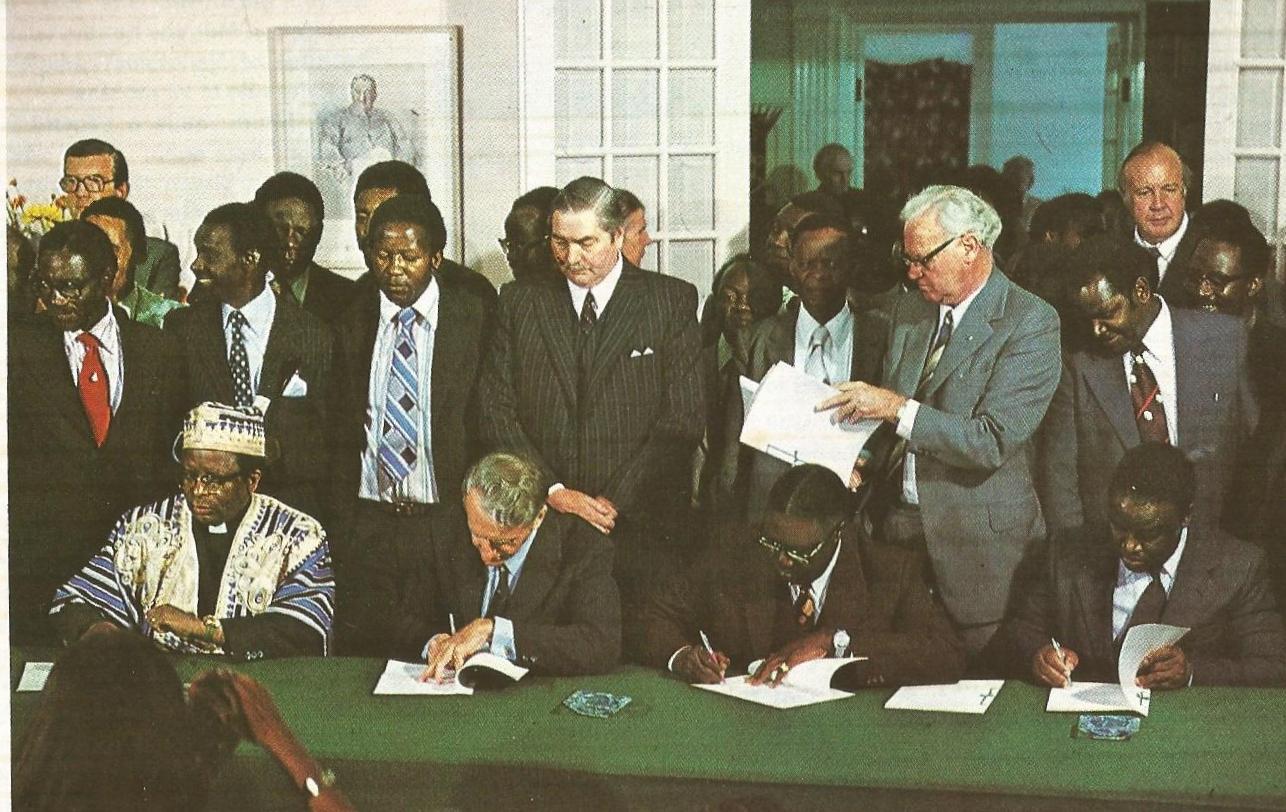
Signing the Rhodesian Internal Settlement (from left: Bishop Abel Muzorewa, Ian Smith, Jeremiah Chirau and Ndabaningi Sithole)

The Internal Settlement (also called the Salisbury Agreement[1][2]) was an agreement which was signed on 3 March 1978 between Prime Minister of Rhodesia Ian Smith and the moderate African nationalist leaders comprising Bishop Abel Muzorewa, Ndabaningi Sithole and Senator Chief Jeremiah Chirau.[2][3] After almost 15 years of the Rhodesian Bush War, and under pressure from the sanctions placed on Rhodesia by the international community, and political pressure from South Africa, the United Kingdom, and the United States, the Rhodesian government met with some of the internally based moderate African nationalist leaders in order to reach an agreement on the political future for the country.[4]

Background

[edit]

By 1975–1976, it was clear that an indefinite postponement of majority rule, which had been the cornerstone of the Smith Government's strategy since Unilateral Declaration of Independence, was no longer viable. The country was under commercial and financial sanctions pursued by the British and guerrilla action was being launched against Rhodesia by the Zimbabwe African People's Union (ZAPU) and the Zimbabwe African National Union (ZANU).[5] With the Carnation Revolution ending Portuguese rule in Mozambique the situation of the Rhodesian government was deteriorating. Overt South African support for Rhodesia was waning, due to growing sentiment in Pretoria that white rule in such an overwhelmingly black country (blacks outnumbered whites by 22-to-1) could not be maintained forever.[6] South Africa began scaling back economic assistance to Rhodesia, placed limits on the amount of fuel and munitions being supplied to the Rhodesian Security Forces, and withdrew the personnel and equipment they had previously provided to aid the war effort, including a border police unit that had been helping guard the Rhodesia-Zambia border.[7] Furthermore, South Africa became concerned about the conflict's scale, and pursued a policy of supporting a "friendly" Black government in Zimbabwe. This was followed by South African attempts to negotiate with nationalist leaders and pressure the Rhodesians into this objective with the help of Zambian president Kenneth Kaunda.[8]

Late in 1976, Ian Smith, after his attempted internal settlement with Joshua Nkomo of the ZAPU failed, accepted the basic elements of the compromise proposals made by US Secretary of State Henry Kissinger to introduce majority rule within two years.[9][8] The Smith Government then sought to negotiate an acceptable settlement with moderate black leaders, while retaining strong white influence in key areas. The Rhodesian military, in turn, aimed to erode the rising military strength of the ZANLA and ZIPRA to the greatest extent possible in order to "buy time" for an acceptable political settlement to be reached. The response from Nkomo's ZAPU and Robert Mugabe's ZANU was to form the Patriotic Front, uniting ZAPU and ZANU efforts, and escalate the fighting in the conflict.[10]

By 1977, the war had spread throughout Rhodesia. ZANLA continued to operate from Mozambique and remained dominant among the Mashona peoples in eastern and central Rhodesia. Meanwhile, ZIPRA remained active in the north and west, using bases in Zambia and Botswana, and were mainly supported by the Ndebele tribes.[11] With this escalation came sophistication, organisation and modern weapons for the guerrillas, and although many were still untrained, an increasing number were trained in Communist bloc and other sympathetic countries.[12] The United Nations Security Council denounced the incursion of the "illegal racist minority regime in Southern Rhodesia" in Resolution 411, on June 30, 1977.[13]

Settlement terms and goals

[edit]

The agreement led to the creation of an interim government in which Africans were included in leading positions for the first time, while creating an independent civil service, judiciary, police force, and army.[14][15] The settlement also created an executive council composed of Ian Smith and three black individuals (Muzorewa, Sithole, and Chirau),[10] and a ministerial council, while Smith retained his title as prime minister. It was also stated that the primary job of this new government was to draw up a constitution for the country, hold elections in April 1979,[10] and arrange a ceasefire with the Patriotic Front.[16][17] A further goal of the agreement was said to be the hope of ending the country's civil war.[17]

Two further goals of the settlement were international recognition and the removal of sanctions imposed after Rhodesia's Unilateral Declaration of Independence in 1965. Following the settlement, Muzorewa attempted to convince the British government to recognize the transitional government, but they did not do so.[18] In the same vein, some believed that the settlement was "sufficient" grounds for recognition of Rhodesia and lifting sanctions.[17] Later in 1978, the removal of sanctions was agreed to by the U.S. House of Representatives and U.S. Senate, with the caveat that they could only be lifted "once elections were held".[19] The settlement also reportedly resulted in the release of political prisoners.[20]

Impact

[edit]

Following the agreement, Muzorewa and his UANC party were elected during the general election of March 1979,[21][17] which had an electorate qualified by educational standard and/or income and/or worth of property owned, not by race.[citation needed] However, ZAPU and ZANU refused to participate in the elections.[22] The United Nations Security Council passed several resolutions against the "illegal" election, including Resolution 445 and Resolution 448, both of which argued that the election was not representative of the Zimbabwean people and was designed to entrench white minority rule. In these resolutions, the UN declared the results of the election null and void.[23][24]

A new government of national unity with Bishop Abel Muzorewa as Prime Minister took office on June 1, 1979.[25] The country was renamed Zimbabwe Rhodesia, and a new national flag was later adopted signifying the transition. It was expected that all sanctions would be lifted now that the country was under democratically elected black majority rule.[26] However, the lifting of sanctions did not occur mainly because the Patriotic Front, composed of the externally based African nationalist parties of ZAPU and ZANU under the respective leadership of Joshua Nkomo and Robert Mugabe, had not been involved in the political process and had not participated in the general election. Under mounting international pressure, particularly from Jimmy Carter, Andrew Young and the British Government, Muzorewa was persuaded to take part in negotiations at Lancaster House late 1979.[27]

The agreement at the Lancaster House Conference between the Zimbabwe Rhodesia and British Governments, ZAPU and ZANU in December 1979 resulted in a ceasefire and the end of the Rhodesian Bush War.[28] The country returned to legality under direct British rule with Lord Soames as governor, thereby ending the rebellion against the British Crown caused by the signing of Rhodesia's Unilateral Declaration of Independence in November 1965.[29] Under the terms of the Lancaster House Agreement, a fresh general election was held in February 1980. Following this, the country attained its independence as the Republic of Zimbabwe on April 18, 1980. Robert Mugabe was elected as the country's first prime minister.[30]

Reaction

[edit]

Before settlement

[edit]

On February 17, 1978, before the agreement was concluded, Nkomo warned that the settlement would lead to increased fighting.[31] On February 28, British foreign secretary David Owen would tell Kingman Brewster Jr., the U.S. Ambassador to the United Kingdom, that he did not believe the settlement was "viable".[32] Seven days earlier, U.S. Deputy National Security Advisor David L. Aaron warned, in a meeting of the National Security Council Special Coordination Committee, that the Soviet Union would enter southern Africa "as a result of the internal settlement in Rhodesia".[33]

After settlement

[edit]

After the internal settlement was announced, the United Kingdom and the United States – in separate statements – said that they viewed the settlement as a step in the right direction, but nevertheless inadequate because ZANU and ZAPU were not included.[34][35][18] Each of the Frontline States – Angola, Botswana, Mozambique, Tanzania, and Zambia – condemned the settlement as a "sell-out" and accused Muzorewa, Sithole, and Chirau of being complicit with the Rhodesian government, which they saw as illegal.[34] The Patriotic Front, composed of ZANU and ZAPU, also condemned the settlement and similarly accused the three black signatories of being Rhodesian puppets.[34][36][37] It vowed to continue fighting until attaining a military victory in the war.[34] The Council of Ministers of the Organisation of African Unity had several days earlier – at its thirtieth ordinary session in Tripoli, Libya, from 20 to 28 February 1978 – foreseen the prospect of a settlement, and issued a statement condemning any agreement that did not include the Patriotic Front.[34][38]

At the meeting of the European Council from April 7–8, 1978, they concluded that the settlement was "inadequate" and endorsed the Anglo-American Initiative on Rhodesia as the "best basis" of an acceptable settlement, and stated that all sides involved need to be brought together in order to avoid "a dangerous escalation of the conflict.[39] It was also reported by the Central Intelligence Agency's National Foreign Assessment Center that television in Havana, Cuba was critical of the settlement, while Nkomo and Mugabe visited Cuba later in the year.[40] In addition, Max T. Chigwida of the South African Institute of International Affairs stated that the agreement's terms had been subjected to a "lot of criticisms and propaganda based on...motives by all sorts of critics"[3] while scholar Tendai Mutunhu said the settlement created a "puppet black regime", prevented a socialist government in Zimbabwe, said the "masses" in the country opposed it, and claimed that the settlement was being supported by huge transnational corporations and foreign investors.[41]

Prompted by the request of the African Group within the United Nations, the UN Security Council of discussed the issue of Rhodesia's internal settlement at its 2061st to 2067th meetings from 6–14 March 1978.[34] Robert Mugabe and Joshuo Nkomo spoke before the council and condemned the settlement.[34] On March 14, 1978, the Security Council adopted Resolution 423, which condemned the internal settlement as "illegal and unacceptable".[34][42] Canada, France, the US, the UK, and West Germany abstained from the vote.[42] The same day, the U.N. Security Council passed Resolution 424 calling for the end of the "illegal racist minority régime" in Rhodesia.[43] At the World Conference against Racism, organized by UNESCO, in August 1978, participants condemned the settlement as a "blatant attempt to split the national liberation movement" in an attempt to cause civil war and perpetuate "racist minority rule" in the country, stated it cannot be an "acceptable solution" to ensure majority rule in the country.[44]

Legacy

[edit]

Scholars Roland Oliver and Anthony Atmore noted that although Rhodesia had taken a "momentous step" toward a primarily Black government, the country would not have "lasting peace" and international recognition until exiled nationalists were accommodated.[10] In an obituary for Muzorewa, in The Guardian, in 2010, Cameron Duodu wrote that the settlement did not "stop the guerrilla warfare" nor was it recognized by the United Nations, with sanctions on Rhodesia continuing, while Muzorewa became "tainted as an opportunist and a sell-out".[45] Zimbabwean scholar Richard S. Maposa stated, in 2013, that although there was "no international recognition" for the settlement, which he described as a "painful interlude", it still facilitated the "transitional process" of the country toward Black majority rule.[46]

Further reading

[edit]

References

[edit]
Revisions and contributorsEdit on WikipediaRead on Wikipedia
from Grokipedia
The Internal Settlement was an agreement signed on 3 March 1978 between Rhodesian Prime Minister Ian Smith and moderate black nationalist leaders Bishop Abel Muzorewa, Ndabaningi Sithole, and Chief Jeremiah Chirau, establishing a transitional framework for majority rule in Rhodesia through universal suffrage and elections, deliberately excluding the Soviet- and Chinese-backed Patriotic Front insurgents. The accord created an executive council with black participation in governance for the first time, promised an amnesty for combatants, and set the stage for a new constitution abolishing racial qualifications for voting and office-holding. In April 1979, elections under the agreement saw Muzorewa's win 67% of the vote and 51 of 72 common-roll seats in the House of Assembly, reflecting broad black support for the internal path to power-sharing amid the ongoing War. The resulting Zimbabwe-Rhodesia government, with Muzorewa as prime minister and Smith retaining influence in security matters, represented the first instance of majority rule in the territory but faced rejection from Western powers and the , who prioritized inclusion of the Patriotic Front despite its rejection of electoral participation and commitment to Marxist one-party rule. This lack of recognition prolonged sanctions and the conflict, culminating in the externally imposed Lancaster House Agreement later that year, which facilitated Robert Mugabe's ascension and the subsequent economic decline of Zimbabwe. The Internal Settlement's defining characteristic was its emphasis on negotiated, democratic transition over armed victory, a approach undermined by international insistence on empowering violent non-state actors aligned with communist interests.

Historical Background

Origins of the Rhodesian Bush War

On November 11, 1965, Rhodesia's Prime Minister Ian Smith issued the Unilateral Declaration of Independence (UDI) from Britain, citing the need to safeguard standards of responsible government and minority rights against London's policy of "no independence before majority rule," which demanded immediate transition to black majority control without protections for the white settler population or economic structures. This move, modeled on the 1776 American declaration, aimed to preserve self-determination amid escalating pressures from African nationalists and British withdrawal from colonial oversight, but it isolated Rhodesia internationally and triggered UN sanctions that strained its export-dependent economy, particularly tobacco and minerals. The ensuing bush war began with limited guerrilla incursions by the Zimbabwe African People's Union (ZAPU) from bases in independent Zambia starting in 1966, followed by the Zimbabwe African National Union (ZANU) establishing its own operations; these early attacks were repelled but marked the shift from political agitation to armed insurgency against the white-minority regime. Conflict escalated dramatically after Mozambique's 1975 independence, when the Marxist FRELIMO government permitted ZANU's Zimbabwe African National Liberation Army (ZANLA) to use eastern border sanctuaries for infiltration, enabling larger-scale operations backed by Chinese arms and training for ZANLA and Soviet support—including AK-47 rifles and heavy weapons—for ZAPU's Zimbabwe People's Revolutionary Army (ZIPRA). By 1977, intensified cross-border launches contributed to annual combat deaths exceeding 1,000, predominantly guerrillas, amid rural farm attacks and urban terrorism that disrupted agriculture and civilian life. Rhodesian security forces achieved tactical dominance through innovations like Fireforce—rapid helicopter-borne assaults combining paratroops, ground troops, and air strikes—and preemptive cross-border raids, such as Operation Dingo in November 1977, which destroyed ZANLA camps in Mozambique and inflicted over 1,000 guerrilla casualties with minimal Rhodesian losses. These successes, yielding kill ratios often exceeding 10:1, stemmed from superior training, mobility, and intelligence, yet proved unsustainable due to a shrinking white population—strained by universal conscription of males aged 18-50 and net emigration of around 20,000 whites between 1976 and 1979 amid war fatigue and sanctions-induced economic contraction. Sanctions, while evaded through smuggling via South Africa and Portugal, reduced GDP growth and foreign exchange, compounding the manpower drain as skilled professionals departed, foreshadowing the internal pressures that later prompted settlement initiatives.

Failed Prior Negotiations and Internal Pressures

The Anglo-Rhodesian talks aboard HMS Tiger in December 1966 proposed constitutional changes building on the 1961 framework, including provisions for gradual progress toward majority rule, but required Rhodesia to suspend its unilateral declaration of independence and return temporarily to British control for implementation. Ian Smith rejected these terms on December 4, 1966, primarily because they demanded relinquishing sovereignty before securing irreversible safeguards against unchecked amendments that could enable one-party dominance and minority disenfranchisement. African nationalists, in turn, dismissed the proposals as perpetuating white minority veto power without immediate transfer to majority rule. Subsequent negotiations aboard HMS Fearless in October 1968 reiterated similar Anglo-Rhodesian terms, incorporating modifications like enhanced entrenched clauses for minority protections but insisting on a British test of acceptability via an independent commission and oversight on constitutional amendments. Smith rejected them on November 18, 1968, citing inadequate guarantees against hasty erosion of blocking mechanisms and the unacceptable precondition of reinstating British authority, which risked exposing Rhodesia to externally imposed formulas favoring rapid majority takeover. Nationalists opposed the plan for entrenching white influence too deeply, viewing it as delaying genuine black empowerment. The 1976 Kissinger initiative, involving U.S.-British diplomacy with South African and regional leaders, culminated in the Geneva Conference from October 28 to December 14, 1976, aiming for a transitional framework with majority rule within two years alongside security guarantees. The talks collapsed due to Patriotic Front demands—led by Joshua Nkomo and Robert Mugabe—for exclusive control of the transition without disarming their forces, coupled with British insistence on their full inclusion regardless of ceasefire compliance, rendering compromise impossible amid mutual accusations of bad faith. Internally, by late 1977, intensified guerrilla incursions had fostered war weariness among white Rhodesians, particularly farmers who produced nearly 80% of agricultural output and faced direct threats, contributing to rising emigration rates—such as a net loss of over 500 whites monthly by late 1976, accelerating amid attacks on rural areas. Moderate black leaders, including Bishop Abel Muzorewa, grew frustrated with Patriotic Front intransigence, which prioritized armed escalation over negotiation and rejected internal power-sharing to end the violence affecting civilians. Demographic realities compounded pressures on Smith: the white population, hovering around 250,000, stagnated and began declining due to emigration outpacing inflows, while the black majority exceeded 6 million, underscoring the unsustainability of prolonged conflict without local reconciliation. These factors shifted focus toward an internal settlement rooted in domestic stakeholders rather than external impositions prone to deadlock.

Negotiation and Agreement

Principal Negotiators and Their Positions

The principal negotiators of the Internal Settlement were Prime Minister Ian Smith of the Rhodesian Front and three moderate black nationalist leaders: Bishop Abel Muzorewa of the United African National Council, Reverend Ndabaningi Sithole of the Zimbabwe African National Union splinter faction, and Chief Jeremiah Chirau of the Zimbabwe United People's Organisation. Formal talks commenced on December 2, 1977, following Smith's announcement of intent to pursue an internal accord with resident black leaders amid escalating guerrilla warfare and stalled external mediation efforts. These discussions, spanning roughly three months, reflected a shared pragmatic assessment that foreign-brokered solutions overlooked domestic tribal dynamics and the preferences of non-militant Africans for negotiated stability over protracted conflict. Ian Smith, as head of the white-minority Rhodesian Front government, entered negotiations prioritizing safeguards for the European community's economic and security roles, which he viewed as foundational to Rhodesia's prosperity and defense against insurgency. He conceded majority rule in principle, advocating a transitional framework to avert immediate white exodus and economic collapse, driven by the unsustainable costs of the Bush War—over 1,000 security force deaths by 1977—and international isolation. Smith's position emphasized empirical realism: rejecting unqualified one-man-one-vote as a recipe for chaos akin to post-colonial failures elsewhere in Africa, while accepting phased power transfer to vetted moderates to preserve institutional continuity. Bishop Abel Muzorewa, a Methodist cleric leading the United African National Council, positioned himself as a bridge for peaceful majority rule, rejecting the Patriotic Front's armed struggle as counterproductive Marxist agitation that alienated rural Africans. His motivation centered on inclusive governance to halt civilian casualties—estimated at thousands from crossfire and reprisals—and leverage his organizational base among urban and mission-educated blacks for a non-violent path to independence. Muzorewa argued that internal dialogue better captured moderate African sentiments, sidelined by external powers favoring guerrillas despite their limited domestic support. Ndabaningi Sithole, ousted from ZANU leadership in 1974 and heading a rival faction, endorsed the settlement as a bulwark against communist dominance, campaigning actively among blacks to frame it as authentic nationalism free from Patriotic Front coercion. He sought to end the war's devastation, which had displaced over 500,000 rural Africans by 1978, by integrating traditional and moderate voices into governance, critiquing external proposals for ignoring local rejection of Mugabe and Nkomo's tactics. Chief Jeremiah Chirau, a senior traditional leader via ZUPO, represented tribal authorities wary of urban radicals, advocating settlement terms that respected customary structures and protected rural stability amid insurgency disruptions. Though his personal following was modest, Chirau's involvement underscored elite African consensus on prioritizing de-escalation over ideological purity, viewing the accord as a pragmatic counter to Patriotic Front violence that exacerbated famine and displacement in tribal areas. Collectively, these figures advanced the settlement to forge a viable alternative to total war, grounded in the observed preference of non-combatant majorities for compromise over the guerrillas' rejectionist stance.

Core Provisions and Safeguards

The Internal Settlement agreement, signed on 3 March 1978 by Rhodesian Prime Minister Ian Smith and moderate African leaders Bishop Abel Muzorewa, Ndabaningi Sithole, and Chief Jeremiah Chirau, outlined a transitional framework to achieve majority rule through universal adult suffrage while incorporating mechanisms to safeguard minority interests. The agreement established an Executive Council comprising the four signatories, which exercised supreme authority during the transition, making decisions by consensus under a rotating chairmanship. Complementing this, a Ministerial Council was formed with an equal number of black and white ministers holding coequal powers, operating on majority vote decisions and rotating chairmanship to ensure balanced input in executive functions. The existing Rhodesian Parliament retained limited roles, convening only as summoned by the Executive Council for essential legislation and constitutional ratification. Electorally, the agreement mandated one-man-one-vote elections by for a 100-member , structured to balance representation: 72 seats elected via a common roll accessible to all qualified voters aged over 18, and 28 seats for to protect minority concerns in areas such as , judicial appointments, and composition. Of the reserved seats, 20 were to be filled by a preferential roll limited to white voters, with the remaining 8 contested on the common roll but by candidates nominated within the white community, thereby guaranteeing substantive white influence without racial franchise restrictions. Constitutional safeguards formed the agreement's core protections against potential majority overreach, including a justiciable Bill of Rights enforceable by an independent judiciary, entrenched guarantees for land tenure and property rights to prevent arbitrary expropriation, and provisions preserving merit-based civil service appointments. Amendments to these entrenched clauses required a supermajority of 78% in the assembly, while the reserved white seats were secured for a minimum of 10 years (or two parliaments), after which an independent commission would review their necessity based on demographic and political stability factors. These mechanisms aimed to facilitate a phased transition to full majority rule by moderate elements, enabling a ceasefire with non-militant African factions and preserving Rhodesia's economic foundations in agriculture and industry, while deliberately excluding participation by armed groups like the Patriotic Front unless they disarmed, to avoid legitimizing violence as a path to power.

Implementation as Zimbabwe-Rhodesia

Establishment of the Transitional Government

The Internal Settlement agreement, signed on 3 March 1978 by Rhodesian Prime Minister Ian Smith and moderate African leaders Bishop Abel Muzorewa, Reverend Ndabaningi Sithole, and Chief Jeremiah Chirau, immediately established an Executive Council to direct the transitional government. This body, chaired by Smith, comprised the four signatories and coordinated with a Ministerial Council of 18 members to maintain administrative continuity, ensuring essential state functions such as security, finance, and public services operated without interruption during the shift toward majority rule. For the first time, the black leaders assumed substantive cabinet roles, including oversight of key portfolios, which facilitated incremental power transfer while preserving Rhodesia's operational stability amid ongoing insurgency. To embed these arrangements constitutionally, amendments were drafted to expand political participation and rename the territory Zimbabwe-Rhodesia, reflecting nominal inclusivity. On 30 January 1979, these changes were endorsed in a referendum limited to white voters, securing over 85% approval from participating electors (with turnout around 75%), thereby legitimizing the framework for transitional governance without altering core minority protections. The Executive prioritized seamless power by incorporating moderate recruits into structures, aiming to broaden composition and for a Patriotic Front ceasefire to de-escalate hostilities; these initiatives, however, encountered rejection from external insurgents, necessitating sustained reliance on existing Rhodesian defense mechanisms to avert functional .

1979 Elections and Constitutional Changes

Elections for the House of Assembly were held in Rhodesia from April 17 to 21, 1979, marking the first universal adult suffrage vote for the majority of seats, with approximately 2.9 million eligible voters, predominantly black Africans, participating. Voter turnout reached 64.5%, with 1,869,000 ballots cast, a figure that Rhodesian officials and observers interpreted as a strong endorsement of moderate internal solutions over the Patriotic Front's armed struggle, especially given the boycott by Robert Mugabe's ZANU and Joshua Nkomo's ZAPU. Bishop Abel Muzorewa's United African National Council (UANC) secured 51 of the 72 seats reserved for African representatives, capturing 1,212,639 votes or 67% of the total, while Ndabaningi Sithole's Zimbabwe African National Union (ZANU) won 12 seats with 262,926 votes (16.5%). The elections were monitored by over 70 observers and 160 foreign journalists, including teams from Union, American , , and a British delegation led by Boyd, who generally reported the process as free, , and efficiently conducted under challenging wartime conditions, with no widespread irregularities noted despite isolated allegations from Sithole. Following the results, Muzorewa was appointed as the first black Prime Minister on June 1, 1979, with Ian Smith serving as Minister without Portfolio to advise on matters, symbolizing a transition from overt white minority rule while preserving institutional continuity. The accompanying for the newly named Zimbabwe-Rhodesia expanded political through and a black-majority assembly but incorporated safeguards for the minority, including 28 seats in the and a veto power over amendments to entrenched clauses on , , and , ensuring against radical expropriation amid ongoing . These changes facilitated the maintenance of rule of law, economic functionality, and administrative stability during intensified bush war operations, providing a moderate governance model that prioritized incremental reform over revolutionary upheaval.

Domestic Reactions

Support from Moderates and White Rhodesians

White Rhodesians demonstrated strong endorsement of the Internal Settlement through a constitutional referendum held on January 30, 1979, approving the framework for limited black majority rule with entrenched minority protections by an overwhelming margin. This vote reflected a preference among the white electorate for negotiated power-sharing over capitulation to the Patriotic Front's demands, as evidenced by pre-referendum polling indicating majority opposition to unconditional surrender amid escalating guerrilla incursions. Among black moderates, support manifested in widespread participation in the April 1979 elections under the settlement's transitional arrangements, where Bishop Abel Muzorewa's United African National Council secured 1,212,639 votes, comprising 67 percent of the total and winning 51 of 72 common-roll seats. Leaders like Muzorewa, Rev. Ndabaningi Sithole, and Chief Jeremiah Chirau framed the agreement as a viable route to political empowerment without the risks of Patriotic Front dominance, which relied on Soviet and Chinese external backing; this resonated with urban and rural moderates wary of Marxist-oriented dictatorship. Some Patriotic Front rank-and-file defected or surrendered following the settlement's announcement, citing disillusionment with external leadership and incentives for reintegration, though overall insurgent momentum persisted. The settlement yielded tangible domestic gains, including temporary reductions in urban disturbances as moderate black factions mobilized rallies and voter registration drives, fostering a perception of stability over chaos. Agricultural output, particularly tobacco and maize, continued to expand despite international sanctions, enabling exports valued at over $320 million in 1976—up 20 percent from prior years—and sustaining food self-sufficiency amid the Bush War. These outcomes underscored voluntary alignment from key demographics prioritizing pragmatic continuity over ideological extremes.

Opposition from Patriotic Front and Radicals

The Patriotic Front, comprising Robert Mugabe's ZANU and Joshua Nkomo's ZAPU, denounced the Internal Settlement as a "treacherous sellout" orchestrated by Ian Smith to perpetuate white minority influence under a facade of black participation. Mugabe and Nkomo rejected inclusion unless it entailed immediate one-man-one-vote elections without power-sharing safeguards or disarmament, conditions they refused to meet, prioritizing their external armed campaigns backed by Soviet and Chinese support over internal compromise. This stance reflected self-interested preservation of their guerrilla hierarchies, as disarmament would have diluted their leverage in any post-war power distribution. In response, Patriotic Front forces escalated guerrilla incursions into Rhodesia, targeting the settlement's legitimacy through intensified attacks on infrastructure, security forces, and civilian areas to coerce rejection of the process. ZANU cadres, operating from Mozambique, conducted assassinations and intimidation against perceived collaborators, including allies of moderate leaders like Ndabaningi Sithole, whose ZANU faction had been supplanted by Mugabe's wing amid earlier internal purges. Such violence aimed to eliminate rivals who endorsed negotiated transitions, underscoring the Front's reliance on coercion to suppress domestic black opposition to their monopoly on representation. The Patriotic Front's united front masked deep ethnic and ideological fissures: ZANU's predominantly Shona forces clashed violently with ZAPU's Ndebele-oriented ZIPRA in joint camps, erupting in bloody infighting that highlighted incompatible visions—Mugabe's Marxist-Leninist orientation versus Nkomo's Soviet-aligned socialism—and longstanding tribal animosities tracing to historical Shona-Ndebele rivalries. These rifts, including mutual accusations of betrayal during the 1970s, undermined claims of monolithic black nationalism, as PF unity served tactical alliance against Smith rather than genuine ideological cohesion. Despite the boycott and threats, the April 1979 elections under the settlement framework drew over 60% turnout among eligible black voters, with Bishop Abel Muzorewa's United African National Congress securing 67% of votes (1,212,639 total), signaling substantial civilian endorsement of moderate internal reform over PF's externally imposed radicalism. This empirical support indicated the Front primarily commanded loyalty from its armed insurgents and exile networks, not the broader populace weary of protracted war, further exposing exclusion from the settlement as a consequence of their insistence on military preconditions incompatible with verifiable peaceful transition.

International Reactions

Western Governments and Sanctions Policy

The Carter administration in the United States refused to recognize the Internal Settlement or lift economic sanctions imposed under the United Nations, despite Bishop Abel Muzorewa's direct appeals for support during meetings with Secretary of State Cyrus Vance in March 1978 and subsequent diplomatic efforts. On June 7, 1979, President Jimmy Carter explicitly announced the continuation of sanctions, arguing that unilateral U.S. action would undermine broader negotiations requiring inclusion of the Patriotic Front guerrillas, a position that prioritized diplomatic leverage with frontline African states over immediate endorsement of the moderate-led government. Similarly, the United Kingdom under Prime Minister James Callaghan withheld recognition, adhering to the precondition of all-party participation including the excluded Patriotic Front, as reiterated in parliamentary statements rejecting the settlement as incompatible with Britain's five principles for majority rule. This policy stance aligned with United Nations Security Council Resolution 423, adopted on March 14, 1978, which declared the Internal Settlement "illegal and unacceptable" for failing to secure participation from all political parties and demanded adherence to prior resolutions mandating comprehensive negotiations. Western non-engagement contributed to the persistence of hostilities, with Rhodesian security forces reporting over 3,000 deaths in the four months following the April 1979 elections—comprising approximately 1,800 insurgents, 1,100 black civilians and security personnel, and dozens of whites—amid intensified guerrilla incursions that the unrecognized government could not diplomatically curtail. Empirical assessments indicate that sanctions maintenance exacerbated economic pressures, limiting the transitional regime's capacity to stabilize and negotiate ceasefires independently, thereby prolonging a conflict where Soviet- and Chinese-backed insurgents held territorial gains disproportionate to their internal political support. In contrast, segments of the U.S. , including Senator , advocated privately and publicly for recognition, facilitating Muzorewa's White House meeting and pushing to conditionally lift sanctions, emphasizing the economic resilience demonstrated by Rhodesia's agricultural exports and industrial output under moderate African . A House to repeal sanctions narrowly failed by six votes, reflecting congressional toward executive that deferred to international consensus favoring Patriotic Front inclusion, despite of the internal government's broader electoral mandate among non-combatant Africans. This divergence underscores a causal dynamic where executive branches in Washington and London subordinated pragmatic endorsement of viable moderate governance to geopolitical calculations aimed at neutralizing Soviet proxy advancements through multilateral concessions, rather than isolated anti-racial criteria, as the settlement had already transferred executive power to a black-led coalition.

African Frontline States and Soviet Bloc Influence

The African Frontline States, comprising Zambia, Mozambique, Tanzania, and Botswana, hosted operational bases for the Patriotic Front's ZIPRA and ZANLA forces, providing logistical rear areas that sustained cross-border incursions into Rhodesia despite the economic burdens of the conflict on their own territories. Following the Internal Settlement's signing on March 3, 1978, these states coordinated through summits and statements to reject the agreement outright, viewing it as insufficiently inclusive of Patriotic Front leadership and demanding instead a framework that prioritized ZANU and ZAPU control, effectively seeking the subordination of moderate African nationalists and retention of white administrative roles only under PF oversight. This stance preserved their regional leverage, as acquiescence to the settlement risked diminishing the guerrillas' sanctuary status and exposing them to retaliatory Rhodesian strikes, though it exacerbated their own vulnerabilities, such as Zambia's disrupted rail links and Mozambique's infrastructure sabotage. Soviet and Chinese support amplified the Frontline States' rejectionism by bolstering Patriotic Front capabilities, with the USSR providing arms, training, and advisors to ZAPU's ZIPRA via Zambian bases—totaling thousands of rifles, mortars, and anti-aircraft systems by 1978—while portraying the aid as backing authentic anti-colonial resistance against a purported Western proxy. China, conversely, equipped and trained ZANU's ZANLA forces in Mozambique with infantry weapons and guerrilla tactics, dispatching cadres to camps where over 10,000 fighters received instruction in Maoist protracted warfare doctrines, similarly rationalized as anti-imperialist solidarity but causally equipping forces whose rhetoric included threats of post-victory ethnic purges against non-aligned groups. These external patrons, leveraging the Frontline States' hosting role, incentivized prolonged hostilities to forestall any internal resolution that might entrench non-communist governance, as evidenced by aligned OAU resolutions echoing demands for PF dominance. Empirically, the rejection correlated with intensified guerrilla activity post-March 1978, as ZIPRA and ZANLA launched over 2,000 documented incursions in 1978 alone—up from prior years—targeting economic infrastructure and civilian areas to discredit the settlement and coerce escalation, with Rhodesian security forces neutralizing approximately 3,000 insurgents that year amid heightened Soviet and Chinese resupplies. This dynamic undermined prospects for internal stabilization, as Frontline insistence on total capitulation to PF terms, backed by bloc materiel, prioritized ideological clientelism over pragmatic de-escalation, despite the states' own mounting war-related losses exceeding $500 million annually by late 1978.

Outcomes and Dissolution

Escalation of the Bush War

The rejection of the Internal Settlement by the Patriotic Front in 1978 prompted an immediate surge in guerrilla activity, as ZANLA and ZIPRA forces sought to undermine the agreement through escalated urban and rural assaults. On , 1978, ZIPRA operatives launched a precision attack on the Salisbury storage depot in the Southerton suburb, destroying over 250,000 barrels of —equivalent to more than a month's supply—and causing damages estimated at $20 million, which crippled civilian and military logistics amid ongoing sanctions. This strike, followed by similar mortar and rocket barrages on Salisbury in early 1979, including during the April elections that targeted polling stations and oil facilities, demonstrated the Patriotic Front's strategy of rejecting internal reconciliation in favor of total military victory, supported by Soviet and Chinese arms supplies. Rhodesian Security Forces, though achieving tactical successes, faced mounting operational pressures as guerrilla incursions from Mozambique and Zambia intensified post-settlement. In response to ZANLA's buildup, Operation Miracle—launched September 21, 1979—involved a deep-penetration raid by Rhodesian troops into Gaza Province, Mozambique, targeting the massive Mavonde training complex; the assault killed an estimated 200-300 guerrillas and destroyed infrastructure, but stretched RSF resources thin due to extended supply lines and air support losses, including a downed Hunter fighter. By mid-1979, RSF mobilization had expanded to over 10,000 regulars, 15,000 reservists, and auxiliary units, yet protected villages and fireforce deployments could not fully contain the cross-border influx, as the settlement's exclusion of Patriotic Front leaders precluded any coordinated de-escalation. Economic pressures compounded the military strain, with UN sanctions unchanged after the settlement's announcement, limiting fuel imports and foreign exchange despite adaptive measures like domestic refining and covert trade networks that maintained GDP growth at around 5% annually through 1979. White emigration, which had reached 11,241 departures in the first nine months of 1978 amid war fatigue, continued at elevated rates into 1979 but showed signs of moderation following the June elections and Muzorewa's ascension, as some settlers viewed the multiracial government as a stabilizing influence against radical takeover, temporarily stemming the white population decline from its 1976 peak of approximately 280,000. Casualties reached their zenith in 1979, with official figures indicating nearly as many deaths in the first seven months as throughout 1978, contributing to a cumulative war toll exceeding 20,000—including over 1,000 security force personnel, hundreds of white civilians, and thousands of black non-combatants and insurgents—highlighting how Patriotic Front intransigence, bolstered by frontline states and communist patrons, squandered the settlement's brief opportunity for reduced hostilities. This escalation underscored the settlement's viability as a path to internal peace, thwarted not by inherent defects but by external rejection and sustained external funding for protracted warfare.

Transition to Lancaster House Conference

Despite diplomatic overtures, including Bishop Abel Muzorewa's visits to the United States in July 1979 and the United Kingdom earlier that year, the Zimbabwe-Rhodesia government failed to secure international recognition or the lifting of economic sanctions. In the UK, Muzorewa received immunity from prosecution but no concessions on sanctions or legitimacy, as British officials prioritized negotiations involving the Patriotic Front (PF). Similarly, U.S. engagement yielded no policy shift, with the Carter administration maintaining sanctions amid domestic and Commonwealth pressures for inclusive talks. This isolation, compounded by frontline states' refusal to endorse the Internal Settlement and ongoing guerrilla incursions, eroded the transitional government's viability by mid-1979. Commonwealth summits in Lusaka (August 1979) and subsequent British initiatives intensified demands for a comprehensive settlement, culminating in the Lancaster House Conference convened on September 10, 1979, under Foreign Secretary Lord Carrington's chairmanship. Britain mandated the inclusion of the PF leaders—Robert Mugabe and Joshua Nkomo—alongside Ian Smith and Muzorewa delegations, rejecting Zimbabwe-Rhodesia's unilateral legitimacy in favor of all-party talks to end the Bush War. Over three months of negotiations, Smith and Muzorewa conceded to diluted minority safeguards, including acceptance of universal suffrage without the Internal Settlement's qualified franchise protections, while Britain guaranteed a ceasefire and transitional authority under Governor Lord Soames. The agreement, signed December 21, 1979, formalized the ceasefire effective midnight that day, requiring PF forces to assemble in designated zones and Zimbabwe-Rhodesian security units to cease operations, effectively suspending the internal government's military autonomy. Under British oversight, the February-March 1980 elections proceeded amid PF mobilization in rural areas, where ZANU-PF leveraged recent guerrilla presence and intimidation to secure 57 of 80 common-roll seats, propelling Mugabe to prime ministership on March 4, 1980. The Lancaster framework's insistence on PF participation and rapid decolonization—bypassing the Internal Settlement's phased approach—causally enabled this outcome by integrating external armed nationalists into the electoral process, while restricting Zimbabwe-Rhodesia's forces and diluting constitutional barriers to majority dominance. Nonetheless, elements of the internal model persisted in the independence constitution, such as reserved white parliamentary seats (20 until 1985) and land acquisition safeguards funded by British commitments, reflecting negotiated compromises on minority rights. The dissolution of Zimbabwe-Rhodesia followed independence on April 18, 1980, marking the Internal Settlement's supersession by a PF-influenced order.

Legacy and Critical Assessment

Empirical Achievements and Failures

The Internal Settlement enabled the holding of Rhodesia's first elections under universal adult suffrage for the black population, conducted from April 17 to 21, 1979, which installed a black-majority executive led by Bishop Abel Muzorewa as prime minister effective June 1, 1979. Muzorewa's United African National Council garnered approximately 1.2 million votes, equivalent to 67% of the total, amid a black voter turnout of nearly 1.9 million, or about 64% of those eligible from an electorate exceeding 2.8 million. This broad participation—dwarfing the Patriotic Front's estimated 10,000 guerrillas committed to disruption—signaled empirical popular endorsement for internal power-sharing over armed insurgency. The resulting Zimbabwe-Rhodesia constitution preserved 28 parliamentary seats for whites out of 100, establishing a precedent for minority protections in transitioning multi-ethnic states and facilitating governance continuity without abrupt economic or administrative collapse during the interim period until December 1979. This framework transferred effective political authority to black leaders while retaining institutional safeguards, averting the rapid state failures seen in contemporaneous African decolonizations like post-1975 Angola or Mozambique. Conversely, the deliberate exclusion of the Patriotic Front prolonged the Bush War by roughly 21 months beyond the March 3, 1978, settlement agreement, as ZANU and ZAPU forces sustained operations from external bases, escalating attacks on infrastructure and civilian targets without cessation. Absent integrated cease-fire enforcement or incentives for guerrilla demobilization, the settlement failed to neutralize sabotage, permitting Patriotic Front incursions that undermined security and economic stability despite the electoral mandate's scale. These shortcomings manifested in sustained casualties and resource diversion, rendering the internal process insufficient to consolidate peace absent broader inclusivity.

Causal Analysis and Counterfactual Scenarios

The collapse of the Internal Settlement was not primarily attributable to its internal design or lack of black moderate support, but to the Western powers' refusal to grant diplomatic recognition, driven by a strategic aversion to isolating Soviet- and Cuban-backed Patriotic Front guerrillas. The Carter Administration, through its endorsement of Anglo-American negotiation frameworks, conditioned legitimacy on inclusive talks involving Robert Mugabe's ZANU and Joshua Nkomo's ZAPU, despite elections under the settlement yielding a 65% voter turnout and Muzorewa's victory on April 24, 1979, reflecting substantial domestic endorsement among non-combatants. This approach prioritized avoiding confrontation with frontline states and communist patrons over bolstering a functioning multiracial government that had already transitioned power-sharing, thereby prolonging the Bush War and facilitating PF leverage at Lancaster House. Causal chains from this non-recognition extended to post-independence pathologies under Mugabe, including the consolidation of ZANU-PF dominance that suppressed opposition through state mechanisms, contrasting with the settlement's constitutional safeguards for . Economic mismanagement followed, with land reforms from 2000 accelerating agricultural —previously contributing over 40% of exports under Rhodesian —amid broader failures. World Bank data records Zimbabwe's GDP per capita (constant 2015 ) peaking at approximately $1,500 in the late 1980s before halving to around $700 by 2008, a steeper than regional peers without comparable Marxist interventions. In counterfactual scenarios grounded in historical contingencies, prompt Western recognition of Zimbabwe-Rhodesia post-1979 elections could have isolated the PF as marginal insurgents, akin to how pre-UDI federation dynamics integrated moderates while containing radicals, potentially averting escalation and yielding sustained growth through preserved commercial farming. Ian Smith argued in his memoirs that such validation would have ended hostilities rapidly, leveraging the settlement's military continuity and moderate coalition to neutralize external pressures, rather than ceding ground to Marxist forces whose governance empirically underperformed in resource allocation compared to Rhodesia's 3-4% annual GDP growth in the 1970s. Left-leaning analyses, often framing the settlement as elite "puppetry" divorced from grassroots nationalism, overlook data from comparable African transitions where moderate pacts endured longer under recognition, as in Botswana's stability versus Zambia's post-independence stagnation. Empirical outcomes vindicate right-leaning assessments: Rhodesia's institutional framework delivered higher per capita outputs and food security than Mugabe-era Zimbabwe, where hyperinflation peaked at 79.6 billion percent monthly in November 2008 amid statist controls.

References

Add your contribution
Related Hubs
User Avatar
No comments yet.