


Community hub
Recent from talks
Contribute something
Nothing was collected or created yet.
International WorkStar
View on Wikipedia| International WorkStar | |
|---|---|
 2012 International WorkStar | |
| Overview | |
| Type | Conventional cab |
| Manufacturer | International Trucks |
| Production | 2008–2018 2013-2017 (New Zealand) |
| Assembly | Garland, Texas Tauranga, New Zealand |
| Body and chassis | |
| Class | Class 7–9 Severe Service |
| Powertrain | |
| Engine | Various inline 6 diesel engines |
| Transmission |
|
| Chronology | |
| Predecessor | 7400 and 7600 Series |
| Successor | HV Series |
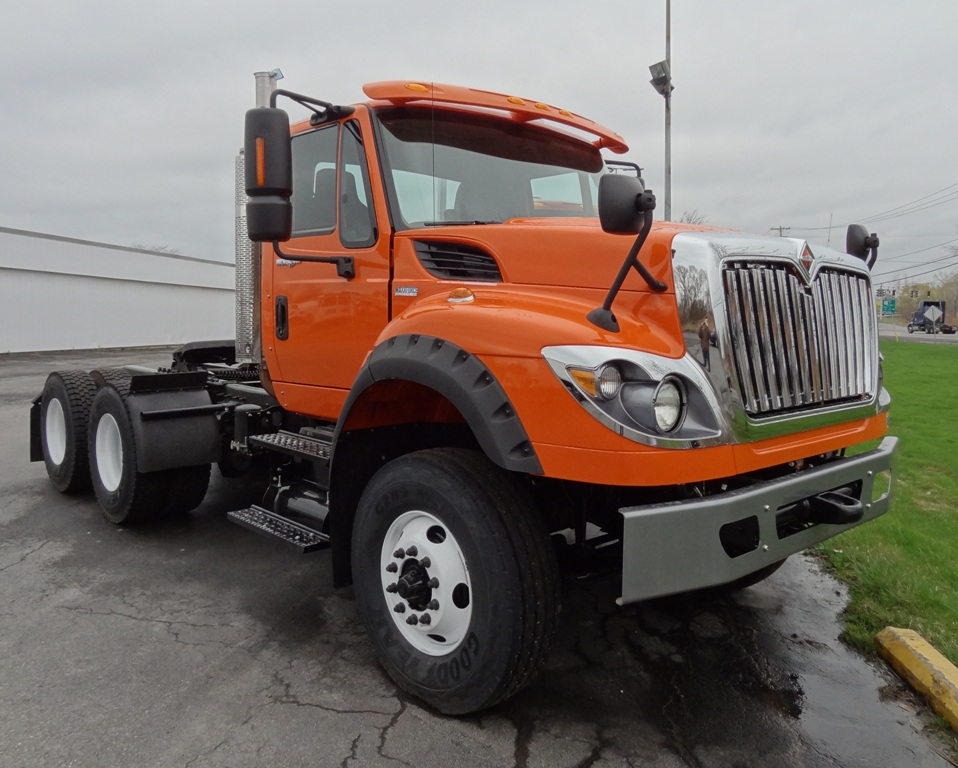
The International WorkStar is a line of severe duty trucks produced by Navistar, Inc.[1] The WorkStar is the successor to the 7400 and 7600 series trucks produced by International. Starting in 2008 the "thousand series" name was dropped in favor of the WorkStar. This change was reflected in the physical construction of the truck in the form of a new hood and grill along with increased MaxxForce Engine options.[2]
For the New Zealand market the WorkStar was assembled locally as a right hand drive product from 2013 through to 2017. There were two variants, the WorkStar 7400 with the 'visibility hood', and the WorkStar 7600 with a MaxxForce 13L engine.[3]
Models
[edit]The WorkStar is commonly custom-built, and has many different layouts. All models are available as 4x2,[a] the 7300-7500 have all-wheel drive 4x4 models. The 7400-7600 are available with both 6x4 and 6x6 tandems, and the 7600 can have an unusual 8x6 layout, with a three driven axle "tridem". Most models can have either forward or set-back front axles.
Electrical systems have become very complex, both for engine control and monitoring the chassis. Controls for power take-offs (PTOs), body operations, snowplow and other types of auxiliary lighting can be factory installed.
Cabs are available in standard, extended, and crew types on all models. Made of galvanized steel, they can have heated windshield, mirrors, air-conditioning and many interior options.
Selected 2016 Models (not all are shown.)
| Model | Max. front GAWR[b] | Max. rear GAWR | Max. GVWR[c] | Engine[d] | Trans |
|---|---|---|---|---|---|
| 7300 4x2 | 10,000 lb (4,500 kg)[e] | 17,500 lb (7,900 kg)[e] | 27,500 lb (12,500 kg)[e] | ISB6.7 | 6M, 6A |
| 7400 6x4 | 20,000 lb (9,100 kg) | 46,000 lb (21,000 kg) | 60,000 lb (27,000 kg) | N9 | 13M, A |
| 7500 6x4 | 22,000 lb (10,000 kg) | 52,000 lb (24,000 kg) | 60,000 lb (27,000 kg) | ISL9 N10 | 18M, A |
| 7600 8x6 | 22,000 lb (10,000 kg) | 69,000 lb (31,000 kg) | 76,000 lb (34,000 kg) | N13 | 18M, A |
Powertrain
[edit]In 2014, the WorkStar is available with 4 diesel engines. The lowest rated is the MaxxForce DT, a 466 cu in (7.6 L) inline 6 with 215 hp (160 kW) at 2200 rpm. The highest rated is the N13, a 758 cu in (12.4 L) inline 6 with up to 475 hp (354 kW) at 1850 rpm.
Eaton/Fuller offers manual transmissions from 6 to 18 speeds, and a self-shifting manual. Allison offers three automatic transmissions.[4]
2016 Engines
| Model[f] | Displacement | Type[g] | Power[h] | Torque[h] |
|---|---|---|---|---|
| Cum ISB6.7[5] | 408 cu in (6.7 L) | Mid | 200 hp (150 kW)[i] | 520 lb⋅ft (710 N⋅m)[i] |
| Cum ISL9 | 543 cu in (8.9 L) | HD | 380 hp (280 kW) | 1,250 lb⋅ft (1,690 N⋅m) |
| Nav N9[6] | 570 cu in (9.3 L) | Mid | 330 hp (250 kW) | 950 lb⋅ft (1,290 N⋅m) |
| Nav 10[7] | 570 cu in (9.3 L) | HD | 370 hp (280 kW) | 1,250 lb⋅ft (1,690 N⋅m) |
| Nav 13[8] | 758 cu in (12.4 L) | HD | 475 hp (354 kW) | 1,250 lb⋅ft (1,690 N⋅m) |
WorkStar applications
[edit]Construction The primary use of the WorkStar is as a heavy 6x4 dump truck with a GVWR[c] of approximately 50,000 lb (23,000 kg). With all the upgrades possible, it can be used as a concrete mixer, where the heavy duty front drive axle is often used. It can also be a semi-tractor, pulling dump or lowboy trailers.

Fire equipment. In rural areas of the US, especially in state and national parks, fire equipment has to go to remote off-road areas, often carrying water with them. The WorkStar has options needed, high strength and power, heavy duty front drive axle, an advanced electrical system, and a crew-cab. An extreme truck can be ordered with factory parts.

Railroad maintenance. Railroad equipment is very heavy, and the track needs maintenance its whole length, no matter how remote. The WorkStar's chassis can be ordered to mount road-rail pilot wheels, which let the truck run directly on the tracks. Racks can be mounted outside and above the cab so the truck can self-load and unload sections of rail onto them. The crew-cab is often used, and the truck also carries a large amount of tools and equipment.

Street and road maintenance In the northern US snow is a problem for roads, which need to be plowed and salted. Built with wiring and controls for lights and equipment, body options like heated windshields, mirrors, and seats, the truck comes ready for the service from the factory. The strong chassis with heavy-duty front wheel drive can plow around the clock for days.

Utilities The WorkStar is popular with utilities, who often work off-road for long periods in bad weather. The front driven axle is very useful when the truck is moved to many different sites. The strong frame adapts to outriggers and a long boom, so employees can work on overhead wires.
-
 Fire tank truck
 -
 Snowplow with spreader body
 -
 Sewer vacuum truck
 -
 Refuse collection truck
 -
 Railroad maintenance truck
Doppler on Wheels (DOW) Truck


_2009_VORTEX_2.jpg)
Aftermarket
[edit]The consumer version of the WorkStar is manufactured by Midwest Automotive Designs, which is a manufacturer based in Elkhart in Indiana that produces conversions of class 5 and 6 commercial trucks conversions as luxury consumer vehicles. The company makes several pickup truck models of the WorkStar, including the International WorkStar Pickup, and WorkStar SUV.[9]
Notes
[edit]- ^ Number of wheels × number of powered wheels, with dual tires counted as a single wheel.
- ^ Gross Axle Weight Rating is the loaded weight of the axle.
- ^ a b Gross Vehicle Weight Rating is the loaded weight of the truck.
- ^ Highest rated engine.
- ^ a b c Lightest rating.
- ^ Mid-range (Mid) or Heavy-duty (HD)
- ^ a b Highest rated model.
- ^ a b Lowest rated model
References
[edit]- ^ "International Trucks - Workstar".
- ^ "International Showcases Truck and Engine Lineup at MATS". TruckingInfo.com. Retrieved 24 July 2012.[permanent dead link]
- ^ "About Us | Intertruck Distributors (NZ) Ltd". Retrieved 2024-01-17.
- ^ "International Workstar". Navistar. 2014. Retrieved 20 July 2014.
- ^ "Cummins 6.7 Turbodiesel (Specs, Info, & Resources)". CumminsHub.com. 2016. Retrieved 3 Sep 2016.
- ^ "Navistar N9". Navistar. 2016. Archived from the original on 16 September 2016. Retrieved 3 Sep 2016.
- ^ "Navistar N10". Navistar. 2016. Archived from the original on 16 September 2016. Retrieved 3 Sep 2016.
- ^ "Navistar N13". Navistar. 2016. Archived from the original on 16 September 2016. Retrieved 3 Sep 2016.
- ^ "WorkStar - Consumer pickup truck and SUV". Midwest Automotive Designs. Archived from the original on 2015-02-15. Retrieved 2015-05-21.
International WorkStar
View on GrokipediaHistory and Development
Origins and Introduction
The International WorkStar originated as a successor to the 7400 and 7600 series trucks, building on the foundations of the 7000 series, which was introduced in late 2001 as part of International Truck and Engine Corporation's lineup of high-performance vocational vehicles.[4] These earlier models emphasized severe-duty capabilities for demanding work environments, setting the stage for the WorkStar's evolution toward greater customization and durability in heavy-duty applications.[5] The WorkStar was officially introduced for the 2008 model year, marking a significant branding shift when International replaced the numeric "thousand series" nomenclature—such as the 7000, 8000, and 9000 lines—with descriptive names to better highlight each model's vocational purpose and rugged performance.[6] This rebranding, announced in early 2007, aimed to streamline marketing and underscore the WorkStar's role as a dedicated severe-duty platform, distinct from lighter-duty siblings like the DuraStar.[6] From its debut, the WorkStar targeted the North American market for Class 7 and 8 trucks, with gross vehicle weight ratings ranging from 27,500 to 73,000 pounds, positioning it for construction, utility service, and heavy-haul operations where reliability under extreme conditions is essential.[7][8] Central to the WorkStar's design philosophy was a highly customizable chassis system, featuring multiple frame-rail options and a Huck-bolted frame for enhanced vocational upfitting and superior ruggedness in off-road and high-stress scenarios.[9] Complementing this durability, the cab incorporated ergonomic enhancements, including a spacious interior, quiet operation, and smooth ride characteristics to prioritize operator comfort during long shifts in challenging environments.[10][11]Production and Assembly
The International WorkStar was primarily assembled at Navistar International Corporation's manufacturing facility in Garland, Texas, beginning with its market introduction as a 2008 model year truck in late 2007 and continuing until the plant's closure in early 2013.[12] The Garland operation focused on severe-duty trucks, including the WorkStar alongside models like the PayStar and TranStar.[12] After the Garland facility shut down, WorkStar production shifted to Navistar's Springfield, Ohio assembly plant, where it became one of the primary medium- and heavy-duty models manufactured until the line's discontinuation in 2018.[13][14] The Springfield site handled vocational configurations of the WorkStar, supporting Navistar's expanded output for North American markets during this period.[14] For international markets requiring right-hand-drive configurations, Intertruck Distributors (NZ) Ltd. performed local assembly of the WorkStar at its Tauranga, New Zealand plant from 2013 to 2017, starting with variants like the 7600 series in 6x4 and 8x4 setups tailored to regional needs.[15][16] A notable production milestone occurred in 2016, when the WorkStar lineup was updated to include the Cummins ISL9 engine option, enabling compliance with 2017 EPA emissions standards while maintaining vocational performance.[17] These changes involved recalibrations and component integrations at the Springfield facility to meet regulatory requirements without major disruptions to output.[18]Design and Models
Chassis and Configurations
The International WorkStar features a conventional cab design available in set-forward or set-back axle configurations, with bumper-to-back-of-cab (BBC) lengths of 107 inches for set-forward setups and 141 inches for set-back options, allowing for tailored wheelbase and body mounting flexibility.[2] These configurations support up to a 50-degree wheel cut for enhanced maneuverability in tight spaces, particularly suited for vocational applications. The cab utilizes double-sided galvanized steel construction, tested to meet SAE J2422 rollover standards and ECE R29 crash regulations, ensuring structural integrity under severe service conditions.[9] The chassis employs high-tensile alloy steel frame rails, available in single or double 10-inch configurations, secured with a Huck-bolted system for superior durability and resistance to twisting forces.[19] This frame design accommodates gross vehicle weight ratings (GVWR) ranging from 27,500 to 73,000 pounds across the model lineup, providing scalability for diverse load requirements.[9] Crossmembers and mounting points are engineered for easy integration of above-frame-rail cooling systems and front-mounted power take-off (PTO) equipment, optimizing clearance and maintenance access.[9] Drivetrain configurations include 4x2 for standard on-road duty, 4x4 and 6x4 for mixed on/off-road operations, and heavier 6x6 or 8x6 setups for extreme terrain and payload demands, with axle ratings from Meritor or Dana Spicer components supporting front capacities up to 22,000 pounds and rear tandem or tridem options up to 69,000 pounds combined.[9] The cab incorporates a tilt-forward fiberglass hood in three-piece design, which facilitates engine access and reduces repair costs by allowing individual panel replacement.[20] Interior ergonomics feature an adjustable center panel, tilt-and-telescoping steering wheel, and optional air-ride seats with integrated HVAC systems for operator comfort during extended shifts.[9]Model Variants
The International WorkStar series encompasses several model variants tailored to different vocational demands, ranging from mid-range to heavy-duty applications. The 7300 model serves as the entry-level option in the lineup, classified as a Class 7–8 truck with available 4x2 and 4x4 axle configurations and a GVWR of 27,500 to 60,000 pounds, making it suitable for lighter to medium vocational tasks such as urban delivery and municipal services.[9][2] The 7400 model bridges mid- and heavy-duty needs, operating in Class 7–8 with 4x2, 4x4, and 6x4 configurations and a GVWR of 27,500 to 60,000 pounds, ideal for balanced construction and utility operations where versatility in load capacity is required.[9][2] In contrast, the 7500 is a dedicated Class 8 model featuring 6x4 and 6x6 configurations with a GVWR of 27,500 to 60,000 pounds, designed for heavy-duty off-road tasks in sectors like waste management and heavy construction.[9][2] At the top of the range, the 7600 model targets Class 8 severe-haul applications with 6x4, 6x6, and 8x6 configurations and a GVWR of 35,000 to 73,000 pounds, providing maximum capacity for demanding utility and construction environments.[9][2] Across the lineup, the design maintained core structural distinctions between models through its production run.[9]| Model | Class | Axle Configurations | GVWR (lb) | Primary Uses |
|---|---|---|---|---|
| 7300 | 7–8 | 4x2, 4x4 | 27,500–60,000 | Lighter to medium vocational tasks (e.g., delivery, municipal) |
| 7400 | 7–8 | 4x2, 4x4, 6x4 | 27,500–60,000 | Construction, utility |
| 7500 | 8 | 6x4, 6x6 | 27,500–60,000 | Heavy-duty off-road (e.g., waste, construction) |
| 7600 | 8 | 6x4, 6x6, 8x6 | 35,000–73,000 | Severe-haul applications (e.g., heavy utility) |