



Community hub
Recent from talks
Knowledge base stats:
Talk channels stats:
Members stats:
Battle of Leyte
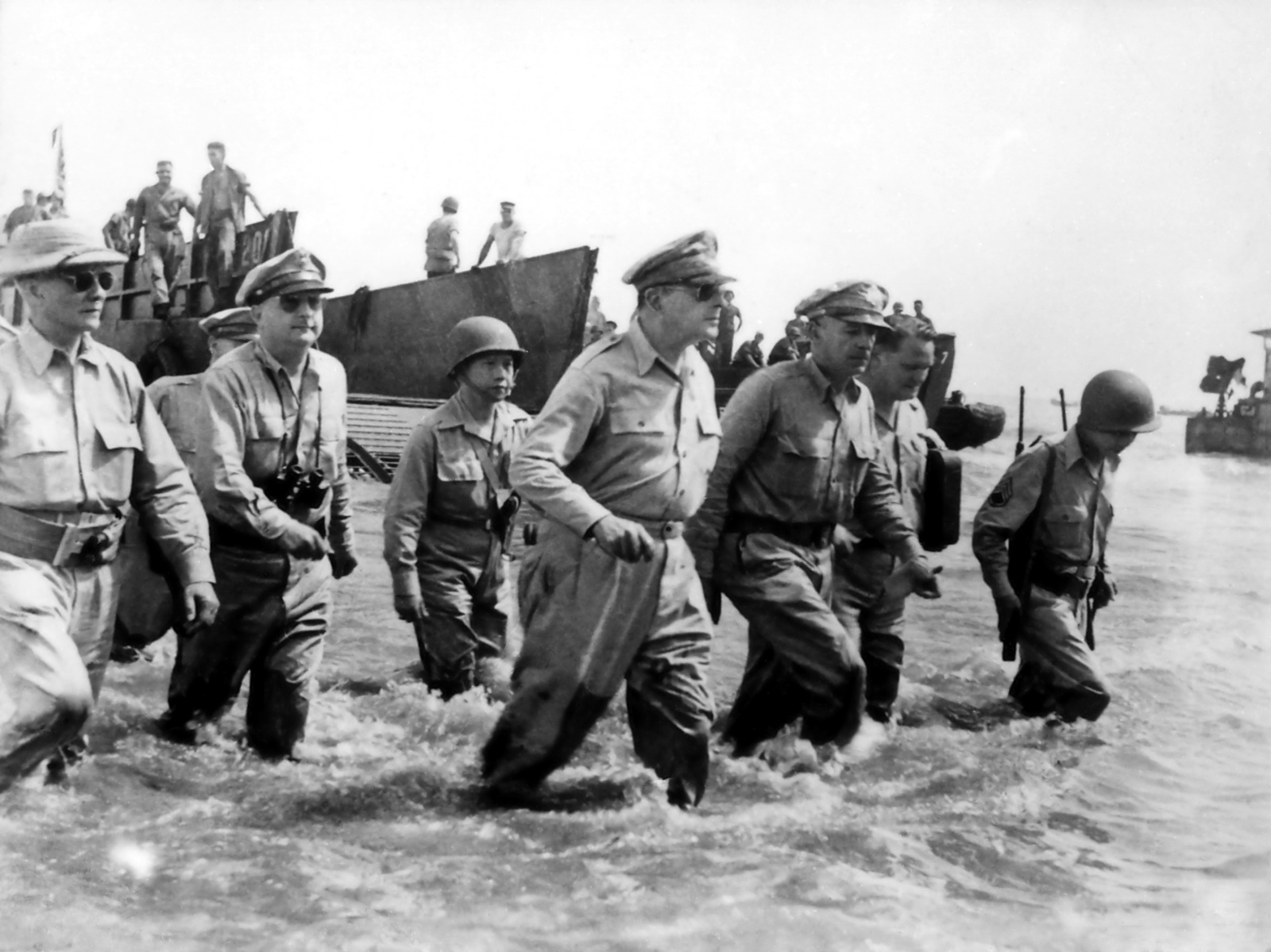
The Battle of Leyte (Filipino: Labanan sa Leyte; Waray: Gubat ha Leyte; Japanese: レイテの戦い) in the Pacific campaign of World War II was the amphibious invasion of the island of Leyte in the Philippines by American forces and Filipino guerrillas under the overall command of General Douglas MacArthur, who fought against the Imperial Japanese Army in the Philippines led by General Tomoyuki Yamashita. The operation, codenamed King Two, launched the Philippines campaign of 1944–45 for the recapture and liberation of the entire Philippine Archipelago and to end almost three years of Japanese occupation.
Japan had conquered the Philippines in 1942. Controlling it was vital for Japan's survival in World War II because it secured sea routes to Borneo and Sumatra in which rubber and petroleum were shipped to Japan.
For the U.S., capturing the Philippines was a key strategic step in isolating Imperial Japan's military holdings in China and the Pacific theater. It was also a personal matter of pride for MacArthur. In 1942, just a month before Japan forced the surrender of all USAFFE forces in the Philippines, U.S. President Franklin D. Roosevelt had ordered MacArthur to leave the Philippines and organize the U.S. forces gathering in Australia, which were meant to relieve the USAFFE. Those relief forces were non-existent; Roosevelt's true intentions in ordering MacArthur to flee the Philippines had been to prevent his capture by the Japanese. Still, MacArthur had vowed that he would return to the Philippines. He repeatedly stated that it was a moral obligation of the U.S. to liberate the Philippines as soon as possible. In March 1944, the Joint Chiefs of Staff ordered MacArthur to plan an attack on the southern Philippines by the end of the year, and Luzon in early 1945. In July 1944, Roosevelt met with MacArthur and Chester Nimitz in Hawaii, where the decision was made to invade the Philippines, from which land air bases could be used for the Pacific Theater of Operations.
Over the summer of 1944, planes from the aircraft carriers of the U.S. 3rd Fleet under Admiral William F. Halsey carried out several successful missions over the Philippines and found weak Japanese resistance. Halsey then recommended a direct strike on Leyte, canceling other planned operations, and the Leyte invasion date moved forward to October.
Leyte, facing the Pacific Ocean, has numerous deep-water approaches and sandy beaches which offered opportunities for amphibious assaults and fast resupply. The roads extend inland with Highway 1, that runs for 40 mi (64 km) along the east coast between Abuyog town to the north and the San Juanico Strait between Leyte and Samar Islands, providing avenues for tank-infantry operations, as well as suitable ground for airfield construction. American air forces based on Leyte could strike at enemy bases and airfields anywhere in the Philippines.
A heavily forested mountain range dominates the interior and separates two plains. The larger Leyte Valley extends from the northern coast to the long eastern shore and contains most of the towns and roadways on the island. The other, Ormoc Valley, situated on the west side, was connected to Leyte Valley by Highway 2 running from Palo town on the east coast, then west and then south through Leyte Valley to Ormoc bay, then along the western shore to Baybay. The road then turned east to cross the mountainous interior and connected it with Highway 1 on the east coast at Abuyog. South of these towns, the mountainous southern third of Leyte was mostly undeveloped. High mountain peaks over 4,400 ft (1,300 m), as well as the jagged karst formations of the island offered formidable defensive opportunities. The timing late in the year forced combat troops and supporting pilots, as well as logistical units, to contend with monsoon rains.
Leyte's population of over 900,000 people—mostly farmers and fishermen—could be expected to assist an American invasion, since many residents already supported the guerrilla struggle against the Japanese. Japanese troop strength on Leyte was estimated by U.S. intelligence at 20,000; mostly of the 16th Division under Lieutenant General Shiro Makino.
Southwest Pacific Area
General Douglas MacArthur in light cruiser Nashville
Hub AI
Battle of Leyte AI simulator
(@Battle of Leyte_simulator)
Battle of Leyte
The Battle of Leyte (Filipino: Labanan sa Leyte; Waray: Gubat ha Leyte; Japanese: レイテの戦い) in the Pacific campaign of World War II was the amphibious invasion of the island of Leyte in the Philippines by American forces and Filipino guerrillas under the overall command of General Douglas MacArthur, who fought against the Imperial Japanese Army in the Philippines led by General Tomoyuki Yamashita. The operation, codenamed King Two, launched the Philippines campaign of 1944–45 for the recapture and liberation of the entire Philippine Archipelago and to end almost three years of Japanese occupation.
Japan had conquered the Philippines in 1942. Controlling it was vital for Japan's survival in World War II because it secured sea routes to Borneo and Sumatra in which rubber and petroleum were shipped to Japan.
For the U.S., capturing the Philippines was a key strategic step in isolating Imperial Japan's military holdings in China and the Pacific theater. It was also a personal matter of pride for MacArthur. In 1942, just a month before Japan forced the surrender of all USAFFE forces in the Philippines, U.S. President Franklin D. Roosevelt had ordered MacArthur to leave the Philippines and organize the U.S. forces gathering in Australia, which were meant to relieve the USAFFE. Those relief forces were non-existent; Roosevelt's true intentions in ordering MacArthur to flee the Philippines had been to prevent his capture by the Japanese. Still, MacArthur had vowed that he would return to the Philippines. He repeatedly stated that it was a moral obligation of the U.S. to liberate the Philippines as soon as possible. In March 1944, the Joint Chiefs of Staff ordered MacArthur to plan an attack on the southern Philippines by the end of the year, and Luzon in early 1945. In July 1944, Roosevelt met with MacArthur and Chester Nimitz in Hawaii, where the decision was made to invade the Philippines, from which land air bases could be used for the Pacific Theater of Operations.
Over the summer of 1944, planes from the aircraft carriers of the U.S. 3rd Fleet under Admiral William F. Halsey carried out several successful missions over the Philippines and found weak Japanese resistance. Halsey then recommended a direct strike on Leyte, canceling other planned operations, and the Leyte invasion date moved forward to October.
Leyte, facing the Pacific Ocean, has numerous deep-water approaches and sandy beaches which offered opportunities for amphibious assaults and fast resupply. The roads extend inland with Highway 1, that runs for 40 mi (64 km) along the east coast between Abuyog town to the north and the San Juanico Strait between Leyte and Samar Islands, providing avenues for tank-infantry operations, as well as suitable ground for airfield construction. American air forces based on Leyte could strike at enemy bases and airfields anywhere in the Philippines.
A heavily forested mountain range dominates the interior and separates two plains. The larger Leyte Valley extends from the northern coast to the long eastern shore and contains most of the towns and roadways on the island. The other, Ormoc Valley, situated on the west side, was connected to Leyte Valley by Highway 2 running from Palo town on the east coast, then west and then south through Leyte Valley to Ormoc bay, then along the western shore to Baybay. The road then turned east to cross the mountainous interior and connected it with Highway 1 on the east coast at Abuyog. South of these towns, the mountainous southern third of Leyte was mostly undeveloped. High mountain peaks over 4,400 ft (1,300 m), as well as the jagged karst formations of the island offered formidable defensive opportunities. The timing late in the year forced combat troops and supporting pilots, as well as logistical units, to contend with monsoon rains.
Leyte's population of over 900,000 people—mostly farmers and fishermen—could be expected to assist an American invasion, since many residents already supported the guerrilla struggle against the Japanese. Japanese troop strength on Leyte was estimated by U.S. intelligence at 20,000; mostly of the 16th Division under Lieutenant General Shiro Makino.
Southwest Pacific Area
General Douglas MacArthur in light cruiser Nashville