



Community hub
Recent from talks
Contribute something
Nothing was collected or created yet.
Invex function
View on WikipediaIn vector calculus, an invex function is a differentiable function from to for which there exists a vector valued function such that



for all x and u.
Invex functions were introduced by Hanson as a generalization of convex functions.[1] Ben-Israel and Mond provided a simple proof that a function is invex if and only if every stationary point is a global minimum, a theorem first stated by Craven and Glover.[2][3]
Hanson also showed that if the objective and the constraints of an optimization problem are invex with respect to the same function , then the Karush–Kuhn–Tucker conditions are sufficient for a global minimum.

Type I invex functions
[edit]A slight generalization of invex functions called Type I invex functions are the most general class of functions for which the Karush–Kuhn–Tucker conditions are necessary and sufficient for a global minimum.[4] Consider a mathematical program of the form
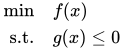
where and are differentiable functions. Let denote the feasible region of this program. The function is a Type I objective function and the function is a Type I constraint function at with respect to if there exists a vector-valued function defined on such that

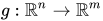




and

for all .[5] Note that, unlike invexity, Type I invexity is defined relative to a point .

Theorem (Theorem 2.1 in[4]): If and are Type I invex at a point with respect to , and the Karush–Kuhn–Tucker conditions are satisfied at , then is a global minimizer of over .

E-invex function
[edit]Let from to and from to be an -differentiable function on a nonempty open set . Then is said to be an E-invex function at if there exists a vector valued function such that



for all and in .

E-invex functions were introduced by Abdulaleem as a generalization of differentiable convex functions.[6]
E-type I Functions
[edit]Let , and be an open E-invex set. A vector-valued pair , where and represent objective and constraint functions respectively, is said to be E-type I with respect to a vector-valued function , at , if the following inequalities hold for all :


Remark 1.
[edit]If and are differentiable functions and ( is an identity map), then the definition of E-type I functions[7] reduces to the definition of type I functions introduced by Rueda and Hanson.[8]

See also
[edit]References
[edit]- ^ Hanson, Morgan A. (1981). "On sufficiency of the Kuhn-Tucker conditions". Journal of Mathematical Analysis and Applications. 80 (2): 545–550. doi:10.1016/0022-247X(81)90123-2. hdl:10338.dmlcz/141569. ISSN 0022-247X.
- ^ Ben-Israel, A.; Mond, B. (1986). "What is invexity?". The ANZIAM Journal. 28 (1): 1–9. doi:10.1017/S0334270000005142. ISSN 1839-4078.
- ^ Craven, B. D.; Glover, B. M. (1985). "Invex functions and duality". Journal of the Australian Mathematical Society. 39 (1): 1–20. doi:10.1017/S1446788700022126. ISSN 0263-6115.
- ^ a b Hanson, Morgan A. (1999). "Invexity and the Kuhn–Tucker Theorem". Journal of Mathematical Analysis and Applications. 236 (2): 594–604. doi:10.1006/jmaa.1999.6484. ISSN 0022-247X.
- ^ Hanson, M. A.; Mond, B. (1987). "Necessary and sufficient conditions in constrained optimization". Mathematical Programming. 37 (1): 51–58. doi:10.1007/BF02591683. ISSN 1436-4646. S2CID 206818360.
- ^ Abdulaleem, Najeeb (2019). "E-invexity and generalized E-invexity in E-differentiable multiobjective programming". ITM Web of Conferences. 24 (1) 01002. doi:10.1051/itmconf/20192401002.
- ^ Abdulaleem, Najeeb (2023). "Optimality and duality for $ E $-differentiable multiobjective programming problems involving $ E $-type Ⅰ functions". Journal of Industrial and Management Optimization. 19 (2): 1513. doi:10.3934/jimo.2022004. ISSN 1547-5816.
- ^ Rueda, Norma G; Hanson, Morgan A (1988-03-01). "Optimality criteria in mathematical programming involving generalized invexity". Journal of Mathematical Analysis and Applications. 130 (2): 375–385. doi:10.1016/0022-247X(88)90313-7. ISSN 0022-247X.
Further reading
[edit]- S. K. Mishra and G. Giorgi, Invexity and optimization, Nonconvex Optimization and Its Applications, Vol. 88, Springer-Verlag, Berlin, 2008.
- S. K. Mishra, S.-Y. Wang and K. K. Lai, Generalized Convexity and Vector Optimization, Springer, New York, 2009.