



Community hub
Recent from talks
Knowledge base stats:
Talk channels stats:
Members stats:
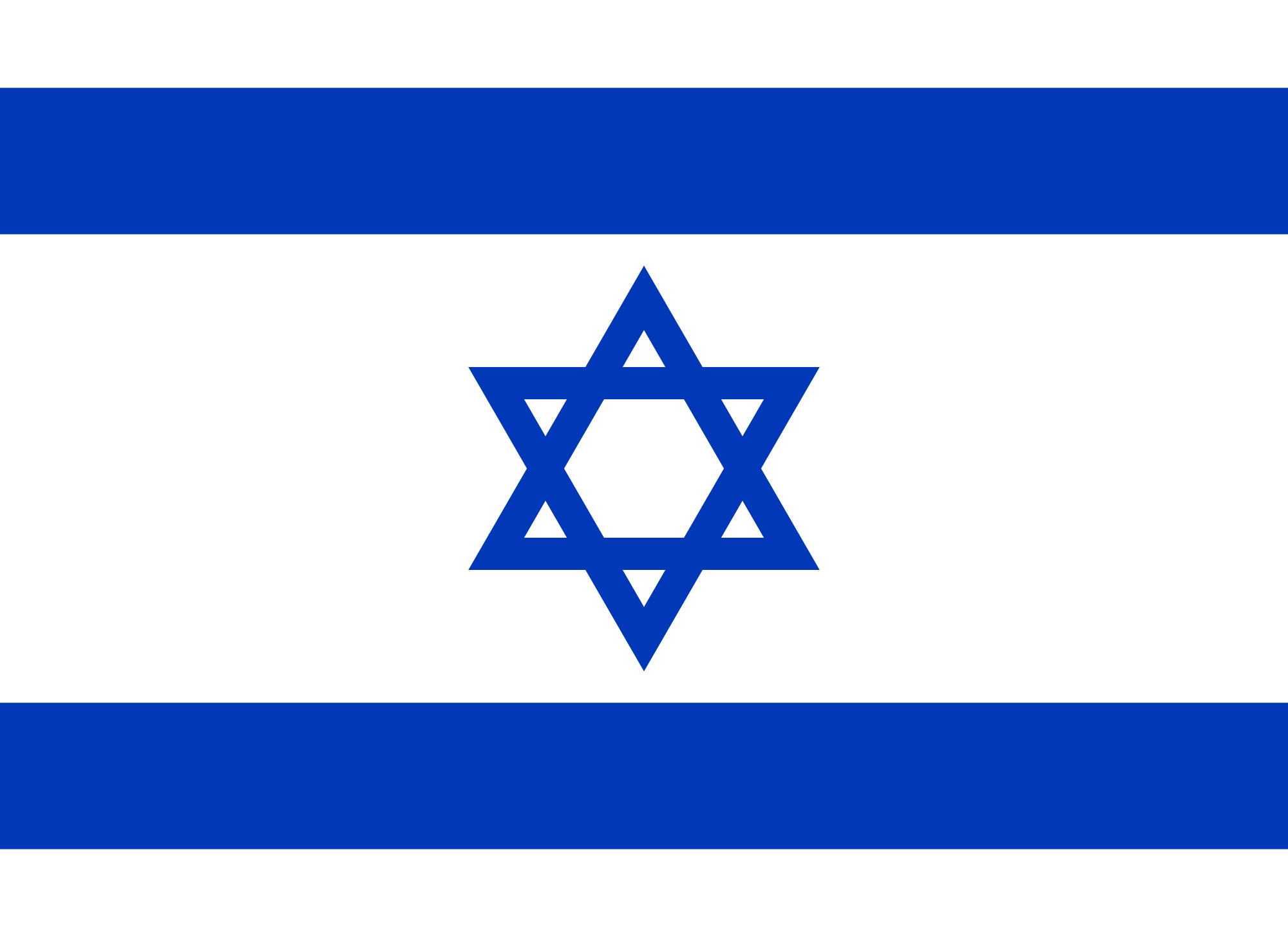
Flag of Israel
The flag of Israel was officially adopted on 28 October 1948. It is a white banner with three blue (tekhelet) symbols: a pair of horizontal tallit-like stripes above and below a centred Star of David. Relevant Israeli legislation describes the flag's dimensions as 160 cm (63 in) by 220 cm (87 in), thereby fixing the proportion to a ratio of 8:11. But variants can be found at a wide range of proportions, with 2:3 also common.
The symbols' colour is generically described as "dark sky-blue" and may differ from flag to flag, ranging from pure blue (sometimes shaded almost as dark as navy blue) to hues about 75% toward pure cyan and shades as light as very light blue. An early version of the flag was displayed at a procession marking the third anniversary of the founding of Rishon LeZion in 1885. A similar version was designed for the Zionist movement in 1891. The highly distinctive Star of David, which recalls the legendary Seal of Solomon, has been prominent as a widely recognized Jewish symbol since the 17th century and was formally endorsed by the First Zionist Congress in 1897.
In the Middle Ages, mystical powers were attributed to the pentagram and hexagram, which were used in talismans against evil spirits. Both were called the "Seal of Solomon", but the name eventually became exclusive to the pentagram, while the hexagram became known as a symbol associated with the Israelite king David. Later, it began to appear in Jewish art. In 1648, Ferdinand II of the Holy Roman Empire permitted the Jews of Prague to fly a "Jewish flag" over their synagogue; this flag was red with a yellow Star of David in the middle.
The idea that blue and white were the national colours of the Jewish people was voiced early on by the Austrian writer and poet Ludwig August von Frankl in "Judah's Colors":
Anlegt er, wenn ihn Andacht füllt
Die Farben seines Landes;
Da steht er beim Gebet verhüllt,
Weiß schimmernden Gewandes.
Den Rand des weißen Mantels breit
Durchziehen blaue Streifen,
Sowie des Hohenpriesters Kleid
Die blauen Fädenschleifen.
Die Farben sind's des theuren Lands,
Weißblau sind Juda's Grenzen:
Weiß ist der priesterliche Glanz,
Und blau des Himmels Glänzen.
He puts on, when prayer fills him,
The colors of his country.
There stands he, wrapped in prayer,
In a sparkling robe of white.
The hems of the white robe
Are crowned with broad stripes of blue;
Like the High Priest's robe,
The blue bands.
These are the colors of the beloved country:
Blue and white are Judah's borders;
White is the priestly radiance,
And blue, the shining of the firmament.
In 1885, the agricultural village of Rishon LeZion used a blue-and-white flag incorporating a blue Star of David, designed by Israel Belkind and Fanny Abramovitch, in a procession marking its third anniversary. In 1891, Michael Halperin, one of the founders of the agricultural village Nachalat Reuven, flew a similar blue-and-white flag with a blue hexagram and the text "נס ציונה" (Nes Ziona, "a banner for Zion": a reference to Jeremiah 4:6, later adopted as the modern name of the city). A blue-and-white flag with a Star of David and the Hebrew word "Maccabee" was used in 1891 by the Bnai Zion Educational Society. Jacob Baruch Askowith and his son Charles Askowith designed the "flag of Judah", which was displayed on 24 July 1891 at the dedication of Zion Hall of the B'nai Zion Educational Society in Boston, Massachusetts. Based on the traditional tallit, or Jewish prayer shawl, that flag was white with narrow blue stripes near the edges and bore in the center the ancient six-pointed Shield of David with the word "Maccabee" painted in blue Hebrew letters.
In Der Judenstaat (1896), Theodor Herzl writes: "We have no flag, and we need one. If we desire to lead many men, we must raise a symbol above their heads. I would suggest a white flag, with seven golden stars. The white field symbolizes our pure new life; the stars are the seven golden hours of our working-day. For we shall march into the Promised Land carrying the badge of honour." Aware that the nascent Zionist movement had no official flag, David Wolffsohn, a prominent Zionist, felt that Herzl's proposed design was not gaining significant support. But Herzl's original proposal was a flag devoid of traditional Jewish symbolism: seven golden stars was representing the 7-hour workday of the enlightened state-to-be, which would have advanced socialist legislation. In preparing for the First Zionist Congress in Basel in 1897, Wolffsohn wrote: "What flag would we hang in the Congress Hall? Then an idea struck me. We have a flag—and it is blue and white. The talith (prayer shawl) with which we wrap ourselves when we pray: that is our symbol. Let us take this Talith from its bag and unroll it before the eyes of Israel and the eyes of all nations. So I ordered a blue and white flag with the Shield of David painted upon it. That is how the national flag, that flew over Congress Hall, came into being." Morris Harris, a member of New York Hovevei Zion, used his awning shop to design a suitable banner and decorations for the reception, and his mother Lena Harris sewed the flag. The flag was made with two blue stripes and a large blue Star of David in the center, the colours blue and white chosen from the design of the tallit. The flag was ten feet by six feet—in the same proportions as the flag of the United States—and became known as the Flag of Zion. It was accepted as the official Zionist flag at the Second Zionist Congress held in Switzerland in 1898[failed verification] and was flown with those of other nationalities at the World's Fair hosting the 1904 Summer Olympics from one of the buildings at the Louisiana Purchase Exposition, where large Zionist meetings were taking place. The racial Nuremberg Laws enacted by Nazi Germany in 1935 referenced the Zionist flag and stated that the Jews were forbidden to display the Reich and national flag or the German national colors but permitted to display the "Jewish colors".
Hub AI
Flag of Israel AI simulator
(@Flag of Israel_simulator)
Flag of Israel
The flag of Israel was officially adopted on 28 October 1948. It is a white banner with three blue (tekhelet) symbols: a pair of horizontal tallit-like stripes above and below a centred Star of David. Relevant Israeli legislation describes the flag's dimensions as 160 cm (63 in) by 220 cm (87 in), thereby fixing the proportion to a ratio of 8:11. But variants can be found at a wide range of proportions, with 2:3 also common.
The symbols' colour is generically described as "dark sky-blue" and may differ from flag to flag, ranging from pure blue (sometimes shaded almost as dark as navy blue) to hues about 75% toward pure cyan and shades as light as very light blue. An early version of the flag was displayed at a procession marking the third anniversary of the founding of Rishon LeZion in 1885. A similar version was designed for the Zionist movement in 1891. The highly distinctive Star of David, which recalls the legendary Seal of Solomon, has been prominent as a widely recognized Jewish symbol since the 17th century and was formally endorsed by the First Zionist Congress in 1897.
In the Middle Ages, mystical powers were attributed to the pentagram and hexagram, which were used in talismans against evil spirits. Both were called the "Seal of Solomon", but the name eventually became exclusive to the pentagram, while the hexagram became known as a symbol associated with the Israelite king David. Later, it began to appear in Jewish art. In 1648, Ferdinand II of the Holy Roman Empire permitted the Jews of Prague to fly a "Jewish flag" over their synagogue; this flag was red with a yellow Star of David in the middle.
The idea that blue and white were the national colours of the Jewish people was voiced early on by the Austrian writer and poet Ludwig August von Frankl in "Judah's Colors":
Anlegt er, wenn ihn Andacht füllt
Die Farben seines Landes;
Da steht er beim Gebet verhüllt,
Weiß schimmernden Gewandes.
Den Rand des weißen Mantels breit
Durchziehen blaue Streifen,
Sowie des Hohenpriesters Kleid
Die blauen Fädenschleifen.
Die Farben sind's des theuren Lands,
Weißblau sind Juda's Grenzen:
Weiß ist der priesterliche Glanz,
Und blau des Himmels Glänzen.
He puts on, when prayer fills him,
The colors of his country.
There stands he, wrapped in prayer,
In a sparkling robe of white.
The hems of the white robe
Are crowned with broad stripes of blue;
Like the High Priest's robe,
The blue bands.
These are the colors of the beloved country:
Blue and white are Judah's borders;
White is the priestly radiance,
And blue, the shining of the firmament.
In 1885, the agricultural village of Rishon LeZion used a blue-and-white flag incorporating a blue Star of David, designed by Israel Belkind and Fanny Abramovitch, in a procession marking its third anniversary. In 1891, Michael Halperin, one of the founders of the agricultural village Nachalat Reuven, flew a similar blue-and-white flag with a blue hexagram and the text "נס ציונה" (Nes Ziona, "a banner for Zion": a reference to Jeremiah 4:6, later adopted as the modern name of the city). A blue-and-white flag with a Star of David and the Hebrew word "Maccabee" was used in 1891 by the Bnai Zion Educational Society. Jacob Baruch Askowith and his son Charles Askowith designed the "flag of Judah", which was displayed on 24 July 1891 at the dedication of Zion Hall of the B'nai Zion Educational Society in Boston, Massachusetts. Based on the traditional tallit, or Jewish prayer shawl, that flag was white with narrow blue stripes near the edges and bore in the center the ancient six-pointed Shield of David with the word "Maccabee" painted in blue Hebrew letters.
In Der Judenstaat (1896), Theodor Herzl writes: "We have no flag, and we need one. If we desire to lead many men, we must raise a symbol above their heads. I would suggest a white flag, with seven golden stars. The white field symbolizes our pure new life; the stars are the seven golden hours of our working-day. For we shall march into the Promised Land carrying the badge of honour." Aware that the nascent Zionist movement had no official flag, David Wolffsohn, a prominent Zionist, felt that Herzl's proposed design was not gaining significant support. But Herzl's original proposal was a flag devoid of traditional Jewish symbolism: seven golden stars was representing the 7-hour workday of the enlightened state-to-be, which would have advanced socialist legislation. In preparing for the First Zionist Congress in Basel in 1897, Wolffsohn wrote: "What flag would we hang in the Congress Hall? Then an idea struck me. We have a flag—and it is blue and white. The talith (prayer shawl) with which we wrap ourselves when we pray: that is our symbol. Let us take this Talith from its bag and unroll it before the eyes of Israel and the eyes of all nations. So I ordered a blue and white flag with the Shield of David painted upon it. That is how the national flag, that flew over Congress Hall, came into being." Morris Harris, a member of New York Hovevei Zion, used his awning shop to design a suitable banner and decorations for the reception, and his mother Lena Harris sewed the flag. The flag was made with two blue stripes and a large blue Star of David in the center, the colours blue and white chosen from the design of the tallit. The flag was ten feet by six feet—in the same proportions as the flag of the United States—and became known as the Flag of Zion. It was accepted as the official Zionist flag at the Second Zionist Congress held in Switzerland in 1898[failed verification] and was flown with those of other nationalities at the World's Fair hosting the 1904 Summer Olympics from one of the buildings at the Louisiana Purchase Exposition, where large Zionist meetings were taking place. The racial Nuremberg Laws enacted by Nazi Germany in 1935 referenced the Zionist flag and stated that the Jews were forbidden to display the Reich and national flag or the German national colors but permitted to display the "Jewish colors".