



Community hub
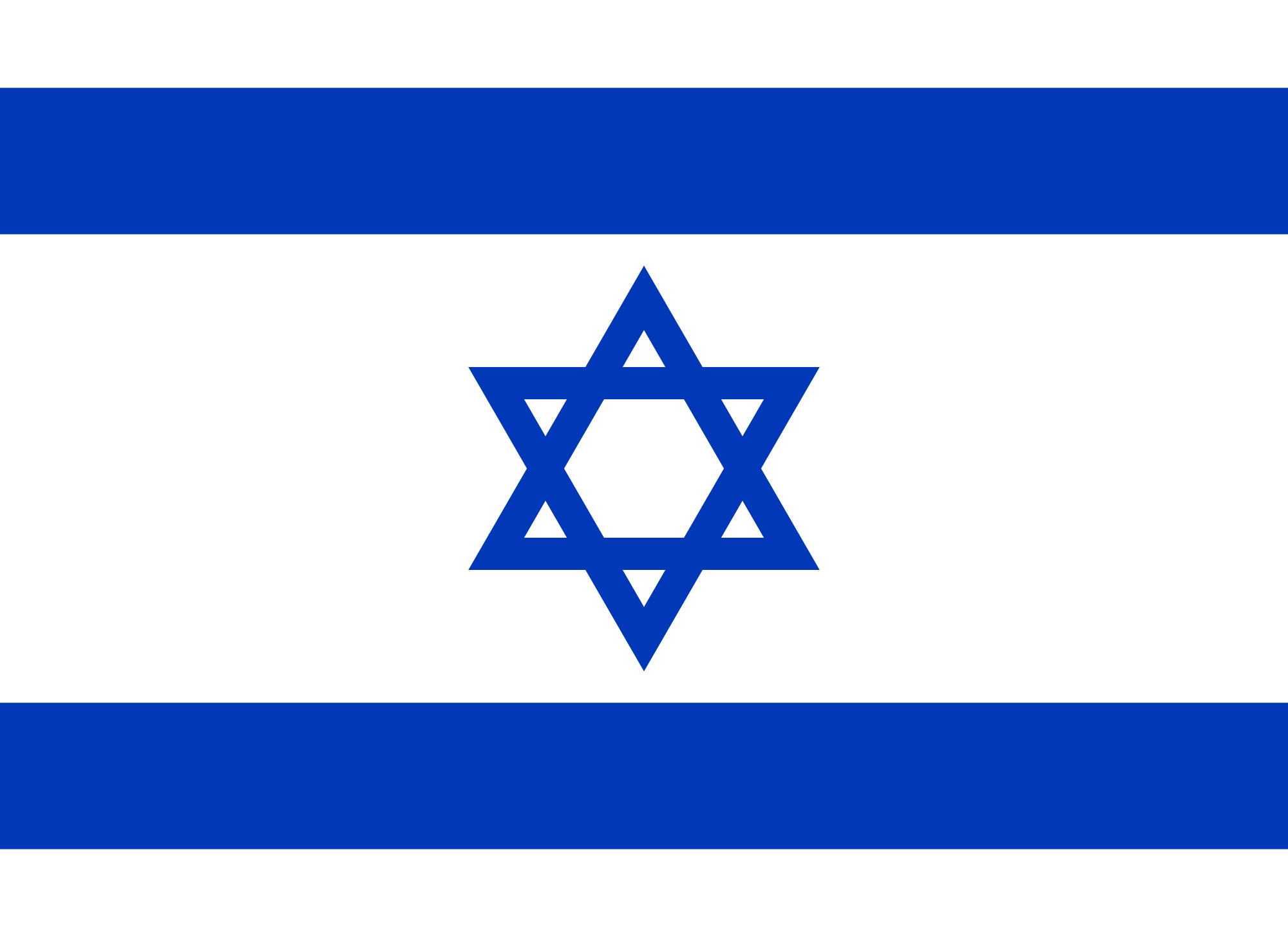
Flag of Israel
View on Wikipedia
 | |
| "Flag of Zion" | |
| Use | National flag    |
|---|---|
| Proportion | 8:11 |
| Adopted | August 1897 (by the Zionist movement) 28 October 1948 (by Israel) |
| Design | White banner with three blue (tekhelet) symbols: a pair of horizontal tallit-like stripes above and below a centred Star of David. |
| Designed by | Israel Belkind and Fanny Abramovitch |
 | |
| Use | Civil ensign   |
| Proportion | 2:3 |
| Adopted | 1948 |
| Design | Navy-blue flag with a white vertically elongated oval set near the hoist containing a vertically elongated blue Star of David. |
 | |
| Use | Naval ensign  |
| Proportion | 2:3 |
| Adopted | 1948 |
| Design | Navy-blue flag with a white triangle containing a blue Star of David at hoist. |
 | |
| Use | Air force ensign |
| Proportion | 2:3 |
| Design | Light blue flag with thin white stripes with dark blue borders near the top and bottom, displaying an air force roundel in the center. |
The flag of Israel[a] was officially adopted on 28 October 1948. It is a white banner with three blue (tekhelet) symbols: a pair of horizontal tallit-like stripes above and below a centred Star of David. Relevant Israeli legislation describes the flag's dimensions as 160 cm (63 in) by 220 cm (87 in), thereby fixing the proportion to a ratio of 8:11. But variants can be found at a wide range of proportions, with 2:3 also common.
The symbols' colour is generically described as "dark sky-blue"[1] and may differ from flag to flag, ranging from pure blue (sometimes shaded almost as dark as navy blue) to hues about 75% toward pure cyan and shades as light as very light blue.[2] An early version of the flag was displayed at a procession marking the third anniversary of the founding of Rishon LeZion in 1885. A similar version was designed for the Zionist movement in 1891. The highly distinctive Star of David, which recalls the legendary Seal of Solomon, has been prominent as a widely recognized Jewish symbol since the 17th century and was formally endorsed by the First Zionist Congress in 1897.[1]
Origin of the flag
[edit]In the Middle Ages, mystical powers were attributed to the pentagram and hexagram, which were used in talismans against evil spirits. Both were called the "Seal of Solomon", but the name eventually became exclusive to the pentagram, while the hexagram became known as a symbol associated with the Israelite king David. Later, it began to appear in Jewish art. In 1648, Ferdinand II of the Holy Roman Empire permitted the Jews of Prague to fly a "Jewish flag" over their synagogue; this flag was red with a yellow Star of David in the middle.[3]
The idea that blue and white were the national colours of the Jewish people was voiced early on by the Austrian writer and poet Ludwig August von Frankl in "Judah's Colors":
Anlegt er, wenn ihn Andacht füllt
Die Farben seines Landes;
Da steht er beim Gebet verhüllt,
Weiß schimmernden Gewandes.
Den Rand des weißen Mantels breit
Durchziehen blaue Streifen,
Sowie des Hohenpriesters Kleid
Die blauen Fädenschleifen.
Die Farben sind's des theuren Lands,
Weißblau sind Juda's Grenzen:
Weiß ist der priesterliche Glanz,
Und blau des Himmels Glänzen.[4]
He puts on, when prayer fills him,
The colors of his country.
There stands he, wrapped in prayer,
In a sparkling robe of white.
The hems of the white robe
Are crowned with broad stripes of blue;
Like the High Priest's robe,
The blue bands.
These are the colors of the beloved country:
Blue and white are Judah's borders;
White is the priestly radiance,
And blue, the shining of the firmament.
In 1885, the agricultural village of Rishon LeZion used a blue-and-white flag incorporating a blue Star of David, designed by Israel Belkind and Fanny Abramovitch, in a procession marking its third anniversary.[5] In 1891, Michael Halperin, one of the founders of the agricultural village Nachalat Reuven, flew a similar blue-and-white flag with a blue hexagram and the text "נס ציונה" (Nes Ziona, "a banner for Zion": a reference to Jeremiah 4:6, later adopted as the modern name of the city). A blue-and-white flag with a Star of David and the Hebrew word "Maccabee" was used in 1891 by the Bnai Zion Educational Society. Jacob Baruch Askowith[6] and his son Charles Askowith designed the "flag of Judah", which was displayed on 24 July 1891 at the dedication of Zion Hall of the B'nai Zion Educational Society in Boston, Massachusetts. Based on the traditional tallit, or Jewish prayer shawl, that flag was white with narrow blue stripes near the edges and bore in the center the ancient six-pointed Shield of David with the word "Maccabee" painted in blue Hebrew letters.[7]

In Der Judenstaat (1896), Theodor Herzl writes: "We have no flag, and we need one. If we desire to lead many men, we must raise a symbol above their heads. I would suggest a white flag, with seven golden stars. The white field symbolizes our pure new life; the stars are the seven golden hours of our working-day. For we shall march into the Promised Land carrying the badge of honour."[8] Aware that the nascent Zionist movement had no official flag, David Wolffsohn, a prominent Zionist, felt that Herzl's proposed design was not gaining significant support. But Herzl's original proposal was a flag devoid of traditional Jewish symbolism: seven golden stars was representing the 7-hour workday of the enlightened state-to-be, which would have advanced socialist legislation.[9] In preparing for the First Zionist Congress in Basel in 1897, Wolffsohn wrote: "What flag would we hang in the Congress Hall? Then an idea struck me. We have a flag—and it is blue and white. The talith (prayer shawl) with which we wrap ourselves when we pray: that is our symbol. Let us take this Talith from its bag and unroll it before the eyes of Israel and the eyes of all nations. So I ordered a blue and white flag with the Shield of David painted upon it. That is how the national flag, that flew over Congress Hall, came into being."[10] Morris Harris, a member of New York Hovevei Zion, used his awning shop to design a suitable banner and decorations for the reception, and his mother Lena Harris sewed the flag. The flag was made with two blue stripes and a large blue Star of David in the center, the colours blue and white chosen from the design of the tallit. The flag was ten feet by six feet—in the same proportions as the flag of the United States—and became known as the Flag of Zion. It was accepted as the official Zionist flag at the Second Zionist Congress held in Switzerland in 1898[11][failed verification] and was flown with those of other nationalities at the World's Fair hosting the 1904 Summer Olympics from one of the buildings at the Louisiana Purchase Exposition, where large Zionist meetings were taking place.[12][13] The racial Nuremberg Laws enacted by Nazi Germany in 1935 referenced the Zionist flag and stated that the Jews were forbidden to display the Reich and national flag or the German national colors but permitted to display the "Jewish colors".[14][15]
In May 1948, the Provisional State Council asked the Israeli public to submit proposals for a flag, and received 164 entries. Initially the council had wished to abandon the traditional design of the Zionist flag and create something completely different, to prevent Jews around the world being charged with dual loyalty when displaying the Zionist flag, which could be seen as the flag of a foreign country.[16] On 14 October 1948, after Zionist representatives from around the world allayed their Israeli colleagues' concerns, the flag of the Zionist Organization was adopted as the official flag of the State of Israel.[17]
Design
[edit]
.svg)
.svg)
The Provisional Council of State Proclamation of the Flag of the State of Israel states:[1]
The flag is 220 cm. long and 160 cm. wide. The background is white and on it are two stripes of dark sky-blue, 25 cm. broad, over the whole length of the flag, at a distance of 15 cm. from the top and from the bottom of the flag. In the middle of the white background, between the two blue stripes and at equal distance from each stripe is a Star of David, composed of six dark sky-blue stripes, 5.5 cm. broad, which form two equilateral triangles, the bases of which are parallel to the two horizontal stripes.
Although the stripes are described as a "dark sky-blue" and the Shield of David as simply "sky-blue", the two elements of the flag are almost always the same shade.
Colours
[edit]In Hebrew, the blue is described as תְּכֵלֶת tḵēleṯ, which traditionally refers to a dark sky-blue dye identical to indigo—so identical in fact that supposedly only God could distinguish between them[18]—and which was extracted from a sea creature called a חִלָּזוֹן ḥillāzōn (almost certainly the banded dye-murex, from which a dye chemically identical to indigo can be extracted).[19] But flags with vastly differing shades of blue are commonplace, such that Israel's national colours are sometimes said to be כָּחֹל לָבָן kāḥol lāḇān ("(dark) blue (and) white") instead of תְּכֵלֶת לָבָן tḵēleṯ lāḇān ("(sky) blue (and) white").
In 1950 a decision was made to set the standard colour for government-regulated Israeli flags as "Indanthren Calidon (GCDN)",[20] while Israeli product labels are told to use CMYK 100/70/0/28.[21]
Colour scheme |
Blue | White |
|---|---|---|
| Pantone | 286 C |
White
|
| RGB | 0/56/184 |
255/255/255
|
| Hexadecimal | #0038b8 |
#FFFFFF
|
| CMYK | 100/70/0/28 |
0/0/0/0
|
Interpretation of colours
[edit]| Scheme | Textile color |
|---|---|
| White | Ḥeseḏ (Divine Benevolence)[22] |
| Blue | It symbolizes God's Glory, purity and Gḇūrā (God's severity)[23][24] |

The blue stripes symbolise the stripes on a tallit, the traditional Jewish prayer shawl. The Star of David is a widely acknowledged symbol of the Jewish people and Judaism. In Judaism, the colour blue symbolises God's glory, purity and gevura (God's severity).[23][24] The White field represents hesed (Divine Benevolence).[22]
In the Bible, the Israelites are commanded to have one of the threads of their tassels (tzitzit) dyed with tekhelet "so that they may look upon it, and remember all the commandments of the LORD, and do them" (Num 15:39). Tekhelet corresponds to the colour of the divine revelation (Midrash Numbers Rabbah xv.). Sometime near the end of the Talmudic era (500–600 CE) the industry that produced this dye collapsed. It became rarer; over time, the Jewish community lost the tradition of which species of shellfish produced this dye. Since Jews were then unable to fulfil this commandment, they have since left their tzitzit (tallit strings) white. But in remembrance of the commandment to use the tekhelet dye, it became common for Jews to weave blue or purple stripes into the cloth of their tallit.[25]
Notable flags
[edit]
- The "Ink Flag" of 1949, which was raised during the War of Independence near present-day Eilat. This homemade flag's raising on a pole by several Israeli soldiers was immortalized in a photograph that has been compared with the famous photograph of the United States flag being raised atop Suribachi on the island of Iwo Jima in 1945. Like the latter photograph, the Ink Flag raising has also been reproduced as a memorial.
- The Israeli flag that stayed flying throughout the siege of Fort Budapest during the Yom Kippur War, which is currently preserved in the Israeli Armored Corps memorial at Latrun. Fort Budapest was the only strongpoint along the Bar-Lev Line to remain in Israeli hands during the war.
- The 2007 World Record Flag, which was unveiled at an airfield near the historic mountain fortress of Masada. The flag, manufactured in the Philippines, measured 660 by 100 meters (2,170 ft × 330 ft) and weighed 5.2 tonnes (5.7 short tons), breaking the previous record, measured and verified by representatives for the Guinness Book of Records. It was made by Filipino entrepreneur and Evangelical Christian Grace Galindez-Gupana as a religious token and diplomatic gesture of support for Israel.[26] In the Philippines, churches often display the Israeli flag.[27] This record has since been surpassed several times.[28]
Criticism
[edit]The High Follow-Up Committee for Arab Citizens of Israel claims that Israel's national symbols, including its flag, constitute an official bias towards the Jewish majority that reinforces the inequality between Arabs and Jews in Israel.[29]
Criticism from strictly Orthodox Jews stems from their opposition to early Zionism, when some went as far as banning the Star of David, originally a religious symbol, which they felt had become "defiled" after the World Zionist Organization adopted it.[30] Similarly, contemporary leaders such as Rabbi Moses Feinstein called the Israeli flag "a foolish and meaningless object", discouraging its display in synagogues,[31] while the Chazon Ish wrote that praying in a synagogue decorated with an Israeli flag should be avoided even if no other synagogue is nearby.[32] The former Sephardic Chief Rabbi of Israel, Ovadia Yosef, also forbade the flying of the Israeli flag in synagogues, calling it "a reminder of the acts of the evil-doers";[33] Rabbi Joel Teitelbaum called the flag the "flag of heresy" and viewed it as an object of idol worship.[34] Despite the legal requirement (since 1997) that all government-funded schools fly the Israeli flag,[35] Haredi Jews generally refrain from displaying it at all,[36] although in a gesture of gratitude for state funding, the Ponevezh Yeshiva raise the flag once a year on Independence Day.[37][38] Some fringe groups that theologically oppose Jewish sovereignty in the Holy Land burn it on Independence Day.[39]
Blue Lines
[edit]Yasser Arafat claimed that the two blue stripes on the Israeli flag represent the Nile and Euphrates rivers and alleged that Israel desires to eventually seize all the land in between.[40] Such a reading is based on the Book of Genesis, which claims the two rivers are the boundaries of the Promised Land.[41] The Hamas Covenant says, "After Palestine, the Zionists aspire to expand from the Nile to the Euphrates" and in 2006, Hamas leader Mahmoud al-Zahar issued a demand for Israel to change its flag, citing the "Nile to Euphrates" issue.[42] The Arab writer Saqr Abu Fakhr has written that the "Nile to Euphrates" claim is a popular misconception about Jews that persists in the Arab world despite being unfounded and refuted by abundant evidence.[43]
See also
[edit]

Notes
[edit]References
[edit]- ^ a b c Israel Ministry of Foreign Affairs publication The Flag and the Emblem Archived 2007-04-17 at the Wayback Machine by art historian Alec Mishory, wherein he quotes "The Provisional Council of State Proclamation of the Flag of the State of Israel" made on 28 October 1948 by Joseph Sprinzak, Speaker.
- ^ Varied examples Archived 2006-07-09 at the Wayback Machine; Flag ~75% toward cyan from pure blue full article: The Flag and the Emblem Retrieved 28 July 2006.
- ^ How Israel Got Its Flag and What It Means, Haaretz
- ^ Frankl, A. L. (1864). "Juda's Farben". Ahnenbilder (in German). Leipzig. pp. 127–8. ISBN 9783598507816.
{{cite book}}: ISBN / Date incompatibility (help)CS1 maint: location missing publisher (link) - ^ Bar-Am, Aviva (26 April 2002). "The first families". The Jerusalem Post. Archived from the original on 18 October 2016.
- ^ Father of Dora Askowith. See Miller, Adinah S. "Dora Askowith". Shalvi/Hyman Encyclopedia of Jewish Women. 31 December 1999. Jewish Women's Archive. Retrieved 9 April 2023.
- ^ Reznikoff, Charles (May 1953). "From the American Scene: Boston's Jewish Community: Earlier Days". Commentary. Retrieved 3 November 2017.
- ^ Herzl, Theodor (1896). "Der Judenstaat. Versuch einer modernen Lösung der Judenfrage" (in German). Leipzig u. a. – via Deutsches Textarchiv.
- ^ Sholem, Gershom (September 1949). "The Curious History of the Six Pointed Star; How the 'Magen David' Became the Jewish Symbol". Commentary. pp. 243–251. Retrieved 19 November 2013.
- ^ Mazur, Edward (2021). "Flags of the forefathers and foremothers" (PDF). Chicago Jewish Historical Society. Retrieved 28 December 2023.
Bein, who in 1955 was appointed by Prime Minister David Ben Gurion as the Keeper of the Israel National Archives, ... claimed that David Wolffsohn, Herzl's successor as president of the Zionist Congress, had been the first to come up with the idea of a blue-and white flag. "One of the many problems with which I had to deal," Wolffsohn wrote in his reminiscences, from which Bein would quote at length and from which Weissman Joselit recounted in her Forward article, "was that of deciding with which flag we should drape the hall. The question troubled me considerably. We would obviously have to create a flag, since we had none … Suddenly, I got a brainwave: We already had a flag—the blue and white of the tallith … We had but to unfurl it before the eyes of the Jewish people and the world at large!"
- ^ "Milestones: 1945–1952". Office of the Historian, U.S. Department of State.
- ^ Zionism article (section Wide Spread of Zionism) by Richard Gottheil in the Jewish Encyclopedia, 1911
- ^ Underwood, Underwood and (1904), English: Title: "From tower of Electricity Building, northeast over Basin and Plaza to Manufactures Building, World's Fair, St. Louis, USA". [Louisiana Purchase Exposition]. U and U 48., retrieved 4 December 2022
- ^ J. Boas: German–Jewish Internal Politics under Hitler 1933–1938 Archived 2004-09-27 at the Wayback Machine, in: Leo Baeck Institute Yearbook, 1984, pp3–25
- ^ "German Press Advises Jews Not to Fly Zionist Flag" (Press release). Jewish Telegraphic Agency. 23 September 1936.
- ^ Charles S. Liebman; Yeshaʿyahu Libman (1 January 1983). Civil Religion in Israel: Traditional Judaism and Political Culture in the Jewish State. University of California Press. p. 108. ISBN 978-0-520-04817-1.
Moshe Sharett argued on behalf of the government that the proposed flag for the new state must be distinct from the Zionist flag. He explained that otherwise it would embarrass Diaspora Jews who "fly the flag of the world Jewish people – the Zionist flag" but who, understandably enough, would not want to fly the flag of the State of Israel.
- ^ Alec Mishory (22 July 2019). Secularizing the Sacred: Aspects of Israeli Visual Culture. BRILL. pp. 125–130. ISBN 978-90-04-40527-1.
- ^ Bava Metzia 61b
- ^ Navon, Mois. "Historical Review of Tekhelet & the Hillazon" (PDF). Ptil Tekhelet Organization. Retrieved 18 September 2015.
- ^ "כחול על גבי לבן". Archived from the original on 13 July 2010. Retrieved 15 November 2024.
{{cite web}}: CS1 maint: bot: original URL status unknown (link) - ^ "Archived copy" (PDF). Archived from the original on 11 November 2023. Retrieved 15 November 2024.
{{cite web}}: CS1 maint: archived copy as title (link) CS1 maint: bot: original URL status unknown (link) - ^ a b "Why the Tallit Barcode?". Chabad. Retrieved 13 November 2014.
- ^ a b Numbers Rabbah 14:3; Hullin 89a.
- ^ a b Exodus 24:10; Ezekiel 1:26; Hullin 89a.
- ^ Simmons, Rabbi Shraga. "Tallit stripes". Ask the Rabbi on About.com. Archived from the original on 20 September 2005. Retrieved 3 April 2006.
- ^ "Giant Israeli flag breaks world record for largest in world". Haaretz. Associated Press. 25 November 2007. Archived from the original on 6 January 2022. Retrieved 2 August 2014.
- ^ "Do Flags Belong in Churches? Pastors Around the World Weigh In". Christianity Today. 2 July 2021. Archived from the original on 3 July 2021.
- ^ "Largest flag flown". Guinness World Records. 28 March 2022.
- ^ The National Committee for the Heads of the Arab Local Authorities in Israel (December 2006). "The Future Vision of Palestinian Arabs in Israel" (PDF). p. 7. Archived from the original (PDF) on 27 March 2009. Retrieved 30 April 2020.
- ^ Diaspora Nationalism and Jewish Identity in Habsburg Galicia. Cambridge University Press. 31 August 2012. pp. 172–173. ISBN 978-1-107-01424-4. Retrieved 9 May 2013.
- ^ Yakov M. Rabkin (2006). A threat from within: a century of Jewish opposition to Zionism. Fernwood Pub. p. 166. ISBN 978-1-55266-171-0. Retrieved 16 August 2011.
- ^ Yakov Rabkin. Judaism vs Zionism in the Holy Land, A Threat from Within: A Century of Jewish Opposition to Zionism, Fernwood/Zed Books, 2006.
- ^ Diaspora Nationalism and Jewish Identity in Habsburg Galicia. Cambridge University Press. 31 August 2012. pp. 172–173. ISBN 978-1-107-01424-4. Retrieved 9 May 2013.
Perhaps, the most prominent Sephardic legal authority, Rabbi Ovadia Yosef of Jerusalem, upholds Rabbi Feinstein's verdict and, in his comment, specifies that "those who chose this flag as a symbol of the State were evil-doers." Emphasizing that removing the flag, "a vain and useless object", from the synagogue should be done in harmony and peace, he recommends "uprooting all related to the flag so that it should not constitute a reminder of the acts of the evil-doers."
- ^ Shimy Dvar HaShem. 22 August 2014. p. 44.
- ^ Gary J. Jacobsohn (10 January 2009). The Wheel of Law: India's Secularism in Comparative Constitutional Context. Princeton University Press. p. 4. ISBN 978-1-4008-2557-8.
- ^ Meir Litvak (2006). "Haredim and Western Culture: A View from Both Sides of the Ocean". Middle Eastern Societies and the West: Accommodation Or Clash of Civilizations?. The Moshe Dayan Center. p. 287. ISBN 978-965-224-073-6.
Note 31: This display of flags stands in sharp contrast with the negative attitude of Israeli Haredim toward the Israeli flag, which consequently is never displayed on Israeli Haredi homes or businesses.
- ^ Simeon D. Baumel (2006). Sacred Speakers: Language and Culture Among the Haredim in Israel. Berghahn Books. p. 40. ISBN 978-1-84545-062-5.
In contrast to other Haredi leaders of the time, he also turned to government sources to further his aims. He was therefore meticulous in making sure that the Israeli flag would be raised above the Yeshiva each Independence Day, a symbol of the modus vivendi he had reached with the Israeli government.
- ^ Matthew Wagner (3 May 2006). "Haredis indifferent to flag on yeshiva". The Jerusalem Post. Retrieved 30 April 2020.
- ^ Erich Goode; Nachman Ben-Yehuda (19 January 2010). Moral Panics: The Social Construction of Deviance. John Wiley & Sons. p. 16. ISBN 978-1-4443-0793-1.
Many haredim or ultra-orthodox Jews believe that the state of Israel should not be considered legitimate until the messiah manifests himself. Hence, some anti-Zionist haredi factions practice the burning of the Israeli flag on Independence Day
- ^ Pipes, Daniel (1994). "Imperial Israel: The Nile-to-Euphrates Calumny". Middle East Quarterly. 1 (2). Retrieved 16 April 2025.
- ^ Genesis 15.18: "The Lord made a covenant with Abram, saying unto thy seed have I given this land from the river of Egypt unto the great river, the River Euphrates."
- ^ Shiloh, Scott. Mofaz: Hamas Acting Responsibly; Hamas: Israel Must Change Flag, Arutz Sheva, 30 January 2006. Retrieved 3 April 2006.
- ^ Abu Fakhr, Saqr. "Seven Prejudices about the Jews", Al-Hayat, 12–14 November 1997.
External links
[edit]


![English: Title: "From tower of Electricity Building, northeast over Basin and Plaza to Manufactures Building, World's Fair, St. Louis, USA". [Louisiana Purchase Exposition]. U and U 48.](https://commons.wikimedia.org/wiki/File:%22From_tower_of_Electricity_Building,_northeast_over_Basin_and_Plaza_to_Manufactures_Building,_World%27s_Fair,_St._Louis,_USA.%22_(Louisiana_Purchase_Exposition)._U_and_U_48_(cropped).jpg)