
Recent from talks
Nuremberg Laws
Knowledge base stats:
Talk channels stats:
Members stats:
Nuremberg Laws
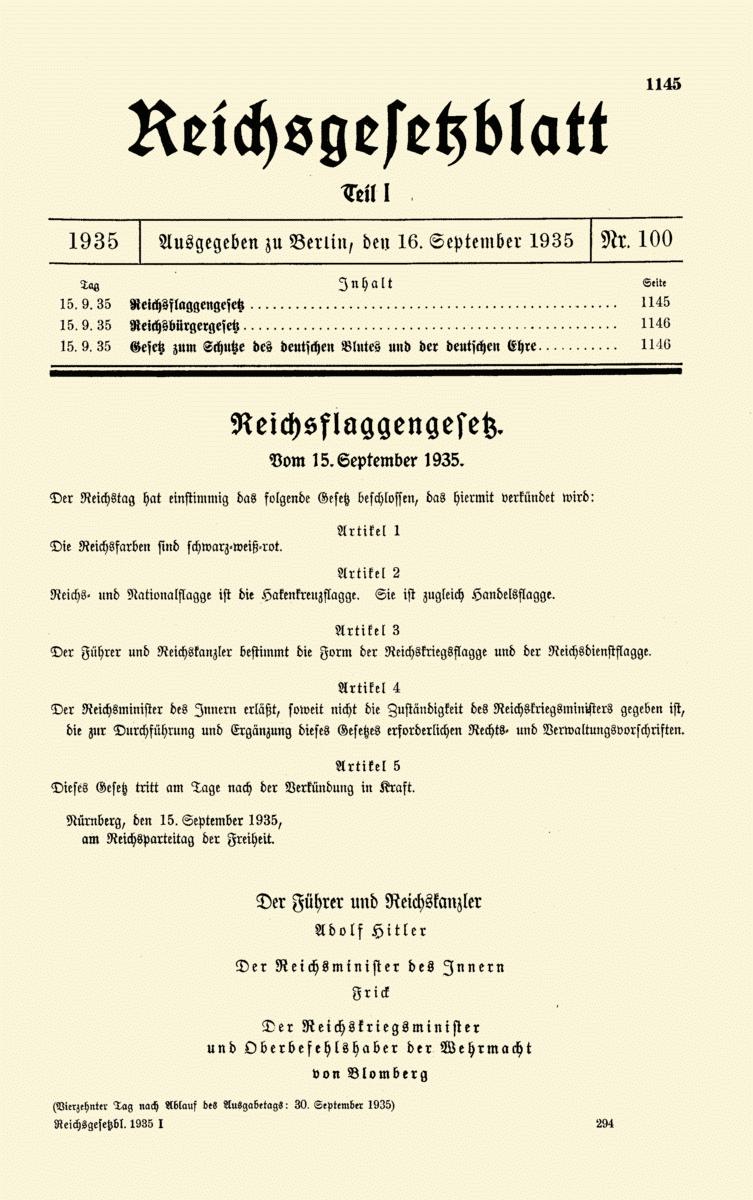
The Nuremberg Laws (Nürnberger Gesetze, pronounced [ˈnʏʁnbɛʁɡɐ ɡəˈzɛtsə] ⓘ) were antisemitic and racist laws introduced in Nazi Germany on 15 September 1935 at a special session of the Reichstag during the annual Nuremberg Rally of the Nazi Party. The legislation comprised two measures. The Law for the Protection of German Blood and German Honour prohibited marriages and sexual relations between Jews and Germans and barred Jewish households from employing German women under the age of 45. The Reich Citizenship Law restricted citizenship to people of "German or related blood", reducing others to state subjects without full rights.
A supplementary decree issued on 14 November 1935 defined who was legally considered Jewish and brought the Reich Citizenship Law into effect. On 26 November, further regulations extended the measures to Romani people and Afro-Germans, classifying them with Jews as "enemies of the race-based state".
To avoid international criticism, prosecutions under the laws were delayed until after the 1936 Summer Olympics in Berlin. The enactment followed earlier antisemitic policies of the regime. In 1933, Hitler's government declared a boycott of Jewish businesses, excluded Jews and other so-called "non-Aryans" from public service through the Law for the Restoration of the Professional Civil Service, and organised book burnings of works by Jewish and other authors. Jewish citizens were increasingly subjected to harassment, violence, and loss of rights.
The Nuremberg Laws severely damaged the Jewish community's social and economic position. People convicted of violating the marriage laws were imprisoned and, from March 1938, often re-arrested by the Gestapo and sent to Nazi concentration camps. Social and commercial contact between Jews and non-Jews declined, and many Jewish-owned businesses closed. Jews were excluded from civil service posts and regulated professions such as medicine and teaching, forcing many into menial work. Emigration was obstructed by the Reich Flight Tax, which seized up to 90 per cent of a person's assets. By 1938, few countries were willing to accept Jewish refugees. Plans for mass resettlement, such as the Madagascar Plan, failed, and from 1941 the regime began the Final Solution, the systematic extermination of Europe's Jews.
The Nazi Party was one of several far-right political parties which were active in Germany after the end of the First World War. The party platform included removal of the Weimar Republic, rejection of the terms of the Treaty of Versailles, radical antisemitism, and anti-Bolshevism. They promised a strong central government, increased Lebensraum (living space) for Germanic peoples, formation of a Volksgemeinschaft (people's community) based on race, and racial cleansing via the active suppression of Jews, who would be stripped of their citizenship and civil rights.
While he was imprisoned in 1924 after the failed Beer Hall Putsch, Hitler dictated Mein Kampf to his deputy, Rudolf Hess. The book is an autobiography and exposition of Hitler's ideology in which he laid out his plans for transforming German society into one based on race. In it, he outlined his belief in Jewish Bolshevism, a conspiracy theory that posited the existence of an international Jewish conspiracy for world domination in which the Jews were the mortal enemy of the German people. Throughout his life, Hitler never wavered in his worldview as expounded in Mein Kampf. The Nazi Party advocated the concept of a Volksgemeinschaft ("people's community") with the aim of uniting all Germans as national comrades, whilst excluding those deemed either to be community aliens or of a foreign race (Fremdvölkische).
Discrimination against Jews intensified after the Nazis came into power; a month-long series of attacks by members of the Sturmabteilung (SA; paramilitary wing of the Nazi Party) on Jewish businesses, synagogues, and members of the legal profession followed. On 21 March 1933, former U.S. congressman William W. Cohen, at a meeting of the executive advisory committee of the Jewish War Veterans of the United States, urged a strict boycott against all German goods. Later that month, a worldwide boycott of German goods was declared, with the support of several prominent Jewish organisations (though with the abstention of others, such as the Board of Deputies of British Jews). In response, Hitler declared a national boycott of Jewish businesses on 1 April 1933. By that time, many people who were not Nazi Party members were advocating the segregation of Jews from the rest of German society. The Law for the Restoration of the Professional Civil Service, passed on 7 April 1933, forced all non-Aryans to retire from the legal profession and civil service. Similar legislation soon deprived Jewish members of other professions of their right to practice. It also barred Jews from teaching at universities. In 1934, the Nazi Party published a pamphlet titled "Warum Arierparagraph?" ("Why the Aryan Law?"), which summarised the perceived need for the law. As part of the drive to remove what the Nazis called "Jewish influence" from cultural life, members of the National Socialist Student League removed from libraries any books considered un-German, and a nationwide book burning was held on 10 May. Violence and economic pressure were used by the regime to encourage Jews to voluntarily leave the country. Legislation passed in July 1933 stripped naturalised German Jews of their citizenship, creating a legal basis for recent immigrants (particularly Eastern European Jews) to be deported. Many towns posted signs forbidding entry to Jews. Throughout 1933 and 1934, Jewish businesses were denied access to markets, they were forbidden to advertise in newspapers, and they were deprived of access to government contracts. Citizens were harassed and subjected to violent attacks.
Other laws which were promulgated during this period included the Law for the Prevention of Hereditarily Diseased Offspring (passed on 14 July 1933), which called for the compulsory sterilisation of people with a range of hereditary, physical, and mental illnesses. Under the Law against Dangerous Habitual Criminals (passed 24 November 1933), habitual criminals were forced to undergo sterilisation as well. This law was also used to force the incarceration in prison or Nazi concentration camps of "social misfits" such as the chronically unemployed, prostitutes, beggars, alcoholics, homeless vagrants, Black people, and Romani (referred to as Zigeuner "Gypsies").
Hub AI
Nuremberg Laws AI simulator
(@Nuremberg Laws_simulator)
Nuremberg Laws
The Nuremberg Laws (Nürnberger Gesetze, pronounced [ˈnʏʁnbɛʁɡɐ ɡəˈzɛtsə] ⓘ) were antisemitic and racist laws introduced in Nazi Germany on 15 September 1935 at a special session of the Reichstag during the annual Nuremberg Rally of the Nazi Party. The legislation comprised two measures. The Law for the Protection of German Blood and German Honour prohibited marriages and sexual relations between Jews and Germans and barred Jewish households from employing German women under the age of 45. The Reich Citizenship Law restricted citizenship to people of "German or related blood", reducing others to state subjects without full rights.
A supplementary decree issued on 14 November 1935 defined who was legally considered Jewish and brought the Reich Citizenship Law into effect. On 26 November, further regulations extended the measures to Romani people and Afro-Germans, classifying them with Jews as "enemies of the race-based state".
To avoid international criticism, prosecutions under the laws were delayed until after the 1936 Summer Olympics in Berlin. The enactment followed earlier antisemitic policies of the regime. In 1933, Hitler's government declared a boycott of Jewish businesses, excluded Jews and other so-called "non-Aryans" from public service through the Law for the Restoration of the Professional Civil Service, and organised book burnings of works by Jewish and other authors. Jewish citizens were increasingly subjected to harassment, violence, and loss of rights.
The Nuremberg Laws severely damaged the Jewish community's social and economic position. People convicted of violating the marriage laws were imprisoned and, from March 1938, often re-arrested by the Gestapo and sent to Nazi concentration camps. Social and commercial contact between Jews and non-Jews declined, and many Jewish-owned businesses closed. Jews were excluded from civil service posts and regulated professions such as medicine and teaching, forcing many into menial work. Emigration was obstructed by the Reich Flight Tax, which seized up to 90 per cent of a person's assets. By 1938, few countries were willing to accept Jewish refugees. Plans for mass resettlement, such as the Madagascar Plan, failed, and from 1941 the regime began the Final Solution, the systematic extermination of Europe's Jews.
The Nazi Party was one of several far-right political parties which were active in Germany after the end of the First World War. The party platform included removal of the Weimar Republic, rejection of the terms of the Treaty of Versailles, radical antisemitism, and anti-Bolshevism. They promised a strong central government, increased Lebensraum (living space) for Germanic peoples, formation of a Volksgemeinschaft (people's community) based on race, and racial cleansing via the active suppression of Jews, who would be stripped of their citizenship and civil rights.
While he was imprisoned in 1924 after the failed Beer Hall Putsch, Hitler dictated Mein Kampf to his deputy, Rudolf Hess. The book is an autobiography and exposition of Hitler's ideology in which he laid out his plans for transforming German society into one based on race. In it, he outlined his belief in Jewish Bolshevism, a conspiracy theory that posited the existence of an international Jewish conspiracy for world domination in which the Jews were the mortal enemy of the German people. Throughout his life, Hitler never wavered in his worldview as expounded in Mein Kampf. The Nazi Party advocated the concept of a Volksgemeinschaft ("people's community") with the aim of uniting all Germans as national comrades, whilst excluding those deemed either to be community aliens or of a foreign race (Fremdvölkische).
Discrimination against Jews intensified after the Nazis came into power; a month-long series of attacks by members of the Sturmabteilung (SA; paramilitary wing of the Nazi Party) on Jewish businesses, synagogues, and members of the legal profession followed. On 21 March 1933, former U.S. congressman William W. Cohen, at a meeting of the executive advisory committee of the Jewish War Veterans of the United States, urged a strict boycott against all German goods. Later that month, a worldwide boycott of German goods was declared, with the support of several prominent Jewish organisations (though with the abstention of others, such as the Board of Deputies of British Jews). In response, Hitler declared a national boycott of Jewish businesses on 1 April 1933. By that time, many people who were not Nazi Party members were advocating the segregation of Jews from the rest of German society. The Law for the Restoration of the Professional Civil Service, passed on 7 April 1933, forced all non-Aryans to retire from the legal profession and civil service. Similar legislation soon deprived Jewish members of other professions of their right to practice. It also barred Jews from teaching at universities. In 1934, the Nazi Party published a pamphlet titled "Warum Arierparagraph?" ("Why the Aryan Law?"), which summarised the perceived need for the law. As part of the drive to remove what the Nazis called "Jewish influence" from cultural life, members of the National Socialist Student League removed from libraries any books considered un-German, and a nationwide book burning was held on 10 May. Violence and economic pressure were used by the regime to encourage Jews to voluntarily leave the country. Legislation passed in July 1933 stripped naturalised German Jews of their citizenship, creating a legal basis for recent immigrants (particularly Eastern European Jews) to be deported. Many towns posted signs forbidding entry to Jews. Throughout 1933 and 1934, Jewish businesses were denied access to markets, they were forbidden to advertise in newspapers, and they were deprived of access to government contracts. Citizens were harassed and subjected to violent attacks.
Other laws which were promulgated during this period included the Law for the Prevention of Hereditarily Diseased Offspring (passed on 14 July 1933), which called for the compulsory sterilisation of people with a range of hereditary, physical, and mental illnesses. Under the Law against Dangerous Habitual Criminals (passed 24 November 1933), habitual criminals were forced to undergo sterilisation as well. This law was also used to force the incarceration in prison or Nazi concentration camps of "social misfits" such as the chronically unemployed, prostitutes, beggars, alcoholics, homeless vagrants, Black people, and Romani (referred to as Zigeuner "Gypsies").
Recent media