Hubbry Logo
Denominazione di origine controllataDenominazione di origine controllataMain
Open search
Denominazione di origine controllata
Community hub
Denominazione di origine controllata
logo
8 pages, 0 posts
0 subscribers
Be the first to start a discussion here.
Denominazione di origine controllata
from Wikipedia

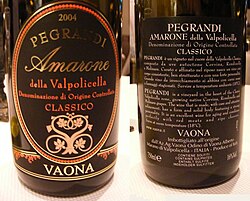
Labels of the Italian wine Amarone della Valpolicella Classico 2004 from the Pegrandi vineyard produced by Vaona. The label indicates that this is a DOC class wine from the Classico region of Valpolicella.

The following four classifications of wine constitute the Italian system of labelling and legally protecting Italian wine:

The system was introduced in 1963 shortly after the Treaty of Rome established Italy as a founding member of the European Economic Community, and was modelled on the extant French appellation d'origine contrôlée (AOC) laws. It was overhauled in 1992 to match new European Union law on protected designation of origin, introducing the more general denominazione di origine protetta (DOP) designation for foods and agricultural products, including wines.[1] Further EU reforms to harmonise agricultural policy in 2008 meant that designations used in member states, and thus Italian designations, were registered with the EU by the end of 2011, with subsequent new denominations or elevations approved by the EU.[2]

Indicazione geografica tipica (IGT)

[edit]

Indicazione geografica tipica was created in 1992 to recognize the unusually high quality of the class of wines known as Super Tuscans, and to be broadly equivalent to the French vin de pays designation, official in Italy's Aosta Valley, where French is an official language.[3] IGT wines are labelled with the locality of their creation, but do not meet the requirements of the stricter DOC or DOCG designations, which are generally intended to protect traditional wine formulations such as Chianti or Barolo. Since 2008 both IGT and vin de pays are equivalent to the EU protected geographical indication (PGI) designation, and many producers have switched to using the Italian translation, Indicazione geografica protetta (IGP).[4] This classification is seen to be a higher quality wine than vino da tavola ('table wine').

Denominazione di origine controllata (DOC)

[edit]

The denominazione di origine controllata classification was created to be roughly equivalent to the French appellation d'origine contrôlée (AOC). It requires that a wine satisfy a defined quality standard and be produced within the specified region. Unlike IGT, the DOC definitions will usually specify additional more stringent rules regarding permitted grape varieties, harvest yields, minimum ageing including use of barrels, minimum alcohol content, and other factors. Wines labelled DOC or DOCG must be sold in bottles holding no more than 5 litres (170 US fl oz). Historically the DOC status has been used to classify other food products such as cheeses, olive oil and vinegar, but the denominazione di origine protetta (DOP) is now used instead.

Since the 2008 EU reforms, both the DOC and DOCG wine classifications are protected in the EU as protected designation of origin (PDO), which in Italy generally is indicated in Italian: denominazione di origine protetta (DOP). They may however still be referred to as DOC/DOCG, or in Bolzano, where German is an official language, kontrollierte Ursprungsbezeichnung,[5] as well as in the Aosta Valley, where French is an official language, dénomination d'origine contrôlée.[6]

Denominazione di origine controllata e garantita (DOCG)

[edit]
A paper strip denoting DOCG on a bottle of 2012 Barbera d'Asti

Denominazione di origine controllata e garantita is intended to be a superior classification to DOC, and is the highest classification in Italy. All DOCG wines from each producer are analysed and tasted by a government-licensed judgement panel before being bottled. Once approved, the wines are "guaranteed" with a numbered governmental seal across the cap or cork, to prevent later manipulation. Where the DOCG classification represents a refinement of an existing DOC wine, the rules for the DOCG wine usually require more stringent quality controls. These controls are usually some combination of a lower proportion of blending grapes, lower yields, higher minimum alcohol, longer ageing requirements, and so on.

The need for a DOCG identification arose when the DOC designation was, in the view of many Italian food industries, given too liberally to different products. A new, more restrictive identification was then created as similar as possible to the previous one so that buyers could still recognize it, but qualitatively different. The three original DOCGs were Brunello di Montalcino, Vino Nobile di Montepulciano, and Barolo, all approved by a presidential decree in July 1980, followed by Barbaresco three months later.

For wines produced in Bolzano, where German is an official language, DOCG may be written as Kontrollierte und garantierte Ursprungsbezeichnung.[5]

For wines produced in the Aosta Valley, where French is an official language, DOCG may be written as Dénomination d'origine contrôlée et garantie.[6]

In 2010–2011 many new DOCG classifications were created or elevated from DOC, in the rush to register them before the EU reform deadline.[2] This has had the effect of potentially diluting the importance of the DOCG classification.[7]

Other label rules

[edit]

Italian legislation additionally regulates the use of qualifying terms for wines. Classico ('classic') is reserved for wines produced in the region where a particular type of wine has been produced "traditionally". For Chianti Classico, this traditional region is defined by a 1932 decree. Riserva ('reserve') may be used only for wines that have been aged at least two years longer than normal for a particular type of wine.

See also

[edit]

References

[edit]
[edit]
Revisions and contributorsEdit on WikipediaRead on Wikipedia
from Grokipedia
Denominazione di origine controllata () is a certification system for Italian wines that ensures the product originates from a defined geographical area and adheres to specific production standards, including varieties, yields, and techniques, to guarantee quality and authenticity. Introduced by the Italian in 1963 through No. 930, the DOC system was established to protect and promote regional wine traditions, modeled after the French (AOC) framework, and marked a significant step in regulating Italy's viticultural heritage following earlier protections dating back to the 1930s. Under DOC regulations, wines must be produced within delimited zones, using approved grape types and methods overseen by government authorities, with the label signifying controlled origin to distinguish them from lower-tier classifications like Indicazione Geografica Tipica (IGT). As of 2025, recognizes 332 DOC appellations across its regions, covering a wide array of styles from crisp whites like Soave to robust reds such as , contributing to the country's status as a leading wine producer while aligning with (PDO) standards for international protection. The system plays a crucial role in preserving and traditional practices, with ongoing updates to production rules ensuring adaptability to challenges and market demands, though DOC wines sit below the stricter Denominazione di Origine Controllata e Garantita (DOCG) level, which includes mandatory tastings for approval.

Overview and History

Definition and Purpose

Denominazione di origine controllata (DOC) serves as a granted to wines produced within designated geographical areas in , adhering to specific production standards that guarantee consistent quality, authenticity, and a direct connection to the region's unique attributes. This system ensures that only wines meeting rigorous criteria—encompassing grape varieties, yields, vinification methods, and aging processes—can bear the DOC label, thereby distinguishing them from generic Italian wines. Established through Presidential No. 930 on July 12, 1963, the DOC framework was Italy's response to post-war overproduction, economic instability, and fraudulent practices in the wine sector, which undermined its integrity and necessitated national standardization. The primary objectives of DOC are multifaceted, focusing on protecting consumers by providing assurance of a wine's and superior attributes, thereby building trust in the . It also bolsters regional economies by incentivizing sustainable practices and highlighting local specialties, which in turn fosters economic development in rural areas through increased value for terroir-driven products. Additionally, the designation combats , such as the illicit use of regional names on non-compliant wines, and elevates Italy's international reputation by promoting authentic, high-caliber exports that showcase the nation's viticultural heritage. Central to the DOC system are principles emphasizing the inseparable bond between a wine's sensory profile and its —the interplay of composition, , and longstanding cultural traditions in the delimited zone. This linkage underscores that the wine's distinctive qualities derive inherently from its environment, rather than solely from techniques. oversight is enforced via ministerial approval of production specifications and ongoing monitoring by dedicated consortia, which represent producers and verify adherence to rules, ensuring the label's credibility.

Historical Development

The development of the Denominazione di origine controllata (DOC) system in drew significant inspiration from the French (AOC) framework, which emerged in the late 19th century to safeguard regional wine identities against and adulteration. In the post-World War II period, grappled with rampant wine overproduction, economic instability, and pervasive in the sector, exacerbated by informal appellation practices that lacked rigorous enforcement. These challenges prompted early legislative efforts, building on protections from , to regulate wine designations and production zones amid growing concerns over quality dilution. A pivotal advancement came with Presidential Decree No. 930 of July 12, 1963, which formally established the DOC system to certify wines tied to specific geographic origins and production methods, with the first DOC wines approved in 1966, including , wines from , and di San Gimignano. This law marked a structured response to ongoing and , mandating controls on grape varieties, yields, and techniques to ensure authenticity. Over the subsequent decades, the number of DOC designations expanded dramatically, reaching 332 as of 2025, reflecting the system's adaptation to Italy's diverse wine regions. The framework evolved further in 1980 with the introduction of the Denominazione di Origine Controllata e Garantita (DOCG) category through amendments to the 1963 decree, targeting elite wines with enhanced guarantees, such as mandatory tastings and stricter yield limits; the first approvals included , , and . This tier addressed criticisms of inconsistent quality within DOC by imposing governmental seals on bottles. In 1992, Regulation (EEC) No. 2081/92 harmonized national systems, integrating DOC and DOCG into the broader (PDO) structure to facilitate cross-border protection and trade. Oversight of the DOC system has been anchored by the Italian Ministry of Agriculture, Food Sovereignty and Forests, which approves designations and enforces standards, in collaboration with regional consortia that monitor compliance and promote specific appellations, such as the Consorzio Vino Classico for its historic zone. These bodies conduct inspections, maintain production registers, and protect against misuse. In the , reforms including updates to national wine laws and alignments introduced tighter sustainability requirements, such as reduced chemical inputs and pathways, to mitigate effects like shifting growing seasons and in Italian vineyards.

Classification Levels

Indicazione Geografica Tipica (IGT)

The Indicazione Geografica Tipica (IGT), introduced in 1992 through Italian Law No. 164, represents the entry-level designation in Italy's wine quality pyramid, established to provide greater flexibility in varieties and production methods compared to the more restrictive Denominazione di Origine Controllata (). This classification emerged amid reforms aimed at harmonizing national systems with broader European standards for geographical indications, allowing producers to experiment with non-traditional blends while still tying wines to specific regions. As the broadest tier below , IGT emphasizes regional identity without imposing rigid traditional constraints, fostering innovation in Italian . IGT wines must originate from a defined geographical area, such as an entire region (e.g., Toscana or ) or a sub-regional zone, with at least 85% of the s sourced from that territory. They require a minimum alcohol content—typically 10-11% ABV depending on the wine type and zone—but lack stringent mandates on maximum yields, aging periods, or specific viticultural techniques, enabling producers to adapt to local conditions and market demands. This permissive framework contrasts with regulations, which enforce stricter limits on grape varieties, yields, and processing to preserve historical styles. The primary purpose of IGT is to support innovative regional wines that might not qualify under DOC rules, particularly by permitting the use of international grape varieties alongside indigenous ones. A prime example is the "Super Tuscan" wines from Toscana IGT, which often blend with or to create bold, age-worthy reds that gained prominence in the 1970s and 1980s for challenging conventional production. Similarly, Veneto IGT facilitates approachable blends like those combining , , and , offering soft, fruit-forward profiles with fewer restrictions on oak aging or varietal proportions than DOC equivalents such as . As of 2025, recognizes 118 IGT zones, accounting for around 24% of national wine production and enabling a significant portion of the country's output to reflect modern trends. The approval process for IGT designations is notably simpler and more decentralized than for , involving regional control bodies that verify compliance with basic specifications rather than national oversight. Producers submit proposals to regional authorities, who approve the zone's parameters—such as the geographical boundaries and minimum alcohol levels—without the extensive governmental tasting panels or yield audits required for higher tiers. This regional focus streamlines , encouraging broader participation and volume production while maintaining to the origin.

Denominazione di Origine Controllata (DOC)

The Denominazione di Origine Controllata (DOC) represents the foundational level of Italy's system for wines, established by Law No. 930 on December 12, 1963, to safeguard traditional regional production methods and ensure authenticity. This classification applies to wines produced in specific delimited geographical areas, emphasizing the link between the wine's characteristics and its , climate, and historical practices. As of 2025, there are 332 DOC designations across , covering a diverse array of still, sparkling, and fortified wines from regions like , , and . DOC designations account for the majority of production within Italy's combined DOC and DOCG categories, underscoring DOC's role as the backbone of the nation's quality wine sector. DOC regulations mandate that 100% of the grapes must originate from the defined production zone, with maximum yields typically ranging from 10 to 12 tons per depending on the specific denomination to maintain concentration and . Approved grape varieties are strictly prescribed for each —for instance, must constitute at least 70-80% in DOC blends—to preserve traditional styles. Optional sub-zones, such as "Classico" for historic core areas or "Riserva" for premium expressions, allow for further differentiation; Riserva wines generally require extended aging of 24 months, including at least three months in bottle, to develop complexity. The process is tightly controlled: grapes must be harvested, vinified, and bottled within the designated zone, ensuring from to . Quality assurance involves both analytical testing—covering parameters like alcohol content, acidity, and levels—and organoleptic evaluations by certified laboratories and panels to verify compliance with sensory standards. Notable examples include Prosecco DOC, a from and primarily made from Glera grapes, and Barolo DOC (prior to its 1980 elevation to DOCG), a robust Nebbiolo-based red from exemplifying structured, age-worthy styles. Economically, DOC wines drive significant export activity, with international sales accounting for around 60% of their total revenue, bolstering Italy's position as a global leader in wine trade. Despite these strengths, the proliferation of DOC designations has posed challenges, leading to variability in quality across some appellations due to inconsistent adherence to standards amid expanding production. This issue prompted ministerial reviews in the by Italy's Ministry of Agricultural, Food and Forestry Policies, which aimed to consolidate lesser-performing designations and reinforce controls to elevate overall consistency without diluting the system's regional focus.

Denominazione di Origine Controllata e Garantita (DOCG)

The Denominazione di Origine Controllata e Garantita (DOCG) denotes the pinnacle of 's wine quality hierarchy, offering enhanced guarantees of authenticity and excellence for the nation's most prestigious appellations. Introduced in 1980 through a presidential to safeguard and elevate iconic wines amid concerns over variable quality in lower classifications, the DOCG system was designed to enforce unparalleled rigor in production. As of 2025, recognizes 78 DOCG designations, the most recent being Cirò Classico DOCG in , which collectively produce around 10% of the volume from classified (DOP) Italian wines, emphasizing small-scale, high-value outputs from delimited zones. DOCG standards exceed those of level by mandating 100% use of approved grape varieties, typically indigenous to the region but sometimes including international ones in specific appellations, coupled with reduced maximum yields to enhance concentration and quality—for instance, 8 tons per in the DOCG. Aging requirements are also compulsory and extended, such as a minimum of 38 months total (with at least 18 months in ) for , ensuring complexity and longevity. involves dual scrutiny: chemical laboratory testing followed by blind sensory evaluation by a state-approved panel, certifying that only compliant wines receive the designation. A hallmark of DOCG certification is the mandatory, government-issued numbered seal placed across the bottle neck, serving as an anti-counterfeiting measure to trace and authenticate each bottle's origin. Exemplary DOCG wines include Chianti Classico DOCG from Tuscany's historic heartland, crafted solely from grapes, and Brunello di Montalcino DOCG, which undergoes even longer maturation for its robust profile. Many designations incorporate sub-categories like "Classico" to denote production from core traditional areas or "Riserva" for selections with additional aging, promoting nuanced expressions of . This elite status drives substantial economic value, with DOCG wines typically retailing at an average of over €20 per bottle due to their scarcity and superior standards, fostering widespread international acclaim. Certain DOCG areas, such as the Hills of , gained UNESCO World Heritage recognition in 2019 for their unique viticultural landscapes, amplifying cultural prestige and global demand.

Regulations and Production Standards

Eligibility and Production Rules

The eligibility for wines under the Denominazione di origine controllata () system requires strict adherence to defined production specifications, known as disciplinari di produzione, which are approved by the Italian Ministry of Agricultural, Food and Forestry Policies (MASAF) in alignment with regulations. These specifications outline the geographical boundaries where grapes must be grown and wines processed, ensuring that the product's qualities derive exclusively from the . For instance, the DOC zone spans central across provinces including , , , , , and , encompassing hilly terrain between 200 and 700 meters altitude with characteristic galestro —friable, schistous clay that promotes deep root growth and contributes to the wines' structure and acidity. Maps of these delimited zones, based on composition, climate, and historical viticultural aptitude, are officially approved and maintained by MASAF to prevent expansion beyond areas with proven environmental suitability. Viticultural rules emphasize practices that preserve local traditions and quality, including restrictions on permitted grape varieties, pruning methods, and planting densities. DOC wines must primarily use indigenous or regionally suitable varieties, often requiring 70-100% from specified local grapes to maintain typicity; for example, in the Roma DOC, white wines like Romanella require at least 50% Malvasia del Lazio and 35% from varieties such as Bellone or , while reds mandate 50% supplemented by Cesanese or . systems are limited to traditional techniques like or cordon spur to control vigor, and new vineyards must achieve a minimum density of 3,000 vines per hectare to optimize yield quality and canopy management, as stipulated in production codes. These rules, derived from historical data and environmental assessments, ensure vines adapt to specific microclimates, such as the Mediterranean-influenced conditions in with significant diurnal temperature shifts. Winemaking standards focus on minimal intervention to highlight terroir-driven flavors, prohibiting unauthorized additives and enforcing EU-compliant oenological practices. must occur using only grapes from the designated zone, with controls on and duration to preserve varietal character; additives are restricted to those permitted under limits, such as limited , and enrichment or deacidification is allowed only within specified parameters. Maximum alcohol levels are capped, typically at 15% for red wines, to avoid overripeness, while sustainability elements introduced post-2019 encourage reduced resource use, including water-efficient in drought-prone areas, though these are integrated into updated specifications rather than universal mandates. All processing occurs within the delimited zone to maintain PDO integrity under rules. Yield limits are calculated in tons of grapes per and vary by zone and wine type to ensure concentration and quality, with excesses leading to . General caps range from 7.5 to 12 tons per hectare; for example, Roma whites allow up to 12 tons/ha, while reds are limited to 10 tons/ha, with a 20% tolerance in exceptional years—any surplus beyond 75% transformation yield into wine results in downgrade to Indicazione Geografica Tipica (IGT). These limits, based on five-year historical averages, prevent overproduction and are enforced through annual declarations. Documentation ensures full traceability from to , mandated since the 2017 Testo Unico del Vino and enhanced by digital systems from 2020. Producers must register in the national schedario viticolo via the Sistema Informativo Agricolo Nazionale (SIAN), submitting annual production declarations that track movements, , and bottling through telematic registries for carico e scarico (intake and dispatch). This digital framework, replacing paper records, allows real-time monitoring and compliance verification by accredited bodies like ICQRF, preventing fraud and supporting chain-of-custody audits.

Quality Assurance and Controls

Quality assurance for Denominazione di origine controllata (DOC) wines is maintained through a system of independent certification bodies and governmental oversight, ensuring compliance with established production standards. Protection consortia, formed by producers within each DOC region, conduct routine monitoring and verification of adherence to regulations, including yields, grape varieties, and practices. These consortia work in coordination with the Istituto Centrale per la Qualità e la Repressione Frodi (ICQRF), Italy's Central Inspectorate for Quality and Repression of Agri-food Products, which supervises private control bodies and performs official inspections. Annual audits by these entities involve on-site visits to , cellars, and bottling facilities, with sampling for analysis to verify that wines meet the geographic and qualitative criteria outlined in DOC disciplinary regulations. Testing protocols for DOC certification combine chemical and sensory evaluations to confirm product integrity. Chemical analyses assess key parameters such as acidity levels, content, alcohol percentage, and residual sugar, ensuring alignment with DOC specifications and detecting any adulteration. Sensory evaluations are performed by approved panels of 8-12 trained experts who assess attributes like aroma, flavor, color, and overall typicity, using standardized scales to rate compliance with the wine's expected profile. These batch-level checks occur during production stages. Enforcement mechanisms deter violations through penalties and corrective actions, preserving DOC integrity. The ICQRF imposes administrative fines for non-compliance, which can reach up to €100,000 depending on the severity, such as unauthorized blending or mislabeling. Serious infractions may result in declassification to a lower category like Indicazione Geografica Tipica (IGT) or revocation of status, as seen in the 2008 scandal where producers faced investigations for adding non-Sangiovese grapes, leading to the declassification of millions of liters to IGT and substantial fines. Wines classified as IGT can upgrade to DOC status through a formal process to the Ministry of Agriculture, and , requiring demonstration of consistent quality over a period of 5-10 years via documented production records, sensory evaluations, and compliance audits. To enhance traceability and combat counterfeiting, technology has been adopted in several Italian wine regions, including DOC appellations, since 2022, allowing real-time tracking from to consumer through immutable digital records of production and supply chain data.

Broader Context and Impact

Relation to EU and International Systems

The Denominazione di origine controllata (DOC) system was integrated into the European Union's framework for geographical indications through Council Regulation (EEC) No. 2081/92, which established the protected designation of origin (PDO) category for products whose quality or characteristics are essentially due to their geographical origin, with production occurring entirely within that area. Under this regulation, Italy's existing DOC designations for wines were recognized as equivalent to PDO status, provided they met criteria linking product qualities to specific terroirs and human factors, while the broader Indicazione geografica tipica (IGT) aligned with the protected geographical indication (PGI) for products with a looser link to origin. This integration ensures mutual recognition and protection of PDO wines across all 27 EU member states, allowing free circulation without additional national barriers, as affirmed in subsequent EU quality schemes legislation. EU regulations on geographical indications have evolved to address modern challenges, with Regulation (EU) No 1151/2012 consolidating and updating protections for PDOs like wines by streamlining registration and enhancing enforcement against misuse. More recent reforms under Regulation (EU) 2024/1143 introduce digital registers for real-time access to GI specifications and provisions for adapting designations to climate change impacts, such as allowing modifications to production rules for sustainability in regions. These updates facilitate electronic monitoring of compliance and promote resilience for PDO wines amid environmental shifts, without altering core origin-based requirements. Internationally, the DOC system shares similarities with other appellation frameworks but differs in emphasis and stringency. France's appellation d'origine contrôlée (AOC), now aligned with the EU's AOP (protected designation of origin), imposes stricter adherence to traditional methods and grape varieties compared to DOC's focus on regional typicity. Spain's denominación de origen (DO) offers more flexibility in yields and blends while maintaining origin controls, contrasting DOC's balanced regulation of production zones and standards. In the United States, American Viticultural Areas (AVAs) define growing regions but lack mandatory production or quality controls, relying instead on voluntary practices unlike the enforceable rules of DOC. Global protection for DOC wines is bolstered by the World Trade Organization's Agreement on Trade-Related Aspects of Rights (TRIPS) since 1994, which mandates legal means to prevent misleading use of geographical indications, with enhanced safeguards for wines under Article 23 prohibiting any evocation of origin even if not deceptive. This has enabled actions against misuse, such as lawsuits in the 2010s paralleling the successful Parma ham PDO enforcement, where Italian wines like faced unauthorized labeling abroad but secured protections through TRIPS-compliant rulings. Challenges persist in non-EU markets, including Brexit's disruption to UK exports of Italian DOC wines, which saw a 20% decline in sparkling categories by 2020 due to new customs barriers and logistics costs. Rising Asian demand requires reciprocal protections, as evidenced by the 2019 EU-China agreement safeguarding over 100 European GIs, including several Italian DOC wines, against imitation while opening markets for mutual recognition; by 2025, implementation has expanded protections for additional DOC designations.

Economic and Cultural Significance

The Denominazione di origine controllata (DOC) system plays a pivotal role in Italy's , contributing significantly to national GDP through wine production, exports, and related industries. In 2025, the sector, dominated by DOC-designated wines, generates a direct turnover of approximately €14.5 billion, with a broader economic impact exceeding €45 billion, accounting for about 1.1% of Italy's GDP. This encompasses upstream activities like and downstream sectors such as bottling, distribution, and , underscoring the system's multiplier effect on rural economies. Over 300,000 jobs are supported across the wine , highlighting its importance for in agrarian regions. DOC wines represent the majority of Italy's bottled exports, with roughly 50% of production shipped abroad, valued at over €8 billion in 2024, bolstering the trade balance. Key markets include the (24% of exports), (17%), and the (11%), where premium DOC labels drive demand for Italian varietals like and . Beyond national figures, the DOC framework fosters regional development by revitalizing rural areas through enotourism and sustainable practices. In Piedmont, for instance, Barolo DOCG (a higher classification building on DOC principles) has transformed the Langhe hills into a tourism hub, attracting millions of visitors annually and generating substantial local revenue from wine-related experiences, accommodations, and gastronomy. This influx supports small producers and preserves depopulated villages, with similar boosts in Tuscany's Chianti region and Veneto's Prosecco hills. Sustainability initiatives within DOC zones have further enhanced economic resilience; since 2015, collective efforts by consortia and wineries have reduced the sector's carbon footprint through measures like precision irrigation, renewable energy adoption, and organic conversions, lowering operational costs and appealing to eco-conscious global buyers. These practices not only mitigate environmental risks but also qualify wines for premium pricing, adding €1-2 billion in annual value. Culturally, the DOC system safeguards Italy's enogastronomic heritage, embedding wine within and global diplomacy. It preserves ancient viticultural traditions tied to over 500 indigenous grape varieties, fostering and regional cuisines that define Italian lifestyle. The 2014 UNESCO World Heritage designation for the Langhe-Roero and Monferrato vineyard landscapes, encompassing several DOC zones, recognizes this cultural mosaic as a "living testimony" to human-land interaction, drawing international acclaim and reinforcing Italy's . Events like Vinitaly, the world's largest wine fair, amplify this influence, hosting approximately 4,100 exhibitors and 97,000 visitors annually (as of 2025) to promote DOC wines as symbols of Italian elegance and conviviality, enhancing diplomatic ties and cultural exports worth €2 billion yearly. Despite these benefits, the DOC system faces criticisms for occasionally prioritizing over , diluting prestige in some denominations amid over 300 active zones. Producers in less-regulated DOCs have been accused of using high-yield techniques, leading to variable standards that undermine consumer trust and export competitiveness. In response, reforms emphasize , with consortia reviving rare grapes like Timorasso and Susumaniello through subsidized plantings and genetic research, aiming to enhance resilience and uniqueness; initiatives like Sicilia DOC now incorporate 50+ native varieties to counter homogenization. Looking ahead, poses challenges, with projections indicating significant shifts in suitable production areas by mid-century—including northward migration of vineyards and earlier harvests by 2-5 days—prompting DOC adaptations such as drought-resistant rootstocks and elevated plantings to sustain yields and .

References

Add your contribution
Related Hubs
User Avatar
No comments yet.