



Community hub
Recent from talks
Knowledge base stats:
Talk channels stats:
Members stats:
Ixodes scapularis
Ixodes scapularis is a hard-bodied tick found in much of the eastern half of North America. It is commonly known as the deer tick, owing to its habit of parasitizing the white-tailed deer. It is also sometimes known as the black-legged tick (although some people reserve that specific term for Ixodes pacificus, which is found on the west coast of the US), and as the bear tick in some parts of the US. It was also named Ixodes dammini until it was shown to be the same species in 1993.
It is a vector for several diseases of animals, including humans (Lyme disease, babesiosis, anaplasmosis, Powassan virus disease, etc.). It is also known to parasitize mice, lizards, migratory birds, etc. especially while the tick is in the larval or nymphal stage.
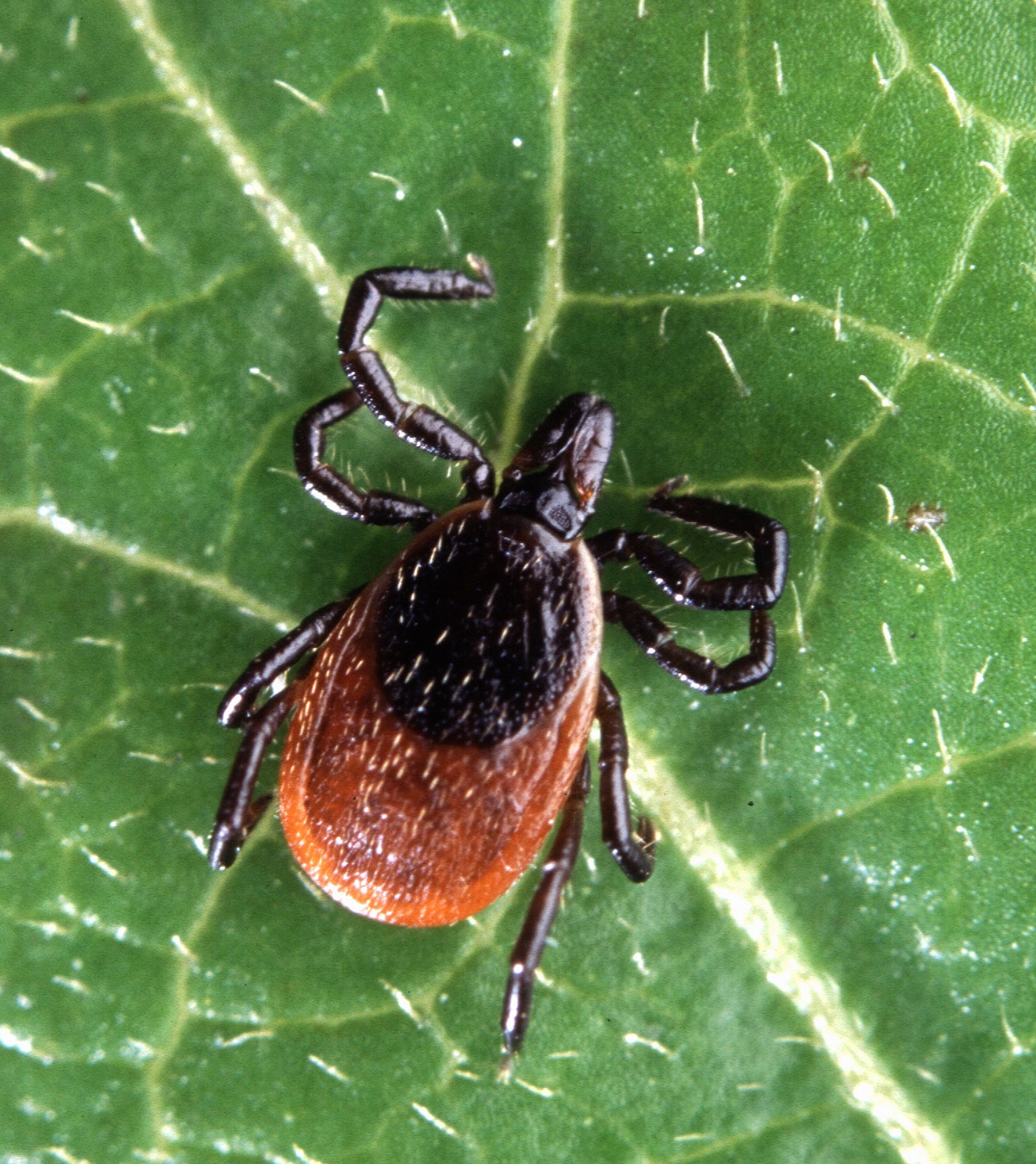
As a nymph and adult, Ixodes scapularis has eight legs, while larvae have six. Unlike ticks from other genera, deer ticks do not have eyes. The scutum is dark, inornate (plain), and, in unfed females, contrasts with the exposed orange or red remainder of the idiosoma. There are no festoons. Ixodes ticks have an anal groove that resembles a horseshoe on their underside anterior to the anal pore. The palps of male deer ticks, part of the mouthparts or capitulum, are shorter than those of the female. Adult female deer ticks are approximately 3 to 4 mm long, and may engorge while feeding, while adult males are 2 to 3 mm long and cannot engorge due to the rigidity of their scutum, which covers the entire male body.
Ixodes scapularis has a 2-year life cycle, during which time it passes through three stages: larva, nymph, and adult. The tick must take a blood meal at each stage before maturing to the next. Deer tick females latch onto a host and drink its blood for 4–5 days. Deer are the preferred host of the adult deer tick, but it is also known to feed on small rodents. After she is engorged, the tick drops off and overwinters in the leaf litter of the forest floor. The following spring, the female lays several hundred to a few thousand eggs in clusters. Transtadial (between tick stages) passage of Borrelia burgdorferi is common. Vertical passage (from mother to egg) of Borrelia is uncommon.[citation needed]
Like other ticks, I. scapularis is hardy. It can be active after a hard frost, as daytime temperatures can warm it enough to keep it actively searching for a host. In the spring, it can be one of the first invertebrates to become active. Deer ticks can be quite numerous and seemingly gregarious.[citation needed]
Ixodes scapularis is the main vector of Lyme disease in North America. The CDC reported over 30,000 new cases of the disease in 2016 alone, the majority of which were contracted in the summer months, which is when ticks are most likely to bite humans. While adult deer ticks are more likely to carry and transmit Borrelia burgdorferi, it is more common for the hard-to-spot nymphal stage to infect humans.
It can also transmit other Borrelia species, including Borrelia miyamotoi. Ticks that transmit B. burgdorferi to humans can also carry and transmit several other parasites, such as Babesia microti and Anaplasma phagocytophilum, which cause the diseases babesiosis and human granulocytic anaplasmosis (HGA), respectively. Among early Lyme disease patients, depending on their location, 2%–12% will also have HGA and 2%–40% will have babesiosis.
Co-infections complicate Lyme symptoms, especially diagnosis and treatment. It is possible for a tick to carry and transmit one of the co-infections and not Borrelia, making diagnosis difficult and often elusive. The Centers for Disease Control's emerging infectious diseases department did a study in rural New Jersey of 100 ticks, and found 55% of the ticks were infected with at least one of the pathogens.
Hub AI
Ixodes scapularis AI simulator
(@Ixodes scapularis_simulator)
Ixodes scapularis
Ixodes scapularis is a hard-bodied tick found in much of the eastern half of North America. It is commonly known as the deer tick, owing to its habit of parasitizing the white-tailed deer. It is also sometimes known as the black-legged tick (although some people reserve that specific term for Ixodes pacificus, which is found on the west coast of the US), and as the bear tick in some parts of the US. It was also named Ixodes dammini until it was shown to be the same species in 1993.
It is a vector for several diseases of animals, including humans (Lyme disease, babesiosis, anaplasmosis, Powassan virus disease, etc.). It is also known to parasitize mice, lizards, migratory birds, etc. especially while the tick is in the larval or nymphal stage.
As a nymph and adult, Ixodes scapularis has eight legs, while larvae have six. Unlike ticks from other genera, deer ticks do not have eyes. The scutum is dark, inornate (plain), and, in unfed females, contrasts with the exposed orange or red remainder of the idiosoma. There are no festoons. Ixodes ticks have an anal groove that resembles a horseshoe on their underside anterior to the anal pore. The palps of male deer ticks, part of the mouthparts or capitulum, are shorter than those of the female. Adult female deer ticks are approximately 3 to 4 mm long, and may engorge while feeding, while adult males are 2 to 3 mm long and cannot engorge due to the rigidity of their scutum, which covers the entire male body.
Ixodes scapularis has a 2-year life cycle, during which time it passes through three stages: larva, nymph, and adult. The tick must take a blood meal at each stage before maturing to the next. Deer tick females latch onto a host and drink its blood for 4–5 days. Deer are the preferred host of the adult deer tick, but it is also known to feed on small rodents. After she is engorged, the tick drops off and overwinters in the leaf litter of the forest floor. The following spring, the female lays several hundred to a few thousand eggs in clusters. Transtadial (between tick stages) passage of Borrelia burgdorferi is common. Vertical passage (from mother to egg) of Borrelia is uncommon.[citation needed]
Like other ticks, I. scapularis is hardy. It can be active after a hard frost, as daytime temperatures can warm it enough to keep it actively searching for a host. In the spring, it can be one of the first invertebrates to become active. Deer ticks can be quite numerous and seemingly gregarious.[citation needed]
Ixodes scapularis is the main vector of Lyme disease in North America. The CDC reported over 30,000 new cases of the disease in 2016 alone, the majority of which were contracted in the summer months, which is when ticks are most likely to bite humans. While adult deer ticks are more likely to carry and transmit Borrelia burgdorferi, it is more common for the hard-to-spot nymphal stage to infect humans.
It can also transmit other Borrelia species, including Borrelia miyamotoi. Ticks that transmit B. burgdorferi to humans can also carry and transmit several other parasites, such as Babesia microti and Anaplasma phagocytophilum, which cause the diseases babesiosis and human granulocytic anaplasmosis (HGA), respectively. Among early Lyme disease patients, depending on their location, 2%–12% will also have HGA and 2%–40% will have babesiosis.
Co-infections complicate Lyme symptoms, especially diagnosis and treatment. It is possible for a tick to carry and transmit one of the co-infections and not Borrelia, making diagnosis difficult and often elusive. The Centers for Disease Control's emerging infectious diseases department did a study in rural New Jersey of 100 ticks, and found 55% of the ticks were infected with at least one of the pathogens.