Hubbry Logo
Jake GibbsJake GibbsMain
Open search
Jake Gibbs
Community hub
Jake Gibbs
logo
8 pages, 0 posts
0 subscribers
Be the first to start a discussion here.
Jake Gibbs
Jake Gibbs
from Wikipedia

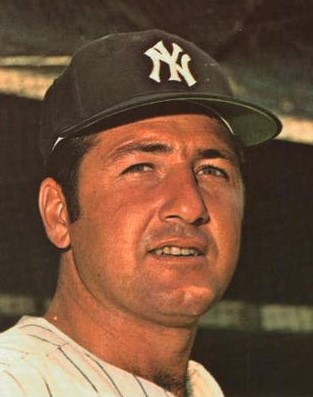
Jerry Dean "Jake" Gibbs (born November 7, 1938) is an American former Major League Baseball player who played for the New York Yankees as a platoon catcher from 1962 to 1971. Although Gibbs was the regular starting catcher for New York in 1967 and 1968, he was primarily a back-up for Elston Howard and then Thurman Munson at the tail-end of his career.

Key Information

Prior to beginning his professional baseball career, Gibbs had successful careers in college baseball and college football at the University of Mississippi (Ole Miss) for the Ole Miss Rebels. He was also a member of the Pi Kappa Alpha (PIKE) Fraternity. He returned to Ole Miss to coach the baseball and football teams.

Amateur career

[edit]

Gibbs attended the University of Mississippi, where he played quarterback for the Ole Miss Rebels football team, and also played for the Ole Miss Rebels baseball team. Both teams compete in the Southeastern Conference (SEC). Gibbs led the Rebels to their first SEC baseball championship, in 1959.[1]

During his junior football season, Gibbs was best remembered for punting the ball to Louisiana State University All-American Billy Cannon in a Halloween Night game at Tiger Stadium. On a third-and-19 with 10 minutes remaining, and the third-ranked Rebels ahead of defending national champion and top-ranked LSU 3-0, Cannon picked up the ball on one bounce at his own 11-yard line and raced past the Rebel coverage unit, including Gibbs, 89 yards for the game's only touchdown. The play helped Cannon win the 1959 Heisman Memorial Trophy.

The 7-3 loss cost Ole Miss a chance at the wire service national championships, since those polls were voted upon at the time prior to bowl games and did not take into account Ole Miss' 21-0 humiliation of LSU in the 1960 Sugar Bowl, 62 days after the teams played in Baton Rouge.

During his senior year at Mississippi, Gibbs led the football team to a 10–0–1 record, with the lone blemish a 6-6 deadlock against an inferior LSU squad (the Tigers went 5-4-1 after winning 20 of 22 games in 1958 and 1959) at Oxford, Mississippi. The Rebels won the 1961 Sugar Bowl, defeating the Rice Owls football team 14-6, as Gibbs scored both touchdowns.[2][3] The Rebels were recognized as national champions by the Football Writers Association of America.[4] Gibbs was named to the 1960 College Football All-America Team.[5] That year, he was also named SEC Player of the Year.[6]

Professional career

[edit]

Gibbs decided instead to go professional in baseball despite being drafted by the Houston Oilers of the American Football League and Cleveland Browns of the National Football League in 1961. Gibbs signed with the New York Yankees in 1961, receiving a $100,000 signing bonus under the bonus rule.[7][8] Gibbs signed as a third baseman and shortstop.[7]

He began his professional career with the Richmond Virginians of the International League; he recorded five hits in a double header in his professional debut[9] and started his career with an eight-game hitting streak.[10] The Yankees optioned him to Richmond in 1962,[11] but his season was limited by injuries.[12] The Yankees asked Gibbs to switch to catcher in 1963.[13][14] Gibbs spent the 1963 season with the Virginians, before the Yankees promoted him again in September.[15]

Gibbs spent his four first professional seasons in minor league baseball,[16] where his highest season batting average was .284 and he managed to hit 28 home runs across the four seasons.[5] With Yogi Berra's retirement before the 1964 season, Gibbs competed for a spot on the Yankees' roster.[17] He was unable to appear in the 1964 World Series due to broken fingers.[18] He also missed the end of the 1966 season after suffering a broken left hand.[19] Gibbs backed up Elston Howard for a number of years.[20] When the Yankees traded Howard during the 1967 season, Gibbs became the team's starting catcher.[21] He eventually lost the first-string job to Thurman Munson, but continued as a back-up with the team.[22] In June 1971, he announced his retirement from baseball, effective at the end of the season.[23] He played his final game on September 29, 1971.

Coaching career

[edit]

Gibbs returned to Ole Miss as an assistant football coach in 1965, working during the Yankees' offseason.[16][23] In this role, Gibbs mentored Heisman Trophy finalist quarterback Archie Manning.[22]

After the 1971 season, Gibbs returned to Ole Miss full-time as a baseball coach and football recruiter.[23] In 1972, he coached Ole Miss to the SEC championship. The team set an SEC record for consecutive conference wins, and went to Omaha for the 1972 College World Series (CWS),[1] and Gibbs was named coach of the year.[24] Gibbs was named coach of the year again in 1977.[25] Gibbs retired in 1990 with 485 wins, more than any coach in Ole Miss history, though this was later surpassed on March 9, 2013, by Mike Bianco.[1]

Gibbs returned to the Yankees' organization in 1993 as the team's bullpen catcher.[26] In 1994 and 1995, Gibbs managed the Tampa Yankees, the Yankees' Class A-Advanced affiliate in the Florida State League.[27][28]

Honors

[edit]

On February 15, 2020, Gibbs' baseball number, 41, was retired in a ceremony prior to the Ole Miss baseball game vs Louisville.

In 1995, Gibbs was inducted into the College Football Hall of Fame.[29] He appeared at the Yankees' Old-Timers' Day in 2012 and 2014.[30]

See also

[edit]

References

[edit]
[edit]
Revisions and contributorsEdit on WikipediaRead on Wikipedia
from Grokipedia
Jerry Dean "Jake" Gibbs (born November 7, 1938) is an American former and college football , best known for his ten-season career with the New York Yankees from 1962 to 1971 and his standout collegiate performances at the , where he became the first athlete from the state to earn honors in two sports. Born in , Gibbs attended Ole Miss from 1958 to 1961, excelling in football as a who led the to a 29-3-1 record over three seasons, including a 10-0-1 campaign in 1960 as recognized by the . In football, Gibbs threw for 1,850 yards and 19 touchdowns while rushing for 560 yards and 14 scores during his tenure, earning unanimous All-American status in 1960, Player of the Year honors, and a third-place finish in voting that year. On the baseball diamond at Ole Miss, he was a three-time All-SEC selection and two-time All-American , helping the team to SEC championships in 1959 and 1960. Transitioning to the majors, Gibbs debuted with the Yankees on , 1962, and appeared in 538 games over his career, batting .233 with 25 home runs and 146 RBIs while establishing himself as a reliable defensive , leading the in fielding percentage (.991) and total zone runs (11) among catchers in 1968. After retiring as a player, Gibbs returned to Ole Miss as an assistant football coach from 1965 to 1970 and served as the Rebels' for 19 years (1972–1990), guiding the team to multiple titles including the overall championship in 1972 and 1977. He later worked as a catching instructor for the Yankees in 1993 and managed their Single-A affiliate, the Tampa Yankees, in 1994. Gibbs' contributions to sports in earned him induction into the Mississippi Sports Hall of Fame in 1976 and the in 1995.

Early life

Childhood and education

Jerry Dean "Jake" Gibbs was born on November 7, 1938, in . He grew up in this small north-central town, surrounded by a close-knit that included his brother, Bobby Gibbs. During his early childhood, Gibbs developed an initial interest in sports through informal play with family members and older boys in the local community, including pickup games along Highway 8 east of . Gibbs attended Grenada High School in his hometown, where he received his formal education leading up to graduation in 1957. While specific non-athletic academic highlights are not widely documented, his schooling provided the foundation for his later pursuits, including exposure to organized sports programs in football and through school and local youth leagues. This early environment in shaped his competitive spirit before he transitioned to college athletics at the .

High school athletics

Jake Gibbs emerged as a standout athlete at Grenada High School in , excelling in both football and during the mid-1950s. In football, Gibbs played as and , leading the Chargers to the Little 10 Conference championship in 1957 as a senior. Gibbs also starred in , beginning his involvement in the and playing six years for the school team, initially at second base before transitioning to . His early passion for baseball was nurtured through games with older boys and family members, including his brother Bobby. Gibbs' high school prowess drew recruitment interest from multiple colleges, particularly for football, with offers from the (Ole Miss) and Mississippi State. He ultimately accepted a football to Ole Miss in 1958, where he continued to play both sports.

College career

Football at Ole Miss

Jake Gibbs enrolled at the in 1957 and joined the team as a , playing from 1958 to 1960 under head coach Johnny Vaught. During his three seasons as the starting , the Rebels compiled an impressive 29-3-1 record, establishing one of the most dominant eras in program history. Gibbs quickly emerged as a dual-threat leader, contributing both through the air and on the ground, while his poise and decision-making helped anchor an offense that emphasized ball control and defensive support. In his junior year of 1959, Gibbs led the SEC in passing yards with 755 and touchdowns with 6, earning All-SEC honors for his efforts. The finished the regular season 9-1, with their sole loss coming in a 7-3 defeat to LSU on Halloween night, marked by Billy Cannon's iconic 89-yard punt return . Ole Miss avenged the loss in the on January 1, 1960, shutting out the Tigers 21-0; Gibbs threw a crucial 43-yard pass to Cowboy Woodruff in the second quarter, helping secure the victory and contributing to the team's claim of a share of the in some polls. Gibbs' senior season in 1960 marked his pinnacle, as he was named SEC Player of the Year, All-SEC, and a unanimous All-American while finishing third in voting. He passed for 970 yards and 12 touchdowns on 66-of-109 attempts (60.6% completion rate), leading the conference in passing touchdowns, and added 246 rushing yards and 5 scores, showcasing his versatility in Vaught's run-heavy scheme. The went undefeated at 10-0 in the regular season, including a 6-6 tie against rival LSU on , before capping the year with a 14-6 win over Rice on January 2, 1961, where Gibbs earned MVP honors with two rushing touchdowns. This performance earned Ole Miss the (FWAA) national championship recognition. Gibbs' leadership was instrumental in Ole Miss' back-to-back triumphs and sustained excellence, as he captained the team alongside Warner Alford and mentored a unit that outscored opponents decisively across his tenure. His ability to manage games efficiently, often relying on short passes and scrambles, complemented the ' stingy defense and solidified his legacy as one of the program's most impactful quarterbacks.

Baseball at Ole Miss

Jake Gibbs joined the team in 1959, playing primarily as an during his three-year collegiate career from 1959 to 1961. Under head coach Tom Swayze, Gibbs quickly became a cornerstone of the program, showcasing strong defensive skills at third base and while contributing offensively as a left-handed batter. His versatility and leadership helped elevate the Rebels' competitiveness in the (SEC), marking the beginning of the program's rise to prominence. In 1959, Gibbs played a pivotal role in leading Ole Miss to its first SEC baseball championship, batting .388 with key hits that drove in runs during critical games. The finished the season with a strong record, securing the title and establishing a foundation for future success. Gibbs earned All-SEC honors that year, recognizing his impact as both a hitter and fielder. His performance exemplified the dual-sport demands he balanced with football, allowing him to contribute significantly without compromising either program. Gibbs continued his excellence in 1960, posting a .424 batting average over 25 games—the second-highest single-season mark in Ole Miss history at the time—and helping the Rebels repeat as SEC champions. He received All-SEC recognition for the second consecutive year and was named an All-American, becoming one of the first Mississippi college athletes to earn such honors in baseball. The following season in 1961, Gibbs batted .333 while earning his third straight All-SEC selection and second All-America accolade, solidifying his legacy as a two-sport star. Over his career, he maintained a .384 batting average in 72 games, driving the team's development into a conference contender.

Professional career

Minor leagues and signing

Following his standout college baseball career at the University of Mississippi, where he excelled as a and , Jake Gibbs attracted significant professional interest. In May 1961, he signed with the New York Yankees as an amateur free agent, receiving a $100,000 —one of the largest ever awarded to a college player at the time—which prompted him to forgo potential opportunities in professional football after being drafted by the . Gibbs began his professional career as an , primarily at third base and , assigned directly to the Yankees' Triple-A affiliate, the Richmond Virginians of the . In his 1961 debut season, he appeared in 106 games, batting .270 with 6 home runs and demonstrating solid defensive skills at second base (52 games) and third base (53 games). The following year, 1962, he continued with Richmond, playing 131 games across third base (70 games) and (57 games), where he improved offensively to a .284 , 8 home runs, and 48 RBIs, helping the team to a strong league standing. Due to organizational needs at and Gibbs' athletic versatility from his football background, the Yankees transitioned him to the position starting in 1963, marking a pivotal shift in his development. That season with Richmond, he played 68 games primarily as a (57 games), posting a .233 with 6 home runs and 26 RBIs in 206 at-bats, while adapting to the demands of handling pitchers and blocking the plate. This progression through Triple-A solidified his path toward the major leagues, showcasing his resilience as a high-profile signee.

Major League Baseball with the Yankees

Jake Gibbs made his debut with the New York Yankees on September 11, 1962, appearing in two games that season as a and . He remained with the organization through the 1971 season, playing in a total of 538 games exclusively for the Yankees. Over his career, Gibbs posted a .233 with 25 home runs and 146 RBIs in 1,639 at-bats. Primarily serving as a platoon catcher, Gibbs backed up early in his tenure and later supported the emergence of , transitioning from infield prospects to a defensive specialist behind the plate. His role emphasized handling pitchers, a skill the Yankees valued in his steady presence during lineup rotations against right-handed starters. Gibbs became a regular starter from 1967 to 1969, with his peak performance in 1967 when he hit .233 with 4 home runs and 25 RBIs over 116 games, followed by 1968 in which he appeared in 124 games, batting .213 with 3 home runs and 29 RBIs. During the Yankees' period of decline in the —marked by their last appearance in 1964, a pennant-winning year in which Gibbs played just 3 games—Gibbs contributed to the team's stability amid roster transitions. A notable moment came in 1967 when he caught Whitey Ford's final pitch in a 1-0 victory, highlighting his rapport with veteran pitchers like Ford, whose intelligence and mound presence Gibbs later praised as instrumental to the team's dynamics. Gibbs announced his retirement in June 1971, effective at the end of the season, concluding his playing career on September 29, 1971.

Coaching career

Ole Miss baseball

Following his retirement from after the 1971 season, Jake Gibbs returned to the as head baseball coach in 1972. This appointment came after Gibbs had served as an assistant football coach at Ole Miss from 1965 to 1970 during the Yankees' offseasons, during which he briefly mentored quarterback on the team's offensive scheme. In his debut season, Gibbs led the Rebels to the championship, setting a league record with 15 consecutive conference wins and earning a berth in the in Omaha. Over 19 seasons from 1972 to 1990, he compiled a record of 485-389-8, the second-highest win total in Ole Miss history at the time, while developing 27 All-SEC players who contributed to the program's growth. His approach prioritized player fundamentals and long-term development, fostering who achieved success in and beyond shortly after his MLB retirement. Gibbs was named SEC Coach of the Year in 1972 and again in 1977, recognizing his immediate and sustained impact on the program. He retired following the 1990 season, holding the Ole Miss record for most coaching wins until surpassed it with his 486th victory on March 9, 2013.

Yankees and other roles

After retiring from his playing career, Gibbs rejoined the New York Yankees organization in 1993 as their catcher, a role in which he provided on-field guidance to pitchers during games by simulating at-bats and offering strategic advice from the . In this capacity, he worked under manager , drawing on his experience as a former Yankees to support the team's relief corps. Gibbs advanced to a managerial position with the Tampa Yankees, the organization's Class A Advanced affiliate in the , serving in that role for the 1994 and 1995 seasons at the request of owner . In 1994, he led the team to an 80-52 regular-season record, securing first place in the league's West Division and capturing the championship. That roster featured promising prospects including and , whom Gibbs helped develop during their early professional development. The following year, in 1995, Gibbs guided Tampa to a 72-64 finish, placing second in the West Division. Following his managerial stint, Gibbs transitioned away from full-time coaching roles within the Yankees system, though he remained deeply connected to the organization as a lifelong loyal alumnus. He made ceremonial appearances at Yankees Old-Timers' Day events in 2012, 2014, and 2024, participating in the annual celebration of the franchise's history alongside other former players. These engagements underscored his enduring bond with the Yankees, where he had spent his entire major league career and later contributed in advisory capacities.

Personal life

Family

Jake Gibbs was married to Ann Monteith, whom he wed in 1961, for 51 years until her death on September 24, 2012, at the age of 70. Originally from , Patricia Gibbs passed away at the family home in , prompting tributes from the Sports Hall of Fame and local community members who remembered her as a supportive partner throughout Gibbs' career. The couple had three sons: Dean, Monte, and Frank. Dean Gibbs, who earned a Bachelor of Professional Accountancy from the in 1985, is married to Paula and resides in ; Monte Gibbs, who received a from the same institution in 1988, is married to Joyce and also lives in ; Frank Gibbs is married to Mary Heather. After retiring from in 1971, Gibbs and his wife built a two-story family home on the west side of , in the 1970s. The family primarily resided in during Gibbs' professional career, with and the children providing stability amid seasonal travels to Yankee games and events.

Later years

Following his retirement from coaching the Ole Miss baseball team in 1990, Jake Gibbs settled in , where he had built a home in 1972 during his coaching tenure. He has maintained strong ties to the university through attendance at events and preservation of personal memorabilia, including a basement collection featuring framed photographs, signed , and trophies from his playing and coaching days at Ole Miss and with the New York Yankees. In his later years, Gibbs has remained engaged with the Ole Miss community, making occasional public appearances and sharing insights on the evolution of . As of 2023, at age 85, he was in good health and commented on the increased speed and preparation in modern football compared to his era, while crediting Ole Miss's historical successes for sustaining current program support. He continues to follow Rebels games closely, driving to practices and matches when possible. Gibbs spends time with family, including his three sons from his first marriage and his wife Amanda, whom he married in 2023.

Honors and legacy

Athletic awards

During his career at the , Jake Gibbs earned consensus honors as a in , selected by major outlets including the (AP), (UPI), (FWAA), and others. He was also named the (SEC) Player of the Year that season, leading the Rebels to a 10-0-1 record and a share of the . In the 1961 Sugar Bowl, which capped the season, Gibbs was awarded the Miller-Digby Trophy as the game's most outstanding player after scoring both touchdowns on runs in Ole Miss's 14-6 victory over . In , Gibbs was a three-time All-SEC selection from 1959 to 1961 and a two-time honoree in 1960 and 1961, becoming the first athlete in history to achieve status in two sports. He played a key role in the ' SEC championships in 1959 and 1960, batting .384 with power hitting as a . Gibbs received no major individual awards during his Major League Baseball career with the New York Yankees from 1962 to 1971, though he contributed as a and appeared in the , where the Yankees lost to the St. Louis Cardinals.

Inductions and recognitions

Gibbs was inducted into the in 1995, recognizing his pivotal role as in leading the to a in 1960, where the Rebels finished with a 10-0-1 record and outscored opponents 266-64. His performances in the 1960 and 1961 Sugar Bowls, including a 43-yard pass against LSU in 1960, further highlighted his contributions to Ole Miss's undefeated season. In 1976, Gibbs was inducted into the Mississippi Sports Hall of Fame for his groundbreaking achievements as the state's first college athlete to earn honors in both and football. This honor celebrated his dual-sport excellence at Ole Miss, where he excelled as a two-time All-American in and a standout in football. In 2021, he received induction into the Sugar Bowl Hall of Fame, honoring his key plays in Ole Miss's consecutive triumphs in 1960 and 1961 under coach Johnny Vaught. The New York Yankees invited Gibbs to participate in Old-Timers' Day ceremonies in 2012 and 2014, where he joined nearly 50 former players each year to engage with fans and reminisce about his decade-long tenure as a catcher from 1962 to 1971. At Ole Miss, Gibbs's number 41 jersey remains retired by the baseball program, one of only two such honors alongside Don Kessinger's, in tribute to his enduring dual-sport legacy as player and coach. In 2014, he was named an SEC Baseball Legend, acknowledging his 19-year coaching tenure that produced 485 wins, 27 All-SEC players, and a 1972 conference championship. That victory total held as the program record until surpassed by Mike Bianco's 486th win on March 9, 2013. Further recognitions include a 2017 ceremony naming the Letterwinner Walk after him and a 2019 induction into the Ole Miss Alumni Hall of Fame. Gibbs's influence on Ole Miss athletics endures through these honors, embodying a rare blend of football and prowess that inspired generations of Rebel athletes and elevated the university's competitive tradition.

References

Add your contribution
Related Hubs
User Avatar
No comments yet.