


Community hub
Recent from talks
Contribute something
Nothing was collected or created yet.
Felix Jones
View on Wikipedia
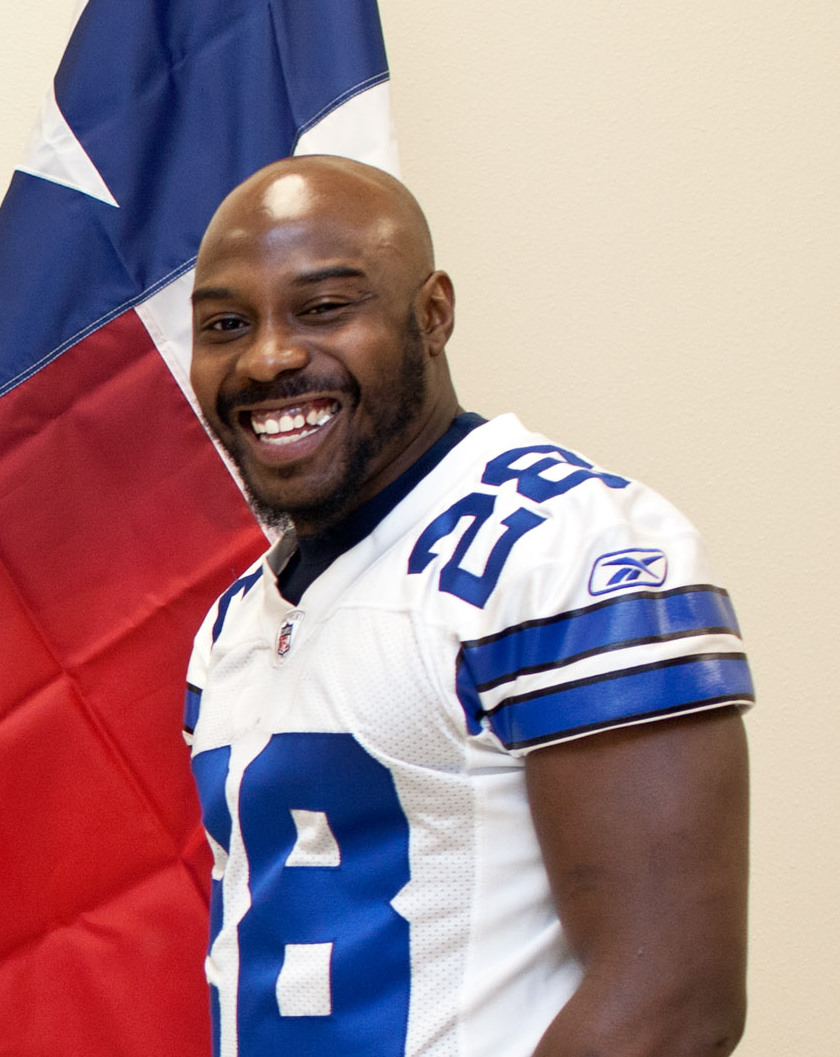
Felix Jones Jr. (born May 8, 1987) is an American former professional football player who was a running back in the National Football League (NFL) for the Dallas Cowboys and Pittsburgh Steelers. He played college football for the Arkansas Razorbacks, earning consensus All-American honors in 2007. He was selected by the Cowboys in the first round of the 2008 NFL draft.
Key Information


Early life
[edit]Jones was born in Tulsa, Oklahoma.[1] He attended Booker T. Washington High School in Tulsa, where he was a standout in football and track.[2] As a junior, he sustained a broken ankle early in the season, but still managed to rack up 800 yards rushing and 20 touchdowns. He was named the Tulsa World Player of the Year following his senior season, after rushing for 2,282 yards and 48 touchdowns, leading his squad to a 13–1 record and a state runner-up finish.[3]
In track & field, Jones competed as a sprinter and jumper. He recorded a personal-best time of 10.87 seconds in the 100 meters, and was a member of the 4 × 100 m relay (43.30 s). In jumping events, he cleared 1.89 meters in high jump and 6.73 meters in the long jump.[4]
Regarded as a four-star recruit by Rivals.com, he was ranked as the No. 19 athlete in the nation and the No. 4 overall player in the state of Oklahoma. He chose to attend Arkansas over scholarship offers from Tennessee, Oklahoma State and LSU.[5]
College career
[edit]Jones attended the University of Arkansas, where he played for the Razorbacks.[6] While serving primarily as the back-up for All-American and two-time Doak Walker Award winner Darren McFadden, Jones was used in a variety of ways alongside McFadden and fullback Peyton Hillis in the Arkansas backfield.[7][8][9]
In the Wild Hog formation, Jones was used as a runner, receiver, blocker, or simply a decoy.[10] Jones gained fame for his ability in returning kickoffs, returning four kicks for touchdowns during his college career.
2005 season
[edit]In his collegiate debut, Jones had eight carries for 137 yards and a touchdown, which was an 80-yarder, against Missouri State.[11] On October 8, against Louisiana-Monroe, he had 14 carries for 102 yards and two touchdowns.[12] On November 19 against Mississippi State, he had a 100-yard kickoff return for a touchdown.[13] Overall, in the 2005 season, Jones had 99 carries for 626 rushing yards and three rushing touchdowns to go along with eight receptions for 100 receiving yards.[14]
2006 season
[edit]
On October 7 against Auburn, Jones had 13 carries for 104 yards and a touchdown in the victory.[15] In the following game, against Southeast Missouri State, he had five carries for 106 yards and a touchdown in the victory.[16] Two weeks later, against Louisiana-Monroe, he had nine carries for 141 yards and a touchdown in the victory.[17] On November 24, against LSU, he had 16 carries for 137 rushing yards and a touchdown.[18] In the Capital One Bowl, against Wisconsin, he had 14 carries for 150 yards and two touchdowns.[19] In the 2006 season, Jones rushed for 1,168 yards and scored six touchdowns on 154 carries, thus averaging 7.6 yards per carry, leading the SEC.[20][21] He was an all-American kickoff returner and had one touchdown on a 100-yard kickoff return against Ole Miss,[22] and caught 15 passes for 107 yards and three touchdowns.[21] Jones alongside McFadden and Peyton Hillis, it was the first time in school history that two different running backs rushed for more than 1,000 yards in the same season.[citation needed] Jones was a second-team All-SEC by the conference's coaches, and second-team All-SEC by the media.[23][24] That team finished 10–4 and won the SEC Western Division title.[25][26]
2007 season
[edit]Jones started the 2007 season with 12 carries for 129 rushing yards and a rushing touchdown to go along with a 90-yard kickoff return for a touchdown in the 46–26 victory over Troy in the Razorbacks' first game.[27] Two games later, Jones had 12 carries for 133 rushing yards and an 82-yard kickoff return for a touchdown against Kentucky.[28] In the following game, against North Texas, he had seven carries for 132 rushing yards and two rushing touchdowns in the victory.[29] On October 6, against Chattanooga, he had 13 carries for 141 rushing yards and two rushing touchdowns in the victory.[30] Two weeks later, against Ole Miss, he had 15 carries for 101 rushing yards and two rushing touchdowns in the victory.[31] On November 3, against South Carolina, he had 13 carries for 166 rushing yards and three rushing touchdowns in the victory.[32] Jones finished with 133 carries for 1,162 yards and 11 touchdowns, while averaging 8.7 yards per carry, finishing second in the SEC and nation.[33][34][35] In addition, he led the Southeastern Conference in kickoff returns with 18 for 564 yards and two touchdowns, averaging 31.3 yards per return. Jones also had 13 receptions for 111 yards. 2007 marked the second straight year that Jones and McFadden have each eclipsed the 1,000 yards rushing in a season. The 2007 Razorbacks finished 8–4 before losing to Missouri in the January 1, 2008 Cotton Bowl Classic.[36][37] Jones was named to the first-team All-SEC squad as a kick returner, and the second-team All-SEC as a running back. He was also named an All-American kick returner.
After being hired as the Razorbacks' head coach, Bobby Petrino stated that Jones was his "highest recruiting target" and soon met with Jones to discuss his future with Arkansas. However, Jones decided to forgo his senior season to enter the 2008 NFL draft where numerous publications projected him to be taken in the first or second round.[38][39]
College statistics
[edit]| Season | Team | GP | Rushing | Receiving | Kickoff Returns | ||||||||||||
|---|---|---|---|---|---|---|---|---|---|---|---|---|---|---|---|---|---|
| Att | Yds | Avg | Lng | TD | Rec | Yds | Avg | Lng | TD | Ret | Yds | Avg | Lng | TD | |||
| 2005 | Arkansas | 11 | 99 | 626 | 6.3 | 80 | 3 | 8 | 100 | 12.5 | 23 | 0 | 17 | 543 | 31.6 | 100 | 1 |
| 2006 | Arkansas | 14 | 154 | 1,168 | 7.6 | 85 | 6 | 15 | 107 | 7.1 | 29 | 3 | 23 | 554 | 24.1 | 100 | 1 |
| 2007 | Arkansas | 13 | 134 | 1,160 | 8.7 | 73 | 11 | 16 | 176 | 11.0 | 40 | 0 | 24 | 647 | 27.0 | 90 | 2 |
| Career | 38 | 387 | 2,954 | 7.6 | 85 | 20 | 39 | 383 | 9.8 | 40 | 3 | 64 | 1,744 | 27.3 | 100 | 4 | |
Professional career
[edit]| Height | Weight | Arm length | Hand span | 40-yard dash | 10-yard split | 20-yard split | 20-yard shuttle | Three-cone drill | Vertical jump | Broad jump | Bench press | |
|---|---|---|---|---|---|---|---|---|---|---|---|---|
| 5 ft 10+1⁄8 in (1.78 m) |
207 lb (94 kg) |
32+3⁄8 in (0.82 m) |
8+3⁄8 in (0.21 m) |
4.47 s | 1.55 s | 2.59 s | 4.19 s | 6.90 s | 33.5 in (0.85 m) |
10 ft 4 in (3.15 m) |
13 reps | |
| All values from NFL Combine/Central Florida Pro Day[40][41][42] | ||||||||||||
Dallas Cowboys
[edit]
Looking to acquire a running back who could complement the bruising style of starter Marion Barber, the Dallas Cowboys selected Jones in the first round of the 2008 NFL draft (22nd overall).[43] The decision process for his selection was captured in the fourth season (2008) of HBO's Hard Knocks series. He signed a professional contract on July 26 for $10.53 million, with $7.67 million guaranteed, including a $3.57 million signing bonus.[44]
The expectations were high in Jones' rookie season; on his first rushing attempt in the NFL Jones ran for an 11-yard touchdown in the third quarter of a 28–10 victory over the Cleveland Browns.[45] On September 15, during a Monday Night Football game versus the Philadelphia Eagles, Jones returned a kickoff 98 yards for a touchdown in the first quarter of a 41–37 win, which earned him NFC Special Teams Player of the Week.[46][47] In his third professional game, Jones ran for a 60-yard touchdown against the Green Bay Packers on November 21.[48] In Week 6 against the Arizona Cardinals, Jones tore his left hamstring. During his recovery process he also suffered a torn ligament in his left toe and was placed on the injured reserve list on November 20.[49] In Jones' first year, he displayed an explosiveness that was difficult to defend for opposing teams. He finished with 30 carries for 266 rushing yards for an 8.87 yards-per-carry average and three rushing touchdowns.[50]
In his second season, Jones received more carries per game and against the New York Giants he rushed seven times for 96 yards and a touchdown.[51] After never rushing for more than nine carries in a professional game, Jones reached the double digit mark against the Carolina Panthers, where he also had his first career start in place of an injured Barber, recording eight carries for 94 yards (11.8) and one reception for 20 yards, but also suffered a sprained PCL in his left knee during the third quarter that ended his day and would make him miss two additional games.[52][53] Jones returned to action against the Atlanta Falcons, where he also started but was ineffective, registering eight carries for 37 yards and two receptions for six yards.[54] Jones began to average over 10 carries per game after the week 13 game against the New York Giants.[55] Against the Eagles, Jones rushed 15 times for 91 yards with a touchdown.[56] In the regular season, Jones set a Cowboys franchise record in average yards per carry with 5.9 yards, the tenth most since the AFL-NFL merger.[57] He finished the year taking the main running back role over Barber and recording 569 total yards in his last six games, while averaging 6.2 yards per touch.[58]
In the first Cowboys playoff win since 1996,[59] playing against the Eagles in the NFC Wild Card Round, Jones led the team with 16 carries for 148 yards (including a 73-yard touchdown run) and a 30-yard reception.[60] His 148 yards are the third-most rushing yards in a playoff game in team history and his 73-yard run is the longest in franchise postseason history. Jones also became the first NFL player with 400 rushing yards on fewer than 50 career carries since Bo Jackson did it in 1987.[61]
In 2010, Jones bulked up to 225 pounds in order to improve his durability and was officially moved to the top of the depth chart at running back. He rushed for 109 yards on 15 carries against the Tennessee Titans, for his first 100-yard game.[62] He played in all 16 games for the first time in his career, starting seven games together or in place of Barber and leading the team with 800 rush yards on 185 carries (4.3 yards average) and a touchdown.[63] Against the New York Giants he had the longest reception in his career (71 yards).
In 2011 after Barber was released by the Cowboys,[64] the expectation was that Jones would be the primary running back.[65] He also slimmed down into the 210–215 pound range, in order to regain some of the explosiveness he lost in the previous year.[66] After suffering a left high ankle sprain in the fifth game of the season against the New England Patriots, the four games he missed gave rookie DeMarco Murray the opportunity to earn the starter position. Against the New York Giants, Murray was lost for the year when he broke his ankle in the first quarter, giving Jones a chance to rush for 106 yards and have six receptions for 31 yards.[67] He rushed for 108 yards on 22 carries, and added three receptions for 23 yards against the Tampa Bay Buccaneers.[68] He finished the year with 585 rushing yards on 127 carries (4.6 average) and 33 receptions for 221 yards.[69]
Jones missed the entire 2012 offseason workouts because of shoulder surgery and failed the conditioning test at the start of training camp.[70][71] Used in a change-of-pace back role, Jones' best game came against the eventual Super Bowl champion Baltimore Ravens, when he replaced an injured Murray and finished with 18 carries for 92 yards and one touchdown in the 31–29 loss.[72] After playing in all 16 games and having seven starts, he battled through knee injuries to finish with 664 yards from scrimmage, five total touchdowns, and a career-worst 3.5 yards average per carry.[73] The Cowboys decided not to re-sign Jones after the season, making him a free agent.
Philadelphia Eagles
[edit]On May 14, 2013, Jones signed a one-year contract with the Philadelphia Eagles who were looking for him to backup LeSean McCoy and Bryce Brown.[74] After being passed on the depth chart by Chris Polk, he was traded to the Pittsburgh Steelers in exchange for linebacker Adrian Robinson on August 23.[75]
Pittsburgh Steelers
[edit]
The Pittsburgh Steelers acquired Jones for depth purposes, while rookie Le'Veon Bell was recovering from a mid-foot sprain.[76] He was named the starting back in week 2 against the Cincinnati Bengals, rushing for 37 yards on ten carries.[77] Jones lost the starter role the next week against the Chicago Bears, where he had seven carries for 34 yards and was benched after a costly third quarter fumble.[78][79] He finished the 2013 season with 48 carries for 184 rushing yards and nine receptions for 63 receiving yards in 16 games and two starts.[80] He was not re-signed at the end of the year.
2015 NFL Veteran Combine
[edit]After being out of football for a year, Jones participated in the first NFL Veteran Combine.[81][82]
NFL career statistics
[edit]Regular season
[edit]| Year | Team | Games | Rushing | Receiving | Fumbles | ||||||||||
|---|---|---|---|---|---|---|---|---|---|---|---|---|---|---|---|
| GP | GS | Att | Yds | Avg | Lng | TD | Rec | Yds | Avg | Lng | TD | Fum | Lost | ||
| 2008 | DAL | 6 | 0 | 30 | 266 | 8.9 | 60T | 3 | 2 | 10 | 5.0 | 7 | 0 | 0 | 0 |
| 2009 | DAL | 14 | 1 | 116 | 685 | 5.9 | 56 | 3 | 19 | 119 | 6.4 | 30 | 0 | 3 | 2 |
| 2010 | DAL | 16 | 7 | 185 | 800 | 4.3 | 34 | 1 | 48 | 450 | 9.4 | 71T | 1 | 2 | 1 |
| 2011 | DAL | 12 | 8 | 127 | 575 | 4.5 | 40 | 1 | 33 | 221 | 6.7 | 27 | 0 | 5 | 2 |
| 2012 | DAL | 16 | 7 | 111 | 402 | 3.6 | 22T | 3 | 25 | 262 | 10.5 | 39 | 2 | 2 | 2 |
| 2013 | PIT | 16 | 2 | 48 | 184 | 3.8 | 14 | 0 | 9 | 63 | 7.0 | 15 | 0 | 1 | 1 |
| Career | 80 | 25 | 617 | 2,912 | 4.7 | 60 | 11 | 136 | 1,125 | 8.3 | 71 | 3 | 13 | 8 | |
Postseason
[edit]| Year | Team | Games | Rushing | Receiving | Fumbles | ||||||||||
|---|---|---|---|---|---|---|---|---|---|---|---|---|---|---|---|
| GP | GS | Att | Yds | Avg | Lng | TD | Rec | Yds | Avg | Lng | TD | Fum | Lost | ||
| 2009 | DAL | 2 | 0 | 30 | 217 | 7.2 | 73 | 1 | 4 | 52 | 13.0 | 30 | 0 | 0 | 0 |
| Career | 2 | 0 | 30 | 217 | 7.2 | 73 | 1 | 4 | 52 | 13.0 | 30 | 0 | 0 | 0 | |
References
[edit]- ^ "Tulsa native Felix Jones still chasing that NFL dream". Claremore Daily Progress. Associated Press. March 23, 2015. Archived from the original on July 9, 2023. Retrieved July 9, 2023.
- ^ Biddy, Trey (October 11, 2004). "Felix Jones having monster year for Booker T." HawgBeat. Archived from the original on July 9, 2023. Retrieved July 9, 2023.
- ^ Lewis, Barry (June 26, 2023). "Tulsa World's All-World Awards on Thursday highlights the best in high school sports". Tulsa World. Archived from the original on July 9, 2023. Retrieved July 9, 2023.
- ^ "Felix Jones". Tracking Football. Archived from the original on February 11, 2017. Retrieved February 19, 2017.
- ^ "Felix Jones, 2005 Athlete, Arkansas". Rivals.com. Archived from the original on July 15, 2023. Retrieved July 9, 2023.
- ^ "Felix Jones College Stats, School, Draft, Gamelog, Splits". Sports Reference. Archived from the original on July 8, 2023. Retrieved July 9, 2023.
- ^ "2005 Arkansas Razorbacks Stats". Sports Reference. Archived from the original on July 9, 2023. Retrieved July 9, 2023.
- ^ "2006 Arkansas Razorbacks Stats". Sports Reference. Archived from the original on July 9, 2023. Retrieved July 9, 2023.
- ^ "2007 Arkansas Razorbacks Stats". Sports Reference. Archived from the original on July 9, 2023. Retrieved July 9, 2023.
- ^ Crawford, Brad (May 12, 2015). "SEC's best backfield ever". Saturday Down South. Archived from the original on July 9, 2023. Retrieved July 9, 2023.
- ^ "Missouri State at Arkansas Box Score, September 3, 2005". Sports Reference. Archived from the original on July 9, 2023. Retrieved July 9, 2023.
- ^ "Louisiana-Monroe at Arkansas Box Score, October 8, 2005". Sports Reference. Archived from the original on July 9, 2023. Retrieved July 9, 2023.
- ^ "Mississippi State at Arkansas Box Score, November 19, 2005". Sports Reference. Archived from the original on July 9, 2023. Retrieved July 9, 2023.
- ^ "Felix Jones 2005 Game Log". Sports Reference. Archived from the original on July 8, 2023. Retrieved July 9, 2023.
- ^ "Arkansas at Auburn Box Score, October 7, 2006". Sports Reference. Archived from the original on October 16, 2022. Retrieved July 9, 2023.
- ^ "Southeast Missouri State at Arkansas Box Score, October 14, 2006". Sports Reference. Archived from the original on April 27, 2023. Retrieved July 9, 2023.
- ^ "Louisiana-Monroe at Arkansas Box Score, October 28, 2006". Sports Reference. Archived from the original on April 28, 2023. Retrieved July 9, 2023.
- ^ "LSU at Arkansas Box Score, November 24, 2006". Sports Reference. Archived from the original on November 26, 2022. Retrieved July 9, 2023.
- ^ "Capital One Bowl – Wisconsin vs Arkansas Box Score, January 1, 2007". Sports Reference. Archived from the original on February 24, 2019. Retrieved July 9, 2023.
- ^ "2006 Southeastern Conference Leaders". Sports Reference. Retrieved July 9, 2023.
- ^ a b "Felix Jones 2006 Game Log". Sports Reference. Archived from the original on July 9, 2023. Retrieved July 9, 2023.
- ^ "Ole Miss at Arkansas Box Score, October 21, 2006". Sports Reference. Archived from the original on July 9, 2023. Retrieved July 9, 2023.
- ^ "2006 All-SEC Football Teams Announced". University of Georgia Athletics. December 5, 2006. Archived from the original on July 9, 2023. Retrieved July 9, 2023.
- ^ "2006 Associated Press All-SEC football team". ESPN.com. Associated Press. December 5, 2006. Archived from the original on July 15, 2023. Retrieved July 9, 2023.
- ^ "2006 Arkansas Razorbacks Schedule and Results". Sports Reference. Archived from the original on April 28, 2023. Retrieved July 9, 2023.
- ^ "2006 Southeastern Conference Year Summary". Sports Reference. Retrieved July 9, 2023.
- ^ "Troy at Arkansas Box Score, September 1, 2007". Sports Reference. Archived from the original on July 9, 2023. Retrieved July 9, 2023.
- ^ "Kentucky at Arkansas Box Score, September 22, 2007". Sports Reference. Archived from the original on July 6, 2023. Retrieved July 9, 2023.
- ^ "North Texas at Arkansas Box Score, September 29, 2007". Sports Reference. Archived from the original on July 9, 2023. Retrieved July 9, 2023.
- ^ "Chattanooga at Arkansas Box Score, October 6, 2007". Sports Reference. Archived from the original on July 9, 2023. Retrieved July 9, 2023.
- ^ "Arkansas at Ole Miss Box Score, October 20, 2007". Sports Reference. Archived from the original on July 9, 2023. Retrieved July 9, 2023.
- ^ "South Carolina at Arkansas Box Score, November 3, 2007". Sports Reference. Archived from the original on July 9, 2023. Retrieved July 9, 2023.
- ^ "2007 Southeastern Conference Leaders". Sports Reference. Retrieved July 9, 2023.
- ^ "2007 College Football Leaders". Sports Reference. Archived from the original on February 18, 2020. Retrieved July 9, 2023.
- ^ "Felix Jones 2007 Game Log". Sports Reference. Archived from the original on July 8, 2023. Retrieved July 9, 2023.
- ^ "2007 Arkansas Razorbacks Schedule and Results". Sports Reference. Archived from the original on April 28, 2023. Retrieved July 9, 2023.
- ^ "Cotton Bowl – Missouri vs Arkansas Box Score, January 1, 2008". Sports Reference. Archived from the original on April 25, 2023. Retrieved July 9, 2023.
- ^ "NFL Draft: Darren McFadden, Felix Jones Both Turn Pro". Bleacher Report. January 15, 2008. Archived from the original on July 9, 2023. Retrieved July 9, 2023.
- ^ "Tulsa's Felix Jones and McFadden say they'll enter NFL draft, skipping senior season at Arkansas". Tulsa World. Associated Press. January 14, 2008. Archived from the original on July 9, 2023. Retrieved July 9, 2023.
- ^ "Felix Jones Draft and Combine Prospect Profile". NFL.com. Archived from the original on October 23, 2021. Retrieved October 22, 2021.
- ^ "Felix Jones, Arkansas, RB, 2008 NFL Draft Scout, NCAA College Football". draftscout.com. Archived from the original on October 23, 2021. Retrieved February 19, 2017.
- ^ "Felix Jones, Combine Results, RB – Arkansas". nflcombineresults.com. Archived from the original on October 23, 2021. Retrieved October 22, 2021.
- ^ "2008 NFL Draft Listing". Pro Football Reference. Archived from the original on November 3, 2018. Retrieved May 11, 2023.
- ^ Phillips, Rob (July 26, 2008). "Felix Jones signs; Arrives for second practice". Dallas Cowboys. Archived from the original on March 18, 2017. Retrieved September 16, 2008.
- ^ "Romo throws for 320 yards, Dallas defense controls Cleveland". ESPN.com. Associated Press. September 7, 2008. Archived from the original on February 5, 2017. Retrieved September 15, 2016.
- ^ "T.O. moves into 2nd on TD receptions list as Cowboys win shootout with Eagles". ESPN.com. Associated Press. September 15, 2008. Archived from the original on July 14, 2020. Retrieved September 15, 2008.
- ^ "2008 NFL Week 2 Leaders & Scores". Pro Football Reference. Archived from the original on October 5, 2022. Retrieved July 9, 2023.
- ^ "Cowboys beat Pack behind Barber to remain perfect". ESPN.com. Associated Press. September 22, 2008. Archived from the original on March 3, 2017. Retrieved February 19, 2017.
- ^ "Former Hog Jones put on injured reserve". Arkansas Online. Associated Press. November 27, 2008. Archived from the original on July 9, 2023. Retrieved July 9, 2023.
- ^ "Felix Jones 2008 Game Log". Pro Football Reference. Archived from the original on July 9, 2023. Retrieved July 9, 2023.
- ^ "New York Giants at Dallas Cowboys – September 20th, 2009". Pro Football Reference. Archived from the original on July 9, 2023. Retrieved July 9, 2023.
- ^ "Carolina Panthers at Dallas Cowboys – September 28th, 2009". Pro Football Reference. Archived from the original on July 9, 2023. Retrieved July 9, 2023.
- ^ O'Brien, Matt (September 29, 2009). "Cowboys RB Felix Jones' Sprained PCL Will Keep Him Sidelined Another Week". SBNation.com. Archived from the original on July 9, 2023. Retrieved July 9, 2023.
- ^ "Atlanta Falcons at Dallas Cowboys – October 25th, 2009". Pro Football Reference. Archived from the original on December 24, 2017. Retrieved July 9, 2023.
- ^ "Dallas Cowboys at New York Giants – December 6th, 2009". Pro Football Reference. Archived from the original on November 15, 2020. Retrieved July 9, 2023.
- ^ "Philadelphia Eagles at Dallas Cowboys – January 3rd, 2010". Pro Football Reference. Archived from the original on October 27, 2022. Retrieved July 9, 2023.
- ^ Mayer, Larry (July 10, 2013). "Peete following in his father's footsteps". Chicago Bears. Archived from the original on July 15, 2013. Retrieved July 11, 2013.
- ^ "Felix Jones 2009 Game Log". Pro Football Reference. Archived from the original on July 8, 2023. Retrieved July 9, 2023.
- ^ "Dallas Cowboys Playoff History". Pro Football Reference. Archived from the original on June 28, 2023. Retrieved July 9, 2023.
- ^ "Wild Card – Philadelphia Eagles at Dallas Cowboys – January 9th, 2010". Pro Football Reference. Archived from the original on January 9, 2021. Retrieved July 9, 2023.
- ^ "Felix, Bo Jackson Comparison Brings Frightening Thought". NBC 5 Dallas-Fort Worth. September 30, 2009. Archived from the original on July 9, 2023. Retrieved July 9, 2023.
- ^ "Tennessee Titans at Dallas Cowboys – October 10th, 2010". Pro Football Reference. Archived from the original on March 18, 2018. Retrieved July 9, 2023.
- ^ "Felix Jones 2010 Game Log". Pro Football Reference. Archived from the original on July 9, 2023. Retrieved July 9, 2023.
- ^ Watkins, Calvin; Archer, Todd (July 26, 2011). "Source: Barber among Cowboys to be released". ESPN.com. Archived from the original on July 10, 2023. Retrieved July 9, 2023.
- ^ "Cowboys release Marion Barber; Felix Jones now team's starting RB?". Sportsnet.ca. July 27, 2011. Archived from the original on July 9, 2023. Retrieved July 9, 2023.
- ^ Halprin, David (February 27, 2011). "Felix Jones Going Back To Normal Weight". Blogging The Boys. SB Nation. Archived from the original on July 9, 2023. Retrieved July 9, 2023.
- ^ "New York Giants at Dallas Cowboys – December 11th, 2011". Pro Football Reference. Archived from the original on October 8, 2020. Retrieved July 9, 2023.
- ^ "Dallas Cowboys at Tampa Bay Buccaneers – December 17th, 2011". Pro Football Reference. Archived from the original on October 27, 2022. Retrieved July 9, 2023.
- ^ "Felix Jones 2011 Game Log". Pro Football Reference. Archived from the original on July 8, 2023. Retrieved July 9, 2023.
- ^ Rosenthal, Gregg (July 30, 2012). "Felix Jones fails Dallas Cowboys' conditioning test". NFL.com. Archived from the original on July 9, 2023. Retrieved July 9, 2023.
- ^ Bien, Louis (July 30, 2012). "Felix Jones Fails Conditioning Test At Cowboys Training Camp". SBNation.com. Archived from the original on July 9, 2023. Retrieved July 9, 2023.
- ^ "Dallas Cowboys at Baltimore Ravens – October 14th, 2012". Pro Football Reference. Archived from the original on October 5, 2020. Retrieved July 9, 2023.
- ^ "Felix Jones 2012 Game Log". Pro Football Reference. Archived from the original on July 8, 2023. Retrieved July 9, 2023.
- ^ "Eagles Sign RB Felix Jones". PhiladelphiaEagles.com. May 14, 2013. Archived from the original on November 14, 2013. Retrieved February 19, 2017.
- ^ Rosenthal, Gregg (August 23, 2013). "Felix Jones traded from Philadelphia Eagles to Steelers". NFL.com. Archived from the original on August 26, 2013. Retrieved August 23, 2013.
- ^ Brown, Scott (August 23, 2013). "Steelers trade for Felix Jones with Bell out". ESPN.com. Archived from the original on July 8, 2023. Retrieved July 8, 2023.
- ^ "Pittsburgh Steelers at Cincinnati Bengals – September 16th, 2013". Pro Football Reference. Archived from the original on March 27, 2019. Retrieved July 8, 2023.
- ^ "Chicago Bears at Pittsburgh Steelers – September 22nd, 2013". Pro Football Reference. Archived from the original on October 5, 2020. Retrieved July 8, 2023.
- ^ Hangst, Andrea (September 23, 2013). "What's Fixable, What's Not for 0–3 Pittsburgh Steelers?". Bleacher Report. Archived from the original on July 8, 2023. Retrieved July 8, 2023.
- ^ "Felix Jones 2013 Game Log". Pro Football Reference. Archived from the original on July 8, 2023. Retrieved July 8, 2023.
- ^ "NFL to host inaugural Veteran Combine". NFL.com. March 11, 2015. Archived from the original on March 22, 2015. Retrieved March 22, 2015.
- ^ Orr, Conor (March 22, 2015). "What we learned from the Veteran Combine". NFL.com. Archived from the original on March 24, 2015. Retrieved March 22, 2015.
External links
[edit]- Career statistics from ESPN · Yahoo Sports · Pro Football Reference
 Media related to Felix Jones at Wikimedia Commons

Felix Jones
View on GrokipediaEarly life
Upbringing and family
Felix Jones was born on May 8, 1987, in Tulsa, Oklahoma.[5] Jones grew up in a close-knit family in Tulsa, the youngest of four siblings. His father, Felix Jones Sr., worked as a pastor and carpenter, personally remodeling the family's modest one-story, two-bedroom home into a larger two-story, six-bedroom structure to better accommodate his children. This hands-on effort by his father exemplified the family's resourcefulness and commitment to providing a stable environment. Jones has credited both his father and uncle for their pivotal support in nurturing his early athletic pursuits, offering guidance and encouragement that shaped his development.[6][7] Raised in Tulsa's working-class neighborhoods, Jones was immersed in the city's vibrant sports culture from a young age, where football held a central place in community life. His initial interest in the sport emerged through local play and family influences, fostering a drive fueled by the socioeconomic challenges of his upbringing—such as his father's dual roles to support the household—which instilled in him a strong work ethic and determination to succeed. This foundation in Tulsa's football-rich environment laid the groundwork for his athletic journey.[8][6]High school career
Felix Jones attended Booker T. Washington High School in Tulsa, Oklahoma, where he emerged as a standout athlete in football and track.[1] His family's support played a key role in motivating his dedication to sports during his formative years.[9] During his senior season in 2004, Jones delivered an exceptional performance as the Hornets' running back, rushing for 2,282 yards and scoring 48 touchdowns while leading the team to a 13-1 record and a berth in the state championship game.[10] These efforts helped propel Booker T. Washington to a strong playoff run, showcasing his speed, vision, and versatility on the field.[11] Jones' outstanding play earned him recognition as the Tulsa World metro and state football player of the year in 2004.[10] As a four-star recruit, he attracted interest from multiple college programs and ultimately committed to the University of Arkansas on February 2, 2005.[9][12]College career
2005 season
Felix Jones entered the University of Arkansas as a highly touted true freshman in 2005, joining a backfield led by sophomore standout Darren McFadden. As the primary backup running back, Jones quickly adapted to the college level, contributing on offense and special teams while learning behind McFadden, who handled the bulk of the carries. His role emphasized versatility, with opportunities arising from McFadden's workload and Arkansas's need for explosive plays in a 4-7 season under head coach Houston Nutt.[13][14] In 11 games, Jones rushed 99 times for 626 yards and 3 touchdowns, averaging 6.3 yards per carry, which ranked him 10th in the Southeastern Conference (SEC) for rushing yards among all players. He added 8 receptions for 100 yards as a pass catcher, providing a secondary option in the Razorbacks' run-heavy offense. On special teams, Jones emerged as a standout kick returner, fielding 17 returns for 543 yards at an SEC-leading average of 31.9 yards per return, including one touchdown that highlighted his speed and vision.[15][16] Jones delivered several impactful performances early in the season, signaling his potential. In his debut against Missouri State on September 3, he rushed for a game-high 137 yards and a touchdown on just 8 carries, helping secure a 63-17 victory. Later, against Louisiana-Monroe on October 8, he exploded for 102 rushing yards and 2 touchdowns on 14 attempts in a 38-7 win. His most memorable special teams play came on November 19 versus Mississippi State, where he returned a kickoff 100 yards for a touchdown, providing a spark in a 17-24 loss. These efforts underscored his adjustment to the physicality and speed of SEC competition, though his carries remained limited to preserve his development.[15]2006 season
In his sophomore year, Felix Jones took on a prominent starting role for the Arkansas Razorbacks, appearing as a starter in all 14 games while sharing carries in the backfield with fellow running back Darren McFadden. Building on the confidence gained from his freshman season, Jones displayed marked improvement in production and versatility, contributing both as a rusher and receiver in an offense that emphasized a balanced ground attack. His efforts helped solidify Arkansas as a competitive force in the SEC West.[17] Jones rushed for 1,168 yards on 154 carries, averaging 7.6 yards per attempt, and scored 6 rushing touchdowns, leading the team in rushing efficiency. He also caught 15 passes for 107 yards and 3 receiving touchdowns, adding a dynamic receiving threat out of the backfield. A highlight of his season came in the Capital One Bowl against Wisconsin, where he exploded for 150 rushing yards and 2 touchdowns on 14 carries, though the Razorbacks fell short in a 17-14 loss. Another strong outing occurred against Louisiana-Monroe, with 141 rushing yards on 9 carries, including a touchdown.[17][2] For his breakout performance, Jones was selected to the second-team All-SEC team by the conference coaches, recognizing his impact as a running back. The Razorbacks concluded the season with a 10-4 overall record, including a 5-3 mark in SEC play, and advanced to the Capital One Bowl as one of the league's top teams.[18][19]2007 season
In his junior and final season at the University of Arkansas in 2007, Felix Jones emerged as a dynamic leader in the Razorbacks' backfield alongside teammate Darren McFadden, sharing carries while excelling in multiple roles.[2] Jones started all 13 games, leading the team in rushing with 1,162 yards on 133 carries for an average of 8.7 yards per attempt and 11 touchdowns.[20] He also contributed as a receiver with 16 catches for 176 yards, showcasing his versatility in Houston Nutt's offensive scheme.[2] His explosive play helped Arkansas achieve a 9-4 record, including a thrilling 50-48 upset victory over No. 1 LSU, where the backfield duo combined for over 400 rushing yards.[21] Jones' performance earned him significant recognition, including consensus All-American honors as a return specialist after averaging 29.6 yards per kickoff return with two touchdowns, one a 90-yard score against Troy.[2] He was also named first-team All-SEC as a return specialist by the Associated Press and second-team All-SEC as a running back by both the AP and coaches.[22] Additionally, he received the SEC Special Teams Player of the Year award, highlighting his impact beyond rushing.[23] A standout performance came on November 3 against South Carolina, where Jones rushed for 166 yards and three touchdowns on 13 carries, contributing to a 48-14 rout. In the Liberty Bowl against Missouri, he added 45 rushing yards on 10 carries and 65 receiving yards on three catches in a 38-31 victory, capping the season.[24] Jones managed a deep thigh bruise sustained against Tennessee, missing practice but returning to play without missing games, demonstrating resilience amid a physically demanding year.[25] Following the Liberty Bowl, Jones announced his decision to forgo his senior year and enter the 2008 NFL Draft, where his speed and production positioned him as a first-round prospect.[2]College statistics and achievements
Felix Jones played college football for the University of Arkansas from 2005 to 2007, appearing in 38 games as a running back and return specialist. Over his career, he amassed 2,956 rushing yards on 386 carries for an average of 7.7 yards per attempt and 20 rushing touchdowns, setting the Arkansas school record for career rushing yards per carry.[2][26] He also recorded 383 receiving yards on 39 receptions with 3 receiving touchdowns and returned 62 kickoffs for 1,749 yards at a 28.2-yard average, including 4 kickoff return touchdowns, which ranks second in the Southeastern Conference (SEC) since 1976.[2] His all-purpose yardage totaled 5,100, highlighting his versatility in the Razorbacks' backfield alongside Darren McFadden.[2] The following table summarizes Jones' yearly college statistics:| Year | Games | Rushing Att | Rushing Yds | Yds/Att | Rush TD | Rec | Rec Yds | KR | KR Yds | KR Avg | KR TD |
|---|---|---|---|---|---|---|---|---|---|---|---|
| 2005 | 11 | 99 | 626 | 6.3 | 3 | 8 | 100 | 17 | 543 | 31.9 | 1 |
| 2006 | 14 | 154 | 1,168 | 7.6 | 6 | 15 | 107 | 23 | 554 | 24.1 | 1 |
| 2007 | 13 | 133 | 1,162 | 8.7 | 11 | 16 | 176 | 22 | 652 | 29.6 | 2 |
| Career | 38 | 386 | 2,956 | 7.7 | 20 | 39 | 383 | 62 | 1,749 | 28.2 | 4 |
Professional career
Dallas Cowboys (2008–2012)
Felix Jones was selected by the Dallas Cowboys in the first round, 22nd overall, of the 2008 NFL Draft, a pick acquired via trade from the Cleveland Browns.[1] His selection was bolstered by his status as a consensus All-American at the University of Arkansas, where he demonstrated explosive speed and versatility as a runner and return specialist.[1] As a rookie in 2008, Jones served primarily as a backup to starter Marion Barber III and also contributed on special teams as a kick returner.[1] He appeared in six games, rushing for 266 yards on 30 carries with three touchdowns, averaging 8.9 yards per attempt.[1] His season was cut short by injuries, including a hamstring strain in October followed by a torn ligament in his left big toe sustained during rehabilitation, leading to surgery and placement on injured reserve in November.[33] In 2009, Jones emerged as a more prominent rotational back, sharing carries with Barber and later Marion Barber's replacement Tashard Choice after Barber's own injuries.[1] He played in 14 games with one start, rushing for 685 yards on 116 carries and scoring three touchdowns, while also adding 19 receptions for 119 yards.[1] A minor neck strain in November briefly sidelined him for one game, but he otherwise stayed relatively healthy compared to his rookie year.[34] Jones reached his peak with the Cowboys in 2010, transitioning to a co-starting role alongside DeMarco Murray, the team's fourth-round draft pick that year.[1] Appearing in all 16 games with seven starts, he led the team in rushing with 800 yards on 185 carries and one touchdown, complemented by 48 receptions for 450 yards and one receiving touchdown.[1] His performance highlighted his big-play ability, including several long runs that showcased the speed that defined his college career. Subsequent seasons were marred by recurring injuries, limiting his consistency. In 2011, a hamstring injury caused him to miss four games, restricting him to 12 appearances with eight starts, where he rushed for 575 yards on 127 carries and one touchdown.[1] He rebounded somewhat in 2012, playing all 16 games with seven starts despite knee and shoulder issues, accumulating 402 rushing yards on 111 carries with three touchdowns.[35] Over his five seasons with Dallas (2008–2012), Jones appeared in 64 games, amassing 2,728 rushing yards on 569 carries with 11 touchdowns, often serving as a change-of-pace back valued for his speed but hampered by durability concerns.[1] The Cowboys released Jones as an unrestricted free agent in March 2013, citing his injury history.[36]Philadelphia Eagles (2013)
Felix Jones signed with the Philadelphia Eagles as a free agent on May 14, 2013, to provide depth as a backup to star running back LeSean McCoy.[37] The one-year contract was valued at $780,000, including a $32,500 signing bonus.[4] Jones saw limited action with the Eagles due to stiff competition in a crowded backfield that included McCoy, Bryce Brown, and Chris Polk, as well as lingering injuries from his Dallas Cowboys tenure that hampered his availability and performance.[38] His injury history with the Cowboys, including recurring hamstring and toe issues, continued to impact him during training camp and preseason.[39] In two preseason games, Jones rushed for 45 yards on 12 carries, averaging 3.8 yards per attempt.[38] On August 23, 2013—prior to the regular season—the Eagles traded him to the Pittsburgh Steelers in exchange for linebacker Adrian Robinson.[40]Pittsburgh Steelers (2013)
Felix Jones was acquired by the Pittsburgh Steelers from the Philadelphia Eagles on August 23, 2013, in exchange for linebacker Adrian Robinson.[40] Jones joined a backfield led by Le'Veon Bell and served primarily as a backup running back and kick returner during the 2013 season. He appeared in all 16 games, making two starts, and recorded 184 rushing yards on 48 carries (3.8 yards per carry average) with no rushing touchdowns. Additionally, he had 9 receptions for 63 yards and returned 23 kickoffs for 510 yards.[1] His playing time was limited by Bell's strong performance and Jones' history of injuries, including prior hamstring issues from his Cowboys days, though he remained active throughout the season without missing games.[41][42] Following the 2013 season, the Steelers did not re-sign Jones, who became an unrestricted free agent in March 2014. He did not play during the 2014 NFL season.[1]2015 NFL Veteran Combine and retirement
After sitting out the 2014 NFL season, Felix Jones participated in the inaugural NFL Veteran Combine on March 22, 2015, at Arizona State's Sun Devil Stadium in Tempe, Arizona. The event provided an opportunity for players who had been inactive for at least one year to perform drills and showcase their skills to scouts from all 32 NFL teams.[43] Jones, a former first-round draft pick known for his speed early in his career, recorded 40-yard dash times of 4.79 seconds and 4.85 seconds during the combine—marking a substantial decline from his 4.47-second performance at the 2008 NFL Scouting Combine. These slower times were attributed to the lingering effects of chronic injuries, including recurring hamstring strains dating back to 2008 and a torn ligament in his left big toe that required surgery and sidelined him for the remainder of his rookie year.[44][33] Despite the platform to demonstrate his abilities, Jones did not attract any contract offers from NFL teams in the wake of the combine. Jones effectively retired from professional football later that year at age 28, concluding a six-year NFL career hampered by persistent physical setbacks.[44]Career statistics
NFL regular season
Felix Jones played 80 regular season games over six NFL seasons, primarily as a versatile running back who contributed in rushing, receiving, and special teams roles. His career rushing totals include 617 carries for 2,912 yards and 11 touchdowns, averaging 4.7 yards per carry, while his receiving contributions consisted of 136 receptions for 1,125 yards and 3 touchdowns.[1] He also recorded 13 fumbles during his career, with 5 lost.[1] Jones began his professional career as a backup to Marion Barber III with the Dallas Cowboys in 2008, seeing limited action in just six games due to injuries but flashing big-play ability with an NFL-leading 8.9 yards per carry on 30 rushes.[1] By 2009, he emerged as a change-of-pace back, increasing his workload to 116 carries for 685 yards and sharing the backfield more prominently. His role evolved into a co-starting position in 2010 alongside rookie DeMarco Murray, where he handled a career-high 185 carries for 800 yards, demonstrating durability over a full 16-game season.[1] Injuries limited him to 12 games in 2011, but he remained a key rotational player with 127 carries for 575 yards. After being released by Dallas following the 2012 season, Jones signed with the Pittsburgh Steelers in 2013, transitioning to a depth role behind Le'Veon Bell with only 48 carries for 184 yards in 16 games.[1] Overall, his yards-per-carry average highlighted his efficiency as a speed back, though fumble issues (particularly in 2011 with five) occasionally hampered his opportunities.[1] The following table summarizes Jones' regular season rushing and receiving statistics by year and team:| Year | Team | Games | Carries | Rush Yards | Rush TDs | Yds/Carry | Receptions | Rec Yards | Rec TDs | Fumbles |
|---|---|---|---|---|---|---|---|---|---|---|
| 2008 | DAL | 6 | 30 | 266 | 3 | 8.9 | 2 | 10 | 0 | 0 |
| 2009 | DAL | 14 | 116 | 685 | 3 | 5.9 | 19 | 119 | 0 | 3 |
| 2010 | DAL | 16 | 185 | 800 | 1 | 4.3 | 48 | 450 | 1 | 2 |
| 2011 | DAL | 12 | 127 | 575 | 1 | 4.5 | 33 | 221 | 0 | 5 |
| 2012 | DAL | 16 | 111 | 402 | 3 | 3.6 | 25 | 262 | 2 | 2 |
| 2013 | PIT | 16 | 48 | 184 | 0 | 3.8 | 9 | 63 | 0 | 1 |
| Career | - | 80 | 617 | 2,912 | 11 | 4.7 | 136 | 1,125 | 3 | 13 |