Recent from talks
Nothing was collected or created yet.
Charlie Conerly
View on Wikipedia
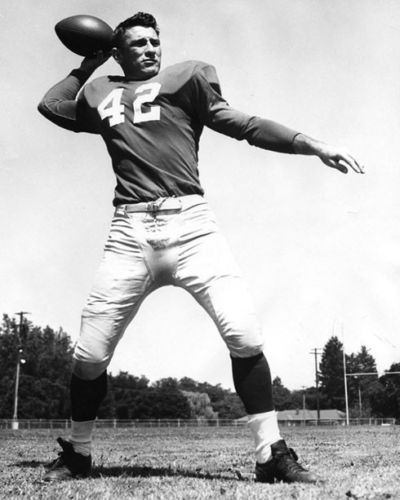
Charles Albert Conerly Jr. (September 19, 1921 – February 13, 1996) was an American professional football player who was a quarterback in the National Football League (NFL) for the New York Giants from 1948 through 1961. Conerly played college football for the Ole Miss Rebels and was inducted into the College Football Hall of Fame in 1966. He was married to Perian Conerly, a sports columnist for The New York Times.
Key Information
College career
[edit]
Conerly attended and played college football at the University of Mississippi (Ole Miss). He started at Ole Miss in 1942, but left to serve as a Marine in the South Pacific during World War II where he fought in the Battle of Guam.[1][2]
He returned to Mississippi in 1946 and led the team to their first Southeastern Conference (SEC) championship in 1947. During that season, he led the nation in pass completions with 133, rushed for nine touchdowns and passed for 18 more, was a consensus All-American selection, and was named Player of the Year by the Helms Athletic Foundation.[2] As an outstanding quarterback played the for the Rebels, Conerly earned consensus All-America recognition in 1947 when he led the Rebels to a record of 9–2, including a 13–9 win over TCU in the Delta Bowl at Crump Stadium in Memphis, Tennessee.[citation needed]
Conerly's 1947 squad had upset wins over Kentucky (14–7 in Oxford), Florida (14–6 in Jacksonville, Florida), LSU (20–18 in Baton Rouge), and Tennessee (43–13 in Memphis). He placed fourth in the Heisman Trophy balloting and was a two-time All SEC performer. He was named Player of the Year and Back of the Year of the SEC in 1947. He set numerous school records and still ranked 12th in 2008 in career total offense with 3,076 yards. He was ranked 12th in career passing with 2,313 yards and 26 TDs.[citation needed]
Conerly also played baseball at Ole Miss, where he hit .467 in 1948 and was offered a professional contract.[2]
Professional career
[edit]Conerly was drafted in the 13th round of the 1945 NFL draft by the Washington Redskins. He played his entire career with the New York Giants as a quarterback, where he was a two-time Pro Bowl selection in 1950 and 1956 and was NFL's Most Valuable Player in 1959 by the Newspaper Enterprise Association.[2] Conerly was named NFL "Rookie of the Year" in 1948, a season when he set many Giants rookie franchise records that still stand. He led the Giants to three NFL Championship games in four seasons (1956, 1958–1959), including a 47–7 victory over the Chicago Bears in the 1956 NFL Championship Game. During his professional career, he earned the alliterative nickname "Chucking Charlie Conerly".
Giants franchise records
[edit]As of 2017[update]'s NFL off-season, Charlie Conerly held at least 10 Giants franchise records,[citation needed] including:
- Most completions (rookie season): 162 (1948)
- Most pass attempts (rookie season): 299 (1948)
- Most passing yards (rookie season): 2,175 (1948)
- Most passing touchdowns (rookie season): 22 (1948)
- Most intercepted (game): 5 (1951-10-14 CRD and 1953-12-13 DET; tied with Jeff Rutledge and Eli Manning)
- Highest passer rating (rookie season): 84.0 (1948)
- Most yards/pass attempt (season): 8.79 (1959)
- Most yards/pass attempt (playoff career): 8.53
- Most yards/pass attempt (playoff season): 10.48 (1958)
- Most passing yards/game (rookie season): 181.3 (1948)
- Most passing touchdowns by a quarterback vs. The Washington Redskins/Football Team/Commanders
NFL career statistics
[edit]| Legend | |
|---|---|
| NEA NFL MVP | |
| Won NFL championship | |
| Led the league | |
| Bold | Career high |
| Year | Team | Games | Passing | ||||||||||
|---|---|---|---|---|---|---|---|---|---|---|---|---|---|
| GP | GS | Record | Cmp | Att | Pct | Yds | Avg | TD | Int | Lng | Rtg | ||
| 1948 | NYG | 12 | 4 | − | 162 | 299 | 54.2 | 2,175 | 7.3 | 22 | 13 | 65 | 84.0 |
| 1949 | NYG | 12 | 12 | 6−6 | 152 | 305 | 49.8 | 2,138 | 7.0 | 17 | 20 | 85 | 64.1 |
| 1950 | NYG | 11 | 8 | 6−2 | 56 | 132 | 42.4 | 1,000 | 7.6 | 8 | 7 | 43 | 67.1 |
| 1951 | NYG | 12 | 11 | 9−2 | 93 | 189 | 49.2 | 1,277 | 6.8 | 10 | 22 | 69 | 49.3 |
| 1952 | NYG | 11 | 11 | 7−4 | 82 | 169 | 48.5 | 1,090 | 6.4 | 13 | 10 | 70 | 70.4 |
| 1953 | NYG | 12 | 11 | 3−8 | 143 | 303 | 47.2 | 1,711 | 5.6 | 13 | 25 | 60 | 44.9 |
| 1954 | NYG | 10 | 10 | 6−4 | 103 | 210 | 49.0 | 1,439 | 6.9 | 17 | 11 | 68 | 76.7 |
| 1955 | NYG | 12 | 4 | 1−3 | 98 | 202 | 48.5 | 1,310 | 6.5 | 13 | 13 | 71 | 64.2 |
| 1956 | NYG | 12 | 0 | − | 90 | 174 | 51.7 | 1,143 | 6.6 | 10 | 7 | 48 | 75.0 |
| 1957 | NYG | 12 | 8 | 6–2 | 128 | 232 | 55.2 | 1,712 | 7.4 | 11 | 11 | 70 | 74.9 |
| 1958 | NYG | 10 | 6 | 4–2 | 88 | 184 | 47.8 | 1,199 | 6.5 | 10 | 9 | 44 | 66.8 |
| 1959 | NYG | 10 | 9 | 8–1 | 113 | 194 | 58.2 | 1,706 | 8.8 | 14 | 4 | 77 | 102.7 |
| 1960 | NYG | 12 | 7 | 5–1–1 | 66 | 134 | 49.3 | 954 | 7.1 | 8 | 7 | 70 | 70.9 |
| 1961 | NYG | 13 | 4 | 2–2 | 44 | 106 | 41.5 | 634 | 6.0 | 7 | 8 | 37 | 52.2 |
| Career | 161 | 105 | 63–37–1 | 1,418 | 2,833 | 50.1 | 19,488 | 6.9 | 173 | 167 | 85 | 68.2 | |
Later life and honors
[edit]Conerly portrayed the "Marlboro Man" in commercials after playing for the Giants.[3][4] Conerly and his wife, Perian (author of the book, Backseat Quarterback) retired to his hometown of Clarksdale, Mississippi, where he spent his final days. Conerly owned shoe stores throughout the Mississippi Delta. On December 13, 1959, Perian appeared on an episode of What's My Line?. Her line was she wrote a football column for newspapers.
Conerly was inducted into the Mississippi Sports Hall of Fame in 1966 and the Ole Miss Athletic Hall of Fame in 1987. He is also a member of the Ole Miss Team of the Century (1893–1992). Conerly is the namesake of the football award, the Conerly Trophy, given annually to the top college player in the State of Mississippi. The Professional Football Researchers Association named Conerly to the PRFA Hall of Very Good Class of 2006.[5] He is a seven-time Pro Football Hall of Fame finalist, but has yet to be elected as a member of the Hall.[6]
Illness and death
[edit]Conerly underwent triple-bypass heart surgery on September 19, 1995, his birthday. He died on February 13, 1996, of heart failure following a long illness, his wife told The New York Times. He was also survived by his sisters.[7]
See also
[edit]References
[edit]- ^ Bowden (2008), p. 112.
- ^ a b c d "Charlie Conerly". College Football Hall of Fame. Football Foundation. Retrieved August 12, 2008.
- ^ "charley conerly marlboro man – Google Search". www.google.com. Retrieved April 8, 2018.
- ^ "Sarasota Journal – Google News Archive Search". news.google.com. Retrieved April 8, 2018.
- ^ "Hall of Very Good Class of 2006". Archived from the original on January 18, 2017. Retrieved November 23, 2016.
- ^ "Hall of Famers: Yearly Finalists". Retrieved August 7, 2019.
- ^ Anderson, Dave (February 14, 1996). "Charlie Conerly, 74, Is Dead; Giants' Quarterback in 50's". The New York Times. ISSN 0362-4331. Retrieved February 3, 2023.
Sources
[edit]- The Best Game Ever: Giants vs. Colts, 1958, and the Birth of the Modern NFL (2008; ISBN 0-87113-988-X)
External links
[edit]- Career statistics from NFL.com · Pro Football Reference
Charlie Conerly
View on GrokipediaEarly life
Upbringing in Mississippi
Charles Albert "Charlie" Conerly Jr. was born on September 19, 1921, in Clarksdale, Coahoma County, Mississippi, to Charles Albert Conerly Sr. and Mary Winifred Fite Conerly.[5][2][8] His father worked as a police officer before becoming a farmer.[9] He grew up as the only son in a family of three children, alongside sisters Ruth and Ray.[7] The Conerly family resided in the heart of the Mississippi Delta, a fertile but economically precarious region dominated by cotton farming and sharecropping. During Conerly's childhood, the Great Depression exacerbated the area's vulnerabilities, with plummeting agricultural prices, widespread farm foreclosures, and high unemployment rates affecting thousands of rural families.[10][11] This era of hardship shaped the socioeconomic landscape of Clarksdale and the surrounding Delta communities, where working-class households like the Conerlys navigated limited opportunities and community interdependence.[12]High school career
Conerly attended Clarksdale High School in Clarksdale, Mississippi, graduating in 1941 after four years of study from 1937 to 1941.[2] During his high school years, he emerged as a standout athlete for the Clarksdale Wildcats football team, where he played as a quarterback and demonstrated the passing and leadership skills that foreshadowed his future success.[13] Conerly was an all-around athlete who excelled in multiple sports, including football, basketball, baseball, and tennis, contributing to his development as a versatile competitor.[9] Standing at 6 feet 1 inch and weighing approximately 185 pounds, his physical build and athletic prowess drew early attention from college scouts, leading to a football scholarship offer upon graduation.[1]College career
Ole Miss Rebels
Charlie Conerly enrolled at the University of Mississippi in the fall of 1941 on a football scholarship, joining the Ole Miss Rebels program as a highly touted recruit from his high school days in Clarksdale. He made an immediate impact as a freshman in the 1942 season, earning a varsity letter while playing tailback in the single-wing formation under head coach Harry Mehre; the Rebels finished with a 2-7 overall record that year. Conerly's early contributions helped establish him as a promising passer in an era when forward passing was still evolving in college football.[9][14][2] Following a three-year interruption for military service during World War II, Conerly returned to Ole Miss in 1946, where he quickly reclaimed a starting role as the single-wing tailback—a position that emphasized his dual-threat abilities as both a runner and thrower. He completed 65 of 124 passes for 609 yards and earned All-Southeastern Conference honors that season, though the Rebels finished 2-7 under head coach Harold Drew. His arm strength and accuracy earned him the affectionate nickname "Chuckin' Charlie" among fans and teammates, reflecting his reputation as one of the premier passing tailbacks in the South.[3][15][16][17] Conerly's leadership peaked in 1947, when he captained the Rebels to their first Southeastern Conference championship under head coach John Vaught, with an 8-2 regular season record followed by a 13-9 victory over TCU in the Delta Bowl for a 9-2 overall mark. That year, he threw for 18 touchdown passes, led the nation with 133 completions for 1,367 yards—setting NCAA records for completions, passing yards, and 87 consecutive passes without an interception—and added nine rushing touchdowns, earning consensus All-American honors and a fourth-place finish in Heisman Trophy voting. In his 1948 senior season, Conerly continued to contribute as the Rebels finished 8-1 under Vaught, capping a collegiate career with 26 touchdown passes and 2,313 passing yards overall, records that underscored his pivotal role in elevating Ole Miss football during the postwar era.[3][5][18][19]World War II service
Following his freshman season at the University of Mississippi in 1942, Charlie Conerly enlisted in the United States Marine Corps amid the ongoing World War II.[13] He underwent basic training as a heavy machine gunner at the Marine Corps Recruit Depot in San Diego, California, where he prepared for combat duties in the Pacific theater.[20] In December 1943, Conerly deployed to the South Pacific with the 3rd Marine Division, serving as a corporal during intense campaigns. He participated in the Battle of Guam in July 1944, a grueling amphibious assault against Japanese forces that lasted over three weeks and resulted in heavy casualties on both sides. Conerly continued to serve through subsequent operations in the Pacific.[21][7][13] Conerly received an honorable discharge in December 1945 at the age of 24, allowing him to return stateside and resume his interrupted college education. His wartime service significantly delayed his academic and athletic pursuits, as he had left school shortly after beginning his studies, but it also provided him with invaluable experiences that shaped his resilience and focus upon re-entering civilian life.[20][9]Professional career
Entry into the NFL
Conerly was selected by the Washington Redskins in the 13th round (127th overall) of the 1945 NFL Draft while still serving in the U.S. Marine Corps during World War II.[1] His college All-American status at Ole Miss contributed to his draft appeal despite the late selection.[22] The Redskins traded Conerly's rights to the New York Giants, who sought a reliable passer to bolster their offense.[23] Following his military discharge, Conerly received competing offers, including from the AAFC's Brooklyn Dodgers, but signed with the Giants in June 1948 on a five-year contract valued at $72,500—approximately $15,000 annually—opting for NFL stability over the rival league's higher bid.[9][21] Conerly made his professional debut in the 1948 season under head coach Steve Owen, transitioning from the single-wing tailback role he played at Ole Miss to the Giants' T-formation offense, a shift that required significant adjustment.[24][21] He competed for playing time with established quarterbacks like Paul Governali, sharing duties early on as the team evaluated his fit.[21] Conerly faced early hurdles, including playing through injuries that tested his resilience, such as strains that occasionally limited his participation.[24] By 1950, however, he had solidified his position as the Giants' primary starting quarterback, guiding the team's offensive efforts with increasing consistency.[1]New York Giants achievements
Charlie Conerly's tenure with the New York Giants from 1948 to 1961 was marked by significant leadership in revitalizing the franchise during its 1950s dynasty era, where he quarterbacked the team to four NFL Championship Game appearances and multiple Eastern Conference titles.[4][2] Under his guidance, the Giants secured the 1956 Eastern Conference title and dominated the postseason that year with a decisive 47-7 victory over the Chicago Bears in the NFL Championship Game, ending an 18-year drought for the franchise's first title since 1938.[4][20] Conerly's poise and precision passing were instrumental in these successes, as he recorded the highest passer rating in NFL Championship Game history (minimum 10 attempts) with a 152.1 mark in the 1956 contest.[4] The Giants returned to the NFL Championship in 1958, where Conerly entered the iconic "Greatest Game Ever Played" against the Baltimore Colts at Yankee Stadium as a relief quarterback, a thrilling 23-17 overtime loss that introduced sudden-death rules to professional football and captivated a national television audience.[25][26] Conerly completed 10 of 14 passes for 187 yards and 1 touchdown, contributing to the Giants' total of 12 completions in 18 attempts for 200 yards and showcasing his veteran composure in a game that highlighted the Giants' resurgence.[27] The team again reached the championship in 1959, falling 31-16 to the Colts, and made a fourth appearance in 1961, losing 37-0 to the Green Bay Packers; these efforts underscored Conerly's role in sustaining the Giants' contention during a competitive era.[4][28] Conerly earned two Pro Bowl selections in 1950 and 1956, recognizing his consistent excellence as a drop-back passer who adapted from his single-wing college background to lead the Giants' offense.[1][29] His pinnacle came in 1959 at age 38, when he captured the NFL Most Valuable Player award from the Newspaper Enterprise Association after leading the league in passing with 1,706 yards, 14 touchdown passes, and just four interceptions, achieving a passer rating of 102.7.[1][30] These career-high performances in completions (113 of 194 attempts) exemplified his efficiency and low-turnover style, bolstering the Giants' 10-2 regular-season record that year.[31] In 1961, Conerly formed a pivotal partnership with new head coach Allie Sherman, who had previously mentored him in transitioning to the T-formation during the late 1940s; this collaboration helped the Giants capture another Eastern Conference title and extend their streak of success into the early 1960s.[32][33] Conerly's enduring contributions, including his mentorship of younger quarterbacks and unflappable leadership, cemented the Giants' status as a perennial powerhouse, amassing four division crowns across his later years.[2][28]Career statistics and records
Charlie Conerly's NFL career spanned 14 seasons with the New York Giants from 1948 to 1961, during which he appeared in 161 games, starting 105. His passing statistics totaled 1,418 completions on 2,833 attempts for 19,488 yards, 173 touchdowns, and 167 interceptions, yielding a passer rating of 68.2.[1] He also contributed on the ground with 270 rushing attempts for 687 yards and 11 rushing touchdowns.[1]| Category | Passing | Rushing |
|---|---|---|
| Games Played | 161 | 161 |
| Attempts | 2,833 | 270 |
| Completions/Yards | 1,418 / 19,488 | 687 |
| Touchdowns | 173 | 11 |
| Interceptions/Fumbles Lost | 167 / 39 | - |
| Passer Rating | 68.2 | - |
