


Community hub
Recent from talks
Contribute something
Nothing was collected or created yet.
Jean Robic
View on Wikipedia
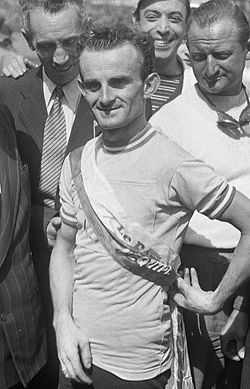
Jean Robic (pronounced [ʒɑ̃ ʁɔ.bik]; 10 June 1921 – 6 October 1980)[2] was a French road racing cyclist who won the 1947 Tour de France. Robic was a professional cyclist from 1943 to 1961. His diminutive stature (1.61m, 60 kg) and appearance[3] was encapsulated in his nickname Biquet (Kid goat).[4] For faster, gravity-assisted descents, he collected drinking bottles ballasted with lead or mercury at the summits of mountain climbs and "cols".[5][6] After fracturing his skull in 1944 he always wore a trademark leather crash helmet.[4]
Key Information


Origins
[edit]Robic has always been described as a Breton but he was born in the Ardennes region of France, where his father had found work as a carpenter.[3]
"I was born in the Ardennes by mistake", Robic always insisted[2]
his father having lived in Brittany before he moved. His father was a racing cyclist and passed the interest to his son.[3] Robic moved to Brittany when he was seven and lived at Radenac. His childhood home is in a street now named for him.
Robic moved to Paris In February 1940 and became a cycle mechanic for the Sausin company.[3] He started racing but made a poor impression on journalists. René de Latour of Sporting Cyclist wrote:
If anybody had told you or me in 1939 that this skinny kid of 17, with ears large enough to be of help with a back wind blowing—if we had been told that here was a future winner of the Tour de France, we would just have laughed. When his name first became known to journalists, he quickly became known as le farfadet de la lande bretonne—the hobgoblin of the Brittany moor. His arrival in the Paris area was not sensational. Robic won a few races out in the villages but this did not mean much. We had hundreds of boys like him in France.[4]
Early career
[edit]The outbreak of war in 1939 and then the German invasion of 1940 made cycle-racing possible but difficult in France. Robic rode cyclo-cross races and as many of the big road races that were still run. He turned professional in 1943.[3] The following year he fell in Paris–Roubaix and finished the race with a broken skull.[4] It was then that he started wearing the leather crash helmet for which he became known.[4] The helmet won him the nickname of tête de cuir, or leather-head; his short stature also brought him the nickname "Biquet", or "kid goat".[7]
Tour de France
[edit]The Tour de France restarted after the war and Robic — still largely unknown — was selected for the regional team from north-west France, which meant largely from Brittany.[4] "He was hardly interviewed by journalists; his retirement on the first day would not have earned him more than a line in small type at the bottom of an obscure page of the papers", said de Latour.[4] Robic, recently married, told his wife Raymonde he would bring her the Tour's yellow jersey as a wedding present.[8][9]
The first stage, from Paris to Lille was won by Ferdinand Kübler of Switzerland. Robic came ninth at 2m 9s. Robic won the stage on the fourth day, from Luxembourg to Strasbourg, then rode well through the Alps. René de Latour said:
And yet the journalists—I among them—still didn't think Robic a Tour winner. We thought so more than ever when, the next day, the route included the great Galibier, and Robic was out of the picture, with the Franco-Italian Camellini unapproachable up there in the snows. It seemed that Robic could not ride well two days running—and consistency is the biggest quality needed in the Tour.[4]
The Tour then had easy stages along the Mediterranean where he could recover before riding still more strongly in the Pyrenees, leading the race over the Aubisque, Tourmalet and Peyresourde on the day from Luchon to Pau. The time he gained moved him to fifth place, and the 139 km time trial to third.
It was on the last day, from Caen, that he secured the race.[10] The leader was Pierre Brambilla and tradition had it that the race leader was left unchallenged to win the Tour when it reached Paris. Robic, however, attacked at half-distance on the two-kilometre hill to the village of Bonsecours, outside Rouen. Another Frenchman, Édouard Fachleitner, went with him. So too did Brambilla, only to become sick from the effort.[11] The main field was uncertain what to do and unfavourable to Brambilla so soon after the war because he was riding for a team of Italians living in France.[4] It left the chase until too late. René de Latour wrote:
Robic had nothing to lose but his third place—end everything to gain. He jumped away as if his life depended on it. Luckily I had swapped from my car to the pillion of a motor-bike, and watched from close quarters every moment of the drama. When Robic opened a gap of a few lengths, Brambilla made a terrific effort to get back, and it seemed that was that. Then, from the bunch behind, that great rider, Fachleitner, sprinted past them both. Robic bounded on his wheel; Brambilla failed—and lost the Tour.[4]
A group of riders were ahead of Robic and Fachleitner. They had lost too much time during the month that the Tour had lasted to challenge for race victory and so Léo Veron of the French national team told Lucien Teisseire to drop back and help Fachleitner. The three joined up 100 km from the finish and Fachleitner attacked several times. Robic countered him each time and then Teisseire took over. Robic took no notice because Teisseire was no danger.[12] It was then, Fachleitner said, that Robic told him:
'Ride with me. You'll come second but I'll give you 100,000 francs'[13]
That seemed straightforward (C'était honnête) to Fachleitner, "So I rode. In my head I was thinking: 'If he cracks or if he crashes, it'll be me who wins the Tour...' But he didn't crack and he didn't crash. He paid the 100,000 francs, not to me but to the French national team [for which Fachleitner was riding], which was the rule. Which brought me another outburst from René Vietto. 'You poor fool [fada],' he said to me, 'you should have asked for a lot more! What's this going to be worth once we've shared it between us?' Right up until his death, he kept saying to me 'You didn't ask enough.'"[14]
Robic, who until then had never led the race, reached the finish at the Parc des Princes 13 minutes ahead of Brambilla.[15] The stage was so fast that it finished an hour ahead of schedule.[16] Legend has it that Brambilla buried his bike in his garden in disgust. More certain is that Robic gave his only yellow jersey to the Sainte-Anne-d'Auray basilica, where it still is, in thanks to Anne, patron saint of Bretons.
The twist to Robic's victory is that he wasn't the fastest rider in the race. Fachleitner had taken 3m 32s less to complete the Tour.[16] It was the time bonuses that Robic picked up in the Pyrenees that made the difference.
Other successes
[edit]Robic also won the Rome-Naples-Rome in 1950, the world cyclo-cross championship in 1950,[17][18] and the Tour de Haute-Savoie and Polymultipliée in 1952.
Personality and appearance
[edit]Pierre Chany said:
He had a face that was speckled like a bitter apple, large ears and a little nervous and muscular body. At the same time proud and stubborn, he detested all those whom nature had made better proportioned and those whom nature had given what he considered a more handsome body. He hated Louison Bobet, accusing of him of being a false Breton because he was born in Ille-et-Vilaine!
Robic was one of the shortest riders; 1m 61 in 1947 and 1m 59 in 1959. He weighed 60 kg.[3] He rode a 19-inch (480 mm) frame but with 172 mm cranks when the norm was 170 mm. Robic was often bitter with the world.
One writer said: He was five-foot nothing [and] so light in weight that he ballasted his water bottles with lead to increase his momentum on the downhills. Tiny guy, blond curls crimped under a string-of-sausages helmet, gnarled face and Mr Punch hooked chin and nose... He wore a ring inscribed kenbeo kenmaro, 'to life, to death' in Breton.[6]
Robic won few friends with his bad language[5] and quick temper. He was at war with everyone, said the journalist Jacques Augendre.[5] In 1959, Robic finished the Tour de France stage to Chalon-sur-Saône outside the time limit. The stage was won by the British rider, Brian Robinson, with an unusually large lead of 20 minutes. Other riders were required to finish the day within a set percentage of the winner's time and Robic didn't make it. Normally the judges would make an exception for a former winner but Robic's personality is said to have gone against him and he was put out of the race.
He was astute at exploiting rules. He collected lead filled drinking bottles at the top of major climbs because his lightness led to his descending mountains slower than he wanted. When the organisers forbade filling bottles with solids, he filled his with mercury instead.[5] He bragged of his talent, once dismissing Gino Bartali and saying of the other leading Italian that he had " a Fausto Coppi in each leg"[5]—meaning he was twice as good.
A fellow professional, André Mahé, said in Procycling in 2007 that Robic's personality and self-importance was such that he would stand in the doorway of a restaurant until all the diners had noticed him and then announce:
"Oui! C'est moi—Robic!"
Doping
[edit]There were no doping rules in Robic's era. The historian and television commentator, Jean-Paul Ollivier, wrote of the 1950 Tour de France in which he said Robic was deeply depressed, weeping abundantly.
He thought the Tour was lost. He had a cold and went to bed shivering with a fever. The next day, the boss of the hotel, unaccustomed to the timetable of the Tour de France, forgot to get up. The riders had to prepare their own breakfast in record time. Robic had enteritis. He was weak [rien ne va plus]. Escorted by his team-mates, Robert Bonnaventure and Gino Sciardis, he finished the stage pitifully at St-Étienne and dropped from fourth to seventh place in the standings, 37 minutes behind Ferdi Kübler. Robic was still weak at the start of the time trial from St-Étienne to Lyon. His soigneur, Libaud, gave him an injection of solucamphor to get him going again [pour le remonter][20]
Robic said doping had always existed but that the most he had taken was a bottle of coffee mixed with "calva"—(Calvados).[21]
Personal life
[edit]In 1943 Robic met Raymonde Cornic, whose father owned the Rendez-vous des Bretons bar near the Gare Montparnasse in Paris.[3] The two married four days before the 1947 Tour. They had a son, Jean-Lou, in 1948, another son, Alain, in 1949 and a daughter, Christine, in 1952.[3] Robic's father was killed in September 1945 by the branch of a tree he was sawing and Robic acquired a house in Petit-Clamart for his mother.[3] Robic and his wife lived in the suburb of Wissous[22] and bought his mother a mercery shop there. His family still live in the region and have attended ceremonies in Robic's memory.
At 40, Robic took over the family bar.
Retirement and death
[edit]Jock Wadley wrote:
Puteaux was where Robic had scored an important cyclo-cross win at the beginning of his main career. Robic's popularity has always been enormous. At his farewell, he was given a great reception. On the course was a very steep hill, which had to be covered 20 times. Robic, at 40, could have been dropped and nobody would have accused him of not trying. But he hung on with a grimace to show how he could suffer to finish his career en beauté. As he crossed the line, he was surrounded by riders less than half his age.
Robic fell again while in the running to win the Tour de France of 1953. He broke bones in his spine. He rode the Tour again in 1954, 1955 and 1959 without finishing.[23] He rode local races and lived from the start money he was offered. He also went back to cyclo-cross, riding throughout the winter.[24] Robic rode his last race in 1967, in the Puteaux suburb of Paris. He was congratulated at the finish by his old rival, Louison Bobet.[4]
Robic found it hard to fit into an ordinary life when his career ended. He ran the family café but it failed, as did his marriage. From then on he became depressed.[3] For a long time he went without work. At others, he tried stunts such as being the referee of professional wrestling bouts, where his shortness encouraged wrestlers to throw him out of the ring. He also sat on a bicycle in the publicity procession of the Tour de France. He became depressed and wandered the streets, asking for work, until his friend, Eugène Letendre, took him into his business.[3]
He died in a car accident near Claye-Souilly on his way home from a party at Germigny-l'Évêque in which Joop Zoetemelk was celebrating his own win in the Tour.[10] Robic's monument on the hill outside Rouen where he won the Tour shows him in his leather helmet.[25][26] He is buried in the cemetery at Wissous[3] A room in the town hall in Radenac is a museum in his memory.[3]
Career achievements
[edit]Major results
[edit]- 1945
 France national cyclo-cross championship
- 1947
- Critérium International de cyclo-cross
- Tour de France:
- Winner stages 4, 7 and 15
 Winner overall classification

- 1948
- À travers Lausanne
- 1949
- Tour de France:
- Winner stage 11
- 4th place overall classification
- 1950
- World Championship cyclo-cross
- Roma-Napoli-Roma
- 1952
- Bol d'Or des Monédières Chaumeil
- Polymultipliée
- Etten-Leur
- Tour de France:
- Winner stage 15
- 5th place overall classification
- 1953
- Tour de France:
- Winner stage 11
Grand Tour results timeline
[edit]| 1947 | 1948 | 1949 | 1950 | 1951 | 1952 | 1953 | 1954 | 1955 | 1956 | 1957 | 1958 | 1959 | |
|---|---|---|---|---|---|---|---|---|---|---|---|---|---|
| Giro d'Italia | DNE | DNE | DNE | DNF | DNE | DNE | DNE | DNE | DNE | DNE | DNE | DNE | DNE |
| Stages won | — | — | — | 0 | — | — | — | — | — | — | — | — | — |
| Mountains classification | — | — | — | NR | — | — | — | — | — | — | — | — | — |
| Points classification | N/A | N/A | N/A | N/A | N/A | N/A | N/A | N/A | N/A | N/A | N/A | — | — |
| Tour de France | 1 | 16 | 4 | 12 | 27 | 5 | DNF-14 | DNF-5 | DNF-10 | DNE | DNE | DNE | DNF-20 |
| Stages won | 3 | 0 | 1 | 0 | 0 | 1 | 1 | 0 | 0 | — | — | — | 0 |
| Mountains classification | 3 | 3 | 3 | 3 | 7 | 3 | NR | NR | NR | — | — | — | NR |
| Points classification | N/A | N/A | N/A | N/A | N/A | N/A | NR | NR | NR | — | — | — | NR |
| Vuelta a España | DNE | DNE | N/A | DNE | N/A | N/A | N/A | N/A | DNE | DNE | DNE | DNE | DNE |
| Stages won | — | — | — | — | — | — | — | — | |||||
| Mountains classification | — | — | — | — | — | — | — | — | |||||
| Points classification | N/A | N/A | N/A | — | — | — | — | — |
| 1 | Winner |
| 2–3 | Top three-finish |
| 4–10 | Top ten-finish |
| 11– | Other finish |
| DNE | Did not enter |
| DNF-x | Did not finish (retired on stage x) |
| DNS-x | Did not start (not started on stage x) |
| HD-x | Finished outside time limit (occurred on stage x) |
| DSQ | Disqualified |
| N/A | Race/classification not held |
| NR | Not ranked in this classification |
Notes
[edit]- ^ Robic was nicknamed Le farfadet de la lande Bretonne (the hobgoblin of the Brittany moor) by eminent authority René de Latour, but there is some doubt whether the nickname was accepted by Robic or his contemporaries. It may have been Latour's conflation of the nickname of Robic's sometime Breton team-mate Jean-Marie Goasmat, "le farfadet de Pluvigner" (the hobgoblin of Pluvigner). Goasmat was also small, slight and had big ears, whilst Pluvigner is a village in Morbihan, Brittany. As of 2014 Latour's is the only known use of the nickname for Robic, whereas for Goasmat there are other French language sources.
References
[edit]- ^ Vergne, Laurent (22 July 2015). "Cannibale, Chéri-pipi, Wookie, Andy torticolis… le Top 20 des surnoms mythiques du cyclisme" [Cannibal, Chéri-pipi, Wookie, Andy Torticollis... the Top 20 mythical nicknames of cycling]. Eurosport (in French). Retrieved 11 April 2016.
- ^ a b L'Équipe, 9 July 2003
- ^ a b c d e f g h i j k l m "Club cyclo du Ninian à Plémet"[permanent dead link].
- ^ a b c d e f g h i j k l Sporting Cyclist, UK, January 1968
- ^ a b c d e Augendre, Jacques (16 July 2001) "Des Complicités Terribles", L'Équipe, France
- ^ a b Fife, Graeme (1999) Tour de France, Mainstream, ISBN 1840188065, p. 105
- ^ Sporting Cyclist, UK, December 1966
- ^ 100 ans de Tour. Radio France
- ^ Fife, Graeme (1999) Tour de France, Mainstream, ISBN 1840188065, p. 107
- ^ a b Rey, Jean-Paul (2000) 100 Rois de la Petite Reine, Solar, France. ISBN 226302980X.
- ^ Clifford, Peter (1966) The Tour de France. S. Paul
- ^ Chany, Pierre (1988) La Fabuleuse Histoire du Tour de France, Nathan, France, p. 356
- ^ Old francs, worth 1,000 revalued francs
- ^ Vélo, France, July 2007
- ^ L'Équipe, France, 19 July 2008
- ^ a b "memoire-du-cyclisme.net" Archived 15 February 2009 at the Wayback Machine.
- ^ "Le cyclo cross, une course dans un milieu naturel !". bloc.com.
- ^ "Cyclo-cross" Archived 16 July 2011 at the Wayback Machine. encyclopedie.snyke.com
- ^ Chany, Pierre (1988) La Fabuleuse Histoire du Tour de France, Nathan, France, p. 357
- ^ "Dictionnaire du dopage".
- ^ Institut National de l'Audiovisuel – Ina.fr. "Ina.fr : vidéo, radio, audio et publicité – Actualités, archives de la radio et de la télévision en ligne – Archives vidéo et radio Ina.fr". Ina.fr.
- ^ Just west of Orly airport, Paris
- ^ "Jean ROBIC" Archived 12 May 2006 at the Wayback Machine. letour.com
- ^ "Jean Robic dominee le cyclo-cruss de Buc. memoire-du-cyclisme.net
- ^ Dave Moulton. "Dave Moulton's Bike Blog: Jean Robic: The little giant".
- ^ Cycling. "Monuments – Jean Robic".
External links
[edit]
- Jean Robic at Cycling Archives (archive)
- Official Tour de France results for Jean Robic


| 1950–1959 |
|
|---|---|
| 1960–1979 |
|
| 1980–1999 |
|
| 2000–2019 |
|
| 2020–2039 |
|


| International | |
|---|---|
| National | |
| Other | |

Jean Robic
View on GrokipediaEarly life
Birth and family background
Jean Robic was born on 10 June 1921 in Condé-les-Vouziers, a commune in the Ardennes department of France. [1] He came from a working-class family, with his father employed as a carpenter, a manual trade that often required travel for work. [4] His father, originally from Brittany, had moved to the Ardennes for work and was also a former racing cyclist. Growing up initially in this rural environment, Robic experienced the demands of physical labor and village life typical of early 20th-century countryside France, shaping his modest beginnings. [5] His family background reflected the humble circumstances common among working-class households in the region. [4]Introduction to cycling and amateur years
Jean Robic developed an interest in cycling through his father, a former racing cyclist, and began using the bicycle as a primary means of transportation in the rural Brittany region where his family settled in Radenac (Morbihan department) when he was seven years old. In February 1940, at the age of 18, he relocated to Paris and took a job as a cycle mechanic for the Sausin company, which provided him with the opportunity to begin competitive racing in local events. He achieved a few wins in minor village races around the Paris area but initially made little impression on the cycling community. The outbreak of World War II and the subsequent German occupation severely restricted organized cycling, yet Robic continued to compete in cyclo-cross races and the limited road events that were still held during this period. He turned professional in 1943. Detailed records of specific amateur victories or placements are scarce due to the wartime disruption, which interrupted major competitions and limited opportunities for notable performances in the late 1930s and early 1940s. His small and skinny physique, evident even in his teenage years, was remarked upon by contemporaries during these early amateur efforts.Professional cycling career
Entry into professional racing (1945–1946)
Jean Robic resumed his professional cycling career after World War II with the Génial Lucifer-Hutchinson team in 1945.[1][3] As French cycling began to recover from the occupation and its restrictions, he competed in the restarted post-war calendar, which included regional classics, criteriums, and cyclo-cross events.[1] In 1945, Robic achieved a notable success by winning the French national cyclo-cross championship, highlighting his versatility and strength in off-road competition during the early revival of professional racing in France.[3] He continued with Génial Lucifer-Hutchinson in 1946, participating in the expanding schedule of road races as the professional peloton regained momentum across Europe.[1][3] These initial post-war seasons allowed Robic to gain experience and visibility in the professional ranks, contributing to the reputation that earned him a place in the 1947 Tour de France.[1]1947 Tour de France victory
Jean Robic competed in the 1947 Tour de France as a member of the Ouest regional team. [6] Considered an outsider at the start, he achieved his only Grand Tour victory by winning the overall general classification in the race's 34th edition, held from 25 June to 20 July over 4,630 km. [6] Robic's performance featured key stage victories in mountainous terrain, including stage 7 from Lyon to Grenoble in the Alps and stage 15 from Luchon to Pau in the Pyrenees, along with an earlier win on stage 4 from Luxembourg to Strasbourg. [6] These results positioned him competitively heading into the race's decisive final phase. The Tour's outcome hinged on the final stage from Caen to Paris, when Robic entered the day in third place overall but finished in a group alongside Édouard Fachleitner that gained critical time on the existing leaders Pierre Brambilla and Aldo Ronconi. [7] He secured the win with a total time of 148:11:25, finishing 3 minutes 58 seconds ahead of Fachleitner in second, with Brambilla third at 10 minutes 7 seconds and René Vietto fifth at 15 minutes 23 seconds. [8] In a historic twist, Robic assumed the race lead only during the final stage and thus never wore the yellow jersey at any point before crossing the finish line in Paris. [6] This triumph represented the first Tour de France victory in the post-World War II period. [9]Later professional years (1948–1961)
After his surprise victory in the 1947 Tour de France, Jean Robic continued competing as a professional cyclist until 1961, participating in numerous editions of the Tour and other races while switching teams frequently amid the shifting sponsorship landscape of post-war cycling.[1] He rode for a variety of French and international sponsors during this period, including Génial Lucifer–Hutchinson in 1948, Riva-Sport–Dunlop in 1949, Fiorelli in 1951, Bottecchia–Ursus in 1952, Gitane–Hutchinson in 1955, Essor–Leroux in 1956–1957, Coupry–Margnat in 1958–1959, Rochet–Margnat in 1960, and Margnat–Rochet–Dunlop in his final season of 1961.[1] Robic remained a capable stage hunter and climber in the Tour de France, securing stage victories in 1949, 1952, and 1953, often on demanding mountain stages late in the race.[1] He also recorded multiple second-place finishes on individual stages across these years, demonstrating sustained competitiveness in the event despite not achieving another overall classification win.[1] Outside the Tour, he earned notable successes including the overall classification and two stage wins at Roma–Napoli–Roma in 1950, victories at À Travers Lausanne in 1948, Subida a Arantzazu in 1949 and 1950, Mont Faron in 1948 and 1949, Polymultipliée in 1952, and Circuit de la Haute-Savoie in 1952.[1] His performances gradually declined in the mid-to-late 1950s due to age and the physical toll of racing, with his last season of significant PCS ranking points occurring in 1956 and only minimal points recorded in 1959.[1] Robic made his final professional appearance in the 1961 GP du Midi-Libre, where he did not finish the race, marking the end of his competitive career at age 40.[1] Throughout these later years, he maintained his distinctive use of a protective helmet for safety.[1]Major achievements and racing style
Tour de France performances
Jean Robic participated in the Tour de France on ten occasions between 1947 and 1959, recording one overall victory, six stage wins, and two days in the yellow jersey across his career in the race. [10] [1] He finished six of these editions and failed to complete four due to abandonments or elimination. [10] [11] His standout performance came in 1947, when he claimed the general classification victory along with three stage wins (stages 4, 7, and 15) and wore the yellow jersey on the final stage into Paris. [10] In 1948, he finished 16th overall. [11] Robic returned stronger in 1949 with a fourth-place finish in the general classification and one stage win (stage 11). [10] He placed 12th in 1950 and 27th in 1951. [11] In 1952, he achieved fifth place overall and secured another stage victory (stage 14). [10] The 1953 edition saw him win stage 11 but abandon before stage 14. [11] Robic abandoned the 1954 Tour on stage 5 and the 1955 Tour on stage 10. [10] His final Tour appearance in 1959 ended with elimination after finishing outside the time limits on stage 20. [10] Across his ten participations, Robic's six stage wins occurred in 1947 (three), 1949 (one), 1952 (one), and 1953 (one). [10] [1]Other notable victories
Jean Robic recorded several notable victories in his professional career beyond his 1947 Tour de France triumph. One of his most prestigious non-Tour successes was winning the general classification of Roma-Napoli-Roma in 1950, a major Italian stage race where he outperformed riders like Fausto Coppi and Louison Bobet while also claiming a stage win. [12] [1] That same year, Robic showcased his versatility across disciplines by capturing the UCI Cyclo-cross World Championship title in the event's inaugural edition. [3] He further distinguished himself in hillclimb races, securing victories at Subida a Arantzazu in both 1949 and 1950, as well as at Mont Faron in 1948 and 1949. [1] These achievements, alongside various stage wins in races such as the Critérium du Dauphiné Libéré and Tour de Suisse, underscored Robic's consistent competitiveness in diverse terrains and formats throughout the late 1940s and 1950s. [1] [13]Racing characteristics and equipment
Jean Robic was distinguished by his diminutive stature, standing at 1.61 meters tall and weighing 60 kilograms, which contributed to his exceptional abilities as a climber in mountainous terrain. [13] [14] This lightweight build provided a significant advantage on ascents, enabling him to excel in the high mountains of races such as the Tour de France, where his climbing prowess was a key strength. [1] [14] Robic's racing style was marked by an aggressive and attacking approach, often launching bold moves in the climbs to seize opportunities and disrupt rivals. [3] To gain an edge on descents, he famously used water bottles filled with lead (later mercury after solids were banned) for added weight and speed, a tactic that complemented his combative nature. His combative nature and willingness to initiate decisive attacks suited his physical attributes, allowing him to capitalize on his climbing edge during critical stages. [3] One of Robic's most distinctive features was his consistent use of a leather crash helmet, which he adopted after fracturing his skull in a fall at the 1944 Paris–Roubaix. [3] [14] In an era when riders typically wore only cloth caps, this protective headgear was highly unusual and became his trademark. [14] The helmet earned him the nickname "tête de cuir" (leather head), reflecting both his commitment to safety and the striking appearance it gave him in the peloton. [3] [14]Personal life
Family and relationships
Jean Robic married Raymonde just four days before the start of the 1947 Tour de France. [14] [15] He reportedly promised his young wife that, having no dowry to offer due to his modest means, he would buy her a villa if he won the race. [16] The couple had three children together: Jean-Loup, born in 1948, and Alain, born in 1949, along with a third child. [14] [15] Little additional public detail is available about Robic's family life or extended relationships beyond these core facts.Personality and public image
Jean Robic was widely known by his nickname "Tête de cuir" (Leather Head), which originated from a severe head injury—a fractured skull—he sustained during the 1944 Paris-Roubaix race.[17] To prevent similar accidents, he adopted the habit of wearing a leather helmet consistently, an unusual choice that became a signature element of his public image.[17] The nickname, along with others such as "Biquet," reflected his distinctive appearance and resilient character, though contemporaries noted that "Biquet" ill-suited him given his "caractère de chien" (difficult temperament).[17] Robic cultivated a reputation as a fiercely determined and combative rider, frequently described as hargneux (aggressive), têtu (stubborn), and the archetype of the "Breton entêté" (stubborn Breton).[18] His personality was marked by provocations, outbursts of anger, and an unyielding refusal to accept defeat, traits that defined him in the eyes of both peers and the public.[18] Journalist Marcel Hansenne portrayed him as "l’homme des grandes colères" (the man of great angers), noting that nothing enraged him more than being dropped in the mountains, yet he would respond by summoning extraordinary energy to fight back.[18] In the French press and among observers, Robic was depicted as a rugueux (rough), instinctif (instinctive), and solitaire (solitary) cyclist who preferred to succeed alone, often earning enmities within the peloton for his independent and frondeur (defiant) attitude.[19] Jean-Paul Ollivier described him as "hargneux, accrocheur, un râleur au grand cœur" (aggressive, tenacious, a grumbler with a big heart), emphasizing that his personality contributed as much to his legendary status as his athletic talents.[19] Though sometimes seen as mal aimé (unloved) due to his reluctance to accept help and his provocative nature, these same qualities—his pugnacity and refusal to renounce—made him a beloved figure among the public, who cherished his embodiment of resilience and rural French spirit for nearly 15 years after his 1947 Tour victory.[19][18]Retirement and death
Transition to retirement
Jean Robic retired from professional cycling in 1961 at the age of 40. [16] His final season with the Margnat-Rochet-Dunlop team included participation in the GP du Midi-Libre in May, where he failed to finish the third stage, marking his last documented professional road race. [1] This end came after a career that had peaked with his surprise victory in the 1947 Tour de France but had seen reduced prominence in the later 1950s due to injuries and less frequent high-level starts. [20] Transitioning to civilian life, Robic took over management of a well-known Breton brasserie in Paris's Montparnasse district, where he entertained patrons with anecdotes from his racing days. [20] The business eventually failed, contributing to a difficult adjustment period marked by modest living and various small jobs, with no notable continued involvement in cycling such as coaching or organizational roles. [16]Death in 1980
Jean Robic died on 6 October 1980 at the age of 59 in a car accident near Claye-Souilly, France. [14] [21] The accident occurred while he was returning home from a party celebrating another cyclist's victory in the Tour de France. [14] No further verified details on the precise cause or his role in the vehicle are available from sources.Legacy
Impact on cycling
Jean Robic's victory in the 1947 Tour de France, the first edition contested after World War II, stood as a powerful symbol of French national recovery and resilience in the immediate post-war years. [9] This triumph provided a major morale boost to a country rebuilding from occupation and devastation, with his unexpected success on the final stage—launching a decisive attack that gained him the lead only on the last day—capturing widespread attention and pride. [9] Known for his diminutive stature and exceptional climbing ability, Robic embodied the potential of smaller riders in a sport often dominated by larger athletes, earning descriptions as a "little giant" who overcame physical disadvantages through determination and aggressive racing. [9] His attacking style, particularly in mountainous terrain and high-risk descents, highlighted how lightweight climbers could exploit the Tour's demanding routes to challenge stronger favorites. Despite the inspirational nature of his 1947 win and his role as an early example for small-statured climbers, Robic's broader influence on the evolution of professional cycling remained limited compared to later dominant figures who achieved multiple Tour victories and shaped enduring tactical and training paradigms in the sport.Recognition and memorials
Jean Robic's legacy in cycling has been acknowledged through various local memorials and annual tributes, primarily in regions connected to his life, birth, and his iconic 1947 Tour de France victory. A commemorative plaque adorns the house where he was born in Condé-lès-Vouziers in the Ardennes department, marking his origins on June 10, 1921. A prominent stele stands at the summit of the Côte de Bonsecours in Normandy, honoring his bold attack during the final stage of the 1947 Tour de France on July 20, 1947, when he launched a decisive assault on that climb en route to overall victory in Paris. [22] The monument features an inscription detailing this pivotal moment in his career. [22] In Radenac, Brittany—where Robic had strong personal ties—a stainless steel stele was inaugurated in 2021 to celebrate his memory as an enduring figure in local and national cycling history. [23] In Wissous, the suburb of Paris where he is buried, the municipality organizes the annual Souvenir Jean Robic cyclo-cross race as an ongoing tribute to his achievements and enduring influence on the sport. The event has continued for over two decades, with editions drawing participants in his honor. Occasional homages from the Tour de France itself have highlighted his status, including route passages near his Bonsecours stele and dedicated tributes marking key anniversaries of his 1947 win. [16] [24]Posthumous reputation
Jean Robic's posthumous reputation centers primarily on his dramatic and unexpected victory in the 1947 Tour de France, widely regarded as one of the most surprising wins in the race's history. [25] He seized the yellow jersey on the final stage into Paris with a bold attack, becoming the first post-war champion without having worn the leader's jersey at any prior point in the race. [26] This underdog story has endured in cycling narratives, portraying him as a diminutive, combative outsider who defied expectations in the event's return after a seven-year hiatus due to World War II. [25] His distinctive nickname "Biquet" (little goat) and his pioneering use of a leather helmet have persisted as part of cycling folklore, symbolizing his gritty, unconventional presence. [9] Modern retrospectives often highlight his 1947 triumph as a standout moment of post-war cycling, though comprehensive coverage of his broader career remains relatively sparse compared to the more extensively documented eras of Jacques Anquetil and Eddy Merckx. [27] Robic appears in various histories, articles, and lists of notable or unsung figures in the sport, frequently cited for his tenacity and the dramatic nature of his sole Tour success rather than sustained dominance. [26] [27]References
- https://commons.wikimedia.org/wiki/File:St%C3%A8le_Jean_Robic_%C3%A0_Bonsecours_07.JPG