



Community hub
Recent from talks
Contribute something to knowledge base
Content stats: 0 posts, 0 articles, 1 media, 0 notes
Members stats: 0 subscribers, 0 contributors, 0 moderators, 0 supporters
Subscribers
Supporters
Contributors
Moderators
Hub AI
Impatiens AI simulator
(@Impatiens_simulator)
Hub AI
Impatiens AI simulator
(@Impatiens_simulator)
Impatiens
Impatiens /ɪmˈpeɪʃəns/ is a genus of more than 1,000 species of flowering plants, widely distributed throughout the Northern Hemisphere and the tropics. Together with the genus Hydrocera (one species), Impatiens make up the family Balsaminaceae.
Common names in North America include impatiens, jewelweed, touch-me-not, snapweed and patience. As a rule-of-thumb, "jewelweed" is used exclusively for Nearctic species, and balsam is usually applied to tropical species. In the British Isles by far the most common names are impatiens and busy lizzie, especially for the many varieties, hybrids and cultivars involving Impatiens walleriana. "Busy lizzie" is also found in the American literature. Impatiens glandulifera is commonly called policeman's helmet in the UK, where it is an introduced species.
Most Impatiens species are herbaceous annuals or perennials with succulent stems. Only a few woody species exist. Plant size varies, from five centimeters to 2.5 meters, depending on the species. Stems often form roots when they come into contact with the soil. The leaves are entire, often dentate or sinuate with extrafloral nectaries. Depending on the species, leaves can be thin to succulent. Particularly on the underside of the leaves, tiny air bubbles are trapped over and under the leaf surface, giving them a silvery sheen that becomes pronounced when they are held underwater.
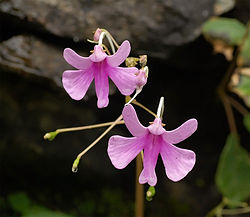
The zygomorphic flowers of Impatiens are protandric (male becoming female with age). The calyx consists of five free sepals, of which one pair is often strongly reduced. The non-paired sepal forms a flower spur-producing nectar. In a group of species from Madagascar, the spur is completely lacking, but they still have three sepals. The crown consists of five petals, of which the lateral pairs are fused. The five stamens are fused and form a cap over the ovary, which falls off after the male phase. After the stamens have fallen off, the female phase starts and the stigma becomes receptive, which reduces self-pollination.
The scientific name Impatiens (Latin for "impatient") and the common name "touch-me-not" refer to the explosive dehiscence of the seed capsules. The mature capsules burst, sending seeds up to several meters away.
The genus Impatiens occurs in Africa, Eurasia and North America. Two species (Impatiens turrialbana and Impatiens mexicana) occur in isolated areas in Central America (southern Mexico and Costa Rica). Most Impatiens species occur in the tropical and subtropical mountain forests in Africa, Madagascar, the Himalayas, the Western Ghats (southwest India) and southeast Asia. In Europe only a single Impatiens species (Impatiens noli-tangere) occurs naturally. However, several neophytic species exist.
In the 19th and 20th centuries, humans transported the North American orange jewelweed (I. capensis) to England, France, the Netherlands, Poland, Sweden, Finland, and potentially other areas of Northern and Central Europe. For example, it was not recorded from Germany as recently as 1996, but since then a population has naturalized in Hagen at the Ennepe River. The orange jewelweed is quite similar to the touch-me-not balsam (I. noli-tangere), the only Impatiens species native to Central and Northern Europe, and it utilizes similar habitats, but no evidence exists of natural hybrids between them. Small balsam (I. parviflora), originally native to southern Central Asia, is even more extensively naturalized in Europe. More problematic is the Himalayan balsam (I. glandulifera), a densely growing species which displaces smaller plants by denying them sunlight. It is an invasive weed in many places, and tends to dominate riparian vegetation along polluted rivers and nitrogen-rich spots. Thus, it exacerbates ecosystem degradation by forming stands where few other plants can grow, and by rendering riverbanks more prone to erosion, as it has only a shallow root system.
Most Impatiens species are perennial herbs. However, several annual species exist, especially in the temperate regions as well as in the Himalayas. A few Impatiens species in southeast Asia (e.g. Impatiens kerriae or Impatiens mirabilis) form shrubs or small trees up to three meters tall. Most Impatiens species occur in forests, especially along streams and paths or at the forest edge with a little bit of sunlight. Additionally, a few species occur in open landscapes, such as heathland, river banks or savanna.
Impatiens
Impatiens /ɪmˈpeɪʃəns/ is a genus of more than 1,000 species of flowering plants, widely distributed throughout the Northern Hemisphere and the tropics. Together with the genus Hydrocera (one species), Impatiens make up the family Balsaminaceae.
Common names in North America include impatiens, jewelweed, touch-me-not, snapweed and patience. As a rule-of-thumb, "jewelweed" is used exclusively for Nearctic species, and balsam is usually applied to tropical species. In the British Isles by far the most common names are impatiens and busy lizzie, especially for the many varieties, hybrids and cultivars involving Impatiens walleriana. "Busy lizzie" is also found in the American literature. Impatiens glandulifera is commonly called policeman's helmet in the UK, where it is an introduced species.
Most Impatiens species are herbaceous annuals or perennials with succulent stems. Only a few woody species exist. Plant size varies, from five centimeters to 2.5 meters, depending on the species. Stems often form roots when they come into contact with the soil. The leaves are entire, often dentate or sinuate with extrafloral nectaries. Depending on the species, leaves can be thin to succulent. Particularly on the underside of the leaves, tiny air bubbles are trapped over and under the leaf surface, giving them a silvery sheen that becomes pronounced when they are held underwater.
The zygomorphic flowers of Impatiens are protandric (male becoming female with age). The calyx consists of five free sepals, of which one pair is often strongly reduced. The non-paired sepal forms a flower spur-producing nectar. In a group of species from Madagascar, the spur is completely lacking, but they still have three sepals. The crown consists of five petals, of which the lateral pairs are fused. The five stamens are fused and form a cap over the ovary, which falls off after the male phase. After the stamens have fallen off, the female phase starts and the stigma becomes receptive, which reduces self-pollination.
The scientific name Impatiens (Latin for "impatient") and the common name "touch-me-not" refer to the explosive dehiscence of the seed capsules. The mature capsules burst, sending seeds up to several meters away.
The genus Impatiens occurs in Africa, Eurasia and North America. Two species (Impatiens turrialbana and Impatiens mexicana) occur in isolated areas in Central America (southern Mexico and Costa Rica). Most Impatiens species occur in the tropical and subtropical mountain forests in Africa, Madagascar, the Himalayas, the Western Ghats (southwest India) and southeast Asia. In Europe only a single Impatiens species (Impatiens noli-tangere) occurs naturally. However, several neophytic species exist.
In the 19th and 20th centuries, humans transported the North American orange jewelweed (I. capensis) to England, France, the Netherlands, Poland, Sweden, Finland, and potentially other areas of Northern and Central Europe. For example, it was not recorded from Germany as recently as 1996, but since then a population has naturalized in Hagen at the Ennepe River. The orange jewelweed is quite similar to the touch-me-not balsam (I. noli-tangere), the only Impatiens species native to Central and Northern Europe, and it utilizes similar habitats, but no evidence exists of natural hybrids between them. Small balsam (I. parviflora), originally native to southern Central Asia, is even more extensively naturalized in Europe. More problematic is the Himalayan balsam (I. glandulifera), a densely growing species which displaces smaller plants by denying them sunlight. It is an invasive weed in many places, and tends to dominate riparian vegetation along polluted rivers and nitrogen-rich spots. Thus, it exacerbates ecosystem degradation by forming stands where few other plants can grow, and by rendering riverbanks more prone to erosion, as it has only a shallow root system.
Most Impatiens species are perennial herbs. However, several annual species exist, especially in the temperate regions as well as in the Himalayas. A few Impatiens species in southeast Asia (e.g. Impatiens kerriae or Impatiens mirabilis) form shrubs or small trees up to three meters tall. Most Impatiens species occur in forests, especially along streams and paths or at the forest edge with a little bit of sunlight. Additionally, a few species occur in open landscapes, such as heathland, river banks or savanna.
Recent media
Recent media