Hubbry Logo
Jose CalugasJose CalugasMain
Open search
Jose Calugas
Community hub
Jose Calugas
logo
8 pages, 0 posts
0 subscribers
Be the first to start a discussion here.
Jose Calugas
Jose Calugas
from Wikipedia

Jose Cabalfin Calugas[6] (December 29, 1907 – January 18, 1998) was a member of the Philippine Scouts during World War II. He received the Medal of Honor for actions during the Battle of Bataan.

Key Information

At the age of 23, Calugas joined the Philippine Scouts of the United States Army and completed training as an artilleryman and served with different artillery batteries of the Philippine Scouts until his unit was mobilized to fight in World War II. After noticing one of his unit's gun batteries had been put out of commission and its crew killed, he gathered several members of his unit together, dug in and attempted to defend the line. He was captured along with other members of his unit and forced to march to a distant enemy prison camp, where he was held as a prisoner of war. When he was released in 1943, he was secretly assigned to a guerrilla unit in the Philippines where he fought for the liberation of the Philippines from the Japanese.

After World War II, Calugas received a direct commission and became a United States citizen. After retiring from the Army, he settled in Tacoma, Washington.

Early life and military training

[edit]

Calugas was born in Barrio Tagsing, Leon, Iloilo, Philippines, on December 29, 1907.[4][7] His mother died when he was ten, and he later left high school in order to work and support his family.[8] In 1930, he enlisted in the United States Army and received his basic training at Fort Sill, Oklahoma. Upon completion, he received additional training as an artilleryman,[3] and was then assigned to the 24th Artillery Regiment of the Philippine Scouts at Fort Stotsenburg, Pampanga. While stationed at Fort Stotsenburg, he married and began to raise a family. His next unit was the 88th Field Artillery Regiment of the Philippine Scouts. He was a Sergeant with Battery B when the United States and the Philippine Commonwealth declared war on Japan in 1941. His unit was mobilized for duty and sent to Bataan in December 1941.[7]

Action in World War II

[edit]

Medal of Honor action at Bataan

[edit]
World War II First Line of Defense Memorial (Dinalupihan, Bataan, Philippines).
Historical Marker (January 6, 1942 -Jose Calugas was awarded the Medal of Honor).

On January 16, 1942, his unit was covering the withdrawal of a portion of the U.S. Army Forces Far East (USAFFE), with the 26th Cavalry Regiment of the Philippine Scouts and the 31st Infantry Regiment. Calugas was working as a mess sergeant in charge of a group of soldiers who were preparing the day's meals, known as KP duty. He noticed that one of his unit's 75 mm M1917 field guns had been silenced, and its crew killed. Without orders, he ran the 1,000 yards (914 m) across the shell-swept area to the inactive gun position. Once there, he organized a squad of volunteers who returned Japanese artillery fire. The position remained under constant and heavy fire for the rest of the afternoon. While Calugas and his squad maintained a steady fire on the enemy positions, other soldiers had time to dig in and defend the line. As the day ended and combat subsided, he returned to KP.[8] For his actions on that day, his superiors recommended Calugas for the United States military's highest decoration for valor, the Medal of Honor. Before he could receive it, however, all American forces on Bataan surrendered to Japanese forces.[9][10]

Surrender of Bataan and the death march

[edit]
Prisoners during the march from Bataan to the prison camp, May 1942. (National Archives)

Arguably, the Battle of Bataan represented the most intense phase of Imperial Japan's invasion of the Philippines during World War II. During the final stage of the Battle of Bataan and after repeated assaults and artillery fire by Japanese forces, the communications and defenses of the allies on Bataan peninsula had been almost completely destroyed. On the last two days, the entire Allied defense collapsed, clogging all roads with refugees and fleeing troops. By April 8, the senior U.S. commander on Bataan, Major General Edward "Ned" P. King, Jr., decided further resistance was futile, and explored proposals for surrender. On April 9, 1942, approximately 76,000 Filipino and American troops surrendered to a Japanese army of 54,000 men under Lt. General Masaharu Homma. This was the single largest surrender of one of its military forces in American history.[11]

Route of the Bataan Death March. The section from San Fernando to Capas was by rail. The prisoners marched the last 8 miles from Capas to Camp O'Donnell.

After the surrender, Calugas and the other prisoners marched from Mariveles to Camp O'Donnell, a prison camp in the province of Tarlac. The Japanese, having expected the fighting to continue, anticipated about 25,000 prisoners of war and were inadequately prepared or unwilling to transport a group of prisoners three times the size. The majority of the prisoners of war were immediately relieved of their belongings and endured a 61-mile (98 km) march in deep dust, over vehicle-broken macadam roads, and crammed into rail cars for the portion of the journey from San Fernando to Capas. En route, over 21,000 men and women died from disease, starvation, dehydration, heat prostration, untreated wounds, and wanton execution. The deaths of Filipinos to Americans was disproportionately high: approximately 5,000–10,000 Filipino and 600–650 American prisoners of war died on the Bataan Death March. Calugas remained a prisoner at Camp O'Donnell until January 1943, when he was released to work for the Japanese.[9]

Post POW release

[edit]

His release placed him as a laborer in a Japanese rice mill, and while assigned there he secretly joined a guerrilla unit, #227 Old Bronco.[7] As an officer of the guerrilla unit, he participated in the attack on the Japanese garrison at Karangalan.[7][clarification needed (see Which Karangalan Village?)] His unit fought in the continued campaign against the Japanese, which eventually led to the liberation of the Philippines.[8]

Filipino male in World War II Army Khaki uniform saluting in the foreground. A color guard in the background; the 48-star United States flag on the viewers left, a reversed/war Philippine Commonwealth flag on the viewers right.
Sergeant Calugas wearing the medal after being awarded it at Camp Olivas.

After the liberation of the Philippines in 1945, he finally received the Medal of Honor for which he had been approved at the beginning of the war. The medal was presented to him by General of the Army George Marshall.[8][9] Calugas subsequently accepted a direct commission in the United States Army,[8] and was later assigned to the 44th Infantry Regiment, which was assigned with the occupation of Okinawa. After the unit was disbanded in 1947, he was assigned to the Ryuku Command, on the Ryukyu Islands in the South China Sea, where he remained until 1953.[7] He was later assigned to Fort Lewis, Washington.[8]

Citizenship

[edit]

Although he had been born in a U.S. territory, and had fought in the United States Army, Calugas was not a citizen. Following the Spanish–American War in 1898, Philippine residents were classified as U.S. nationals rather than citizens. The 1934 Tydings–McDuffie Act, or Philippine Independence Act, reclassified Filipinos as aliens, and set a quota of 50 immigrants per year to the United States, with the exception of those who joined the U.S. Navy, but not the U.S. Army.[12] While serving in Okinawa, Calugas completed the process of becoming a naturalized United States citizen.[7][8]

Post-military life

[edit]

Calugas eventually retired from the army with the rank of captain and in 1957 he moved to Tacoma, Washington with his family. He earned a degree in business administration from the University of Puget Sound in 1961 and worked for Boeing. Calugas was involved in several veterans groups within the Seattle and Tacoma area. He died in Tacoma on January 18, 1998, at age 90.[3] His children included Sergeant First Class Jose Calugas Jr.[13] His wife of 52 years died in 1991.[8]

Honors and awards

[edit]

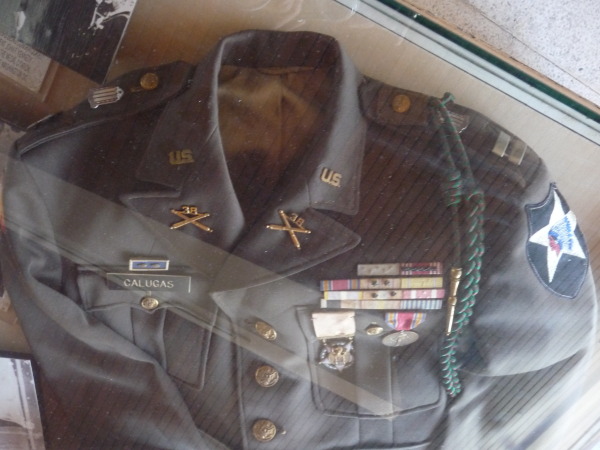
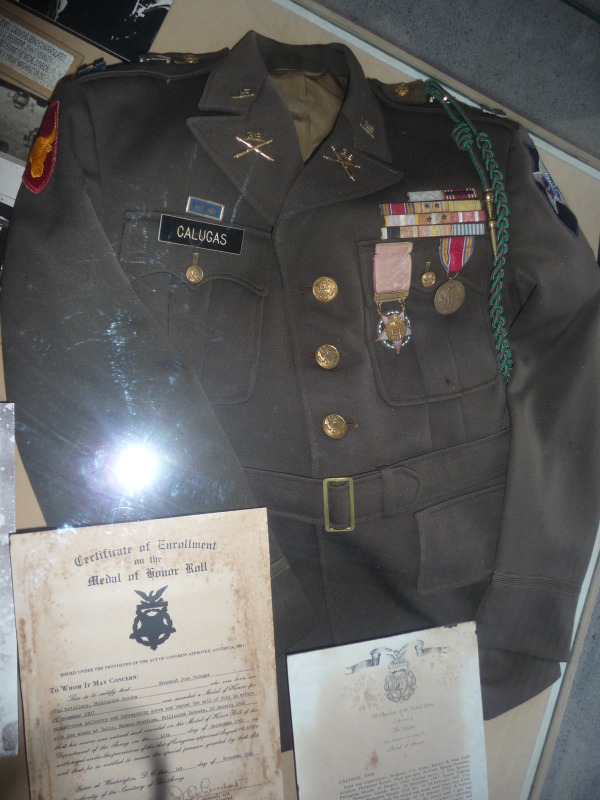
Calugas earned multiple military decorations before he died, including the Medal of Honor.[1][2][5][14]

Bronze star
Bronze star
Bronze star
Bronze star
Bronze star
Bronze oak leaf cluster

Medal of Honor citation

[edit]

The action for which the award was made took place near Culis, Bataan Province, Philippine Islands, on 16 January 1942. A battery gun position was bombed and shelled by the enemy until 1 gun was put out of commission and all the cannoneers were killed or wounded. Sgt. Calugas, a mess sergeant of another battery, voluntarily and without orders ran 1,000 yards across the shell-swept area to the gun position. There he organized a volunteer squad which placed the gun back in commission and fired effectively against the enemy, although the position remained under constant and heavy Japanese artillery fire.[15][16][17]

Legacy

[edit]

On Mount Samat, there is a relief commemorating the event that lead to the awarding of the Medal of Honor.[18]

Calugas was portrayed by Filipino actor Ronnie Lazaro in a 2003 one-hour Philippine documentary A Legacy of Heroes: The Story of Bataan and Corregidor.[19]

His Medal of Honor was given to the Fort's museum for safekeeping and display by Calugas and his family before his death.[20]

In 2006, a 36-unit apartment building, designed for low-income and disabled residents was dedicated as the "Sgt. Jose Calugas, Sr. Apartments" in High Point, Seattle.[21]

On Memorial Day in 2009, his memory was honored at the Living War Memorial Park on a memorial that had previously been established there.[22]

See also

[edit]

References

[edit]

Further reading

[edit]
[edit]
Revisions and contributorsEdit on WikipediaRead on Wikipedia
from Grokipedia
Jose Cabalfin Calugas Sr. (December 29, 1907 – January 18, 1998) was a Filipino soldier who served in the Army's and received the for conspicuous gallantry during the in . Born in Barrio Tagsing, , in the , Calugas enlisted in the U.S. Army in 1930 at age 23, initially assigned to the 24th before transferring to the 88th . On January 16, 1942, as a sergeant in Battery B, 1st Battalion, 88th , at Culis, , , he observed his unit's guns silenced by Japanese shelling and bombing; without orders, he dashed 1,000 yards across exposed terrain under intense fire to a reserve battery, rallied its crew, and directed effective counterfire that neutralized the enemy battery, returning afterward to reorganize his original position. This action, detailed in his official citation, marked him as the only Filipino to earn the award during , presented posthumously in recognition of his initiative and courage amid the desperate defense against Japanese . Captured following the fall of , Calugas endured imprisonment as a before resuming service, eventually attaining the rank of and contributing to postwar military efforts until retirement.

Early Life and Enlistment

Birth and Family Background

Jose Calugas was born on December 29, 1907, in Barrio Tagsing, Province, on the island of in the . He grew up in a large farming family facing economic hardship in a rural setting. His mother died when he was ten years old, leaving the family in further financial distress and causing him to drop out of school to work and contribute to their support.

Entry into the Philippine Scouts

In 1930, at the age of 23, Jose Calugas enlisted in the , an elite branch of the composed exclusively of Filipino enlisted personnel serving under American officers. The Scouts, established in 1901, were renowned for their rigorous standards, volunteer-only recruitment, and specialized roles in , , and reconnaissance, leveraging local knowledge of Philippine terrain. Calugas, born in , on December 29, 1907, met the enlistment criteria as a physically fit Filipino male, undergoing initial processing likely at a recruitment center in the before stateside training. Following enlistment, Calugas received basic and artillery training at , , where he qualified as an artilleryman, focusing on skills in operating field guns and mess duties. This training emphasized precision gunnery, maintenance of 75mm pack howitzers and similar equipment standard to Scout units, and unit discipline under the U.S. Army's professional standards. Upon completion, he returned to the and was assigned to artillery regiments, initially with the 24th , stationed at Fort Stotsenburg in Province. His entry into the Scouts marked the beginning of a career that integrated him into a highly selective force, numbering around 12,000 by , tasked with defending U.S. interests in the Philippine Islands.

Pre-World War II Military Service

Training and Assignments

Calugas enlisted in the , a specialized unit of Filipino soldiers serving under U.S. Army command, on March 12, 1930, at the age of 23. Following enlistment, he traveled to the for initial military instruction, completing basic training at , , where recruits received foundational soldiering skills including drill, marksmanship, and field exercises. Subsequent to basic , Calugas underwent specialized preparation as an artilleryman, focusing on the operation, maintenance, and firing of pieces, which equipped him for service in horse-drawn or pack units common to the . This -specific instruction built on Fort Sill's established role as a key U.S. center, emphasizing technical proficiency in gunnery calculations, piece handling, and crew coordination. Upon finishing training, Calugas returned to the Philippines and received his first assignment to Battery C, 24th Field Artillery Regiment (Philippine Scouts), stationed at Fort Stotsenburg in Pampanga province. The 24th Field Artillery, part of the U.S. Army's Philippine Division, operated 75mm field guns and conducted routine garrison duties, including live-fire exercises, equipment upkeep, and defense preparations amid rising tensions in the Pacific. During this period, he advanced through enlisted ranks, gaining experience in artillery logistics and unit administration, which later positioned him as a mess sergeant by the outbreak of hostilities in 1941. His pre-war service at Fort Stotsenburg involved standard Scout responsibilities such as tropical environment acclimation drills, inter-unit maneuvers, and support for the division's readiness against potential Japanese aggression.

Role in the U.S. Army Structure

Jose Calugas enlisted in the on October 25, 1930, at age 23, joining an elite component of the composed primarily of Filipino enlisted personnel serving under American commissioned officers, with the status of soldiers tasked with maintaining order and defense in the Philippine Islands. The operated within the broader U.S. Army structure under the , a geographic command responsible for military operations in the U.S.-controlled territory, where Scout units provided specialized , , and support capabilities integrated into Army divisions and fortifications. Following basic training and specialized artillery instruction at Fort Sill, Oklahoma, Calugas returned to the Philippines and was assigned to Battery A, 24th Field Artillery Regiment, Philippine Scouts, stationed at Fort Stotsenburg in Pampanga Province, where he initially served as a mess sergeant handling logistical duties for the battery's operations and personnel. In this role, he supported the regiment's 75mm field guns and associated equipment, contributing to the unit's readiness as part of the artillery arm essential for defensive maneuvers in the archipelago's terrain. By the late 1930s, Calugas advanced to the rank of sergeant and was reassigned to Battery B, 88th Field Artillery Regiment, Philippine Scouts, focusing on direct artillery crew responsibilities including gun positioning, firing, and maintenance during peacetime drills. As a in these Scout artillery units, Calugas operated within the standard hierarchy, reporting through battery commanders to regimental leadership and ultimately to the Philippine Department's commanding general, with Scout regiments often attached to divisions for training and coastal defense exercises prior to 1941. His position exemplified the Scouts' dual role in garrison duties—such as fortification upkeep at bases like Fort Stotsenburg—and field exercises simulating invasion scenarios, reflecting the 's strategic emphasis on professionalizing Filipino forces for potential Pacific contingencies. This integration ensured Scout artillery batteries, like those Calugas served in, adhered to Army field manuals and for 75mm pack howitzers, emphasizing mobility and in tropical environments.

World War II Combat Actions

Defense of Bataan and Medal of Honor Heroism

Jose Calugas served as a mess sergeant in Battery B, 1st Battalion, 88th Field Artillery Regiment (Philippine Scouts), during the Defense of Bataan, where U.S. and Filipino forces resisted the Japanese invasion of the Philippine Islands following landings on Luzon in December 1941. His unit provided artillery support amid the grueling campaign on the Bataan Peninsula, which lasted from January to April 1942 and involved intense combat against superior Japanese numbers and supplies. On January 16, 1942, near Culis in Province, Japanese aircraft and artillery bombarded a nearby battery gun position, destroying the weapon and killing or wounding all its cannoneers. Observing the crisis from about 1,000 yards away while performing mess duties, Calugas voluntarily dashed across open, shell-swept terrain under heavy enemy fire to the site, without awaiting orders. He then rallied sixteen volunteers from his own battery, who helped repair and reactivate the gun despite ongoing bombardment. Directing the restored gun's fire himself, Calugas sustained a continuous barrage against advancing Japanese forces, halting their momentum in the sector until additional reinforcements arrived to consolidate the position. His initiative and leadership under extreme hazard exemplified exceptional valor, for which he received the —the sole such award to a Filipino national during —presented on April 30, 1945, by Major General Richard J. Marshall at Camp Olivas, , .

Capture, Death March, and Prisoner of War Ordeal

Following the surrender of on April 9, 1942, Jose Calugas was captured along with approximately 76,000 American and Filipino troops by Japanese forces numbering around 54,000. The prisoners, including Calugas, were then subjected to the , a forced trek of about 65 miles from the Peninsula to in Province, enduring extreme , , , and exposure to without adequate food or water. During the march, random executions and beatings were common, contributing to thousands of deaths among the captives. Calugas survived the grueling conditions of the , though he contracted , which he later used to his advantage by feigning more severe symptoms—wrapping himself in burlap and shaking vigorously during Japanese inspections—to avoid closer scrutiny and potential execution. Upon reaching , he was imprisoned there for nearly eight months, from April 1942 until January 1943, under horrific conditions marked by chronic malnourishment, frequent beatings, and high mortality rates due to disease, overwork, and inadequate medical care. To protect his recognition as a recipient, which had been ordered but not yet presented, Calugas buried the documentation during his captivity to prevent Japanese guards from discovering it and subjecting him to harsher treatment. In January 1943, Calugas was released from and transferred to forced labor at a Japanese-controlled rice mill in Province, where he continued to endure exploitation while secretly aiding guerrilla resistance efforts. This phase of his ordeal extended his time under Japanese control until he escaped in to join Filipino guerrilla forces, marking the end of his formal prisoner status, though full liberation came with the Allied reconquest of the in 1945.

Post-Liberation Military Service

Return to Duty and Occupation in Japan

Following liberation from Japanese prisoner-of-war camps during the recapture of the in 1945, Calugas resumed active duty with the , continuing his service in the U.S. Army despite the physical toll of over three years in captivity, including the and forced labor. He remained with the unit through the immediate postwar transition, contributing to reorganization efforts as the Scouts integrated into ongoing Army operations amid the of many Pacific Theater forces. In 1947, Calugas was assigned to the 44th Infantry Regiment, where he served in occupation forces stationed on Okinawa, a key Japanese island under U.S. as part of the Allied following the 1945 surrender. His duties there supported stabilization and reconstruction efforts in the region, which had been devastated by the earlier that year, involving patrols, security operations, and logistical support typical of occupation regiments enforcing the terms of the and overseeing demilitarization. This assignment marked a continuation of his and expertise from prewar service, though specific engagements in Okinawa remain undocumented in available records.

Commission and Final Active Service

Following his occupation duty in Okinawa with the 44th Infantry Regiment, Calugas was offered and accepted a direct commission in the U.S. Army, which elevated his status from to commissioned rank. This commission recognized his wartime heroism and prior service with the , aligning with policies to retain experienced Filipino personnel amid the transition of Philippine and U.S. restructuring. By the time of his retirement, he had attained the rank of . In 1955, Calugas was transferred to Fort Lewis, Washington, for his final active-duty assignment, likely involving administrative, training, or support roles typical for senior non-combat officers in a stateside post-war Army. He continued serving there until his retirement from the U.S. Army on May 6, 1957, after 27 years of total service spanning the Philippine Scouts era through the early Cold War period. This concluded his active military career, during which he contributed to the demobilization and reorganization efforts following World War II, though specific operational details of his Fort Lewis tenure remain limited in declassified records.

Path to American Citizenship and Retirement

Acquisition of U.S. Citizenship

Following the presentation of the to Calugas on April 30, 1945, at the , the U.S. government extended an offer of to him in recognition of his wartime heroism and service with the . This gesture aligned with broader provisions for Filipino veterans of U.S. forces, particularly those in the , who faced uncertain legal status after Philippine independence on July 4, 1946, rendered them ineligible for automatic U.S. national status previously afforded under territorial arrangements. Calugas accepted the offer, which facilitated his continued enlistment in the U.S. Army beyond the war. Calugas completed the process during his post-war assignment to occupation duties in Okinawa with the 44th Infantry Regiment, beginning in 1947. As a non-citizen serving in the U.S. , he qualified under expedited naturalization statutes for armed forces personnel, requiring fulfillment of residency, , and attachment to U.S. principles, without a specified declaration of intent period. This service-era naturalization distinguished his case from later mass grants to Filipino WWII veterans, such as those under 1990 executive action, and enabled his eventual direct commission to in 1957.

Retirement from the Army

Calugas retired from the United States Army on May 6, 1957, at Fort Lewis, Washington, with the rank of captain after approximately 27 years of active service, beginning with his enlistment in the Philippine Scouts in 1930. His post-World War II assignments, including occupation duties in Japan and subsequent roles leading to his commission as an officer, culminated in this retirement, marking the end of a career that spanned enlistment as a mess sergeant, combat heroism, prisoner-of-war survival, and peacetime service. The retirement occurred amid his family's relocation efforts to the United States, following his naturalization as a citizen a decade earlier, allowing him to transition to civilian life in the Puget Sound region.

Civilian Life and Personal Legacy

Settlement and Employment in Tacoma

After retiring from the U.S. Army as a captain on May 6, 1957, at Fort Lewis, Washington, Calugas settled with his family in Tacoma, remaining in the Puget Sound region. He enrolled at the University of Puget Sound, earning a degree in business administration, with encouragement from his employer to pursue further education. Calugas obtained employment at the Boeing Airplane Company in the Seattle-Tacoma area, where he worked until his permanent retirement in 1972. During summers, he supplemented his income by farming a small plot of land. This post-military career reflected his transition to civilian life in the , leveraging his education and skills in a major industrial employer of the era.

Family, Death, and Personal Reflections

Calugas married Nora Calugas, with whom he shared 52 years of marriage until her death in 1991. The couple had four children—Noel, Jose Jr., Minerva, and Jorge—who immigrated to the by 1963 and later became naturalized citizens. His son Jose Calugas Jr. pursued a military career, attaining the rank of in the . Calugas died on January 18, 1998, in Tacoma, Washington, at the age of 90. He was interred at Mountain View Memorial Park in Tacoma. At the time of his death, he was survived by three children, eleven grandchildren, and six great-grandchildren. Calugas was known for his humility and reticence regarding his wartime experiences, seldom sharing details of his heroism or ordeals with family members. In later reflections on his youth, he described rural life in , as monotonous and unfulfilling, which influenced his decision to enlist in the in 1930. Post-retirement, he maintained a simple routine, including summers farming a small plot of land outside Tacoma.

Military Honors and Awards

Medal of Honor Citation and Presentation

The Medal of Honor was awarded to Sergeant Jose Calugas for his actions on January 16, 1942, during the Battle of Bataan, when he voluntarily traversed 1,000 yards of shell-swept terrain to repair a disabled artillery gun and resume firing against Japanese forces. The official citation states: "The action took place near Culis, Bataan Province, Philippine Islands, on January 16, 1942. A battery gun position was bombed and shelled by the enemy until one gun was put out of commission and all cannoneers were killed or wounded. Sgt. Calugas, a mess sergeant of another battery, voluntarily and without orders ran 1,000 yards across the shell-swept area to the gun position. There he organized a volunteer squad which placed the gun back in commission and fired effectively against the enemy, although the position remained under constant and heavy Japanese artillery fire." Calugas' award was delayed due to the fall of and his subsequent capture as a , with the medal finally presented on April 30, 1945, following the liberation of the . The presentation ceremony occurred at Camp Olivas in Province, where J. Marshall, commanding general of U.S. Army Forces in the , placed the around Calugas' neck amid a color guard and flags of the and Philippine . Calugas, then a captain after his release from captivity, saluted during the event, marking him as the only Filipino recipient of the in .

Additional Decorations and Recognitions

Calugas received the Distinguished Unit Citation (later redesignated the Presidential Unit Citation) with two oak leaf clusters for the exemplary performance of his unit, Battery B, 88th Field Artillery Regiment, during the defense of the . He was awarded the Asiatic-Pacific Campaign Medal for participation in campaigns in the theater from December 1941 to May 1942. The recognized his active service prior to the U.S. entry into . Additional service awards included the for completion of qualifying service between December 7, 1941, and December 31, 1946; the with Japan clasp for duty in the occupation forces from 1945 to 1947; and the for honorable active duty during the period from June 27, 1950, to July 27, 1954, amid his continued service until retirement in 1957. The Army Good Conduct Medal was conferred for exemplary behavior, efficiency, and fidelity in active service. From the Philippine government, Calugas earned the Philippine Defense Medal for defense of the islands against Japanese invasion; the for participation in the 1944–1945 liberation campaigns; and the Philippine Independence Medal (also known as the Independence Ribbon) commemorating the restoration of Philippine sovereignty on July 4, 1946. These decorations collectively acknowledged his extended combat exposure, captivity as a following the fall of , and subsequent contributions to Allied victory and post-war stabilization efforts.

Broader Impact and Commemoration

Influence on Filipino-American Military History

Jose Calugas' Medal of Honor award for gallantry on January 16, 1942, during the represented a rare official acknowledgment of Filipino military prowess within U.S. forces. As a in the 88th of the , his single-handed operation of a under heavy fire exemplified the discipline and bravery of these elite Filipino units, which formed a cornerstone of the allied defense in the campaign. This recognition distinguished him as the first and, for over 50 years, the only Filipino recipient of the for actions, highlighting the valor of Filipino soldiers amid a force that included approximately 250,000 Filipinos serving under U.S. command. Calugas' legacy has shaped the narrative of Filipino-American by serving as a symbol of exceptional service in advocacy for broader veteran recognition. Despite the U.S. government's Rescission Act of 1946, which revoked promised benefits for most Filipino WWII veterans, Calugas' post-war career continuation with the and eventual U.S. citizenship underscored pathways for distinguished servicemen, influencing commemorative efforts and historical preservation. Organizations such as the Philippine Scouts Heritage Society cite his achievements in maintaining the units' reputation for professionalism and loyalty, contributing to renewed interest in their disbanded role after 1946. His story features prominently in observances and military tributes, reinforcing the contributions of Philippine natives to U.S. defense and inspiring contemporary Filipino-American enlistment and service pride. This enduring emblem of heroism has paralleled legislative recognitions, such as the 1990s awards of the to additional Filipino veterans for Bataan-related actions, affirming a collective historical impact.

Memorials, Namesakes, and Enduring Tributes

A monument at Layac Junction in Bataan Province, Philippines, commemorates the World War II battle fought there as the "First Line of Defense," featuring a depiction of Calugas manning a 75mm field artillery piece in recognition of his Medal of Honor action on January 16, 1942. A plaque at the site details the engagement and explicitly notes the Medal of Honor awarded to Calugas for his heroism under fire. At the in —a memorial to Filipino and American defenders against the Japanese invasion—Calugas's actions are preserved in a illustrating the artillery defense near Culis during the . The relief panel portrays him during the specific engagement that earned him the , highlighting his role in sustaining fire after his gun crew was killed. In —Calugas's birthplace—local authorities observe as Jose Calugas Day, with events tracing his roots to Barangay Tagsing and celebrating his contributions as the first Filipino recipient of the in . The Sgt. Jose Calugas, Sr. Apartments, a 36-unit low-income housing development in 's High Point neighborhood, was dedicated on April 12, 2006, by the Seattle Housing Authority to honor his service and sacrifice as a Filipino-American veteran.

References

Add your contribution
Related Hubs
User Avatar
No comments yet.