Hubbry Logo
Joseph AgassiJoseph AgassiMain
Open search
Joseph Agassi
Community hub
Joseph Agassi
logo
8 pages, 0 posts
0 subscribers
Be the first to start a discussion here.
Joseph Agassi
Joseph Agassi
from Wikipedia

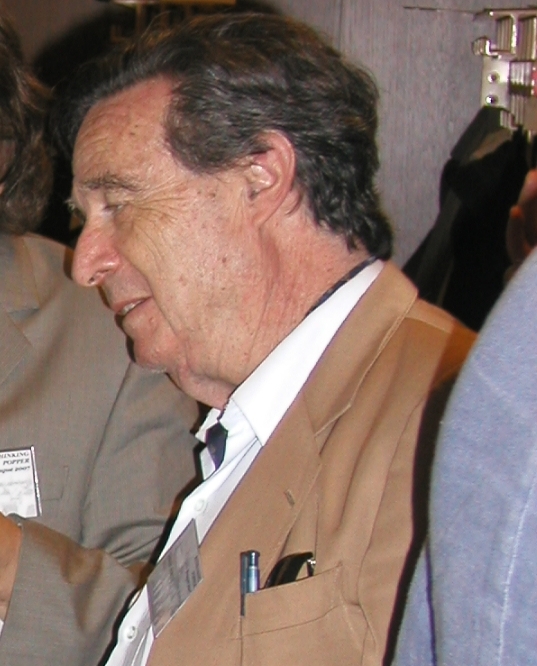
Joseph Agassi (/ˈæɡəsi/; Hebrew: יוסף אגסי; born Joseph Birnbaum; 7 May 1927 – 22 January 2023)[1] was an Israeli academic with contributions in logic, scientific method, and philosophy. He studied under Karl Popper and taught at the London School of Economics.

Key Information

Agassi taught in the Department of Philosophy of the University of Hong Kong from 1960 to 1963.[2] He later taught at the University of Illinois, Boston University, and York University in Canada. He had dual appointments in the last positions with Tel Aviv University.

Personal life and death

[edit]

Agassi was born into a Haredi family who lived in Jerusalem's Buchari neighborhood. In his youth studied in the Mercaz haRav yeshiva in Jerusalem. Later he left religious life.[citation needed]

He was married to Judith Buber AgassiMartin Buber's granddaughter – from 1949 until her death in 2018. Together they had two children, Tirzah, who died of cancer in March 2008, and Aaron. Agassi resided in Herzliya, Israel. Tirzah's name, when she was a child, was often used by Popper in his dictum "Write it for Tirzah!" to explain his view that everyone has the duty to write in a clearly and easily understandable language.[3] Agassi died on 22 January 2023, at the age of 95.

Philosophy

[edit]

Agassi's prime interest was in science, metaphysics, and politics. He took it that philosophy is nothing if not rationalist. For over fifty years he studied the rationality of science, metaphysics, and democratic politics.

An advocate of Popper's philosophy with variations, Agassi ignored many of the problems that concern some philosophers of science, chiefly that of theory choice. The problems of the philosophy of technology engaged him, including the problem of choosing scientific theories and ideas worthy of application and implementation.

Israeli politics

[edit]

Agassi had expressed criticism against the settler movement and advocated for Israel to "separate" from the worldwide Jewish community:

The flimsy excuse – the notion that Israel belongs to the Jewish people and not to the Israeli nation – is the very threat to its independence. It is therefore imperative that Israel should recognize its nation as separate and different from the Jewish people.[4]

He was close to Hillel Kook who advocated severely limiting the Right of Return, forming a Hebrew Nation and creation of a Constitution already in 1948. Agassi was very much influenced by these views.[citation needed]

Global politics

[edit]

Agassi had written widely on global politics and on the methodology to implement global politics. His methodology was consistently procedural, without having requests for systematic procedures. His demands from those who design global politics are minimalist: small methodological changes may lead to large-scale achievements.

Agassi also proposed to bring global problems to public agendas for discussions in different forums, in particular in workshops where discussions are held with an agreed-upon agenda: the agenda, said Agassi, should be discussed and set by the participants prior to the discussion.

Publications

[edit]

Books in English

[edit]
  • Towards an Historiography of Science, History and Theory, Beiheft 2, 1963; facsimile reprint, Middletown: Wesleyan University Press, 1967.
  • The Continuing Revolution: A History of Physics From The Greeks to Einstein, New York: McGraw Hill, 1968.
  • Faraday as a Natural Philosopher, Chicago, Chicago University Press, 1971.
  • Science in Flux, Boston Studies in the Philosophy of Science, Dordrecht, Reidel, 28, 1975.
  • (with Yehuda Fried) Paranoia: A Study in Diagnosis, Boston Studies in the Philosophy of Science, 50, 1976.
  • Towards a Rational Philosophical Anthropology, The Hague: Martinus Nijhoff, 1977.
  • Science and Society: Studies in the Sociology of Science, Boston Studies, 65, 1981.
  • (with Yehuda Fried) Psychiatry as Medicine, Dordrecht: Kluwer, 1983.
  • Technology: Philosophical and Social Aspects, Dordrecht: Kluwer, 1985.
  • The Gentle Art of Philosophical Polemics: Selected Reviews and Comments, LaSalle IL: Open Court, 1988.
  • (with Nathaniel Laor) Diagnosis: Philosophical and Medical Perspectives, Dordrecht: Kluwer, 1990.
  • The Siblinghood of Humanity: Introduction to Philosophy, Delmar NY: Caravan Press, 1990, 1991.
  • Radiation Theory and the Quantum Revolution, Basel: Birkhäuser, 1993.
  • A Philosopher's Apprentice: In Karl Popper's Workshop, Series in the Philosophy of Karl R. Popper and Critical Rationalism, Amsterdam and Atlanta GA: Editions Rodopi, 1993. Second edition, 2008. Contents
  • Liberal Nationalism for Israel: Towards an Israeli National Identity, Jerusalem and New York: Gefen. Translation from the Hebrew book of 1984.
  • Science and Culture, Boston Studies in the Philosophy of Science, 231, 2003.
  • (with I. C. Jarvie) A Critical Rationalist Aesthetics, Series in the Philosophy of Karl R. Popper and Critical Rationalism, Amsterdam: Rodopi, 2008.
  • (with Abraham Meidan) Philosophy from a Skeptical Perspective, NY and Cambridge: Cambridge University Press, 2008.
  • Science and Its History: A Reassessment of the Historiography of Science, Boston Studies in the Philosophy of Science, 253, 2008. (This includes a corrected reprint of Towards an Historiography of Science, History and Theory)
  • The Philosophy of Practical Affairs: An Introduction, Lexington Books, November 14, 2022.
  • (with Uri Weiss) Games to Play and Games not to Play, Studies in Systems, Decision and Control (SSDC, volume 469), Springer, Springer Nature, 2023.

Books in Hebrew

[edit]
  • Letters to My Sister Concerning Contemporary Philosophy, Omer: Sarah Batz, 1976 1977. New enlarged edition, Tel-Aviv, Yedioth Aharonoth Books and Chemed Books, 2000.
  • (with Dov Rappel) Philosophy of Education: A Philosophical Dialogue, Israeli Ministry of Defense, 1979.
  • Between Faith and Nationality: Towards an Israeli National Identity, Tel-Aviv: Papirus, Tel-Aviv University, 1984. Second Edition, Revised and enlarged, 1993. English translation, 1999.
  • (with Moshe Berent, and Judith Buber Agassi), Israeli National Awareness, Discussion Paper No. 11–88, 1988. Sapir Center for Development, Tel-Aviv University.
  • Albert Einstein: Unity and Diversity, Israeli Ministry of Defense, 1989, 1994, and 2000.
  • The Philosophy of Technology, Israeli Ministry of Defense, 1990.
  • J. A., Judith Buber Agassi and Moshe Berent, Who is an Israeli? Rehovot: Kivunim, 1991. A variant of the Discussion Paper.
  • The History of Modern Philosophy from Bacon to Kant (1600–1800): An Introduction. Tel-Aviv: Ramot, Tel-Aviv University, 1993 and reprints.
  • An Introduction to Modern Philosophy, Israeli Ministry of Defense, 1996.
  • (With Yeshayahu Leibowitz) Chemi Ben-Noon, editor, Conversations Concerning the Philosophy of Science, Israeli Ministry of Defense, 1996.
  • (With Yeshayahu Leibowitz) Chemi Ben-Noon, editor, The Limits of Reason: Thought, Science and Religion; Yeshayahu Leibowitz and Joseph Agassi in Conversation, Jerusalem: Keter, 1997.
  • (with Abraham Meidan) Beg to Differ: The Logic of Disputes and Argumentation, Springer, 2016

Books in Italian

[edit]
  • Scienza, metodolgia e societá, edited by Michael Segre, Roma: Luiss Edizioni, 2000. 186 pp.
  • Michael Segre, Accademia e società, Conversazioni con Joseph Agassi, Rubbatino Editore, 2004, 129 pages.
  • Joseph Agassi, La filosofia e l'individuo – Come un filosofo della scienza vede la vita, Di Renzo Editore, Roma, 2005

Books edited

[edit]
  • Psychiatric Diagnosis: Proceedings of an International Interdisciplinary Interschool Symposium, Bielefeld Universität, 1978, Philadelphia: Balaban Intl. Science Service, 1981. 184 pp.
  • (With Robert S. Cohen), Scientific Philosophy Today: Essays in Honor of Mario Bunge, Boston Studies in the Philosophy of Science, 67, 1982. 503 pp.
  • (With I. C. Jarvie), Rationality: The Critical View, Dordrecht: Kluwer, 1987. xi+462 pp.
  • Hebrew Translation of Karl Popper's The Open Society and Its Enemies, Jerusalem, Shalem Publications, forthcoming, 2005.

Online papers

[edit]
  • A Note on Smith's Term "Naturalism" [1]
  • Anthropomorphism in Science [2]
  • Brainwashing [3]
  • Bye Bye Weber [4]
  • Can Adults Become Genuinely Bilingual? [5]
  • Causality and Medicine [6]
  • Deception: A View from the Rationalist Perspective [7]
  • Deconstructing Post-Modernism: Gellner and Crocodile Dundee [8]
  • Dissertation without tears [9]
  • Halakha and Agada [10]
  • Israeli Judaism [11]
  • Jacob Katz on Jewish Social History [12]
  • Karl Popper [13]
  • Leibniz's Place in the History of Physics [14]
  • Let a Thousand Flowers Bloom: Popper's Popular Critics [15]
  • Liberal Forensic Medicine [16]
  • Liberal Nationalism for Israel [17]
  • Liberal Nationalism (Chapters from the book in Russian) [18]
  • Movies Seen Many Times [19]
  • Neo-Classical Economics as 18th Century Theory of Man [20]
  • One Palestine [21][permanent dead link]
  • On the Limits of Scientific Explanation: Hempel and Evans-Pritchard [22]
  • On the open grave of Hillel Kook [23]
  • Prescriptions for Responsible Psychiatry [24]
  • Quanta in Context [25]
  • Rights and Reason [26]
  • Science Education Without Pressure [27]
  • Scientific Literacy [28]
  • Summary of AFOS Workshop, 1994 [29]
  • Tautology and Testability in Economics [30]
  • Technology: Philosophical and Social Aspects [31] The Gro
  • Brundtland Report (1987) Or, The Logic of Awesome Decisions [32]
  • The Heuristic Bent [33]
  • The Interface of Philosophy and Physics [34]
  • The Ivory Tower and the Seat of Power [35]
  • The Lakatosian Revolution [36]
  • The Last Refuge of the Scoundrel [37]
  • The Novelty of Chomsky's Theories [38]
  • Theoretical Bias in Evidence: a Historical Sketch [39]
  • The Philosophy of Science Today [40]
  • The Role of the Philosopher among the Scientists: Nuisance or Necessity? [41]
  • The Theory and Practice of the Welfare State [42]
  • To Save Verisimilitude [43]
  • Training to Survive the Hazard Called Education [44]
  • Variations on the Liar's Paradox [45]
  • Verisimilitude [46]
  • Who Discovered Boyle's Law? [47]

References

[edit]
[edit]
Revisions and contributorsEdit on WikipediaRead on Wikipedia
from Grokipedia
Joseph Agassi (7 May 1927 – 22 January 2023) was an Israeli philosopher of renowned for extending beyond the framework of his mentor , emphasizing open critical debate in scientific methodology and historiography over dogmatic or . Born in to a with a strict religious upbringing that he later rejected, Agassi pursued studies in physics and , culminating in his intellectual formation under Popper's guidance in during the , an experience detailed in his autobiographical work A Philosopher's Apprentice. As professor emeritus at and visiting positions at institutions like , he authored over 500 publications spanning metaphysics, , , and the demarcation of from technology, advocating for the role of metaphysics in facilitating empirical progress without dominating scientific inquiry. Agassi's defining contributions include his critical historiography of science, which challenged prevailing narratives by prioritizing evidence-based scrutiny of research traditions, and his application of rationalist principles to social sciences and humanities, as honored in dedicated essay volumes that underscore his influence as a provocative thinker unafraid to critique institutional orthodoxies. His work, marked by a commitment to fallibilism and the rejection of authority-driven consensus, continues to inspire debates on the interplay between theory, experiment, and societal progress, particularly in countering uncritical reliance on empirical corroboration alone.

Early Life and Education

Birth and Upbringing

Joseph Agassi was born on May 7, 1927, in , then part of , to parents from a modest, religiously observant family. The family resided in a culturally rich but economically poor environment typical of 's communities during the British Mandate era, where diverse ethnic groups—, , and others—coexisted amid rising intercommunal frictions leading up to 's independence. This setting exposed young Agassi to the practical realities of national aspirations and conflicts in pre-state , though specific personal anecdotes from his childhood remain limited in documented accounts. Raised in a strict Haredi (ultra-Orthodox) household, Agassi received an early education steeped in traditional Jewish , attending a where he engaged with Talmudic scholarship and . By age 15, however, he rejected , marking an early shift toward intellectual independence and skepticism of dogmatic authority—a departure that contrasted sharply with his upbringing's emphasis on piety and textual orthodoxy. This formative break influenced his later advocacy for critical inquiry over unquestioned tradition, though it did not erase the cultural imprint of his roots.

Academic Training

Agassi pursued undergraduate and graduate studies in physics at the from 1946 to 1951, earning a degree that emphasized rigorous empirical methods and experimental validation central to the discipline. This training under the department led by Giulio Racah equipped him with a foundational understanding of scientific practice grounded in and , contrasting with later philosophical inquiries into the logic underlying such . Subsequently, Agassi shifted to , enrolling at the London School of Economics (part of the ) where he served as research assistant to from 1953 to 1956 and completed his PhD in 1956 under Popper's supervision. His doctoral work focused on the , introducing him to Popper's falsificationism, which posits that scientific theories gain credibility through attempts at refutation rather than confirmation via . This exposure prompted Agassi's initial critiques of , arguing logically that generalizations from particulars cannot justify universal laws without assuming unproven premises, thus highlighting the asymmetry between verification and falsification in scientific . These formative experiences in physics and shaped Agassi's approach to , blending empirical discipline with critical scrutiny of foundational assumptions in knowledge production.

Academic Career

Teaching Positions and Affiliations

Agassi began his academic teaching career with a lectureship at the London School of Economics from September 1957 to August 1960. Following this, he held positions including teaching roles at and the University of , reflecting his early international mobility outside dominant academic centers. From 1971 to 1996, Agassi served as Professor of in the Department of Philosophy at . He simultaneously held a professorship in philosophy at in from 1982 to 1997, maintaining dual appointments that allowed him to engage North American and Israeli scholarly communities. These roles positioned him to advance critical rationalist perspectives amid institutional environments often resistant to non-conformist methodologies, emphasizing empirical scrutiny over consensus-driven paradigms. After retiring in 1997, Agassi was granted emeritus status at both and , enabling ongoing involvement in academic discourse. He also affiliated with the University of Chieti-Pescara in as a , supporting interdisciplinary explorations in and societal implications. This post-retirement phase underscored his commitment to truth-oriented inquiry, bypassing mainstream academic gatekeeping to influence broader intellectual networks.

Key Collaborations and Influences

Joseph Agassi's intellectual development was profoundly shaped by his mentorship under at the London School of Economics, where he completed his PhD dissertation in 1956 under Popper's supervision, focusing on interpretation in physics as a in scientific . This period, detailed in Agassi's autobiographical account A Philosopher's Apprentice: In Karl Popper's Workshop, involved close collaboration in Popper's seminars, fostering Agassi's adoption of while prompting early independent critiques of aspects of Popper's framework, such as the empirical basis of . Their relationship, initially formative, diverged over time, culminating in Popper severing ties with Agassi in 1972 amid philosophical disagreements, though Agassi acknowledged a lasting debt to Popper's emphasis on bold conjecture and refutation. Agassi engaged critically with Imre Lakatos's methodology of scientific research programmes, adapting its focus on progressive and degenerating shifts within theoretical frameworks to stress the role of competing schools of thought in scientific progress, rather than isolated falsification events. While Lakatos portrayed research programmes as internally coherent units resistant to immediate refutation, Agassi viewed Lakatos's approach as overly conciliatory toward dogmatic elements, arguing instead for open rivalry among alternative paradigms to expose weaknesses more effectively; this adaptation informed Agassi's broader , prioritizing institutional pluralism over Lakatos's historicist reconstructions. Agassi's interactions with Lakatos, including perceptions of Lakatos as domineering within Popper's circle, underscored his insistence on criticism as a tool for intellectual independence rather than allegiance to any single programme. Agassi's exchanges with highlighted shared commitments to pluralism in scientific inquiry, though Agassi critiqued Feyerabend's "" as undermining rational standards in favor of unbridled proliferation of theories. Their correspondence and mutual reflections, evolving from Feyerabend's early admiration for Popperian students like Agassi to later divergences, reinforced Agassi's advocacy for of diverse views alongside rigorous , positioning pluralism not as relativistic tolerance but as a precondition for effective in science. This interaction catalyzed Agassi's defense of rational pluralism against monistic views, emphasizing that scientific advance requires sustaining rival traditions to prevent stagnation from consensus.

Philosophical Contributions

Development of Critical Rationalism

Agassi extended Karl Popper's by advocating the preference for bold conjectures subjected to severe tests while incorporating tolerance for competing research traditions as essential to scientific progress. This development addressed limitations in Popper's framework, which Agassi viewed as overly focused on individual refutations without sufficiently accounting for the institutional dynamics of sustained disagreement in scientific communities. Historical analysis of scientific disputes, such as those in physics and , supported Agassi's position that often emerges from parallel lines of inquiry rather than convergence toward a single theory. Central to Agassi's was Popper's implicit assumption of eventual scientific , which he argued idealized and ignored of enduring factionalism. Drawing on first-principles examination of institutional histories, Agassi proposed pluralism as a structural requirement, where multiple schools or paradigms coexist under conditions of open to prevent stagnation and . This institutional pluralism, evidenced in cases like the prolonged debates over quantum interpretations persisting since the , ensures that refutations challenge not only theories but also the frameworks sustaining them. Agassi applied these ideas to metaphysics, positing that rationality originates in untestable foundational assumptions—such as commitments to realism or mechanism—that anchor intellectual traditions yet demand perpetual subjection to critical . Unlike dogmatic defenses, this approach treats metaphysical roots as provisional, open to replacement if they hinder , as illustrated by shifts from Aristotelian to Newtonian . Such ongoing , Agassi contended, mirrors scientific practice and avoids the of uncritical adherence, fostering a broader applicable beyond empirical domains.

Philosophy of Science and Historiography

Agassi's approach to the centered on a critical that portrayed scientific progress as emerging from sustained rivalries between competing schools of thought, rather than from myths of harmonious consensus or linear accumulation of facts. In Towards an Historiography of Science (1963), he dismantled inductivist narratives, which depict as building theories from neutral observations, and conventionalist accounts, which treat theoretical choices as mere linguistic conventions without deeper commitment. Agassi argued instead that enduring research programs thrive through and bold conjectures, clashing via and empirical tests, with metaphysics providing the foundational assumptions that differentiate schools. Central to Agassi's rejection of Whig —prevalent in many accounts that retroactively frame past discoveries as inevitable precursors to modern truths—was the insistence on examining actual historical debates without presentist bias. He emphasized external influences, including , institutional structures, and metaphysical preferences, as causal elements in resolving controversies, rather than attributing shifts solely to evidential superiority or abstract . changes, in this view, result from pressures exerted by professional establishments and broader cultural contexts, which can delay or accelerate the decline of dominant schools amid accumulating anomalies. Agassi grounded these ideas in empirical historiography, drawing on archival evidence to analyze specific rivalries, such as those in 19th-century physics over , where Faraday's field theories competed against action-at-a-distance models amid institutional alliances and metaphysical divides between continuous versus discrete conceptions of . This method treats scientific archives not as records of triumphant verification but as traces of error-prone yet improvable debates, enabling causal realism in explanations of progress: institutional inertia often sustains flawed paradigms until rival schools exploit refutations under favorable social conditions.

Critiques of Inductivism and Mainstream Views

Agassi's refutation of inductivism centered on David Hume's , which demonstrates the lack of logical justification for generalizing from observed particulars to universal laws, rendering inductivist methodology untenable. In his 1963 paper "Empiricism and ," he endorsed Hume's critique unequivocally, arguing that 's insistence on deriving theories solely from accumulating facts ignores refutations and fosters an irrational conservatism by privileging entrenched views over bold conjectures. This conservatism manifests historically in inductivist portrayals of scientific progress as uninterrupted ascent from data to generality, disregarding episodes like the refutation of , which demand explanatory shifts rather than mere data aggregation. Agassi extended this analysis to mainstream philosophical trends, dismissing Wittgensteinian quietism—exemplified in the (1953)—as an evasion that therapeutically dissolves problems without advancing causal understanding or rational debate. He contended that Wittgenstein's approach, by deeming traditional philosophical questions meaningless or resolvable through language-game clarifications, halts intellectual progress and precludes improvements in the philosophy of life, substituting analysis for bold criticism. Similarly, Agassi targeted postmodern for promoting anti-intellectual that erodes objective standards of inquiry, as seen in its detachment of judgment from universal rationality, thereby undermining the critical evaluation essential to science. In exposing academic tribalism, Agassi highlighted how mainstream philosophy often elevates consensus and institutional loyalty over rigorous criticism, evident in fields like the philosophy of mind, where materialist paradigms marginalize dualist alternatives despite unresolved logical challenges to , and in , where inductivist econometric modeling prevails amid critiques of its Humean flaws in predictive . This , he argued in works on academic pathologies, perpetuates dogmatism by rewarding conformity within schools of thought—such as inductivism's historical dominance—while sidelining dissenting evidence and innovative . Historical counterevidence, like the paradigm shifts in physics from Newtonian to relativistic frameworks, underscores the flaws in such consensus-driven approaches, which Agassi traced to inductivism's lingering influence post-Hume.

Rationality, Psychiatry, and Social Philosophy

Agassi extended to by portraying mental disorders as manifestations of impaired yet partial , where individuals aspire to rational action but falter due to illness or environmental factors, rather than absolute . He critiqued Freudian for emphasizing —revealing 's psychological dimensions—while rendering its core claims unfalsifiable, thereby insulating them from empirical refutation and perpetuating dogmatic interpretations over testable alternatives. In his 1976 collaboration with Yehuda Fried, Paranoia: A Study in Diagnosis, Agassi addressed paradoxes in diagnoses, such as the logical coherence of paranoiac delusions amid evident illness, by invoking institutional : social frameworks shape , rendering paranoiacs defective not through innate psychological flaws alone but via institutional dependencies that demand reform for greater patient agency. This framework rejects monistic reductions like or extremes, advocating institutional changes to prioritize falsifiable diagnostics and over entrenched therapeutic orthodoxies sustained by professional inertia rather than evidential support. Agassi's social philosophy applied similar rationality standards to human behavior, conceptualizing traditions and institutions as evolving conjectures open to criticism, where individual agency operates within but is not subsumed by collective structures. He critiqued collectivist accounts for overemphasizing group determinism at the expense of personal rational choice, instead favoring institutional individualism to explain social persistence—such as dogmatic practices—as outcomes of unexamined conventions rather than inherent societal logic, urging ongoing refutation to enhance adaptive rationality. Empirical illustrations, like paranoia case analyses, demonstrate how institutional norms entrench ineffective therapies despite contradictory outcomes, underscoring the need for critical openness over inertial adherence.

Political Views

Israeli Politics and Nationalism

Joseph Agassi advocated a form of liberal nationalism for , positing it as compatible with through an emphasis on rooted in open societal debate and institutional reform, rather than ethnic or religious exclusivity. In his 1999 book Liberal Nationalism for Israel: Towards an Israeli National Identity, Agassi argued that Israeli statecraft should foster a civic identity aligned with Western liberal-democratic principles, including separation of and state to enable rational policy-making and national cohesion. This framework diverged from his mentor Karl Popper's staunch opposition to nationalism, which Agassi critiqued as overly dismissive of legitimate aspirations for cultural and political in historically oppressed groups. Agassi leveled specific criticisms at the post-1967 settler movement and the conflation of religious-ethnic priorities with state policy, contending that such developments eroded Israel's modern civic rationality by prioritizing irredentist claims over pragmatic security and democratic governance. He viewed the expansion of settlements in the as a deviation from liberal nationalism's core tenets, fostering dependency on messianic ideologies that hindered open debate and long-term sovereignty. This stance reflected his broader insistence that Israeli identity must evolve beyond traditional Jewish particularism to embrace pluralistic, debate-driven , avoiding the pitfalls of identity-based excesses that could undermine the state's legitimacy. Central to Agassi's vision was the advocacy for Israel's separation from undue influences of the global , prioritizing national sovereignty through historical analysis of efforts from the state's founding in onward. He argued that excessive reliance on diaspora funding and ideological pressures—such as those promoting uncritical support for —compromised Israel's ability to pursue independent, rational policies tailored to its geopolitical realities. By insulating Israeli decision-making from external communal loyalties, Agassi believed the state could better cultivate a unified grounded in liberal principles, enhancing resilience against both internal divisions and international scrutiny.

Global Politics and Criticisms of Internationalism

Agassi advocated pragmatic realism in , emphasizing the primacy of national interests over supranational ideals that overlook empirical realities of human allegiance. Diverging from Karl Popper's trenchant critique of as tribalistic, Agassi developed a theory of liberal , positing it as compatible with open societies and essential for civic cohesion in democracies. He argued that anti-nationalist ideologies, including cosmopolitan variants, fail to account for persistent tribal loyalties observed in historical conflicts, such as Cold War proxy struggles where ideological internationalism yielded to strategic national calculations, and post-colonial state fragilities where imposed unity ignored ethnic divisions, leading to civil wars in nations like (1967–1970) and (1955–1972). International institutions like the , in Agassi's view, often promote pseudo-consensus mechanisms that mirror inductivist errors in science—seeking broad agreement without sufficient critical scrutiny, thereby impeding effective . In his analysis, such bodies prioritize gradualist diplomacy over bold, realistic interventions, resulting in "a whimper" of inaction rather than "a bang" of resolute action against threats like proliferation or . This extended to utopian , which he saw as detached from causal realities of , evidenced by the UN's limited success in enforcing resolutions during the era (1945–1991), where veto powers preserved national vetoes over collective will. Agassi critiqued multiculturalism's erosion of cultural traditions through policies that prioritize diversity over assimilation, citing failures in causal integration where empirical data show persistent parallel societies rather than cohesive nationals. In works examining across cultures, he challenged the relativist underpinnings of , arguing that differing judgments of do not entail incommensurability but demand critical rationalist standards to avoid dogmatic fragmentation. This stance aligned with his broader defense of national frameworks against globalist dilutions, as seen in post-colonial experiments where forced internationalist models exacerbated tribal fractures, contributing to over 100 ethnic conflicts since 1945.

Major Works and Publications

Books and Monographs

Agassi's inaugural monograph, Towards an Historiography of Science (1963), advanced a critical approach to the by rejecting inductivist narratives and emphasizing the role of research programs and external factors in scientific progress, thereby laying foundational critiques of mainstream . Published by Mouton as part of the History and Theory series, it argued for viewing scientific revolutions through the lens of bold conjectures and refutations rather than cumulative induction, influencing subsequent debates on scientific . In Faraday as a Natural Philosopher (1971), Agassi examined Michael Faraday's work to illustrate the interplay between metaphysics and empirical inquiry, portraying Faraday's research as guided by speculative hypotheses rather than strict , thus exemplifying Agassi's broader anti-inductivist stance in . This work, published by the , highlighted how untestable assumptions underpin successful scientific traditions, challenging the positivist dismissal of metaphysics. Science in Flux (1975), a comprehensive volume in the Boston Studies in the Philosophy of Science series by D. Reidel Publishing, synthesized Agassi's views on the dynamic nature of scientific knowledge, critiquing inductivism's static view of theory confirmation and advocating for Popperian falsificationism extended to social and historical contexts. Spanning over 550 pages, it detailed how science evolves through controversy and institutional factors, underscoring the flux in paradigms without Kuhnian relativism. Later English monographs, such as Towards a Rational (1977), explored through critical rationalist principles, rejecting behaviorist and rationalist extremes in favor of a dualist yet empirically grounded view of rationality and tradition. Published by Martinus Nijhoff, it applied first-principles reasoning to , arguing for the integration of reason and culture in understanding . Science and Its History (2008), issued by Springer as volume 253 in the same series, reassessed Agassi's earlier , incorporating decades of debate to defend objective standards in evaluating scientific episodes amid inductivist biases in academia. Agassi authored Hebrew monographs to engage Israeli audiences on rationality and politics, including Letters to My Sister Concerning Contemporary Philosophy (1976–1977, Omer: Sarah Batz), which critiqued modern philosophical trends through accessible dialogues emphasizing critical scrutiny over dogmatic acceptance. Works like Ben Dat u-Le'om addressed intersections of religion, nationhood, and rational governance, promoting liberal nationalism grounded in empirical traditions rather than ethnic essentialism. These publications, alongside Italian translations of select English texts such as excerpts from his science critiques, extended his anti-inductivist and rationalist arguments to non-academic spheres, fostering public discourse on evidence-based policy. Posthumous compilations, including Liberal Nationalism for Israel (2022), distilled Agassi's into arguments for a civic identity balancing universal with particular traditions, drawing on his lifelong empirical analyses of nationalism's causal roles in stability. These later editions underscore the ongoing applicability of his critiques, particularly in countering relativist trends in and .

Edited Volumes and Articles

Agassi co-edited Rationality: The Critical View with I. C. Jarvie in 1987, compiling essays that critically examined rationality from a Popperian perspective, including debates on the limits of instrumental and value rationality in social sciences. This volume fostered interdisciplinary dialogue by including contributions from philosophers and social scientists challenging mainstream inductivist assumptions. He also edited Science and Culture in 2003 as part of the Boston Studies in the Philosophy of Science series, addressing the interplay between scientific progress and cultural contexts, with chapters critiquing and . The collection emphasized Agassi's view that thrives through open cultural integration rather than isolation, drawing on historical case studies to highlight institutional influences on knowledge production. In addition, Agassi contributed to edited works on key figures in , such as co-editing a volume on Paul Feyerabend's Physics and Philosophy papers, which engaged critics of and promoted polemical exchanges. These efforts underscored his commitment to curating debates that exposed weaknesses in conventional historiographies. Agassi published prolifically in journals on , distinguishing it from pure science by arguing that technological choices involve social values and limited rather than mere corroboration. For example, in "Technology: Philosophical and Social Aspects" (1976), he analyzed how technological overlooks institutional barriers, advocating for critical assessment over naive . His article "The Limited Rationality of Technology" (2019) further critiqued over-reliance on technological solutions in policy, highlighting risks of ignoring metaphysical assumptions. On and , Agassi's articles challenged environmentalist claims rooted in , arguing that policy debates require separating empirical refutation from ideological . Post-retirement, he contributed online essays and interviews on , critiquing institutional biases in and funding as threats to critical inquiry. These periodical outputs reinforced his role in sparking ongoing controversies within communities.

Legacy and Controversies

Influence on Subsequent Thinkers

Agassi's emphasis on , extending Karl Popper's framework, profoundly shaped subsequent philosophers within that tradition, including David , who advanced pancritical rationalism as a comprehensive rejecting justificationism. Miller's defenses of non-justificatory rationality drew directly from Agassi's critiques of and , integrating them into broader arguments against dogmatic elements in . In of , Agassi's for examining rival intellectual traditions—contrasting inductivist orthodoxy with alternative metaphysical commitments—influenced scholars to prioritize pluralistic narratives over monolithic reconstructions, fostering a view of scientific progress as contention between competing paradigms rather than linear accumulation. This approach resonated in works analyzing the , where Agassi's insistence on institutional and cultural factors in theory choice informed extensions into , emphasizing policy implications for open academic debate. Empirical measures of Agassi's reach include over 8,700 citations across his oeuvre as tracked by Google Scholar, reflecting sustained engagement in philosophy of science and social theory. Obituaries following his death on January 22, 2023, highlighted his role in challenging institutional conformity within academia, crediting him with promoting a robust realism that prioritized empirical scrutiny over consensus-driven narratives, thereby inspiring thinkers to resist prevailing orthodoxies in favor of adversarial inquiry.

Debates and Criticisms of Agassi's Ideas

Agassi's advocacy for pluralism in science, which posits that maintaining diverse research traditions and metaphysical views promotes through sustained criticism, has sparked debates among Popperians who prioritize rigorous falsification as the demarcation criterion for scientific theories. Critics contended that Agassi's pluralism risks diluting methodological standards by tolerating potentially unfalsifiable programs, as seen in exchanges where his flexible approach to Popper's empirical basis—arguing it overly restricts basic statements—was challenged for undermining decisive refutations. Agassi rebutted by emphasizing that pluralism institutionalizes criticism rather than suspending it, countering charges of laxity with the view that uniform falsificationism historically stifled , as evidenced in pre-Popper rationalist traditions. These tensions surfaced prominently at the 1975 Kronberg conference, where Agassi contributed to efforts bridging and the more relativistic stances of and , advocating a "middle ground" that preserved Popperian openness while incorporating pluralistic tolerance. Opponents, including some strict Popperians, argued this compromise conceded too much to , potentially excusing paradigm shifts without sufficient empirical confrontation; Agassi responded that such pluralism aligns with Popper's by enabling broader error-detection across competing frameworks, unresolved as sociological turns in marginalized rational reconstructions like his. Agassi's political nationalism, particularly his defense of civic nationhood as essential for democratic rationality, drew criticism from universalist rationalists who viewed it as parochial, conflicting with the impartiality demanded by . Detractors, often from left-leaning academic circles, charged inconsistency, claiming prioritization of over global echoed the very traditionalisms Agassi critiqued in science; he countered via historical , asserting that nations provide the minimal institutional framework for open and error-correction, without which abstract rationalism devolves into elitist abstraction. Accusations of contrarianism have targeted Agassi's relentless challenges to inductivism, consensus-driven science, and mainstream historiography, portraying his style as obstructive rather than constructive. In rebuttal, Agassi highlighted predictive validations, such as his early warnings of scientific stagnation from eroding pluralism and criticism within societies, which anticipated observed declines in institutional vitality by the late 20th century. These disputes remain open, with Agassi insisting that defensiveness to critique betrays rationalism, urging responses grounded in evidence over authority.

References

Add your contribution
Related Hubs
User Avatar
No comments yet.