
Recent from talks
Joseph Francis Shea
Knowledge base stats:
Talk channels stats:
Members stats:
Joseph Francis Shea
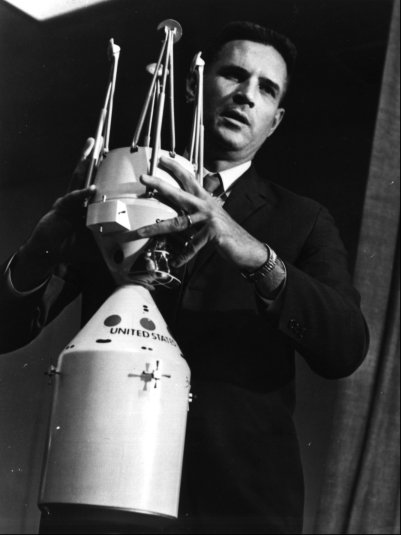
Joseph Francis Shea (September 5, 1925 – February 14, 1999) was an American aerospace engineer and NASA manager. Born in the Bronx borough of New York City, he was educated at the University of Michigan, receiving a Ph.D. in Engineering Mechanics in 1955. After working for Bell Labs on the guidance systems of the Titan I and Titan II intercontinental ballistic missiles, he was hired by NASA in 1961. As deputy director of NASA's Office of Manned Space Flight, and later as head of the Apollo Spacecraft Program Office, Shea played a key role in shaping the course of the Apollo program, helping to lead NASA to the decision in favor of lunar orbit rendezvous and supporting "all up" testing of the Saturn V rocket. While sometimes causing controversy within the agency, Shea was remembered by his former colleague George Mueller as "one of the greatest systems engineers of our time".
Deeply involved in the investigation of the 1967 Apollo 1 fire, Shea suffered from stress. He was moved to an alternative position in Washington and left NASA shortly afterwards. From 1968 until 1990, he worked as a senior manager at Raytheon in Lexington, Massachusetts, and thereafter became an adjunct professor of aeronautics and astronautics at MIT. While Shea served as a consultant for NASA on the redesign of the International Space Station in 1993, he was forced to resign from the position due to health issues. He died in 1999.
Shea was born September 5, 1925, and grew up in the Bronx, the eldest son in a working-class Irish Catholic family. His father worked as a mechanic on the New York City Subway. As a child, Shea had no interest in engineering; he was a good runner and hoped to become a professional athlete. He attended a Catholic high school and graduated when he was only sixteen. On graduating in 1943, Shea enlisted in the U.S. Navy and enrolled in a program that would put him through college. He began his studies at Dartmouth College, later moving to MIT and finally to the University of Michigan, where he would remain until he earned his doctorate in 1955. In 1946, he was commissioned as an ensign in the Navy and received a Bachelor of Science degree in Mathematics. Shea went on to earn a MSc (1950) and a Ph.D. (1955) in Engineering Mechanics from the University of Michigan. While obtaining his doctorate, Shea found the time to teach at the university and to hold down a job at Bell Labs.
After receiving his doctorate, Shea took a position at Bell Labs in Whippany, New Jersey. There he first worked as systems engineer on the hybrid radio-inertial guidance system of the Titan I intercontinental ballistic missile (ICBM), and then as the development and program manager on the inertial guidance system of the Titan II ICBM. Shea's specialty was systems engineering, a new type of engineering developed in the 1950s that focused on the management and integration of large-scale projects, turning the work of engineers and contractors into one functioning whole. He played a significant role in the Titan I project; as George Mueller writes, "[H]e contributed a considerable amount of engineering innovation and project management skill and was directly responsible for the successful development of this pioneering guidance system." In addition to Shea's technical abilities, it quickly became obvious he was also an excellent manager of people. Known for his quick intellect, he also endeared himself to his subordinates through small eccentricities such as his fondness for bad puns and his habit of wearing red socks to important meetings.
During the critical days of the Titan project, Shea moved into the plant, sleeping on a cot in his office so as to be available at all hours if he was needed. Having brought in the project on time and on budget, Shea established a reputation in the aerospace community. In 1961, he was offered and accepted a position with Space Technology Laboratories, a division of TRW Inc., where he continued to work on ballistic missile systems.
In December 1961, NASA invited Shea to interview for the position of deputy director of the Office of Manned Space Flight (OMSF). D. Brainerd Holmes, Director of the OMSF, had been searching for a deputy who could offer expertise in systems engineering, someone with the technical abilities to supervise the Apollo program as a whole. Shea was recommended by one of Holmes' advisors, who had worked with him at Bell Labs. Although Shea had worked at Space Technology Labs for less than a year, he was captivated by the challenge offered by the NASA position. "I could see they needed good people in the space program," he later said, "and I was kind of cocky in those days."
When Shea was hired by NASA, President John F. Kennedy's commitment to landing men on the Moon was still only seven months old, and many of the major decisions that shaped the Apollo program were yet to be made. Foremost among these was the mode NASA would use to land on the Moon. When Shea first began to consider the issue in 1962, most NASA engineers and managers—including Wernher von Braun, the director of the Marshall Space Flight Center—favored either a direct ascent approach, where the Apollo spacecraft would land on the Moon and return to the Earth as one unit, or Earth orbit rendezvous, where the spacecraft would be assembled while still in orbit around the Earth. However, dissenters such as John Houbolt, a Langley engineer, favored an approach then considered to be more risky: lunar orbit rendezvous, in which two spacecraft would be used. A command/service module (CSM) would remain in orbit around the Moon, while a lunar module would land on the Moon and return to dock with the CSM in lunar orbit, then be discarded.
In November 1961, John Houbolt had sent a paper advocating lunar orbit rendezvous (LOR) to Robert Seamans, the deputy administrator of NASA. As Shea remembered, "Seamans gave a copy of Houbolt's letter to Brainerd Holmes [the director of OMSF]. Holmes put the letter on my desk and said: Figure it out." Shea became involved in the lunar orbit rendezvous decision as a result of this letter. While he began with a mild preference for earth orbit rendezvous, Shea "prided himself", according to space historians Charles Murray and Catherine Cox, "on going wherever the data took him". In this case, the data took him to NASA's Langley Research Center in Hampton, Virginia, where he met with John Houbolt and with the Space Task Group, and became convinced LOR was an option worth considering.
Hub AI
Joseph Francis Shea AI simulator
(@Joseph Francis Shea_simulator)
Joseph Francis Shea
Joseph Francis Shea (September 5, 1925 – February 14, 1999) was an American aerospace engineer and NASA manager. Born in the Bronx borough of New York City, he was educated at the University of Michigan, receiving a Ph.D. in Engineering Mechanics in 1955. After working for Bell Labs on the guidance systems of the Titan I and Titan II intercontinental ballistic missiles, he was hired by NASA in 1961. As deputy director of NASA's Office of Manned Space Flight, and later as head of the Apollo Spacecraft Program Office, Shea played a key role in shaping the course of the Apollo program, helping to lead NASA to the decision in favor of lunar orbit rendezvous and supporting "all up" testing of the Saturn V rocket. While sometimes causing controversy within the agency, Shea was remembered by his former colleague George Mueller as "one of the greatest systems engineers of our time".
Deeply involved in the investigation of the 1967 Apollo 1 fire, Shea suffered from stress. He was moved to an alternative position in Washington and left NASA shortly afterwards. From 1968 until 1990, he worked as a senior manager at Raytheon in Lexington, Massachusetts, and thereafter became an adjunct professor of aeronautics and astronautics at MIT. While Shea served as a consultant for NASA on the redesign of the International Space Station in 1993, he was forced to resign from the position due to health issues. He died in 1999.
Shea was born September 5, 1925, and grew up in the Bronx, the eldest son in a working-class Irish Catholic family. His father worked as a mechanic on the New York City Subway. As a child, Shea had no interest in engineering; he was a good runner and hoped to become a professional athlete. He attended a Catholic high school and graduated when he was only sixteen. On graduating in 1943, Shea enlisted in the U.S. Navy and enrolled in a program that would put him through college. He began his studies at Dartmouth College, later moving to MIT and finally to the University of Michigan, where he would remain until he earned his doctorate in 1955. In 1946, he was commissioned as an ensign in the Navy and received a Bachelor of Science degree in Mathematics. Shea went on to earn a MSc (1950) and a Ph.D. (1955) in Engineering Mechanics from the University of Michigan. While obtaining his doctorate, Shea found the time to teach at the university and to hold down a job at Bell Labs.
After receiving his doctorate, Shea took a position at Bell Labs in Whippany, New Jersey. There he first worked as systems engineer on the hybrid radio-inertial guidance system of the Titan I intercontinental ballistic missile (ICBM), and then as the development and program manager on the inertial guidance system of the Titan II ICBM. Shea's specialty was systems engineering, a new type of engineering developed in the 1950s that focused on the management and integration of large-scale projects, turning the work of engineers and contractors into one functioning whole. He played a significant role in the Titan I project; as George Mueller writes, "[H]e contributed a considerable amount of engineering innovation and project management skill and was directly responsible for the successful development of this pioneering guidance system." In addition to Shea's technical abilities, it quickly became obvious he was also an excellent manager of people. Known for his quick intellect, he also endeared himself to his subordinates through small eccentricities such as his fondness for bad puns and his habit of wearing red socks to important meetings.
During the critical days of the Titan project, Shea moved into the plant, sleeping on a cot in his office so as to be available at all hours if he was needed. Having brought in the project on time and on budget, Shea established a reputation in the aerospace community. In 1961, he was offered and accepted a position with Space Technology Laboratories, a division of TRW Inc., where he continued to work on ballistic missile systems.
In December 1961, NASA invited Shea to interview for the position of deputy director of the Office of Manned Space Flight (OMSF). D. Brainerd Holmes, Director of the OMSF, had been searching for a deputy who could offer expertise in systems engineering, someone with the technical abilities to supervise the Apollo program as a whole. Shea was recommended by one of Holmes' advisors, who had worked with him at Bell Labs. Although Shea had worked at Space Technology Labs for less than a year, he was captivated by the challenge offered by the NASA position. "I could see they needed good people in the space program," he later said, "and I was kind of cocky in those days."
When Shea was hired by NASA, President John F. Kennedy's commitment to landing men on the Moon was still only seven months old, and many of the major decisions that shaped the Apollo program were yet to be made. Foremost among these was the mode NASA would use to land on the Moon. When Shea first began to consider the issue in 1962, most NASA engineers and managers—including Wernher von Braun, the director of the Marshall Space Flight Center—favored either a direct ascent approach, where the Apollo spacecraft would land on the Moon and return to the Earth as one unit, or Earth orbit rendezvous, where the spacecraft would be assembled while still in orbit around the Earth. However, dissenters such as John Houbolt, a Langley engineer, favored an approach then considered to be more risky: lunar orbit rendezvous, in which two spacecraft would be used. A command/service module (CSM) would remain in orbit around the Moon, while a lunar module would land on the Moon and return to dock with the CSM in lunar orbit, then be discarded.
In November 1961, John Houbolt had sent a paper advocating lunar orbit rendezvous (LOR) to Robert Seamans, the deputy administrator of NASA. As Shea remembered, "Seamans gave a copy of Houbolt's letter to Brainerd Holmes [the director of OMSF]. Holmes put the letter on my desk and said: Figure it out." Shea became involved in the lunar orbit rendezvous decision as a result of this letter. While he began with a mild preference for earth orbit rendezvous, Shea "prided himself", according to space historians Charles Murray and Catherine Cox, "on going wherever the data took him". In this case, the data took him to NASA's Langley Research Center in Hampton, Virginia, where he met with John Houbolt and with the Space Task Group, and became convinced LOR was an option worth considering.
Recent media