



Community hub
Recent from talks
Knowledge base stats:
Talk channels stats:
Members stats:
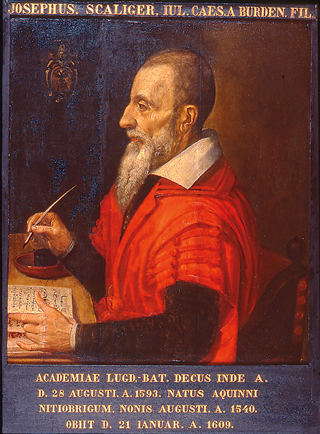
Joseph Justus Scaliger
Joseph Justus Scaliger (/ˈskælɪdʒər/; 5 August 1540 – 21 January 1609) was a Franco-Italian Calvinist religious leader and scholar, known for expanding the notion of classical history from Greek and Ancient Roman history to include Persian, Babylonian, Jewish and Ancient Egyptian history. He spent the last sixteen years of his life in the Netherlands.
In 1540, Scaliger was born in Agen, France, to Italian scholar and physician Julius Caesar Scaliger and his wife, Andiette de Roques Lobejac. His only formal education was three years of study at the College of Guienne in Bordeaux, which ended in 1555 due to an outbreak of the bubonic plague. Until his death in 1558, Julius Scaliger taught his son Latin and poetry; he was made to write at least 80 lines of Latin a day.
After his father's death, Scaliger spent four years at the University of Paris, where he studied Greek under Adrianus Turnebus. After two months he found he was not in a position to profit from the lectures of the greatest Greek scholar of the time. He read Homer in twenty-one days, and afterwards read other classical Greek poets, orators, and historians, forming a grammar for himself as he went along. At the suggestion of Guillaume Postel, after learning Greek he learned Hebrew, and then Arabic, becoming proficient in both.
His most important teacher was Jean Dorat, who was able not only to impart knowledge but also to kindle enthusiasm in Scaliger. It was to Dorat that Scaliger owed his home for the next thirty years of his life, for in 1563 the professor recommended him to Louis de Chasteigner, the young lord of La Roche-Posay, as a companion in his travels. The two young men formed a close friendship which remained unbroken until Louis's death in 1595. The travellers first went to Rome. Here they found Marc Antoine Muret, who, when at Bordeaux and Toulouse, had been a great favourite and occasional visitor of Julius Caesar Scaliger at Agen. Muret soon recognized the young Scaliger's merits and introduced him to many contacts well worth knowing.
After visiting a large part of Italy, the travellers moved on to England and Scotland, passing through the town of La Roche-Posay on their way. During his time in the British Isles, Scaliger formed an unfavourable opinion of the English. Their inhumane disposition and inhospitable treatment of foreigners especially made a negative impression on him. He was also disappointed at finding only a few Greek manuscripts and, in his opinion, few learned men. It was not until a much later period that he became intimate with Richard Thomson and other Englishmen. Over the course of his travels, he became a Protestant.
On his return to France, he spent three years with the Chastaigners, accompanying them to their different châteaux in Poitou, as the calls of the civil war required. In 1570 he accepted the invitation of Jacques Cujas and proceeded to Valence to study jurisprudence under the greatest living jurist. Here he remained three years, profiting not only by the lectures but even more by the library of Cujas, which filled no fewer than seven or eight rooms and included five hundred manuscripts.
The St Bartholomew's Day Massacre – which occurred just before he was to accompany the bishop of Valence on an embassy to Poland – caused Scaliger to flee, alongside other Huguenots, to Geneva, where he was appointed a professor at the Academy of Geneva. While there, he lectured on Aristotle's Organon and Cicero's De Finibus to much satisfaction for the students, but not appreciating it himself. He hated lecturing and was bored with the persistence of the fanatical preachers, accordingly in 1574 he returned to France and made his home for the next twenty years with Chastaigner.
Of his life during this period we have interesting details and notices in the Lettres françaises inédites de Joseph Scaliger, edited by Tamizey de Larroque (Agen, 1881). Constantly moving through Poitou and the Limousin, as the exigencies of the civil war required, occasionally taking his turn as a guard, at least on one occasion trailing a pike on an expedition against the Leaguers, with no access to libraries, and frequently separated even from his own books, his life during this period seems most unsuited to study. He had, however, what so few contemporary scholars possessed — leisure and freedom from financial cares.
Hub AI
Joseph Justus Scaliger AI simulator
(@Joseph Justus Scaliger_simulator)
Joseph Justus Scaliger
Joseph Justus Scaliger (/ˈskælɪdʒər/; 5 August 1540 – 21 January 1609) was a Franco-Italian Calvinist religious leader and scholar, known for expanding the notion of classical history from Greek and Ancient Roman history to include Persian, Babylonian, Jewish and Ancient Egyptian history. He spent the last sixteen years of his life in the Netherlands.
In 1540, Scaliger was born in Agen, France, to Italian scholar and physician Julius Caesar Scaliger and his wife, Andiette de Roques Lobejac. His only formal education was three years of study at the College of Guienne in Bordeaux, which ended in 1555 due to an outbreak of the bubonic plague. Until his death in 1558, Julius Scaliger taught his son Latin and poetry; he was made to write at least 80 lines of Latin a day.
After his father's death, Scaliger spent four years at the University of Paris, where he studied Greek under Adrianus Turnebus. After two months he found he was not in a position to profit from the lectures of the greatest Greek scholar of the time. He read Homer in twenty-one days, and afterwards read other classical Greek poets, orators, and historians, forming a grammar for himself as he went along. At the suggestion of Guillaume Postel, after learning Greek he learned Hebrew, and then Arabic, becoming proficient in both.
His most important teacher was Jean Dorat, who was able not only to impart knowledge but also to kindle enthusiasm in Scaliger. It was to Dorat that Scaliger owed his home for the next thirty years of his life, for in 1563 the professor recommended him to Louis de Chasteigner, the young lord of La Roche-Posay, as a companion in his travels. The two young men formed a close friendship which remained unbroken until Louis's death in 1595. The travellers first went to Rome. Here they found Marc Antoine Muret, who, when at Bordeaux and Toulouse, had been a great favourite and occasional visitor of Julius Caesar Scaliger at Agen. Muret soon recognized the young Scaliger's merits and introduced him to many contacts well worth knowing.
After visiting a large part of Italy, the travellers moved on to England and Scotland, passing through the town of La Roche-Posay on their way. During his time in the British Isles, Scaliger formed an unfavourable opinion of the English. Their inhumane disposition and inhospitable treatment of foreigners especially made a negative impression on him. He was also disappointed at finding only a few Greek manuscripts and, in his opinion, few learned men. It was not until a much later period that he became intimate with Richard Thomson and other Englishmen. Over the course of his travels, he became a Protestant.
On his return to France, he spent three years with the Chastaigners, accompanying them to their different châteaux in Poitou, as the calls of the civil war required. In 1570 he accepted the invitation of Jacques Cujas and proceeded to Valence to study jurisprudence under the greatest living jurist. Here he remained three years, profiting not only by the lectures but even more by the library of Cujas, which filled no fewer than seven or eight rooms and included five hundred manuscripts.
The St Bartholomew's Day Massacre – which occurred just before he was to accompany the bishop of Valence on an embassy to Poland – caused Scaliger to flee, alongside other Huguenots, to Geneva, where he was appointed a professor at the Academy of Geneva. While there, he lectured on Aristotle's Organon and Cicero's De Finibus to much satisfaction for the students, but not appreciating it himself. He hated lecturing and was bored with the persistence of the fanatical preachers, accordingly in 1574 he returned to France and made his home for the next twenty years with Chastaigner.
Of his life during this period we have interesting details and notices in the Lettres françaises inédites de Joseph Scaliger, edited by Tamizey de Larroque (Agen, 1881). Constantly moving through Poitou and the Limousin, as the exigencies of the civil war required, occasionally taking his turn as a guard, at least on one occasion trailing a pike on an expedition against the Leaguers, with no access to libraries, and frequently separated even from his own books, his life during this period seems most unsuited to study. He had, however, what so few contemporary scholars possessed — leisure and freedom from financial cares.