Hubbry Logo
Josh HancockJosh HancockMain
Open search
Josh Hancock
Community hub
Josh Hancock
logo
8 pages, 0 posts
0 subscribers
Be the first to start a discussion here.
Josh Hancock
Josh Hancock
from Wikipedia

Joshua Morgan Hancock (April 11, 1978 – April 29, 2007) was an American professional baseball pitcher, who played Major League Baseball (MLB) for the Boston Red Sox, Philadelphia Phillies, Cincinnati Reds, and St. Louis Cardinals. He was killed in an auto accident on April 29, 2007, at the age of 29.[1]

Key Information

Career

[edit]

Born in Cleveland, Mississippi,[1] Hancock graduated from Vestavia Hills High School in Vestavia Hills, Alabama. After high school, he was selected in the fourth round of the 1996 Major League Baseball draft by the Milwaukee Brewers, but did not sign. An Alabama fan, Hancock instead attended college at Auburn University in Auburn, Alabama, because the Tigers offered him a better scholarship. Hancock was selected by the Boston Red Sox in the fifth round (155th overall) of the 1998 amateur draft and signed with the Red Sox, making his major-league debut on September 10, 2002. In December 2002 Hancock was traded to the Philadelphia Phillies for Jeremy Giambi. On July 30, 2004, he was traded along with Andy Machado to the Cincinnati Reds for Todd Jones and Brad Correll. The next day, Hancock was the winning pitcher for the Reds in a game against the Houston Astros (a suspended game that began the day before while he was still with the Phillies).

On the first day of Spring training 2006, Hancock was released by the Reds for being 17 pounds overweight — thus, violating a clause in his contract. He promptly signed with the St. Louis Cardinals and had his best season, pitching 77 innings, compiling a 4.09 earned run average (ERA), and appearing in the 2006 postseason with the Cardinals. Hancock performed in a variety of roles for the Cardinals' bullpen, from short term relief appearances to less desirable roles when the game was out of hand.

Hancock was on the Cardinals roster for the 2006 World Series but did not pitch.

Before coming to the Cardinals, Hancock had a penchant for giving up home runs. He gave up 17 homers over 68 innings pitched in 2005. Hancock improved in 2006, giving up only nine over 77 innings. In 2007, he had pitched 8 games with an 0–1 record and a 3.55 ERA.

Death

[edit]
Shortly after his death, memorials sprang up outside Busch Stadium. At the above memorial, the staff of a bar owned by former Cardinals pitcher Al Hrabosky paid their respects to Hancock.

On April 29, 2007, Hancock was killed in a motor vehicle accident when the 2007 Ford Explorer he was driving while intoxicated struck the rear of a flat bed tow truck at 12:35 a.m. Central Time. The truck was reportedly in the left lane assisting another vehicle that was involved in a prior accident.[2][3][4][5][6]

Memorial #32 patch worn by the St. Louis Cardinals during the 2007 season to honor Josh Hancock

A police report revealed that Hancock was intoxicated at the time of his fatal accident with a blood-alcohol level of 0.157, nearly double the legal limit in Missouri. Police found 10.95 grams of marijuana and a pipe in his vehicle, although toxicology reports revealed that there was no marijuana in his system. Hancock was texting on his cell phone when the accident occurred, and was not wearing a seatbelt. An accident reconstruction team determined that Hancock was driving 68 mph (109 km/h) in a 55 mph (89 km/h) zone.[6]

The Cardinals' scheduled game with the Chicago Cubs later that day was postponed due to his accident. The game was eventually made up on September 15, a 3–2 Cubs victory.

Hancock's death marked the second time in five years a player for the Cardinals died during the baseball season, the first being of pitcher Darryl Kile in 2002 with a coronary artery blockage. Hancock was the second active MLB player to be killed in an accident in less than a year, after the plane crash of Yankees pitcher Cory Lidle.

Three days earlier, his teammates were concerned when they could not reach Hancock after he had overslept and had not shown up for the game on time, likening it to the events leading up to the sudden death of Kile. Hancock did not answer until the "20th call", having thought the start time was later than it actually was. Hancock was expected to be fined by the Cardinals after the incident.[7]

On May 31, 2007, it was reported that Hancock had been involved in another accident involving his GMC Denali three nights before his fatal crash involving a rented Ford Explorer. Hancock's final appearance for the team was April 28, 2007, giving up one run in three innings of relief.[8]

Aftermath

[edit]

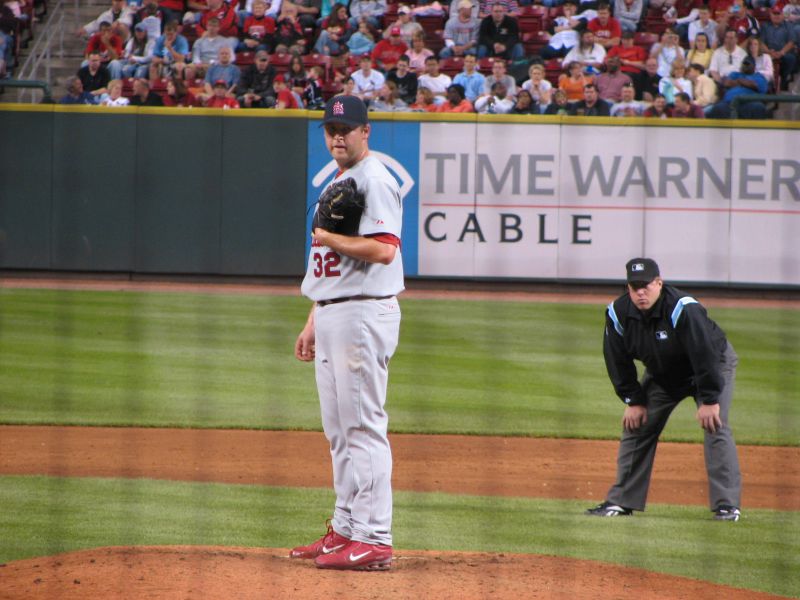
The Cardinals wore a special patch on their uniform sleeves with Hancock's number (32) for the duration of the 2007 season to commemorate his life. [9] Although his number is not retired, he is currently honored with his number being displayed above his name in the Cardinals bullpen at Busch Stadium, alongside Darryl Kile, who died in 2002.

In the wake of Hancock's accident, several teams banned alcohol from their home clubhouses. The Florida Marlins had already implemented this policy several seasons before Hancock's death, saying that they wanted to keep their players from driving home intoxicated after home games. They did not ban alcohol from visiting clubhouses because their opponents would usually ride a team bus after playing away games.[10] In 2006, after Esteban Loaiza was arrested for drunk driving, Oakland A's GM Billy Beane banned alcohol in both clubhouses, saying it was a liability issue. After Hancock died, the Baltimore Orioles implemented a similar policy, at least on a temporary basis.[11]

Hancock's family filed a lawsuit on May 24, 2007, against Mike Shannon's restaurant, the tow truck company, tow truck driver, and the driver of the car that the tow truck was stopped to help.[12] On May 31, 2007, the Missouri Division of Alcohol and Tobacco Control announced results of an investigation revealed no wrongdoing on the part of employees at Mike Shannon's Steaks and Seafood restaurant in Hancock's death. [13] The lawsuit was dropped on July 30, 2007.[14]

See also

[edit]

References

[edit]
[edit]
Revisions and contributorsEdit on WikipediaRead on Wikipedia
from Grokipedia
Joshua Morgan Hancock (April 11, 1978 – April 29, 2007) was an American professional baseball pitcher who played in (MLB) as a right-handed reliever for four teams over five seasons. Born in , Hancock attended , where he played college baseball and helped lead the Tigers to the 1997 alongside future MLB pitcher . Drafted by the Red Sox in the fifth round of the 1998 MLB Draft (145th overall), he made his big-league debut with Boston on September 10, 2002, before being traded to the Philadelphia Phillies in 2003. Hancock's MLB career included stints with the Phillies (2003–2004), (2004–2005), and Cardinals (2006–2007), where he appeared in a career-high 62 games during the 2006 season as a key member of the Cardinals' . Over 102 total games, he compiled a 9–7 record with a 4.07 , 110 strikeouts, and one save across 177⅔ . Notably, he contributed to the Cardinals' championship team, providing reliable middle relief during their postseason run. Tragedy struck on April 29, 2007, when Hancock, then 29, was killed in a single-vehicle car crash in , , shortly after a Cardinals game. Driving a 2007 , he collided with the rear of a stationary flatbed on ; an investigation later determined he was speeding at 68 mph in a 55 mph zone, had a blood alcohol level over the legal limit, and marijuana was found in the . His death prompted widespread mourning in the community and led to discussions about player safety, alcohol awareness, and the pressures of .

Early Life

Family Background and Education

Joshua Morgan Hancock was born on April 11, 1978, in , to parents Dean Hancock and Shirley Morgan. His family included siblings Katie, Jon Jon, and Jessica, with his mother later remarrying and becoming Shirley Morgan Sammut. Little is documented about his father's professional background, but the family provided a supportive environment during his early years in the rural region. After growing up in areas such as Tupelo and Baldwyn in North , the Hancock family relocated to , a suburb of Birmingham, during his childhood before he attended high school, seeking better opportunities in a growing community with strong athletic programs. This move exposed him to a vibrant youth sports scene in , fostering his initial passion for through local leagues and school activities, though specific family influences on his interest remain unrecorded in available accounts. Hancock attended Vestavia Hills High School, where he was involved in the school's rigorous academic curriculum alongside extracurriculars, graduating in 1996. No particular academic honors or non-athletic pursuits, such as clubs or leadership roles, are prominently noted in records from his high school years, which emphasized a balanced student life in a competitive educational environment. Following graduation, Hancock enrolled at in the fall of 1996 as a , initially pursuing while adjusting to campus life in . His time there was brief, with limited details on specific academic majors or coursework before his focus shifted toward athletics in his sole season with the team. This period marked a transition from high school accomplishments to collegiate opportunities in .

Amateur Baseball Career

Josh Hancock developed his pitching skills at Vestavia Hills High School in , where he played on three state championship teams between 1994 and 1996. As a senior in 1996, he posted an undefeated 9-0 record with a 0.92 , establishing himself as one of the top high school pitchers in the state. His performance earned him All-State honors, selection to the Mizuno High School All-American team, and the Gatorade Alabama Player of the Year award. Despite being drafted by the Milwaukee Brewers in the fourth round (103rd overall) of the 1996 , Hancock opted not to sign and instead committed to to continue his amateur career. At Auburn, Hancock joined the Tigers as a freshman in 1997 and played a supporting role in the team's 49-15 season, which advanced to the . In 13 appearances, including two starts and 11 relief outings, he went 2-0 with a 4.75 , allowing 34 hits and 15 walks while recording 32 strikeouts over 30.1 . His contributions helped bolster a pitching staff that featured future Major League standout during Auburn's postseason run.

Professional Career

Draft and Minor Leagues

Hancock was selected by the Boston Red Sox in the fifth round, 145th overall, of the out of . Following the draft, Hancock began his professional career in the Red Sox minor league system at the rookie level with the Gulf Coast League Red Sox, where he posted a 1-1 record with a 3.38 over five appearances, including one start, in 13.1 . He made one additional start that season for the short-season Class A in the New York-Penn League, going 0-1 with a 2.25 in four innings. In 1999, Hancock advanced to full-season Class A ball with the of the , recording a 6-8 mark and a 3.80 across 25 starts and 139.2 , striking out 106 batters while walking 46. He progressed to high Class A with the Sarasota Red Sox in the the following year, finishing 5-10 with a 4.45 in 24 starts over 143.2 . By 2001, Hancock reached Double-A with the in the Eastern League, where he achieved a career-best 8-6 record and 3.65 in 24 starts, logging 130.2 with 119 strikeouts. Hancock returned to Trenton in 2002, going 3-4 with a 3.61 in 14 starts before earning a promotion to Triple-A of the , where he excelled with a 4-2 record and 3.45 in eight starts over 44.1 innings. Across his five seasons in the Red Sox organization, he compiled a 27-31 record with a 3.81 in 104 appearances (98 starts), demonstrating steady development from rookie ball to the upper minors. On December 15, 2002, the Red Sox traded Hancock to the Philadelphia Phillies in exchange for . He spent the 2003 season at Triple-A with the Scranton/Wilkes-Barre Red Barons in the , leading the affiliate with a 10-9 record and 3.86 over 27 starts and a league-high-tying two shutouts in 165.2 innings. In 2004, Hancock continued at Scranton/Wilkes-Barre, posting an 8-7 record with a 4.01 in 18 starts across 107.2 innings before the July 30 trade deadline. Hancock was traded to the on , 2004, along with Anderson , for reliever Todd and Brad Correll. His time in the Reds' minor league system was limited, primarily consisting of rehab assignments in 2005 with the Triple-A of the , where a strained right injury sidelined him for most of the season; he went 1-2 with a 5.93 in 11 appearances (eight starts) over 44 innings. Over his minor league career from 1998 to 2005, Hancock appeared in 161 games (150 starts), compiling a 46-50 record with a 3.98 , 877.2 , and 668 strikeouts.

Major League Teams and Statistics

Josh Hancock made his debut with the Red Sox on September 10, 2002, at against the Tampa Bay Devil Rays, where he pitched one scoreless in relief during a 12-1 loss. He appeared in two more games that month, including his first start on September 26 against the , in which he pitched 5⅓ , allowing three runs on five hits and one home run while striking out six, but took the loss in a 4-2 defeat; his other relief outing on September 16 was also scoreless in a 7-1 loss to the Baltimore Orioles. Overall, Hancock's 2002 season was limited to three appearances (one start), where he went 0-1 with a 3.68 over 7⅓ and six strikeouts, serving primarily as a late-season call-up after strong minor league performances. On December 15, 2002, the Red Sox traded Hancock to the Phillies in exchange for outfielder . With the Phillies in 2003, Hancock made just two relief appearances in September, posting a 3.00 over three innings with four strikeouts and no decisions, as he spent most of the year in Triple-A with the Scranton/Wilkes-Barre Red Barons. His 2004 season with Philadelphia was similarly brief, limited to four games (two starts) early in the year, where he struggled with a 9.00 over nine innings, going 0-1 with five strikeouts; these limited opportunities reflected his ongoing transition from assignments and minor ailments, including a prior pelvic wall tear repaired via surgery in late 2002. On July 30, 2004, the Phillies traded Hancock and Anderson Machado to the in exchange for reliever and catcher Brad Correll. Joining the Reds midseason, Hancock transitioned to a starting role, making 12 appearances (nine starts) and posting a 5-1 record with a 4.45 over 54⅔ , including 31 strikeouts, providing solid rotation support down the stretch. In 2005, Hancock's role shifted to relief due to persistent injuries, including a strained right and issues that sidelined him for much of the year, limiting him to 11 appearances with a strong 1-0 record, 1.93 over 14 , and five strikeouts; he was released by the Reds in 2006 for reporting overweight, in violation of his . Hancock's aggregate Major League statistics through the 2005 season across the Red Sox, Phillies, and Reds totaled 32 games (12 starts), a 6-3 win-loss record, 4.47 , 88 , and 51 strikeouts, with one save; he primarily served as a reliever early and late in this period but showed promise as a starter during his 2004 stint with .
YearTeamGGSW-LERAIPSO
2002BOS310-13.687.16
2003PHI200-03.003.04
2004PHI420-19.009.05
2004CIN1295-14.4554.231
2005CIN1101-01.9314.05
TotalBOS/PHI/CIN32126-34.4788.051

St. Louis Cardinals Tenure

Hancock signed with the Cardinals as a minor league free agent on February 21, 2006, shortly after being released by the earlier that month. His prior Major League experience with the Boston Red Sox, Philadelphia Phillies, and Reds positioned him for a role in , where he transitioned to a middle reliever following a strong performance. During the 2006 regular season, Hancock appeared in 62 games for the Cardinals, posting a 3-3 record with a 4.09 over 77 , relying primarily on his right-handed sinker to induce ground balls and limit home runs. Hancock contributed to the Cardinals' successful 2006 campaign, which culminated in the National League pennant and a victory over the Detroit Tigers. Although he made three postseason appearances in the NLDS against the San Diego Padres (1.2 scoreless innings) and NLCS against the (0.1 inning), he did not pitch in the but remained on the active roster as part of the championship team, participating in the celebrations. His versatility in the complemented teammates like closer and setup man , providing reliable middle relief during the Cardinals' 83-78 regular season that defied low expectations. In the early 2007 season, Hancock made eight relief appearances for the Cardinals before his final outing on against the Chicago Cubs, where he pitched three in an 8-1 loss, allowing one run on three hits. Through those games, he recorded a 0-1 mark with a 3.55 over 12.2 , showing early effectiveness in high-leverage situations similar to his ground-ball-oriented style from the previous year.

Death and Investigation

Circumstances of the Accident

On April 28, 2007, Josh Hancock made a relief appearance for the St. Louis Cardinals in their game against the Chicago Cubs at Busch Stadium, pitching three innings in an 8-1 loss. After the game, Hancock went to Mike Shannon's Steaks and Seafood restaurant in St. Louis, where he remained at the bar for more than three and a half hours. Early on April 29, 2007, at approximately 12:35 a.m., Hancock was driving alone in a rented 2007 on in Chesterfield, a of . The vehicle, traveling at 68 miles per hour in a 55 mph zone, struck the rear of a flatbed that was stopped in the left westbound lane while assisting with a prior accident. Hancock did not apply the brakes but attempted to swerve at the last moment. At the time of the crash, Hancock was talking on his cell phone to a female acquaintance and was not wearing a seat belt. The single-vehicle accident resulted in Hancock, aged 29, being pronounced dead at the scene from massive impact injuries. The tow truck driver sustained no injuries. The autopsy and report conducted by the St. Louis revealed that Josh Hancock's blood-alcohol concentration was 0.157 percent at the time of his , nearly twice Missouri's legal limit of 0.08 percent for . tests for other substances, including drugs, were completed but did not indicate the presence of any impairing agents in his system beyond alcohol. Although 8.55 grams of marijuana and a glass pipe were found in the rented , no evidence linked these items to Hancock's impairment. The police investigation confirmed that Hancock was driving at approximately 68 miles per hour in a 55 mph zone, contributing significantly to the crash's severity. Cell phone records showed he was on a call immediately before the collision, establishing distracted driving as a key factor. Additionally, Hancock was not wearing a seatbelt, which investigators noted would likely have been fatal regardless but exacerbated the outcome. No criminal charges were filed against Hancock's estate, as his death precluded prosecution. In May 2007, Hancock's father, Dean Hancock, filed a wrongful-death on behalf of the family against Mike Shannon's restaurant, alleging that staff overserved alcohol to Hancock despite visible intoxication, in violation of laws. The suit also named the driver, Charles Tolar, and his employer, claiming for stopping in the travel lane without adequate warning and failing to move the stalled vehicle promptly. On July 30, 2007, the family voluntarily dismissed the claims against the restaurant without disclosing any settlement details. The case against the parties proceeded separately but did not result in publicly reported liability findings against them.

Aftermath and Legacy

Team and MLB Responses

Following Josh Hancock's fatal car accident on April 29, 2007, the St. Louis Cardinals postponed their scheduled game against the Chicago Cubs that day. closed the clubhouse to reporters ahead of the team's return to the field on April 30 and held a team meeting to address the loss, describing it as "brutal to go through" and noting that Hancock left "a big hole" in the team. La Russa also informed Hancock's family of the accident and praised the pitcher's , stating, "I respect and miss Josh, and want to honor his memory by competing like he did for us." To honor Hancock, the Cardinals announced they would wear black arm patches bearing his uniform number 32 for the remainder of the 2007 season, beginning with their first game back on April 30 against the Brewers. The team participated in a public memorial service on May 3 in , joining an estimated 500 mourners at the event; a private funeral service for the family was held on May 2. Major League Baseball Commissioner issued a statement expressing condolences, saying, "All of baseball today mourns the tragic and untimely death of St. Louis pitcher Josh Hancock. He was a fine young pitcher, who played an important role on last year's world championship team. On behalf of all of , I extend my deepest condolences to his family, friends and teammates." In the immediate aftermath, particularly after toxicology reports revealed Hancock's blood alcohol level was nearly twice the legal limit, MLB and several teams initiated discussions on player safety, including the presence of alcohol in clubhouses. This led to short-term actions such as multiple clubs, including the , banning alcohol from locker rooms and team functions in May 2007.

Memorials and Long-Term Impact

Hancock was buried at Kirkville Cemetery in Kirkville, , following a memorial service held on May 3, 2007, at First United Methodist Church in Tupelo. His tombstone bears the St. Louis Cardinals' "Birds on the Bat" logo and his uniform number 32. In baseball, the Cardinals honored Hancock by wearing a black memorial patch featuring his number 32 on their uniforms for the remainder of the 2007 season. Although the number was not officially retired, the team refrained from issuing it to any player until 2013, when it was assigned to Rob Johnson, marking the first reuse since Hancock's death. Hancock's death prompted significant policy changes across Major League Baseball, particularly regarding alcohol consumption. The St. Louis Cardinals banned alcohol from their clubhouse at Busch Stadium and ceased serving it on homebound charter flights, a measure that extended to outbound flights as well. Other teams followed suit, including the New York Yankees, Chicago Cubs, Washington Nationals, San Diego Padres, and Baltimore Orioles, which limited or prohibited alcohol in clubhouses and on team travel; by mid-2007, at least five clubs had implemented such restrictions. These actions reflected a broader reevaluation of alcohol's role in professional baseball environments, aiming to mitigate risks associated with impaired driving among players. The incident also contributed to heightened awareness of driving safety in MLB, underscoring the dangers of alcohol-related accidents and influencing ongoing discussions about player conduct and league-wide prevention efforts. Teammates and former colleagues have long remembered Hancock for his positive character and dedication; Cardinals pitcher Randy Flores recalled being reminded daily of Hancock's "heart," while Angels reliever Chris Bootcheck, a teammate, described him as "a fun guy, a great teammate" with no negative traits. peer echoed this, calling Hancock "such a good person" whose loss felt like "being punched in the stomach." These reflections highlight Hancock's enduring reputation as a valued member of the community, even as his tragedy spurred cultural shifts toward greater responsibility in the sport.

References

Add your contribution
Related Hubs
User Avatar
No comments yet.