Hubbry Logo
Joy of CookingJoy of CookingMain
Open search
Joy of Cooking
Community hub
Joy of Cooking
logo
7 pages, 0 posts
0 subscribers
Be the first to start a discussion here.
Joy of Cooking
Joy of Cooking
from Wikipedia

Joy of Cooking, often known as "The Joy of Cooking",[1] is one of the United States' most-published cookbooks. It has been in print continuously since 1936 and has sold more than 20 million copies.[2] It was published privately during 1931 by Irma S. Rombauer (1877–1962), a homemaker in St. Louis, Missouri, after her husband's suicide the previous year. Rombauer had 3,000 copies printed by A.C. Clayton, a company that had printed labels for fancy St. Louis shoe companies and for Listerine mouthwash, but never a book. Beginning in 1936, the book was published by a commercial printing house, the Bobbs-Merrill Company. With nine editions, Joy of Cooking is considered the most popular American cookbook.[3]

Key Information

Background

[edit]

Born to German immigrants in 1877, Irma Starkloff was born and grew up in St. Louis, Missouri. She married Edgar Rombauer, a lawyer, in 1899. Edgar committed suicide in 1930 after a severe bout of depression, widowing Irma at age 52 and leaving her with $6,000 in savings.[citation needed]

Rombauer's children, Marion Rombauer Becker and Edgar Roderick ("Put") Rombauer, Jr.,[4] encouraged her to compile her recipes and thoughts on cooking to help her cope with her loss. Rombauer spent much of the summer of 1930 in Michigan, creating the first drafts that would later become Joy of Cooking. With the help of her late husband's secretary, Mazie Whyte, Rombauer began writing and editing recipes and commentaries while searching for more recipes in St. Louis. During the autumn of 1930, Rombauer went to the A.C. Clayton Printing Company, a printer for the St. Louis shoe manufacturers. She paid them $3,000 to print 3,000 copies of The Joy of Cooking: A Compilation of Reliable Recipes with a Casual Culinary Chat in November 1931.[5]

Editions

[edit]

First edition (1931)

[edit]

In 1931 Rombauer self-published The Joy of Cooking: A Compilation of Reliable Recipes with a Casual Culinary Chat with more than 500 tested recipes and related commentaries.

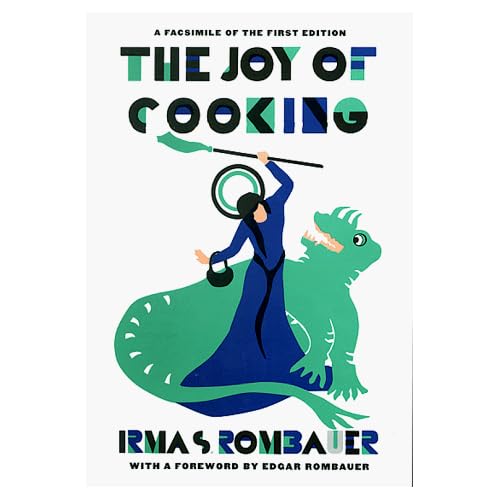
The book was illustrated by Rombauer's daughter, Marion Rombauer Becker, who directed the art department at John Burroughs School. Working weekends during the winter of 1930–31, Marion designed the cover,[6] which depicted Saint Martha of Bethany, the patron saint of cooking, subduing a tarasque. She also produced silhouette cutouts to illustrate chapter headings.[7] By 1932, a majority of the 3,000 copies printed by A.C. Clayton were sold.[8] Rombauer began to look for a publisher in 1932.[citation needed]

Second edition (1936)

[edit]
Editions of (The) Joy of Cooking, from the 1st printing in 1931 (top left) to the most recent edition, published in 2019

After Rombauer had searched for a publisher and been rejected many times, the Bobbs-Merrill Company published an expanded (640 page) second edition on May 1, 1936.[9] The company had limited experience with publishing cookbooks, and Rombauer, similarly inexperienced in dealing with publishers, performed the negotiations herself without an agent or lawyer. The resulting contract, in which Bobbs-Merrill was granted the copyright not only for the 1936 edition but also for the original 1931 version, resulted in many years of conflict between the author and the publisher.[10]: 151–153 

The 1936 edition differed from other commercial cookbooks of the era by its retention of the author's folksy comments and anecdotes, and its layout of the recipes.[10]: 153–154  Instead of listing the ingredients for a dish at the top with preparation directions following, the recipes in Joy (1936) were presented by narratives, with the ingredients indicated as the need for them occurred, with each placed in boldface on a new indented line — thus preserving a conversational style throughout the recipe. This method came to be known as the "action method".[11] These innovations, along with an aggressive marketing effort by Bobbs-Merrill, resulted in good sales.[10]: 159–161  Joy reached the best-seller list in St. Louis and promoted as "the famous private cookbook" in the New York Times.[12][13] By the end of 1942, the second edition had had six printings, and 52,151 copies had been sold.[9]

Third edition (1943/1946)

[edit]

In 1939, Rombauer published Streamlined Cooking, a collection of recipes that could be prepared in less than 30 minutes, with an emphasis on use of canned and frozen foods. This book was not a commercial success,[10]: 166–169  but many of the recipes it contained became part of a new edition of Joy of Cooking published during 1943. This edition also included material intended to help readers deal with wartime rationing restrictions, including alternatives to butter in some recipes.[14] Sales of this edition were phenomenal: from 1943 through 1946 a total of 617,782 copies were sold, surpassing sales of Joy of Cooking's principal competitor, Fannie Farmer's Boston Cooking-School Cook Book.[10]: 172 

During 1946, a minor revision of the 1943 edition was published. While substantially the same as its predecessor, the 1946 revision omitted the material related to wartime rationing and incorporated additional recipes from Streamlined Cooking.[9]

Fourth edition (1951)

[edit]

Irma Rombauer was 69 years old when the 1946 edition of Joy was published, and her health was beginning to decline.[10]: 194–195  She was concerned about the future of her book, since Bobbs-Merrill (which owned the copyright for the original publication) might have selected an author of their own choosing for future editions once Rombauer was unable to continue. To ensure that the book remained a family project, Rombauer negotiated with the publisher a clause in her contract naming her daughter, Marion Rombauer Becker, as her sole successor in any future revision.[10]: 201 

Relations between Rombauer and Bobbs-Merrill, never cordial, worsened during the late 1940s, and in the fracas Marion Becker gradually assumed increasing responsibility, at first regarding the book's design, and eventually its content. Partly for legal reasons, the 1951 edition was published with Marion Rombauer Becker listed as co-author, and she received 40% of the royalties.[10]: chap 8  The authors strongly resisted the publisher's wish to illustrate the book with photographs and instead embellished the book with simple, functional line drawings by Ginnie Hofmann, a friend of Becker's.[10]: 262–270 

Becker was a passionate advocate of healthy eating, and the 1951 edition was marked by an increased emphasis of such topics as whole grains and fresh produce. Many of the old "can-opener" recipes from Streamlined Cooking were eliminated. This edition also was the first to introduce the use of the blender and other modern household items into its recipes. The number of recipes had increased to more than 4,000.[citation needed]

Because of the time taken by the protracted legal arguments, final editing of the 1951 edition was done hastily. The same edition was reprinted in 1952 with some errors corrected, and again during 1953 with a revised index.[9]

Fifth edition (1962/1963/1964)

[edit]
Well-worn copies of the book from the library of Julia Child on display at the National Museum of American History

In 1962, the year of Irma Rombauer's death, a revised edition of Joy of Cooking was published. This edition was released without Marion Becker's consent. Subsequent releases of the book during 1963 and 1964 were essentially massive corrections, and Becker arranged for the publisher to exchange copies of the 1962 edition for later corrected versions upon request.[10]: 342 

The foreword of the 1962 edition explains that Becker's favorite recipes include "Cockaigne" in the name, (e.g., "Fruit Cake Cockaigne"), after the name of her country home in Anderson Township, near Cincinnati.[15][16]

This edition was also published in paperback format (most notably, a two-volume mass market paperback edition); it is still widely available in used bookstores. The 1962 edition was also released as a single-volume comb-ring bound paperback mass-market edition starting in November 1973 and continuing into the early 1990s.[17]

Sixth edition (1975)

[edit]

The 1975 edition was the last to be edited by Becker and remains the most popular, with more than 6 million copies sold.[18] More than 1,000 pages long, and with over 4,300 recipes, it became a standard in kitchens throughout the country. The book included sections concerning backpacking, hiking, and substitutions, and though many sections may seem antiquated to contemporary fashion, many home cooks still use it.[18]

Seventh edition (1997)

[edit]

After the 1975 edition, the project was unchanged for about 20 years. During the mid-1990s, publisher Simon & Schuster, which owns the Joy of Cooking's copyrights (gained from its acquisition of Macmillan Inc. which had previously acquired Bobbs-Merrill catalog)., hired cookbook editor Maria Guarnaschelli, formerly of William Morrow, and editor of works by Jeff Smith and others. Guarnaschelli, supervised by Rombauer's grandson Ethan Becker, managed the creation of the 1997 edition, published by Simon & Schuster's Charles Scribner's Sons division. The new edition kept the concise style of its predecessors, but it eliminated the conversational first-person narration. Much of the edition was ghostwritten by teams of expert chefs instead of the single dedicated amateur Irma Rombauer had been when she created the book. The 1997 version is fairly comprehensive; however, it no longer contains much information about ingredients or frozen desserts.[citation needed]

Upon its publication during January 1997, the edition was titled The All-New, All-Purpose Joy of Cooking; during November of that same year, it was reissued with the title The 1997 Joy of Cooking.[19][20]

Other special editions and printings

[edit]

In 1995, a hardbound edition illustrated by Ginnie Hofmann and Ikki Matsumoto was released.[21]

In 1998, a reproduction, described as "A Facsimile of the First Edition", was released.[8]

Eighth edition (2006): 75th anniversary edition

[edit]

In 2006, Scribner published a 75th anniversary edition, containing 4,500 recipes, that reproduced much of Rombauer's original style.[22] The new version removes some of the professionalism of the 1997 edition and returns many simpler recipes and recipes assisted by ready-made products such as cream of mushroom soup and store-bought wontons. The 2006 edition also reinstates the cocktail section and the frozen desserts section, and restores much of the information that was omitted for the 1997 edition.

The new version includes a new index section named "Joy Classics" that contains 35 recipes from 1931 to 1975 and a new nutrition section.[23] It was still edited and written by the Rombauer-Becker family.[3]

Ninth edition (2019)

[edit]

600 new recipes were added to this edition. Irma's great grandson, John Becker, and his wife Megan Scott, were responsible for the updates.[24]

Reception

[edit]

Joy of Cooking became a bestseller originally due to its readability for the middle classes and Rombauer's unique style. Her recipes were designed specifically for middle-class people doing most of their own cooking for their family. She specifically tested and practiced the recipes to ensure they could be produced easily in a relatively brief period of time without much complication. Once she combined her witty comments on the cooking and serving with the action method, her cookbook became readily readable by the average cook in America. Moreover, Rombauer paired the conversational style of the recipes with casual discussions of etiquette and hosting. Her methods were distinct from the other cookbooks of the time, which featured many complex recipes, while her style was simple and conversational. By providing an interesting and easy to read cookbook for the middle class, Joy of Cooking became the main reference book for many mid-century American cooks.[8][11][16][25][26]

Legacy

[edit]

The Joy of Cooking is considered the most popular American cookbook.[3]

Julia Child learned to cook from The Joy of Cooking and Gourmet magazine. She enjoyed "Mrs. Joy's Book" and believed it taught her the basic principles of cooking.[27]

The book popularized the title formula "The Joy of..." used to indicate an accessible, popular overview of a topic, such as The Joy of Painting (1983), The Joy of Sex (1972), The Joy of Art (2020), The Joy of X: A Guided Tour of Mathematics (2012), The Joy of Living (2007), The Joy of Accounting (2020), and even The Joy of Uncircumcising (1992).[28]

See also

[edit]

References

[edit]
[edit]
Revisions and contributorsEdit on WikipediaRead on Wikipedia
from Grokipedia
Joy of Cooking is an enduring American originally written by and first self-published in 1931, featuring over 500 recipes compiled as a personal project following her husband's the previous year. The book quickly gained popularity for its accessible, conversational style and step-by-step instructions, which were innovative for the era, and it was commercially published by Bobbs-Merrill in a revised edition in 1936. Subsequent editions have been revised by Rombauer's daughter Marion Rombauer Becker starting in 1951, her grandson Ethan Becker in 1997, and great-grandson John Becker and his wife Megan Scott in the 2019 edition, expanding the content to over 4,500 recipes while adapting to modern ingredients, techniques, and cultural shifts. With over 20 million copies sold worldwide, Joy of Cooking remains one of the most influential and bestselling cookbooks in history, praised for introducing diverse cuisines to mainstream American households and emphasizing practical, joyful home cooking during times like the and rationing. Its legacy endures as a comprehensive reference, covering everything from basic techniques to exotic dishes, and continues to shape culinary education and traditions.

Origins and Authors

Irma S. Rombauer and Initial Creation

was born on October 30, 1877, in , , to German immigrant parents, with her father serving as a prominent local doctor in the city's large German-American community. Raised in a comfortable household that included domestic help, she received education through public and boarding schools before briefly attending art classes at Washington University in 1894. married , a who had graduated from in 1887, and the couple raised three children while she managed the home without any formal culinary training, embodying the role of a typical middle- to upper-class homemaker of her era. The sudden death of her husband by in left Rombauer widowed at age 52 and facing financial hardship amid the , with an inheritance of just $6,000 from his modest estate. To cope with her grief and generate income, her children—including daughter Marion, who later contributed illustrations—urged her to expand a personal collection of family recipes into a comprehensive , providing both emotional support and a practical outlet during this difficult period. This initiative culminated in a manuscript featuring over 500 "kitchen-tested" recipes, specifically tailored for novice cooks with clear, step-by-step instructions and an emphasis on accessible techniques using everyday ingredients like canned soups and . Determined to share her work, Rombauer invested $3,000—half of her inheritance—in the book in 1931, producing an initial run of 3,000 copies through the A.C. Clayton Company in . Titled The Joy of Cooking: A Compilation of Reliable Recipes with a Casual Culinary Chat, the volume included Marion's work and opened with a underscoring the book's of simplicity: "the of cooking is a to give to those we love." This private edition marked Rombauer's bold entry into culinary publishing, later leading to commercial distribution in 1936.

Subsequent Contributors and Editorial Evolution

Following Irma's death in 1961, her daughter Marion Rombauer Becker took a leading role in revising the book, beginning with the 1963 edition and co-authoring through the 1975 edition. Marion expanded the recipes with meticulous research, adding greater depth to instructions while preserving the witty, personable tone that characterized her mother's work. She incorporated humor into sections, such as whimsical notes on unconventional ingredients, and collaborated with her husband on elements that enhanced the book's approachable style. Marion's son, Ethan Becker, contributed illustrations and editorial input starting with the 1975 edition, where he assisted in revisions and helped shape the visual layout alongside structural updates. As grandson of Irma, Ethan later oversaw the 1997 and 2006 editions, focusing on recipe testing and maintaining family oversight during a period of significant changes. In the 2019 edition, Irma's great-grandson John Becker and his wife Megan Scott undertook a thorough revision, adding over 600 new recipes that addressed contemporary interests like plant-based cooking, global cuisines, and regional American dishes such as St. Louis gooey butter cake. They tested approximately 1,500 recipes, updated more than 4,000 others for accuracy and cultural sensitivity, and included modern techniques like sous vide while replacing less practical elements, such as outdated illustrations, with more relevant guidance. The editorial philosophy of Joy of Cooking evolved from Irma's folksy, conversational voice—marked by humor and accessibility—to Marion's expansions that deepened detail without sacrificing warmth. The 1997 edition introduced a brief phase of professionalization, emphasizing structured expertise over personality, which some revisions sought to temper. Subsequent editions in 2006 and 2019 restored the original style, prioritizing a friendly, empowering tone for home cooks while integrating modern updates to ensure relevance.

Publication History and Editions

Early Editions (1931–1951)

The first edition of Joy of Cooking was self-published by on November 30, , through A.C. Clayton in , spanning 396 pages and containing over 500 recipes; of the 3,000 copies printed, all were sold locally to friends, family, and through church groups. This debut reflected the practical needs of the era, focusing on economical cooking with a casual, approachable tone. In 1936, the released the first commercial edition on May 1, expanding the book to 640 pages and introducing the innovative "action method" of writing, which presented instructions in a step-by-step, verb-led format to guide novice cooks. The initial print run of 10,000 copies quickly sold out, with reprints of 10,000 each from 1938 to 1942, totaling 52,151 copies sold by the end of that period. The 1943 wartime edition, published on June 7 and revised from the 1936 version to reach 884 pages with approximately 3,350 , incorporated practical adaptations for shortages, including tips on and substitutions for scarce ingredients like (such as using or oils). A 1946 reprint of this edition, also 884 pages, removed the explicit sections but retained streamlined "quick cooking" suited to efficiencies; combined sales for these wartime printings exceeded 617,000 copies, with 61,428 sold in 1943 alone, 167,261 in 1944, 94,693 in 1945, and 294,400 in 1946. The 1951 fourth edition, released on July 16 and co-authored with Marion Rombauer Becker, ballooned to 1,136 pages with 4,500 recipes, shifting emphasis toward and healthy eating through sections on , whole grains, and balanced diets. It also integrated modern appliances like blenders and freezers into recipes, reflecting technological advances in American kitchens, and launched with a first of 100,000 copies that sold approximately 202,000 in 1952. These early editions marked Joy of Cooking's transformation from a regional self-published effort to a national , with surging amid economic recovery from the Depression and wartime demands, ultimately establishing it as an indispensable American culinary resource.

Mid-20th Century Editions (1962–1975)

The fifth edition of Joy of Cooking was released in 1962, coinciding with the death of original author on August 14 of that year. This edition, prepared without the approval of co-author Marion Rombauer Becker, introduced minor revisions to existing content but was marred by significant errors, prompting the publisher to issue corrections in subsequent printings through 1963 and 1964. Spanning 852 pages, it encompassed over 4,000 recipes and maintained the book's foundational structure while adapting to kitchen advancements like blenders. The sixth edition, published in 1975, marked a major expansion under Marion Rombauer Becker's primary editorial direction, with assistance from her son Ethan Becker on revisions and illustrations. Growing to 915 pages, this version featured more than 4,300 recipes and incorporated new sections on grains, beans, , natural and raw foods, and international cuisines such as Mexican and Middle Eastern dishes, aligning with the era's rising interest in health-conscious eating and global flavors. Additional content addressed lifestyle shifts, including chapters on backpacking and outdoor meals, vegetarian options, and expanded guidance on , entertaining, and home preservation techniques. This edition achieved unprecedented commercial success, becoming the best-selling version of Joy of Cooking with millions of copies distributed and solidifying its status as a kitchen essential that outsold rival cookbooks like The Fannie Farmer Cookbook. By reflecting post-war prosperity and countercultural trends, it reinforced the book's role as a versatile guide for American home cooks during a period of culinary diversification.

Late 20th and 21st Century Editions (1997–2019)

The seventh edition of Joy of Cooking, published in 1997, marked a significant overhaul under the editorial guidance of at Scribner, with contributions from Ethan Becker, grandson of original author . Spanning 1,136 pages, this revision reconceived nearly all recipes to align with contemporary tastes and techniques, incorporating over 200 new entries focused on grains, beans, , and global influences such as and risottos. Critics noted a shift away from Rombauer's signature witty, conversational voice toward a more professional and streamlined tone, which some described as corporate and less personal, reflecting broader editorial efforts to modernize the book's structure for efficiency. Despite over these changes, the edition achieved strong commercial success, contributing to the series' ongoing popularity. In response to feedback on the 1997 revision, the eighth edition—released in 2006 to commemorate the book's 75th anniversary—restored much of the original's engaging, chatty style while expanding to include approximately 4,500 recipes across 1,132 pages. Edited by Ethan Becker and guided by Scribner, this version reinstated beloved elements like the eclectic ", , and " chapter and sections on preserving and freezing, addressing criticisms that the prior edition had diluted the book's intimate charm. New illustrations, including over 1,000 line drawings, enhanced the visual appeal, drawing on traditional formats to aid home cooks in mastering techniques from quick breads to celebratory roasts. The anniversary update balanced nostalgia with practicality, solidifying Joy of Cooking's role as a versatile kitchen reference. The ninth edition, published in 2019 and thoroughly revised by John Becker—Irma's great-grandson—and his wife Megan Scott, further evolved the book to 1,200 pages, introducing more than 600 new recipes alongside updates to thousands of classics. This iteration emphasized inclusivity through expanded vegan, vegetarian, and gluten-free options, such as caramelized and miso-based dishes, while incorporating techniques like and to reflect modern wellness trends. Global flavors were amplified with entries for , flan, and other international staples, promoting via resourceful uses of seasonal produce and plant-based alternatives. The revisions maintained the book's encyclopedic depth, ensuring it remained relevant for diverse contemporary kitchens. As of 2025, the 2019 edition remains the current print version, with no major new editions released since. Since its commercial debut in 1936, Joy of Cooking has sold over 20 million copies across all editions as of 2024, a testament to its enduring influence. Digital adaptations, including versions available through major platforms, have extended its accessibility in the 21st century.

Special Editions and Adaptations

During , a special wartime edition of Joy of Cooking was published in , featuring adaptations to address food rationing, such as substitute ingredients and conservation tips for home cooks facing shortages. This edition, bound in hardcover with blue and white cloth, maintained the book's core structure while incorporating practical wartime advice to help American households manage limited resources. In 1953, Bobbs-Merrill released a edition that marked a post-war expansion, with 1,013 pages of revised recipes and techniques, reflecting the publisher's growing role in the book's distribution. This printing, available in blue-striped binding, emphasized durability for everyday kitchen use and included updates to align with mid-century culinary trends. International adaptations of Joy of Cooking have included editions, such as those from the 1970s, which incorporated British measurement conversion charts to accommodate metric preferences alongside . These versions retained the original content but added practical tools like equivalents for cups and ounces, making the book more accessible to British audiences accustomed to systems. In the digital era, derivative works extended the book's reach through a dedicated app launched in 2014 by for and , containing all 4,000-plus recipes from the print edition along with searchable features and timers. Priced at $9.99, the app modernized the classic for mobile users, allowing quick access to instructions without physical pages. Collectible aspects of Joy of Cooking center on early and signed copies, particularly the rare 1931 self-published originals, which number around 3,000 and command high values due to their historical significance. By 2025, well-preserved first editions have sold for up to $6,800 at reputable booksellers, while signed examples from later printings, such as 1946 editions, fetch around $2,000, appealing to culinary historians and collectors.

Content and Format

Recipe Structure and Organization

The Joy of Cooking is structured around chapters that systematically categorize culinary topics, beginning with foundational elements like Beverages and progressing through Breads, and Soups, , and , , Salads and Dressings, and concluding with extensive sections, often incorporating subheadings for specialized techniques such as stock preparation within the soups chapter. This organization reflects a logical flow from preparatory drinks and baked goods to main courses and sweets, allowing users to navigate by meal component or skill level. The presentation of recipes has evolved significantly across editions to enhance usability. In the initial 1931 self-published version and early commercial printings up to the 1930s, recipes followed a conventional format with a separate list of ingredients followed by numbered procedural steps. Starting with the 1936 edition, author introduced the innovative "action method," which weaves ingredients directly into the instructional narrative, eliminating the discrete list and creating a seamless, verb-driven sequence that mimics the cooking process itself. Subsequent revisions, including the 1951 edition by Marion Rombauer Becker and later updates in 1975 and 1997, refined this approach while preserving its core principle, and the 2019 update by John Becker and Megan Scott further modernized timings and measurements without altering the integrated style. The scope of recipes spans beginner-friendly fundamentals, such as instructions on boiling water or preparing simple stocks, to sophisticated techniques like crafting soufflés or advanced work, ensuring accessibility for novices while challenging experienced cooks. Comprehensive indices at the end of each edition list recipes by , technique, and occasion, enabling quick reference amid the book's thousands of entries. Beyond recipes, the book dedicates substantial space to instructional material, including detailed discussions of kitchen equipment selection and , suggested menus for various events, and guidance on table etiquette and entertaining, which together form integral chapters that support practical home cooking. These elements, often illustrated for clarity, emphasize the book's role as a complete culinary rather than solely a recipe collection.

Unique Features and Innovations

One of the most distinctive innovations in Joy of Cooking is the "action method" of recipe writing, pioneered by in the 1936 second edition. This approach integrates ingredients directly into the instructional steps in an imperative narrative style, such as "Cream butter and sugar," rather than listing them separately at the top, making the recipes flow like a continuous guide for the cook. By bolding ingredients as they appear, the method emphasizes practical, step-by-step clarity, which Rombauer developed to enhance readability and accessibility for home cooks. Complementing this structure are Rombauer's conversational commentaries, which infuse the book with witty, personal asides and practical tips, restoring a lighthearted tone in later editions after periods of more formal revisions. Her signature style, often blending humor with encouragement, includes remarks like those on cocktails—"Most cocktails containing are made today with and ingenuity"—to make cooking feel approachable and enjoyable rather than intimidating. This narrative voice, carried forward by subsequent editors, sets Joy of Cooking apart by treating readers as companions in the kitchen, offering insights that go beyond mere instructions. The book has evolved to address inclusivity through targeted innovations for diverse dietary needs across editions. The 2019 edition further advanced this by expanding recipes for allergies, , and gluten-free diets—such as vegan and gluten-free pizza dough—while incorporating global flavors like beef to reflect and modern American diversity. These updates ensure the book remains relevant for varied lifestyles without altering its core encyclopedic scope. At its heart, Joy of Cooking adopts a pedagogical approach designed for novices, providing detailed explanations of the "why" behind techniques to build foundational skills rather than relying solely on rote recipes. Introductory chapters cover essential methods, ingredient science, and use, enabling beginners to understand processes like or for confident adaptation. This educational framework, evident from Rombauer's early emphasis on practical learning, distinguishes the book as a comprehensive tool that empowers users to cook intuitively over time.

Reception and Cultural Impact

Critical and Commercial Success

Joy of Cooking has achieved remarkable commercial success, with over 20 million copies sold worldwide since its initial publication. The 1975 edition, revised by Marion Rombauer Becker, became the book's biggest seller, moving more than 6 million copies and remaining in print unchanged for two decades. It has consistently ranked as a , recognized as the best-selling retail in American history. Critically, the book has been praised for its accessible, practical approach to cooking, particularly appealing to middle-class households navigating economic hardships like the Great Depression. Reviews in The New York Times from 1936 onward highlighted its straightforward recipes and helpful guidance, while Gourmet magazine lauded its comprehensive yet approachable style. Julia Child described it as "a fundamental resource for any American cook." In recognition of its enduring impact, Joy of Cooking was inducted into the James Beard Foundation's Cookbook Hall of Fame in 1978. The 1997 edition faced significant criticism for adopting a more corporate tone that diluted the original's distinctive voice, sparking among fans and reviewers. This backlash prompted the 2006 75th anniversary edition, which restored much of the book's traditional charm while incorporating modern updates.

Influence on American Cooking and Beyond

Joy of Cooking has profoundly shaped American home cooking, particularly during the mid-20th century, by serving as a comprehensive that adapted to economic hardships and technological advancements. Originally published in 1931 amid the , the book emphasized resourceful recipes using affordable staples like potatoes and eggs, helping households stretch limited ingredients while introducing accessible techniques for everyday meals. Its inclusive voice addressed "cooks" broadly, blurring traditional gender stereotypes and empowering primarily women in the kitchen to approach cooking with confidence and creativity rather than rigid formulas. By the and , it became a staple in American households, reflecting shifting tastes through Americanized versions of global dishes such as Italian and curried rice, which broadened mainstream palates and fostered a more diverse culinary culture. The book's educational role has endured across generations, functioning as an invaluable guide for novice and experienced home cooks alike. It demystified cooking methods like and blanching, providing clear, flexible instructions that built practical skills and encouraged experimentation in the kitchen. This approachable style marked a departure from the formulaic, math-like recipes common in home economics texts of the era, instead promoting joyful, intuitive learning that inspired countless individuals—especially women—to master meal preparation independently. While not formally tied to school curricula, its status as a "kitchen bible" has made it a go-to resource for self-taught cooks and , influencing family traditions and community cooking practices. Beyond the kitchen, Joy of Cooking extended its cultural footprint by paving the way for media-driven culinary enthusiasm and satirical tributes. It predated and complemented the rise of television chefs like , who built on the groundwork of accessible women's cookbooks to popularize gourmet techniques on screen, transforming cooking into a shared national pastime. The book's title and format even inspired the 1972 bestseller by , which adopted a similar "" structure to present intimate acts as approachable recipes, spawning a "Joy of..." franchise that underscored the original's pervasive influence on . In its global and modern iterations, Joy of Cooking continues to evolve, adapting to contemporary needs and expanding its reach. The 2019 edition, revised by Rombauer's great-grandson John Becker and his wife Megan Scott, incorporates over 600 new recipes tailored for diverse diets, including vegan options like , gluten-free baking, and vegetarian dishes such as , alongside classics. It also integrates international flavors reflective of America's multicultural landscape, featuring recipes like Indian and Malaysian , ensuring the book's relevance in an era of globalized eating habits. Through nine editions and continuous printings, it has introduced worldly cuisines to home cooks worldwide, maintaining its legacy as a bridge between tradition and innovation.

References

Add your contribution
Related Hubs
User Avatar
No comments yet.