


Community hub
Recent from talks
Contribute something
Nothing was collected or created yet.
Jupp Derwall
View on Wikipedia
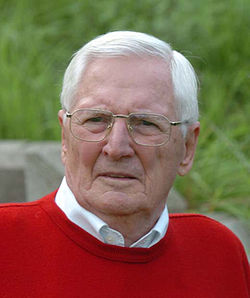
Josef "Jupp" Derwall (10 March 1927 – 26 June 2007) was a German professional football manager and player. He was head coach of the West Germany national team between 1978 and 1984, winning the UEFA Euro 1980 and reaching the final of the 1982 FIFA World Cup.[2]
Key Information


Derwall's hairdo provided the basis for his nickname "Chieftain Silver Curl" (Häuptling Silberlocke).[3]
Playing career
[edit]Derwall started in 1938 with Rhenania Würselen. Later, he played for Alemannia Aachen and Fortuna Düsseldorf in the western division[4] of the five-way split first German league called Oberliga. With Aachen, Derwall reached the DFB-Pokal final in 1953 where he scored one goal at the 1–2 defeat at the hands of Rot-Weiss Essen. Five years later he reached the cup final with Düsseldorf, which was lost 3–4 against VfB Stuttgart. In 1954, after the Herberger team won the FIFA World Cup, Derwall was also called twice to play for West Germany[5]
Managerial career
[edit]Early career
[edit]Not yet retired, Derwall took up player-managing first in Switzerland with Biel-Bienne (1959–1961) and Schaffhausen (1961–1962).[6] After completely retiring from playing, he became the new manager of Fortuna Düsseldorf. Derwall reached the cup final with Fortuna in 1962, losing to 1. FC Nürnberg 1–2 after extra time. Afterwards he became manager of the regional association of Saarland for six years. In 1965, he was also manager of 1. FC Saarbrücken, winning the 1964–65 Regionalliga Südwest and promoting Saarbrücken to the Bundesliga.
West Germany
[edit]In 1970, Derwall was appointed as successor to Udo Lattek as the West German national team's assistant coach under the legendary Helmut Schön. At the 1972 Summer Olympics, he was responsible for the West German team, taking it into the last eight.
Derwall served as Schön's assistant until after the 1978 FIFA World Cup. When Schön retired from managing, also in light of the achievements in the tournament, Derwall was chosen to take his place as head coach of West Germany. His major rivals for this appointment were his coaching staff colleague Erich Ribbeck and Helmut Benthaus, then manager with the reigning German champions VfB Stuttgart, who received no release from his contract.
Derwall's first major tournament as West Germany head coach was UEFA Euro 1980 in Italy, and under his guidance West Germany won the championship in impressive fashion, winning four out of their five games and finishing with the tournament's top scorer in Klaus Allofs. Confidence was high going into the 1982 FIFA World Cup in Spain. Derwall was heard to have said before the first match against Algeria, "If we don't beat Algeria I'll take the next train home!" As things turned out he didn't stick to his promise. After a shock 1–2 defeat by Algeria in the first match, Derwall's West Germany regained their composure and progressed all the way to the final after some tough matches, including the infamous 1–0 win over Austria ("The Shame of Gijón") and the more memorable semi-final against France, where the Germans came back from 1–3 down to tie 3–3 and win on penalties. In the final itself, Germany lost 3–1 to Italy. The stars of this side were Karl-Heinz Rummenigge and Paul Breitner.
Notwithstanding this setback, Derwall remained a highly regarded manager and West Germany were still counted among the favourites for UEFA Euro 1984, but their performance in France was not impressive and Derwall's team were eliminated in the first round. Public opinion in West Germany turned against Derwall rapidly. It reached an absolute low point when people would begin to yell angrily at Derwall had they spotted him in public. He in the end, of what amounted to a public campaign, was forced to resign his position, being replaced by the hitherto-untested Franz Beckenbauer who acted as team manager.
Galatasaray
[edit]Derwall then shocked observers by turning down several job offers in the Bundesliga in favour of accepting the manager's position at Turkish club Galatasaray. At the time, Turkish football was not well regarded in Europe, and Turkish clubs had never made any real impression on the international scene. The arrival of Derwall, an internationally respected and experienced manager, changed this perception, and his tenure at Galatasaray is often credited with having helped spark the revival in the fortunes of Turkish football.[7] As well as winning one national championship and one Turkish Cup, Derwall's time in Istanbul also involved his introducing modern Western European training techniques and tactical ideas to the Turkish game. Therefore, he's regarded as the revolutionizer of Turkish football.[8] Two of Turkey's most respected managers, Fatih Terim and Mustafa Denizli, both trained under Derwall during his time in Turkey, have been quick to praise Derwall's influence.
Derwall retired from managing with Galatasaray in 1987 after helping his club become league champions (for the first time since 1973); despite speculation that he might take over as head coach of the Turkey national team, he chose instead to return to Germany and enjoy his retirement, with the managerial position of the Turkey national team later went to Sepp Piontek, also a German and one of Derwall's students.[9][10] He was happy to see that the spark he lit grew enormously, with Galatasaray reaching the semi-finals of the 1988–89 European Cup (predecessor of the UEFA Champions League) and winning both the UEFA Cup and UEFA Super Cup in 2000.
His work in Turkey was also considered a major contribution to German-Turkish relations and was honoured with an honorary doctorate of the University of Hacettepe in Ankara and the German Cross of Merit 1st Class (Bundesverdienstkreuz).
Health problems and death
[edit]Derwall died after a heart attack in Sankt Ingbert on 26 June 2007. He already had suffered a heart attack in 1991.[11]
His former club Galatasaray gave his name to their training ground after his death.
Managerial statistics
[edit]| Team | Nat | From | To | Record | |||||||
|---|---|---|---|---|---|---|---|---|---|---|---|
| G | W | D | L | GF | GA | GD | Win % | ||||
| West Germany | 
|
11 October 1978 | 20 June 1984 | 67 | 44 | 12 | 11 | 144 | 60 | +84 | 65.67 |
| Galatasaray | 
|
19 July 1984 | 30 June 1987 | 148 | 70 | 55 | 23 | 206 | 117 | +89 | 47.30 |
| Total | 215 | 114 | 67 | 34 | 350 | 177 | +173 | 53.02 | |||
Honours
[edit]Manager
[edit]1. FC Saarbrücken
Galatasaray
- Süper Lig: 1986–87
- Turkish Cup: 1984–85
- Turkish Super Cup: 1987
West Germany
- UEFA European Championship: 1980
- FIFA World Cup runner-up: 1982
References
[edit]- ^ Goldstein, Richard (29 June 2007). "Jupp Derwall, Former Coach of West German Soccer Team, Dies at 80". The New York Times. Retrieved 22 August 2018.
- ^ Goldstein, Richard (29 June 2007). "Jupp Derwall, Former Coach of West German Soccer Team, Dies at 80". The New York Times. Retrieved 11 July 2014.
- ^ Childs, David (28 September 2007). "Obituaries: Jupp Derwall". The Independent. Retrieved 11 July 2014.
- ^ Arnhold, Matthias (1 August 2019). "Josef 'Jupp' Derwall - Matches and Goals in Oberliga". RSSSF. Retrieved 2 August 2019.
- ^ Arnhold, Matthias (1 August 2019). "Josef 'Jupp' Derwall - International Appearances". RSSSF. Retrieved 2 August 2019.
- ^ Garin, Erik (20 June 2007). "Switzerland Trainers of First and Second Division Clubs". RSSSF. Archived from the original on 27 June 2008. Retrieved 13 July 2013.
- ^ Glanville, Brian (28 June 2007). "Obituary: Jupp Derwall". The Guardian. Retrieved 11 July 2014.
- ^ "Eski ünlü teknik direktör Derwall öldü..." (in Turkish). milliyet.com.tr. 26 June 2007. Retrieved 13 July 2013.
- ^ "German foundation beneath Turkey's rise to greatness". TheGuardian.com. 7 October 2003.
- ^ "Dawn of a new Turkish era". 16 May 2004.
- ^ "Ex-Lions coach Jupp Derwall dies". Today's Zaman. Istanbul. 27 June 2007. Archived from the original on 14 July 2014. Retrieved 11 July 2014.
External links
[edit]
- Jupp Derwall at WorldFootball.net
- Jupp Derwall at fussballdaten.de (in German)
- Jupp Derwall at National-Football-Teams.com
West Germany squads | |||||||||||||||||||||||||
|---|---|---|---|---|---|---|---|---|---|---|---|---|---|---|---|---|---|---|---|---|---|---|---|---|---|
| |||||||||||||||||||||||||

| International | |
|---|---|
| National | |
| People | |

Jupp Derwall
View on GrokipediaEarly life
Family and childhood
Josef "Jupp" Derwall was born on 10 March 1927 in Würselen, a small town near Aachen in the Weimar Republic (present-day Germany), to parents in the railway sector. His father worked as a railway official.[6][2]Youth football beginnings
Derwall began his organized football journey at the age of 11 when he joined the junior side of his local club, Rhenania Würselen, in 1938.[6] As a young player in the industrial town of Würselen near Aachen, he quickly immersed himself in the sport, honing his skills amid the pre-war enthusiasm for football in Germany's Rhineland region.[6] He returned to Rhenania Würselen in 1945 following the end of hostilities, resuming competitive youth matches as postwar reconstruction allowed clubs to reform.[6] Derwall had a brief stint with BV Cloppenburg from 1945 to 1946.[7] During these formative years at Rhenania and Cloppenburg, Derwall emerged as a versatile half-back and forward, earning early recognition in local amateur leagues for his tactical awareness and scoring ability.[6][7]Playing career
Club career
Before joining Alemannia Aachen, Derwall played for local club Rhenania Würselen from 1938, including 23 appearances and 10 goals in the Oberliga West in 1948/49.[8] Derwall began his professional club career with Alemannia Aachen in 1949, making 109 appearances and scoring 44 goals over the next four seasons in the Oberliga West.[8] During his tenure at Aachen, the club advanced to the inaugural DFB-Pokal final in 1953, where they suffered a 2–1 defeat to Rot-Weiss Essen at the Rheinstadion in Düsseldorf; Derwall scored Aachen's lone goal in the match.[9][10] In 1953, Derwall transferred to Fortuna Düsseldorf, where he remained until 1959, contributing 110 appearances and 47 goals in the same regional league.[8] With Düsseldorf, he participated in the 1958 DFB-Pokal final, a high-scoring affair that Fortuna lost 4–3 after extra time to VfB Stuttgart. Derwall then moved to Switzerland, joining FC Biel-Bienne for the 1959–1961 period and registering 40 appearances with 26 goals in the Nationalliga A.[11] He spent his final season with FC Schaffhausen in 1961–1962, adding 24 appearances and 8 goals before retiring from professional play that year.[11] Throughout his career, Derwall was valued for his versatility, capable of playing as an attacking midfielder or forward, with a reputation as a prolific scorer in cup competitions.[12][10]International career
Jupp Derwall's international career with the West Germany national team was brief, consisting of just two caps in late 1954, following the nation's historic "Miracle of Bern" World Cup triumph earlier that year, in which he did not feature.[13] These appearances came amid strong club form at Fortuna Düsseldorf, where his technical skill as an inside forward earned him selection by coach Sepp Herberger.[14] Derwall scored no goals in his international outings, reflecting the depth of talent in the post-World Cup squad. His debut occurred on 1 December 1954, in a high-profile friendly against England at Wembley Stadium, which West Germany lost 3–1.[15] Starting in midfield, Derwall played the full 90 minutes alongside established players like Jupp Posipal and Helmut Rahn, contributing to a competitive performance despite the defeat. The match highlighted West Germany's emerging resilience just months after their global success. Derwall's second and final cap came two weeks later, on 19 December 1954, in another friendly versus Portugal at Estádio Nacional in Oeiras, ending in a 3–0 victory for West Germany.[16] Again starting and completing the full match, he supported a dominant display that included goals from Herbert Erhardt, Alfred Pfaff, and Erich Juskowiak, but did not register on the scoresheet himself. This outing marked the conclusion of his senior international involvement, as he never earned further call-ups.[13]Managerial career
Early coaching roles
Following his retirement from playing, Derwall transitioned into coaching by serving as a player-coach for FC Biel-Bienne in the Swiss National League B from 1959 to 1961.[17] He remained in Switzerland for one more season, taking on the same dual role at FC Schaffhausen in 1961–1962.[17][18] Returning to Germany, Derwall was appointed manager of Fortuna Düsseldorf in the Oberliga West for the 1962–1963 season, during which the team advanced to the DFB-Pokal final but lost 1–2 after extra time to 1. FC Nürnberg.[1][17] Fortuna finished 13th in the league table that year, missing qualification for the newly formed Bundesliga. In 1964, Derwall joined the Saarland Football Association as a regional trainer, a role he held until 1970, where he oversaw youth and amateur development programs. During this period, he was temporarily loaned to 1. FC Saarbrücken in January 1965 as interim manager in the Regionalliga Südwest, taking over mid-season from Helmut Schneider.[19] Under his guidance, the team secured the league title with 58 points from 34 matches and earned promotion to the Bundesliga via the qualification round. Saarbrücken, however, struggled in the top flight and suffered immediate relegation the following season.Assistant coach for West Germany
In 1970, Jupp Derwall was appointed by the German Football Association (DFB) as assistant coach to Helmut Schön for the West Germany national team, succeeding Udo Lattek in the role. He served in this capacity for eight years, until Schön's retirement following the 1978 FIFA World Cup.[1] During this period, Derwall played a key supportive role in the team's preparation and strategy, contributing to West Germany's emergence as a dominant force in international football. Derwall's tenure as assistant coincided with major triumphs, including the 1972 UEFA European Championship victory. Under Schön's leadership, with Derwall's assistance, West Germany defeated the Soviet Union 3–0 in the final held at the Olympiastadion in Munich, securing their first European title through a display of fluid possession and effective finishing, highlighted by Gerd Müller's two goals.[1][20] This success was built on a tactical evolution toward a more adventurous style, moving away from rigid structures to emphasize player versatility and ball control.[1] The partnership extended to the 1974 FIFA World Cup on home soil, where West Germany clinched the title with a 2–1 win over the Netherlands in the final at the Olympiastadion.[1] Derwall's input helped foster a disciplined yet dynamic approach, blending man-to-man defending with counter-attacking transitions and positional fluidity, often likened to early elements of Total Football.[20] This framework supported the development and integration of star players such as Franz Beckenbauer, who thrived as a libero advancing into midfield, and Gerd Müller, the prolific goalscorer who netted four times in the tournament.[20] Derwall's emphasis on tactical discipline and player readiness was instrumental in maintaining team cohesion across these high-stakes campaigns.Head coach of West Germany
Derwall was appointed head coach of the West Germany national team in 1978, succeeding Helmut Schön following the latter's retirement after a second-round exit at the 1978 FIFA World Cup. His eight years as Schön's assistant had equipped him with deep familiarity with the team's structure and players, facilitating a smooth transition. Derwall managed the side until 1984, overseeing a period of competitive success that built on West Germany's established reputation in international football.[21][1] One of Derwall's major achievements came at the 1980 UEFA European Championship, where West Germany, as defending champions from 1972, claimed their second continental title. Hosted in Italy, the tournament featured an expanded eight-team format, and Derwall's team navigated it undefeated, topping Group 1 with a 3–2 victory over the Netherlands, a 0–0 draw with Greece, and a 4–1 win over Czechoslovakia, before securing a 2–1 final win over Belgium at Rome's Stadio Olimpico. Substitute Horst Hrubesch scored both goals in the final eight minutes, with René Vandereycken's penalty as Belgium's reply, showcasing Derwall's tactical emphasis on resilience and late-game substitutions. Key contributors included Karl-Heinz Rummenigge and a young Bernd Schuster in midfield, highlighting the blend of experience and emerging talent under Derwall's guidance.[22][1][23] At the 1982 FIFA World Cup in Spain, Derwall led West Germany to the final as runners-up, though the campaign was marked by early controversy and high drama. An unexpected 2–1 opening loss to Algeria drew scrutiny, followed by a 1–0 win over Austria that ensured both teams' advancement at the expense of Algeria—a result prompting FIFA to introduce a "no more matches" rule for future tournaments. The knockout stages intensified, culminating in a semifinal against France that ended 3–3 after extra time, with West Germany prevailing 5–4 on penalties. The match was overshadowed by goalkeeper Harald Schumacher's reckless challenge on Patrick Battiston, which left the Frenchman unconscious and hospitalized, sparking outrage but no red card from referee Charles Corver. In the final, Italy defeated West Germany 3–1, with goals from Paolo Rossi, Alessandro Altobelli, and Alessandro Scirea sealing the triumph. Derwall's strategy focused on defensive solidity and counterattacks, propelled by stars like Rummenigge and Pierre Littbarski.[24][1][25] Over his tenure, Derwall compiled a record of 45 wins, 11 draws, and 11 losses across 67 matches, including a national record 23-game unbeaten streak established early in his reign. This run underscored the consistency and mental fortitude he instilled in the squad. However, his time ended amid mounting pressure after West Germany's disappointing group-stage exit at the 1984 UEFA European Championship in France, where they finished third in their group behind Romania and hosts France, failing to advance. Derwall resigned shortly thereafter, replaced by Franz Beckenbauer as criticism intensified over perceived tactical stagnation and failure to evolve the team.[2][26][27][1]Galatasaray
Following his resignation from the West Germany national team after the 1984 UEFA European Championship, Jupp Derwall signed with Galatasaray on 19 July 1984, becoming the club's manager and bringing his experience from international football to Turkish domestic competition.[28] His tactical approach, honed during successful national team campaigns, emphasized disciplined pressing and zonal marking, which he adapted to suit the intensity of the Süper Lig.[5] Derwall's tenure transformed Galatasaray's infrastructure and playing style, introducing modern training methods that were revolutionary for Turkish football at the time. He insisted on replacing the club's earth and mud training surface with a proper grass pitch to improve player safety, technique, and ball control, while implementing rigorous fitness regimes and periodic training camps in Germany to build endurance and team cohesion.[5] These innovations extended to youth development, where he overhauled the academy system to focus on scouting and nurturing local talents, including future star Hakan Şükür, who joined the youth setup in 1987 and debuted professionally the following season.[29] Under Derwall's leadership, Galatasaray achieved significant domestic success, winning the Turkish Cup in the 1984–85 season—their first major trophy in several years—and the Süper Lig title in 1986–87, ending a 14-year league drought.[5][30] They also secured the Turkish Super Cup in 1987. In the 1987–88 season, Derwall transitioned to a technical advisor role midway through, contributing to another Süper Lig victory under successor Mustafa Denizli, though his direct managerial involvement ended in 1987.[5][30] Derwall's impact extended beyond the pitch, as he became the first foreign coach to achieve long-term success in Turkey by immersing himself in local culture—learning basic Turkish phrases and earning respect from players and fans alike.[5] His methods influenced a generation of Turkish coaches, including Fatih Terim, and he continued advising the Turkish Football Federation until health issues, including a heart attack in 1991, prompted his full retirement from active involvement.[5][31]Personal life and death
Family
Jupp Derwall married Elisabeth, a Swiss woman, in 1963, and the couple remained together for 44 years until his death in 2007.[32][33] The couple had two children, a son named Patrick and a daughter named Manuela, though details about their personal lives have remained largely private.[32][34] At the time of Derwall's death, they also had four grandchildren.[32][35] Derwall and his family maintained a private lifestyle, residing in Sankt Ingbert in the Saarland region of Germany for many years.[32][36] His family provided steadfast support during his professional transitions, including relocations to Switzerland early in his coaching career and to Turkey later on.[33]Health issues and death
In 1991, Derwall suffered his first major heart attack, which prompted him to partially retire from public life and adopt a more subdued lifestyle.[37] Following the incident, he managed his health cautiously, frequently declining public invitations due to ongoing medical concerns, and steadfastly avoided any return to coaching.[38] Derwall died on 26 June 2007 in Sankt Ingbert, Germany, at the age of 80, from a second heart attack.[2] His funeral, held on 2 July 2007 in St. Ingbert, was attended by prominent football figures including Franz Beckenbauer, as well as mourners from Turkey who arrived via a chartered flight from Istanbul.[39][5]Legacy
Impact on German football
Jupp Derwall's tenure as head coach of the West Germany national team from 1978 to 1984 marked a pivotal era in German football, where he emphasized the integration of young talents into the senior squad following the relative disappointment of the 1978 World Cup. He mentored emerging stars such as Karl-Heinz Rummenigge and Pierre Littbarski, providing them with opportunities to develop alongside veterans and fostering a blend of experience and dynamism that revitalized the team's competitiveness. This approach to youth integration helped build a cohesive unit that achieved key successes, including the 1980 European Championship title.[1][2] Derwall's influence extended to the Deutscher Fußball-Bund (DFB) training methodologies, where his prior role as assistant coach from 1970 to 1978 informed a structured, resilient playing philosophy that prioritized tactical discipline and physical preparation. His teams established a benchmark with a record 23 consecutive unbeaten international matches, a streak that underscored the effectiveness of his methods and served as a standard for successors like Franz Beckenbauer, who took over in 1984. This unbeaten run, part of an overall managerial record of 45 wins in 67 games, demonstrated the scalability of Derwall's strategies within the DFB framework.[40][1] In recognition of his contributions, the DFB honored Derwall posthumously following his death in 2007, highlighting his enduring role in elevating German football's standards through innovative coaching and player development. His legacy within the DFB continues to be viewed as foundational to the national team's emphasis on youth pathways and tactical evolution.[40]Influence on Turkish football
During his tenure at Galatasaray from 1984 to 1987, Jupp Derwall played a pivotal role in modernizing Turkish football by introducing advanced training methodologies, including pressing tactics and zonal marking, which elevated the club's competitive standards and contributed to winning the Turkish Cup in 1985 and the Süper Lig title in 1987—the latter ending a 14-year drought.[5][29] Derwall revolutionized club infrastructure at Galatasaray by advocating for professional-grade facilities, notably insisting on replacing the inadequate earth and mud pitch at Florya with a proper grass surface to improve player safety and training quality.[5] In recognition of his enduring contributions, the main training field at Florya Metin Oktay Tesisleri was named Jupp Derwall Antrenman Sahası shortly after his death in 2007, symbolizing his foundational impact on the club's development.[41][42] He mentored emerging Turkish talents who later became prominent coaches, such as Fatih Terim and Mustafa Denizli, providing them with hands-on guidance during his time at the club and fostering their transition into professional roles—Denizli even succeeded him as head coach.[5][43] Derwall also promoted professional scouting practices by organizing training camps in Germany, which enhanced player development and integrated systematic talent identification into Turkish football structures.[5] As a cultural bridge between German and Turkish football, Derwall exemplified successful foreign integration through his humility, adoption of local customs—including learning basic Turkish—and fatherly approach to players, earning him widespread respect and an honorary doctorate from the University of Ankara in 1989.[5] His legacy endures through annual memorials at Galatasaray, where the club honors his death anniversary on June 26 with official tributes, underscoring his status as a beloved figure in Turkish sports history.[44][45]Managerial statistics
Derwall's overall managerial record across his career is not comprehensively documented in a single source, but key statistics from his major roles are available.National team
| Team | From | To | Pld | W | D | L | Win % |
|---|---|---|---|---|---|---|---|
| West Germany | 11 October 1978 | 20 June 1984 | 67 | 45 | 11 | 11 | 67.16% |
Club career
Detailed records for Derwall's club management, including early roles at FC Biel-Bienne, FC Schaffhausen, Fortuna Düsseldorf, 1. FC Saarbrücken, and his tenure at Galatasaray (1984–1989), vary by source and are not fully aggregated here due to inconsistencies in historical data. He achieved significant success at Galatasaray, winning two league titles and a cup, but exact match statistics require further verification from period-specific league records.Honours
As manager
As manager of the West Germany national team, Jupp Derwall achieved significant success at the international level by leading the side to victory in the UEFA European Championship in 1980, defeating Belgium 2–1 in the final held in Rome.[22][46] In domestic German football, Derwall did not win any major titles as head coach, though his earlier roles as assistant were instrumental in other successes. During his tenure at Galatasaray in Turkey from 1984 to 1987, Derwall guided the club to the Turkish Cup in the 1984–85 season, and secured the Süper Lig title in 1986–87, marking the club's first league championship since 1973.[5][47][48] Earlier in his career, Derwall managed 1. FC Saarbrücken to the Regionalliga Südwest title in the 1964–65 season.[49]Honours
International
- UEFA European Championship: 1980 (West Germany)[22]
Domestic (Germany)
- None as head coach
Domestic (Turkey)
- Süper Lig: 1986–87 (Galatasaray)[47]
- Turkish Cup: 1984–85 (Galatasaray)[5]
- Turkish Super Cup: 1986–87 (Galatasaray)[50]
Lower leagues
- Regionalliga Südwest: 1964–65 (1. FC Saarbrücken)[49]