Hubbry Logo
KMGUKMGUMain
Open search
KMGU
Community hub
KMGU
logo
8 pages, 0 posts
0 subscribers
Be the first to start a discussion here.
KMGU
KMGU
from Wikipedia

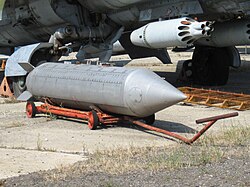
KMGU (Russian: Контейнер малогабаритных грузов унифицированный, Unified Container for Small-sized Load) is a Soviet munitions dispenser similar to the British JP233 and the German MW-1. It can be carried by most Soviet and Russian attack aircraft, including the MiG-23, the MiG-27, the MiG-29, the Su-22, the Su-24, the Su-25, the Su-27, the Su-30, and the Su-34 and the Mi-24, Ka-50 and the Ka-52 attack helicopter. The cylindrical aluminum fuselage is divided into 8 sections, each has its own pneumatically opened doors. It can be filled with:

Key Information

  • 96 (8×12) AO-2,5RT 2.5 kilogram-mass high explosive mines
  • 96 (8×12) PTM-1 anti-tank mines
  • 156 PFM-1S mines

KMGU-2 is an advanced version of the system.

Users

[edit]

See also

[edit]
  • JP233 – (United Kingdom)
  • MW-1 – (Germany)
  • K/YBS500 – (China)
  • CS/BBC5 – (China)

External sources

[edit]
Revisions and contributorsEdit on WikipediaRead on Wikipedia
from Grokipedia
The KMGU (Russian: Контейнер малогабаритных грузов унифицированный, Unified Container for Small-Sized Loads) is a reusable, aircraft-mounted cluster munitions dispenser developed by the in the 1970s for delivering submunitions such as anti-personnel and anti-tank mines from . Designed as a lightweight aluminum canister with a conical nose, four-fin tail unit, and cylindrical body divided into multiple sections (typically eight), the KMGU is suspended externally via 250 mm spaced lugs and features pneumatically operated doors or clamshell compartments that eject payloads using high-pressure air bags upon reaching the target area. An upgraded variant, the KMGU-2, was introduced by the in the 2000s, enhancing deployment capabilities while maintaining compatibility with various submunitions, including up to 96 AO-2.5RT fragmentation bombs, 96 PTM-1S anti-tank mines, or 156 PFM-1 anti-personnel mines. Primarily employed by Russian and former Soviet bloc forces for area denial and armored vehicle suppression, the system remains in active service, though production totals are undisclosed and its use has raised international concerns over hazards.

Design and Development

Historical Background

The KMGU (Konteyner Malogabaritnykh Gruzov Unifitsirovannyy), or Unified Container for Small-Sized Loads, was developed in the during the 1970s as part of efforts to modernize aerial delivery systems for cluster munitions amid tensions. This dispenser emerged from the Soviet military's push to create versatile platforms for area-denial ordnance, addressing the need for efficient dispersion of submunitions in response to evolving battlefield requirements against potential forces. The initial design goals centered on producing a reusable, -mounted container capable of carrying and releasing small submunitions, such as anti-personnel and anti-tank mines, to saturate target areas with minimal aircraft exposure. Unlike single-use bombs, the KMGU was engineered for adaptability across various Soviet fixed-wing and rotary-wing platforms, allowing for the integration of different payload types to enhance tactical flexibility in ground support roles. This approach built upon earlier Soviet cluster systems, including the RBK series of cassette bombs, which had demonstrated the effectiveness of submunition dispersal but lacked the modularity of a dedicated dispenser. Key milestones included the introduction in the 1970s, with initial operational capability around 1970, followed by first combat use in the during the Soviet-Afghan War, which provided impetus for such innovations in aerial mining and submunition delivery. Testing occurred at Soviet facilities focused on ordnance, confirming the dispenser's reliability for operational deployment and paving the way for its integration into frontline units. The KMGU's design was similar to some Western counterparts in its emphasis on low-altitude, high-volume submunition release.

Engineering Features

The KMGU dispenser features a cylindrical aluminum designed for aerodynamic efficiency, incorporating a conical nose section and a four-fin tail unit that provides stability during flight. This construction utilizes lightweight aluminum to minimize drag while maintaining structural integrity under operational stresses. The is divided into eight independent sections, each serving as a modular compartment capable of holding submunitions in standardized cassettes, allowing for flexible payload configurations without compromising the overall dispenser integrity. Each of the eight sections is equipped with pneumatically operated rotating doors, enabling sequential or simultaneous release of submunitions as determined by the mission parameters. These doors are actuated by a high-pressure compressed air system, which powers the opening mechanism without employing explosive forces that could damage the dispenser. The dispersal technology emphasizes a non-explosive ejection process, where compressed air inflates internal bags to propel the contents outward, preserving the container for potential reuse; in some configurations, pyrotechnic charges assist in the ejection while still avoiding destruction of the dispenser body. This modularity supports the KMGU's role in deploying anti-personnel mines such as the PTM-1, where the pneumatic system ensures controlled dispersal. The dispenser's reusability is a core engineering principle, facilitated by its non-destructive dispersal mechanism that allows recovery and reloading after missions. It includes standard Soviet-era suspension lugs spaced 250 mm apart for secure external mounting on aircraft pylons, ensuring compatibility with various release systems. The aluminum construction inherently provides corrosion resistance, combined with weatherproof sealing on compartments, enabling the KMGU to withstand multiple exposure cycles to environmental elements during repeated deployments.

Specifications

Physical Characteristics

The KMGU dispenser measures 3.7 meters in length and 0.46 meters in diameter. Its empty weight is 170 kg, while the maximum gross weight reaches 525 kg when fully loaded with munitions. The dispenser's aerodynamic profile includes a conical designed to minimize drag during flight, complemented by rectangular stabilizing fins. Constructed primarily from aluminum, it provides the necessary durability for aerial deployment. The KMGU operates effectively across a range of environmental conditions, including deployment from low altitudes of 30 meters to 1,000 meters at aircraft speeds between 700 km/h and 1,100 km/h.

Munition Capacities

The dispenser is designed to carry up to 96 AO-2.5RT high-explosive fragmentation mines, each weighing 2.5 kg, arranged in an 8x12 configuration within its modular cassettes. This configuration allows for efficient packing of the submunitions, which are housed in BFK cassettes that facilitate aerial dispersal. Similarly, the dispenser accommodates 96 PTM-1 anti-tank mines, each with a total weight of approximately 1.5 kg, or up to 156 PFM-1S anti-personnel scatterable mines, each weighing about 75 g. The KMGU supports modular loading across its eight internal sections, enabling mixtures of munition types such as fragmentation mines, anti-tank mines, and anti-personnel mines, while maintaining structural integrity during deployment from . This flexibility allows operators to tailor the load for specific tactical needs, such as area denial or anti-armor operations. Other compatible items include small bombs like the PTAB-2.5KO submunitions, also in quantities up to 96. When deployed, these submunitions are ejected to create dispersal patterns, providing broad coverage for saturating target areas with ordnance. This area effect is achieved through pneumatic ejection mechanisms that scatter the cassettes' contents over the designated , enhancing the dispenser's utility in Soviet-era tactical doctrines.

Deployment

Compatible Aircraft

The KMGU submunition dispenser is compatible with a range of Soviet and Russian fixed-wing aircraft, primarily mounted on underwing or centerline pylons for delivery of cluster munitions. Notable platforms include the MiG-23, which utilizes external pylons for KMGU integration in ground attack roles. The MiG-27 employs underwing hardpoints to carry the dispenser, often in configurations supporting anti-armor submunitions. Similarly, the MiG-29 integrates the KMGU via wing pylons, with electrical systems ensuring timed release of submunitions like AO-2.5 fragmentation bombs. The Sukhoi family of aircraft provides extensive compatibility, with the Su-22 using underwing stations for KMGU loads up to 500 kg equivalents. The Su-24 mounts the dispenser on multiple nodes, including centerline and wing pylons, accommodating up to four units for all-weather strikes. The Su-25, a primary close air support platform, typically carries four KMGU units on underwing pylons, integrated with its BKF cartridge system for interval dispensing. Advanced variants like the Su-27, Su-30, and Su-34 support 4-6 dispensers depending on pylon configuration, with the Su-27 using wing and fuselage stations for high-speed deployment from altitudes up to 10 km. Rotary-wing platforms include the Mi-24 attack helicopter, which attaches the KMGU to external hardpoints for low-level dispensing, though later upgrades like the Mi-35M are incompatible. The Ka-50 and Ka-52 helicopters utilize wing stubs and external pylons for KMGU carriage, with the dispenser's pneumatic doors adapted for release sequences. Overall, the KMGU integrates seamlessly with Soviet and Russian weapon management systems via standard electrical and mechanical interfaces, enabling salvo releases across platforms. Post-Soviet aircraft such as the Su-30 require minor modifications for enhanced linkage to modern fire control systems, ensuring compatibility without major structural changes.

Release Mechanisms

The KMGU dispenser is activated by the pilot through controls, which initiate a to open the clamshell doors of its eight cargo compartments. This system relies on a high-pressure air bottle to power the actuators, ensuring reliable door opening without pyrotechnic components in the primary release phase. Once activated, the dispersal sequence proceeds automatically: a compressed air cylinder inflates airbags within each compartment to eject the BKF cassettes containing submunitions, with releases occurring in programmable intervals of 0.05, 0.2, 1.0, or 1.5 seconds to control spread. Deployment typically occurs at low altitudes ranging from 30 to 1,000 meters and airspeeds of 700 to 1,100 km/h, allowing for effective submunition release during high-speed passes. In some configurations, a low-explosive bursting charge, triggered by a mechanical time fuze, supplements the pneumatic ejection for specific submunition types. Pattern control is achieved through adjustable timing delays in the automated release system, combined with maneuvers such as banking or speed adjustments, enabling patterns from concentrated targeted dispersal to wider coverage over areas up to several hundred meters. For example, shorter intervals produce tighter spreads, while longer ones, paired with flight path variations, expand the footprint for area denial. Safety features include post-release arming of submunition fuses, which activate only after ejection via airstream or , preventing premature detonation during carriage. Certain submunitions, such as the PTAB-1M, incorporate a pyrotechnic mechanism with a 20- to 40-second delay to mitigate risks. The KMGU container itself features no inherent recovery systems like parachutes, though training variants may employ them for safe retrieval.

Operational History

Soviet Era

The KMGU munitions dispenser saw its first combat deployment during the Soviet-Afghan War from 1979 to 1989, where Soviet Air Force aircraft used it to deliver submunitions against positions, particularly for area denial through the dispersal of PTM-1 anti-tank mines. This marked the system's operational debut in a major conflict, tying back to its development as a versatile container for small-sized loads in the 1970s. The KMGU was widely employed across as part of broader Soviet efforts to counter guerrilla tactics in mountainous terrain, often integrated with and fixed-wing strikes. Within Soviet doctrine, the KMGU was incorporated into tactics, emphasizing rapid submunition dispersal over enemy troop concentrations and nodes during training exercises and combat missions. Pilots practiced low-altitude releases to maximize coverage, aligning with the emphasis on area saturation to compensate for the elusive nature of forces.

Modern Conflicts

In the , Russian and Syrian government forces extensively employed , including the KMGU dispenser loaded with AO-2.5RT and PTAB-2.5KO submunitions, from 2012 onward, with documented use continuing into 2024. KMGU variants have been documented in northern since 2013. These dispensers were deployed via aircraft in populated areas, contributing to significant civilian harm; for instance, on November 6, 2022, strikes using Uragan rockets on internally displaced persons (IDP) camps in province killed at least eight civilians and injured 75 others. Earlier incidents, such as the October 6, 2023, attack on Termanin in using , resulted in two civilian deaths and nine injuries, while a November 18, 2023, strike near Aleppo's Qabasin killed one child and injured three more. The use of such weapons has left extensive (UXO) contamination, exacerbating long-term risks in regions like and . During the Russo-Ukrainian War, particularly following the 2022 escalation, Russian forces utilized KMGU dispensers with submunitions including AO-2.5RT from aircraft such as the Su-25 and Su-34 in strikes across the Donbas and Kharkiv regions, causing widespread civilian casualties. Human Rights Watch documented over 300 civilian casualties from Russian cluster munition attacks in 2022–2023. Ukrainian forces also employed KMGU systems in response, though on a smaller scale, further contaminating front-line areas with submunitions. Cluster munition remnants have been observed in areas like Dobropillia in Donbas, where a March 2025 incident using cluster munitions killed 11 civilians. By mid-2025, the conflict had produced the highest global toll from cluster munitions for the third consecutive year, with the Cluster Munition Monitor noting over 1,200 civilian victims in Ukraine from 2022–2025 amid ongoing UXO threats (as of September 2025). In the 2011 Libyan Civil War, forces loyal to deployed cluster munitions, including RBK-series bombs, in assaults on civilian areas such as and , though specific KMGU use remains unconfirmed in combat records. Reports of potential Sudanese applications of cluster dispensers like KMGU in conflicts post-2000 are unverified, but UN experts confirmed the presence of series munitions at El Fasher Airport in as late as 2014, linked to government operations. The deployment of KMGU and similar systems in these conflicts has drawn international condemnation for violating the 2008 , which prohibits their use despite non-signatory status by key actors like and . UN reports as of 2025 highlight severe UXO contamination in and , with persistent clearance challenges in Syrian governorates like and , where submunitions continue to cause casualties years after strikes. This legacy echoes earlier Soviet-era applications, such as in , but has intensified humanitarian crises in post-1991 battlefields.

Variants

Original KMGU

The original KMGU (Konteyner Malogabaritnykh Gruzov Universal'nyy), or Universal Container for Small Cargo, was a Soviet-era aerial dispenser introduced in the 1970s as a primary munition delivery system for fixed-wing bombers and . Developed during the to enhance area-denial capabilities, it represented an early standardized platform for dispersing submunitions without requiring the dispenser itself to be jettisoned, allowing for repeated use after reloading. Its design emphasized simplicity and compatibility with a range of Soviet assets, marking a shift toward more efficient deployment in tactical operations. The baseline model featured an aluminum divided into eight cylindrical sections, each equipped with independent pneumatically actuated doors for controlled release. A cylinder powered the actuators, inflating expulsion bags to eject contents at programmable intervals of 0.05, 0.2, 1.0, or 1.5 seconds, ensuring patterned dispersal over target areas. Optimized for standard mine loads, it typically accommodated 96 units such as AO-2.5RT fragmentation submunitions or PTAB-2.5KO anti-armor bomblets, arranged in eight BKF cassettes of 12 each, with the empty dispenser weighing approximately 170 kg and measuring 3.7 meters in length. This configuration prioritized high-volume delivery for anti-personnel and anti-vehicle roles, though it required aircraft integration via fixed suspension lugs spaced 250 mm apart. As a captive, non-releasable system, the original KMGU remained attached to the host aircraft post-dispersion, facilitating reusability in non-combat scenarios but exposing it to operational wear. It saw its first combat application during the Soviet-Afghan War (1979–1989), where it proved effective for wide-area saturation against insurgent positions. While the design's pneumatic simplicity supported broad adoption, later variants like the KMGU-2 addressed evolving requirements, though the original persisted in service due to its reliability in legacy stockpiles.

KMGU-2

The KMGU-2 represents an advanced iteration of the Soviet-era KMGU munitions dispenser, developed and introduced by the during the 2000s to improve overall reliability and compatibility with contemporary platforms. This addressed limitations in the original design, focusing on improved reliability and compatibility with post-Soviet military requirements. Key physical modifications include a of 3.7 , allowing for a more streamlined profile while maintaining the core eight-compartment structure divided by pneumatically operated doors. The system supports variable submunition capacities depending on the payload configuration, such as 96 units of AO-2.5RT high-explosive bomblets or PTAB-2.5KO shaped-charge submunitions per dispenser, and up to 248 PTAB-1M submunitions in specialized setups. Deployment relies on automated pneumatic actuators and cylinders, enabling precise ejection intervals of 0.05, 0.2, 1.0, or 1.5 seconds to optimize dispersal patterns. The KMGU-2 also enhances compatibility with rotary-wing such as the Ka-52 . Enhancements emphasize reusability, with the dispenser classified as a non-releasable, recoverable unit suitable for multiple missions after payload expenditure. It integrates with a variety of submunitions, including anti-personnel and anti-tank mines like the PTM-1 and POM-2, facilitating versatile area-denial roles. By the early 2010s, the KMGU-2 had entered standard service with Russian fixed-wing and rotary-wing assets, including the Su-34 fighter-bomber and Ka-52 attack helicopter, enhancing their capabilities. It saw documented deployment in Syrian operations, where it delivered submunitions such as AO-2.5RT and PTAB-2.5KO for targeted strikes against ground forces.

Operators

Primary Users

The Russian Aerospace Forces serve as the primary operator of the KMGU munitions dispenser, inheriting and maintaining the system as a key component of its aerial ordnance inventory from the Soviet era. Russia continues to integrate the KMGU into its military doctrine for area suppression tactics, with the dispenser compatible across various fixed-wing platforms in active service. Among Soviet successor states, inherited KMGU from Soviet stockpiles and retains them as of 2023. As a non-signatory to the 2008 , views such dispensers as legitimate conventional weapons and sustains ongoing production of systems without adhering to international prohibitions on their use or stockpiling.

Export Users

The KMGU munitions dispenser has been exported to several countries outside the former Soviet sphere, primarily through Russian state channels, with documented use in regional conflicts. received supplies from starting in 2011, enabling the Syrian Arab Air Force to deploy KMGU units loaded with cluster submunitions during airstrikes in the ongoing . Libya maintained stockpiles of KMGU dispensers under the Gaddafi regime, as reported in defense assessments from 2004, with remnants employed by pro-government forces amid the 2011 civil war. In Sudan, the has held KMGU units in its inventory since the 1990s, with indications of potential deployment in conflicts involving . Additional recipients include , , and , where Russian-origin cluster munitions, including KMGU dispensers, are reported in national stockpiles as of 2004 (confirmed in 2023 assessments). Other countries possessing KMGU include , , and . Ukrainian forces captured Russian KMGU units during the 2022 conflict escalation. Exports of the KMGU have been handled primarily by , Russia's state arms exporter, with sales limited in scope compared to domestic production.

References

Add your contribution
Related Hubs
User Avatar
No comments yet.