


Community hub
Recent from talks
Contribute something
Nothing was collected or created yet.
Kamov Ka-50
View on Wikipedia
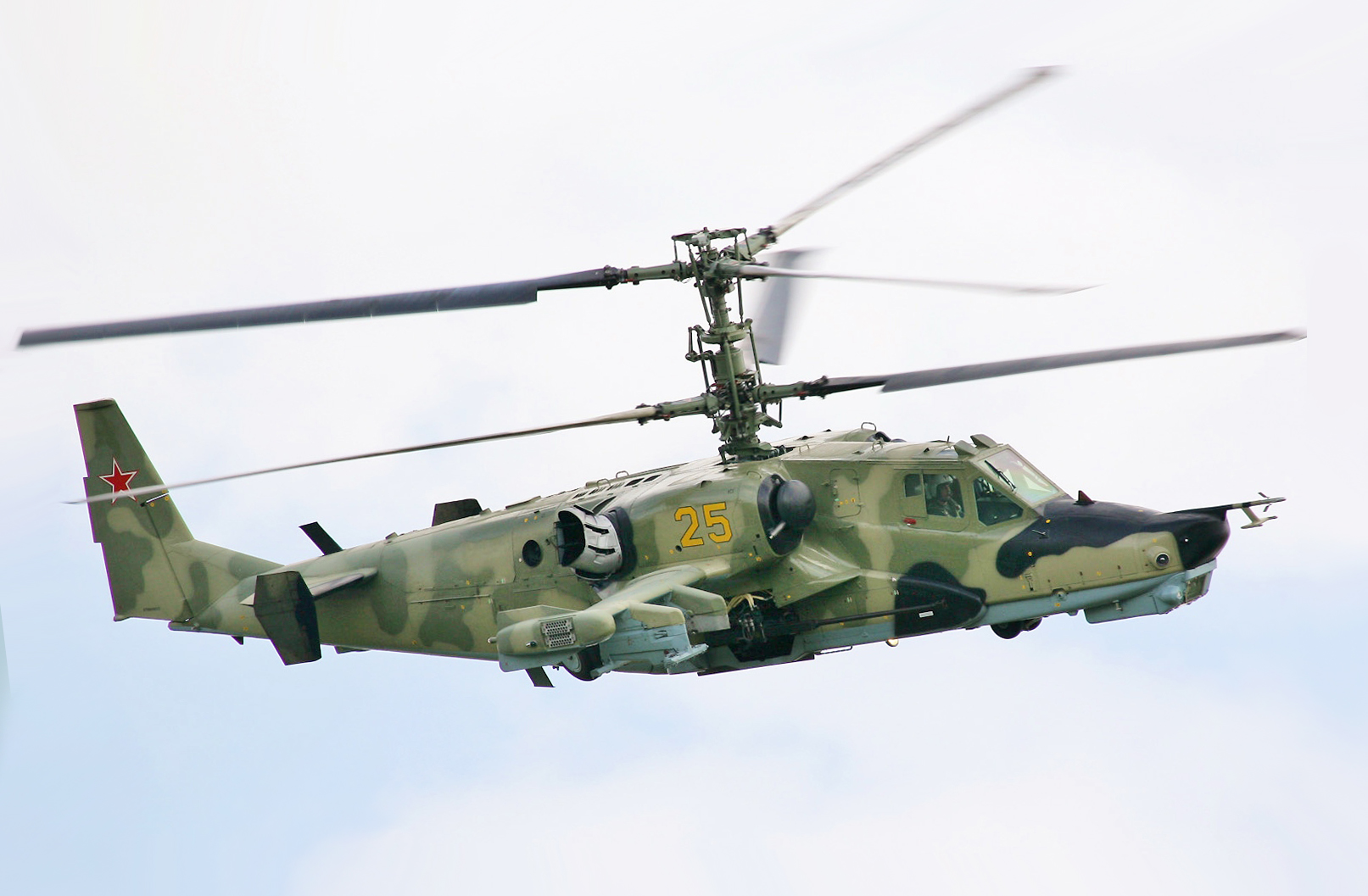
The Kamov Ka-50 "Black Shark" (Russian: Камов Ка-50 «Чёрная акула», romanized: Chyornaya akula, English: kitefin shark, literally: black shark), NATO reporting name Hokum A, is a Soviet/Russian single-seat attack helicopter with the distinctive coaxial rotor system of the Kamov design bureau. It was designed in the 1980s and adopted for service in the Russian army in 1995. The Ka-50 is manufactured by the Progress company in Arsenyev. It is used as a heavily armed scout helicopter[2] and has a rescue ejection system, rare for helicopters.
Key Information


During the late 1990s, Kamov and Israel Aerospace Industries developed a tandem-seat cockpit version, the Kamov Ka-50-2 "Erdogan" (Russian: Эрдоган, Turkish: Erdoğan), to compete in Turkey's attack helicopter competition. Kamov also designed another two-seat variant, the Kamov Ka-52 "Alligator" (Russian: Аллигатор, NATO reporting name: Hokum B).[10] The Ka-52's unit cost is US$16 million as of 2023.[11]
Development
[edit]The Ka-50 is the production version of the V-80Sh-1 prototype. Production of the attack helicopter was ordered by the Soviet Council of Ministers on 14 December 1987.[12] Development of the helicopter was first reported in the West in 1984, while the first photograph appeared in 1989.[13] During operational testing from 1985 to 1986, the workload on the pilot was found to be similar to that of a fighter-bomber pilot, such that the pilot could perform both flying and navigation duties.[14]
Like other Kamov helicopters, it features Kamov's characteristic coaxial contra-rotating rotor system, which removes the need for the entire tail rotor assembly and improves the aircraft's aerobatic qualities—it can perform loops, rolls and "the funnel" (circle-strafing), where the aircraft maintains a line-of-sight to the target while flying circles of varying altitude and airspeed around it.[15] The omission of the tail rotor is a qualitative advantage, because the torque-countering tail rotor can use up to 30% of engine power. The Ka-50's entire transmission presents a comparatively small target to ground fire.[16]
For improved pilot survivability the Ka-50 is fitted with a NPP Zvezda (transl. Star) K-37-800 ejection seat, which is a rare feature for a helicopter.[17] Before the rocket in the ejection seat deploys, the rotor blades are blown away by explosive charges in the rotor disc and the canopy is jettisoned.[18]

Following initial flight testing and system tests, the Council ordered the first batch of helicopters in 1990. The attack helicopter was first described publicly as the "Ka-50" in March 1992 at a symposium in the United Kingdom.[12] The helicopter was unveiled at the Mosaeroshow '92 at Zhukovskiy in August 1992. The following month, the second production example made its foreign debut at the Farnborough Airshow, where it was displayed with an image of a werewolf on its rudder—gaining the popular nickname "Werewolf". The fifth prototype, painted black, played the title role in the movie Чёрная акула (Black Shark), which made the Ka-50 known by its current nickname.[19]
In November 1993, four production helicopters were flown to the Army Aviation Combat Training Centre at Torzhok to begin field trials. The president of the Russian Federation authorized the fielding of the Ka-50 with the Russian Ground Forces (army) on 28 August 1995. The collapse of the Soviet Union led to a severe drop in defense procurement. This resulted in only a dozen Ka-50s delivered, instead of the planned several hundred to replace the Mil Mi-24.[20]
The single-seat configuration was considered undesirable by NATO. The first two Ka-50 prototypes had false windows painted on them,[21] which successfully misled the first western reports of the aircraft in the mid-1980s,[22] to the point of some analysts even concluding that its primary mission was as an air superiority aircraft for hunting and killing NATO attack helicopters, an alarming but expected Soviet move by NATO planners following the recent J-CATCH program evaluation.[23]
The Ka-50 and its modifications have been chosen as the special forces' support helicopter, while the Mil Mi-28 has become the main army's gunship. The production of Ka-50 was recommenced in 2006. In 2009, the Russian Air Force received three units built from incomplete airframes dating from the mid-1990s.[24]
Ka-50N "Night Shark" and Ka-50Sh
[edit]From the time the Ka-50 was ordered in 1987, it was known that the limited night-time capability of the original version would have to be upgraded to meet night attack requirements.[25] Initially, Ka-50N was meant to be fitted with the Merkury Low-Light TV (LLTV) system. Due to lack of funding, the system was late and experienced reliability and capability issues. As a result, focus shifted to forward looking infrared (FLIR) systems.[26] Kamov drafted a design in 1993 that included the Shkval-N sighting system with an infrared sensor.[25] Many variants were tried. On some, the original Shkval was supplemented by a thermal imaging system, while others saw a complete replacement by the Samshit day-and-night system (also used on Ka-52). Some of the imagers included in the trials were manufactured by the French SAGEM and Thomson companies. Kamov was forced to consider foreign analogues as a temporary replacement for domestic imaging systems because of their slow development.[26]
Trials led to two "final" versions: Ka-50N "Night Shark" (Russian: Ночная акула, "velvet belly lanternshark")[27] and Ka-50Sh (Russian: Шар, romanized: Shar, "ball"; because of the spherical FLIR turret). The first Ka-50Sh, which was the eighth pre-production aircraft, Bort 018, first flew on 4 March 1997. The Kamov company and Black Shark logos were displayed on the endplate fins and the vertical tail. It featured the Samshit-50 system installed within a 640 mm (25 in) diameter sphere under the nose. Shkval system was moved to the nose cone area.[20] Neither of the Ka-50 night-attack versions has entered full production.[26]
Ka-50-2 "Erdogan"
[edit]In 1997, Israel Aerospace Industries (IAI) in cooperation with the Kamov bureau entered the Ka-50-2 Erdoğan in a Turkish design competition for a $4 billion contract for 145 (later changed to 50) combat helicopters.[citation needed]
The Ka-50-2 is a tandem cockpit variant of the Ka-50. It featured a modern, Israeli-made "glass cockpit" avionics and a turret-mounted folding (for landing clearance) 30 mm cannon instead of the fixed cannon on the Ka-50. It features combat-proven avionics and advanced anti-tank guided missiles for a high level of combat effectiveness. It is equipped with IAI's flexible modular avionics suite, which can be readily tailored to meet the TLF's operational requirements and provides growth potential.[28]
IAI and Kamov performed flights of the variant with IAI's Core Avionics. These flights demonstrated the helicopter's "glass cockpit" with multifunctional displays and Control and Display Unit (CDU) driven by centralized mission computers. Also tested were its flight navigation and the operation of the Helicopter Multi-Mission Optronic Stabilized Payload (HMOSP) targeting system. The demonstration flights included night mission capability demonstrations using Night Vision Goggles (NVG) and the day/night targeting system.[28]
Turkey initially selected an improved version of the Bell AH-1 SuperCobra over the Erdogan, Eurocopter Tiger, AH-64 Apache, Denel Rooivalk, and A129 Mangusta. In the end, the contract was awarded to the A129 in 2007.[29]
Ka-52 "Alligator"
[edit]
In the early 1980s, while comparative tests of the V-80 (Ka-50 prototype) and the Mi-28 were being conducted, the Kamov design team came up with a proposal to develop a dedicated helicopter to conduct battlefield reconnaissance, provide target designation, support and coordinate group attack helicopter operations based on the Ka-60. However, the economic hardships that hit the nation in the late 1980s hampered this new development program. This prompted Kamov's Designer General to choose a modified version of Ka-50 on which to install the reconnaissance and target designation system. The modified "Black Shark" required a second crew member to operate the optotronics/radar reconnaissance suite. Kamov decided to use side-by-side seating arrangement, due to the verified improvements in co-operation between the crew members. This twin-seat version was designated Ka-52.[20]

In comparison to the original Ka-50, the Ka-52 has a new radome with a nose-mounted radar system for targeting giving the Ka-52 a rounder nose profile. A day-and-night TV/thermal sighting system is fitted in a spherical turret under the nose (some examples have an additional mast radar for aerial targets and a second sighting system above the cockpit). The Ka-52 has the side-mounted cannon of the original Ka-50.[30] It features six wing-mounted hardpoints compared to four on the Ka-50. To keep the weight and performance on par with that of the Ka-50, the armor and the capacity of the cannon magazine/feed were reduced. Also some flight parameters deteriorated: rate of climb dropped from 10 to 8 m/s and maximum positive load factor became 3.0 g. Most of the problems were solved by installing the new VK-2500 engine.[18] The Ka-52 is approved for day, night and adverse weather conditions.[31]
Manufacturing of the first Ka-52 airframe began in mid-1996.[20] Series production was started in autumn 2008.[32] As of September 2010[update], the 696th Instructor and Research Helicopter Regiment, based at Torzhok (air base), is operating eight helicopters, in varying degrees of capability and/or modification, for research and development.[24] In December 2010, four new, series-production Ka-52s were delivered to the Air Base[33] of the 344th Centre for Combat Training and Aircrew Conversion.[34]
.jpg)
The first phase of the official tests (ГСИ) was completed in December 2008 and after that permission was given for the production of an experimental batch for phase 2 (ГСИ, including fire tests and the search for targets)[35]
Serial production of the Ka-52 began at the Progress Arsenyev Aviation Company plant in Arsenyev, Primorsky Krai by end of the 2008.[36][37] After the completion of the state trials, the Ka-52 entered service in May 2011 with first operational units joining the Russian Air Force the same month. Under previous State Defense Procurement Plans, the Russian Armed Forces was to receive 2 experimental and 24 serial Ka-52s by 2012.[38] The second long-term contract signed in 2011 worth 120 billion rubles is to provide the Russian Aerospace Forces with 146 Ka-52 helicopters in total until 2020. In February 2018, the Russian Ministry of Defence expressed an interest to purchase 114 Ka-52s of a new version within the new State Armament Program for 2018–2027.[39]
Ka-52 "Nile Crocodile"
[edit]In 2015, Egypt signed a deal for the purchase of 46 Ka-52 helicopters, with a stated completion year of 2020.[40] Russian Helicopters started producing its first export models in early 2017, the overall production was doubled in order to meet new demands.[41] The first batch of 3 Ka-52 attack helicopters was delivered to Egypt in July 2017, with a second batch of another 3 helicopters being delivered in August. By year-end 2017, Egypt had received 19 Ka-52s,[42] but these early units came with issues related to power, night vision, navigation systems, and other avionics equipment.[43] On 6 December 2018, it was announced at the Egypt Defence Expo (EDEX) that Ka-52s had officially entered service with the Egyptian Air Force.[44]
Egypt's helicopter is a modified version of the basic Ka-52 Alligator that serves in the Russian Aerospace Forces. Unlike the basic model, the Egyptian Ka-52 utilizes anti-corrosion materials and has a reinforced fuselage structure. It received new landing gear and wheels, designed for the increased takeoff weight of the helicopter. The Egyptian model features updated avionics and a new cooling system for operating in hot climate. Dmitry Rogozin, Deputy Prime Minister of Russia on defense and space industry, proposed to name it the "Nile Crocodile".[45]
The helicopter is equipped with the new OES-52 electro-optical observation and laser targeting system, replacing the standard GOES-451 mounted under the nose.[46] The new optronic system began development in 2011 as a collaboration between Kamov and Sagem, and is based on the French company's STRIX sighting System.[47] The OES-52 provides greater range of target detection and recognition.
The helicopter features the Arbalet-52 dual-band coherent pulse radar, which has an Earth mapping range of 32 km and a detection range of 25 km for ground targets and 15 km for aerial targets.[48]
The Nile Crocodiles use President-S airborne defense systems for protection against guided missiles.[49][50] The system includes both radar and laser warning receivers, MAW sensors, chaff/flare dispensers, in addition to ECM and DIRCM jammers.[51] Egyptian Ka-52s feature two new DIRCM sets installed on either side of the fuselage, which are different from the standard L370-5 sets.[52] Moreover, the laser-warning system present on the Russian variants of the Ka-52 has been removed, and a L-150 Pastel radar warning receiver has been installed instead.[49]
Egypt plans to arm its Ka-52s with Russian anti-tank guided missiles. The Air Force has chosen two types of missiles; namely the laser-guided Vikhr and the radar-guided Ataka beam-riding missiles.[53]
Ka-52K "Katran"
[edit].jpg)
The Mistral-class amphibious assault ships, ordered by the Russian Defense Ministry,[citation needed] were to contain rotary-wing assets, formed into aviation groups. Each of these groups was planned to include eight attack and eight assault/transport helicopters. The Ka-52K "Katran" (Russian: Катран, 'mud shark'), a navalised derivative of the Ka-52, has been selected as the new ship-borne attack type for the Russian Naval Aviation. Its features include folding rotor blades, folding wings, and reinforced landing gear. Since its wings are shorter than those of the land-based variants, the Ka-52K only has four weapons pylons, instead of six on the land-based Ka-52. There are plans to install a new radar in the Ka-52K, with longer range compared to the Ka-52's radar. The Ka-52K will also be able to use Kh-35 and Kh-38 missiles. However, they haven't yet been integrated in the helicopter's mission suite.[54] Russian Naval Aviation will need at least 40 Ka-52Ks, the first of which was tentatively slated to enter squadron service by early 2015, coinciding with the delivery of the first carrier.[55]
However, following the Russian annexation of Crimea the sale of the Mistrals was cancelled and they have since been sold to Egypt.[56][57] Later, Egypt bought 46 Ka-52s, with deliveries lasting from 2017 to 2019. These helicopters have been deployed on the Mistrals originally built for Russia; however, Egyptian Ka-52s are regular land-based variants, not Ka-52Ks.[58]
Still, the first of four Ka-52Ks ordered for the Russian Navy flew on 7 March 2015; the Navy also had an option for a further 28 helicopters.[59] As of 2017, 4 pre-series Ka-52Ks were operated and used for testing by the Russian Navy.[60][61] After a period of uncertainty, the Ka-52K's future with the Russian Navy now appears clearer. In July 2020, the keel was laid for two new Project 23900 amphibious assault ships in the Zalyv Shipbuilding yard. Each ship will be able to carry up to 18 helicopters, including Ka-52Ks.[62] The Ka-52K has passed all tests and was ready for serial production as of September 2020.[63]
According to the SCMP, China is considering the purchase of 36 Ka-52Ks to be used aboard the Type 075 helicopter carrier, which would fulfil the role of a heavy attack helicopter. These helicopters are necessary to equip the carrier with powerful attack weapons, which it currently lacks.[64]
Ka-52M
[edit]The new version announced by the Russian Ministry of Defence in 2018 eventually crystalized into the Ka-52M; 114 helicopters of this new version are to be acquired. Additionally, older Ka-52s are to be upgraded to Ka-52M standard. The contract for the first 30 Ka-52Ms was signed in August 2021.[65] A new contract was signed in August 2022.[66] Upgrades embodied in the Ka-52M include a modernized GOES-451M electro-optical targeting turret with an increased range, stronger undercarriage wheels, and improved cockpit ergonomics, with better adaptation to the use of night-vision goggles. The LMUR missile is added to the helicopter's armament options.[67] Several new radar types are being considered for the Ka-52M.[68] A new self-protection system will also be fitted to the Ka-52M, replacing the current L370-5 Vitebsk. Lastly, the Ka-52M is adapted to work within a new battlefield command and control system.[69] The Russian military received its first 10 modified Ka-52M helicopters on 9 January 2023. The state defense order for the helicopters was doubled in 2023.[8][70]
Design
[edit]
The Ka-50 and its two-seat version Ka-52 are high-performance combat helicopters with day and night capability, high survivability and fire power, to defeat air targets and heavily armoured tanks armed with air defence weapons. It was designed to be small, fast and agile to improve survivability and lethality.[16]
Maneuvering
[edit]The hovering ceiling is 4,000 m and vertical rate of climb 10 m/s at an altitude of 2,500 m. Having a coaxial rotor with blades of polymer results in low inertia both relative to vertical and lateral axes, at 50%–75% as compared to a single rotor helicopter with tail rotor. No tail rotor also means it can perform flat turns at all speeds. A maximum vertical load of 3.5 g combined with low inertia makes the Ka-50 highly agile.
Navigation systems
[edit]Flight systems include an inertial navigation system (INS), autopilot and head-up display (HUD). Sensors include forward-looking infrared (FLIR) and terrain-following radar.[26][16]
The Kamov Ka-50 is also fitted with an electronic radio and sighting-piloting-navigating system allowing flights at day and night in VFR and IFR weather conditions. The novelty of this avionics is based on the system of precise target designation with digital coded communication system, which ensures the exchange of information (precise enemy coordinates) between helicopters flying far apart from each other as well as with ground command posts.[26] The Ka-52 is also equipped with a "Phazotron" cockpit radio-locator, allowing flights in adverse meteorological conditions and at night. The necessary information acquired by this radio-locator is transferred to the cockpit's multi-functional display screen. For conducting a fight, both pilots are equipped with range-finders built-in their helmets and they can use night vision eyepieces for night flights.[31]
Protection and survivability
[edit]For its own protection, Ka-50 is fitted with a radar warning receiver, electronic warfare system and chaff and flare dispensers.[16] Aerodynamic cases at wings' ends each contain two dispensers, which in turn have 32 x 26 mm countermeasures each. The whole system works on principle of evaluated response based on infrared or electronic impulse irradiation.[31] Extensive all-round armour in the cockpit protects the pilot against 12.7 mm armour-piercing bullets and 23 mm projectile fragments. The rotor blades are rated to withstand several hits of ground-based automatic weapons.[16]
Other survivability features include armour protection for vital aircraft systems, and crash-absorbing landing gear and seats.[71] Also, not having a tail rotor can improve survivability, since the tail boom isn't load-bearing; during testing, a Ka-50 lost its tail, but still managed to return to base without a problem.[72]
It is the world's first operational helicopter with a rescue ejection system allowing the pilot to escape at all altitudes and speeds. The rotor blades detach using explosive bolts prior to ejection to prevent damage to the crew. The K-37-800 rocket-assisted ejection system is manufactured by NPP Zvezda.[16]
Armament
[edit]
The aircraft has one Shipunov 2A42 autocannon with selective fire, and a dual-feed, giving it a cyclic rate of fire between 200 and 800 rounds per minute.[73] It is mounted near centre of gravity for accuracy, and carries 460 high-fragmentation, explosive incendiary, or armour-piercing rounds. The type of ammunition is selected by the pilot during flight.[74] The integrated 30 mm cannon is semi-rigidly fixed on the helicopter's side, movable only slightly in elevation and azimuth.[citation needed] Semi-rigid mounting improves the cannon's accuracy, giving the 30 mm a longer practical range and better hit ratio at medium ranges than with a free-turning turret mount.
The fire control system automatically shares all target information in real time, allowing one helicopter to engage a target spotted by another aircraft, and the system can also input target information from ground-based forward scouts with personnel-carried target designation gear.[18]
Weapons can be carried on four external hardpoints under the stub wings, plus two on the wingtips, a total of more than 2,000 kg (depending on the mix).[75] The pylons can be tilted up to 10 degrees downward. Fuel tanks may be mounted on a suspension point, whenever necessary.[26]
Anti-tank armament comprises twelve Vikhr laser-guided anti-tank missiles (transl. Vortex or whirlwind), with a maximum range of some 8 km. The laser guidance is reported to be virtually jam-proof and the system features automatic guidance to target, enabling evasive action immediately after missile launch, alternatively it can also use Ataka laser-guided anti-tank missiles.[53] Before firing laser-guided missiles it often must hover a few hundred feet off the ground to direct a laser at a target, leaving itself briefly exposed.[76]
Ka-50/52 can also carry several rocket pods, including the S-13 and S-8 rockets. The "dumb" rockets could be upgraded to laser guided with the proposed Ugroza system.[77]
Operational history
[edit]Second Chechen War
[edit]The Ka-50 took part in the Russian Army's operations against separatists in the Chechen Republic during the Second Chechen War. In December 2000, a pair of production Ka-50s arrived in the area. With the Ka-50s was a Ka-29 to provide reconnaissance and target designation. On 6 January 2001, the Ka-50 used live weapons against a real enemy for the first time. On 9 January, at the entry into a mountain gorge in the area of a settlement named Komsomolskoye, a single Ka-50 accompanied by an Mi-24 used S-8 unguided rockets to destroy a warehouse full of ammunition belonging to Chechen insurgents. On 6 February, in the forest-covered mountain area to the south of the village of Tsentoroj, a strike group composed of two Ka-50s and the sole Ka-29 discovered and, from a range of 3 km, destroyed a fortified camp of insurgents using two "9K121 Vikhr" guided missiles. On 14 February, a similar strike group carried out a "hunting" mission in the area of Oak-Yurt and Hatun. In difficult conditions, pilots found and destroyed eight targets. These missions tested the type's airframe, as well as its on-board systems and armament. Its successful performance in difficult, mountainous terrain confirmed the usefulness of the many advanced features of the Ka-50's design, and its power and maneuverability.[20]
Syrian Civil War
[edit]Ka-52 helicopters were spotted being deployed in support of the Russian military intervention in the Syrian Civil War in 2015, various sources stating they were involved in defense of the Russian base in Latakia, providing escort for search and rescue helicopters, and supporting Russian special forces.[78]
On 5 May 2018, a Ka-52 crashed near Mayadin due to a technical failure, according to some sources.[79]
The Ka-52 was briefly used in Syria during the Fall of the Assad regime in December 2024.[citation needed]
Russo-Ukrainian War
[edit]- Russian invasion of Ukraine

On 24 February 2022, during the initial stages of the Russian invasion of Ukraine, at least one Russian Ka-52 helicopter was damaged but was able to land on its own.[80] On 2 March, a Russian Ka-52 was hit by a surface-to-air missile and crash landed.[81] On 12 March, Ukrainian forces reported that Ka-52 tail number RF-13409 had been shot down in Novomykolaivka near Kherson.[82] Ukraine officials claimed on 16 March 2022 that Ka-52 number RF-13411 was shot down at an undisclosed location in Ukraine, providing footage of the airframe wreckage.[83] Footage appeared on social media on 5 April 2022 that appeared to show a hovering Ka-52 shot down by a Ukrainian Stugna-P anti-tank guided missile.[84] On 15 April, Ukrainian forces claimed to have shot down another Ka-52 and published footage of the wreckage; the crew were reported to have died.[85] On 1 May footage appeared of another Ka-52 shot down using a Stugna-P anti-tank guided missile.[86] On 4 June, Ukrainian forces of the 128th Mountain Brigade reported the downing of a Russian Ka-52 in the north. According to Ukrainian officials, the helicopter was shot down by MANPADS.[87][88] On 27 June, another helicopter was hit by a British-made Martlet MANPADS, forcing it to land.[89] On 15 August, Ukrainian forces damaged a Russian Ka-52 helicopter flying in Donetsk Oblast.[90]
Reportedly, a few Ka-52s have suffered from wing vibration under heavy-load attack missions. This was observed months after the invasion. It has been suggested that this may be due to causes such as fatigue, inadequate design, lack of maintenance, and poor management.[91] Ukrainian military intelligence claimed that the Ka-52 can be "disabled with a 7.62mm machine gun" despite a claimed ability to withstand 12.7mm rounds.[92]
Ka-52s have been heavily used by Russian forces to defend against the 2023 Ukrainian counteroffensive. They have been successful, due in part to a shortage of Ukrainian short-range air defence, or SHORAD, weapons. Due to the unique design of the coaxial main rotors, the helicopter can withstand the destruction of the tail. A video released on 19 June 2023 shows a Ka-52 losing its tail. The UK MOD has noted the movement of additional Ka-52s to an airfield near Berdiansk, "In the constant contest between aviation measures and counter-measures, it is likely that Russia has gained a temporary advantage in southern Ukraine, especially with attack helicopters employing longer-range missiles against ground targets".[93][94][95]
As of late July 2023, the UK MoD claimed that Russia has lost 40 Ka-52s since the start of the Russian invasion. At the same time the UK MoD said on 27 July 2023: "One of the single most influential Russian weapon systems in the sector is the Ka-52 HOKUM attack helicopter". With the LMUR missile, the Ka-52 has an attack range of 15 km, putting it beyond the range of Ukrainian air defences.[96][97]
On 7 August 2023, a Russian Ka-52 was reported shot down over Robotyne, making it the 40th lost during the current invasion according to Oryx. Oryx only counts losses confirmed through open sources.[98]
On 17 August 2023, Ukrainian military claimed to have shot down two Ka-52s in one day. One was downed near Robotyne with a MANPAD by the 47th Mechanized Brigade, a second was claimed by the Ukrainian Air Force near Bakhmut.[99] Ukraine has reported that the missile system used to shoot down a Ka-52 near Robotyne was the RBS-70. While a Ka-52 has countermeasures for infra-red and laser guided missiles, it appears to lack radar jamming. It has to rely flying with helicopters like the Mi-28s that have radar jamming technology.[100] Despite sanctions Russia has continued to manufacture Ka-52s.[101]
Additionally five Ka-52s have been destroyed by Ukrainian tactical missiles on 18 October on the grounds of Berdiansk airport, as reported by Oryx (via satellite imaging).[102] A Ka-52 was shot down during the Wagner Group rebellion.[103] Another Ka-52 was able to decoy a missile fired from a Wagner operated 9K35 Strela-10 by use of flares.[104]
On 19 July 2024, a Ka-52 was purportedly shot down by a BM-27 Uragan rocket according to Russian telegram source, both crew were killed, but the location and date of the downing have not been released. This followed a similar event where a rocket narrowly missed an Ka-52 per cockpit footage.[105]
On 7 August 2024 during the Ukrainian incursion into Kursk, a Ka-52 was destroyed along with the two-man crew. The Ukrainians are concerned about the ability of the aircraft to carry 9K121 Vikhr air-to-surface missiles, as they are able to penetrate tank armour. The Ka-52 "can carry up to 12 units, allowing it to attack targets from 5 to 11 kilometres."[106][107]
Ukrainian forces have shot down a Ka-52 attack helicopter using a Swedish-made RBS-70 man-portable anti-air missile in the Kursk region.[108] As of 7 September 2024, 61 Ka-52s have been destroyed during the conflict.[109]
On 23 March 2025, in an operation carried out by the Ukrainian special operations forces, two KA-52s along with two Mi-8s were destroyed by HIMARS at a forward deployment point in Ivnyansky Raion, Belgorod Oblast.[110]
Russia downs several Ukrainian kamikaze drones with KA-52's 30mm cannon and Igla-V missiles.[2][3][4]
Oryx, a Dutch open source website, visually confirmed 64 Ka-52s were destroyed or damaged as of 24 March 2025 (of which, 51 destroyed and 13 damaged).[111]
Other
[edit]It has participated in a number of exercises, including "Boundary 2004" at the Edelweiss training center in Kyrgyzstan during August 2004. The "Shark" demonstrated its advantages by operating at a high altitude and an air temperature of more than 30 °C. A Ka-50 provided cover for the landing of troops and then worked on the ground targets using its cannons and rockets.[20]
India issued a request for proposal for 22 attack helicopters for the Indian Air Force in May 2008.[112] The Ka-50, the Mil Mi-28, and the Eurocopter Tiger were the front-runners for this order as of October 2008.[113] The tender though was eventually cancelled and later India announced a new tender, with revised conditions. Russia again offered the Mi-28N and Ka-52.[citation needed]
The Russian Air Force has accepted 12 Ka-52 helicopters for operational service in 2011, and the total number of completed Ka-52s was already 65 units. 20 Ka-52 aircraft were located at the 575th Airbase Chernigovsky District, Eastern Military District. 16 were at 393rd "Sevastopol" Airbase Korenovsk, Southern Military District, 12 were transferred to newly formed 15th Army Aviation Brigade of the Western Military District at the airport of Ostrov, 8 – Torzhok 344th Centre for Combat Training and Flight Personnel Training. Five test aircraft are owned by JSC "Kamov"; two machines were lost in accidents.[114] The Ka-52 was displayed to the international community at the 2013 Paris Air Show.[115]
In 2013, the AAC "Progress" has completed the contract with the Ministry of Defense of the Russian Federation, signed in 2009, and would begin the next long-term contract for supplying 143 Ka-52, worth about 120 billion rubles (≈US$3.5 bln).[116]
In June 2015, Sergei Kornev, the head of Rosoboronexport's delegation, said that Russia has signed its first contracts on the export of Ka-52 Alligator attack helicopters. "We have the Ka-52 in its export model and we have contracts for it, and it's already being spun because it has a good, firm future" he said at the airshow outside Paris. Kornev did not specify the volume of contracts or with whom they were signed.[117]
The Algerian Air Force is negotiating a sale for 12 Ka-52Es as of 2022. In September 2015, the Ka-52 was presented at Aïn Oussera Air Base.[58]
North Macedonia reportedly bought two Ka-52s (or Ka-50s) from Russia in June 2001 for its North Macedonia Air Brigade. However, the Ministry of Defense of Macedonia denied this report.[118][119]
Variants
[edit].jpg)
- Kamov V-80
- Prototype version for the Ka-50.[120]
- Kamov Ka-50
- Single-seat version[120]
- Kamov Ka-50Sh
- Ka-50 with improved night-attack capability[121]
- Kamov Ka-50-2 "Erdogan"
- Version marketed to Turkey, with a two-seat tandem cockpit.[122]
- Kamov Ka-52 "Alligator"
- Highly upgraded version with a two-seat side-by-side cockpit for the Russian Aerospace Forces[123]
- Kamov Ka-52E
- Export version, sold to Egypt.[124]
- Kamov Ka-52K "Katran"
- Naval version with folding blades and reinforced landing gear, wing shortened for basing on ships and planned capability of using Kh-35 and Kh-38 missiles.[54]
- Kamov Ka-52M
- Upgraded Ka-52 with a modernized targeting turret with an increased range, stronger undercarriage wheels, and improved cockpit ergonomics,[125] nicknamed "Super Alligator".[citation needed]
Operators
[edit]
- Egyptian Air Force[126] – 46 Ka-52s as of 2022.[127]
- 549 Air Wing
- 39 Squadron (Wadi al Jandali)
- 40 Squadron (Wadi al Jandali)
- 41 Squadron (Wadi al Jandali)
- 549 Air Wing

- Russian Aerospace Forces[126] – 133 Ka-52 helicopters as of 2022.[128][129] At least 61 Ka-52s have been destroyed or heavily damaged since the Russian invasion of Ukraine in 2022, as of January 2025.[130]
- 39th Guards Independent Helicopter Regiment (Dzhankoi)
- 55th Independent Helicopter Regiment (Korenovsk)
- 319th Independent Helicopter Regiment (Chernigovka)
- 440th Independent Helicopter Regiment (Vyazma/Dvoevka)
- 15th Army Aviation Brigade (Ostrov)
- 18th Army Aviation Brigade (Khabarovsk/Bolshoy)
- Special Purpose Aviation Brigade Syria
- Helicopter Squadron (Khmeimim Air Base)[131]
- Russian Naval Aviation[60][61]
Specifications (Ka-50)
[edit]
Data from Manufacturer sources[18][30][132] Donald,[14] naval-technology.com,[133][unreliable source?] Federation of American Scientists[134][verification needed]
General characteristics
- Crew: 1
- Length: 16 m (52 ft 6 in)
- Height: 4.93 m (16 ft 2 in)
- Empty weight: 7,700 kg (16,976 lb)
- Gross weight: 9,800 kg (21,605 lb)
- Max takeoff weight: 10,800 kg (23,810 lb)
- Powerplant: 2 × Klimov VK-2500 turboshaft engines, 1,800 kW (2,400 shp) each
- Main rotor diameter: 2 × 14.5 m (47 ft 7 in)
- Main rotor area: 330.3 m2 (3,555 sq ft) contra-rotating 3-bladed main rotors
Performance
- Maximum speed: 315 km/h (196 mph, 170 kn)
- Cruise speed: 270 km/h (170 mph, 150 kn)
- Never exceed speed: 350 km/h (220 mph, 190 kn)
- Range: 545 km (339 mi, 294 nmi)
- Combat range: 470 km (290 mi, 250 nmi)
- Ferry range: 1,160 km (720 mi, 630 nmi)
- Service ceiling: 5,500 m (18,000 ft)
- Rate of climb: 12 m/s (2,400 ft/min)
- Disk loading: 30 kg/m2 (6.1 lb/sq ft)
- Power/mass: 0.33 kW/kg (0.20 hp/lb)
Armament
- Guns: 1 × mobile semi-rigid 30 mm Shipunov 2A42 cannon (460 rounds total, dual feeding AP or HE-Frag)
- Hardpoints: 6 × under-wing hardpoints, plus 2 on wingtips for countermeasures or air-to-air missiles with a capacity of 2,000 kg, with provisions to carry combinations of:
- Rockets: 80 × 80 mm S-8 rockets and 20 × 122 mm S-13 rocket, 4 × Igla air-to-air missiles[16]
- Missiles: 2 × APU-6 Missile racks, able to accommodate a total of 12 × 9K121 Vikhr anti-tank missiles, 2 × LMUR[135]
- Bombs: 4 × 250 kg (550 lb) bombs or 2 × 500 kg (1,100 lb) bombs,
- Other: 23 mm UPK-23-250 gun pods (240 rounds each), 500 L (130 US gal) external fuel tanks.
- Two pods on the wingtips with flare and chaff countermeasure dispensers, 4 UV-26 dispensers each (total 32 chaff/flare cartridges in each pod)
See also
[edit]
Related development
Aircraft of comparable role, configuration, and era
- Agusta A129 Mangusta
- AgustaWestland Apache
- Bell AH-1 SuperCobra
- Bell AH-1Z Viper
- Boeing AH-64 Apache
- CAIC Z-10
- Denel Rooivalk
- Eurocopter Tiger
- HAL Prachand
- Harbin WZ-19
- IAIO Toufan
- Mil Mi-28
- Panha 2091
- TAI/AgustaWestland T129 ATAK
References
[edit]Notes
[edit]- ^ Donald and March 2004, pp. 304–05.
- ^ a b Russian Scout Helicopters Get Stronger Archived 16 December 2012 at the Wayback Machine. Strategypage.com, 29 January 2010.
- ^ Вертолеты Ка-52 начали службу в Дальневосточном объединении ВВС и ПВО [Ka-52 helicopters began service in the Far Eastern Air Force and Air Defense Association]. aex.ru (in Russian). Archived from the original on 31 May 2011. Retrieved 24 May 2011.
- ^ Butowski 2022, p. 17
- ^ Butowski 2022, pp. 47, 74, 82
- ^ "Ка-50". narod.ru (in Russian). Archived from the original on 1 September 2004. Retrieved 21 February 2014.
- ^ "Ка-52". narod.ru (in Russian). Archived from the original on 20 September 2013. Retrieved 23 March 2012.
- ^ a b "Russian army receives 10 upgraded Ka-52M attack helicopters". airrecognition.com. Archived from the original on 11 October 2023. Retrieved 16 November 2023.
- ^ "ЦАМТО / / Гособоронзказ на ААК «Прогресс» в Приморье в 2023 году вырос вдвое". armstrade.org. Archived from the original on 1 October 2023. Retrieved 16 November 2023.
- ^ Hewson, R. The Vital Guide to Military Aircraft, p. 58. England: Airlife Publishing Ltd, 2001.
- ^ Vaniyan, Roman (24 May 2023). "AFU down Ka-52 attack helicopter worth USD 16 million". Ukrainian News Agency. Archived from the original on 26 August 2023. Retrieved 26 February 2024.
- ^ a b Donald and March 2004, pp. 310–11.
- ^ "Kamov Ka-50 Chernaya Akula". Jane's All the World's Aircraft. Jane's Information Group, 2009. (subscription article[permanent dead link], dated 14 September 2009).
- ^ a b Donald and March 2004, p. 310.
- ^ Teplitz, Jerome (1 February 1971). "The FAA Flying and Handling Qualities Program". SAE Technical Paper Series. National Business Aircraft Meeting and Engineering Display. Vol. 1. SAE International. doi:10.4271/710372 – via FAA Gov.
- ^ a b c d e f g "Ka-50 Black Shark (Hokum) Attack Helicopter". Airforce Technology. Archived from the original on 8 December 2013. Retrieved 14 December 2013.
- ^ Donald and March 2004, p. 308.
- ^ a b c d "Ka-52 "Alligator" Reconnaissance and combat helicopter". Russian Helicopters. Archived from the original on 3 November 2013. Retrieved 23 February 2014.
- ^ Babič, Saša (17 October 2011). "Lingvistična antropologija in etnolingvistika
Linguistic Anthropology and Ethnolinguistics". Studia mythologica Slavica. 14: 169. doi:10.3986/sms.v14i0.1607. ISSN 1581-128X. - ^ a b c d e f Andrey Fomin. "Kamov Warriors". Combat Aircraft, July 2005. Vol. 7, No. 1, pp. 64–73.
- ^ Eden, Paul. Encyclopedia of Modern Military Aircraft, p. 223, Amber Books, 2004. ISBN 1-904687-84-9.
- ^ Encyclopedia of World Air Power, 1985, ISBN 978-0517537541.
- ^ Baribeau, Stephen R (2 December 1985). "Soviet Attack Helicopters and Their Implications for U.S. Army Division Operations". Archived from the original on 10 October 2021. Retrieved 10 October 2021.
{{cite journal}}: Cite journal requires|journal=(help) - ^ a b Alexander Mladenov. September 2010. "Reforming a formidable foe". Air Forces Monthly. Issue 269, pp. 62–68.
- ^ a b Donald and March 2004, pp. 311–314.
- ^ a b c d e f "Ka-50N". Archived 8 December 2011 at the Wayback Machine kamov.net.
- ^ Mazepov, A.; Mikheev, A.; Zenkin, V.; Zhirnov, A.; Fomin, A. (1997). "Night Shark and Alligator". Ka-50, Ka-52, Ka-50N – Combat Helicopters. Polygon (2 ed.): 126–127. ISBN 5-7656-0005-0.
- ^ a b Ka-50-2 Erdogan Archived 19 February 2010 at the Wayback Machine. globalsecurity.org, 9 November 2008.
- ^ "Turkey picks A129 in delayed attack helicopter competition" Archived 22 August 2010 at the Wayback Machine. Flight International, 10 April 2007.
- ^ a b Ka-52 product page Archived 7 November 2010 at the Wayback Machine. Kamov.
- ^ a b c "Ka-52". Archived 20 January 2012 at the Wayback Machine kamov.net.
- ^ Началось серийное производство вертолетов Ка-52 [Serial production of Ka-52 helicopters has begun]. lenta.ru (in Russian). Archived from the original on 1 November 2008. Retrieved 5 January 2009.
- ^ Sergy Aleksandrov. April 2011. "Four new Ka-52s delivered to Torzhok". Air Forces Monthly. Issue 277, p. 29.
- ^ "More Ka-52s for Russian AF". Combat Aircraft. Vol. 12, No. 4, p. 16.
- ^ "Новости науки". R&D.CNews. Archived from the original on 30 December 2013. Retrieved 17 May 2019.
- ^ ""Аллигатор" поддержит экономику "Прогресса"" ["Alligator" will support the economy of "Progress"]. Kommersant. 30 October 2008. Archived from the original on 5 November 2018. Retrieved 4 November 2018.
- ^ "How the Ka-52 Alligator is made: A guided tour of the helicopter factory". RIA Novosti. 7 September 2011. Archived from the original on 27 February 2014. Retrieved 24 February 2014.
- ^ "Министерством обороны России планируется закупка еще 114 вертолетов Ка-52". bmpd.livejournal.com. 7 February 2018. Archived from the original on 18 September 2020. Retrieved 4 November 2018.
- ^ "Минобороны намерено закупить 114 вертолетов Ка-52 в рамках новой Госпрограммы вооружений". mil.ru. 6 February 2018. Archived from the original on 5 November 2018. Retrieved 4 November 2018.
- ^ "Russian Helicopters confirms agreement with Egypt for 46 Kamov Ka-52 aircraft" (in Russian). 30 December 2015. Archived from the original on 26 January 2016. Retrieved 23 January 2016.
- ^ ""Russian Helicopters" produced the first "Alligator" in 2017" (in Russian). 31 January 2017. Archived from the original on 19 February 2017. Retrieved 6 May 2017.
- ^ Российское оружие удержало свое место [Russian weapons held their place] (in Russian). 5 March 2018. Archived from the original on 6 December 2018. Retrieved 9 March 2018.
- ^ "Egypt snaps up the 'Nile Crocodile' | Times Aerospace". Times Aerospace. Archived from the original on 29 February 2024. Retrieved 24 October 2023.
- ^ Lake, John (30 January 2019). "Kamov Ka-52 in service in Egypt". Asian Military Review. Archived from the original on 4 November 2023. Retrieved 24 October 2023.
- ^ "Foreign pilots appreciated the Ka-52 helicopter" (in Russian). Archived from the original on 9 September 2017. Retrieved 9 September 2017.
- ^ "Russian "Alligators" for export: the details of a large assembly of the Ka-52". 14 May 2017. Archived from the original on 9 September 2017.
- ^ "Kamov and Sagem team up on Ka-52 Alligator attack helicopter". 28 August 2013. Archived from the original on 9 September 2017. Retrieved 15 May 2017.
- ^ "Arbalet / Arbalet-D Technical Characteristics". Archived from the original on 9 September 2017. Retrieved 15 May 2017.
- ^ a b Butowski 2022, p. 76
- ^ Perry, Dominic (11 April 2016). "Russian Helicopters integrates new defensive aids suite". Flight Global. Archived from the original on 25 December 2022. Retrieved 29 January 2023.
- ^ "airborne defense system President-S" (in Russian). Archived from the original on 7 May 2017. Retrieved 7 May 2017.
- ^ Butowski, Piotr; Angrand, Antony (12 May 2017). "Le Ka-52 égyptien vole". Air & Cosmos N° 2547. journaux.fr. Archived from the original on 6 May 2017. Retrieved 15 May 2017.
- ^ a b "Egypt first international customer for Russian 9A1472 Vikhr-1 AT-16 Scallion anti-tank guided missile". 24 February 2016. Archived from the original on 27 February 2016. Retrieved 25 February 2016.
- ^ a b Butowski 2022, pp. 79–80
- ^ Mladenov, Alexander. "Force Report: Russian Navy". Air Forces Monthly. Issue 286, p. 80, January 2012.
- ^ "Egypt agrees to buy warships built for Russia from France". 23 September 2015. Archived from the original on 16 September 2018. Retrieved 1 October 2015.
- ^ "Egypt to Equip its New Mistral-Class Helicopter Carriers With 50 Russian Made Ka-52K Alligators". defense-update.com. 24 September 2015. Archived from the original on 29 September 2015. Retrieved 1 October 2015.
- ^ a b Butowski 2022, p. 74
- ^ "First flight edges Ka-52K towards maritime debut". Flight International. 187 (5480): 15. 17 March 2015. ISSN 0015-3710.
- ^ a b ""Вертолеты России" обсуждают с ВМФ поставки машин Ка-52К". ria.ru. 13 October 2017. Archived from the original on 16 September 2018. Retrieved 16 September 2018.
- ^ a b "KA52K Katran for the Russian Navy". heliopsmag.com. Archived from the original on 16 September 2018. Retrieved 16 September 2018.
- ^ Butowski 2022, pp. 82–83
- ^ "Морские вертолеты Ка-52К "Катран" прошли все испытания и готовы к серийному производству". 17 September 2020. Archived from the original on 25 November 2020.
- ^ "PLA in market for Russian Ka-52K heavy attack helicopters". South China Morning Post. 21 September 2021. Archived from the original on 1 May 2022. Retrieved 5 April 2022.
- ^ Butowski 2022, pp. 85–86
- ^ "ЦАМТО / Главное / На форуме «Армия-2022» подписаны 7 и вручены 29 госконтрактов с 26 предприятиями ОПК". Archived from the original on 22 August 2022. Retrieved 27 August 2022.
- ^ Butowski 2022, p. 86
- ^ Butowski 2022, p. 87
- ^ Butowski 2022, p. 93
- ^ "ЦАМТО / / Гособоронзказ на ААК «Прогресс» в Приморье в 2023 году вырос вдвое". armstrade.org. Archived from the original on 1 October 2023. Retrieved 16 November 2023.
- ^ Butowski 2022, pp. 59, 62, 69
- ^ Butowski 2022, p. 11
- ^ "KBP Instrument Design Bureau - 2A42". Archived from the original on 7 April 2019.
- ^ Ka-50 photos and video Archived 1 May 2013 at the Wayback Machine AirForceWorld.com.
- ^ Butowski 2022, p. 65
- ^ "Ukraine shoots down Russian attack helicopters, making a dent in Moscow's fleet". The New York Times. 25 October 2022. Archived from the original on 25 October 2022. Retrieved 25 October 2022.
- ^ "jetdiscovery.com". THE DRIVE. Archived from the original on 13 July 2011. Retrieved 9 August 2010.
- ^ Axe, David (30 March 2016). "Russia's Secret Weapon of the ISIS War". The Daily Beast. Archived from the original on 10 April 2016. Retrieved 30 March 2016.
- ^ "Lostarmour ID - 17912, Ka-52, Mayadin". lostarmour.info. Archived from the original on 9 February 2019. Retrieved 8 February 2019.
- ^ "Video of Alleged Downed Russian Ka-52 Helicopter in Ukraine Goes Viral". Newsweek. 24 February 2022. Archived from the original on 24 February 2022. Retrieved 24 February 2022.
- ^ "На Київщині знайшли збитий бойовий вертоліт Ка-52" (In the Kyiv region, the Ka-52 combat helicopter was shot down) Archived 5 March 2022 at the Wayback Machine. mil.in.ua, 3 March 2022.
- ^ "На Херсонщині знищено черговий найновіший ударний вертоліт РФ Ка-52". Defense Express. 12 March 2022. Archived from the original on 5 January 2023. Retrieved 13 March 2022.
- ^ "Ще один ударний вертоліт Ка-52 рашистів на Миколаївщині перетворили на металобрухт". Defense Express Ukraine (in Ukrainian). 16 March 2022. Archived from the original on 31 March 2022. Retrieved 31 March 2022.
- ^ Cenciotti, David (5 April 2022). "Footage Emerges Of Russian Ka-52 Alligator Gunship Shot Down By Ukrainian Anti-Tank Missile". theaviationist.com. The Aviationist. Archived from the original on 5 April 2022. Retrieved 5 April 2022.
- ^ Donik, Roman. "The 93rd Separate Kholodnyi Yar Mechanized Brigade shot down a Russian Ka-52 attack helicopter". mil.in.ua. Ukrainian Military Center. Archived from the original on 8 July 2022. Retrieved 16 April 2022.
- ^ Bochkala, Roman. "Військові показали знищення з ПТРК "Стугна-П" другого Ка-52". mil.in.ua (in Ukrainian). Ukrainian Military Center. Archived from the original on 1 May 2022. Retrieved 1 May 2022.
- ^ "Aviation Incident #278972". Archived from the original on 7 June 2022. Retrieved 25 September 2022.
- ^ "ППО України на Донбасі збила російський вертоліт". Mil.in.ua (in Ukrainian). 4 June 2022. Archived from the original on 14 June 2022. Retrieved 25 September 2022.
- ^ "Українські десантники з ПЗРК Martlet уразили ворожий гелікоптер" (in Ukrainian). 27 June 2022. Archived from the original on 27 June 2022. Retrieved 25 September 2022.
- ^ "Українська ППО збила ворожий Ка-52 на Донеччині" (in Ukrainian). 15 August 2022. Archived from the original on 15 August 2022. Retrieved 25 September 2022.
- ^ "Russia's Ka-52 Attack Helicopters Have A Serious Vibration Problem". 16 May 2022. Archived from the original on 17 May 2022. Retrieved 19 May 2022.
- ^ Miriah Davis (11 August 2022). "Russian weapons are old and ineffective, new report from Ukraine's Ministry of Defence says". skynews.com.au. Archived from the original on 13 August 2022. Retrieved 13 August 2022.
- ^ Newdick, Thomas (19 June 2023). "The unusual design features of the Ka-52 attack helicopter allow it to keep flying even with much of its tail missing in action". thedrive.com. Archived from the original on 20 June 2023. Retrieved 19 June 2023.
- ^ Jessica Abrahams; James Kilner (17 June 2023). "Russian attack helicopters gain upper hand on key southern front, says UK MoD". telegraph.co.uk. Archived from the original on 3 July 2023. Retrieved 19 June 2023.
- ^ THOMAS NEWDICK; TYLER ROGOWAY (15 June 2023). "Ukraine's Armor Appears To Have A Russian Attack Helicopter Problem". thedrive.com. Archived from the original on 7 December 2023. Retrieved 19 June 2023.
- ^ David Hambling (28 July 2023). "New Russian Missile Is Slowing Ukraine's Counteroffensive". Forbes. Archived from the original on 3 August 2023. Retrieved 3 August 2023.
- ^ Sinéad Baker (27 July 2023). "Russia is using heavily modified Ka-52M aircraft in Ukraine and has equipped its fleet with long-range anti-tank missiles, says UK intel". Business Insider. Archived from the original on 3 August 2023. Retrieved 3 August 2023.
- ^ Rebecca Rommen (13 August 2023). "Russia loses 40th Ka-52 Alligator, which the Kremlin calls the world's 'best helicopter gunship'". Business Insider.
- ^ Sinéad Baker (17 August 2023). "Ukraine says it downed 2 Ka-52 attack helicopters, which Russia calls the world's best, in a single morning". Business Insider. Archived from the original on 17 August 2023. Retrieved 17 August 2023.
- ^ David Axe (17 August 2023). "Ukraine's Helicopter-Killing RBS-70 Missiles Can See Right Through Russian Jamming". Forbes. Archived from the original on 18 August 2023. Retrieved 18 August 2023.
- ^ Jake Epstein (18 August 2023). "Ukraine says it can shoot down Ka-52 attack helicopters but Russia needs to be stopped from making new ones". Forbes. Archived from the original on 18 August 2023. Retrieved 18 August 2023.
- ^ "Attack On Europe: Documenting Russian Equipment Losses During The Russian Invasion Of Ukraine". Oryx. Archived from the original on 4 June 2022. Retrieved 19 October 2023.
- ^ Jennings, Gareth (26 June 2023). "Russian Air Force suffers significant losses in Wagner mutiny". Janes. Archived from the original on 26 June 2023. Retrieved 27 June 2023.
- ^ Lenkov, Alexey (26 June 2023). "Ka-52 came back from the dead by dropping anti-missile decoys". Bulgarian Military. Archived from the original on 27 June 2023. Retrieved 27 June 2023.
- ^ "In Russia it has been announced the loss of Ka-52 due to Uragan rocket hit". mil.in.ua. 19 July 2024. Retrieved 19 July 2024.
- ^ Kaluga, Mateusz (7 August 2024). "Ukrainian forces storm Kursk Oblast, destroy prized Ka-52 helicopter". Daily Wrap. Virtual Poland. Retrieved 18 August 2024.
- ^ Kaluga, Mateusz (7 August 2024). "Ukrainian forces strike deep into Kursk, Russia suffers losses". Daily Wrap. Virtual Poland. Retrieved 18 August 2024.
- ^ GDC (4 September 2024). "Russian Ka-52 attack helicopter falls victim to Swedish RBS-70 MANDAP again, FPV drones down Mi-28 helicopters". Global Defense Corp. Retrieved 4 September 2024.
- ^ "Attack On Europe: Documenting Russian Equipment Losses During The Russian Invasion Of Ukraine". Oryx, Accessed 7 September 2024.
- ^ "Ukraine Launched HIMARS Attack On Russian Helicopters In Belgorod". TWZ, Accessed 25 March 2025.
- ^ "Attack On Europe: Documenting Russian Equipment Losses During The Russian Invasion Of Ukraine". 18 March 2025. Retrieved 18 March 2025.
- ^ "India to Buy 22 Attack Helos for $550M" [dead link]. Defense News,
- ^ Govindasamy, Siva. "Bell, Boeing quit Indian attack helicopter contest" Archived 10 July 2009 at the Wayback Machine. Flight International, 10 October 2008.
- ^ "Поставка вертолетов Ка-52 ВВС России". 25 December 2013. Archived from the original on 25 December 2015.
- ^ "Kamov Working On Naval Alligator" Archived 23 April 2014 at the Wayback Machine. AIN online, 19 June 2013.
- ^ "Шесть заводов под одним крылом" Archived 1 February 2014 at the Wayback Machine. Nezavisimaya gazeta
- ^ "Algeria interested in Kamov Ka-52 attack helicopter". defenceWeb. 26 June 2015. Archived from the original on 2 June 2022. Retrieved 5 April 2022.
- ^ Krott, Rob (October 2003). "Macedonia's Weaponry: A New Nation Re-Arms and Fights". Small Arms Review. Vol. 7, no. 1. Archived from the original on 30 March 2019. Retrieved 30 March 2019.
- ^ [1] Archived 1 June 2023 at the Wayback Machine [verification needed]
- ^ a b Butowski 2022, p. 9
- ^ Butowski 2022, p. 28
- ^ Butowski 2022, p. 35
- ^ Butowski 2022, p. 45
- ^ Butowski 2022, pp. 74–75
- ^ Butowski, Piotr (21 July 2023). "Enhanced Version Of Russia's Ka-52 Attack Helicopter Appears". The Drive. Archived from the original on 20 September 2023. Retrieved 16 November 2023.
- ^ a b "World Air Forces 2018". Flightglobal Insight. 2018. Archived from the original on 6 February 2018. Retrieved 7 September 2018.
- ^ "Moscow struggles to sell fighter jets in the Mideast". Al-Monitor. 13 January 2022. Archived from the original on 28 May 2022. Retrieved 27 May 2022.
- ^ The Military Balance 2022. p. 201.
- ^ Scramble.nl Russian Aerospace Forces Archived 21 May 2022 at the Wayback Machine, accessed November 2023.
- ^ Oryx. "List Of Aircraft Losses During The Russian Invasion Of Ukraine". Oryx. Retrieved 10 January 2025.
- ^ "Russia packing up military equipment at base in Syria, satellite images show". Reuters. 10 January 2025.
- ^ Ka-50 product page Archived 7 November 2010 at the Wayback Machine. Kamov.
- ^ "KA-50 HOKUM (KAMOV)". Federation of American Scientists. Archived from the original on 12 January 2015. Retrieved 12 January 2015.
- ^ "ЦАМТО / / ВКС России в ходе СВО начали применять вертолеты Ка-52М с ракетами "Изделие 305"". armstrade.org. Archived from the original on 17 January 2023. Retrieved 2 February 2023.
Bibliography
[edit]- Butowski, Piotr (2022). Ka-52 Hokum. Stamford, UK: Key Publishing. ISBN 978-1-80282-269-4.
- Donald, David, and Daniel J. March. "Ka-50/52, Kamov's 'Hokum' family". Modern Battlefield Warplanes. AIRtime Publishing, 2004. ISBN 1-880588-76-5.
- Eden, Paul, ed. (July 2006). The Encyclopedia of Modern Military Aircraft. London, UK: Amber Books, 2004. ISBN 978-1-904687-84-9.
- Mladenov, Alexander "Gator On The Rise: Kamov's Hokum Attack Helicopter Story 1977-2015" Helion & Company, 2017 ISBN 9781911096450
External links
[edit]
- Kamov Ka-50, and Kamov Ka-52 official pages
- Helicopter site Archived 23 March 2014 at the Wayback Machine
- Ka-52 Rosoboronexport Archived 29 January 2020 at the Wayback Machine

Kamov Ka-50
View on GrokipediaDevelopment
Design Origins and Initial Requirements
In the late 1970s, the Soviet Ministry of Defense identified the need for a specialized next-generation attack helicopter to enhance anti-armor capabilities against anticipated NATO tank formations, prioritizing superior speed, agility, and pilot survivability over the multi-role Mi-24 Hind, which had entered service in 1972 but lacked dedicated precision strike optimization for high-threat environments.[5] This stemmed from Cold War doctrinal requirements for rapid, autonomous engagement of massed armor, leveraging terrain masking and standoff weapons to counter Western numerical advantages in ground forces.[3] Design work on the V-80 (later Ka-50) commenced at the Kamov design bureau in January 1977, following preliminary specifications issued by the Ministry of Defense, with the project emphasizing a coaxial contra-rotating rotor system inherent to Kamov's expertise in eliminating tail rotors for reduced mechanical complexity, enhanced yaw control, and minimized vulnerability to ground fire or battle damage.[6][7] The coaxial configuration enabled tighter turning radii, higher climb rates, and improved stability at low altitudes, addressing causal limitations of single-rotor designs in dynamic combat maneuvers without power diversion to a tail rotor.[8] Initial requirements specified a single-pilot cockpit to minimize crew logistics and cognitive workload through automated fire control and navigation, allowing the operator to focus on tactical decision-making amid intense anti-air threats.[3] For survivability, the design incorporated the world's first helicopter ejection seat system (K-37-800M), enabling zero-altitude, zero-velocity ejections by explosively severing rotors prior to canopy jettison and seat deployment, a direct response to projected attrition rates in forward armored engagements.[5] Weapon integration centered on advanced laser-guided anti-tank missiles, such as precursors to the 9K121 Vikhr, with provisions for up to 12 munitions on wing stubs to deliver suppressive strikes from beyond visual range.[9]Prototyping, Testing, and Adoption
The V-80 prototype of the Kamov Ka-50 conducted its maiden flight on 17 June 1982 at the Kamov design bureau facility, with test pilot Nikolai Bezdetnov at the controls, marking the start of flight testing for the coaxial-rotor attack helicopter concept.[10][5] Initial tests focused on validating the rigid coaxial rotor system's stability and the TV3-117VMA turboshaft engines' performance under high load, addressing causal challenges like vibration damping inherent to counter-rotating blades through empirical adjustments to hub rigidity and blade stiffness.[9] Subsequent prototyping advanced to pre-production airframes by the early 1990s, incorporating iterative refinements from over 1,000 flight hours accumulated during manufacturer-led trials, which emphasized high-G maneuvers up to 3g sustained loads to exploit the design's low inertia for rapid attitude changes.[5] The NPP Zvezda K-37-800 ejection system, unique among operational helicopters, underwent validation testing to ensure pilot survivability from altitudes as low as 100 meters and speeds across the envelope, via sequenced explosives severing the rotors before seat deployment, countering the causal risk of blade strikes during emergency egress.[9][11] In state trials concluding in the mid-1990s, the Ka-50 demonstrated empirically superior agility over the competing Mil Mi-28, achieving tighter turn radii and higher roll rates due to its single-seat, zero-torque configuration, which informed selection despite the Mi-28's advantages in crew coordination.[12] This edge, quantified in trial data showing faster target acquisition under dynamic conditions, led to formal adoption by the Russian Army on 28 August 1995, authorized by presidential decree following proof of combat-effective survivability metrics.[5] Initial serial production commenced at the Progress Arsenyev Aviation Company plant, with the first production-standard Ka-50 flying in May 1991, though post-Soviet economic collapse constrained output to fewer than 40 units by the late 1990s, limited by funding shortfalls that halted planned monthly rates of one airframe.[13] Early deliveries equipped limited Army aviation regiments, prioritizing validation of field reliability over mass fielding amid fiscal realism dictating incremental procurement.[14]Upgrade Programs and Recent Revivals
The Ka-50N variant, developed in the 1990s, incorporated night-vision goggles (NVG) compatibility, a Samshit-50T thermal imager, daytime television camera, and laser rangefinder to enable all-weather and low-light operations, addressing limitations in the baseline model's nighttime performance.[1] A related export-oriented upgrade, the Ka-50Sh, featured similar night-capability enhancements tailored for international markets, though production remained limited with few units delivered.[5] Following initial adoption, Ka-50 development entered dormancy in the 2000s as Russian forces prioritized the twin-seat Ka-52 "Alligator" for its improved crew coordination and avionics, sidelining further single-seat Ka-50 procurement despite its coaxial rotor advantages.[15] Revival efforts accelerated from 2023 amid rotorcraft attrition in the Ukraine conflict, with upgrades including replacement of TV3-117 engines by more powerful Klimov VK-2500 units for enhanced thrust, reliability, and high-altitude operation, alongside avionics modernizations such as digital cockpits, upgraded NVG systems, and advanced targeting pods compatible with precision-guided munitions.[15] These modifications, leveraging existing airframes amid sanctions-constrained new production, aim to extend service life and bolster attack helicopter inventories, with potential for refurbishing additional stored units or limited new output to offset losses.[15] By August 2025, integration of modern sensors had progressed, signaling renewed Russian ambitions in single-pilot rotorcraft despite persistent vulnerabilities to advanced air defenses.[15]Design Features
Rotor System and Flight Characteristics
The Kamov Ka-50 utilizes a coaxial contra-rotating rotor system featuring two three-bladed main rotors, each with a diameter of 14.5 meters. This configuration achieves torque cancellation through the opposing rotation of the upper and lower rotors, obviating the need for a tail rotor and directing the entirety of engine power toward lift generation and propulsion. In contrast to single-rotor helicopters, where a tail rotor consumes 10 to 15 percent of available power for anti-torque compensation, the coaxial design enhances lift efficiency by avoiding such losses, enabling superior hover performance and reduced susceptibility to settling with power.[16][17][16] The rotor system's physics-based advantages manifest in the Ka-50's exceptional flight characteristics, including the ability to execute flat pedal turns across the full speed range without tail rotor limitations, facilitating rapid yaw control via differential rotor speeds. Flight tests confirm low vibration levels during hover and forward flight, which minimize pilot fatigue and airframe stress. The elimination of the tail rotor further improves survivability by removing a vulnerable component prone to battle damage. Empirically, this setup supports a maximum speed of 310 km/h and a service ceiling of 5,500 meters (18,000 feet), with a hover ceiling out of ground effect at 4,000 meters.[9][18][19][19] While offering causal superiority in agility over single-rotor counterparts like the AH-64 Apache—due to uncompromised power utilization and enhanced responsiveness—the coaxial mechanism entails higher mechanical complexity in the rotor head and drivetrain, elevating maintenance requirements. Nonetheless, operational data underscores the net benefits for combat maneuverability, where quick altitude and directional changes prove decisive.[16][20]Avionics, Cockpit, and Navigation
The Ka-50's single-seat cockpit incorporates armored glazing and structure to protect the pilot, with integrated displays and controls optimized for high-workload combat scenarios. Essential flight data is presented via a head-up display (HUD), while multi-function indicators handle navigation and sensor inputs, minimizing head-down time.[11][9] Navigation relies on the PVI-800 inertial navigation system (INS) for dead-reckoning waypoint routing and autopilot cueing, enabling precise low-altitude flight paths in GPS-denied environments. The ABRIS system supplements this with GPS-derived positioning and a digital moving map for real-time terrain correlation and route planning, supporting all-weather operations up to six pre-loaded waypoints.[21][11] Automated flight controls, including stability augmentation and modes for heading, altitude, and hover hold, reduce manual inputs during complex maneuvers, allowing the pilot to prioritize sensor management. Data links integrate with the INS for sharing position and route data with ground stations or other aircraft, facilitating coordinated operations.[21][22] The Shkval electro-optical targeting pod, slaved to the helmet-mounted sight (HMS), provides 360-degree situational awareness by aligning sensors with the pilot's gaze, independent of aircraft orientation. This setup offsets single-seat limitations by enabling rapid target designation and monitoring without dedicated crew, enhancing nap-of-the-earth navigation and threat detection.[21][23]Armament and Offensive Capabilities
The Kamov Ka-50 features a chin-mounted Shipunov 2A42 30 mm autocannon with 460 rounds of dual-feed ammunition, selectable for armor-piercing or high-explosive incendiary projectiles, and fire rates of 200–300 or 550–800 rounds per minute. This configuration enables precise suppression of armored vehicles and low-flying targets at effective ranges up to 4 km, with the cannon's semi-rigid mounting on a gyro-stabilized platform improving accuracy during maneuvering flight.[1][24][25] Primary anti-tank armament consists of up to twelve 9M120 Vikhr supersonic guided missiles, carried in trainable wing-mounted launchers (six per side), offering a maximum engagement range of 10 km and penetration of over 700 mm of rolled homogeneous armor. These missiles utilize SACLOS radio-command guidance, with empirical tests demonstrating hit probabilities of approximately 90% against static and moving targets, even in cluttered environments.[1][26] The helicopter's four under-wing pylons accommodate a total external weapons load of 2,000 kg, including S-8 (80 mm) or S-13 (122 mm) unguided rocket pods for area suppression, Kh-25 air-to-surface missiles, or unguided bombs up to 500 kg for strikes on fortifications and low-value targets. Air-to-air capability is provided by Igla-V infrared-guided missiles on compatible pylons, supporting offensive intercepts of enemy helicopters and reinforcing the Ka-50's versatility beyond ground-attack specialization. The Shkval electro-optical/FLIR targeting pod integrates with helmet-mounted sights for automatic lock-on via contrast detection, enabling rapid salvo firing—up to six Vikhr missiles in seconds—and concurrent tracking of multiple threats for high-volume, high-precision engagements against armored columns or aerial intruders.[25][1][27]Protection, Survivability, and Defensive Systems
The Ka-50's cockpit is encased in a titanium armored "bathtub" that shields the pilot from small arms fire, shell fragments, and projectiles up to 23 mm caliber, prioritizing vital areas while maintaining the helicopter's agility.[3] This design draws from first-principles engineering to localize protection where human factors determine mission success, contrasting with less focused armor in peers that distribute weight less efficiently. Empirical testing demonstrated resilience against 12.7 mm rounds without immediate catastrophic failure, enabling continued flight or safe egress in many scenarios.[28] To address the inherent risks of single-pilot operation, the Ka-50 incorporates the K-37-800M ejection seat, the first rotorcraft system with zero-zero capability—allowing safe pilot extraction at zero airspeed and altitude. Prior to deployment, explosive charges sever the coaxial rotors and jettison the canopy, followed by rocket-propelled ejection, a feature absent in multi-crew attack helicopters like the AH-64, where crew interdependence can compound vulnerabilities without comparable escape options. This mitigates single-seat criticisms by enabling rapid, automated pilot recovery, potentially preserving more operational personnel over repeated engagements than designs reliant on crash-landing two crew members.[29][30] Defensive aids include chaff and flare dispensers integrated into wingtip pods, a radar warning receiver, and electronic countermeasures suite for disrupting incoming threats, with redundant hydraulic systems ensuring control retention after partial damage. Later upgrades added infrared countermeasures, though base models emphasize passive evasion through low-observable profiles and high maneuverability over active jamming like DIRCM, which is more prominent in derivatives. These elements, validated in simulations and limited combat data, underscore a survivability philosophy favoring systemic redundancy and pilot-centric resilience over crew redundancy, yielding higher per-incident pilot return rates in modeled contested environments compared to non-ejectable peers.[3][28]Variants and Derivatives
Ka-50-Specific Upgrades
The Ka-50N variant, developed in the late 1990s, introduced enhancements for night and all-weather operations while preserving the single-seat configuration of the base model.[2] Key additions included the Samshit-50 gyrostabilized electro-optical turret, comprising low-light-level television (LLTV), forward-looking infrared (FLIR) imaging, and a laser rangefinder/target designator to enable target acquisition and engagement in low-visibility conditions.[2] Initial trials incorporated an interim French Thompson-CSF FLIR pod for evaluation, with domestic Urals Optico-Mechanical Plant systems prioritized for production integration.[2] First flight of the Ka-50N demonstrator occurred on 4 March 1997, followed by testing of the nose-mounted Samshit-50 system later that year.[9] By mid-1998, further refinements added a digital mapping display and a Marconi helmet-mounted sight to support pilot cueing during nocturnal flights.[9] The variant also evaluated a mast-mounted Phazotron-NIIR Arbalet-52 radar for ground mapping, though it was later removed in some configurations.[9] The Ka-50Sh designation applied to upgraded demonstrators emphasizing a spherical ("Shar") sensor pod arrangement, building on Ka-50N features with dual GOES turrets—one for targeting and a smaller unit for navigation—to extend detection envelopes without structural modifications to the airframe.[2] These systems maintained compatibility with the existing Vikhr (AT-16 Scallion) anti-tank guided missiles, supporting laser-guided strikes at ranges up to 8 km during trials conducted from 1997 onward.[2] Electronic countermeasures remained tied to the base model's President-S warning suite and chaff/flare dispensers, with no major ECM expansions documented in these iterations.[2] Following combat deployments in Chechnya starting in 2001, incremental modernizations were applied by November 2002, incorporating unspecified avionics and survivability tweaks derived from operational feedback, such as refined IR/TV/laser sensor fusion for 24-hour target detection.[9] Production remained limited to prototypes and test airframes, prioritizing data collection over fleet-wide retrofitting to inform broader attack helicopter requirements.[2]Export-Oriented Proposals
The Ka-50-2 "Erdogan", a tandem-seat export variant developed jointly by Kamov and Israel Aerospace Industries in the late 1990s, incorporated Israeli avionics, fly-by-wire controls, and advanced anti-tank missiles to enhance compatibility with Western systems.[31] This configuration demonstrated the Ka-50's adaptability for international markets, including potential integration of non-Russian electronics, but the proposal for Turkey—where it competed against the AH-1Z Viper and A129 Mangusta—was ultimately rejected in favor of the Viper due to preferences for NATO-interoperable platforms amid geopolitical alignments.[32] Political tensions, including deteriorating Israel-Turkey relations and Turkey's NATO membership favoring U.S.-sourced equipment, overshadowed the variant's technical viability, such as its proven coaxial rotor stability and ejection system.[9] Proposals extended to other nations, including offers of the Ka-50-2 to India and China in 1999, emphasized upgraded sensors and weapons but failed to secure contracts amid competition from the more prolifically produced Mil Mi-28 and buyer inclinations toward diversified suppliers.[32] Bids for markets like Malaysia similarly stalled, with limited production runs of the base Ka-50—totaling fewer than 40 units—exacerbating high per-unit costs and deterring exports compared to rivals with established manufacturing scales.[3] Subsequent Western sanctions post-2014 Crimea annexation further constrained access to NATO-aligned or neutral buyers, who prioritized systems with broader logistical support and interoperability over the Ka-50's innovative single-pilot design and armor.[31] Empirical testing of export prototypes validated avionics compatibility and flight performance, yet causal factors like procurement politics and sanctions regimes consistently impeded adoption, underscoring that technical merits alone insufficiently overcame entrenched preferences for Western or alternative Russian offerings like the Mi-28.[9] No Ka-50 variants achieved significant foreign sales, reflecting broader challenges in Russian rotorcraft exports beyond traditional partners.[3]Related Ka-52 Family Developments
The Kamov Ka-52 "Alligator" evolved from the Ka-50 as a tandem-seat derivative, designed to address pilot workload limitations in single-seat operations by dividing responsibilities between a pilot and a weapons systems officer, thereby enhancing capabilities for integrated reconnaissance and attack roles. It inherits core Ka-50 technologies, including the coaxial contrarotating rotor system for improved maneuverability, the K-37-800M ejection seats adapted for dual occupancy, and titanium armored cockpits offering protection against 23 mm projectiles. Development began in the mid-1990s, with the first prototype—converted from a Ka-50—achieving initial flight on June 25, 1997.[2] The Ka-52 retains the Ka-50's emphasis on survivability and agility but scales single-pilot innovations to a crewed configuration, countering critiques of overload in complex scenarios while preserving coaxial rotor advantages like J-turn maneuvers and hover stability without a tail rotor. It entered service with the Russian Aerospace Forces in 2011, following state trials completion. The Ka-52M upgrade program, initiated for enhanced reconnaissance-attack duality, incorporates the GOES-451M electro-optical targeting pod, BKS-50M communications suite, VK-2500 engines for improved performance, and compatibility with advanced munitions like the LMUR missile; the upgraded variant achieved first flight in August 2020.[33][34][35] A navalized variant, the Ka-52K "Katran," features folding main rotor blades, corrosion-resistant coatings, and reinforced landing gear for carrier operations, originally developed for Russia's Mistral-class amphibious assault ships under a 2010 contract. France canceled delivery of the Mistrals in 2014 following Russia's annexation of Crimea, rendering initial Ka-52K plans obsolete.[36][37] Egypt repurposed the redirected Mistral ships, acquiring 46 Ka-52 helicopters—including Katran-adapted shipborne models—designated "Nile Crocodile" for operations from these platforms and land bases. Deliveries commenced in 2017, with official entry into Egyptian Air Force service announced in 2019, bolstering maritime strike and support capabilities while leveraging Ka-50/52 family shared technologies for export customization.[38][39][40]Production and Operators
Manufacturing History and Output Levels
The Kamov Ka-50 was produced at the Progress Arsenyev Aviation Plant in Arsenyev, Primorsky Krai, Russia, with initial serial manufacturing commencing in the early 1990s following prototype development. The first four production units (serial numbers 20-23) were delivered to the Russian military between 1995 and 1996.[14] Overall output remained severely limited, totaling approximately 15-16 units by the mid-2000s, encompassing prototypes, pre-series, and serial helicopters.[5][25] This low volume stemmed from acute post-Soviet economic disruptions, including massive funding shortfalls and unpaid debts exceeding 20 billion rubles owed by the Russian Ministry of Defence to the plant by 1995, which stalled assembly lines despite ambitions to reach one unit per month by 1997.[14] Production effectively paused in the mid-1990s amid these fiscal constraints, with resources redirected toward rival designs like the Mil Mi-28 and, crucially, the two-seat Ka-52 derivative, which offered operational advantages in crew coordination and entered serial production at the same facility by late 2008.[14] A modest resumption occurred in 2006-2009, yielding a handful of additional airframes completed from mid-1990s incomplete stock—such as three delivered to the Russian Air Force in 2009—but no sustained series followed due to persistent budgetary prioritization of the Ka-52 for both domestic needs and export potential.[41] These decisions reflected pragmatic assessments of scalability and market viability rather than flaws in the Ka-50's coaxial rotor design or single-seat configuration, which had proven viable in testing.[5] By 2025, manufacturing showed signs of revival, with upgrades integrating modern engines and avionics to extend service life and incorporate sanctioned-component workarounds, signaling potential for restarted low-rate output amid heightened demand for attack helicopters.[15] Historical constraints on volume were thus driven by macroeconomic instability and procurement shifts, not inherent production inefficiencies, though recent Western sanctions have compounded integration delays for advanced electronics.[14] Total Ka-50 output never exceeded small-series levels, underscoring the model's niche role overshadowed by higher-volume alternatives.[25]Primary Operator: Russian Forces
The Kamov Ka-50 entered service with Russian Army Aviation in 1995, following state trials that began in 1991 and initial commissioning for evaluation at the 4th Army Aviation Training Centre in 1993.[9] With production limited to approximately 18 units, integration emphasized small-scale squadrons within specialized regiments for doctrinal testing and operational familiarization, reflecting constraints on procurement during the 1990s economic challenges.[4][5] Training programs highlighted single-pilot tactics, relying on automated systems for flight stabilization, navigation, and target acquisition to allow the sole crew member to prioritize combat tasks such as weapon employment and threat evasion.[1] This approach aligned with Russian aviation doctrine's push for rotary-wing platforms akin to fighter aircraft, reducing crew requirements while demanding high proficiency from pilots in integrated mission execution.[9] By the early 2000s, as the two-seat Ka-52 variant entered wider production and deployment, Ka-50 formations were scaled back and reassigned to reserve roles, preserving the type's unique capabilities for potential augmentation of frontline assets amid evolving fleet priorities.[5] Surviving airframes remain available for reactivation, underscoring their role in sustaining attack helicopter reserves despite the preference for tandem-crew designs in active units.[4]Export Attempts and International Interest
The Kamov Ka-50 has seen no confirmed export sales, despite marketing efforts targeting multiple nations in the 1990s and early 2000s. Prospective buyers included Algeria, India, Malaysia, Myanmar, South Korea, Syria, and Turkey, where the helicopter was pitched for its coaxial rotor advantages in maneuverability and single-seat efficiency for anti-armor roles.[9] Demonstrations emphasized parity or superiority in agility compared to competitors like the AH-64 Apache, but evaluations highlighted persistent challenges in maintenance due to the coaxial system's higher part count and service complexity.[42] A notable export adaptation was the Ka-50-2 "Erdogan," developed in collaboration with Israel Aerospace Industries during the late 1990s for Turkey's attack helicopter competition. This tandem-seat variant integrated Western avionics, a glass cockpit, and compatibility with NATO-standard weapons to address single-pilot workload concerns, while retaining the core Ka-50 airframe for cost efficiency. The proposal aimed to offer combat-proven anti-tank capabilities via Vikhr missiles but failed to secure the contract, as Turkey prioritized alternatives with established supply chains and political alignments favoring U.S. systems.[31][9] In South Korea and Malaysia, trials or evaluations were considered but did not advance to procurement, with rejections attributed to lifecycle costs exceeding those of incumbent Western helicopters and logistical barriers from Russia's post-Soviet export limitations, including lack of subsidized financing.[9] Algerian interest similarly faded without formal acquisition, amid preferences for platforms enabling seamless integration into diverse multinational operations. By the mid-2000s, enthusiasm diminished as demonstration reliability issues surfaced and buyers favored ecosystems with proven interoperability, underscoring how technical merits alone could not overcome entrenched dependencies on U.S.-aligned sustainment networks.[1]Operational History
Early Deployments and Chechen Combat
In December 2000, two production Ka-50 helicopters, designated #24 and #25, were deployed to Chechnya as part of a combat strike group that included one modified Ka-29VPNCU for reconnaissance and target designation, marking the type's first operational combat use during the Second Chechen War.[43] The group operated from bases near Grozny, focusing on strikes against insurgent positions in mountainous terrain.[44] This deployment lasted until February 14, 2001, during which the Ka-50s flew 76 sorties totaling over 63 flight hours, contributing to the group's overall 121 sorties.[43][45] The Ka-50s demonstrated effectiveness in engaging ground targets, destroying assigned insurgent camps, ammunition depots, and trench networks using unguided S-8 rockets (over 900 fired across the sorties), the 30 mm 2A42 cannon (approximately 1,600 rounds expended), and three Vikhr anti-tank guided missiles, all of which achieved direct hits as verified by onboard video and ground intelligence.[43][45] No combat losses occurred, though Ka-50 #25 sustained minor shrapnel damage to a rotor blade on January 6, 2001, from ground fire; the helicopter was repaired on-site after three weeks without pilot injury, underscoring the type's armor and structural resilience in contested environments.[43] The single-pilot configuration and coaxial rotor system enabled high maneuverability over rugged terrain, allowing precise low-level operations that boosted pilot confidence despite the absence of a second crew member for workload sharing.[43] Operational limitations constrained the deployment's scale and scope, including frequent adverse weather such as fogs and poor visibility in January, which prevented night operations and reduced sortie availability despite pilots' requests for enhanced thermal imaging.[43] Single-pilot fatigue from extended missions, combined with ammunition resupply constraints, further restricted sustained high-tempo use against dispersed insurgents.[43] Russian Ministry of Defense reports characterized the tests as successful in validating core capabilities for counterinsurgency roles, though the small unit size limited broader tactical integration.[46]Roles in Syrian and Ukrainian Conflicts
In the Russian military intervention in Syria beginning in September 2015, the Kamov Ka-50 saw no confirmed operational deployments, with attack helicopter roles dominated by the twin-seat Ka-52 variant and Mil Mi-28.[47][48] Ka-52 units provided close air support, convoy escort, and base defense from airfields like Khmeimim, conducting strikes against Islamist militants with guided missiles and cannon fire in desert environments that tested rotor and avionics durability.[46] No Ka-50 losses were recorded, reflecting its limited fleet size—fewer than 30 airframes produced—and preference for the Ka-52's enhanced sensors and tandem crew configuration suited to networked operations.[49] During the Russian invasion of Ukraine starting February 24, 2022, Ka-50 appearances remained rare, with open-source intelligence documenting only sporadic unverified sightings amid a reliance on Ka-52 for initial assault and reconnaissance-strike missions.[50] The Ka-50's single-pilot design and obsolescent avionics sidelined it in favor of over 140 Ka-52s, which suffered heavy attrition: at least 61 visually confirmed losses by November 2024, primarily to man-portable air-defense systems (MANPADS) like Stinger and Igla, often during low-altitude advances without adequate suppression of enemy air defenses or fixed-wing cover.[50][51] These vulnerabilities stemmed from contested airspace and Ukrainian ground forces' mobility, rather than inherent Ka-50 flaws, as helicopter operations globally falter without air superiority; Russian tactics shifted to standoff loitering munitions post-2022 to mitigate exposure.[52] No confirmed Ka-50 combat losses occurred, underscoring its marginal role in a conflict exposing rotary-wing limitations against integrated defenses.[53]Post-2022 Usage and Upgrade Implications
Amid substantial attrition of Russia's Ka-52 attack helicopter fleet in Ukraine—estimated at over 60 losses by September 2024, representing roughly half of pre-war operational strength—military analysts report drawdowns from storage depots, including legacy Ka-50 units, to sustain rotary-wing strike capacity.[54][55] These activations, noted in mid-2025 defense assessments, reflect doctrinal adaptations toward replenishing quantitative shortfalls through refurbished older assets rather than new-build reliance, amid constrained production rates for modern variants.[15] Announced in August 2025, Ka-50 modernization efforts encompass engine overhauls with updated TV3-117VMA variants for improved reliability and avionics enhancements, including integrated electro-optical systems, aimed at prolonging airframe viability into the late 2020s.[15] These upgrades, driven by combat lessons emphasizing survivability against man-portable air defenses and unmanned threats, enable extended operational tempos but hinge on domestic supply chains strained by sanctions-induced component shortages, as evidenced by Russia's reported repurchase of exported engines.[56] Implications include potential synergies with unmanned systems, mirroring Ka-52 tactics where helicopters provide overwatch for drone strikes or counter incoming threats, per Russian military integration trials documented in early 2025.[57] While such revivals mitigate immediate fleet depletion—paralleling state media claims of doubled output for analogous platforms—they underscore persistent vulnerabilities, including limited export revival prospects due to international restrictions and the Ka-50's niche single-pilot design ill-suited for high-intensity peer conflicts without further automation.[58] Overall, these measures prioritize attrition resistance over transformative doctrinal shifts, constrained by resource realities rather than yielding decisive qualitative edges.Performance Evaluation
Key Achievements and Technological Innovations
The Kamov Ka-50 pioneered the integration of an ejection seat in an operational helicopter, utilizing the NPP Zvezda K-37-800 system, which ejects the pilot after explosive detachment of the rotors to enhance survivability in combat scenarios.[5] This innovation addressed vulnerabilities inherent to rotorcraft, allowing rapid escape from damaged aircraft without the need for manual blade jettisoning common in multi-crew designs.[3] The coaxial rotor configuration provided inherent advantages in agility and efficiency, reducing moments of inertia by 1.5 to 2 times compared to conventional single-rotor helicopters, enabling tighter turns and rapid altitude changes essential for close air support.[9] This design increased overall rotor efficiency by 10-15 percent, contributing to superior maneuverability in dynamic battlefields.[59] Advanced automation in avionics and weapon systems further optimized single-pilot operation, debunking prior assumptions about the necessity of dual crew for attack helicopters by distributing workload across automated targeting, navigation, and fire control.[60] Integration of the 9K121 Vikhr anti-tank guided missile system enabled precision strikes at ranges up to 10 kilometers, with beam-riding guidance supporting both automatic and manual modes for engaging armored targets beyond direct visual line-of-sight under favorable conditions.[3] In combat testing during the Second Chechen War, the Ka-50 demonstrated reliable performance in mountainous terrain, completing multiple sorties with effective engagement of ground targets using Vikhr missiles, rockets, and cannon fire without reported airframe failures.[25] These capabilities underscored Russian engineering focus on high survivability through armor, redundant systems, and pilot egress options, proving effective in asymmetric conflicts.[5]Criticisms, Limitations, and Failures
The single-seat configuration of the Ka-50 imposed significant workload demands on the pilot during reconnaissance-attack missions, requiring simultaneous management of flight, navigation, targeting, and countermeasures, which some analysts deemed unsustainable compared to tandem-seat alternatives like the Ka-52.[61][62] This limitation contributed to the Russian military's preference for the two-seat Ka-52, which offered improved crew coordination and reduced individual overload in complex operations.[63] Production of the Ka-50 remained limited, with only about 16 units built by 2006, primarily due to high costs and the shift toward the more versatile Ka-52 variant.[5][41] The coaxial rotor system, while enhancing maneuverability, introduced maintenance challenges, including the risk of inter-blade collisions during aggressive maneuvers, as evidenced by expert concerns over blade interference in harsh conditions.[64] Export efforts faced repeated setbacks, exemplified by the Ka-50-2 Erdogan variant proposed to Turkey in collaboration with Israel Aerospace Industries, which was eliminated from the Turkish attack helicopter competition in favor of other contenders amid geopolitical and competitive factors.[65] The Ka-50 experienced notable accidents attributable to design and operational factors, including a fatal crash on June 17, 1998, near Torzhok, Russia, where coaxial rotor blade collision caused the loss of the helicopter and its pilot, Major General Boris Vorbiev, during training.[64][66] An earlier prototype was also lost in a fatal accident on April 3, 1985, highlighting early developmental risks.[9]Comparative Analysis with Competitors
The Kamov Ka-50's coaxial contra-rotating rotor system provides superior maneuverability compared to the tail rotor designs of the Mil Mi-28 Havoc and Boeing AH-64 Apache, enabling enhanced low-speed horizontal agility and reduced vulnerability to rotor damage from ground fire or collisions.[5][4] This configuration eliminates the tail rotor's mechanical complexity and single point of failure, contributing to higher survivability in contested environments, as demonstrated in flight trials where coaxial systems maintained lift efficiency without power diversion to anti-torque.[67] In contrast, the Mi-28's tail rotor, while allowing for a heavier maximum takeoff weight of 12,000 kg versus the Ka-50's 10,800 kg, introduces potential weaknesses in drivetrain redundancy.[68] Against the AH-64 Apache, the Ka-50 exhibits a top speed of 310 km/h compared to the Apache's 293 km/h, facilitating quicker ingress and egress in dynamic battlefields, though the Apache carries a greater weapons payload, including up to 16 AGM-114 Hellfire missiles versus the Ka-50's typical load of 12 9K121 Vikhr anti-tank guided missiles.[69] The Ka-50's single-seat design enhances operational efficiency by reducing crew workload in high-threat scenarios supported by automated systems, but it lacks the tandem seating of the Mi-28 and AH-64, which enables better task division for sustained engagements and endurance flights.[70] A key survivability differentiator is the Ka-50's K-37-800M ejection seat, the first in a production helicopter, allowing zero-zero ejections that outperform the AH-64's crew door gunnery or crash positioning methods in pilot recovery rates during combat damage.[71]| Metric | Ka-50 | Mi-28 Havoc | AH-64 Apache |
|---|---|---|---|
| Top Speed (km/h) | 310 | 320 | 293 |
| Max Takeoff Weight (kg) | 10,800 | 12,000 | 10,433 |
| Armament Load (kg) | ~2,000 | ~2,500 | ~2,268 |
| Rotor Configuration | Coaxial contra-rotating | Single main + tail | Single main + tail |
| Crew | 1 | 2 (tandem) | 2 (tandem) |
Specifications
Ka-50 Baseline Variant Details
The baseline Kamov Ka-50 is a single-seat attack helicopter designed for anti-armor and close air support roles, featuring a coaxial contra-rotating rotor system that eliminates the need for a tail rotor.[41] It accommodates one pilot equipped with an ejection seat system unique for rotary-wing aircraft.[3] The airframe measures 16 meters in length with rotors turning, 14.5 meters in main rotor diameter, and 4.93 meters in height.[19] Powered by two Klimov TV3-117VMA turboshaft engines, each delivering 2,200 shaft horsepower (1,640 kW), the Ka-50 achieves a maximum takeoff weight of 10,800 kg.[41][3] Performance includes a maximum speed of 310 km/h, a combat range of approximately 520 km with internal fuel, and a vertical climb rate of 10 m/s.[1][9]| Category | Specification |
|---|---|
| Crew | 1 pilot |
| Engines | 2 × Klimov TV3-117VMA (2,200 shp each) |
| Dimensions | Length: 16 m; Rotor diameter: 14.5 m; Height: 4.93 m |
| Weights | MTOW: 10,800 kg |
| Performance | Max speed: 310 km/h; Range: 520 km; Climb rate: 10 m/s |