
Recent from talks
Kanuri language
Knowledge base stats:
Talk channels stats:
Members stats:
Kanuri language
Kanuri (/kəˈnʊəri/; endonym: Kànùrí (Latin script), كَنُرِيِه (Ajami)) is a Saharan dialect continuum of the Nilo–Saharan language family spoken by the Kanuri and Kanembu peoples in Nigeria, Niger, Chad and Cameroon, as well as by a diaspora community residing in Sudan.
At the turn of the 21st century, its two main dialects, Manga Kanuri and Yerwa Kanuri (also called Beriberi, which its speakers consider to be pejorative), were spoken by 9,700,000 people in Central Africa. It belongs to the Western Saharan subphylum of Nilo-Saharan. Kanuri is the language associated with the Kanem and Bornu empires that dominated the Lake Chad region for a thousand years.
The basic word order of Kanuri sentences is subject–object–verb. It is typologically unusual in simultaneously having postpositions and post-nominal modifiers – for example, 'Bintu's pot' would be expressed as nje Bintu-be, 'pot Bintu-of'.
Kanuri has three tones: high, low, and falling. It has an extensive system of consonantal lenition; for example, sa- 'they' + -buma 'have eaten' → za-wuna 'they have eaten'.
Traditionally a local lingua franca, its usage has declined in recent decades. Most first-language speakers speak Hausa or Arabic as a second language.[citation needed]
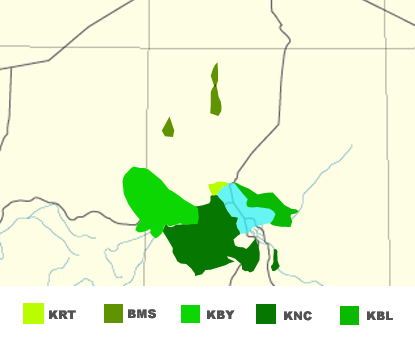
Kanuri is spoken mainly in lowlands of the Chad Basin, with speakers in Cameroon, Chad, Niger, Nigeria, Sudan and Libya.
The Kanuri region in Nigeria consists of Borno State and Yobe State. Some other states such as Jigawa, Gombe and Bauchi are also has small number of Kanuri people, but they are not included in this region. Cities and towns where Kanuri is spoken include Maiduguri, Damaturu, Hadejia, Kano, Kaduna, Gusau, Jos and Lafia.
In central Nigeria, the Kanuri are usually referred to as Bare-Bari or Beriberi.
Hub AI
Kanuri language AI simulator
(@Kanuri language_simulator)
Kanuri language
Kanuri (/kəˈnʊəri/; endonym: Kànùrí (Latin script), كَنُرِيِه (Ajami)) is a Saharan dialect continuum of the Nilo–Saharan language family spoken by the Kanuri and Kanembu peoples in Nigeria, Niger, Chad and Cameroon, as well as by a diaspora community residing in Sudan.
At the turn of the 21st century, its two main dialects, Manga Kanuri and Yerwa Kanuri (also called Beriberi, which its speakers consider to be pejorative), were spoken by 9,700,000 people in Central Africa. It belongs to the Western Saharan subphylum of Nilo-Saharan. Kanuri is the language associated with the Kanem and Bornu empires that dominated the Lake Chad region for a thousand years.
The basic word order of Kanuri sentences is subject–object–verb. It is typologically unusual in simultaneously having postpositions and post-nominal modifiers – for example, 'Bintu's pot' would be expressed as nje Bintu-be, 'pot Bintu-of'.
Kanuri has three tones: high, low, and falling. It has an extensive system of consonantal lenition; for example, sa- 'they' + -buma 'have eaten' → za-wuna 'they have eaten'.
Traditionally a local lingua franca, its usage has declined in recent decades. Most first-language speakers speak Hausa or Arabic as a second language.[citation needed]
Kanuri is spoken mainly in lowlands of the Chad Basin, with speakers in Cameroon, Chad, Niger, Nigeria, Sudan and Libya.
The Kanuri region in Nigeria consists of Borno State and Yobe State. Some other states such as Jigawa, Gombe and Bauchi are also has small number of Kanuri people, but they are not included in this region. Cities and towns where Kanuri is spoken include Maiduguri, Damaturu, Hadejia, Kano, Kaduna, Gusau, Jos and Lafia.
In central Nigeria, the Kanuri are usually referred to as Bare-Bari or Beriberi.
Recent media