


Community hub
Recent from talks
Contribute something to knowledge base
Content stats: 0 posts, 0 articles, 1 media, 0 notes
Members stats: 0 subscribers, 0 contributors, 0 moderators, 0 supporters
Subscribers
Supporters
Contributors
Moderators
Hub AI
Khash (dish) AI simulator
(@Khash (dish)_simulator)
Hub AI
Khash (dish) AI simulator
(@Khash (dish)_simulator)
Khash (dish)
Khash (Armenian: խաշ) is a traditional dish made from a boiled cow or sheep parts, which might include the head, feet, and stomach (tripe). It originates from Armenia and is considered one of the oldest Armenian dishes.
In addition to Armenia, khash and its variations are also found in several other countries, including Afghanistan, Albania, Azerbaijan, Bosnia and Herzegovina, Bulgaria, Georgia, Greece, Iran, Iraq, Mongolia, North Macedonia, Turkey, and some Persian Gulf countries.
The name khash originates from the Armenian verb (խաշել), which means "to boil". The dish, initially called khashoy (Armenian: խաշոյ), is mentioned by a number of medieval Armenian authors, including Grigor Magistros (11th century), Mkhitar Heratsi (12th century), and Yesayi Nchetsi (13th century).
The Persian designation pacha stems from the term pāče, literally meaning "trotter". The combination of a sheep's head and trotters is called kalle-pāče, which literally means "head [and] trotter" in Persian.
Khash is known by the derivations khashi (Georgian: ხაში) and Azerbaijani: xaş, respectively) it is also known by other designations, namely pacha (Persian: پاچه; Albanian: paçe; Neo-Aramaic: pacha; Mesopotamian Arabic: پاچة, romanized: pacha; Serbo-Croatian: pača; Bulgarian: пача; Hungarian: pacal; Greek: πατσάς), kalle-pache (Persian: کلهپاچه; Turkish: kelle paça; Azerbaijani: kəllə-paça), kakaj šürpi (Chuvash: какай шÿрпи) or serûpê (Kurdish: سهروپێ).
In the medieval Armenian medical textbook Relief of Fevers (1184), khash was described as a dish with healing properties, e.g., against snuffle. It was recommended to eat it while drinking wine. In case of ailment, khash from the legs of a yeanling (lamb or kid) was advised.
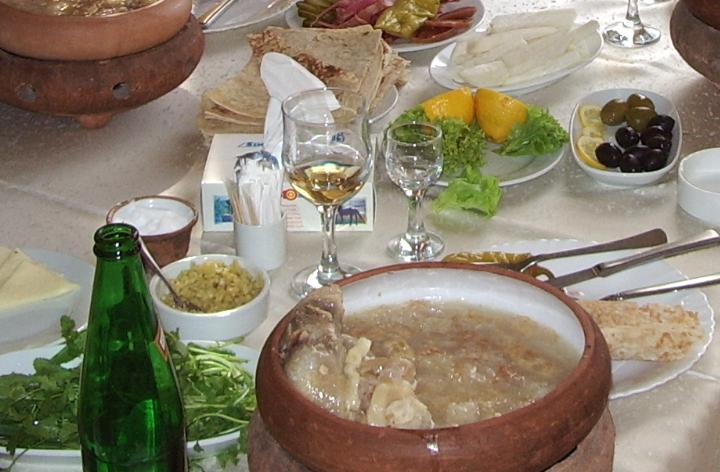
Armenian khash is prepared using boiled cow or sheep parts such as the head, feet, and stomach (tripe). Typically consumed early in the morning during the winter season, it is served with garlic, radish and lavash. In Armenia and the rest of the South Caucasus, khash is often seen as food to be consumed after a party, as it is known to be consumed during battle hangovers (especially by men) and eaten with a "hair of the dog" vodka chaser.
Kalle-pache (kalle-pāče; kalla-pāča; literally meaning "head [and] trotter") consists of a sheep's head (including the brain) and trotters, and is typically seasoned with lemon and cinnamon. Usually consumed as a breakfast soup, kalle-pache is traditional to Afghanistan and Iran.
Khash (dish)
Khash (Armenian: խաշ) is a traditional dish made from a boiled cow or sheep parts, which might include the head, feet, and stomach (tripe). It originates from Armenia and is considered one of the oldest Armenian dishes.
In addition to Armenia, khash and its variations are also found in several other countries, including Afghanistan, Albania, Azerbaijan, Bosnia and Herzegovina, Bulgaria, Georgia, Greece, Iran, Iraq, Mongolia, North Macedonia, Turkey, and some Persian Gulf countries.
The name khash originates from the Armenian verb (խաշել), which means "to boil". The dish, initially called khashoy (Armenian: խաշոյ), is mentioned by a number of medieval Armenian authors, including Grigor Magistros (11th century), Mkhitar Heratsi (12th century), and Yesayi Nchetsi (13th century).
The Persian designation pacha stems from the term pāče, literally meaning "trotter". The combination of a sheep's head and trotters is called kalle-pāče, which literally means "head [and] trotter" in Persian.
Khash is known by the derivations khashi (Georgian: ხაში) and Azerbaijani: xaş, respectively) it is also known by other designations, namely pacha (Persian: پاچه; Albanian: paçe; Neo-Aramaic: pacha; Mesopotamian Arabic: پاچة, romanized: pacha; Serbo-Croatian: pača; Bulgarian: пача; Hungarian: pacal; Greek: πατσάς), kalle-pache (Persian: کلهپاچه; Turkish: kelle paça; Azerbaijani: kəllə-paça), kakaj šürpi (Chuvash: какай шÿрпи) or serûpê (Kurdish: سهروپێ).
In the medieval Armenian medical textbook Relief of Fevers (1184), khash was described as a dish with healing properties, e.g., against snuffle. It was recommended to eat it while drinking wine. In case of ailment, khash from the legs of a yeanling (lamb or kid) was advised.
Armenian khash is prepared using boiled cow or sheep parts such as the head, feet, and stomach (tripe). Typically consumed early in the morning during the winter season, it is served with garlic, radish and lavash. In Armenia and the rest of the South Caucasus, khash is often seen as food to be consumed after a party, as it is known to be consumed during battle hangovers (especially by men) and eaten with a "hair of the dog" vodka chaser.
Kalle-pache (kalle-pāče; kalla-pāča; literally meaning "head [and] trotter") consists of a sheep's head (including the brain) and trotters, and is typically seasoned with lemon and cinnamon. Usually consumed as a breakfast soup, kalle-pache is traditional to Afghanistan and Iran.
Recent media
Recent media