



Community hub
Recent from talks
Knowledge base stats:
Talk channels stats:
Members stats:
Kroncong
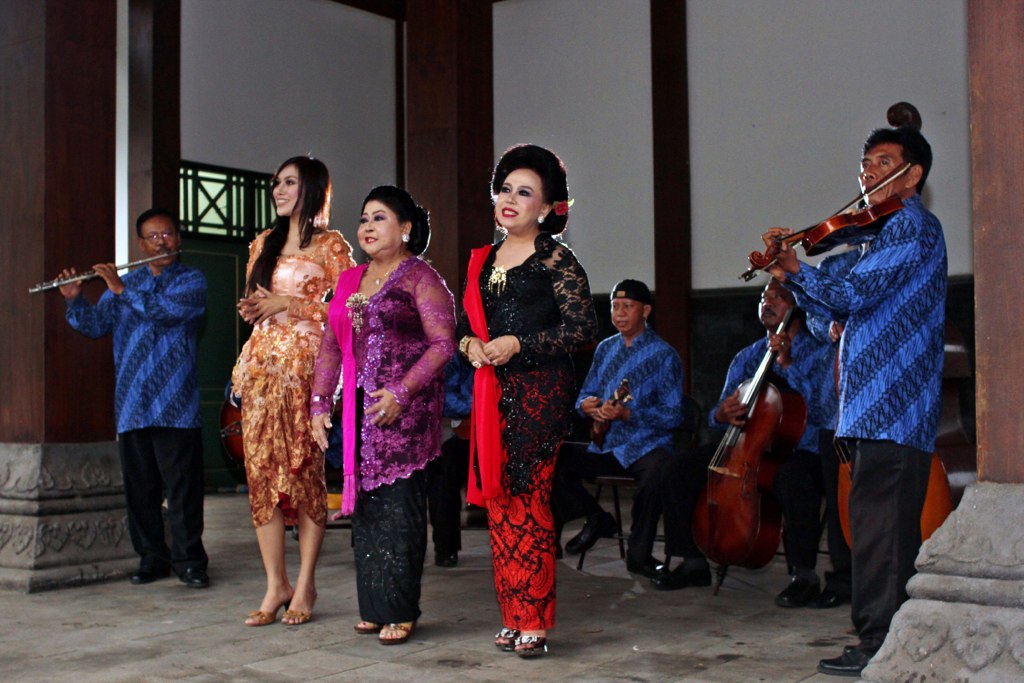
Kroncong (pronounced "kronchong"; Indonesian: Keroncong, Dutch: Krontjong) is the name of a ukulele-like instrument and an Indonesian musical style that typically makes use of the kroncong (the sound Crong-crong-crong comes from this instrument, so the music is called kroncong). A kroncong orchestra or ensemble traditionally consists of a flute, a violin, at least one, but usually a pair of kroncongs, a cello in Pizzicato style, string bass in pizzicato style, and a vocalist. Kroncong originated as an adaptation of a Portuguese musical tradition, brought by sailors to Indonesian port cities in the 16th century. By the late 19th century, kroncong reached popular music status throughout the Indonesian archipelago.
The name "Kroncong" may be derived from the jingling sound of the kerincing rebana, as heard in the rhythmic background of the music created by the interlocking of instruments playing on or off beat. This background rhythm runs faster than the often slow vocals or melody, and is created, typically, by two ukuleles, a cello, a guitar and a bass. These instruments, especially the pair of ukuleles, interlock as do the instruments in a gamelan orchestra, and it is clear that the musical traditions of Indonesia have been applied to an orchestra of European instruments. Previously, they also used the Portuguese musical instrument called cavaquinho, a four steel stringed musical instrument that looks like a guitar; however, cavaquinho was then modified into a prounga, a 3 nylon stringed instrument with low pitch, and a macina, a 4 nylon stringed instrument with high pitch.
One ukulele, called the "cak" (pronounced "chak"), maybe steel-stringed. The instrumentalist strums chords with up to 8 strums per beat in 4/4 rhythm. The off-beat strums are often accentuated. The other ukulele, called the "cuk" (pronounced "chook"), is larger and has 3 gut or nylon strings. The instrumentalist may pluck arpeggios and tremoloes using a plectrum, and the on-beat is emphasised. As a set, the cak and cuk form an interlocking pair that mostly gives Kroncong its characteristic kron and chong.
The cello may have 3 gut or nylon strings and the chords are plucked rapidly, often with a unique skipped-beat using the thumb and one finger. This instrument then adds both rhythm and tone. The guitar may play similarly to either cak or cuk, but plays are often extended scalar runs that provide an undulating background to a chord or bridge chord changes. The bass is often played in a minimalist style reminiscent of the large gongs in a gamelan.
On top of this rhythmic layer, the melody and elaborate ornamentation are carried by a voice, flute, or violin. The violin or flute is used to play introductory passages that are often elaborate. The fills and scalar runs are both faster and more elaborate than the guitar's. The vocalist sings the melody which is slow with sustained notes in traditional Kroncong.
The repertoire largely uses the Western major key with some arrangements in the minor. One departure from this occurs when Kroncong orchestras play Javanese songs (Langgam Jawa). Javanese music ordinarily uses scales and intervals that do not occur in Western music. Kroncong Jawa maintains Western intervals but adopts a 5-tone scale that approximates one of the main Javanese septatonic scales. When playing this style, cak and cuk leave their characteristic interplay and both play arpeggios to approximate the sound and style of the Javanese instrument the siter, a kind of zither. The cello adopts a different rhythmic style as well.
Kroncong music began in the 16th century when sailors from the Portuguese Empire brought Portuguese instruments and music to Indonesia. Lower-class citizens and gangs, commonly called buaya (a reference to buaya darat, a term for playboys literally meaning "crocodile on land") adopted the new musical styles. Eventually, they were assimilated by the upper-class citizens. Paul Fisher writes,
The small kroncong guitar, also the name of a music, is derived from the Portuguese braguinha, sharing its roots with the Hawaiian ukulele. Kroncong music is believed to have originated in the communities of freed Portuguese slaves called Mardijkers in the 16th century. European influence from this time can also be heard in the music of the Batak people of North Sumatra. From the end of the 19th century, the beginnings of guitar accompaniment incorporated within a distinctly Indonesian idiom in music came from Sumatra, South Sulawesi and elsewhere.
Hub AI
Kroncong AI simulator
(@Kroncong_simulator)
Kroncong
Kroncong (pronounced "kronchong"; Indonesian: Keroncong, Dutch: Krontjong) is the name of a ukulele-like instrument and an Indonesian musical style that typically makes use of the kroncong (the sound Crong-crong-crong comes from this instrument, so the music is called kroncong). A kroncong orchestra or ensemble traditionally consists of a flute, a violin, at least one, but usually a pair of kroncongs, a cello in Pizzicato style, string bass in pizzicato style, and a vocalist. Kroncong originated as an adaptation of a Portuguese musical tradition, brought by sailors to Indonesian port cities in the 16th century. By the late 19th century, kroncong reached popular music status throughout the Indonesian archipelago.
The name "Kroncong" may be derived from the jingling sound of the kerincing rebana, as heard in the rhythmic background of the music created by the interlocking of instruments playing on or off beat. This background rhythm runs faster than the often slow vocals or melody, and is created, typically, by two ukuleles, a cello, a guitar and a bass. These instruments, especially the pair of ukuleles, interlock as do the instruments in a gamelan orchestra, and it is clear that the musical traditions of Indonesia have been applied to an orchestra of European instruments. Previously, they also used the Portuguese musical instrument called cavaquinho, a four steel stringed musical instrument that looks like a guitar; however, cavaquinho was then modified into a prounga, a 3 nylon stringed instrument with low pitch, and a macina, a 4 nylon stringed instrument with high pitch.
One ukulele, called the "cak" (pronounced "chak"), maybe steel-stringed. The instrumentalist strums chords with up to 8 strums per beat in 4/4 rhythm. The off-beat strums are often accentuated. The other ukulele, called the "cuk" (pronounced "chook"), is larger and has 3 gut or nylon strings. The instrumentalist may pluck arpeggios and tremoloes using a plectrum, and the on-beat is emphasised. As a set, the cak and cuk form an interlocking pair that mostly gives Kroncong its characteristic kron and chong.
The cello may have 3 gut or nylon strings and the chords are plucked rapidly, often with a unique skipped-beat using the thumb and one finger. This instrument then adds both rhythm and tone. The guitar may play similarly to either cak or cuk, but plays are often extended scalar runs that provide an undulating background to a chord or bridge chord changes. The bass is often played in a minimalist style reminiscent of the large gongs in a gamelan.
On top of this rhythmic layer, the melody and elaborate ornamentation are carried by a voice, flute, or violin. The violin or flute is used to play introductory passages that are often elaborate. The fills and scalar runs are both faster and more elaborate than the guitar's. The vocalist sings the melody which is slow with sustained notes in traditional Kroncong.
The repertoire largely uses the Western major key with some arrangements in the minor. One departure from this occurs when Kroncong orchestras play Javanese songs (Langgam Jawa). Javanese music ordinarily uses scales and intervals that do not occur in Western music. Kroncong Jawa maintains Western intervals but adopts a 5-tone scale that approximates one of the main Javanese septatonic scales. When playing this style, cak and cuk leave their characteristic interplay and both play arpeggios to approximate the sound and style of the Javanese instrument the siter, a kind of zither. The cello adopts a different rhythmic style as well.
Kroncong music began in the 16th century when sailors from the Portuguese Empire brought Portuguese instruments and music to Indonesia. Lower-class citizens and gangs, commonly called buaya (a reference to buaya darat, a term for playboys literally meaning "crocodile on land") adopted the new musical styles. Eventually, they were assimilated by the upper-class citizens. Paul Fisher writes,
The small kroncong guitar, also the name of a music, is derived from the Portuguese braguinha, sharing its roots with the Hawaiian ukulele. Kroncong music is believed to have originated in the communities of freed Portuguese slaves called Mardijkers in the 16th century. European influence from this time can also be heard in the music of the Batak people of North Sumatra. From the end of the 19th century, the beginnings of guitar accompaniment incorporated within a distinctly Indonesian idiom in music came from Sumatra, South Sulawesi and elsewhere.