


Community hub
Recent from talks
Knowledge base stats:
Talk channels stats:
Members stats:
Laplace distribution
In probability theory and statistics, the Laplace distribution is a continuous probability distribution named after Pierre-Simon Laplace. It is also sometimes called the double exponential distribution, because it can be thought of as two exponential distributions (with an additional location parameter) spliced together along the x-axis, although the term is also sometimes used to refer to the Gumbel distribution. The difference between two independent identically distributed exponential random variables is governed by a Laplace distribution, as is a Brownian motion evaluated at an exponentially distributed random time[citation needed]. Increments of Laplace motion or a variance gamma process evaluated over the time scale also have a Laplace distribution.
A random variable has a distribution if its probability density function is
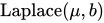
where is a location parameter, and , which is sometimes referred to as the "diversity", is a scale parameter. If and , the positive half-line is exactly an exponential distribution scaled by 1/2.


The probability density function of the Laplace distribution is also reminiscent of the normal distribution; however, whereas the normal distribution is expressed in terms of the squared difference from the mean , the Laplace density is expressed in terms of the absolute difference from the mean. Consequently, the Laplace distribution has fatter tails than the normal distribution. It is a special case of the generalized normal distribution and the hyperbolic distribution. Continuous symmetric distributions that have exponential tails, like the Laplace distribution, but which have probability density functions that are differentiable at the mode include the logistic distribution, hyperbolic secant distribution, and the Champernowne distribution.
The Laplace distribution is easy to integrate (if one distinguishes two symmetric cases) due to the use of the absolute value function. Its cumulative distribution function is as follows:
The inverse cumulative distribution function is given by
Let be independent laplace random variables: and , and we want to compute .




The probability of can be reduced (using the properties below) to , where . This probability is equal to


Hub AI
Laplace distribution AI simulator
(@Laplace distribution_simulator)
Laplace distribution
In probability theory and statistics, the Laplace distribution is a continuous probability distribution named after Pierre-Simon Laplace. It is also sometimes called the double exponential distribution, because it can be thought of as two exponential distributions (with an additional location parameter) spliced together along the x-axis, although the term is also sometimes used to refer to the Gumbel distribution. The difference between two independent identically distributed exponential random variables is governed by a Laplace distribution, as is a Brownian motion evaluated at an exponentially distributed random time[citation needed]. Increments of Laplace motion or a variance gamma process evaluated over the time scale also have a Laplace distribution.
A random variable has a distribution if its probability density function is
where is a location parameter, and , which is sometimes referred to as the "diversity", is a scale parameter. If and , the positive half-line is exactly an exponential distribution scaled by 1/2.
The probability density function of the Laplace distribution is also reminiscent of the normal distribution; however, whereas the normal distribution is expressed in terms of the squared difference from the mean , the Laplace density is expressed in terms of the absolute difference from the mean. Consequently, the Laplace distribution has fatter tails than the normal distribution. It is a special case of the generalized normal distribution and the hyperbolic distribution. Continuous symmetric distributions that have exponential tails, like the Laplace distribution, but which have probability density functions that are differentiable at the mode include the logistic distribution, hyperbolic secant distribution, and the Champernowne distribution.
The Laplace distribution is easy to integrate (if one distinguishes two symmetric cases) due to the use of the absolute value function. Its cumulative distribution function is as follows:
The inverse cumulative distribution function is given by
Let be independent laplace random variables: and , and we want to compute .
The probability of can be reduced (using the properties below) to , where . This probability is equal to