Hubbry Logo
Kyle OrtonKyle OrtonMain
Open search
Kyle Orton
Community hub
Kyle Orton
logo
8 pages, 0 posts
0 subscribers
Be the first to start a discussion here.
Kyle Orton
Kyle Orton
from Wikipedia

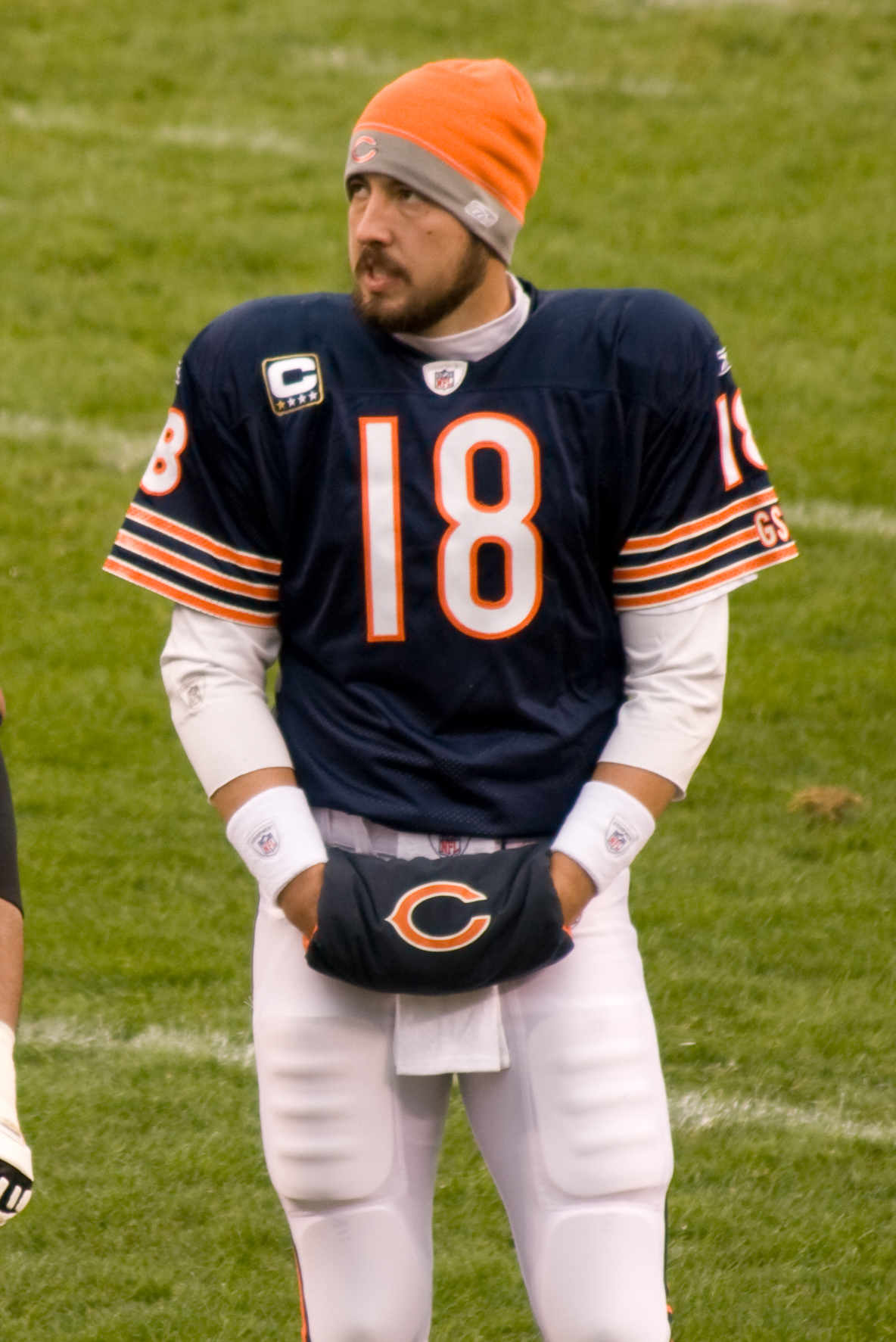
Kyle Raymond Orton (born November 14, 1982) is an American former professional football player who was a quarterback in the National Football League (NFL). He played college football for Purdue, where he started four straight bowl games. He was selected by the Chicago Bears in the fourth round of the 2005 NFL draft. After an injury to Bears starter Rex Grossman, Orton was pressed into service as the starting quarterback during his rookie year, starting the first 14 games of the 2005 season, but was replaced by Grossman for the playoffs that year. Orton did not play at all in 2006, and sparingly in 2007. He regained his starting job from Grossman in 2008, but the team finished a disappointing 9–7 and out of the playoffs. In the offseason of that year, he was traded to the Denver Broncos.

Key Information

Orton spent the next three seasons with Broncos, where he amassed a 12–21 record as a starting quarterback over three seasons. He lost his starting role to Tim Tebow during the 2011 season and was released by the team. Orton was claimed off waivers by the Kansas City Chiefs. He spent the next three seasons as a back-up quarterback for the Dallas Cowboys and Buffalo Bills. Orton became the Bills' starting quarterback in 2014, where he went 7–5. He retired after the season.

Early life

[edit]

Orton attended Southeast Polk High School in Pleasant Hill, Iowa, where he was a four-sport star in football, basketball, tennis, and track & field.

At the end of his high school career, Orton was the No. 2 ranked quarterback in the nation by SuperPrep and No. 7 by Rivals.com. His career passing statistics were 208 for 450 (46.2%), 3,176 yards with 24 touchdowns, and 18 interceptions. He earned honorable mention all-state and first-team all-conference his senior year, after completing 95 of 192 attempts (49.5%), 1,366 yards with 12 touchdowns, and 5 interceptions.[1]

Orton wore uniform No. 18 in honor of former Nebraska quarterback Brook Berringer, who died in a plane crash in 1996.[2]

College career

[edit]

Orton committed to Purdue, but considered attending Colorado before ultimately deciding on the former.[3] Orton started in the 2001, 2002 and 2004 Sun Bowl, and the 2003 Capital One Bowl. He is the only Purdue quarterback to start four consecutive bowl games (Drew Brees and Mark Herrmann started three straight). During his undergraduate years at Purdue, Orton was a member of the Pi Kappa Alpha fraternity.

In 2004, Orton was the preseason third-team All-American quarterback, behind USC's Matt Leinart and Oklahoma's Jason White as well as a Heisman Trophy hopeful early in the season. After starting the season 5–0 the Boilermakers lost 4 straight close games. During that stretch Orton suffered injuries against Michigan and Northwestern. Brandon Kirsch took over for Orton in the 3rd quarter against Northwestern and Orton subsequently missed the game the following week against Iowa. Orton was able to return to the field in the 4th quarter against Ohio State to help the Boilermakers get the go ahead TD to overcome the Buckeyes and snap their losing streak. The following week the Boilermaker's defeated their rival, Indiana Hoosiers, 63–24. During that game Orton tied former Purdue quarterback Drew Brees' record for number of passing yards in a game (522). That record stood until 2018 when David Blough threw for 572 yards in a game against University of Missouri.

Orton makes a cameo in NCAA Football 2006, where he says, "EA Sports, it's in the game", along with Derek Anderson in the game's introduction.

College statistics

[edit]
Season Team GP Passing Rushing
Cmp Att Pct Yds TD Int Rtg Att Yds TD
Purdue Boilermakers
2001 Purdue 6 69 142 48.6 686 2 3 92.1 27 −63 0
2002 Purdue 13 192 317 60.6 2,257 13 9 128.2 43 47 0
2003 Purdue 13 251 414 60.6 2,885 15 7 127.7 112 237 3
2004 Purdue 11 236 389 60.7 3,090 31 5 151.1 80 112 3
Totals[4] 43 748 1,262 59.3 8,918 61 24 128.9 262 333 6

Professional career

[edit]
Pre-draft measurables
Height Weight Arm length Hand span 40-yard dash 10-yard split 20-yard split 20-yard shuttle Three-cone drill Vertical jump Wonderlic
6 ft 4 in
(1.93 m)
233 lb
(106 kg)
30+14 in
(0.77 m)
10 in
(0.25 m)
5.11 s 1.78 s 2.96 s 4.52 s 7.38 s 26+12 in
(0.67 m)
26[5]
All values from NFL Combine[6][7]

Chicago Bears

[edit]

2005

[edit]

Orton was drafted by the Chicago Bears in the fourth round of the 2005 NFL draft.[8] In the 2005 NFL season, he was rushed into the Bears starting lineup as a rookie after a preseason injury to starter Rex Grossman, and the poor play of back-up Chad Hutchinson. Orton started 15 games of the season, but was replaced by Grossman after halftime during the Bears' Week 15 victory against the Atlanta Falcons. After sitting for Week 16, Orton started the regular season finale, Week 17, against the Minnesota Vikings. The outcome of this game, for the Chicago Bears, did not have any effect on their post-season hopes. The Bears had already clinched the NFC North championship and a first-round bye in the 2005–06 playoffs with their Week 16 victory over the Green Bay Packers. Grossman then started for the Bears in their only post-season game. They lost to the Carolina Panthers.[9]

Overall, the Bears had a record of 10–5 in games that Orton started, including an eight-game winning streak after a 1–3 start. Despite the team's success, Orton finished with the lowest quarterback rating in the NFL (59.7) among all "qualified" quarterbacks (those with 224+ pass attempts).[10] Despite the low rating, the Bears coaches repeatedly insisted that they were pleased with Orton's performance. The coaching staff asked Orton to minimize mistakes and to let the rushing attack and the defense win ballgames rather than employing an aggressive passing attack.

Measuring Orton's victories, his rookie season was successful. His 15 starts and 10 victories are both rookie records for Bears quarterbacks. 10 rookie wins is also sixth most in the NFL since 1970.[11] As of 2017, Orton held at least 5 other Bears rookie franchise records, including completions (190), attempts (368), passing yards (1,869), passing TDs (9), and interceptions in a single game (5 on September 25 against Cincinnati).

2006

[edit]

Following the 2005 season, the Bears signed veteran Brian Griese as the team's second-string quarterback. Orton, now demoted, became the Bears’ third-string quarterback, and did not see any action throughout the entire 2006 season.

Orton throws a pass to Garrett Wolfe.

2007

[edit]

The following off-season, the Bears acquired Chris Leak, who had previously led the Florida Gators to a BCS Championship, shortly after the 2007 NFL draft. Leak struggled in training camp, while Orton, who had trained in the off-season, excelled but was placed at third string.[12] According to the Chicago Tribune, Orton was en route to overtake Griese's (then) second string position.[13] Orton continued to show signs of improvement in the preseason. He completed sixteen of twenty-five passes for 151 yards and one touchdown en route to leading the Bears to a comeback victory over the Houston Texans.[14]

After the Bears lost their chances of making a postseason berth, Lovie Smith chose to start Orton over Griese.[15] Orton made his first start in nearly two seasons on December 17, 2007, against the Minnesota Vikings. The Bears lost the game 20–13. Orton finished with 22 completions on 38 attempts, 184 yards, and 1 interception.[16] He improved in the final two games of the season, leading the Bears to two consecutive victories, passing for 294 yards, 3 touchdowns and an interception.[17]

2008

[edit]

On February 25, 2008, the Bears and Orton agreed to a one-year contract extension running through the 2009 season. Competition for the starting quarterback job was expected to be fierce with Rex Grossman, during training camp.

On August 18, after deadlock against Grossman in games with the Kansas City Chiefs and Seattle Seahawks, Bears head coach Lovie Smith named Orton the team's starting QB for the 2008 season in Week 3 of the preseason, despite not throwing a pass over 17 yards or for a touchdown in the first two preseason games.[18]

On September 7, 2008, Orton led the Bears to a 29–13 victory over the Indianapolis Colts in the first regular season game of the season. He threw for a career-high 334 yards and two touchdowns, while completing 24 of 34 passes in a 34–7 victory over the Detroit Lions.[19] He finished the game with a career-high, at that time, passer rating of 121.4.

From the start of November 2008, Kyle Orton passed for ten touchdowns, and four interceptions, leading the Bears to a 4–3 record. Orton sustained an ankle injury against the Detroit Lions in Week 9 of the NFL season,[20] and did not start the next week. He rushed himself back into the starting lineup a week after Grossman had a solid outing coming off the bench against the Titans. After his return, Orton threw eight touchdowns, and eight interceptions while averaging a quarterback rating of 66.9, including ratings of 39.1 against Minnesota, 49.2 against New Orleans, and 48.7 against Green Bay.[17]

The Bears finished the season with a 9–7 record, while missing the playoffs by one game.[21] Coach Lovie Smith was pleased with Orton's performance and believed he would be the team's starting quarterback for the following season.[22] However, Jerry Angelo, the team's general manager, stated he wished to further solidify the quarterback position in the long run.[23]

Denver Broncos

[edit]
Orton walking onto the field om 2--0.

2009

[edit]

On April 2, 2009, the Bears traded Orton (along with their first and third-round draft picks in 2009 and their first-round pick in '10) to the Denver Broncos for Pro Bowl quarterback Jay Cutler and the Broncos' fifth round pick in '09.[24]

On June 13, Broncos head coach Josh McDaniels declared Orton the starting quarterback for the season. Orton led the Broncos to a 12–7 victory in the 2009 season opener against the Cincinnati Bengals. The game was won on a deflected pass that landed in the arms of Brandon Stokley who took it 87 yards for a touchdown.[25]

Over the next five weeks, Orton led the Broncos to a surprising 6–0 record to begin the season. His most impressive effort in that streak came against the New England Patriots, when he completed 35–48 passes for 330 yards and orchestrated a 98-yard drive to tie the game and send it into overtime. He threw his first interception of the season to Randy Moss, who came in to help on the attempted Hail Mary pass, at the end of the first half. It was his first in 173 pass attempts which dated back to 2008 when he was with the Chicago Bears. He led another drive for the game-winning field goal in overtime.[26] On October 13, 2009, Orton was named the AFC Offensive Player of the Week, for that effort.[27]

On November 15, Orton suffered an ankle injury on the road against the Washington Redskins. He came out of the game at halftime with a career-high passer rating of 134.7. The injury kept him from starting the next game against the Chargers. He did return partway through that game, replacing Chris Simms.

For the 2009 season (playing in 16 games with 15 starts), Orton threw 21 touchdown passes and 12 interceptions with an 86.8 QB rating.

2010

[edit]

Orton was named the Broncos starting quarterback for 2010. He signed a one-year contract extension (through the 2011 season), on August 19, 2010. On September 26, 2010, Orton threw for 476 yards against the Indianapolis Colts, a career-high. Less than two months later, November 14, Orton threw a career-high four touchdown passes against the Kansas City Chiefs. Later in the season, with the Broncos eliminated from playoff contention, Orton played poorly against the Arizona Cardinals on December 12, 2010. Tim Tebow was named the starter the following week by interim coach Eric Studesville and played the last three games of the season.[28] Orton finished the season with 3,653 yards, 20 touchdowns, and nine interceptions

2011

[edit]

Orton entered the 2011 season as the Broncos starting quarterback. The team had a 1–4 start with Orton throwing 8 touchdowns and 7 interceptions as the starter, accumulating 979 yards and completing 58.7% of his passes.[29] He was replaced as the starter by Tim Tebow during the week 5 contest against the San Diego Chargers, and Orton never took another snap for the Broncos. Orton was waived on November 22, 2011, officially ending his tenure with the Denver Broncos. He had a record of 12–21 as a starter during his time with the Broncos, throwing for 8,434 yards, 49 touchdowns, and 28 interceptions.

Kansas City Chiefs

[edit]

He was claimed off waivers by the Kansas City Chiefs on November 23, 2011, after a season-ending injury to starting quarterback Matt Cassel.[30] Kansas City paid $2.5 million remaining on Orton's nearly $8.9 million salary for the year. Chicago (looking to replace injured Jay Cutler) and the Dallas Cowboys (because of concerns of injuries to backup quarterback Jon Kitna) also made claims on him. However, since Kansas City had a worse record than the other two teams it was given priority in claiming him per the NFL's inverse order of the standings rule on the waiver priority list.[31]

On December 4, 2011, in a game against his former team, the Chicago Bears, Orton came into the second quarter to relieve Tyler Palko, but was injured on his first pass attempt.[32] Palko led the Chiefs to a 10–3 win over the Bears, but struggled the following week in a 37–10 loss to the Jets.[33]

Palko's injury paved the way for a quarterback change, and on December 18, Orton was named the starting Chiefs' quarterback by new interim coach Romeo Crennel. In his first game as their starter, he led the Chiefs to a 19–14 upset of the previously undefeated Green Bay Packers, ending the defending 2011 Super Bowl champions winning streak at 19 games, dating back to the previous season.[34] He completed 23 of 31 passes for 299 yards with no interceptions and no passing touchdowns.

In the final two games of the season, Orton lost 16–13 in overtime against the Raiders before returning to Denver to defeat the Broncos in the season finale.

Dallas Cowboys

[edit]

On March 14, 2012, Orton signed a three-year contract with the Dallas Cowboys to replace former backup quarterback Jon Kitna, who retired after the Cowboys' 2011 season. In week 4 against the Bears, his former team, Orton replaced Tony Romo late in the game and threw a 5-yard touchdown pass to Jason Witten, though the Bears still won the contest 34–18. The Cowboys went on to finish the season 8–8, losing to the Washington Redskins in a do-or-die week 17 contest.[35]

In the 2013 season, Orton had seen minimal time on the field with a total of 40 passing yards which all came during week 14 against the Chicago Bears. On December 27, 2013, head coach Jason Garrett announced that Orton would be the starting quarterback for the week 17 game against the Philadelphia Eagles after Tony Romo underwent back surgery.[36] He threw for 30 completions and 358 yards on 46 attempts (65.2%) and two touchdowns. He threw an early interception by Mychal Kendricks which was dropped by Witten, and another interception by Brandon Boykin on the Cowboys' last drive which secured a 24–22 victory for the Eagles.

Buffalo Bills

[edit]
Orton during the 2014 season.

Prior to the 2014 NFL season, Orton threatened the Cowboys with a possible retirement and did not report to any of the team's organized team activities or workouts. Besides accumulating $70,000 in fines, quarterback coach Wade Wilson reported that Orton did not maintain any communications with the Cowboys during this period.[37] Orton, who risked losing part of his signing bonus by holding out, eventually showed up to training camp. The team released him on July 15 and promoted Brandon Weeden to the backup quarterback position.[38] The Cowboys were relieved of Orton's $3.25 million salary in 2014, but still had to pay him a signing bonus.[39] He would follow Jeremiah Ratliff as the second player in two straight years to force the Cowboys to waive him.

On August 29, 2014, Orton agreed on a two-year deal with the Buffalo Bills, with the team paying him $5 million in the first year alone, making him the highest paid backup quarterback in the league.[40] On September 29, 2014, at the beginning of week 5, Bills head coach Doug Marrone announced that Orton would become the new starting quarterback for the Bills in relief of EJ Manuel.[41] Taking over with the team at 2–2, Orton led the Bills to a 9–7 finish. Though they missed the playoffs, the 2014 season marked the first time since 2004 that the Bills had finished with a winning record.[42] Orton finished the season with 3,018 passing yards, 18 touchdowns, 10 interceptions and an 87.8 quarterback rating.

On December 29, 2014, Orton announced his retirement from the NFL.[43]

NFL career statistics

[edit]
Legend
Bold Career high
Year Team Games Passing Rushing Sacks
GP GS Record Cmp Att Pct Yds Avg TD Int Rtg Att Yds Avg TD Sck SckY
2005 CHI 15 15 10–5 190 368 51.6 1,869 5.1 9 13 59.7 24 44 1.8 0 30 190
2006 CHI 0 0 DNP
2007 CHI 3 3 2–1 43 80 53.8 478 6.0 3 2 73.9 5 −1 −0.2 0 2 12
2008 CHI 15 15 9–6 272 465 58.5 2,972 6.4 18 12 79.6 24 49 2.0 3 27 160
2009 DEN 16 15 8–7 336 541 62.1 3,802 7.0 21 12 86.8 24 71 3.0 0 29 159
2010 DEN 13 13 3–10 293 498 58.8 3,653 7.3 20 9 87.5 22 98 4.4 0 34 243
2011 DEN 5 5 1–4 91 155 58.7 979 6.3 8 7 75.7 5 17 3.4 0 9 49
KC 4 3 2–1 59 97 60.8 779 8.0 1 2 81.1 6 −4 −0.7 0 1 5
2012 DAL 1 0 9 10 90.0 89 8.9 1 0 137.1 0 0 0.0 0 0 0
2013 DAL 3 1 0–1 33 51 64.7 398 7.8 2 2 85.3 1 8 8.0 0 0 0
2014 BUF 12 12 7–5 287 447 64.2 3,018 6.8 18 10 87.8 15 14 0.9 1 33 198
Total 87 82 42–40 1,613 2,712 59.5 18,037 6.7 101 69 81.2 126 296 2.3 4 132 818

Personal life

[edit]

After retiring from the NFL in 2014, Orton and his wife moved to Baton Rouge, Louisiana, to raise their daughter. Orton intends to mentor high school and college-level football players in Louisiana.[44]

Orton's father, Byron Orton, served on the Iowa Labor Commission. Orton said that running for the United States Congress "is definitely something that I want to do when I get older."[45]

Orton is currently coaching for his high school alma mater, Southeast Polk in Pleasant Hill, Iowa, as an assistant coach.[46]

References

[edit]
[edit]
Revisions and contributorsEdit on WikipediaRead on Wikipedia
from Grokipedia
Kyle Orton is an American former professional football who played ten seasons in the (), primarily as a starter and backup for five teams. Born on November 14, 1982, in Altoona, , Orton attended , where he passed for 8,918 yards and 61 touchdowns during his college career from 2001 to 2004, setting several single-season records including 31 touchdowns in 2004. Selected by the in the fourth round (106th overall) of the , he quickly rose to prominence as a starter, leading the Bears to an 11-5 record and a playoff appearance while throwing for 1,869 yards and 9 touchdowns in 15 games (14 starts). Orton's professional journey included stints with the Denver Broncos (2009–2011), where he posted a career-high 3,802 passing yards and 21 touchdowns in 2009, leading the team to an 8-8 record (he was later benched in 2011 after a 1-4 start); the Kansas City Chiefs (2011), appearing in four games (three starts) after a midseason trade; the Dallas Cowboys (2012–2013), mainly as a backup but starting one game in 2013 with 358 yards and two touchdowns; and the Buffalo Bills (2014), where he went 7-5 as a starter, passing for 3,018 yards and 18 touchdowns to earn votes for NFL Comeback Player of the Year. Over his career, Orton appeared in 87 games (82 starts), accumulating 18,037 passing yards, 101 touchdowns, and 69 interceptions, with a completion percentage of 59.5. He announced his retirement from the NFL on December 29, 2014, at age 32, citing a desire to pursue other opportunities outside of football.

Early years

Early life

Kyle Orton was born on November 14, 1982, in Altoona, Iowa, a small suburb east of Des Moines. His father, Byron Orton, had played football at the University of South Dakota and later worked in state government since 1975, eventually serving as Iowa's labor commissioner from 1995 until his retirement in 2005, providing a stable but modest family environment in the working-class community of Altoona. The family's routine included nightly viewings of the CBS Evening News, followed by discussions on politics and current events at the dinner table, which instilled in Orton a strong sense of civic awareness and intellectual curiosity alongside his growing interest in sports. This upbringing in rural Iowa emphasized hard work and family values, shaping Orton's early development in a close-knit household. Orton's initial exposure to sports came through his father's athletic background, sparking an early passion for competition. These experiences, combined with the familial encouragement to pursue physical and mental discipline, laid the groundwork for his athletic pursuits in a community-focused setting typical of small-town life. This foundation in Altoona transitioned into organized high school athletics at nearby Southeast Polk High School.

High school career

Orton attended Southeast Polk High School in Pleasant Hill, , where he excelled as a on the football team while also participating in , , and . Over his high school career, he amassed 3,176 passing yards and 24 touchdowns, with a standout senior season in 2000 in which he threw for 1,366 yards and 12 touchdowns. His performances earned him all-state honors, recognizing his contributions to the ' program. As a highly regarded prospect, Orton drew attention from several Division I programs, receiving a scholarship offer from based on highlight tapes from his junior year without an in-person evaluation. He initially considered attending the but ultimately committed to Purdue, signing in February 2001 and impressing coaches with his dedication to the Boilermakers. In November 2025, Orton was inducted into the Iowa High School Athletic Association Football Hall of Fame.

College career

Purdue Boilermakers

Orton enrolled at Purdue University in 2001 following a standout high school career at Southeast Polk High School in Iowa, where he committed to the Boilermakers ahead of offers from schools including Colorado. He majored in history and quickly adapted to head coach Joe Tiller's pass-oriented spread offense, which emphasized quarterback decision-making and arm strength. As a true in 2001, Orton emerged as the starting midway through the season after an injury to Brandon Hance, replacing the departed and leading Purdue to a 6-6 record while starting seven games. He retained the starting role for the full 2002 and 2004 seasons and most of 2003, compiling a 25-23 record as the primary signal-caller in 36 career starts. Orton is the only Purdue to start four consecutive bowl games (2001 , 2002 , 2003 Capital One Bowl, and 2004 ). Orton's tenure helped solidify Purdue's reputation as the "Cradle of Quarterbacks" in the , where he ranked among the league's top passers in efficiency and yards per game during his junior year. One of Orton's signature performances came on September 27, 2003, when he guided Purdue to a 23-10 home victory over Notre Dame, completing 12 of 24 passes for 127 yards and two touchdowns in a defensive battle that snapped a rivals' momentum. The following season, he orchestrated high-powered offenses, including a 63-24 rout of where he threw for 522 yards and six touchdowns. In the 2004 against Arizona State, Orton passed for 281 yards and three touchdowns despite a 27-23 defeat. That year, Orton completed 60.7% of his passes, reflecting his accuracy in Tiller's system.

College statistics

Orton's college career at Purdue spanned four seasons from 2001 to 2004, during which he established himself as a prolific passer in the . His statistical output demonstrated steady progression, particularly in his final two years, where he emerged as one of the conference's top quarterbacks. Over 43 games, Orton completed 748 of 1,262 pass attempts for 8,918 yards, throwing 61 touchdowns and 24 interceptions. The following table summarizes Orton's year-by-year passing statistics:
YearCompletions/AttemptsYardsTouchdownsInterceptions
200169/14268623
2002192/3172,257139
2003251/4142,885157
2004236/3893,090315
Career748/1,2628,9186124
Orton also contributed as a runner, utilizing his mobility to extend plays and score. In 262 rushing attempts, he gained 333 yards and scored 6 touchdowns, with his most productive rushing season coming in (112 carries for 237 yards and 3 touchdowns). His rushing totals reflect a dual-threat element uncommon for pro-style quarterbacks of his era. Efficiency metrics underscore Orton's development as a decision-maker and deep-ball thrower. He finished his Purdue career with a 59.3% completion rate and 7.1 yards per attempt, improvements from his year that highlighted better accuracy and ball security in later seasons. In 2004, Orton led the Big Ten in both passing yards (3,090) and touchdowns (31), capping a senior campaign that earned him recognition as one of the conference's elite performers. Relative to Big Ten peers, Orton's career marks placed him among the conference's historical leaders: his 8,918 passing yards ranked 19th since , while his 748 completions ranked 14th in that span. At Purdue, these figures positioned him as the program's second-leading passer in yards and touchdowns behind only , contributing to the Boilermakers' status as a passing-oriented offense during his tenure.

Professional career

Chicago Bears (2005–2008)

Orton was selected by the Chicago Bears in the fourth round (106th overall) of the 2005 NFL Draft. As a rookie in 2005, Orton stepped in as the starting quarterback after Rex Grossman suffered a season-ending ankle injury in the preseason, starting the first 14 games of the season and leading the Bears to a 10-5 record in those contests. Over 15 games played, he completed 190 of 368 passes for 1,869 yards, 9 touchdowns, and 13 interceptions, posting a passer rating of 59.7. His performance helped the Bears finish with an 11-5 record and secure a playoff berth, though they lost in the Divisional Round to the Carolina Panthers. In 2006, Orton served as the third-string quarterback behind Grossman and , appearing in no games during the regular season or playoffs as the Bears advanced to , where they fell to the . The following year, 2007, he remained primarily a but started the final three games after Grossman sprained his knee in Week 14, going 3-0 with 478 passing yards, 3 touchdowns, and 2 interceptions in those appearances. Orton entered the 2008 preseason in a quarterback competition with Grossman and won the starting role, guiding the Bears to a 3-4 start before suffering a in Week 9 against the , which caused him to miss one game. He returned to start the final five games, finishing the season with 15 games played and 14 starts, 2,972 passing yards, 18 touchdowns, and 12 interceptions for a 79.6 , as the Bears ended 9-7 and missed the . Following the season, on April 2, 2009, the Bears traded Orton, along with their 2009 first-round pick, 2010 first-round pick, and 2009 third-round pick, to the in exchange for quarterback and a 2009 fifth-round pick. During his four seasons with the Bears, Orton appeared in 33 games, making 32 starts and compiling a 21-12 record as a starter, establishing himself as a reliable option in a defense-oriented offense.

Denver Broncos (2009–2011)

On April 2, 2009, the acquired Kyle Orton from the in a blockbuster that sent quarterback and a fifth-round draft pick to in exchange for Orton, the Bears' first- and third-round picks in the , and their first-round pick in 2010. The deal, orchestrated by new head coach , aimed to stabilize the quarterback position amid Cutler's contract disputes and provided with draft capital to rebuild the roster. Orton, who had served as a backup and occasional starter in , won the starting job over during training camp and became a central figure in McDaniels' offensive scheme, which emphasized a West Coast-style passing attack. In the 2009 season, Orton started all 16 games for the Broncos, completing 336 of 541 passes for 3,802 yards, 21 touchdowns, and 12 interceptions, earning a of 83.0. He led Denver to a surprising 6-0 start, including a 20-17 overtime victory over the in Week 7, where he threw for 330 yards and two touchdowns. Despite a midseason slump that included a 59-14 loss to the , Orton guided the team to an 8-8 finish, second in the , though they missed the playoffs. His performance marked a career high in starts and production, contributing to an offensive rebuild that featured rookie Knowshon and as key targets. Orton's tenure continued into 2010, where he started the first 13 games, passing for 3,653 yards, 20 touchdowns, and nine interceptions with a 87.5 . The Broncos struggled to a 3-9 record under his leadership amid offensive line issues and injuries, but he showed efficiency in games like a 24-20 win over the , throwing for 285 yards and two scores. Late in the season, following a 1-4 stretch, McDaniels benched Orton for rookie in Week 16 against the Houston Texans, a move that signaled shifting team dynamics as Denver finished 4-12. Orton appeared in relief during the loss, completing 4 of 14 passes for 35 yards. The 2011 season proved short for Orton in Denver, as he started the first four games, going 1-3 with 946 passing yards, four touchdowns, and six interceptions. After a 34-24 loss to the in Week 4, head coach John Fox benched him mid-game in Week 5 against the , inserting Tebow as the starter amid fan pressure and the team's 1-4 start. Orton did not play again for Denver, serving as a until the Broncos waived him on November 22, 2011, allowing him to join the [Kansas City Chiefs](/page/Kansas_City Chiefs) via waivers. Over three seasons, Orton started 33 games for the Broncos, compiling 8,401 passing yards, 45 touchdowns, and 27 interceptions, playing a pivotal role in the transition from Mike Shanahan's era to a youth-infused offense under McDaniels and Fox.

Kansas City Chiefs (2011)

On November 23, 2011, the Kansas City Chiefs claimed quarterback Kyle Orton off waivers from the Denver Broncos, two days after the Broncos released him, to address a quarterback crisis following starting quarterback Matt Cassel's season-ending injury in Week 9. The move came amid a turbulent season for the Chiefs, who were 4-6 at the time and seeking veteran depth behind Tyler Palko. Orton, who had previously started the first five games for Denver, joined a team dealing with multiple injuries across the roster, including to key offensive and defensive players. Orton appeared in four games for the Chiefs, including three starts, completing 59 of 97 passes for 779 yards, one , and two interceptions, while posting a of 81.1. He made his debut in relief against the on December 4, attempting one pass, before taking over as the starter for the final three contests. In those starts, Orton threw for 299 yards in a 19–14 upset win over the undefeated on December 18, 300 yards with one and two interceptions in a 16–13 overtime loss to the on December 24, and 180 yards in a 7–3 victory against the Broncos on January 1, 2012. Under interim head coach , who replaced the fired on December 12, Orton started the Chiefs' last three games as the team navigated significant injuries, including to wide receivers and the offensive line, which hampered offensive production. The Chiefs went 2–1 in Orton's starts, contributing to a 7–8 overall finish and snapping a two-game losing streak to end the season on a positive note despite the challenges. Orton became an unrestricted free agent after the 2011 season and was not re-signed by the Chiefs as part of the team's roster overhaul under new , who prioritized other quarterback options in the 2012 offseason.

Dallas Cowboys (2012–2013)

After the 2011 season, Orton became an unrestricted and signed a three-year, $10.5 million contract with the on March 14, 2012, to serve as the backup to starting quarterback . In the 2012 season, Orton appeared in one game, relieving an injured Romo in the fourth quarter of a Week 4 loss to the on October 1; he completed 9 of 10 passes for 89 yards and 1 , including a 5-yard scoring pass to Jason . Orton's playing time increased slightly in 2013 amid Romo's injury issues, as he appeared in three games total. In Week 14, he entered in relief during a loss to the on December 9, completing 3 of 5 passes for 40 yards. Orton then made his only start of the season in the Week 17 finale against the on December 29, with Romo sidelined by a back injury; he went 30-for-46 for 358 yards, 2 , and 2 interceptions in a narrow 24-22 defeat that eliminated from playoff contention. For the year, Orton completed 33 of 51 passes for 398 yards, 2 , and 2 interceptions across his limited action. Over his two seasons in Dallas, Orton logged minimal snaps primarily as a reliable backup and contributor, emphasizing preparation and support for the quarterback room rather than extended starting duties. The Cowboys released him on July 16, 2014, ahead of the next .

Buffalo Bills (2014)

On March 10, 2014, Orton was released by the Dallas Cowboys after serving primarily as a backup, but he did not sign with the Buffalo Bills until late August. On August 29, 2014, the Bills agreed to a one-year contract with Orton worth up to $5 million, positioning him as the backup to second-year quarterback EJ Manuel while providing an opportunity to compete for the starting role if needed. Manuel struggled through the first four games, completing just 56.5% of his passes with four touchdowns and three interceptions, prompting head coach Doug Marrone to bench him on September 29 in favor of Orton. Orton took over as the starter beginning in Week 5 against the Detroit Lions, leading the Bills to a 17-14 comeback victory despite early offensive inconsistencies. Over his 12 starts from Weeks 5 through 16, Orton went 7-5, throwing for 3,018 yards, 18 touchdowns, and 10 interceptions with a passer rating of 87.8, helping stabilize the passing game amid a young receiving corps featuring rookie Sammy Watkins. However, the offense faced significant challenges from a porous offensive line that allowed 41 sacks during the season—one of the highest totals in the NFL—exacerbating protection issues and contributing to Orton's late-season turnover problems, including three interceptions in a Week 16 loss to the New York Jets. Marrone benched Orton for the regular-season finale against the New England Patriots, reverting to Manuel, though the Bills had already been eliminated from playoff contention. The Bills finished the 2014 season with a 9-7 record, their first winning mark since 2004, but missed the for the 14th consecutive year. Orton's tenure marked his final stint as an NFL starter, as he informed the team of his decision to retire on December 29, 2014, one day after the season ended. At age 32, Orton cited the physical demands of a 10-year career and a desire to prioritize family time as a father, stating, "I've decided to get home and be a dad and call it a day."

NFL career statistics

Passing statistics

Kyle Orton's NFL passing career spanned from 2005 to 2014 across five teams, during which he demonstrated a consistent but unspectacular performance as a pocket passer, accumulating over 18,000 yards through the air while managing turnovers in varied offensive systems. The following table summarizes his year-by-year passing statistics:
YearTeamGCmpAttCmp%YdsTDIntY/ARate
2005CHI1519036851.61,8699135.159.7
2007CHI3438053.8478326.073.9
2008CHI1527246558.52,97218126.479.6
20091633654162.13,80221127.086.8
20101329349858.83,6532097.387.5
20112TM915025259.51,758997.077.8
2012191090.089108.9137.1
20133335164.7398227.885.3
2014BUF1228744764.23,01818106.887.8
Career5TM871,6132,71259.518,037101696.781.2
Note: G = games played; 2TM = two teams (Denver Broncos and Kansas City Chiefs); 5TM = five teams total. Orton's career advanced passing metrics reflect a mid-tier efficiency, with a 59.5% completion percentage, 6.7 yards per attempt, and an 81.2 , indicating solid ball security but limited explosiveness in downfield passing. His season highs included 3,802 passing yards in 2009 with the and 541 attempts that same year, showcasing his role as a high-volume starter in a pass-oriented offense. Analyzing trends in his touchdown-to-interception by team reveals variability tied to supporting casts and schemes: with the , he posted a 30-to-27 (1.11:1) over limited starts, hampered by inconsistent protection; in , it improved to 41-to-21 (1.95:1) amid better receivers; saw a small-sample 3-to-2 (1.50:1); and Buffalo ended with 18-to-10 (1.80:1), benefiting from a run-heavy approach that reduced risks. Overall, his career 101-to-69 (1.46:1) underscores a cautious style that prioritized possession over aggressive plays.

Rushing statistics

Kyle Orton's rushing statistics demonstrate limited but effective mobility as a , with the majority of his carries resulting from scrambles to extend plays rather than designed runs. His rushing output peaked during his initial seasons with the , where he recorded 24 carries in both 2005 and 2008, averaging around 3 yards per game in those years. Notably, in 2008, Orton achieved a career-high three rushing touchdowns, showcasing opportunistic scoring on short scrambles. The following table summarizes Orton's year-by-year rushing statistics:
YearTeamGPAttYdsTDLngY/A
2005CHI1524440151.8
2007CHI35-101-0.2
2008CHI1524493122.0
20091624710133.0
20101322980144.5
2011DEN/KC911130131.2
2013318088.0
2014BUF1215141100.9
Career871262964152.3
Orton's career yards per carry stood at 2.3, with his longest rush measuring 15 yards, underscoring his conservative approach to ground gains compared to more mobile quarterbacks.

Personal life

Family

Kyle Orton married Bridget Orton in 2008. The couple has two children: a daughter, Olivia, born on August 26, 2011, and a son, Jack, born in 2015. Orton has emphasized the importance of in maintaining work-life balance throughout his NFL career, notably leaving practice early for Olivia's birth to prioritize being present for key family moments. Following his 2014 retirement, which was partly influenced by a desire to spend more time with his growing family, Orton and his wife relocated to —her hometown and near —in 2015 to raise their children there.

Post-NFL activities

Following his retirement from the on December 29, 2014, Kyle Orton prioritized family life and personal pursuits, citing the need to be a more present father after a decade of professional football that involved frequent relocations. He completed his degree in from in 2014, shortly after the season ended. In the years immediately after retirement, Orton resided in Baton Rouge, Louisiana, where he focused on raising his young children without pursuing formal coaching roles. By 2022, he had relocated to a small community in , his home state, continuing to emphasize family activities such as supporting his daughter's horseback riding and his son's sports interests. During this period, Orton coached his son Jack's youth football team, providing informal guidance to young players while declining opportunities to return to professional football. In 2022, he was inducted into the Indiana Football Hall of Fame. In 2023, Orton began volunteering as an assistant coach at Southeast Polk High School in Pleasant Hill, —his —where he works primarily with quarterbacks on drills, passing mechanics, game planning, and overall offensive strategy. His role involves hands-on instruction, such as throwing passes during practices and sharing insights from his NFL experience to develop the team's young talent. Orton has maintained a low-profile lifestyle centered on youth football development, with no involvement in major or endeavors noted through 2025. In November 2025, Orton was inducted into the Iowa High School Athletic Association Football Hall of Fame as part of the 2025 class, recognizing his standout high school career at Southeast Polk.

References

Add your contribution
Related Hubs
User Avatar
No comments yet.