Hubbry Logo
L-functionL-functionMain
Open search
L-function
Community hub
L-function
logo
8 pages, 0 posts
0 subscribers
Be the first to start a discussion here.
L-function
L-function
from Wikipedia
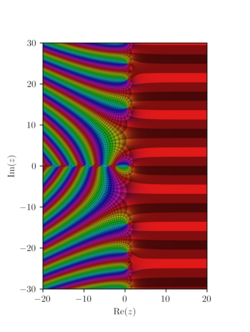
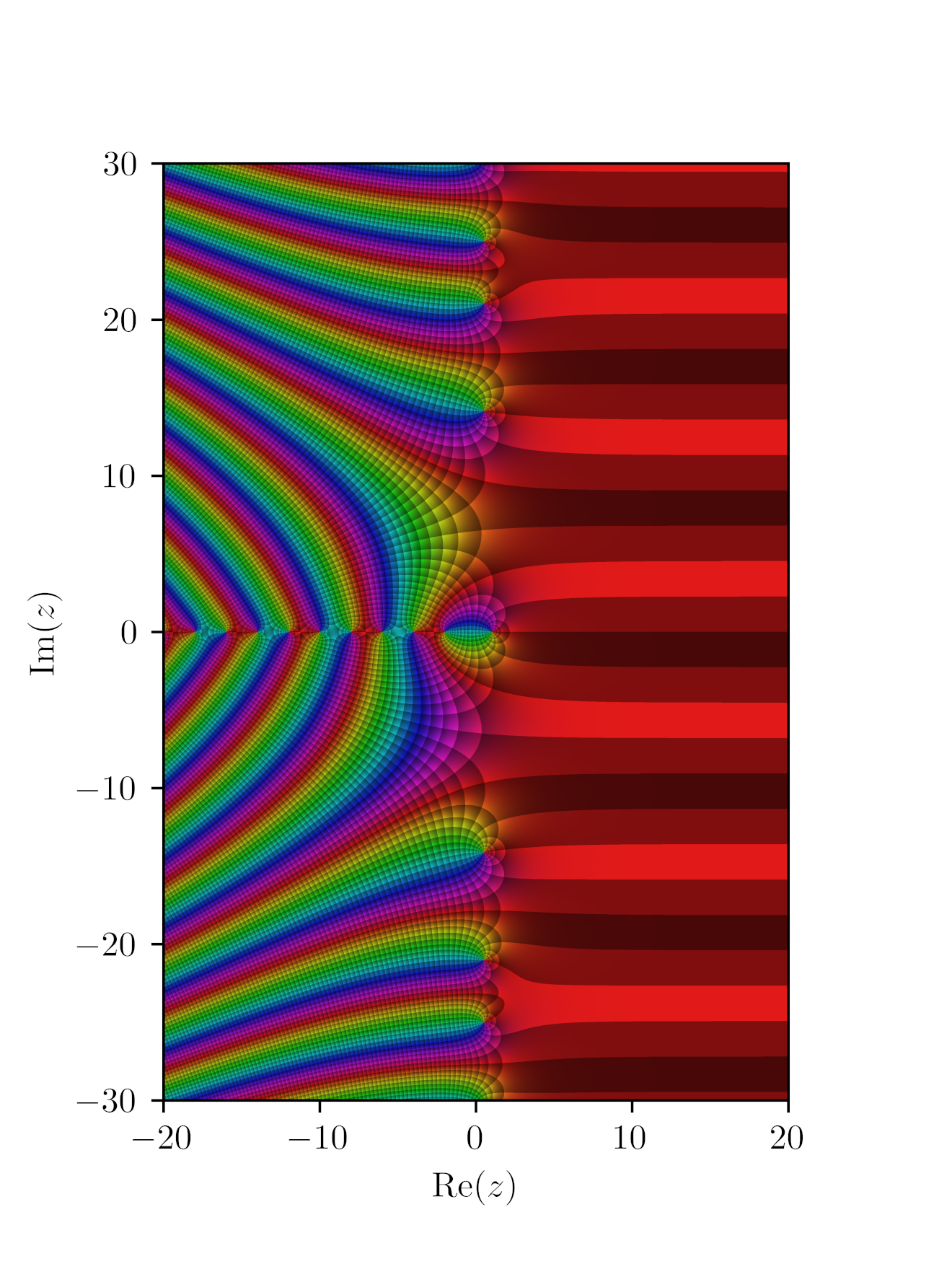
The Riemann zeta function can be thought of as the archetype for all L-functions.[1]

In mathematics, an L-function is a meromorphic function on the complex plane, associated to one out of several categories of mathematical objects. An L-series is a Dirichlet series, usually convergent on a half-plane, that may give rise to an L-function via analytic continuation. The Riemann zeta function is an example of an L-function, and some important conjectures involving L-functions are the Riemann hypothesis and its generalizations.

The theory of L-functions has become a very substantial, and still largely conjectural, part of contemporary analytic number theory. In it, broad generalisations of the Riemann zeta function and the L-series for a Dirichlet character are constructed, and their general properties, in most cases still out of reach of proof, are set out in a systematic way. Because of the Euler product formula there is a deep connection between L-functions and the theory of prime numbers.

The mathematical field that studies L-functions is sometimes called analytic theory of L-functions.

Construction

[edit]

We distinguish at the outset between the L-series, an infinite series representation (for example the Dirichlet series for the Riemann zeta function), and the L-function, the function in the complex plane that is its analytic continuation. The general constructions start with an L-series, defined first as a Dirichlet series, and then by an expansion as an Euler product indexed by prime numbers. Estimates are required to prove that this converges in some right half-plane of the complex numbers. Then one asks whether the function so defined can be analytically continued to the rest of the complex plane (perhaps with some poles).

It is this (conjectural) meromorphic continuation to the complex plane which is called an L-function. In the classical cases, already, one knows that useful information is contained in the values and behaviour of the L-function at points where the series representation does not converge. The general term L-function here includes many known types of zeta functions. The Selberg class is an attempt to capture the core properties of L-functions in a set of axioms, thus encouraging the study of the properties of the class rather than of individual functions.

Conjectural information

[edit]

One can list characteristics of known examples of L-functions that one would wish to see generalized:

Detailed work has produced a large body of plausible conjectures, for example about the exact type of functional equation that should apply. Since the Riemann zeta function connects through its values at positive even integers (and negative odd integers) to the Bernoulli numbers, one looks for an appropriate generalisation of that phenomenon. In that case results have been obtained for p-adic L-functions, which describe certain Galois modules.

The statistics of the zero distributions are of interest because of their connection to problems like the generalized Riemann hypothesis, distribution of prime numbers, etc. The connections with random matrix theory and quantum chaos are also of interest. The fractal structure of the distributions has been studied using rescaled range analysis.[2] The self-similarity of the zero distribution is quite remarkable, and is characterized by a large fractal dimension of 1.9. This rather large fractal dimension is found over zeros covering at least fifteen orders of magnitude for the Riemann zeta function, and also for the zeros of other L-functions of different orders and conductors.

Birch and Swinnerton-Dyer conjecture

[edit]

One of the influential examples, both for the history of the more general L-functions and as a still-open research problem, is the conjecture developed by Bryan Birch and Peter Swinnerton-Dyer in the early part of the 1960s. It applies to an elliptic curve E, and the problem it attempts to solve is the prediction of the rank of the elliptic curve over the rational numbers (or another global field): i.e. the number of free generators of its group of rational points. Much previous work in the area began to be unified around a better knowledge of L-functions. This was something like a paradigm example of the nascent theory of L-functions.

Rise of the general theory

[edit]

This development preceded the Langlands program by a few years, and can be regarded as complementary to it: Langlands' work relates largely to Artin L-functions, which, like Hecke L-functions, were defined several decades earlier, and to L-functions attached to general automorphic representations.

Gradually it became clearer in what sense the construction of Hasse–Weil zeta functions might be made to work to provide valid L-functions, in the analytic sense: there should be some input from analysis, which meant automorphic analysis. The general case now unifies at a conceptual level a number of different research programs.

See also

[edit]

References

[edit]
[edit]
Revisions and contributorsEdit on WikipediaRead on Wikipedia
from Grokipedia
In mathematics, an L-function is a meromorphic function on the complex plane defined by a Dirichlet series L(s)=n=1annsL(s) = \sum_{n=1}^\infty \frac{a_n}{n^s} for (s)>1\Re(s) > 1, where the coefficients ana_n are complex numbers associated with an arithmetic object such as a Dirichlet character, a modular form, or a motive, and which extends analytically to the entire complex plane except for finitely many poles. These functions generalize the Riemann zeta function ζ(s)\zeta(s), the prototypical L-function with an=1a_n = 1 for all nn, and are characterized by an Euler product representation L(s)=p(j=0d1(1αj,pps)1)L(s) = \prod_p \left( \prod_{j=0}^{d-1} (1 - \alpha_{j,p} p^{-s})^{-1} \right) over primes pp, where dd is the degree and αj,p\alpha_{j,p} are the local parameters (the roots of the reciprocal local polynomial factors). They satisfy a functional equation relating L(s)L(s) to L(1s)L(1-s) (or a shifted version), often involving Gamma factors and a conductor parameter, which encodes arithmetic information about the underlying object. The concept of L-functions originated in the 19th century with Peter Gustav Lejeune Dirichlet's 1837 introduction of series now called Dirichlet L-functions to prove the infinitude of primes in arithmetic progressions, where an=χ(n)a_n = \chi(n) for a χ\chi a positive qq. Bernhard Riemann's 1859 memoir on the zeta function provided the analytic framework, including meromorphic continuation and the , which later axiomatized broader classes of L-functions. Subsequent developments included Dedekind's 1877 generalization to Dedekind zeta functions for number fields, Hecke's 1910s work on L-functions attached to modular forms, and Artin's 1920s construction of L-functions from Galois representations. Key properties of L-functions include convergence of the in a half-plane, for large (s)\Re(s), and the Euler product, which reflects multiplicativity of the coefficients and links to prime distribution. They often obey a of the form Λ(s)=ϵΛ(1s)\Lambda(s) = \epsilon \Lambda(1-s), where Λ(s)\Lambda(s) is a completed L-function incorporating Gamma shifts and a root number ϵ\epsilon with ϵ=1|\epsilon| = 1, alongside conjectural bounds like the Ramanujan conjecture on the growth of local factors. Special values at integers, such as L(1,χ)0L(1, \chi) \neq 0 for non-principal characters (ensuring Dirichlet's theorem), reveal arithmetic data like class numbers or regulators in number fields. L-functions are central to modern , particularly the , which posits deep connections between Galois representations, automorphic forms, and their attached L-functions, with applications to solving Diophantine equations and understanding prime distributions. The generalized , asserting that non-trivial zeros lie on the critical line (s)=1/2\Re(s) = 1/2, remains a major unsolved problem for all primitive L-functions. Ongoing research, facilitated by databases like the L-functions and Modular Forms Database (LMFDB), computes and classifies millions of L-functions to test conjectures and explore their symmetries.

Definition and Construction

Formal Definition

In number theory, an L-function is formally defined as a Dirichlet series of the form L(s)=n=1annsL(s) = \sum_{n=1}^\infty \frac{a_n}{n^s}, where ss is a complex variable with real part greater than 1, and the coefficients ana_n are complex numbers satisfying the multiplicativity condition amn=amana_{mn} = a_m a_n whenever mm and nn are coprime. For the specific case of Dirichlet L-functions, the coefficients are given by an=χ(n)a_n = \chi(n), where χ\chi is a Dirichlet character, a completely multiplicative function periodic modulo some positive integer qq. This multiplicativity ensures that the series admits an Euler product representation over primes, though the focus here is on the series form. A primitive L-function is one that cannot be expressed as a non-trivial product of two other L-functions, meaning it has no "factors" beyond units or itself in the relevant ring of such functions. General L-functions can be uniquely decomposed into a product of primitive L-functions (up to units), which plays a crucial role in studying their analytic properties and arithmetic significance, as this reflects the underlying arithmetic data. This decomposition is part of the axiomatic framework, such as the Selberg class, where primitive elements form the building blocks. The completed L-function Λ(s)\Lambda(s) provides a normalized version of L(s)L(s) to facilitate the , typically defined as Λ(s)=Ns/2(j=1d1Γ(λjs+μj))(k=1d2Γ(λks+νk))L(s),\Lambda(s) = N^{s/2} \left( \prod_{j=1}^{d_1} \Gamma(\lambda_j s + \mu_j) \right) \left( \prod_{k=1}^{d_2} \Gamma(\lambda_k s + \nu_k) \right) L(s), where NN is the conductor, the Γ\Gamma-factors account for the degree and growth, and the parameters ensure holomorphy and the equation Λ(s)=ϵΛ(1sˉ)\Lambda(s) = \epsilon \overline{\Lambda(1 - \bar{s})} with ϵ=1|\epsilon| = 1. For simpler cases like Dirichlet L-functions, the completion simplifies to Λ(s,χ)=(qπ)s/2Γ(s+κ2)L(s,χ)\Lambda(s, \chi) = \left( \frac{q}{\pi} \right)^{s/2} \Gamma\left( \frac{s + \kappa}{2} \right) L(s, \chi), where qq is the modulus, κ=0\kappa = 0 or 1 depending on the parity of χ\chi, and no s(s1)s(s-1) factor is included unless L(s)L(s) has a pole. The conductor NN of an L-function is a positive that encodes the arithmetic complexity or "level" of the function, appearing in the to normalize the Gamma factors and distinguishing primes where the local factors may ramify or behave differently. It generalizes the modulus of a and is minimal such that the L-function satisfies its defining properties.

Euler Product Representation

One defining feature of L-functions is their Euler product representation, which expresses the Dirichlet series as an infinite product over prime numbers, thereby encoding arithmetic information local to each prime. For an L-function L(s)=n=1annsL(s) = \sum_{n=1}^\infty a_n n^{-s} in the Selberg class with Dirichlet coefficients ana_n, the Euler product takes the form L(s)=p(k=0apkpks)L(s) = \prod_p \left( \sum_{k=0}^\infty a_{p^k} p^{-k s} \right) for (s)>1\Re(s) > 1, where the local factor at each prime pp is the subsum over powers of pp. Equivalently, for primitive L-functions—those not expressible as a product of L-functions of strictly smaller degree—this can be written as L(s)=pj=1d(1αj,pps)1,L(s) = \prod_p \prod_{j=1}^d \left(1 - \alpha_{j,p} p^{-s}\right)^{-1}, where dd is the degree and the αj,p\alpha_{j,p} (with αj,p=1|\alpha_{j,p}| = 1 under the Ramanujan conjecture) are the local roots or Satake parameters; this is the inverse of a degree-dd polynomial Pp(ps)=j=1d(1αj,pps)P_p(p^{-s}) = \prod_{j=1}^d (1 - \alpha_{j,p} p^{-s}), whose coefficients are the elementary symmetric functions of the αj,p\alpha_{j,p}. The Euler product converges absolutely in the half-plane (s)>1\Re(s) > 1 for primitive L-functions, mirroring the absolute convergence of the corresponding Dirichlet series in this region, due to the boundedness of the coefficients annεa_n \ll n^\varepsilon for any ε>0\varepsilon > 0. Outside this half-plane, the product may exhibit conditional convergence, depending on the growth of the local factors, though the full analytic continuation is addressed elsewhere. This representation underscores the arithmetic nature of L-functions, as the local factors k=0apkpks\sum_{k=0}^\infty a_{p^k} p^{-k s} capture the behavior at each prime pp. A key generalization arises in the context of number fields, where the ζK(s)\zeta_K(s) for a number field [K](/page/K)[K](/page/K) extends the via the Euler product ζK(s)=p(1N(p)s)1,\zeta_K(s) = \prod_{\mathfrak{p}} \left(1 - N(\mathfrak{p})^{-s}\right)^{-1}, with the product over prime ideals p\mathfrak{p} of [K](/page/K)[K](/page/K) and N(p)N(\mathfrak{p}) their norms; this serves as a for higher-degree L-functions in the Selberg class, with degree equal to [K:Q][K : \mathbb{Q}]. The Euler product plays a crucial role in establishing the multiplicativity of the coefficients ana_n, meaning amn=amana_{mn} = a_m a_n whenever gcd(m,n)=1\gcd(m,n) = 1, which follows directly from the unique factorization in the product and enables the decomposition of ana_n into contributions from its factors. This multiplicativity facilitates partial fraction-like decompositions of the coefficients via , allowing explicit computations and analytic estimates based on local data at primes.

Analytic Properties

Analytic Continuation and Functional Equation

L-functions are initially defined via Dirichlet series that converge absolutely in the right half-plane (s)>1\Re(s) > 1, but they admit a meromorphic continuation to the entire complex plane C\mathbb{C}, holomorphic everywhere except for a possible simple pole at s=1s=1. This extension is a cornerstone of their analytic theory, enabling the study of their behavior across the plane, including in the critical strip 0<(s)<10 < \Re(s) < 1. To capture their symmetry, one forms the completed L-function Λ(s)\Lambda(s), which incorporates non-archimedean and archimedean factors. For functions in the Selberg class, Λ(s)=Qsj=1rΓ(λjs+μj)L(s)\Lambda(s) = Q^s \prod_{j=1}^r \Gamma(\lambda_j s + \mu_j) L(s), where Q>0Q > 0 is the conductor, λj>0\lambda_j > 0, (μj)0\Re(\mu_j) \geq 0, and rr relates to the analytic conductor; this satisfies the Λ(s)=εΛ(1s)\Lambda(s) = \varepsilon \Lambda(1-s), with root number ε\varepsilon satisfying ε=1|\varepsilon| = 1. For zeta-like functions of degree 1, the archimedean factor simplifies to πs/2Γ(s/2)\pi^{-s/2} \Gamma(s/2). The reflects a duality between ss and 1s1-s, interchanging the roles of the series and its continuation. As a prototype, the ζ(s)\zeta(s) has the completed form Λ(s)=πs/2Γ(s/2)ζ(s)\Lambda(s) = \pi^{-s/2} \Gamma(s/2) \zeta(s), satisfying Λ(s)=Λ(1s)\Lambda(s) = \Lambda(1-s), and exhibits a simple pole at s=1s=1 with residue $1$. This pole arises from the series term in its Euler product, and the residue encodes arithmetic data like the constant in the . Regarding growth, in any fixed vertical strip σ1(s)σ2\sigma_1 \leq \Re(s) \leq \sigma_2, L-functions from the Selberg class are of finite order, implying bounds of the form L(σ+it)=O(tμ(logt)ν)L(\sigma + it) = O(|t|^\mu (\log |t|)^\nu) on lines (s)=σ\Re(s) = \sigma, where μ\mu and ν\nu depend on σ\sigma and the degree dd of the L-function (with μd(1/2min(σ,1σ))+ε\mu \leq d(1/2 - \min(\sigma, 1-\sigma)) + \varepsilon for any ε>0\varepsilon > 0 via Phragmén-Lindelöf principles applied to the ). These estimates control the size in the critical strip and facilitate applications to zero-free regions and distribution laws.

Zeros and the Critical Line

The non-trivial zeros of an L-function, after , are located within the critical strip defined by 0<Re(s)<10 < \operatorname{Re}(s) < 1. These zeros are the primary objects of study in the analytic theory of L-functions, as the trivial zeros (typically at negative integers or related points depending on the Gamma factors) lie outside this strip. The functional equation of the L-function implies a symmetry in the distribution of these zeros, pairing each zero ρ\rho with 1ρ1 - \overline{\rho}, thus reflecting them across the critical line Re(s)=1/2\operatorname{Re}(s) = 1/2. A key result in the theory is the existence of zero-free regions near the right boundary of the critical strip, which have important implications for arithmetic applications analogous to the prime number theorem. Specifically, for a broad class of L-functions—including Dirichlet L-functions, Dedekind zeta functions, and Rankin-Selberg L-functions associated to cuspidal automorphic representations—there are no zeros in the region σ1clog(q(t+3)d)\sigma \geq 1 - \frac{c}{\log(q(|t| + 3)^d)}, where s=σ+its = \sigma + it, c>0c > 0 is an absolute constant, qq denotes the analytic conductor, and dd is the degree of the L-function, for sufficiently large t|t| (with a possible exception of a simple real zero β<1\beta < 1). This classical zero-free region, first established for the Riemann zeta function and extended to general L-functions via similar methods involving the Euler product and logarithmic derivatives, ensures that the L-function does not vanish too close to the line Re(s)=1\operatorname{Re}(s) = 1. Density theorems provide further insight into the location of zeros within the strip, particularly their tendency to cluster near the critical line. For L-functions in specific classes, such as the Riemann zeta function, it has been proven that a positive proportion δ>0\delta > 0 of the non-trivial zeros lie on the critical line Re(s)=1/2\operatorname{Re}(s) = 1/2. Selberg established this result in , showing that the number of such zeros up to height TT satisfies N0(T)>δN(T)N_0(T) > \delta N(T), where N(T)N(T) is the total number of non-trivial zeros up to TT, with δ\delta effectively positive (later refinements improved δ\delta to over 40%). Analogous density results hold for families of Dirichlet L-functions and elements of the Selberg class, where at least a fixed positive proportion of zeros are on the critical line, often obtained via methods or moments of L-functions. These theorems highlight the critical line's significance without resolving the full distribution of zeros.

Classical Examples

Dirichlet L-functions

Dirichlet L-functions are associated to s, which are completely multiplicative functions χ:ZC\chi: \mathbb{Z} \to \mathbb{C} that are periodic with period qq (the modulus), vanish on integers not coprime to qq, and satisfy χ(1)=1\chi(1) = 1. For a Dirichlet character χ\chi modulo qq, the corresponding is defined for Re(s)>1\operatorname{Re}(s) > 1 by the L(s,χ)=n=1χ(n)ns.L(s, \chi) = \sum_{n=1}^\infty \frac{\chi(n)}{n^s}. This series converges absolutely in this half-plane and admits an Euler product representation L(s,χ)=p(1χ(p)ps)1,L(s, \chi) = \prod_p \left(1 - \chi(p) p^{-s}\right)^{-1}, where the product is over all primes pp, reflecting the multiplicative nature of χ\chi. A fundamental property of Dirichlet characters modulo qq is their : for integers a,ba, b coprime to qq, χmodqχ(a)χ(b)=φ(q)if ab(modq),\sum_{\chi \bmod q} \chi(a) \overline{\chi(b)} = \varphi(q) \quad \text{if } a \equiv b \pmod{q}, and the sum is zero otherwise, where φ\varphi is and the sum runs over all φ(q)\varphi(q) characters modulo qq. This underpins many applications of L-functions, including the decomposition of arithmetic functions into character sums. For non-principal characters χ\chi (i.e., χχ0\chi \neq \chi_0, the principal character modulo qq), the value L(1,χ)0L(1, \chi) \neq 0. This non-vanishing result is crucial for Dirichlet's theorem on primes in arithmetic progressions, which states that if gcd(a,q)=1\gcd(a, q) = 1, there are infinitely many primes congruent to aa modulo qq, with asymptotic density 1/φ(q)1/\varphi(q) among all primes. The proof relies on the partial summation of the weighted by characters, where the non-vanishing ensures the logarithmic singularity from the principal character dominates without cancellation from others. Dirichlet L-functions satisfy an explicit functional equation relating L(s,χ)L(s, \chi) to L(1s,χ)L(1-s, \overline{\chi}). For a primitive character χ\chi of conductor qq (the smallest modulus for which χ\chi is periodic), define the completed L-function Λ(s,χ)=(qπ)s/2Γ(s+κ2)L(s,χ),\Lambda(s, \chi) = \left( \frac{q}{\pi} \right)^{s/2} \Gamma\left( \frac{s + \kappa}{2} \right) L(s, \chi), where κ=0\kappa = 0 if χ\chi is even (χ(1)=1\chi(-1) = 1) and κ=1\kappa = 1 if odd (χ(1)=1\chi(-1) = -1). The functional equation is then Λ(s,χ)=τ(χ)iκqΛ(1s,χ),\Lambda(s, \chi) = \frac{\tau(\chi)}{i^\kappa \sqrt{q}} \Lambda(1-s, \overline{\chi}),
Add your contribution
Related Hubs
User Avatar
No comments yet.