
Hubbry Logo
Modularity theoremModularity theoremMain
Open search
Modularity theorem
Community hub
Modularity theorem
logo
7 pages, 0 posts
0 subscribers
Be the first to start a discussion here.
Modularity theorem
Modularity theorem
from Wikipedia

In number theory, the modularity theorem states that elliptic curves over the field of rational numbers are related to modular forms in a particular way. Andrew Wiles and Richard Taylor proved the modularity theorem for semistable elliptic curves, which was enough to imply Fermat's Last Theorem (FLT). Later, a series of papers by Wiles's former students Brian Conrad, Fred Diamond and Richard Taylor, culminating in a joint paper with Christophe Breuil, extended Wiles's techniques to prove the full modularity theorem in 2001. Before that, the statement was known as the Taniyama–Shimura conjecture, Taniyama–Shimura–Weil conjecture, or the modularity conjecture for elliptic curves.

Key Information

Statement

[edit]

The theorem states that any elliptic curve over can be obtained via a rational map with integer coefficients from the classical modular curve X0(N) for some integer N; this is a curve with integer coefficients with an explicit definition. This mapping is called a modular parametrization of level N. If N is the smallest integer for which such a parametrization can be found (which by the modularity theorem itself is now known to be a number called the conductor), then the parametrization may be defined in terms of a mapping generated by a particular kind of modular form of weight two and level N, a normalized newform with integer q-expansion, followed if need be by an isogeny.

[edit]

The modularity theorem implies a closely related analytic statement:

To each elliptic curve E over we may attach a corresponding L-series. The L-series is a Dirichlet series, commonly written
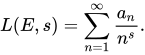
The generating function of the coefficients an is then

If we make the substitution

we see that we have written the Fourier expansion of a function f(E,τ) of the complex variable τ, so the coefficients of the q-series are also thought of as the Fourier coefficients of f. The function obtained in this way is, remarkably, a cusp form of weight two and level N and is also an eigenform (an eigenvector of all Hecke operators); this is the Hasse–Weil conjecture, which follows from the modularity theorem.

Some modular forms of weight two, in turn, correspond to holomorphic differentials for an elliptic curve. The Jacobian of the modular curve can (up to isogeny) be written as a product of irreducible Abelian varieties, corresponding to Hecke eigenforms of weight 2. The 1-dimensional factors are elliptic curves (there can also be higher-dimensional factors, so not all Hecke eigenforms correspond to rational elliptic curves). The curve obtained by finding the corresponding cusp form, and then constructing a curve from it, is isogenous to the original curve (but not, in general, isomorphic to it).

History

[edit]

Yutaka Taniyama[1] stated a preliminary (slightly incorrect) version of the conjecture at the 1955 international symposium on algebraic number theory in Tokyo and Nikkō as the twelfth of his set of 36 unsolved problems. Goro Shimura and Taniyama worked on improving its rigor until 1957. André Weil[2] rediscovered the conjecture, and showed in 1967 that it would follow from the (conjectured) functional equations for some twisted L-series of the elliptic curve; this was the first serious evidence that the conjecture might be true. Weil also showed that the conductor of the elliptic curve should be the level of the corresponding modular form. The Taniyama–Shimura–Weil conjecture became a part of the Langlands program.[3][4]

The conjecture attracted considerable interest when Gerhard Frey[5] suggested in 1986 that it implies FLT. He did this by attempting to show that any counterexample to FLT would imply the existence of at least one non-modular elliptic curve. This argument was moved closer to its goal in 1987 when Jean-Pierre Serre[6] identified a missing link (now known as the epsilon conjecture or Ribet's theorem) in Frey's original work, followed two years later by Ken Ribet's completion of a proof of the epsilon conjecture.[7]

Even after gaining serious attention, the Taniyama–Shimura–Weil conjecture was seen by contemporary mathematicians as extraordinarily difficult to prove or perhaps even inaccessible to proof.[8] For example, Wiles's Ph.D. supervisor John Coates states that it seemed "impossible to actually prove", and Ken Ribet considered himself "one of the vast majority of people who believed [it] was completely inaccessible".

With Ribet’s proof of the epsilon conjecture, Andrew Wiles saw an opportunity: Fermat’s Last Theorem was a respectable research project because it was now a corollary of the TSW conjecture. He had expertise in Iwasawa theory; maybe there was a path from Iwasawa theory to Taniyama–Shimura–Weil.

In 1995, Andrew Wiles, with some help from Richard Taylor, proved the Taniyama–Shimura–Weil conjecture for all semistable elliptic curves. Wiles used this to prove FLT,[9] and the full Taniyama–Shimura–Weil conjecture was finally proved by Diamond,[10] Conrad, Diamond & Taylor; and Breuil, Conrad, Diamond & Taylor; building on Wiles's work, they incrementally chipped away at the remaining cases until the full result was proved in 1999.[11][12] Once fully proven, the conjecture became known as the modularity theorem.

Several theorems in number theory similar to FLT follow from the modularity theorem. For example: no cube can be written as a sum of two coprime nth powers, n ≥ 3.[a]

In 2025, modularity was extended to over 10% of abelian surfaces by Boxer, Calegari, Gee and Pilloni.[13][14]

Generalizations

[edit]

The modularity theorem is a special case of more general conjectures due to Robert Langlands. The Langlands program seeks to attach an automorphic form or automorphic representation (a suitable generalization of a modular form) to more general objects of arithmetic algebraic geometry, such as to every elliptic curve over a number field. Most cases of these extended conjectures have not yet been proved.

In 2013, Freitas, Le Hung, and Siksek proved that elliptic curves defined over real quadratic fields are modular.[15]

Example

[edit]

For example,[16][17][18] the elliptic curve y2y = x3x, with discriminant (and conductor) 37, is associated to the form

For prime numbers l not equal to 37, one can verify the property about the coefficients. Thus, for l = 3, there are 6 solutions of the equation modulo 3: (0, 0), (0, 1), (1, 0), (1, 1), (2, 0), (2, 1); thus a(3) = 3 − 6 = −3.

The conjecture, going back to the 1950s, was completely proven by 1999 using the ideas of Andrew Wiles, who proved it in 1994 for a large family of elliptic curves.[19]

There are several formulations of the conjecture. Showing that they are equivalent was a main challenge of number theory in the second half of the 20th century. The modularity of an elliptic curve E of conductor N can be expressed also by saying that there is a non-constant rational map defined over , from the modular curve X0(N) to E. In particular, the points of E can be parametrized by modular functions.

For example, a modular parametrization of the curve y2y = x3x is given by[20]

where, as above, q = e2πiz. The functions x(z) and y(z) are modular of weight 0 and level 37; in other words they are meromorphic, defined on the upper half-plane Im(z) > 0 and satisfy
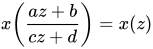
and likewise for y(z), for all integers a, b, c, d with adbc = 1 and 37 | c.

Another formulation depends on the comparison of Galois representations attached on the one hand to elliptic curves, and on the other hand to modular forms. The latter formulation has been used in the proof of the conjecture. Dealing with the level of the forms (and the connection to the conductor of the curve) is particularly delicate.

The most spectacular application of the conjecture is the proof of Fermat's Last Theorem (FLT). Suppose that for a prime p ≥ 5, the Fermat equation

has a solution with non-zero integers, hence a counter-example to FLT. Then as Yves Hellegouarch [fr] was the first to notice,[21] the elliptic curve

of discriminant
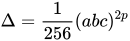
cannot be modular.[7] Thus, the proof of the Taniyama–Shimura–Weil conjecture for this family of elliptic curves (called Hellegouarch–Frey curves) implies FLT. The proof of the link between these two statements, based on an idea of Gerhard Frey (1985), is difficult and technical. It was established by Kenneth Ribet in 1987.[22]

Notes

[edit]

References

[edit]
[edit]
Revisions and contributorsEdit on WikipediaRead on Wikipedia
from Grokipedia
The Modularity theorem, formerly known as the Taniyama–Shimura conjecture, asserts that every elliptic curve over the field of rational numbers Q\mathbb{Q} is modular, in the sense that its associated LL-function arises from a weight-2 newform (a cuspidal Hecke eigenform) of corresponding level and character. This bijection between isomorphism classes of elliptic curves over Q\mathbb{Q} and such modular forms provides a deep link between the arithmetic of elliptic curves and the analytic theory of modular forms. The conjecture originated in the 1950s through independent insights by and Goro Shimura, who proposed connections between elliptic curves and modular forms as part of broader reciprocity laws in . refined and popularized the statement in 1967, emphasizing its implications for the and functional equations of LL-functions attached to elliptic curves. Numerical evidence supported the conjecture for many specific curves, but a general proof remained elusive until the 1990s. A major breakthrough came in 1995 when , building on the and earlier work by Gerhard Frey, , and Kenneth Ribet, proved the semistable case of the theorem using advanced techniques in Galois representations, deformation theory, and the structure of Hecke algebras. This partial result sufficed to establish as a , since semistable s arising from putative counterexamples to were shown to violate modularity. Wiles' proof involved demonstrating that the residual Galois representation attached to an elliptic curve lifts to a modular representation, with key innovations in showing Hecke algebras are complete intersections. The full theorem for all elliptic curves over Q\mathbb{Q} was established in 2001 by Christophe Breuil, Brian Conrad, Fred Diamond, and Richard Taylor, who extended Wiles' methods to handle the "wild" ramification cases at the prime 3 using base change to totally real fields and automorphic induction. Their work completed the proof by addressing potential non-modularity in curves with more general reduction types at primes of bad reduction. The theorem has profound implications beyond , including the resolution of many cases of the via the Gross–Zagier formula and Heegner points, as well as advancements in the for GL(2). It also underpins the study of elliptic curves over number fields, with generalizations to higher dimensions and other fields now actively pursued.

Background Concepts

Elliptic Curves over

An over the rational numbers Q\mathbb{Q} is defined as a smooth projective of 1 equipped with a specified base point, which serves as the identity for the group on its points. Such curves can be represented by a Weierstrass of the form y2=x3+ax+b,y^2 = x^3 + a x + b, where a,bQa, b \in \mathbb{Q} and the Δ=16(4a3+27b2)0\Delta = -16(4a^3 + 27b^2) \neq 0 ensures the is nonsingular. The point at infinity provides the base point, and this model embeds the in the over Q\mathbb{Q}. The set of points on the EE forms an under a geometric law derived from the chord-and-tangent . For distinct points P1=(x1,y1)P_1 = (x_1, y_1) and P2=(x2,y2)P_2 = (x_2, y_2) with x1x2x_1 \neq x_2, the sum P3=P1+P2=(x3,y3)P_3 = P_1 + P_2 = (x_3, y_3) is the reflection across the x-axis of the third point of the line through P1P_1 and P2P_2 with the curve, given by x3=(y2y1x2x1)2x1x2,y3=y2y1x2x1(x1x3)y1.x_3 = \left( \frac{y_2 - y_1}{x_2 - x_1} \right)^2 - x_1 - x_2, \quad y_3 = \frac{y_2 - y_1}{x_2 - x_1} (x_1 - x_3) - y_1. Doubling a point P=(x,y)P = (x, y) with y0y \neq 0 uses the line: x3=(3x2+a2y)22x,y3=3x2+a2y(xx3)y.x_3 = \left( \frac{3x^2 + a}{2y} \right)^2 - 2x, \quad y_3 = \frac{3x^2 + a}{2y} (x - x_3) - y. The is the point at infinity O\mathcal{O}, and the inverse of P=(x,y)P = (x, y) is P=(x,y)-P = (x, -y). The rational points E(Q)E(\mathbb{Q}) form a subgroup, and by the Mordell-Weil theorem, E(Q)E(\mathbb{Q}) is a , isomorphic to ZrT\mathbb{Z}^r \oplus T where rr is the rank and TT is the finite torsion subgroup. The j-invariant, j(E)=2833a34a3+27b2j(E) = \frac{2^8 3^3 a^3}{4a^3 + 27b^2}, classifies elliptic curves up to isomorphism over Q\overline{\mathbb{Q}} and is independent of the choice of Weierstrass model. Associated to an EE over Q\mathbb{Q} is its Hasse-Weil L(E,s)L(E, s), defined for (s)>3/2\Re(s) > 3/2 by the L(E,s)=n=1anns,L(E, s) = \sum_{n=1}^\infty \frac{a_n}{n^s}, where the coefficients ana_n arise from the Euler product over primes, with ap=p+1#E(Fp)a_p = p + 1 - \#E(\mathbb{F}_p) for primes of good reduction. This encodes arithmetic data about EE and admits to the .

Modular Forms and Representations

A modular form of weight 2 and level NN is a f:HCf: \mathbb{H} \to \mathbb{C} on the upper half-plane H\mathbb{H} that satisfies the transformation property f(az+bcz+d)=(cz+d)2f(z)f\left(\frac{az + b}{cz + d}\right) = (cz + d)^2 f(z) for all matrices (abcd)Γ0(N)\begin{pmatrix} a & b \\ c & d \end{pmatrix} \in \Gamma_0(N), where Γ0(N)={(abcd)SL2(Z)c0(modN)}\Gamma_0(N) = \left\{ \begin{pmatrix} a & b \\ c & d \end{pmatrix} \in \mathrm{SL}_2(\mathbb{Z}) \mid c \equiv 0 \pmod{N} \right\}, and ff is at the cusps of Γ0(N)\H\Gamma_0(N) \backslash \mathbb{H}^*. Such forms admit a Fourier expansion f(z)=n=0anqnf(z) = \sum_{n=0}^\infty a_n q^n at the cusp \infty, where q=e2πizq = e^{2\pi i z}, with a0=0a_0 = 0 for cusp forms. The space of cusp forms of weight 2, level NN, and nebentypus character ε:(Z/NZ)×C×\varepsilon: (\mathbb{Z}/N\mathbb{Z})^\times \to \mathbb{C}^\times with ε(1)=1\varepsilon(-1) = 1 is denoted S2(Γ0(N),ε)S_2(\Gamma_0(N), \varepsilon). Newforms are the normalized Hecke eigenforms in the new subspace S2new(Γ0(N),ε)S_2^{\mathrm{new}}(\Gamma_0(N), \varepsilon), meaning they are eigenfunctions of the Hecke operators TT_\ell for all primes \ell with eigenvalues aa_\ell, normalized so that a1=1a_1 = 1, and they generate the one-dimensional eigenspaces under the action. The Hecke operators TnT_n act on the space of modular forms by summing over certain cosets, commuting with each other when coprime, and preserving the cusp forms subspace. To a newform fS2new(Γ0(N),ε)f \in S_2^{\mathrm{new}}(\Gamma_0(N), \varepsilon) with rational Fourier coefficients, Deligne attached a continuous representation ρf,λ:Gal(Q/Q)GL2(Q)\rho_{f,\lambda}: \mathrm{Gal}(\overline{\mathbb{Q}}/\mathbb{Q}) \to \mathrm{GL}_2(\overline{\mathbb{Q}}_\ell) for primes N\ell \nmid N, which is unramified at primes outside \ell and the primes dividing NN, and satisfies trace(ρf,λ(Frobp))=ap\mathrm{trace}(\rho_{f,\lambda}(\mathrm{Frob}_p)) = a_p for primes pp \neq \ell. For a prime pNp \nmid N not dividing the level, the residual representation ρf,p:Gal(Q/Q)GL2(Fp)\overline{\rho}_{f,p}: \mathrm{Gal}(\overline{\mathbb{Q}}/\mathbb{Q}) \to \mathrm{GL}_2(\mathbb{F}_p) is the reduction modulo pp of ρf,p\rho_{f,p}, which is unramified outside pp and the primes dividing NN, with trace(ρf,p(Frob))=a(modp)\mathrm{trace}(\overline{\rho}_{f,p}(\mathrm{Frob}_\ell)) = a_\ell \pmod{p} for p\ell \neq p. The dimension of S2(Γ0(N),ε)S_2(\Gamma_0(N), \varepsilon) equals the genus gg of the modular curve X0(N)X_0(N), given explicitly by g=1+μ12ε4ν23ν32,g = 1 + \frac{\mu}{12} - \frac{\varepsilon_\infty}{4} - \frac{\nu_2}{3} - \frac{\nu_3}{2}, where μ=[SL2(Z):Γ0(N)]=NpN(1+1/p)\mu = [ \mathrm{SL}_2(\mathbb{Z}) : \Gamma_0(N) ] = N \prod_{p \mid N} (1 + 1/p) is the index, ε\varepsilon_\infty is the number of cusps, and νi\nu_i (for i=2,3i=2,3) counts the elliptic points of order ii. For trivial nebentypus ε=1\varepsilon = 1, this simplifies to approximately μ/12\mu/12 for large NN, reflecting the growth of the space. The Eichler-Shimura isomorphism identifies the space S2(Γ0(N))S_2(\Gamma_0(N)) of cusp forms of weight 2 and trivial nebentypus with the C\mathbb{C}- of Hecke-invariant classes in H1(X0(N),C)H^1(X_0(N), \mathbb{C}), more precisely, S2(Γ0(N))Hc1(X0(N),V2)+S_2(\Gamma_0(N)) \cong H^1_c(X_0(N), V_2)^+ where V2V_2 is the standard 2-dimensional representation of SL2(R)\mathrm{SL}_2(\mathbb{R}), up to the action of complex conjugation. This links the analytic theory of modular forms to the of the modular curve, providing a geometric realization of the Hecke eigenvalues as traces on classes.

Formal Statement

The Theorem

The modularity theorem states that every EE defined over the rational numbers Q\mathbb{Q} is modular. Specifically, for any such EE, there exists a cuspidal newform ff of weight 2 and level equal to the conductor NEN_E of EE such that the LL-function of EE coincides with that of ff, i.e., L(E,s)=L(f,s).L(E, s) = L(f, s). This equality implies that the Hecke eigenvalues of ff match the Fourier coefficients of the LL-series expansion of EE. The theorem was first established in 1995 for the case of semistable elliptic curves by Andrew Wiles. The proof for the general case, covering all elliptic curves over Q\mathbb{Q}, was completed in 2001 by Christophe Breuil, Brian Conrad, Fred Diamond, and Richard Taylor. Modularity of EE further implies that the pp-adic Galois representation ρE,p:\Gal(Q/Q)\GL2(Fp)\rho_{E,p}: \Gal(\overline{\mathbb{Q}}/\mathbb{Q}) \to \GL_2(\mathbb{F}_p) attached to EE is modular, meaning it is isomorphic to the residual representation ρf,p\rho_{f,p} attached to some weight-2 newform ff of level dividing NEN_E. Conversely, the modularity criterion asserts that if an irreducible, odd, two-dimensional residual representation ρ:\Gal(Q/Q)\GL2(Fp)\rho: \Gal(\overline{\mathbb{Q}}/\mathbb{Q}) \to \GL_2(\mathbb{F}_p) arises from a modular form (i.e., ρρf,p\rho \cong \rho_{f,p} for some newform ff), then under suitable conditions on the determinant and image, ρ\rho is the residual representation attached to some over Q\mathbb{Q}.

Equivalent Formulations

One equivalent formulation of the modularity theorem arises in the context of Galois representations. For an elliptic curve EE over Q\mathbb{Q}, the pp-adic Tate module Tp(E)T_p(E) yields a continuous representation ρE,p:\Gal(Q/Q)\GL2(Zp)\rho_{E,p}: \Gal(\overline{\mathbb{Q}}/\mathbb{Q}) \to \GL_2(\mathbb{Z}_p). The modularity theorem is equivalent to the statement that, for some prime pp, the reduction modulo pp of ρE,p\rho_{E,p} is modular, meaning it is isomorphic to the mod pp Galois representation attached to a weight-two newform ff of level equal to the conductor of EE with rational coefficients. The modularity theorem is a precise realization of the broader Taniyama-Shimura-Weil conjecture, which posits that every elliptic curve over Q\mathbb{Q} is modular. This conjecture asserts that for any such elliptic curve EE with conductor NN, there exists a cuspidal newform fS2(Γ0(N))f \in S_2(\Gamma_0(N)) with rational Fourier coefficients such that the L-function of EE equals the L-function of ff. The full conjecture, now a theorem, encompasses all elliptic curves over Q\mathbb{Q}, extending beyond the original semi-stable cases initially proved by Wiles and others. From the perspective of the , the modularity theorem represents a special case of the Langlands correspondence for \GL2/Q\GL_2/\mathbb{Q}. It establishes that the two-dimensional Galois representation ρE,p\rho_{E,p} attached to an EE corresponds to a cuspidal automorphic representation of \GL2(AQ)\GL_2(\mathbb{A}_\mathbb{Q}) generated by a weight-two , thereby realizing functoriality in this setting. This connection highlights modularity as an instance of the reciprocity conjecture linking Galois representations to automorphic forms.

Historical Development

Origins and Conjectures

The origins of the modularity theorem trace back to early observations in by Erich Hecke, who developed the analytic theory of modular forms and their associated L-functions. Hecke noted striking formal similarities between the L-functions of cusp forms of weight 2 and the L-functions arising from elliptic curves, which are Riemann surfaces of genus one. These L-functions, constructed via Hecke operators, exhibited properties analogous to those expected from the zeta functions of genus one curves, suggesting a deeper connection between analytic objects like modular forms and algebraic varieties such as elliptic curves. In the 1950s, advanced these ideas during the International Symposium on Algebraic Number Theory in Tokyo-Nikko in 1955, where he proposed a series of problems linking to . Specifically, Taniyama conjectured that the zeta function of an should coincide with the of a of weight 2, parametrizing analytic families of abelian varieties through . This formulation posited that abelian varieties could be constructed uniformly from modular data, extending Hecke's observations to a broader arithmetic framework. Goro Shimura refined Taniyama's conjecture in the 1960s, focusing on defined over the rational numbers Q\mathbb{Q}. In his work on complex multiplication, Shimura proposed that every over Q\mathbb{Q} arises as a of the of a modular curve, establishing a precise correspondence between such curves and weight-2 newforms. This refinement emphasized the role of modular curves as moduli spaces and provided a geometric interpretation, making the conjecture more amenable to algebraic verification. André Weil formalized these developments in the , dubbing the statement the Taniyama-Shimura-Weil . Weil's contribution clarified the conditions under which the of an over Q\mathbb{Q} matches that of a corresponding , including and functional equations. He highlighted the conjecture's implications for reciprocity laws and , while noting remaining challenges in its general validity. In the 1970s, Jean-Pierre Serre shifted attention to the residual representations associated with elliptic curves, posing questions about their modularity modulo primes. In 1975, Serre conjectured that every odd, irreducible, two-dimensional residual Galois representation of Gal(Q/Q)\mathrm{Gal}(\overline{\mathbb{Q}}/\mathbb{Q}) arises from a modular form, with the level, weight, and nebentypus determined by the representation's local behavior. This modularity conjecture for residual representations provided a foundational tool for studying the original conjecture through reductions modulo primes, influencing subsequent arithmetic investigations.

Key Milestones Leading to Proof

In the 1980s, advanced the understanding of Galois representations attached to elliptic curves through his development of deformation theory, which systematically studied liftings of residual representations to characteristic zero. This framework was pivotal in joint work with , where they analyzed p-adic analytic families of Galois representations arising from elliptic curves, establishing connections between universal deformation rings and Hecke algebras that foreshadowed modularity lifting techniques. A landmark contribution came in 1983 from the Langlands–Tunnell theorem, which proved that every irreducible odd two-dimensional Galois representation over Q\mathbb{Q} with dihedral (solvable) image corresponds to a weight 1 . This resolved Artin's conjecture in this case and provided early evidence for the of elliptic curves whose residual representations have solvable image, supporting the Taniyama–Shimura conjecture for a specific class of curves. The year 1986 marked a turning point with Gerhard Frey's introduction of "Frey curves," a geometric construction associating a semistable to any hypothetical solution of Fermat's equation xn+yn=znx^n + y^n = z^n for integers x,y,z>0x, y, z > 0 and n3n \geq 3. Frey showed that such a curve would have conductor 2 and minimal discriminant 24(xyz)2n-2^{4}(xyz)^{2n}, and he conjectured that no such curve could be modular, thereby forging a direct link between the non-existence of Fermat solutions and the Taniyama-Shimura conjecture. This idea built on earlier work tying Diophantine equations to elliptic curves but highlighted the potential of modularity to resolve Fermat's Last Theorem. That same year, Kenneth Ribet proved Serre's epsilon conjecture, establishing a level-lowering result for modular Galois representations. Ribet's theorem demonstrated that if an elliptic curve over the rationals admits a non-modular residual representation at a prime pp, then any associated modular form must have higher level unless the representation satisfies specific irreducibility conditions; crucially, for Frey curves, this implied the attached Galois representation could not arise from a modular form, reducing to the modularity of semistable elliptic curves. The proof, leveraging Mazur's deformation theory and properties of Hecke algebras, appeared in print in 1990 but was announced in 1986, galvanizing efforts toward a full modularity proof. These milestones in the 1980s and early 1990s, rooted in the Taniyama-Shimura conjecture first articulated in the 1950s, provided the theoretical and motivational foundation for Andrew Wiles' subsequent strategy, transforming the abstract modularity question into a concrete pathway for proving Fermat's Last Theorem.

Proof Strategy

Ribet's Level-Lowering

Ribet's level-lowering theorem provides a crucial technique for reducing the level of modular residual Galois representations, serving as a foundational step in establishing connections between elliptic curves and modular forms in the proof of the modularity theorem. Specifically, the theorem asserts that if ρ:\Gal(Q/Q)\GL2(F)\overline{\rho}: \Gal(\overline{\mathbb{Q}}/\mathbb{Q}) \to \GL_2(\mathbb{F}_\ell) is an irreducible representation arising from a modular form of level MpMp, where pMp \nmid M, \ell is an odd prime (the characteristic of F\mathbb{F}_\ell), and ρ\overline{\rho} is finite at pp (meaning it arises from a finite flat group scheme over Zp\mathbb{Z}_p), then ρ\overline{\rho} is modular of level MM provided either M\ell \nmid M or p≢1(mod)p \not\equiv 1 \pmod{\ell}. This reduction removes the prime pp from the level while preserving the associated Galois representation up to congruence modulo \ell. The base case for modularity of such irreducible representations, particularly when the level is minimal or 1, relies on the Langlands–Tunnell theorem, which establishes that every continuous, odd, irreducible 2-dimensional Galois representation over Q\mathbb{Q} with coefficients in a of characteristic an odd prime is modular. This result, building on the Artin conjecture for \GL2\GL_2, ensures that the lowered representation corresponds to a newform of the reduced level, allowing iterative application of level-lowering to reach the minimal conductor. In the application to Frey curves, Ribet's technique demonstrates the non-modularity of the E:y2=x(xap)(x+bp)E: y^2 = x(x - a^p)(x + b^p) attached to a hypothetical primitive solution (a,b,c)(a, b, c) to Fermat's ap+bp=cpa^p + b^p = c^p with p5p \geq 5 an odd prime. The associated residual Galois representation ρE,\overline{\rho}_{E,\ell} (for suitable \ell) is irreducible and odd, with conductor dividing 2p2p. Assuming at level 2p2p, level-lowering at pp forces at level 2; however, no cuspidal newform of weight 2 and level 2 exists, yielding a contradiction. This level-lowering approach also resolves the epsilon conjecture, which posits that Frey curves arising from non-trivial Fermat solutions are non-modular. By showing that modularity would imply the existence of a non-existent weight-2 newform at the lowered level, Ribet proves the conjecture, thereby linking the modularity theorem directly to the negation of . Furthermore, it implies that non-semistable elliptic curves (like Frey curves, which have non-minimal reduction at pp) cannot be modular without violating the level-minimality conditions, reinforcing the assumption of semistability in modularity proofs.

Wiles' Approach and Fixes

Wiles' strategy for proving the modularity theorem centered on the comparison of two rings: the universal deformation ring RR parametrizing lifts of a residual Galois representation ρˉ:\Gal(\Qˉ/\Q)\GL2(\Fp)\bar{\rho}: \Gal(\bar{\Q}/\Q) \to \GL_2(\F_p) attached to an EE over \Q\Q, and the TT, which acts on the space of s of level dividing the conductor of EE and weight 2. Under suitable conditions, including minimality of the Selmer group H\ad1(G\Q,\adρˉ)H^1_{\ad}(G_{\Q}, \ad \bar{\rho}), Wiles established that RR and TT are isomorphic as complete local Zp\Z_p-algebras at the corresponding to ρˉ\bar{\rho}. This R=TR = T theorem implies that the p-adic Galois representation of EE arises from a , as the Hecke action on s deforms compatibly with the Galois action on the deformation space. A core innovation was the Taylor-Wiles method, which addresses the potential non-finiteness or lack of flatness in the map TRT \to R by introducing auxiliary primes QQ of good reduction where detρˉ(\Frobq)=1\det \bar{\rho}(\Frob_q) = 1 for qQq \in Q. For such sets QQ of growing with the patching level, Taylor and Wiles constructed patched Hecke algebras TQT_Q and deformation rings RQR_Q that are finite flat over a fixed Iwasawa algebra Λ\Lambda, ensuring TQT_Q is Cohen-Macaulay and TQΛRRQT_Q \otimes_{\Lambda} R \cong R_Q after base change. This patching argument, combined with a numerical criterion comparing the minimal number of generators of RR and TT via the Wiles defect formula, proves the desired isomorphism RTR \cong T when the adjoint vanishes. The method guarantees finite generation and flatness by minimizing the dimension of certain Selmer groups through the choice of auxiliary primes. However, the initial R=TR = T argument relied on the Hecke algebra being Gorenstein, but there was a gap when this might fail due to a non-trivial Eisenstein quotient. Wiles resolved this by employing the "3-5 switch," which transfers from a congruent modular form at level NpNp (where NN is the conductor) to one at level N3N \cdot 3 or N5N \cdot 5, avoiding problematic cases while preserving the residual representation via Mazur's deformation theory of modular curves. Specifically, if ρˉ\bar{\rho} is modular at level N3N \cdot 3, the switch uses the action of Atkin-Lehner operators and correspondences to lift to a form at level NpNp congruent modulo the Eisenstein ideal. The proof initially covered semistable elliptic curves but left open cases with wild ramification at 2 and 3. In 2001, Breuil, Conrad, , and Taylor completed the modularity theorem for all elliptic curves over \Q\Q by developing integral methods using Breuil modules, which classify potentially crystalline lifts of residual representations at these primes. Their approach extends the Taylor-Wiles patching to the 2-adic setting with ordinary conditions and handles the wild 3-adic case via explicit computations of local deformation rings, ensuring the global R=TR = T holds without additional assumptions. Central to the ring comparison is the congruence between the characteristic polynomials: for a prime Np\ell \nmid Np, the characteristic polynomial of Frobenius \Frob\Frob_\ell acting on the p-adic Tate module of the universal deformation equals the reverse characteristic polynomial of the Hecke operator TT_\ell on the space of modular forms, reflecting the Langlands reciprocity encoded in the isomorphism RTR \cong T. This equality, verified through the determinant of the action on cohomology, confirms that the Galois representation deforms as a modular representation.

Examples and Illustrations

A Specific Elliptic Curve

A concrete example illustrating the modularity theorem is the elliptic curve EE defined by the minimal Weierstrass equation y2+y=x3x210x20.y^2 + y = x^3 - x^2 - 10x - 20. This curve has conductor N=11N = 11 and jj-invariant j(E)=215/11=32768/11j(E) = -2^{15}/11 = -32768/11. The prime dividing the conductor is p=11p = 11, where EE has split multiplicative reduction. The modularity theorem associates EE to the unique newform ff of weight 2, level 11, and trivial character in S2(Γ0(11))S_2(\Gamma_0(11)), with qq-expansion f(q)=q2q2q3+2q4+2q5+2q62q72q8q92q10+.f(q) = q - 2q^2 - q^3 + 2q^4 + 2q^5 + 2q^6 - 2q^7 - 2q^8 - q^9 - 2q^{10} + \cdots. The Hecke eigenvalues ap(f)a_p(f) of this form coincide with the traces of Frobenius ap(E)=p+1#E(Fp)a_p(E) = p + 1 - \#E(\mathbb{F}_p) for all primes pp of good reduction (i.e., p11p \neq 11). For instance, a2(f)=2a_2(f) = -2, corresponding to #E(F2)=2+1(2)=5\#E(\mathbb{F}_2) = 2 + 1 - (-2) = 5; a3(f)=1a_3(f) = -1, corresponding to #E(F3)=3+1(1)=5\#E(\mathbb{F}_3) = 3 + 1 - (-1) = 5; and a5(f)=2a_5(f) = 2, corresponding to #E(F5)=5+12=4\#E(\mathbb{F}_5) = 5 + 1 - 2 = 4. These matches for small primes exemplify the isogeny correspondence between EE and the modular Jacobian. The LL-functions satisfy L(E,s)=L(f,s)L(E, s) = L(f, s), as guaranteed by the modularity theorem; this equality is verified computationally via tables of special values, such as the analytic rank 0 and L(E,1)=L(f,1)0.25384186>0L(E, 1) = L(f, 1) \approx 0.25384186 > 0.

Connection to Fermat's Last Theorem

The modularity theorem plays a pivotal role in the proof of through the celebrated Frey-Ribet strategy, which links hypothetical solutions to the Fermat equation with properties of and modular forms. Suppose there exists a primitive solution a,b,ca, b, c to the equation an+bn=cna^n + b^n = c^n, where n>2n > 2 is an odd prime, with gcd(a,b,c)=1\gcd(a, b, c) = 1, aa odd, and b,cb, c even. Gerhard Frey proposed associating to this solution the elliptic curve E:y2=x(xan)(x+bn),E: y^2 = x(x - a^n)(x + b^n), known as the Frey curve, whose conductor divides 2(abc)22(abc)^2. Ken Ribet established that the mod-nn Galois representation attached to this Frey curve is irreducible and, under the assumptions of semistability, can be shown to arise from a of weight 2 and level 2 via level-lowering techniques. However, the space of cusp forms of weight 2 and level Γ0(2)\Gamma_0(2) is empty, leading to a contradiction if the Frey curve were modular. This implies that no such can exist under the modularity theorem, and thus no primitive solutions to the Fermat equation exist for odd primes n>2n > 2. For the specific case n=3n = 3, the Frey curve attached to a hypothetical primitive solution a3+b3=c3a^3 + b^3 = c^3 would similarly possess an irreducible mod-3 Galois representation that level-lowers to a nonexistent of level 2, directly contradicting modularity and ruling out such solutions. Combined with the known solution for n=2n = 2 and infinite descent arguments for composite exponents, this establishes in full.

Generalizations and Extensions

Beyond Rational Coefficients

The modularity theorem, originally established for elliptic curves over the rational numbers Q\mathbb{Q}, has inspired efforts to extend the correspondence to elliptic curves over more general number fields, though complete results remain elusive beyond Q\mathbb{Q}. Over imaginary quadratic fields, modularity is known for elliptic curves with complex multiplication (CM). These curves are associated to grossencharacters (Hecke characters of infinite type) on the CM field, yielding L-functions that match those of CM modular forms. The groundbreaking work of Gross and Zagier establishes a precise formula relating the Néron-Tate of Heegner points on the modular curve to the central derivative of the of the CM elliptic curve, enabling proofs of the in the rank-one case for such curves. In contrast, full modularity has been proved for all elliptic curves over real quadratic fields by Freitas, Le Hung, and Siksek in 2016. For elliptic curves over arbitrary number fields KK, the full modularity theorem is open, with only partial progress. Naive attempts to generalize the level-lowering arguments from the Q\mathbb{Q}-case fail in general, as counterexamples demonstrate that certain residual Galois representations over KK do not lift to modular forms in the expected way. Nonetheless, conditional modularity results follow from the Fontaine-Mazur conjecture, which posits that a continuous, irreducible, pp-adic Galois representation of Gal(K/K)\mathrm{Gal}(\overline{K}/K) is automorphic (hence modular for dimension 2) it is de Rham at all primes above pp with non-critical Hodge-Tate weights. This conjecture implies modularity for elliptic curves over KK whose associated Galois representations satisfy the local conditions. Significant advances have been made in the integral setting, particularly for ordinary primes. The works of Bellaïche on the structure of Hecke algebras acting on modular symbols modulo pp provide essential tools for analyzing congruences between modular forms and their Galois representations at ordinary primes. Complementing this, Diamond's contributions to modularity lifting theorems for ordinary residual representations enable the passage from mod pp modularity to characteristic zero under ordinary conditions, extending the Taylor-Wiles method to this context. Modularity lifting theorems for potentially Barsotti-Tate Galois representations over finite extensions of Q\mathbb{Q} form a cornerstone of these extensions. A representation is potentially Barsotti-Tate if it becomes Barsotti-Tate (arising from the Tate module of an ) after restriction to a finite extension. Conrad, , and Taylor proved that certain 2-dimensional, odd, irreducible pp-adic Galois representations over Q\mathbb{Q} that are potentially Barsotti-Tate at pp and finite at all other primes are modular, resolving cases of the . Kisin extended this to 2-adic representations, establishing lifting under crystalline conditions at pp. Thorne further generalized these results to representations over totally real fields, proving modularity for potentially Barsotti-Tate cases with minimal ramification. These theorems underpin modularity over extensions of Q\mathbb{Q} by allowing lifts from known modular residual representations. Serre's modularity conjecture, formulated in 1978, posits that every irreducible two-dimensional odd Galois representation of the absolute Galois group of the rationals with coefficients in a finite field of characteristic p>2p > 2 is modular, meaning it arises from a modular form of level dividing the conductor of the representation and weight at most pp. This conjecture extends the Taniyama-Shimura-Weil conjecture (now theorem) to modular representations, bridging Galois theory and modular forms for a broader class of residual characteristics. The conjecture was fully proved by Chandrashekhar Khare and Jean-Pierre Wintenberger in 2009, employing the Taylor-Wiles method of constructing modular deformation rings that match the Hecke algebra, adapted to handle the potentially non-minimal deformations at primes of bad reduction. Their proof first establishes modularity for representations with odd conductor and p2p \neq 2, then extends to the remaining cases using linked auxiliary primes and ordinary lifting techniques. The Fontaine-Mazur conjecture, proposed in 1995, addresses the modularity of crystalline pp-adic Galois representations of dimension two over the rationals that are unramified outside a of primes (including pp) and de Rham at pp with distinct Hodge-Tate weights. It predicts that such representations, which satisfy necessary local conditions for arising from , are precisely those attached to cuspidal eigenforms, providing a pp-adic analogue to the modularity theorem and constraining the possible global behaviors of these representations. Partial progress includes proofs for representations with small residual image or under Serre weight assumptions, often relying on potential automorphy and base change to CM fields. The conjecture remains open in general but has been verified for p=3p=3 in the regular case as of 2024. The modularity theorem serves as a key instance of the Artin conjecture within the for GL2(Q)\mathrm{GL}_2(\mathbb{Q}), where it establishes the holomorphicity and of Artin LL-functions for irreducible odd two-dimensional representations via their identification with LL-functions of modular forms, incorporating reciprocity laws that equate Galois parameters with automorphic data. This correspondence realizes the global Langlands duality for GL2\mathrm{GL}_2, transforming non-abelian Artin representations into automorphic forms and enabling functoriality transfers, such as symmetric powers, that underpin broader reciprocity in the program. The work of Christopher Skinner and Eric Urban on the Iwasawa main conjecture for GL2\mathrm{GL}_2 connects modularity to the arithmetic of pp-adic LL-values, proving that the Selmer group of a modular representation over a pp-adic Lie extension matches the characteristic ideal generated by a two-variable pp-adic LL-function under ordinary assumptions at pp. Their 2014 proof uses Euler systems from Beilinson-Kato classes and control theorems for Hecke algebras to establish both divisibility and injectivity, linking the conjecture's Λ\Lambda-adic formulation to the modularity lifting theorems of Kisin and others. This resolves the conjecture for a wide class of elliptic modular forms, with implications for non-vanishing of pp-adic LL-values and Birch-Swinnerton-Dyer ranks in Iwasawa theory.

References

Add your contribution
Related Hubs
User Avatar
No comments yet.
