Hubbry Logo
LGOC B-typeLGOC B-typeMain
Open search
LGOC B-type
Community hub
LGOC B-type
logo
8 pages, 0 posts
0 subscribers
Be the first to start a discussion here.
LGOC B-type
LGOC B-type
from Wikipedia

LGOC B-type
B340, owned by the London Transport Museum; London to Brighton Run, 2006
Overview
ManufacturerLondon General Omnibus Company
Body and chassis
Doors1 door
Floor typeStep entrance
AEC B 43 (1910-1919)

The LGOC B-type is a model of double-decker bus that was introduced in London in 1910. It was both built and operated by the London General Omnibus Company (LGOC).

Design and pre-war service

[edit]

B-type buses were built in Walthamstow and replaced the X-type bus. It had a 34-seat capacity and is often considered to be the first mass-produced bus.[1] The first bus began carrying passengers in 1911.[2][3] By 1913 over 2500 had been built.[3]

The B-type was designed by Frank Searle, who was chief engineer of the LGOC. It had a wooden frame, steel wheels, a worm drive and chain gearbox. Its top speed was 16 miles per hour (26 km/h), which was above the legal speed limit at that time of 12 miles per hour (19 km/h). However the vehicle could reach 30–35 miles per hour (48–56 km/h) under the right conditions.[4]

B-types carried 16 passengers inside and had seats for 18 on the uncovered top deck. These outside seats were fitted with wet-weather canvas covers. Electric lighting was introduced from 1912, and headlights in 1913. Before this, it was thought that interior lighting would render the bus sufficiently visible at night.[4]

World War I service

[edit]

A total of 900 of the buses were used to move troops behind the lines during World War I.[2] After initially serving without any modifications and in their red-and-white livery, they were painted khaki.[2] It was soon found that the glass windows on the lower deck were prone to breakage, mostly from contact with the men's rifles and packs. The glass was therefore removed and replaced by planks nailed to the sides of the vehicle.[5] Others were converted to lorries or vans, with the bus bodies being placed in storage. [6]

The B-Type could carry 24 fully equipped infantrymen and their kit. Some were converted into mobile pigeon lofts to house the pigeons used for communication along the front.[4] They served until the end of the war when they were used to bring troops home.[2]

Ole Bill

[edit]
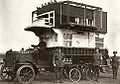
B-type Omnibus "Ole Bill" troop transport
Ole Bill
If you know of a better ‘ole . .

The Imperial War Museum preserves a B-Type bus, B43, which was built by AEC in 1911 and ran on London bus routes until being purchased by the War Office in 1914.[7] B43 served in France and Belgium until 1919 when it was repurchased by the LGOC. On 14 February 1920 B43 was inspected by King George V at Buckingham Palace, becoming the first bus any British monarch had ever boarded.[7][6][nb 1] During the early 1920s the bus was retired from service and preserved by the Auxiliary Omnibus Companies Association, who renamed it Ole Bill after Bruce Bairnsfather's celebrated caricature of a British soldier.[7] Ole Bill continued to appear in commemorative parades,[nb 2] before being presented to the Imperial War Museum in April 1970.[11]

Post war

[edit]

In 1920 more than 60 buses were converted to single deckers with new bodies based on that of the K-type.[12] The last double decker was withdrawn from regular service on 12 October 1926, though a few were held in reserve until 9 August 1927. The single deckers were all withdrawn by 18 October 1927. In all, over 2,900 had been built.[13]

[edit]

See also

[edit]

Notes

[edit]

References

[edit]

Further reading

[edit]
Revisions and contributorsEdit on WikipediaRead on Wikipedia
from Grokipedia
The LGOC B-type was a model introduced in 1910 by the London General Omnibus Company (LGOC), recognized as the world's first reliable mass-produced motor bus. Designed by LGOC chief engineer Frank Searle to withstand London's demanding traffic conditions, it emphasized rugged construction and simplicity in maintenance. Manufactured at the (AEC) works in , the B-type utilized for efficient production, seating 34 passengers on its upper and lower decks while capable of reaching speeds up to 16 mph. By 1912, production had scaled to 20 buses per week, and nearly 2,500 were in service across 112 routes spanning 1,106 miles by , revolutionizing urban in . During , over 1,000 B-types were requisitioned by the for the Western Front, repurposed as troop carriers, ambulances, mobile pigeon lofts, and command posts after being painted and fitted with protective boarding. By the outbreak of in 1914, B-types had supplanted all horse-drawn omnibuses in and most earlier motor buses by 1919, solidifying their legacy as a pivotal in mass transit until their gradual withdrawal in the 1920s.

Design and Development

Origins and Specifications

The London General Omnibus Company (LGOC) introduced the B-type bus in 1910 to address the shortcomings of earlier motorbus designs amid London's congested streets. Chief engineer Frank Searle led the development at the company's works, drawing on experience with prior models like the X-type to create a optimized for reliability and . The prototype was unveiled in October 1910, with the first vehicles entering passenger service the following year. The B-type featured a double-decker layout with a 34-seat capacity, comprising 16 upholstered seats on the enclosed lower deck and 18 slatted wooden seats on the open upper deck, which used rolled tarpaulins for weather protection. Its construction utilized a wooden frame reinforced with plating on a , mounted on with solid rubber tires. The design emphasized durability for urban routes, with a that varied slightly across production batches to accommodate different body lengths and operational needs. Power came from a four-cylinder water-cooled petrol engine rated at 30 horsepower, positioned at the front and driving the rear wheels. The transmission consisted of a worm drive coupled to a four-speed chain gearbox, while braking was provided by mechanical systems acting on concentric drums at the rear wheels only, reflecting the era's engineering priorities for simplicity and cost. Despite a legal speed limit of 12 mph in urban areas, the B-type achieved a top speed of 16 mph under load, demonstrating its robust performance. Subsequent refinements included the addition of electric interior lighting in 1912 for improved nighttime usability and acetylene headlights in 1913 to enhance visibility, marking early steps toward modern passenger comfort in public transport.

Chassis, Body, and Features

The LGOC B-type bus featured a robust chassis constructed primarily from wood, forming a ladder-style frame that provided structural integrity for the vehicle's heavy double-decker configuration. This design incorporated semi-elliptical leaf springs for suspension on both the front and rear axles, offering a degree of ride comfort over London's uneven roads while supporting the bus's laden weight. The rear axle utilized a worm drive mechanism with chain final drive, contributing to the vehicle's reliable power transmission from its 30-horsepower petrol engine, while steel-spoked wheels with solid rubber tires completed the undercarriage setup. The body was built as a classic double-decker layout with an enclosed lower saloon and an open-top upper deck, emphasizing capacity and ventilation in urban service. Constructed largely from wood with paneling that included decorative elements on the lower deck, the body measured approximately 23 feet in length and 7 feet in width, allowing for efficient passenger flow. Seating arrangements totaled 34 passengers, with 16 cushioned seats in the lower deck arranged in longitudinal benches and 18 bench seats on the open upper deck, protected by canvas weather covers during inclement weather; early examples adhered to this standardized capacity from introduction, though wartime modifications sometimes altered layouts for troop transport. Access was via a rear open platform with a central entrance and exit area, facilitating quick boarding and alighting managed by the conductor. Key features included safety-oriented handrails along the spiral staircase connecting decks and around the upper seating perimeter, reducing fall risks on the open top. The conductor's , a simple mechanical gong operated by a cord running the length of the bus, allowed signaling to the driver for stops or emergencies, a standard innovation for efficient operation. Electric lighting was added to the lower deck by 1912, with headlights introduced in 1913, enhancing nighttime usability. Radiator designs evolved from early flat-top units emblazoned with "LGOC" lettering to later curved-top versions marked "GENERAL," reflecting branding changes under the London General Omnibus Company.

Pre-War Operations

Introduction to Service

The LGOC B-type bus entered passenger service in 1911 as a pivotal element of the London General Omnibus Company's (LGOC) modernization initiative, systematically replacing the aging fleet of horse-drawn omnibuses that had dominated London's streets for decades. This transition culminated with the final LGOC horse bus service operating on October 25, 1911, between and Street, after which motor buses like the B-type became the standard. The debut of the B-type on routes such as route 1, departing from garage, exemplified this shift, providing efficient transport across key corridors. In daily operations, B-type buses focused on routes, accommodating up to 34 passengers—16 seated inside and 18 on the open top deck—while adhering to frequent schedules that supported the growing urban commuter demand. These services operated from early morning to late evening, with intervals typically ranging from 5 to 10 minutes on high-traffic lines, enabling reliable connectivity between residential outskirts and commercial hubs. The initial fleet comprised around 120 B-type buses by the end of 1910, expanding rapidly to nearly 1,000 by the close of 1911, which facilitated widespread adoption. Public and operational reception was overwhelmingly positive, with feedback praising the B-type's enhanced reliability—experiencing far fewer mechanical failures than prior motor buses—and improved comfort, including a smoother ride free from the odors and unpredictability of horse-drawn vehicles. Regulatory compliance was integral from the outset, with B-type buses limited to a 12 mph speed in to ensure traffic safety, despite their capability for up to 16 mph. Drivers were required to obtain a basic driving license under the 1903 Motor Car Act, primarily for identification and , marking an early step in professionalizing operations.

Production and Fleet Expansion

The production of the LGOC B-type bus occurred at the London General Omnibus Company's (LGOC) facility, where assembly began in 1910. This marked a shift toward in-house , enabling greater control over design and output for the growing London bus network. As the world's first mass-produced motorbus, the B-type benefited from early efficiencies that streamlined and body construction, achieving a rate of 20 units per week by 1912. These processes involved standardized wooden framing for the double-decker body and integration of mechanical components, reducing build times compared to prior hand-crafted models. By 1913, over 2,500 B-type buses had been built, forming the backbone of the LGOC's expanding fleet and replacing much of the remaining horse-drawn omnibuses. Following their initial deployment on key routes in , these vehicles were rapidly integrated across the LGOC network, serving 112 routes and covering approximately 1,106 miles by 1914, with nearly 2,500 operational units in service. This expansion supported London's booming passenger demand, carrying an estimated 340,000 passengers annually per bus.

Military Service in World War I

Adaptation for War Use

At the outbreak of in , the rapidly requisitioned approximately 1,300 LGOC double-decker buses, mainly B-types, from the London General Omnibus Company's fleet for military transport, with over 300 taken within the first few weeks to support the mobilization of the British Expeditionary Force. These vehicles, originally designed for civilian passenger service with a capacity of 34, were selected for their reliability and the specialized skills of their drivers, many of whom were part of a pre-war transport reserve and volunteered to accompany the buses overseas. Physical modifications were swiftly implemented to convert the buses for wartime troop carrying, including repainting the bright red in or green for , removing glass windows and replacing them with protective wooden planks to shield against shrapnel, and stripping out upper deck seats to prevent instability on rough while increasing utility. This reduced the capacity to 24 fully equipped infantrymen with their kit, focusing on the lower deck for secure and the upper for standing or equipment storage. Approximately 2,500 LGOC drivers and conductors underwent brief training before the buses were dispatched in convoys from ports like to France by late 1914, operating around the clock to ferry troops from lines. Beyond troop carriers, some B-type buses underwent further conversions to meet diverse logistical needs, such as ambulances for evacuating wounded soldiers, lorries for supply by enclosing the upper deck, and mobile pigeon lofts where the lower deck served as an office and feed store for carrier pigeons used in communications. These adaptations highlighted the versatility of the B-type's robust , enabling rapid repurposing without major structural overhauls.

Deployment and Role

The LGOC B-type buses played a pivotal role in troop transport on the Western Front from 1914 to 1919, ferrying soldiers to key battle zones including in late 1914, the Somme offensive in 1916, and various sectors in and . Approximately 1,300 of these double-deckers, primarily B-types, were requisitioned by the , forming a significant portion of the British Expeditionary Force's logistical fleet and enabling the rapid movement of up to 24 fully equipped infantrymen per bus in convoys. Following their adaptation for military use, such as the removal of upper-deck seating to increase capacity, these vehicles operated around the clock, with drivers working in shifts and often sleeping aboard in cramped conditions. In addition to frontline troop movements, the B-types contributed substantially to by carrying soldiers directly to lines, performing evacuation duties for the wounded to field hospitals, and supporting units through conversions into mobile platforms for anti-aircraft guns or supply lorries. Their versatility extended to secondary roles like mobile workshops and command posts, helping sustain operations across the muddy terrains of and the extended 15-mile front during the Somme. This logistical backbone was crucial for maintaining troop rotations and supply flows, with buses shipped from British ports like to , where they covered vast distances under relentless demand. The operational environment posed severe challenges, including constant exposure to shellfire that damaged or destroyed numerous vehicles, mechanical strain from navigating deep mud and cratered roads—particularly during the wet seasons at and the Somme—and the inherent risks to crews. Crews, numbering around 9,500 busmen in total service, faced high casualty rates from artillery barrages and accidents, with many drivers and conductors injured or killed despite their transport role; for instance, buses came under nightly fire, and harsh winter conditions required frequent engine maintenance to prevent freezing. Despite these hardships, the B-types demonstrated remarkable durability, continuing service until the in 1918.

Ole Bill and Notable Examples

One of the most emblematic LGOC B-type buses of is B43, known as "Ole Bill," which served as a troop transport on the Western Front after its requisition in September 1914. Built in 1911 for civilian routes 8 and 25 in , it participated in pivotal operations, including the 1914 defense of , the 1915 , the 1916 , the 1917 , and the 1918 Battle of Amiens, enduring harsh conditions while moving soldiers and wounded personnel. The nickname "Ole Bill" derived from Bruce Bairnsfather's renowned cartoon series depicting "Old Bill," a grizzled yet indomitable British infantryman, capturing the stoic humor and tenacity of frontline troops amid the war's grim realities. A bust of the character was affixed to the bus's radiator cap, reinforcing its symbolic role as a emblem of British endurance. In February 1920, "Ole Bill" was formally presented to King George V at , where the king conducted his first omnibus inspection, shook hands with its wartime drivers, and praised their service; at his behest, the bus later featured in parades as a rolling memorial inscribed with its battle honors. Donated to the in April 1970, it remains a preserved testament to the B-type's wartime legacy. Another key surviving example is B340, constructed in 1911 and repurposed by the War Department in 1914 for home defense duties in , where it transported wounded soldiers and supported military logistics during the conflict. B-type buses also played critical roles in major engagements like the Third (Passchendaele) in 1917, shuttling troops through devastated terrain under artillery fire to sustain supply lines and reinforcements. These vehicles embodied British resilience, with drivers recounting tales of navigating shell-cratered roads and mud-choked paths while troops aboard shared makeshift camaraderie—using upper decks for rest or even as temporary observation posts—fostering a sense of continuity between home and . One LGOC driver, James "Jim" Woodards, exemplified this grit by volunteering in 1915 to operate military in France, earning the in 1918 for maintaining operations under bombardment despite his non-combat status. Of the over 2,500 B-type buses produced, only four original examples from the war era are known to survive, underscoring their historical rarity and the profound impact of their service.

Post-War Service and Legacy

Return to Civilian Service

Following the in 1918, demobilization of LGOC B-type buses began in earnest during 1919, with surviving vehicles repatriated from and repurchased by the London General Omnibus Company (LGOC). These buses, many of which had endured harsh conditions on the Western Front, required extensive repairs to address structural damage, mechanical wear, and modifications like troop-carrying platforms or conversions. Wartime liveries were stripped, and the vehicles were repainted in the familiar red and white LGOC scheme to reintegrate them into civilian operations on familiar London routes. Operational resumption commenced swiftly in , with B-types returning to urban services such as route 9, where they supplemented the depleted peacetime fleet and adapted to heightened passenger demands from economic rebound and returning civilians. Adjustments included optimizing seating for commuters—reverting from military configurations to the standard 34-passenger layout—and scheduling to manage peak-hour surges, ensuring the buses remained a staple of London's amid growing . Some, like B2737, initially operated in emergency roles while full restoration proceeded, helping to restore service reliability on key thoroughfares. By late , around 2,000 B-type buses were available for civilian use, comprising the bulk of the LGOC's double-decker fleet after accounting for wartime attrition from the original production run exceeding 2,500 units. This substantial number enabled the handling of increased traffic volumes during the economic recovery, with the vehicles' proven allowing them to absorb the strain of expanded ridership without immediate need for wholesale replacement. Early challenges in this reintegration included acute shortages of spare parts, as bus production had been suspended during the in favor of military output, and a scarcity of skilled mechanics, many of whom were still demobilizing or had been lost to the conflict. These issues delayed full fleet readiness and necessitated improvised maintenance, underscoring the transitional difficulties in restoring London's transport infrastructure.

Withdrawals and Conversions

Following the end of , many surviving LGOC B-type buses returned to civilian duties but showed significant wear from military use, including damage sustained overseas where approximately 1,300 double-deckers had been deployed. This accelerated the need for fleet renewal, with scrapping rates increasing due to structural fatigue and maintenance costs in the economically strained environment marked by high and rising operational expenses. Over 2,900 B-type had been produced in total between 1910 and 1919, primarily for bus bodies, but the intensive wartime service contributed to a high attrition rate, with numerous vehicles abandoned or scrapped abroad. In the early , the London General Omnibus Company (LGOC) began a gradual phase-out of the B-type, replacing them with more modern designs such as the AEC K-type and S-type buses, which offered improved (up to 46 passengers) and better reliability. These newer models addressed limitations in the B-type's , including its lower capacity of 34 seats and vulnerability to wear, while from expanding networks pressured the LGOC to modernize its fleet for cost efficiency. Single-deck variants of the B-type continued in limited service on routes like the 108, but were themselves replaced by single-deck S-types by September 1922. The final double-decker B-type was retired from regular service in October 1926. This marked the end of the B-type's frontline role, though a few were repurposed for non-passenger uses or parades amid ongoing economic recovery challenges that favored newer, more economical vehicles.

Preservation and Modern Replicas

Of the over 2,500 LGOC B-type buses produced, only four originals are known to survive today. B43, built in 1911 and famously known as "Ole Bill" after the cartoon character by , is preserved at the in , where it commemorates its service transporting troops on the Western Front from 1914 to 1919. B340, also constructed in 1911 with registration LA 9928, is held by the London Transport Museum and displayed at its Acton Depot; it served in transporting wounded soldiers during the war before returning to civilian routes until withdrawal in 1924. In preparation for the centenary, the London Transport Museum undertook a major restoration project from 2013 to 2014 on another surviving example, B2737, built in 1914. This initiative, funded by the Heritage Lottery Fund and supported by the museum's friends group, fully restored the open-top double-decker to operational condition, initially in its original red LGOC livery before converting it to wartime khaki as a troop carrier. The restored bus participated in commemorative events, including a 2014 tour to the Somme and battlefields in , and public displays such as the Regent Street motor show cavalcade, highlighting the B-type's wartime role in troop transport and ambulance duties. To further preserve the B-type's legacy, in operates a full-scale designated B1349, constructed around 1990 on a 1960s VAM14 chassis with a Leyland engine. Painted in Newcastle Corporation to reflect regional adaptations of the design, the replica runs on the museum's circuits and supports historical reenactments, providing visitors with an interactive experience of early 20th-century . The LGOC B-type endures as a cultural symbol of early motorized transport and wartime resilience, appearing in films and media depictions of , such as troop movements in historical dramas. Its educational role is prominent in museums, where preserved examples like B43 and the restored B2737 facilitate public programs on the war's impact on civilian life and . Additionally, operational vehicles participate in commemorative events, including parades and historic vehicle runs, reinforcing the bus's significance in British heritage.

References

Add your contribution
Related Hubs
User Avatar
No comments yet.