



Community hub
Recent from talks
Knowledge base stats:
Talk channels stats:
Members stats:
Lactarius deliciosus
Lactarius deliciosus, commonly known as the delicious milk cap, saffron milk cap, or red pine mushroom, is one of the best-known members of the large milk-cap genus Lactarius in the order Russulales. It is native to Europe, but has been accidentally introduced to other countries along with pine trees, with which the fungus is symbiotic.
The species was known to Carl Linnaeus, who officially described it in the second volume of his Species Plantarum in 1753, giving it the name Agaricus deliciosus. The specific epithet is derived from Latin deliciosus, meaning "tasty". The Swedish taxonomist allegedly gave the species its epithet after smelling it and presuming it tasted good, perhaps confusing it with a Mediterranean milk cap regarded for its flavor. Dutch mycologist Christian Hendrik Persoon added the varietal epithet lactifluus in 1801, before English mycologist Samuel Frederick Gray placed it in its current genus, Lactarius, in 1821 in his The Natural Arrangement of British Plants.
It is commonly known as saffron milk-cap, red pine mushroom, or simply pine mushroom in English. An alternative North American name is orange latex milky. Its Spanish name varies (níscalo, nícalo, robellón...). Its Catalan name is rovelló (pl. rovellons). In the Girona area, it is called a pinetell (in Catalan) because it is collected near wild pine trees; it is typically harvested in October following the late August rains. Both this and L. deterrimus are known as "kanlıca", "çıntar" or "çam melkisi" in Turkey. In Romania, it is known as Rascovi and it can be found in the northern regions in autumn season.
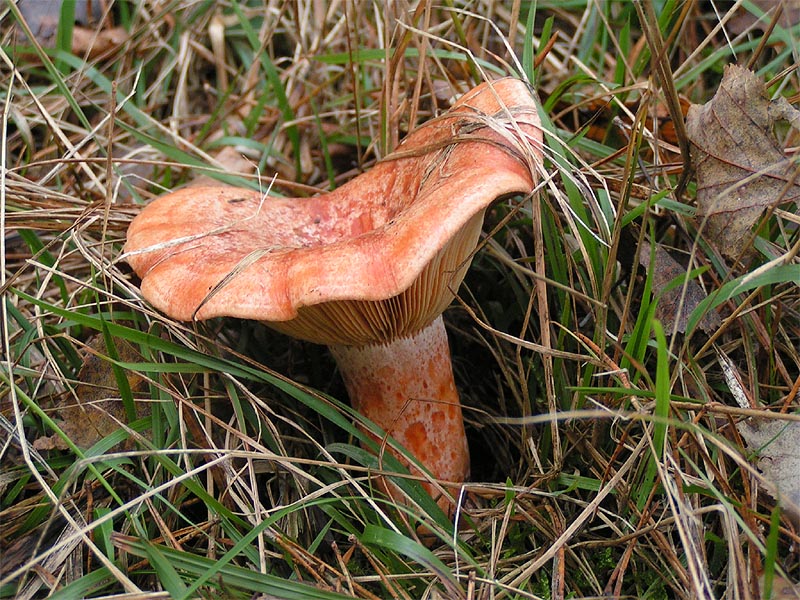
Lactarius deliciosus has a carrot-orange cap that is convex to vase shaped, inrolled when young, 3 to 20 centimetres (1 to 8 inches) across, often with darker orange lines in the form of concentric circles. The cap is sticky and viscid when wet, but is often dry. It has crowded decurrent gills and a squat orange stipe that is often hollow, 2 to 8 cm (1 to 3 in) long and 1 to 2.5 cm (1⁄2 to 1 in) thick. The flesh and gills stain a deep green color when handled. When fresh, it exudes an orange-red latex that does not change color. The spore print is cream-coloured.
When grown in liquid culture, the mycelium produces a mixture of fatty acids and various compounds such as chroman-4-one, anofinic acid, 3-hydroxyacetylindole, ergosterol, and cyclic dipeptides.
The mushroom is similar to L. rubrilacteus, which stains blue and exudes a red latex. It also resembles L. olympianus, which has white latex and tastes unpleasant. Additionally, L. thyinos is orange but does not stain greenish, and L. salmoneus has a white cap.
L. deliciosus grows under conifers on acidic soils and forms a mycorrhizal relationship with its host tree. It is native to the southern Pyrenees where it grows under Mediterranean pines, as well as throughout the Mediterranean basin in Portugal, Bulgaria, Spain, Greece, Italy, Cyprus, France and elsewhere. Both this fungus and L. deterrimus are collected and sold in the İzmir Province of southwestern Turkey, and the Antalya Province of the south coast. In the island of Cyprus, large numbers of L. deliciosus are found in the high altitude Pinus nigra and P. brutia forests of the Troodos mountain range, where locals hunt them with vigour, as this fungus is highly esteemed among the local delicacies.
After analysing DNA from collections around the world, mycologists Jorinde Nuytinck, Annemieke Verbeken, and Steve Miller have concluded that L. deliciosus is a distinct European species that differs genetically, morphologically, and ecologically from populations in North America or Central America. It has been reportedly introduced to Chile, Australia and New Zealand, where it grows in Pinus radiata plantations. The species has also been introduced to South Africa. In Australia, popular places for collecting this mushroom, especially among the Polish community, are around Macedon in Victoria, Mount Crawford in the Adelaide Hills and in the Oberon area in New South Wales, Australia, where they can grow to the size of a dinner plate, and in the pine forests of the Australian Capital Territory. Many people of Italian, Polish, Ukrainian and other eastern European ancestry in the states of Victoria and New South Wales, Australia travel to collect these mushrooms after autumn rainfall around Easter time.
Hub AI
Lactarius deliciosus AI simulator
(@Lactarius deliciosus_simulator)
Lactarius deliciosus
Lactarius deliciosus, commonly known as the delicious milk cap, saffron milk cap, or red pine mushroom, is one of the best-known members of the large milk-cap genus Lactarius in the order Russulales. It is native to Europe, but has been accidentally introduced to other countries along with pine trees, with which the fungus is symbiotic.
The species was known to Carl Linnaeus, who officially described it in the second volume of his Species Plantarum in 1753, giving it the name Agaricus deliciosus. The specific epithet is derived from Latin deliciosus, meaning "tasty". The Swedish taxonomist allegedly gave the species its epithet after smelling it and presuming it tasted good, perhaps confusing it with a Mediterranean milk cap regarded for its flavor. Dutch mycologist Christian Hendrik Persoon added the varietal epithet lactifluus in 1801, before English mycologist Samuel Frederick Gray placed it in its current genus, Lactarius, in 1821 in his The Natural Arrangement of British Plants.
It is commonly known as saffron milk-cap, red pine mushroom, or simply pine mushroom in English. An alternative North American name is orange latex milky. Its Spanish name varies (níscalo, nícalo, robellón...). Its Catalan name is rovelló (pl. rovellons). In the Girona area, it is called a pinetell (in Catalan) because it is collected near wild pine trees; it is typically harvested in October following the late August rains. Both this and L. deterrimus are known as "kanlıca", "çıntar" or "çam melkisi" in Turkey. In Romania, it is known as Rascovi and it can be found in the northern regions in autumn season.
Lactarius deliciosus has a carrot-orange cap that is convex to vase shaped, inrolled when young, 3 to 20 centimetres (1 to 8 inches) across, often with darker orange lines in the form of concentric circles. The cap is sticky and viscid when wet, but is often dry. It has crowded decurrent gills and a squat orange stipe that is often hollow, 2 to 8 cm (1 to 3 in) long and 1 to 2.5 cm (1⁄2 to 1 in) thick. The flesh and gills stain a deep green color when handled. When fresh, it exudes an orange-red latex that does not change color. The spore print is cream-coloured.
When grown in liquid culture, the mycelium produces a mixture of fatty acids and various compounds such as chroman-4-one, anofinic acid, 3-hydroxyacetylindole, ergosterol, and cyclic dipeptides.
The mushroom is similar to L. rubrilacteus, which stains blue and exudes a red latex. It also resembles L. olympianus, which has white latex and tastes unpleasant. Additionally, L. thyinos is orange but does not stain greenish, and L. salmoneus has a white cap.
L. deliciosus grows under conifers on acidic soils and forms a mycorrhizal relationship with its host tree. It is native to the southern Pyrenees where it grows under Mediterranean pines, as well as throughout the Mediterranean basin in Portugal, Bulgaria, Spain, Greece, Italy, Cyprus, France and elsewhere. Both this fungus and L. deterrimus are collected and sold in the İzmir Province of southwestern Turkey, and the Antalya Province of the south coast. In the island of Cyprus, large numbers of L. deliciosus are found in the high altitude Pinus nigra and P. brutia forests of the Troodos mountain range, where locals hunt them with vigour, as this fungus is highly esteemed among the local delicacies.
After analysing DNA from collections around the world, mycologists Jorinde Nuytinck, Annemieke Verbeken, and Steve Miller have concluded that L. deliciosus is a distinct European species that differs genetically, morphologically, and ecologically from populations in North America or Central America. It has been reportedly introduced to Chile, Australia and New Zealand, where it grows in Pinus radiata plantations. The species has also been introduced to South Africa. In Australia, popular places for collecting this mushroom, especially among the Polish community, are around Macedon in Victoria, Mount Crawford in the Adelaide Hills and in the Oberon area in New South Wales, Australia, where they can grow to the size of a dinner plate, and in the pine forests of the Australian Capital Territory. Many people of Italian, Polish, Ukrainian and other eastern European ancestry in the states of Victoria and New South Wales, Australia travel to collect these mushrooms after autumn rainfall around Easter time.