
Recent from talks
Operation Spring Awakening
Knowledge base stats:
Talk channels stats:
Members stats:
Operation Spring Awakening
Operation Spring Awakening (German: Unternehmen Frühlingserwachen) was the last major German offensive of World War II. The operation was referred to in Germany as the Plattensee Offensive and in the Soviet Union as the Balaton Defensive Operation. It took place in Western Hungary on the Eastern Front and lasted from 6 March until 15 March 1945. The objective was to secure the last significant oil reserves still available to the European Axis powers and prevent the Red Army from advancing towards Vienna. The Germans failed in their objectives.
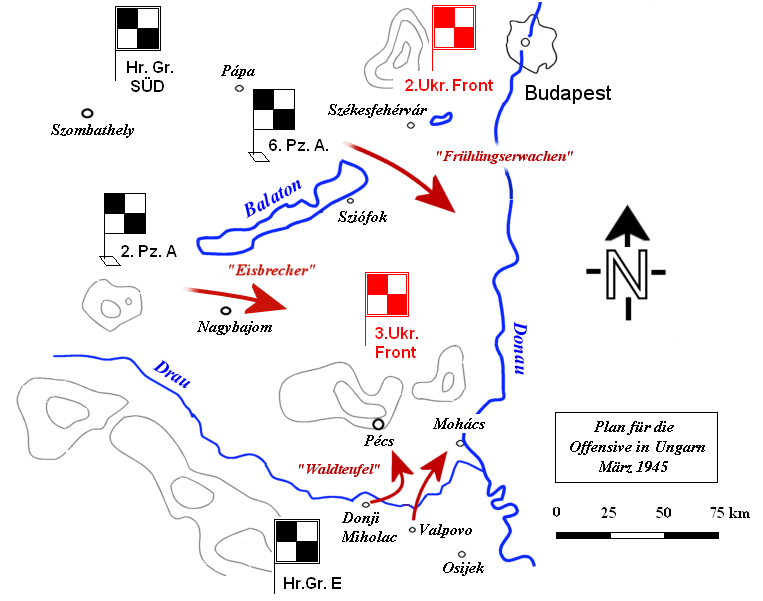
The operation, initially planned for 5 March, began after German units were moved in great secrecy to the Lake Balaton (Plattensee) area. Many German units were involved, including the 6th Panzer Army and its subordinate Waffen-SS divisions after being withdrawn from the failed Ardennes offensive on the Western Front. The Germans attacked in three prongs: Frühlingserwachen in the Balaton-Lake Velence-Danube area, Eisbrecher south of Lake Balaton, and Waldteufel south of the Drava-Danube triangle. The advance stalled on 15 March, and on 16 March the Red Army and allied units began their delayed Vienna offensive.
On 12 January Hitler received confirmation that the Soviet Red Army had begun a massive winter offensive through Poland, named the Vistula–Oder offensive. Hitler ordered OB West Field Marshal Gerd von Rundstedt to withdraw the following units from active combat in the Battle of the Bulge: I SS Panzer Corps with 1st SS Panzer Division Leibstandarte SS Adolf Hitler (LSSAH) and 12th SS Panzer Division Hitlerjugend, along with II SS Panzer Corps with 2nd SS Panzer Division Das Reich and 9th SS Panzer Division Hohenstaufen. These units were to be refitted by 30 January and attached to the 6th Panzer Army under the command of Sepp Dietrich for the upcoming Operation Spring Awakening. Hitler wanted to secure the extremely vital Nagykanizsa oil fields of southern Hungary, as these were the most strategically valuable assets remaining on the Eastern Front. The deadline of 30 January proved impossible for refitting to be completed.
As Operation Spring Awakening would be of great importance, lengthy preparation and strategic care was taken to preserve the operation's secrecy. But while the 6th Panzer Army was refitting in Germany, Hitler ordered a preliminary offensive with a similar object to be conducted, resulting in Operation Konrad III beginning 18 January. The objectives of Konrad III included relieving besieged Budapest and the recapturing of the Transdanubia region. By 21 January, only 5 days into Operation Konrad III, the Germans had taken the towns of Dunapentele and Adony which are on the Western shore of the Danube. Their push resulted in the annihilation of the Soviet 7th Mechanized Corps. This sudden and savage push caused the Soviet command to contemplate an evacuation to the opposite shore of the Danube. Before the end of the 4th day, the Germans had recaptured 400 square kilometers of territory, an achievement comparable to the initial German gains during the Ardennes offensive and the Western Front in December 1944. At the height of Operation Konrad III, January 26, the Axis front lines had reached within 20 km of Budapest's southern perimeter, and within about 10 km of the northern perimeter, but their forces were exhausted.
From 27 January through 15 February, the Soviets conducted numerous successful counter-attacks, forcing the Germans to give up the greater portion of their territorial gains, pushing the front line back to the area between Lake Velence, the village of Csősz, and Lake Balaton. This area had the Margit Line running right through it, and would see more fighting in the upcoming Operation Spring Awakening.
By mid-February, the Soviet bridgehead across the Garam River north of Esztergom was identified as a threat. This bridgehead would jeopardize the upcoming Spring Awakening's southeastern push past Lake Balaton to secure the southern Hungarian oilfields while also exposing a straight route towards Vienna. Thus, beginning on 17 February, Operation Southwind began the effort to secure the Garam bridgehead from the 2nd Ukrainian Front, and by 24 February the task was successfully achieved, proving to be the very last successful German offensive of the war.
During a Situation Conference on 7 January 1945, at which both Hermann Göring and Rundstedt were present, Hitler proposed his intention of pulling the 6th SS Panzer Army to reserve due to severe Allied air attacks. Rundstedt received the withdrawal orders on January 8, and the Panzer Army's divisions began preparations to withdraw from the stalled Ardennes Offensive. The slow withdrawal was greatly hampered by Allied air superiority.
On 12 January, the Soviet 1st Ukrainian and 1st Belorussian Fronts began their Vistula–Oder offensive with over 2 million men[citation needed], placing considerable new pressure on the Eastern Front. When this news reached Hitler, he immediately began to plan a major offensive of his own on this Front. Unfortunately, at the time, Hitler's best remaining panzer forces were still engaged on the Western Front. On 20 January, Hitler ordered Rundstedt to withdraw forces from the ongoing Battle of the Bulge; the 1st SS, 2nd SS, and 12th SS Panzer Divisions managed to disengage and withdraw the same day. Almost all support units of the 6th SS Panzer Army were pulled from the Ardennes by 22 January, while the 9th SS Panzer Division was the last to leave on 23 January.
Hub AI
Operation Spring Awakening AI simulator
(@Operation Spring Awakening_simulator)
Operation Spring Awakening
Operation Spring Awakening (German: Unternehmen Frühlingserwachen) was the last major German offensive of World War II. The operation was referred to in Germany as the Plattensee Offensive and in the Soviet Union as the Balaton Defensive Operation. It took place in Western Hungary on the Eastern Front and lasted from 6 March until 15 March 1945. The objective was to secure the last significant oil reserves still available to the European Axis powers and prevent the Red Army from advancing towards Vienna. The Germans failed in their objectives.
The operation, initially planned for 5 March, began after German units were moved in great secrecy to the Lake Balaton (Plattensee) area. Many German units were involved, including the 6th Panzer Army and its subordinate Waffen-SS divisions after being withdrawn from the failed Ardennes offensive on the Western Front. The Germans attacked in three prongs: Frühlingserwachen in the Balaton-Lake Velence-Danube area, Eisbrecher south of Lake Balaton, and Waldteufel south of the Drava-Danube triangle. The advance stalled on 15 March, and on 16 March the Red Army and allied units began their delayed Vienna offensive.
On 12 January Hitler received confirmation that the Soviet Red Army had begun a massive winter offensive through Poland, named the Vistula–Oder offensive. Hitler ordered OB West Field Marshal Gerd von Rundstedt to withdraw the following units from active combat in the Battle of the Bulge: I SS Panzer Corps with 1st SS Panzer Division Leibstandarte SS Adolf Hitler (LSSAH) and 12th SS Panzer Division Hitlerjugend, along with II SS Panzer Corps with 2nd SS Panzer Division Das Reich and 9th SS Panzer Division Hohenstaufen. These units were to be refitted by 30 January and attached to the 6th Panzer Army under the command of Sepp Dietrich for the upcoming Operation Spring Awakening. Hitler wanted to secure the extremely vital Nagykanizsa oil fields of southern Hungary, as these were the most strategically valuable assets remaining on the Eastern Front. The deadline of 30 January proved impossible for refitting to be completed.
As Operation Spring Awakening would be of great importance, lengthy preparation and strategic care was taken to preserve the operation's secrecy. But while the 6th Panzer Army was refitting in Germany, Hitler ordered a preliminary offensive with a similar object to be conducted, resulting in Operation Konrad III beginning 18 January. The objectives of Konrad III included relieving besieged Budapest and the recapturing of the Transdanubia region. By 21 January, only 5 days into Operation Konrad III, the Germans had taken the towns of Dunapentele and Adony which are on the Western shore of the Danube. Their push resulted in the annihilation of the Soviet 7th Mechanized Corps. This sudden and savage push caused the Soviet command to contemplate an evacuation to the opposite shore of the Danube. Before the end of the 4th day, the Germans had recaptured 400 square kilometers of territory, an achievement comparable to the initial German gains during the Ardennes offensive and the Western Front in December 1944. At the height of Operation Konrad III, January 26, the Axis front lines had reached within 20 km of Budapest's southern perimeter, and within about 10 km of the northern perimeter, but their forces were exhausted.
From 27 January through 15 February, the Soviets conducted numerous successful counter-attacks, forcing the Germans to give up the greater portion of their territorial gains, pushing the front line back to the area between Lake Velence, the village of Csősz, and Lake Balaton. This area had the Margit Line running right through it, and would see more fighting in the upcoming Operation Spring Awakening.
By mid-February, the Soviet bridgehead across the Garam River north of Esztergom was identified as a threat. This bridgehead would jeopardize the upcoming Spring Awakening's southeastern push past Lake Balaton to secure the southern Hungarian oilfields while also exposing a straight route towards Vienna. Thus, beginning on 17 February, Operation Southwind began the effort to secure the Garam bridgehead from the 2nd Ukrainian Front, and by 24 February the task was successfully achieved, proving to be the very last successful German offensive of the war.
During a Situation Conference on 7 January 1945, at which both Hermann Göring and Rundstedt were present, Hitler proposed his intention of pulling the 6th SS Panzer Army to reserve due to severe Allied air attacks. Rundstedt received the withdrawal orders on January 8, and the Panzer Army's divisions began preparations to withdraw from the stalled Ardennes Offensive. The slow withdrawal was greatly hampered by Allied air superiority.
On 12 January, the Soviet 1st Ukrainian and 1st Belorussian Fronts began their Vistula–Oder offensive with over 2 million men[citation needed], placing considerable new pressure on the Eastern Front. When this news reached Hitler, he immediately began to plan a major offensive of his own on this Front. Unfortunately, at the time, Hitler's best remaining panzer forces were still engaged on the Western Front. On 20 January, Hitler ordered Rundstedt to withdraw forces from the ongoing Battle of the Bulge; the 1st SS, 2nd SS, and 12th SS Panzer Divisions managed to disengage and withdraw the same day. Almost all support units of the 6th SS Panzer Army were pulled from the Ardennes by 22 January, while the 9th SS Panzer Division was the last to leave on 23 January.
Recent media