
Operation Spring Awakening
View on Wikipedia| Operation Spring Awakening | |||||||
|---|---|---|---|---|---|---|---|
| Part of the Eastern Front of World War II | |||||||
 German advances during the operation | |||||||
| |||||||
| Belligerents | |||||||
 Germany Germany Hungary Hungary |
 Soviet Union Soviet Union Bulgaria Bulgaria Yugoslav Partisans Yugoslav Partisans | ||||||
| Commanders and leaders | |||||||
| |||||||
| Units involved | |||||||
| Strength | |||||||
|
5 March (for the offensive): [1][2][3]
|
| ||||||
| Casualties and losses | |||||||
|
German offensive (6–15 March 1945):
|
German offensive (6–15 March 1945):
Soviet counter-offensive (16 March–15 April 1945):
Bulgarian casualties:
| ||||||
 | |||||||
Operation Spring Awakening (German: Unternehmen Frühlingserwachen) was the last major German offensive of World War II. The operation was referred to in Germany as the Plattensee Offensive and in the Soviet Union as the Balaton Defensive Operation. It took place in Western Hungary on the Eastern Front and lasted from 6 March until 15 March 1945. The objective was to secure the last significant oil reserves still available to the European Axis powers and prevent the Red Army from advancing towards Vienna. The Germans failed in their objectives.
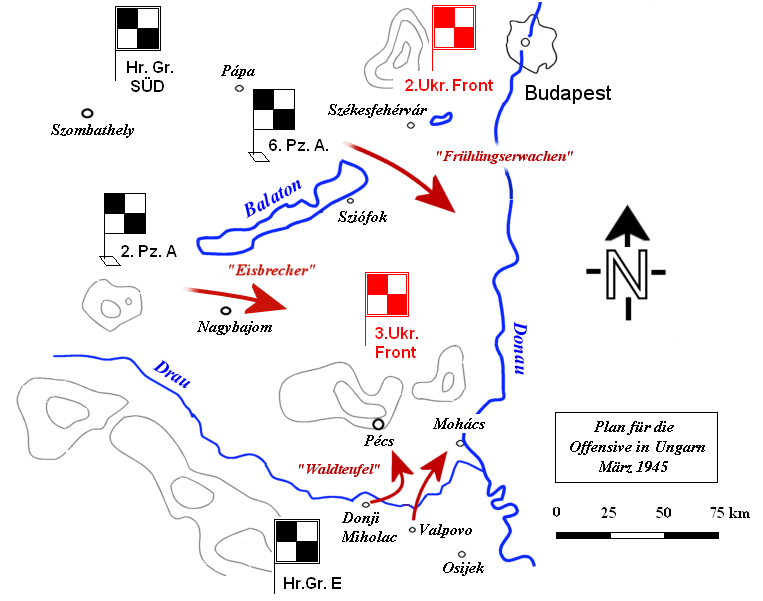
The operation, initially planned for 5 March, began after German units were moved in great secrecy to the Lake Balaton (Plattensee) area. Many German units were involved, including the 6th Panzer Army and its subordinate Waffen-SS divisions after being withdrawn from the failed Ardennes offensive on the Western Front. The Germans attacked in three prongs: Frühlingserwachen in the Balaton-Lake Velence-Danube area, Eisbrecher south of Lake Balaton, and Waldteufel south of the Drava-Danube triangle. The advance stalled on 15 March, and on 16 March the Red Army and allied units began their delayed Vienna offensive.
Background
[edit]On 12 January Hitler received confirmation that the Soviet Red Army had begun a massive winter offensive through Poland, named the Vistula–Oder offensive.[14] Hitler ordered OB West Field Marshal Gerd von Rundstedt to withdraw the following units from active combat in the Battle of the Bulge: I SS Panzer Corps with 1st SS Panzer Division Leibstandarte SS Adolf Hitler (LSSAH) and 12th SS Panzer Division Hitlerjugend, along with II SS Panzer Corps with 2nd SS Panzer Division Das Reich and 9th SS Panzer Division Hohenstaufen.[14] These units were to be refitted by 30 January and attached to the 6th Panzer Army under the command of Sepp Dietrich for the upcoming Operation Spring Awakening. Hitler wanted to secure the extremely vital Nagykanizsa oil fields of southern Hungary, as these were the most strategically valuable assets remaining on the Eastern Front.[15] The deadline of 30 January proved impossible for refitting to be completed.
As Operation Spring Awakening would be of great importance, lengthy preparation and strategic care was taken to preserve the operation's secrecy. But while the 6th Panzer Army was refitting in Germany, Hitler ordered a preliminary offensive with a similar object to be conducted,[16] resulting in Operation Konrad III beginning 18 January. The objectives of Konrad III included relieving besieged Budapest and the recapturing of the Transdanubia region. By 21 January, only 5 days into Operation Konrad III, the Germans had taken the towns of Dunapentele and Adony which are on the Western shore of the Danube.[17] Their push resulted in the annihilation of the Soviet 7th Mechanized Corps. This sudden and savage push caused the Soviet command to contemplate an evacuation to the opposite shore of the Danube.[17] Before the end of the 4th day, the Germans had recaptured 400 square kilometers of territory, an achievement comparable to the initial German gains during the Ardennes offensive and the Western Front in December 1944.[18] At the height of Operation Konrad III, January 26, the Axis front lines had reached within 20 km of Budapest's southern perimeter, and within about 10 km of the northern perimeter, but their forces were exhausted.[16]
From 27 January through 15 February, the Soviets conducted numerous successful counter-attacks, forcing the Germans to give up the greater portion of their territorial gains, pushing the front line back to the area between Lake Velence, the village of Csősz, and Lake Balaton.[19] This area had the Margit Line running right through it, and would see more fighting in the upcoming Operation Spring Awakening.

By mid-February, the Soviet bridgehead across the Garam River north of Esztergom was identified as a threat. This bridgehead would jeopardize the upcoming Spring Awakening's southeastern push past Lake Balaton to secure the southern Hungarian oilfields while also exposing a straight route towards Vienna. Thus, beginning on 17 February, Operation Southwind began the effort to secure the Garam bridgehead from the 2nd Ukrainian Front, and by 24 February the task was successfully achieved, proving to be the very last successful German offensive of the war.
German plan
[edit]Creation of Operation Spring Awakening
[edit]
During a Situation Conference on 7 January 1945, at which both Hermann Göring and Rundstedt were present, Hitler proposed his intention of pulling the 6th SS Panzer Army to reserve due to severe Allied air attacks.[21] Rundstedt received the withdrawal orders on January 8, and the Panzer Army's divisions began preparations to withdraw from the stalled Ardennes Offensive.[22] The slow withdrawal was greatly hampered by Allied air superiority.[23]
On 12 January, the Soviet 1st Ukrainian and 1st Belorussian Fronts began their Vistula–Oder offensive with over 2 million men[citation needed], placing considerable new pressure on the Eastern Front. When this news reached Hitler, he immediately began to plan a major offensive of his own on this Front. Unfortunately, at the time, Hitler's best remaining panzer forces were still engaged on the Western Front.[22] On 20 January, Hitler ordered Rundstedt to withdraw forces from the ongoing Battle of the Bulge; the 1st SS, 2nd SS, and 12th SS Panzer Divisions managed to disengage and withdraw the same day.[24] Almost all support units of the 6th SS Panzer Army were pulled from the Ardennes by 22 January, while the 9th SS Panzer Division was the last to leave on 23 January.[24]
On this same day, 22 January, Hitler committed to send the fatigued 6th SS Panzer Army to Hungary for his new counteroffensive, a view Heinz Guderian (OKH) partially agreed with. Guderian wanted the 6th SS Panzer Army on the Eastern Front, but would have preferred its employment in the defence of Berlin.[23] A glimpse of the ensuing verbal exchange during this argument was captured in Alfred Jodl's (OKW) post-war interrogation, where he quotes Hitler saying: "You want to attack without oil – good, we'll see what happens when you attempt that".[25]
Hitler's reasoning for sending the 6th SS Panzer Army south into Hungary can be understood through the list of main strategic points listed in a Situation in the East conference held on January 23: 1) The Hungarian oil region and Vienna oil region, which made up 80% of remaining reserves, had to be defended and/or retaken, and without which the war effort could not be continued; 2) the defense of the Upper Silesian industrial region, vital for the war economy and coal production.[23] Two quotes illustrate how seriously Hitler viewed this ruling: "Hitler considered the protection of Vienna and Austria as of vital importance and that he would rather see Berlin fall than lose the Hungarian oil area and Austria",[26] "He [Hitler] accepted the risk of the Russian threat to the Oder east of Berlin".[23] Hitler chose to ignore Guderian's view for how the 6th SS Panzer Army should be deployed.
On 27 January, Guderian was tasked by Hitler to stop the 3rd Ukrainian Front in the vicinity of the Margit Line in order to protect the vital oil fields.[27] The following day, 28 January, this operation received its preliminary name, Operation Süd (German: South).[27] The main objectives of the operation were as follows: 1) the security of vital raw materials such as oil, bauxite, and manganese for iron, 2) the defense of arable land for food and crops, the Austrian military industrial complex, and the city of Vienna, and 3) to stop the Soviet advance.[27] Interestingly, an additional side-objective was the hope that the counteroffensive would force the Soviet command to divert some forces from its northern offensives headed to Berlin instead towards Hungary.[27][23]
Operation Süd was scheduled to start after a path to Budapest had been established.[27] The operation would be considered a success if 1) Operation Konrad III could pin the Soviets between the Vértes mountains and the Danube, 2) the 8th Army could secure its Front in Northern Hungary, and 3) if the incoming panzer armies could be refitted during transit to maintain the element of surprise.[27]
Four plans for Operation Süd were produced by high-ranking officials from Army Group South, the 6th SS Panzer Army, and the 6th Army: "Lösung A" (German: Solution A) by Fritz Krämer of the 6th SS Panzer Army; "Lösung B" and "Lösung C2" by Helmuth von Grolman of Army Group South; and "Lösung C1" by Heinrich Gaedcke of the 6th Army. There was much fighting and bickering as to which plan should be implemented.[28] The commander of Army Group South, Otto Wöhler, chose "Lösung B".[28]
The four plans were sent to Guderian on 22 February for review, and Army Group South informed Army Group F commander Maximilian von Weichs on 23 February that the operation would commence on 5 March, in anticipation that Operation Südwind (German: South Wind) would have finished successfully by 24 February.[29] If Operation Südwind was successful, Operation Süd's start could be deferred by 8 to 9 days.[30] On 25 February, Hitler ordered Wöhler, Weichs, and Dietrich to personally present the plans for Operation Süd to him, along with Guderian and Jodl,[31] at the Reich Chancellery in Berlin, where he ultimately chose "Lösung C2", disagreeing with the commander of Army Group South, Otto Wöhler.[30] Guderian then ordered Wöhler to increase the daily fuel allowance from 400 to 500 cubic meters of fuel on February 26,[32] and by February 28 the specifics of the operation, now officially named "Operation Frühlingserwachen" (Spring Awakening), were completed.[30] As per "Lösung C2", 3 offensive prongs were planned, with the main attack of the 6th Army and 6th SS Panzer Army, "Frühlingserwachen", being directed towards the Danube through Lakes Velence and Balaton; the 2nd Panzer Army's "Eisbrecher" (Icebreaker) attack directed eastward from the western end of Lake Balaton; and the LXXXXI Corps "Waldteufel" (Forest Devil) attack directed north from the Drava River.[33]
Overarching German military structure
[edit]OKW was the overarching military command for the German army in WW2, while the OKH was officially a high command operating under OKW. Adolf Hitler was the Commander-in-chief of OKH, while also being the supreme commander of OKW.[34] Finding itself issuing more and more direct orders, OKW eventually became responsible for Western and Southern commands, while OKH was responsible for Eastern commands.[34] This operational overlap caused by the centralized command led to disagreements, shortages, waste, inefficiencies, and delays, often escalating to the point where Hitler himself would have to give the final ruling on a matter.[34]
For Operation Spring Awakening, the area for the new offensive was set on the borderline between OKW (Army Group F) and OKH (Army Group South), and this would cause troubles.[34] Army Group E wanted to assemble its troops north of the Drava River by February 25, but Army Group South was not prepared to start the offensive this early due to the ongoing Operation Southwind; subsequently, the OKW and Hitler grew more impatient.[35] The chosen course of action on 25 February, "Lösung C2", favored the quicker and farther-reaching joint operation of the 2nd Panzer Army and 6th SS Panzer Army, while "Lösung B" opted to first secure the left flank of the main thrust "Frühlingserwachen" (between Lake Velence and the Danube) before moving south toward the 2nd Panzer army. Guderian was in favor of "Lösung C2" because this plan would shorten the time the 6th SS Panzer Division would need to stay in Hungary. The OKW and OKH did not use common terminology for parts of the offensive, as OKH referred to the entire offensive as Frühlingserwachen, while the OKW referred to the operation attacking north of the Drava as "Waldteufel".[31]
Army Group South and the OKH could not agree on how to best utilize the 1st Cavalry Corps. OKH wanted to send the Corps south-west to the 2nd Panzer army, a move Wöhler saw of little use since the 2nd Panzer army would have a lower chance of success compared to the main attacking thrust of "Frühlingserwachen". Wöhler wanted to use the 1st Cavalry Corps on the eastern shore of Lake Balaton, as German intelligence reported that "the enemy is still the weakest between Lake Balaton and the Sárviz Channel".[36]
To further complicate matters, due to the limited number of newly trained personnel this late in the war, units under Waffen-SS command were often kept at acceptable capacity levels using Wehrmacht personnel. For instance, only 1/3 of the 6th SS Panzer Army's staff were actually from the Waffen-SS.[37]
Arrival into the Hungarian theater
[edit]When withdrawing from the Western Front, elements of the III. Flak-Korps were tasked with protecting the 6th SS Panzer Army while en route to Zossen south of Berlin.[24] From here the units' possible de-training locations would seem to be the cities along the Oder River, however this was a calculated misinformation measure to confuse enemy forces who actually attacked these cities.[38] The real plan for the units of 6th SS Panzer Army was to travel south through Vienna to their first Hungarian destination, the city of Győr and its surrounding area.[38] Other units from other armies were also sent to the Hungarian theater, for example the 16th SS Panzer Grenadier Division Reichsführer-SS who was brought up from Italy through the Brenner straight and sent to the 2nd Panzer Army.[39] Some units necessary for the major offensive did not arrive in Hungary until just a few days before its start, the last being the 9th SS Panzer Division Hohenstaufen arriving in Győr at the beginning of March.[36] Many of the incoming units also received cover names to help further mask the build-up of forces from the enemy.
| Cover Names[40] | ||
|---|---|---|
| Unit | Official name | Cover name |
| 6th SS Panzer Army HQ | HQ | Higher Pioneer Leader Hungary |
| 1st SS Panzer Division | Leibstandarte SS Adolf Hitler | SS replacement unit "Totenkopf" |
| 2nd SS Panzer Division | Das Reich | SS training group North |
| 9th SS Panzer Division | Hohenstaufen | SS training group South |
| 12th SS Panzer Division | Hitlerjugend | SS replacement unit "Wiking" |
| 16th SS Panzer Gren. Division | Reichsführer-SS | 13th SS Division replacement group |
By 7 February, on orders of Hitler, strict secrecy rulings were put into place: death penalty for command infractions, license plates were to be covered, insignia on vehicles and uniforms to be covered, no reconnaissance in forward combat areas, unit movements only by night or overcast conditions, no radio traffic, and the units were not to appear on situation maps.[41]
Prior to these measures, on 30 January, 1st SS Panzer Division Leibstandarte was ordered to follow many of the same secrecy measures, including the temporary removal of their cuff titles.[42]
Objectives of the German forces
[edit]As per the selected "Lösung C2", the Germans planned to attack Soviet General Fyodor Tolbukhin's 3rd Ukrainian Front.[43] On 27 February, Army Group South hosted a chiefs-of-staff conference to which the chiefs-of-staff of the 2nd Panzer Army, 6th SS Panzer Army, 6th Army, 8th Army, and Luftflotte 4 attended; here the plans for Operation Spring Awakening were laid out.[36] The offensive would consist of four forces, three were to be attack forces while one was to be a defense force.[36] Below are the units under their respective command as discussed on 27 February.
| "Frühlingserwachen" Attack Force[44] | ||||||
|---|---|---|---|---|---|---|
| Army Group | Commander | Army | Commander | Corps | Commander | Divisions |
| Army Group South | Otto Wöhler | 6th SS Panzer Army | Sepp Dietrich | I SS Panzer Corps | Hermann Priess | 1st and 12th SS Panzer Divisions |
| II SS Panzer Corps | Wilhelm Bittrich | 2nd and 9th SS Panzer Divisions, 23rd Panzer Division, 44th Volksgrenadier Division | ||||
| 1st Cavalry Corps | 3rd and 4th Cavalry Divisions | |||||
| 6th Army | Hermann Balck | III Panzer Corps | Hermann Breith | 1st and 3rd Panzer Divisions, 356th Infantry Division, 25th Hungarian Infantry Division | ||
| "Eisbrecher" Attack Force[44] | ||||||
|---|---|---|---|---|---|---|
| Army Group | Commander | Army | Commander | Corps | Commander | Divisions |
| Army Group South | Otto Wöhler | 2nd Panzer Army | Maximilian de Angelis | LXVIII Corps | Rudolf Konrad | 16th SS Panzergrenadier Division, 71st Infantry Division |
| XXII Mountain Corps | Hubert Lanz | 1st Volksgrenadier Division, 118th Jäger Division (elements) | ||||
| "Waldteufel" Attack Force[44] | ||||||
|---|---|---|---|---|---|---|
| Army Group | Commander | Army | Commander | Corps | Commander | Divisions |
| Army Group F | Maximilian von Weichs | Army Group E | Alexander Löhr | LXXXXI Corps | Werner von Erdmannsdorff | 297th Infantry Division, 104th Jäger Division, 11th Luftwaffe Field Division, 1st Cossack Division, |
| Defense Force[44] | ||||||
|---|---|---|---|---|---|---|
| Army Group | Commander | Army | Commander | Corps | Commander | Divisions |
| Army Group South | Otto Wöhler | 6th Army | Hermann Balck | IV SS Panzer Corps | Herbert Gille | 3rd and 5th SS Panzer Divisions, 96th, 711st Infantry Divisions |
| Third Hungarian Army | József Heszlényi | VIII Corps (Hun.) | Dr Gyula Hankovszky | 2nd Hungarian Armoured Division, 1st Hussar Division, 6th Panzer Division, 37th SS Cavalry Division | ||
| 2nd Panzer Army | Maximilian de Angelis | II Corps (Hun.) | Istvan Kudriczy | 20th Hungarian Infantry Division (2-3 Battalions) | ||
On 28 February, the start date for Operation Spring Awakening was finally moved back to 6 March, though many commanders felt that a greater delay was necessary.[45] During the first days of March, alarming reports about road and terrain conditions due to the spring thaw flooded Army Group South Headquarters. Such thaws had previously badly affected 3 other operations in the area: planned Operation Spätlese in December, Operation Southwind, and the "Waldteufel" attack forcing a change of location for the attack bridgehead from Osijek to Donji Miholjac.[46] Despite the start of the operation being so close, some additional plans were thought up to help the sluggish assembly speeds of incoming units. On 3 March, the 6th SS Panzer Army suggested that a naval assault across Lake Balaton itself could be implemented to help the 1st Cavalry Corps on the southeastern edge, but this turned out to be impossible as the spring storms had blown the pack ice against the southern shore.[47] On 5 March, the 6th SS Panzer Army took over command of the Hungarian II Corps, along with its 20th Hungarian Division and 9th replacement Division, hereby becoming responsible for the northern shore of Lake Balaton.[48]
The 6th Panzer Army was responsible for the primary thrust of the offensive, "Frühlingserwachen". It was to advance from an area north of Lake Balaton, through the two lakes (Balaton and Velence), and southeast to capture territory from the Sió Channel to the Danube. After reaching the Danube, one part of the army would turn north creating a northern spearhead and move along the Danube River to retake Budapest, which had been captured on 13 February 1945. Another part of 6th SS Panzer Army would then turn south and create a southern spearhead. The southern spearhead would move along the Sió to link up with units from German Army Group E, which was to thrust north through Mohács. However, the commanding staff of Army Group E was pessimistic about the LXXXXI Corps' ability to reach Mohács due to the unfavorable terrain and sole dependence on infantry.[49] Nonetheless, if successful, it was envisioned that the meeting of Army Group E's "Waldteufel" and the 6th SS Panzer Army's "Frühlingserwachen" would encircle both the Soviet 26th Army and the Soviet 57th Army.[43]
The 6th Army would join the 6th SS Panzer Army in its thrust southeast to the Danube, then turn north to cover the flank of "Frühlingserwachen". The 2nd Panzer Army's "Eisbrecher" would advance from an area southwest of Lake Balaton and progress towards Kaposvár to engage the Soviet 57th Army. All this time, the Hungarian Third Army would hold the area west of Budapest along the Vértes Mountains.[43]
Soviet preparation
[edit]Interrupted Soviet offensive preparations
[edit]On 17 February 1945, the Stavka of the Supreme High Command instructed the 2nd and 3rd Ukrainian Fronts to prepare for an offensive towards Vienna which would begin on March 15.[50] However, from 17 to 18 February, the 2nd Ukrainian Front noticed the 1st SS Panzer division Leibstandarte and the 12th SS Panzer division Hitlerjugend fighting at the Garam River during the German Operation Southwind.[22] Knowing that German Panzer divisions were not created for defensive purposes, the Soviet Fronts in Hungary became suspicious of the enemy's intentions. Prisoners taken during Operation Southwind testified that the Germans were in fact preparing to gather a large offensive force.[22] By 20 February, the Soviet fronts in Hungary began to understand what the Germans planned to do.[50] The security of the lands west of the Danube, particularly in the south which held the Hungarian oil fields, was the Germans' main priority at this stage of the war.
Soviet defensive preparations
[edit]As the 2nd Ukrainian Front held the territory of Budapest and the lands north of the Hungarian capital, defensive preparations in this sector were not paid much attention due to the lower likelihood of attack, but this was not the same in the south. 3rd Ukrainian Front marshal Fyodor Tolbukhin ordered his armies to prepare for a German offensive on his entire Front, preparation of which would have to be completed no later then 3 March.[51] To ensure sufficient supply of war materials and fuel, stockpiles were set up on either side of the Danube, a ferry was put into use and additional temporary bridges and gas pipelines were built on the Danube River.[1][43]
Tolbukhin's plan was to initially slow down the German advance to rob their offensive of momentum, then begin grinding down the attacking armies, then initiate the planned Soviet offensive to finish off the remaining German forces.[51] This plan, along with the strategic deployment of the Soviet forces, was quite similar to that of the Battle of Kursk, although it utilized experiences learned in 1943. The 3rd Ukrainian Front worked on digging in, creating extensive trench networks ideal for anti-tank defenses, along with defensive earthworks for the artillery and infantry. The main differences between the Soviet defenses during the Battle of Kursk and the Balaton defensive operation (the Russian name for Operation Spring Awakening) was the relative short time frame allowed for defensive preparations (half a month), the smaller number of Soviet forces partaking in the defensive, and a reduced focus on perfecting the defensive lines as after all the 3rd Ukrainian Front would need to start its offensive from these lines. Other minor differences included the lack or limited use of barbed wire installations, anti-tank obstacles, and bunkers,[52] although the 4th Guards Army command did suggest placing the burnt out wrecks of 38 previously destroyed German tanks into advantageous positions; it is unclear how many were actually set up.[22]
Tolbukhin's 3rd Ukrainian Front had 5 Armies plus 1 Air Army, in addition it also had the 1st Bulgarian Army[53] with the 3rd Yugoslav Partisan Army also partaking in the defense. The 3rd Ukrainian Front would be set up in a two echelon defensive layout, with the 4th Guards Army, 26th Army, and 57th Army, and the 1st Bulgarian Army in the first echelon, while the 27th Army would be held back in the second echelon for reserve.[53] The 4th Guards Army's three Guards Rifle Corps and one Guards Fortified District would be spread out over a 39 km front and reach 30 km deep, broken into two belts with one behind the other.[53] The 26th Army, which was expected to take the brunt of the German offensive, arranged its three Rifle Corps along a 44 km front but only 10–15 km deep.[54] The 26th Army's Corps' would be layered in two belts whose defensive preparations had originally begun back on 11 February,[54] prior to any sign of German offensive intentions. The 57th Army's one Guards Rifle and one Rifle Corps were spread along a 60 km front and 10–15 km deep; the Army would receive another Rifle Corps during the fighting.[55] The 27th Army's one Guards Rifle and two Rifle Corps would remain in reserve unless the situation in the 26th Army called for its use.[55] Held in reserve, the 3rd Ukrainian Front also had the 18th Tank Corps and 23rd Tanks Corps, along with the 1st Guards Mechanized Corps and the 5th Guards Cavalry Corps.[56] While these Armies were preparing for the imminent offensive, the 17th Air Army was busy flying reconnaissance missions, although they could not report on much due to excellent German camouflage.[57]
Because of the serious tank losses of January–February along the Margit line, Marshal Tolbukhin ordered that no Front/Army level counter-attacks were to take place, and local tactical attacks should be very limited; the only objective was to hold the Front and grind down the German offensive.[52] The two tanks Corps would remain under the 26th and 27th Armies to be utilized only in dire need.[52] The defensive strategy of the 3rd Ukrainian Front was one of anti-tank defense as this was what the Germans were going to use. On average for every kilometer of Front, 700+ anti-tank and 600+ anti-infantry mines were placed, with these numbers rising to 2,700 and 2,900 respectively in the 26th Army's sector.[58] Between the 4th Guards Army and 26th Guards Army, 66 anti-tank zones were created whose depth reached 30–35 km.[58] Each anti-tank position had 8–16 artillery guns and a similar number of anti-tank guns.[58] A prime example of the scale of defensive installments can be seen in the 26th Army's 135th Rifle Corps. Between 18 February and 3 March the 233rd Rifle Division had dug 27 kilometers of trenches, 130 gun and mortar positions, 113 dugouts, 70 command posts and observation points, and laid 4,249 antitank and 5,058 antipersonnel mines, all this on a frontage of 5 kilometers. Although there were no tanks in this defensive zone, there was an average of 17 anti-tank guns per kilometer forming 23 tank killing grounds.[16]
Overarching Soviet military structure
[edit]The Soviet forces, contrary to the Germans, did not have such odd structural complications as the Soviet armies could make independent decisions while the Stavka could intervene when asked or if necessary;[59] a much more straightforward military structure with clear boundaries. This is an example of a de-centralized command. It was not uncommon for the Soviets to actually search out and exploit the boundaries between the OKW and OKH as they knew these areas would suffer from poorer military command;[59] the advance to Budapest is an example.[34]
Order of battle for 6–15 March 1945
[edit]These are the main units that were a part of the Army Groups/Front which saw combat in Operation Spring Awakening.[22][60][61][62][63] Please note that the units below are subordinate to the commanding structure under which they spent the most time during the offensive. Units during the final months of the war were very prone to location reassignments as the front situation evolved. Reserve units are not included in the list.
German Forces – Army Group South
Army Group E – subordinate to Army Group F until March 25, 1945
|
Soviet Forces – 3rd Ukrainian Front
|
German offensive
[edit]
The offensive units did not start in unison owing to complications, thus the units of the 6th SS Panzer Army began their attack at 04:00 while the 2nd SS Panzer Corps attacked at 18:30.[64] On the 6 March 1945, the German 6th Army, joined by the 6th SS Panzer Army launched a pincer movement north and south of Lake Balaton. Ten armoured (Panzer) and five infantry divisions, including a large number of new heavy Tiger II tanks, struck 3rd Ukrainian Front, hoping to reach the Danube and link up with the German 2nd Panzer Army forces attacking south of Lake Balaton.[65] The attack was spearheaded by the 6th SS Panzer Army and included once elite units such as the 1st SS Panzer Division Leibstandarte SS Adolf Hitler, by now seriously degraded from constant fighting and heavy losses. Dietrich's army made "good progress" at first, but as they drew near the Danube, the combination of the muddy terrain and strong Soviet resistance had ground the German advance to a halt.[66]
On 10 March, the Axis forces fighting under Operation Spring Awakening around Lake Balaton had a total of 230 operational tanks and 167 operational assault guns between their 17 divisions.[67] A single fully equipped late 1944 Panzer division would officially have held no fewer than 136 tanks, meaning that by 10 March the entire offensive immediately surrounding Lake Balaton had enough tanks for only 1.7 Panzer divisions as opposed to the 11 which were in action.
By the 14 March, Operation Spring Awakening was at risk of failure. The 6th SS Panzer Army was well short of its goals. The 2nd Panzer Army did not advance as far on the southern side of Lake Balaton as the 6th SS Panzer Army had on the northern side. Army Group E met fierce resistance from the Bulgarian First Army and Josip Broz Tito's Yugoslav Partisans, and failed to reach its objective of Mohács. German losses were heavy. Heeresgruppe Süd lost 15,117 casualties in the first eight days of the offensive.
On the 15 March, strength returns on this day show the Hohenstaufen Division with 35 Panther tanks, 20 Panzer IVs, 32 Jagdpanzers, 25 Sturmgeschützes and 220 other self-propelled weapons and armoured cars. 42% of these vehicles were damaged, under short or long-term repair. The Das Reich Division had 27 Panthers, 22 Panzer IVs, 28 Jagdpanzers and 26 Sturmgeschützes on hand (the number of those under repair is not available).[16]
Soviet counterattack – Vienna offensive
[edit]
On 16 March, the Soviets forces counterattacked in strength. The Germans were driven back to the positions they had held before Operation Spring Awakening began.[68] The overwhelming numerical superiority of the Red Army made any defense impossible, but Hitler believed victory was attainable.[69]
On 22 March, the remnants of the 6th SS Panzer Army withdrew towards Vienna. By 30 March, the Soviet 3rd Ukrainian Front crossed from Hungary into Austria. By 4 April, the 6th SS Panzer Army was already in the Vienna area desperately setting up defensive lines against the anticipated Soviet Vienna offensive. Approaching and encircling the Austrian capital were the Soviet 4th and 6th Guards Tank, 9th Guards, and 46th Armies.[68]
The Soviet's Vienna Offensive ended with the fall of the city on 13 April. By 15 April, the remnants of the 6th SS Panzer Army were north of Vienna, facing the Soviet 9th Guards and 46th Armies. By 15 April, the depleted German 6th Army was north of Graz, facing the Soviet 26th and 27th Armies. The remnants of the German 2nd Panzer Army were south of Graz in the Maribor area, facing the Soviet 57th Army and the Bulgarian First Army. Between 25 April and 4 May, the 2nd Panzer Army was attacked near Nagykanizsa during the Nagykanizsa–Körmend offensive.

Some Hungarian units survived the fall of Budapest and the destruction which followed when the Soviets counterattacked after Operation Spring Awakening. The Hungarian Szent László Infantry Division was still indicated to be attached to the German 2nd Panzer Army as late as 30 April. Between 16 and 25 March, the Hungarian Third Army had been destroyed about 40 kilometres (25 mi) west of Budapest by the Soviet 46th Army which was driving towards Bratislava and the Vienna area.
On 19 March, the Red Army recaptured the last territories lost during the 13‑day Axis offensive. Sepp Dietrich, commander of the Sixth SS Panzer Army tasked with defending the last sources of petroleum controlled by the Germans, joked that "6th Panzer Army is well named—we have just six tanks left."[70]
Armband order
[edit]The failure of the operation resulted in the "armband order" that was issued by Hitler to Dietrich, who claimed that the troops, and more importantly, the Leibstandarte, "did not fight as the situation demanded."[71] As a mark of disgrace, the Waffen-SS units involved in the battle were ordered to remove their cuff titles. Dietrich did not relay the order to his troops.[66] The reason for not relaying this order was twofold; firstly the order had already been partially previously completed as cuff tiles were already removed from the uniforms as per a secrecy measure ordered on 30 January 1945,[42] secondly there was no need to further disgrace his men beyond the fatal loss they had just suffered.
Trophy tanks
[edit]
After new territory had been captured, Soviet collection teams scoured the countryside and towns to document and photograph knocked out Axis vehicles and tanks. This was an effort to document not only the sudden buildup of Axis forces and to gain intelligence, but also an opportunity to assess the quality of their opponent's technology. Four main commissions were formed by the HQ of the artillery of the 3rd Ukrainian Front, the 17th Air Army, the 9th Guards Army, and the 18th Tank corps.[72] Hundreds of tanks and armored fighting vehicles were documented.
See also
[edit]
Notes
[edit]References
[edit]Citations
[edit]- ^ a b c Frieser 2007, p. 930.
- ^ Számvéber 2017, pp. 567–569.
- ^ Maksim & Kolomiets 2014.
- ^ Számvéber 2017, pp. 22, 574–575.
- ^ a b c d Frieser 2007, p. 941.
- ^ Frieser 2007, p. 942.
- ^ Tucker-Jones, Anthony (2016). The Battle for Budapest. Barnsley: Pen & Sword. ISBN 978-1473877320.
- ^ a b Frieser 2007, p. 953.
- ^ Frieser 2007, p. 952.
- ^ O. Baronov, Balaton Defense Operation, Moscow, 2001, pp. 82–106
- ^ G.F. Krivosheyev, 'Soviet Casualties and Combat Losses in the twentieth century', London, Greenhill Books, 1997, ISBN 1-85367-280-7, p. 110
- ^ G.F. Krivosheyev, 'Soviet Casualties and Combat Losses in the twentieth century', London, Greenhill Books, 1997, pp. 156–167
- ^ G.F. Krivosheyev, 'Soviet Casualties and Combat Losses in the twentieth century', London, Greenhill Books, 1997, pp. 156–157
- ^ a b "Hitler's Last Offensive: Operation Spring Awakening". Warfare History Network. 2016-10-31. Retrieved 2020-05-05.
- ^ Duffy, Christopher (2002). Red Storm on the Reich: The Soviet March on Germany, 1945. Edison, NJ: Castle Books. ISBN 0-7858-1624-0.
- ^ a b c d "Hitler's Last Offensive: Operation Spring Awakening". Archived from the original on 2017-04-14.
- ^ a b Számvéber, Norbert (2013). Kard a Pajzs Mögött – A "Konrád" hadműveletek története,1945 2.bővített kiadás. Budapest: PeKo Publishing. pp. 221–222. ISBN 978-963-89623-7-9.
- ^ Frieser 2007, p. 913.
- ^ Számvéber, Norbert (2013). Kard a Pajzs Mögött – A "Konrád" hadműveletek története, 1945 2.bővített kiadás. Budapest: PeKo Publishing. p. 456. ISBN 978-963-89623-7-9.
- ^ Juhász, Attila. "New achievements in WW II. military historical reconstruction with GIS". ResearchGate.
- ^ Maier, Georg (2004). Drama Between Budapest and Vienna. Canada: J.J. Fedorowicz Publishing, Inc. p. 112. ISBN 0-921991-78-9.
- ^ a b c d e f Aleksei Maksim; Isaev Kolomiets (2014). Tomb of the Panzerwaffe The Defeat of the 6th SS Panzer Army in Hungary 1945. Moscow: Helion & Company. ISBN 978-1-909982-16-1.
- ^ a b c d e Maier, Georg (2004). Drama Between Budapest and Vienna. Canada: J.J. Fedorowicz Publishing, Inc. p. 113. ISBN 0-921991-78-9.
- ^ a b c Maier, Georg (2004). Drama Between Budapest and Vienna. Canada: J.J. Fedorowicz Publishing, Inc. p. 115. ISBN 0-921991-78-9.
- ^ Maier, Georg (2004). Drama Between Budapest and Vienna. Canada: J.J. Fedorowicz Publishing, Inc. p. 120. ISBN 0-921991-78-9.
- ^ Warlimont, Walter (1990). Inside Hitler's Headquarters. p. 499.
- ^ a b c d e f Számvéber 2017, p. 13.
- ^ a b Számvéber 2017, pp. 15–17.
- ^ Számvéber 2017, p. 17.
- ^ a b c Számvéber 2017, p. 18.
- ^ a b Maier, Georg (2004). Drama Between Budapest and Vienna. Canada: J.J. Fedorowicz Publishing, Inc. p. 152. ISBN 0-921991-78-9.
- ^ Számvéber 2017, p. 20.
- ^ Számvéber 2017, pp. 19–20.
- ^ a b c d e Maier, Georg (2004). Drama Between Budapest and Vienna. Canada: J.J. Fedorowicz Publishing, Inc. p. 4. ISBN 0-921991-78-9.
- ^ Maier, Georg (2004). Drama Between Budapest and Vienna. Canada: J.J. Fedorowicz Publishing, Inc. p. 148. ISBN 0-921991-78-9.
- ^ a b c d Maier, Georg (2004). Drama Between Budapest and Vienna. Canada: J.J. Fedorowicz Publishing, Inc. p. 155. ISBN 0-921991-78-9.
- ^ Maier, Georg (2004). Drama Between Budapest and Vienna. Canada: J.J. Fedorowicz Publishing, Inc. p. 9. ISBN 0-921991-78-9.
- ^ a b Maier, Georg (2004). Drama Between Budapest and Vienna. Canada: J.J. Fedorowicz Publishing, Inc. p. 116. ISBN 0-921991-78-9.
- ^ Maier, Georg (2004). Drama Between Budapest and Vienna. Canada: J.J. Fedorowicz Publishing, Inc. p. 124. ISBN 0-921991-78-9.
- ^ Maier, Georg (2004). Drama Between Budapest and Vienna. Canada: J.J. Fedorowicz Publishing, Inc. p. 125. ISBN 0-921991-78-9.
- ^ Maier, Georg (2004). Drama Between Budapest and Vienna. Canada: Drama Between Budapest and Vienna. p. 419. ISBN 0-921991-78-9.
- ^ a b Maier, Georg (2004). Drama Between Budapest and Vienna. Canada: J.J. Fedorowicz Publishing, Inc. p. 425. ISBN 0-921991-78-9.
- ^ a b c d Higgins, David R. (2014). Jagdpanther vs SU-100. Eastern Front 1945. Osprey Publishing.
- ^ a b c d Maier, Georg (2004). Drama Between Budapest and Vienna. Canada: J.J. Fedorowicz Publishing, Inc. pp. 156–157. ISBN 0-921991-78-9.
- ^ Maier, Georg (2004). Drama Between Budapest and Vienna. Canada: J.J. Fedorowicz Publishing, Inc. p. 161. ISBN 0-921991-78-9.
- ^ Maier, Georg (2004). Drama Between Budapest and Vienna. Canada: J.J. Fedorowicz Publishing, Inc. p. 164. ISBN 0-921991-78-9.
- ^ Maier, Georg (2004). Drama Between Budapest and Vienna. Canada: J.J. Fedorowicz Publishing, Inc. p. 169. ISBN 0-921991-78-9.
- ^ Maier, Georg (2004). Drama Between Budapest and Vienna. Canada: J.J. Fedorowicz Publishing, Inc. p. 172. ISBN 0-921991-78-9.
- ^ Maier, Georg (2004). Drama Between Budapest and Vienna. Canada: J.J. Fedorowicz Publishing, Inc. p. 166. ISBN 0-921991-78-9.
- ^ a b Számvéber 2017, p. 21.
- ^ a b Számvéber 2017, pp. 21–22.
- ^ a b c Számvéber 2017, p. 26.
- ^ a b c Számvéber 2017, p. 22.
- ^ a b Számvéber 2017, p. 23.
- ^ a b Számvéber 2017, p. 24.
- ^ Számvéber 2017, p. 25.
- ^ Számvéber 2017, p. 30.
- ^ a b c Számvéber 2017, p. 27.
- ^ a b Maier, Georg (2004). Drama Between Budapest and Vienna. Canada: J.J. Fedorowicz Publishing, Inc. p. 5. ISBN 0-921991-78-9.
- ^ Horváth, Gábor (2013). Bostonok a Magyar Égen és Földben (1944–1945). Szolnok: Self-Published.
- ^ "Lexicon der Wehrmacht".
- ^ "TsAMO – pamyat-naroda (memory of the people)".
- ^ Számvéber 2017, p. [page needed].
- ^ Norbert, Norbert (2017). Páncélosok a Dunántúlon – Az utolsó páncélosütközetek Magyarországon 1945 tavaszán. Hungary: PeKo Publishing. p. 57. ISBN 978-963-454-083-0.
- ^ Glantz & House 1995, p. 253.
- ^ a b Stein 1984, p. 238.
- ^ Nevenkin, Kamen (2020). Bloody Vienna: The Soviet Offensive Operations in Western Hungary and Austria, March – May 1945. Keszthely, Hungary: PeKo Publishing Kft. pp. 10–12. ISBN 978-615-5583-26-1.
- ^ a b Dollinger 1967, p. 182.
- ^ Ziemke 1968, p. 450.
- ^ "Germans Trapped in Hungarian Capital". 4 January 2014.
- ^ Dollinger 1967, p. 198.
- ^ Lee Archer, Kamen Nevenkin (2016). Panzerwrecks 20: Ostfront 3. Sussex: Panzerwrecks publishing. pp. 4–5. ISBN 978-1-908032-14-0.
Bibliography
[edit]- Maksim, Aleksei; Kolomiets, Isaev (2014). Tomb of the Panzerwaffe The Defeat of the 6th SS Panzer Army in Hungary 1945. Moscow: Helion & Company. ISBN 978-1-909982-16-1.
- Dollinger, Hans (1967) [1965]. The Decline and Fall of Nazi Germany and Imperial Japan. New York: Bonanza. ISBN 978-0-517-01313-7.
- Duffy, Christopher (2002). Red Storm on the Reich: The Soviet March on Germany, 1945. Edison, NJ: Castle Books. ISBN 0-7858-1624-0.
- Frieser, Karl-Heinz; Schmider, Klaus; Schönherr, Klaus; Schreiber, Gerhard; Ungváry, Kristián; Wegner, Bernd (2007). Die Ostfront 1943/44 – Der Krieg im Osten und an den Nebenfronten [The Eastern Front 1943–1944: The War in the East and on the Neighbouring Fronts]. Das Deutsche Reich und der Zweite Weltkrieg [Germany and the Second World War] (in German). Vol. VIII. München: Deutsche Verlags-Anstalt. ISBN 978-3-421-06235-2.
- Fritz, Stephen (2011). Ostkrieg: Hitler's War of Extermination in the East. Lexington: The University Press of Kentucky. ISBN 978-0-81313-416-1.
- Glantz, David M.; House, Jonathan (1995). When Titans Clashed: How the Red Army Stopped Hitler. Lawrence, Kansas: Kansas University Press. ISBN 0-7006-0717-X.
- Horváth, Gábor (2013). Bostonok a Magyar Égen és Földben 1944–1945. Szolnok.
{{cite book}}: CS1 maint: location missing publisher (link)[self-published source] - Maier, Georg (2004). Drama Between Budapest and Vienna. J.J. Fedorowicz Publishing, Inc. ISBN 0-921991-78-9.
- Seaton, Albert (1971). The Russo-German War, 1941–45. New York: Praeger Publishers. ISBN 978-0-21376-478-4.
- Stein, George H. (1984). The Waffen SS: Hitler's Elite Guard at War, 1939–1945. Ithaca, NY: Cornell University Press. ISBN 0-8014-9275-0.
- Számvéber, Norbert (2013). Kárd a Pajzs Mögött – A "Konrád" hadműveletek tőrténete, 1945 2.bővitett kiadás. Budapest: PeKo Publishing. ISBN 978-963-89623-7-9.
- Számvéber, Norbert (2017). Páncélosok a Dunantulon – Az Utolsó Páncélosütközetek Magyarországon 1945 Tavaszán. Budapest: PeKo Publishing. ISBN 978-963-454-083-0.
- Ziemke, Earl F. (1968). Stalingrad to Berlin: The German Defeat in the East. Washington: Office of the Chief of Military History – U.S. Army. ASIN B002E5VBSE.

Operation Spring Awakening
View on GrokipediaStrategic Prelude
Eastern Front Context in Early 1945
By early 1945, the Eastern Front had shifted decisively against Germany following the Red Army's sweeping offensives of late 1944, which eliminated major Axis salients and advanced Soviet forces into the heart of German-occupied territories. The Vistula-Oder Offensive, launched on January 12 by Marshal Ivan Konev's 1st Belorussian Front and Georgy Zhukov's forces, shattered German defenses in Poland, covering over 300 miles in two weeks to reach the Oder River by January 31, positioning Soviet troops approximately 40 miles from Berlin while inflicting around 150,000 German casualties and capturing 140,000 prisoners.[7] Concurrently, the East Prussian Offensive from January 13 overwhelmed Army Group Center remnants, encircling and destroying key formations like the German 4th Army, with Soviet forces under Chernyakhovsky and Rokossovsky advancing to the Baltic coast by February, resulting in over 200,000 German dead or captured amid brutal urban fighting in Königsberg.[8] These operations underscored the Wehrmacht's exhaustion, with manpower shortages exacerbated by transfers to the Western Front after the Ardennes failure and fuel deficits crippling mobile reserves. In the southern sector, relevant to Hungary, Soviet gains compounded German vulnerabilities. The Siege of Budapest, initiated in mid-October 1944 by the 2nd and 3rd Ukrainian Fronts under Malinovsky and Tolbukhin, culminated in the unconditional surrender of the encircled German 9th Mountain Corps and Hungarian 1st Army on February 13, 1945, after 102 days of attrition warfare that destroyed much of the city and yielded approximately 38,000 German and 38,000 Hungarian combatants killed or missing, plus 138,000 Axis prisoners.[9] Army Group South, commanded by Generaloberst Otto Wöhler, had committed elite units including the 6th SS Panzer Army in failed relief attempts (Operations Konrad I-III in January), suffering irreplaceable tank losses—over 100 armored vehicles in those actions alone—and leaving the front fragmented.[10] By February, Soviet forces controlled eastern and central Hungary, compressing German-Hungarian lines into a shrinking bridgehead west of the Danube, critically threatening the Nagykanizsa oil fields and refineries that supplied up to 30% of Germany's remaining aviation fuel.[4] This dire configuration reflected broader Axis collapse: German divisions in the south numbered under 400,000 effectives against Soviet fronts exceeding 1 million, with the Red Army's 6:1 superiority in artillery and tanks enabling relentless pressure despite logistical strains from overextended supply lines.[11] Hitler prioritized holding Hungary for its economic assets, diverting reinforcements from other sectors, but partisan activity, desertions, and Allied bombing of synthetic fuel plants further eroded operational capacity, setting the stage for desperate counteroffensives amid the impending Soviet push toward Vienna and the Reich's borders.[12]German Motivations: Oil Security and Defensive Imperatives
By early 1945, Nazi Germany's fuel crisis had intensified dramatically, with Allied strategic bombing reducing synthetic petroleum output to a fraction of prior levels—down to approximately 107,000 tons per month by mid-1944 from peaks exceeding 300,000 tons—and the August 1944 Romanian coup severing access to the Ploiești fields, which had supplied 30-40% of Axis needs earlier in the war.[13][14] The Nagykanizsa oil fields south of Lake Balaton in Hungary emerged as the last major natural petroleum source under Axis control, yielding millions of tons during the conflict and fueling critical operations for panzer divisions and the Luftwaffe amid dwindling reserves.[4][15] Securing these fields was imperative to avert total paralysis of mobile forces, as Hitler prioritized their defense in directives emphasizing their strategic value for prolonging the war effort.[16] Defensively, Soviet forces under Marshal Tolbukhin had captured Budapest on February 13, 1945, after a prolonged siege, exposing the Hungarian plains to rapid Red Army advances toward Vienna and the Austrian border, with bridgeheads established across the Danube and Drava rivers threatening direct encirclement of the oil infrastructure.[1] German high command, including Army Group South under General Otto Wöhler, viewed the offensive as essential to eliminate these Soviet salients, restore a coherent front line, and establish a buffer zone protecting not only the fuel assets but also the flanks of retreating units from Balkan allies like Bulgaria, which defected in September 1944.[17] Failure to act risked the complete loss of Transdanubia, accelerating the collapse of Axis positions in the southeast and facilitating unrestricted Soviet penetration into central Europe.[4] Hitler personally mandated the operation despite logistical strains and warnings from subordinates like General Heinz Guderian about insufficient reserves for a major armored push, insisting that capturing additional terrain would enable defensive consolidation and deny the Soviets resources for their own offensives.[5] This reflected a broader imperative to maintain operational mobility in the face of overwhelming enemy superiority, where oil security intertwined with the need to forestall imminent breakthroughs that could isolate German armies and precipitate the front's disintegration by spring 1945.[18]German Planning and Deployment
Conception and Operational Objectives
Operation Spring Awakening, known in German as Frühlingserwachen, was conceived in late February 1945 by Adolf Hitler as a desperate counteroffensive on the Eastern Front, following the collapse of earlier relief efforts for Budapest and amid acute fuel shortages crippling German armored operations.[1] Hitler directed the transfer of elite units, including the Sixth SS Panzer Army recently redeployed from the Ardennes, to Army Group South under Generaloberst Hermann Lothar von Löhr, overriding concerns from field commanders about the terrain's vulnerability to mud after the spring thaw and the inability to achieve meaningful strategic relief given the overall Allied superiority.[4] The plan emphasized secrecy and rapid concentration of forces around Lake Balaton, with planning finalized by early March despite incomplete refitting of transferred divisions, reflecting Hitler's pattern of insisting on offensive action to restore momentum rather than consolidate defenses.[19] The operation's core objectives centered on eliminating Soviet forces of the 3rd Ukrainian Front in the sector bounded by Lake Balaton to the north, the Danube River to the east, and the Drava River to the south, thereby recapturing approximately 400 square kilometers of territory lost in prior Soviet advances.[1] A paramount goal was to secure the Hungarian oil fields near Nagykanizsa, which produced an estimated 20% of remaining Axis petroleum supplies critical for sustaining mechanized warfare, as German stocks had dwindled to critically low levels following the loss of Romanian Ploiești fields in August 1944.[4] By destroying Marshal Fyodor Tolbukhin's armored concentrations and bridging operations south of the lake, German planners aimed to blunt the Red Army's drive toward Vienna and southeastern Austria, establishing a coherent defensive front along the Danube to shield industrial regions in southern Germany from immediate threat.[6] These aims were articulated in Hitler's directives to exploit a narrow window of firm ground conditions in early March 1945, prior to the anticipated rasputitsa mud season, with the Sixth SS Panzer Army tasked for the main thrust from the northern sector and supporting attacks by the Second Panzer Army to envelop Soviet positions.[3] However, the objectives' feasibility was undermined by inherent constraints, including insufficient infantry support and overreliance on understrength panzer divisions averaging only 40-50% combat readiness, as noted in contemporaneous German assessments, prioritizing tactical penetration over sustainable logistics in a theater where Soviet numerical superiority exceeded 2:1 in tanks and artillery.[19]Command Structure and Unit Transfers
Army Group South, commanded by General Otto Wöhler, oversaw the operation's execution in southwestern Hungary.[4] Under Wöhler, the primary striking force was the Sixth SS Panzer Army, led by SS-Oberstgruppenführer Josef "Sepp" Dietrich, which included the I SS Panzer Corps and II SS Panzer Corps for the main assault between Lake Balaton and Lake Velence.[1] The Second Panzer Army, under General Maximilian de Angelis, handled the southern pincer, while the Sixth Army, commanded by General Hermann Balck, provided flank support and contained Soviet forces north of Lake Balaton.[4] Significant unit transfers bolstered the Axis forces, with the bulk of the Sixth SS Panzer Army redeployed from the Western Front following the Ardennes Offensive's failure in January 1945.[1] Support elements began moving eastward by 22 January, while combat formations like the 9th SS Panzer Division "Hohenstaufen" departed as late as 23 February, enabling secretive concentration near the offensive area by early March.[16] These transfers included elite Waffen-SS divisions such as the 1st SS Panzer Division "Leibstandarte SS Adolf Hitler," 2nd SS Panzer Division "Das Reich," and 3rd SS Panzer Division "Totenkopf," though many arrived understrength after rebuilding from prior losses.[4] Hungarian First Army units, including the 1st and 2nd Armies under Colonel-General József Heszlényi, were integrated for auxiliary roles but subordinated to German command.[16]Deception Efforts and Logistical Constraints
The German High Command implemented stringent deception measures to conceal the massing of forces for Operation Spring Awakening, including enforced radio silence during the repositioning of key units such as the II SS Panzer Corps from the Western Front. This secrecy, combined with camouflaged assembly areas and feigned defensive preparations elsewhere along the front, misled Soviet intelligence into anticipating only limited counterattacks rather than a major offensive, thereby enabling the undetected concentration of over 400 tanks and assault guns in the Lake Balaton sector by early March 1945.[4] Logistical constraints profoundly undermined these preparations, exacerbated by Germany's acute fuel shortages that had prompted the operation's conception to seize Hungarian oil fields. Panzer divisions received strictly rationed fuel supplies sufficient only for initial breakthroughs, estimated at around 60-80 kilometers of advance, with reserves depleted by ongoing Eastern Front demands and Allied bombing of synthetic fuel plants.[1][20] Terrain and seasonal conditions further compounded supply challenges; the selection of the swampy, lake-dotted Balaton region ignored warnings of the impending spring thaw, which by 8-9 March transformed frozen ground into deep mud (rasputitsa), immobilizing heavy Panthers and King Tigers that sank into quagmires unsuited for their weight and wide tracks. Unpaved roads crumbled under wheeled logistics vehicles, while rail transports faced disruptions from Soviet air interdiction, limiting ammunition and spare parts delivery to forward units. Mechanical breakdowns plagued newly issued vehicles due to rushed maintenance amid resource scarcity, reducing operational readiness from planned highs to approximately 70-80% by offensive start.[17][21]Soviet Anticipation and Fortifications
Intelligence Assessments and Interrupted Offensives
By the second half of February 1945, Soviet intelligence had detected significant concentrations of German armored units in western Hungary, particularly south of Budapest near [Lake Balaton](/page/Lake Balaton), indicating preparations for a major counteroffensive.[16] Marshal Fyodor Tolbukhin, commander of the 3rd Ukrainian Front, assessed the primary German threat as originating between Lakes Balaton and Velence, prompting a shift from offensive planning toward fortified defenses, including extensive minefields and artillery positions emulating those used at Kursk in 1943.[16] This anticipation was reinforced by signals intelligence, aerial reconnaissance, and reports from local sources, though exact German unit dispositions remained partially obscured by deception efforts.[22] In response to the identified buildup, Tolbukhin authorized limited probing attacks to disrupt German assembly and gather further tactical intelligence. On 20 February, the Soviet 6th Guards Tank Army launched an assault between Várpalota and Székesfehérvár, aiming toward the northeastern tip of Lake Balaton to test defenses and interdict reinforcements.[22] German forces, including elements of Army Group South, repelled the attack after heavy fighting, holding Székesfehérvár as demanded by Hitler to maintain operational secrecy and positions. These engagements inflicted casualties on both sides but failed to significantly delay the German concentration, with Soviet losses estimated in the thousands and several dozen tanks destroyed.[22] The detected German threat ultimately interrupted broader Soviet offensive preparations for an advance toward Vienna, as Tolbukhin prioritized containment over exploitation of recent gains from the Budapest operation.[16] Early March confirmations from Hungarian deserters pinpointed the offensive's timing and axis, allowing the Stavka to refuse requests for deploying the 9th Guards Army on 13 March, preserving it instead for a counteroffensive commencing 16 March.[16] This strategic pause enabled the 3rd Ukrainian Front to absorb the initial German blows on 6 March while maintaining reserves for the subsequent Balaton defensive operation.[16]Defensive Preparations Around Lake Balaton
The Soviet 3rd Ukrainian Front, commanded by Marshal Fyodor Tolbukhin, initiated defensive fortifications around Lake Balaton in late February 1945, anticipating a German offensive based on intelligence from reconnaissance and intercepted signals indicating massed panzer concentrations.[17] These preparations involved constructing multi-echeloned defenses averaging 30 kilometers in depth between Lakes Balaton and Velencei, drawing on lessons from prior operations like Kursk to create layered obstacles tailored to counter armored breakthroughs.[1][17] Primary defensive works included extensive trench networks, anti-tank ditches, and wire entanglements, with individual divisions such as the 233rd Rifle Division engineering 27 kilometers of trenches, 130 gun and mortar firing positions, 113 dugouts, and 70 command posts across a 5-kilometer frontage between 18 February and 3 March.[17] Minefields were a cornerstone, with 68 mobile mine-laying detachments deploying approximately 30,000 anti-tank mines, 9,000 anti-personnel mines, and 9 metric tons of additional explosives; three motorized blocking detachments each emplaced 4,500 anti-tank mines to seal potential breach points.[17] For instance, the 233rd Rifle Division alone laid 4,249 anti-tank and 5,058 anti-personnel mines in its sector during the same period.[17] Anti-tank defenses emphasized density and firepower, featuring an average of 17 anti-tank guns per kilometer of front and up to 23 designated tank-killing grounds in key sectors, supported by 114 guns and mortars per division—including six 122 mm howitzers and 33 mortars, concentrated at 22 per kilometer overall and up to 67 on primary axes.[17][1] Specialized units, such as the 208th and 209th Self-Propelled Anti-Tank Brigades equipped with SU-100 tank destroyers, were positioned to reinforce these lines, while captured German 88 mm Flak guns and fixed electric flamethrowers augmented the first defensive echelon.[17] The overall 3rd Ukrainian Front disposition comprised 37 infantry divisions, two tank corps, one mechanized corps, and one cavalry corps, backed by hundreds of artillery regiments and about 1,000 aircraft, with rifle divisions like the 68th Guards and 36th Guards holding forward positions north and south of the lake.[17] These measures, completed amid thawing terrain that complicated engineering but also hindered potential attackers, aimed to absorb and attrit any assault while preserving forces for a subsequent counteroffensive.[17]Soviet Command Organization
The Soviet defensive posture during Operation Spring Awakening was orchestrated by the 3rd Ukrainian Front, commanded by Marshal Fyodor Ivanovich Tolbukhin, who had led the front since May 1944 following successful operations in the Balkans.[11] [3] Tolbukhin coordinated with Stavka, the Soviet High Command, to integrate intelligence assessments indicating a likely German offensive, prompting reinforcements such as the 9th Guards Army, which he specifically requested for deployment to bolster lines north of Lake Balaton.[3] The front's structure emphasized layered defenses, comprising five field armies positioned in echelons around the Lake Balaton sector, supported by specialized corps including one cavalry, one mechanized, and two tank formations for counterattacks.[23] Key armies directly engaged included the 57th Army anchoring southern positions below the lake and elements of the 4th Guards Army contributing to the main defensive belt, with reserves like the 9th Guards Army held for rapid commitment.[1] Allied contingents under Soviet operational control, such as the 1st Bulgarian Army and 3rd Yugoslav Army, augmented ground forces, totaling over 400,000 personnel by early March 1945.[3] Aerial operations fell under the 17th Air Army, which fielded around 965 combat aircraft to contest German air superiority and support ground defenses with close air support and interdiction.[11] Tolbukhin's organization prioritized artillery and engineer assets for minefields and anti-tank obstacles, reflecting lessons from prior encounters like Kursk, though initial dispositions underestimated the exact axis of the German thrust between Lakes Balaton and Velence.[16] This setup enabled a resilient response despite the surprise element, transitioning to counteroffensive preparations by mid-March.[1]Opposing Forces
Axis Order of Battle
The Axis order of battle for Operation Spring Awakening, launched on 6 March 1945, fell under Army Group South, commanded by Generaloberst Otto Wöhler. The primary striking force was the 6th SS Panzer Army, led by SS-Oberstgruppenführer Josef "Sepp" Dietrich, which included elite Waffen-SS panzer divisions transferred from the Western Front after the Ardennes Offensive. Supporting elements came from the 6th Army under General Hermann Balck and the Hungarian 3rd Army commanded by General József Heszlényi, with the 2nd Panzer Army under General Maximilian de Angelis handling the southern flanking operation (Unternehmen Eisbrecher). Overall, Axis forces committed to the main offensive comprised roughly 20 divisions, including about 430 operational tanks and self-propelled guns in the 6th SS Panzer Army's spearhead, supplemented by infantry and limited Hungarian armored units totaling fewer than 100 tanks across the front.[24] The 6th SS Panzer Army's structure emphasized two panzer corps for the pincer attack north and south of Lake Balaton:- I SS Panzer Corps (SS-Obergruppenführer Hermann Prieß): 1st SS Panzer Division Leibstandarte SS Adolf Hitler, 12th SS Panzer Division Hitlerjugend, and Kampfgruppe from the 356th Infantry Division. This corps formed the northern arm, tasked with advancing toward Velence Lake.[24]
- II SS Panzer Corps (SS-Obergruppenführer Matthias Kleinheisterkamp, later Willi Bittrich): 2nd SS Panzer Division Das Reich, 9th SS Panzer Division Hohenstaufen, with attached 23rd Panzer Division and 44th Infantry Division Hoch- und Deutschmeister. This corps drove the southern thrust from the Szekesfehervar area.[25][24]
| Formation | Commander | Key Units | Approximate Armor Strength |
|---|---|---|---|
| 6th SS Panzer Army | Sepp Dietrich | I SS & II SS Panzer Corps | ~430 tanks/SPGs |
| I SS Panzer Corps | Hermann Prieß | 1st SS Leibstandarte, 12th SS Hitlerjugend | ~200 King Tigers, Panthers, Panzer IVs |
| II SS Panzer Corps | Matthias Kleinheisterkamp | 2nd SS Das Reich, 9th SS Hohenstaufen | ~150-200 assorted panzers |
| Hungarian 3rd Army | József Heszlényi | 1st Armored Div., Cavalry Divs. | ~40-50 light/medium tanks |
Soviet Order of Battle
The Soviet defenses against Operation Spring Awakening were organized under the 3rd Ukrainian Front, commanded by Marshal Fyodor Tolbukhin as of March 1945. This front encompassed roughly 865,000 troops, supported by over 6,000 artillery pieces and initially about 410 operational tanks and self-propelled guns on 6 March.[17] The structure featured five principal armies deployed across the Lake Balaton sector, bolstered by independent tank, mechanized, and cavalry corps, along with anti-tank brigades equipped with SU-100 vehicles.[17] [19] Northern and central sectors were held by the 4th Guards Army and 26th Army, facing the main thrust of the German 6th SS Panzer Army. The 4th Guards Army included the 31st Guards Rifle Corps and elements like the 68th Guards Rifle Division, while the 26th Army incorporated the 35th Guards Rifle Corps.[26] [19] Further south, the 57th Army defended with rifle divisions such as the 84th, 104th, and 299th, reinforced by the 32nd Guards Motorized Brigade.[17] The 27th Army provided flank support, contributing corps like the 64th Rifle Corps.[17] Armored reserves included the 18th Tank Corps (with the 181st Tank Brigade), 23rd Tank Corps (severely understrength at 21 tanks and 7 SPGs on 6 March), and 1st Guards Mechanized Corps, positioned west of the Danube.[19] [17] The 5th Guards Cavalry Corps offered mobile exploitation capabilities. Anti-tank defenses featured brigades like the 207th, 208th, and 209th, each with around 63 SU-100 tank destroyers.[17] Allied forces augmented the front: the 1st Bulgarian Army with two corps and a separate tank brigade operating captured Panzer IVs, plus elements of the Yugoslav 3rd Army (12th Corps under Tito).[17] The 9th Guards Army operated in reserve or adjacent positions, while the 6th Guards Tank Army arrived later for the counteroffensive phase.[27] By mid-March, reinforcements elevated tank strength to approximately 923-953 vehicles.[17]| Army/Corps | Key Subunits/Divisions | Role/Position |
|---|---|---|
| 4th Guards Army | 31st Guards Rifle Corps, 68th Guards Rifle Division, 366th Guards SPG Regiment | Northern sector defense |
| 26th Army | 35th Guards Rifle Corps, 74th, 236th Rifle Divisions | Central sector, boundary with 4th Guards |
| 57th Army | 84th, 104th, 113th, 122nd, 151st, 299th Rifle Divisions, 32nd Guards Motorized Brigade | Southern sector |
| 27th Army | 64th Rifle Corps | Southern flank support |
| 18th Tank Corps | 181st Tank Brigade | Mobile reserve |
| 23rd Tank Corps | Task forces | Counterattacks near Shar Egresh |
| 1st Guards Mechanized Corps | Sherman-equipped units | West of Danube reserve |
| 5th Guards Cavalry Corps | With attached tank regiments | Exploitation and pursuit |
The German Offensive Phase
Initial Assaults on 6 March
The German offensive opened in the early hours of 6 March 1945 with a limited 30-minute artillery preparation designed to minimize alerting Soviet forces, followed immediately by armored and infantry assaults across a broad front north and south of Lake Balaton.[16] The primary thrust north of the lake fell to the 6th SS Panzer Army under Sepp Dietrich, comprising the I SS Panzer Corps (with the 1st SS Panzer Division Leibstandarte SS Adolf Hitler and 12th SS Panzer Division Hitlerjugend) and II SS Panzer Corps (including the 2nd SS Panzer Division Das Reich and 9th SS Panzer Division Hohenstaufen), supported by heavy Tiger battalions and infantry divisions, aiming to penetrate southeastward toward the Danube to encircle Soviet units of the 3rd Ukrainian Front.[16] [3] South of the lake, the 2nd Panzer Army, reinforced by elements of Army Group E advancing from the Drava River, conducted a supporting attack to link up with the northern pincer and protect the Nagykanizsa oil fields.[16] These initial assaults achieved tactical surprise due to deception measures and restricted Soviet intelligence, enabling German panzer spearheads—totaling around 800 tanks and assault guns across the offensive—to overrun forward Soviet positions held by the 57th and 6th Guards Armies.[28] [3] In the northern sector, the 6th SS Panzer Army committed up to 70 tanks and assault guns in concentrated attacks, breaching the first two defensive lines and advancing approximately 5 kilometers by midday, though progress slowed against prepared reserves and minefields.[29] Soviet responses involved immediate counterattacks with anti-tank guns and surviving T-34 units, inflicting losses but failing to halt the momentum entirely on the first day.[3] By evening, German forces had secured limited bridgeheads and disrupted Soviet cohesion in the sector between Lakes Balaton and Velence, with the I SS Panzer Corps reporting penetrations of up to 8 kilometers in places, though overall gains remained modest amid thawing ground that began complicating mechanized movement.[16] Air support was negligible due to fuel shortages and Soviet air superiority, limiting close coordination, while the 6th Army's parallel effort northeast of the lake tied down additional Soviet reserves without major breakthroughs.[16] These early successes validated the emphasis on massed panzer tactics but exposed vulnerabilities to Soviet depth defenses, as reserves from the 4th Guards Army began redeploying to contain the incursions.[3]Advances and Engagements Through 11 March
On 6 March 1945, the Sixth SS Panzer Army, comprising the I SS Panzer Corps (including the 1st SS Panzer Division Leibstandarte SS Adolf Hitler and 12th SS Panzer Division Hitlerjugend) and II SS Panzer Corps, alongside elements of the German 6th Army under Armeegruppe Balck, launched the main assault north of Lake Balaton between Lakes Velence and Balaton. The offensive penetrated Soviet defenses of the 3rd Ukrainian Front in a narrow 3.5 km sector near Seregélyes, advancing 3–4 km deep while seizing commanding heights near Soponya-Káloz; however, the bridgehead contracted to 3–4 km wide and 1.5–2 km deep amid heavy Soviet artillery fire that separated German infantry from supporting tanks. Concurrently, supporting attacks by the LXXXXI Army Corps and I Cavalry Corps (3rd and 4th Cavalry Divisions) established small bridgeheads across the Drava River near Osijek and Valpovo, targeting the Soviet 57th Army, though progress remained limited against the 1st Guards Fortified District and 155th Rifle Division.[30] By 7 March, the I SS Panzer Corps captured Káloz after multiple assaults on Soviet positions west of the Sárviz Canal, while Armeegruppe Balck's forces took strongpoints south of Seregélyes; the advance stalled as Soviet reserves, including the 18th Tank Corps, deployed to halt penetrations, with anti-tank units destroying 54 German vehicles. Engagements intensified around the Székesfehérvár-Cece highway, where five attacks targeted the 155th Rifle Division, but German momentum waned due to marshy terrain and coordinated Soviet artillery barrages.[30] On 8 March, the II SS Panzer Corps, led by the 2nd SS Panzer Division Das Reich, breached the primary Soviet defensive belt between Sárosd and Aba, forcing the 233rd and 74th Rifle Divisions to withdraw to their second line; nine assaults occurred near Hill 159.0, leaving 24 German tanks disabled. The I Cavalry Corps supported flanking efforts, but Soviet self-propelled guns and heavy artillery repelled further gains west of the Sárviz Canal.[30] Advances continued on 9 March, with the I SS Panzer Corps penetrating the second Soviet defensive belt near Aranyos and the II SS Panzer Corps' 9th SS Panzer Division reaching Gárdony along Lake Velence's southern shore after assaults on the 36th Guards Rifle Division; massed Soviet artillery (65 guns per km) and the 208th Self-propelled Artillery Brigade curtailed deeper exploitation. East of the Sárviz Canal, the I SS Panzer Corps and I Cavalry Corps breached the primary belt in the 135th Rifle Corps sector but failed to cross the Sárviz and Kapos Canals due to resistance from the 11th Guards Cavalry Division and 49th Destroyer Anti-tank Artillery Brigade.[30][31] On 10 March, the 3rd Panzer Division advanced northeast of Seregélyes under snow cover, reaching the Soviet second defensive belt by evening; counterattacks by the Soviet 23rd Tank Corps and 207th Self-propelled Artillery Brigade repelled subsequent probes. The I SS Panzer Corps maintained pressure despite exposed flanks and hilly terrain.[31] German forces under Armeegruppe Balck and the II SS Panzer Corps resumed attacks on 11 March from Kis Velence to Sándor, advancing 2–4 km with Luftwaffe support against the Soviet 27th Army; tenacious Soviet resistance, including artillery and reserves, slowed progress and prevented breakthroughs near Cece-Simontornya.[31]Emerging Challenges: Terrain, Mines, and Supply
The terrain surrounding Lake Balaton featured expansive flat plains, low hills, and marshy areas that proved highly challenging during the German offensive. In early March 1945, the onset of the spring thaw—known as rasputitsa—saturated the soil, creating deep mud that bogged down heavy tanks and supply vehicles after initial advances on 6 March. German Panzer divisions, including those of the Sixth SS Panzer Army, experienced severe mobility restrictions, with many King Tiger and Panther tanks becoming immobilized, limiting exploitation of breakthroughs and exposing flanks to Soviet reserves.[17][32] Soviet fortifications incorporated extensive anti-tank minefields, which emerged as a persistent hazard for German forces pushing forward through 8–11 March. Engineers from units like the 1st SS Panzer Division were compelled to clear paths through these dense fields under fire, incurring delays and losses; for example, breaching operations revealed layered mines that halted armored spearheads and inflicted casualties on combat engineers. These mine obstacles, combined with the terrain, fragmented German assaults and prevented cohesive advances beyond shallow penetrations of 10–15 kilometers.[33][17] Logistical strains intensified as the offensive progressed, with fuel and ammunition shortages crippling sustained operations by 9 March. Pre-stocked supplies across the Danube proved insufficient amid mud-choked roads that immobilized truck convoys, while Soviet air superiority and artillery targeted remaining lines, exacerbating deficits; German aviation, allocated only limited fuel, provided minimal close support. The Sixth SS Panzer Army reported acute shortages, forcing commanders to ration fuel and abandon damaged vehicles, which further diminished combat effectiveness against fortified Soviet positions.[17][1]Soviet Counteroffensive
Launch of the Vienna Offensive
The Vienna Strategic Offensive Operation, commonly known as the Vienna Offensive, commenced in the afternoon of 16 March 1945, as Soviet forces exploited the exhaustion of German units following the failure of Operation Spring Awakening.[34][35] This counteroffensive involved the Soviet 2nd Ukrainian Front under Marshal Rodion Ya. Malinovsky, tasked with advancing northwest along the Danube River toward Győr, and the 3rd Ukrainian Front under Marshal Fyodor I. Tolbukhin, directed to push west and northwest through Székesfehérvár, Várpalota, Pápa, and Sopron toward Vienna.[34] The primary objectives were to seize the Austrian capital, eliminate Axis forces in western Hungary and eastern Austria, and trap the German 6th SS Panzer Army east of Lake Balaton amid deteriorating Axis defenses.[34] Initial assaults by Tolbukhin's 3rd Ukrainian Front focused on the sector between Lake Velence and Bicske, where the 4th Guards Army under General-Leytenant Nikanor D. Zakhvatayev and the 9th Guards Army under General-Polkovnik Vasili V. Glagolev struck the German IV SS Panzer Corps and adjacent Hungarian 3rd Army formations.[34] These attacks overwhelmed the Hungarian units, whose flank collapsed by 17 March, enabling rapid Soviet penetrations and forcing German elements into defensive counteractions, including a limited IV SS Panzer Corps thrust southwest of Székesfehérvár.[34] The 6th Guards Tank Army under General-Polkovnik Andrei G. Kravchenko was not fully committed on the launch day due to ongoing preparations but positioned for subsequent exploitation.[34] German higher commands, including Army Group South under Generaloberst Otto Wöhler, responded by repositioning the I SS and II SS Panzer Corps to shore up lines, though fuel shortages and prior attrition from Spring Awakening hampered effective resistance.[34] Soviet numerical superiority in infantry and artillery, combined with the element of surprise after feints during the German offensive, facilitated initial breakthroughs, setting the stage for encirclements in the following days.[34]Encirclements and German Withdrawals
As Soviet forces of the 3rd Ukrainian Front initiated counterattacks on 16 March 1945, exploiting the stalled German offensive, they rapidly penetrated Axis lines north and south of Lake Balaton, threatening the flanks of the 6th SS Panzer Army. By 18 March, breakthroughs against the IV SS Panzer Corps between the Marcal River and Lake Velence forced German units, including elements of the 1st and 2nd SS Panzer Divisions, into defensive withdrawals to avoid isolation.[34] The most critical encirclement developed by 21 March, when Soviet armored spearheads closed around the German 6th Army east of Lake Balaton, trapping Hermann Balck's formations—including the 6th Panzer Division and Führer-Grenadier Division—in a shrinking pocket amid deteriorating supply lines and fuel shortages. German forces escaped westward through a narrow corridor by 23 March, but the maneuver resulted in heavy losses, morale collapse, and the abandonment of significant equipment, with the pocket's relief dependent on rearguard actions by the 2nd SS Panzer Division "Das Reich."[34][4] Concurrent withdrawals characterized the broader German response, as I SS Panzer Corps began pulling back from exposed bridgeheads like Simontornya on 16 March under pressure from converging Soviet armies. The 6th SS Panzer Army, under Josef Dietrich, conducted a fighting retreat toward the Vienna-Linz line by mid-April, with II SS Panzer Corps abandoning Vienna outskirts on 13 April to evade full encirclement. South of the lake, the 2nd Panzer Army under Maximilian de Angelis fell back west of Nagykanizsa by early April, ceding control of peripheral oil facilities while preserving core defenses. These maneuvers, hampered by Hitler's no-retreat orders and logistical collapse, fragmented Axis cohesion and facilitated Soviet advances into Austria.[34][1]Collapse by 15 March
By 12 March, Soviet forces under the 3rd Ukrainian Front initiated counterattacks on the exposed flanks of the German 6th SS Panzer Army, exploiting the limited Axis advances and logistical strains. In the southern sector near Lake Balaton, elements of the Soviet 6th Guards Tank Army and 57th Army struck the Hungarian 3rd Army and attached German units, inflicting significant casualties and threatening to sever supply lines amid the deepening spring thaw that turned the terrain into impassable mud.[4] Northern probes by the Soviet 9th Guards Army against the German III Panzer Corps further pressured the Axis lines, destroying dozens of tanks and forcing defensive reallocations.[16] German tank losses mounted rapidly, with over 150 armored vehicles knocked out by 14 March due to minefields, antitank fire, and mechanical failures in the rasputitsa conditions, while fuel shortages immobilized reserves.[31] The elite SS divisions, including the 1st SS Panzer Division Leibstandarte SS Adolf Hitler and 12th SS Panzer Division Hitlerjugend, exhausted their offensive momentum after initial penetrations, unable to breach the Soviet 27th Army's prepared defenses east of Szekesfehervar. Soviet artillery and air superiority compounded the attrition, with Axis forces reporting 12,000 casualties by mid-March against Soviet losses of approximately 8,500 killed or missing.[16] On 14 March, the offensive teetered on collapse as flank penetrations risked encirclement of forward elements, prompting urgent requests for withdrawal from 6th SS Panzer Army commander Sepp Dietrich. Final German assaults on 15 March, aimed at consolidating gains, faltered against reinforced Soviet positions, with units like SS Heavy Panzer Battalion 501 reduced to fewer than 10 operational King Tigers.[36] Late that evening, at 21:30, Adolf Hitler reluctantly authorized regrouping to more defensible lines, effectively ending the operation's offensive phase and initiating disorganized retreats under mounting Soviet pressure.[37] This marked the rapid disintegration of Axis cohesion in the sector, paving the way for broader Soviet advances.Immediate Aftermath
Casualties, Losses, and Material Assessment
Axis forces incurred approximately 15,000 personnel casualties (killed, wounded, and missing) during the operation, as acknowledged in reports from Army Group South.[17] The Soviet 3rd Ukrainian Front reported sustaining around 30,000 casualties in the defensive fighting against the German offensive phase.[17] These figures reflect the intense but ultimately unsuccessful Axis push, with German records indicating 14,818 total casualties (2,451 killed in action, 11,116 wounded, 1,251 missing) drawn from Heeresgruppe Süd operational summaries up to mid-March.[38] German material losses were particularly devastating given the concentration of elite armored units, including much of the remaining panzer reserves in the east. The 6th SS Panzer Army lost over 250 tanks and self-propelled guns, contributing to overall Axis armored vehicle losses estimated at 300–500, many abandoned due to fuel exhaustion, mechanical breakdowns exacerbated by the spring thaw's mud (rasputitsa), and supply disruptions rather than solely combat attrition.[39] Soviet forces, while inflicting these losses, suffered 152 tracked armored fighting vehicles destroyed and 415 anti-tank guns during the initial German assaults through 11 March.[5]| Side | Personnel Casualties | Armored Losses | Other Material Losses |
|---|---|---|---|
| Axis (primarily German) | ~15,000 (KIA, WIA, MIA) | 300–500 AFVs (tanks, assault guns; many non-combat) | Significant artillery and vehicles to terrain/supply issues |
| Soviet | ~30,000 (KIA, WIA, MIA) | 152 tracked AFVs | 415 anti-tank guns |