



Community hub
Recent from talks
Contribute something to knowledge base
Content stats: 0 posts, 0 articles, 1 media, 0 notes
Members stats: 0 subscribers, 0 contributors, 0 moderators, 0 supporters
Subscribers
Supporters
Contributors
Moderators
Hub AI
Lake Bermudez AI simulator
(@Lake Bermudez_simulator)
Hub AI
Lake Bermudez AI simulator
(@Lake Bermudez_simulator)
Lake Bermudez
10°11′48″N 62°52′14″W / 10.19667°N 62.87056°W
Lake Guanoco (Spanish: Lago Guanoco or Lago de Asfalto de Guanoco, also Lake Bermudez) is the world's second largest natural tar pit and lies in Venezuela in northern South America.
Lake Guanoco is one of the five natural asphalt lake areas in the world, the others being Pitch Lake in Trinidad and Tobago and La Brea Tar Pits (Los Angeles), McKittrick Tar Pits (McKittrick) and Carpinteria Tar Pits (Carpinteria) all located in the US state of California.
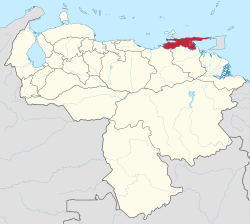
Lake Guanoco lies in the state of Estado Sucre about 140 km (87 mi) southeast of Cumaná close to Libertador at the Guanoco River only about 25 km (16 mi) east of the Golfo de Paria.
The asphalt lake has a surface area of about 445 ha (1,100 acres) and the depth varies between 1.5 to 2 m (4.9 to 6.6 ft). Even though Lake Guanoco is larger in area than Trinidad's Pitch Lake, it is smaller in volume; nevertheless its tar is purer.[citation needed] The Instituto Venezolano del Asfalto (INVEAS) estimated the lake contains 75 million barrels of crude.
Lake Guanoco is also different from other asphalt lakes as it is covered in vegetation.[citation needed]
All asphalt lakes were probably created during the Pleistocene epoch and share the same geological principle.
Asphalt lakes are the largest examples of natural oil seeps. They occur when oil migrating toward the surface as a result of buoyancy (oil is lighter than ground water) actually reaches the surface, instead of being trapped in deeper stratigraphic layers. The reason the petroleum becomes asphaltic, or tarry, is the action of oil-metabolizing bacteria. This process of biodegradation occurs close to the earth's surface, where temperatures are low enough for the bacteria to thrive, and where the oil is surrounded by fresh meteoric water.
Lake Bermudez
10°11′48″N 62°52′14″W / 10.19667°N 62.87056°W
Lake Guanoco (Spanish: Lago Guanoco or Lago de Asfalto de Guanoco, also Lake Bermudez) is the world's second largest natural tar pit and lies in Venezuela in northern South America.
Lake Guanoco is one of the five natural asphalt lake areas in the world, the others being Pitch Lake in Trinidad and Tobago and La Brea Tar Pits (Los Angeles), McKittrick Tar Pits (McKittrick) and Carpinteria Tar Pits (Carpinteria) all located in the US state of California.
Lake Guanoco lies in the state of Estado Sucre about 140 km (87 mi) southeast of Cumaná close to Libertador at the Guanoco River only about 25 km (16 mi) east of the Golfo de Paria.
The asphalt lake has a surface area of about 445 ha (1,100 acres) and the depth varies between 1.5 to 2 m (4.9 to 6.6 ft). Even though Lake Guanoco is larger in area than Trinidad's Pitch Lake, it is smaller in volume; nevertheless its tar is purer.[citation needed] The Instituto Venezolano del Asfalto (INVEAS) estimated the lake contains 75 million barrels of crude.
Lake Guanoco is also different from other asphalt lakes as it is covered in vegetation.[citation needed]
All asphalt lakes were probably created during the Pleistocene epoch and share the same geological principle.
Asphalt lakes are the largest examples of natural oil seeps. They occur when oil migrating toward the surface as a result of buoyancy (oil is lighter than ground water) actually reaches the surface, instead of being trapped in deeper stratigraphic layers. The reason the petroleum becomes asphaltic, or tarry, is the action of oil-metabolizing bacteria. This process of biodegradation occurs close to the earth's surface, where temperatures are low enough for the bacteria to thrive, and where the oil is surrounded by fresh meteoric water.
Recent media
Recent media