



Community hub
Recent from talks
Knowledge base stats:
Talk channels stats:
Members stats:
Laksa
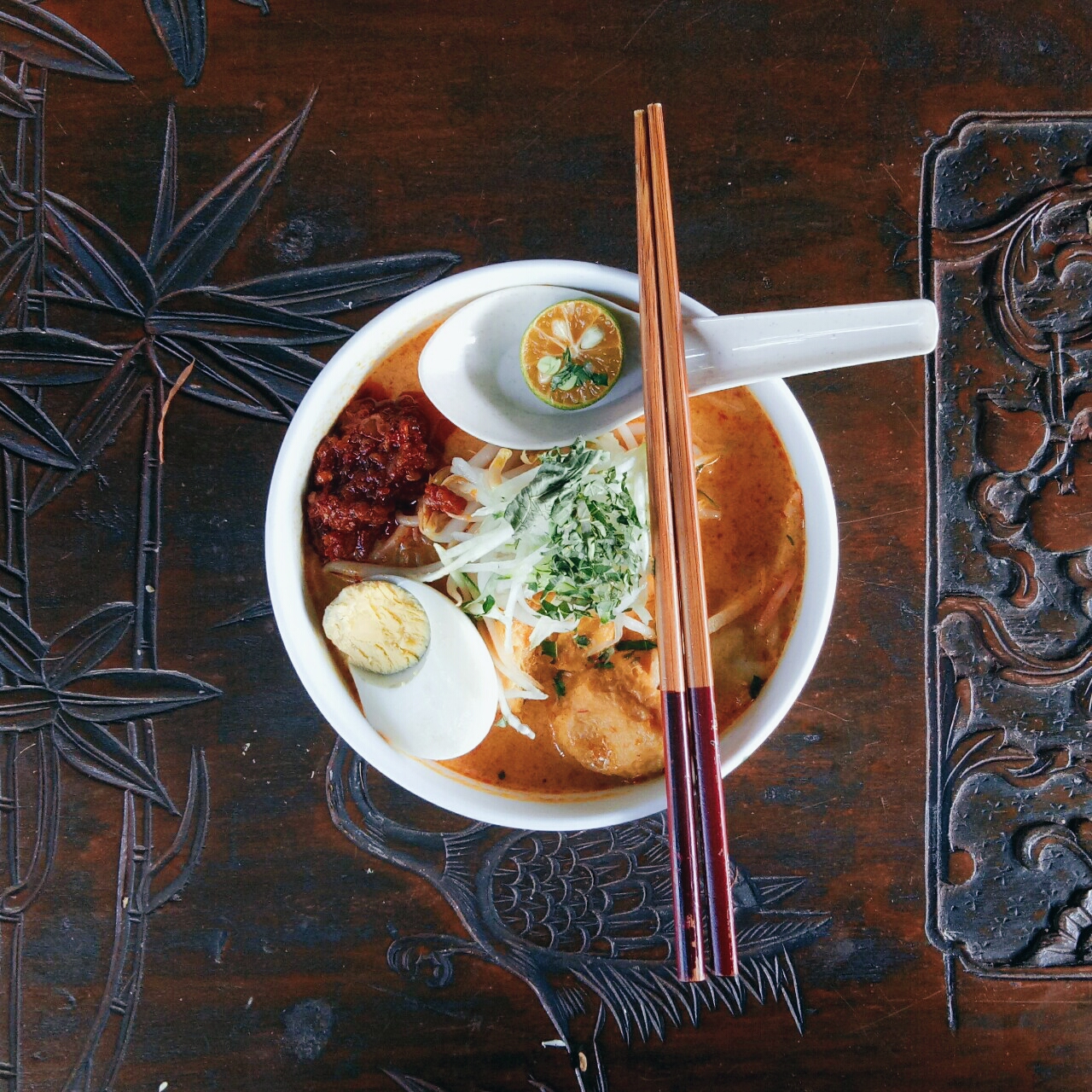
Laksa (Jawi: لقسا; Chinese: 叻沙) is a spicy noodle dish popular in Southeast Asia. Laksa consists of various types of noodles, most commonly thick rice noodles, with toppings such as chicken, prawns or fish. Most variations of laksa are prepared with a rich and spicy coconut curry soup or a broth seasoned with a souring ingredient like tamarind or asam gelugur.
Originating from Peranakan Chinese cuisine, laksa recipes are commonly served in Singapore, Indonesia, Malaysia and Australia.
Laksa is a dish of Peranakan Chinese origin, with a variety of ingredients and preparation processes that vary greatly by region. Because laksa has different varieties across the region, it is difficult to pinpoint the exact origin of the dish. Nevertheless, a number of laksa recipes have been developed along the trade channels of Southeast Asia—where the ports of Singapore, Penang, Medan, Malacca, Palembang, and Batavia (now Jakarta) are the major stops along the historic spice route. The intensive trade links among these port cities enable exchanges of ideas to take place, including sharing recipes.
There are various theories about the origins of laksa. One goes back to the 15th-century Ming Chinese naval expeditions led by Zheng He, whose armada navigated Maritime Southeast Asia. Overseas Chinese migrants had settled in various parts of Maritime Southeast Asia, long before Zheng He's expedition. However, it was after this that the number of Chinese migrants and traders significantly increased. These Chinese men intermarried into the local populations, and together they formed mixed-race communities called the Peranakan Chinese or Straits Chinese.
In Malaysia, the earliest variant of laksa is believed to have been introduced by the Peranakan Chinese in Malacca. The name laksa is derived from the word spicy (辣) and grainy or sandy (沙) in the Min Chinese dialect, which denotes the spicy taste and the grainy texture (either from grinding onion, granules of fish or meat, or curdled coconut milk) of laksa, since the Peranakan Malay is a creole language that is heavily influenced by a dialect of Hokkien. An early mention of "laksa" in the English language can be found in a Royal Geographical Society journal from 1846.
In Singapore, the dish is believed to have been created after interaction between the Peranakan Chinese with local Singaporean Malays.
Another theory is that the word laksa is theorised to come from an ancient Persian word for "noodles". According to Denys Lombard in the book Le carrefour Javanais. Essai d'histoire globale II (The Javanese Crossroads: Towards a Global History, 2005), one of the earliest record of the word laksa to describe noodles was found in the Javanese Biluluk inscription dated from 1391 of Majapahit era that mentions the word hanglaksa. Hanglaksa in Kawi means "vermicelli maker". In Sanskrit, laksa means "one hundred thousand", referring to numerous strands of the vermicelli. The term laksa, or lakhshah, is also believed to have come from Persian or Hindi, which refer to a kind of vermicelli.
In traditional Sundanese community of Baduy in Banten province, there is a harvest ceremony involving the making of laksa, called ngalaksa ceremony. Ngalaksa is a Sundanese traditional harvest thanksgiving ceremony, in which a traditional noodle-like laksa dish made of rice flour is prepared and consumed communally. In old Sundanese language the term laksa also means "noodle", which is the same meaning as in Javanese Kawi counterpart.
Hub AI
Laksa AI simulator
(@Laksa_simulator)
Laksa
Laksa (Jawi: لقسا; Chinese: 叻沙) is a spicy noodle dish popular in Southeast Asia. Laksa consists of various types of noodles, most commonly thick rice noodles, with toppings such as chicken, prawns or fish. Most variations of laksa are prepared with a rich and spicy coconut curry soup or a broth seasoned with a souring ingredient like tamarind or asam gelugur.
Originating from Peranakan Chinese cuisine, laksa recipes are commonly served in Singapore, Indonesia, Malaysia and Australia.
Laksa is a dish of Peranakan Chinese origin, with a variety of ingredients and preparation processes that vary greatly by region. Because laksa has different varieties across the region, it is difficult to pinpoint the exact origin of the dish. Nevertheless, a number of laksa recipes have been developed along the trade channels of Southeast Asia—where the ports of Singapore, Penang, Medan, Malacca, Palembang, and Batavia (now Jakarta) are the major stops along the historic spice route. The intensive trade links among these port cities enable exchanges of ideas to take place, including sharing recipes.
There are various theories about the origins of laksa. One goes back to the 15th-century Ming Chinese naval expeditions led by Zheng He, whose armada navigated Maritime Southeast Asia. Overseas Chinese migrants had settled in various parts of Maritime Southeast Asia, long before Zheng He's expedition. However, it was after this that the number of Chinese migrants and traders significantly increased. These Chinese men intermarried into the local populations, and together they formed mixed-race communities called the Peranakan Chinese or Straits Chinese.
In Malaysia, the earliest variant of laksa is believed to have been introduced by the Peranakan Chinese in Malacca. The name laksa is derived from the word spicy (辣) and grainy or sandy (沙) in the Min Chinese dialect, which denotes the spicy taste and the grainy texture (either from grinding onion, granules of fish or meat, or curdled coconut milk) of laksa, since the Peranakan Malay is a creole language that is heavily influenced by a dialect of Hokkien. An early mention of "laksa" in the English language can be found in a Royal Geographical Society journal from 1846.
In Singapore, the dish is believed to have been created after interaction between the Peranakan Chinese with local Singaporean Malays.
Another theory is that the word laksa is theorised to come from an ancient Persian word for "noodles". According to Denys Lombard in the book Le carrefour Javanais. Essai d'histoire globale II (The Javanese Crossroads: Towards a Global History, 2005), one of the earliest record of the word laksa to describe noodles was found in the Javanese Biluluk inscription dated from 1391 of Majapahit era that mentions the word hanglaksa. Hanglaksa in Kawi means "vermicelli maker". In Sanskrit, laksa means "one hundred thousand", referring to numerous strands of the vermicelli. The term laksa, or lakhshah, is also believed to have come from Persian or Hindi, which refer to a kind of vermicelli.
In traditional Sundanese community of Baduy in Banten province, there is a harvest ceremony involving the making of laksa, called ngalaksa ceremony. Ngalaksa is a Sundanese traditional harvest thanksgiving ceremony, in which a traditional noodle-like laksa dish made of rice flour is prepared and consumed communally. In old Sundanese language the term laksa also means "noodle", which is the same meaning as in Javanese Kawi counterpart.