



Community hub
Recent from talks
Knowledge base stats:
Talk channels stats:
Members stats:
Lambeth Palace
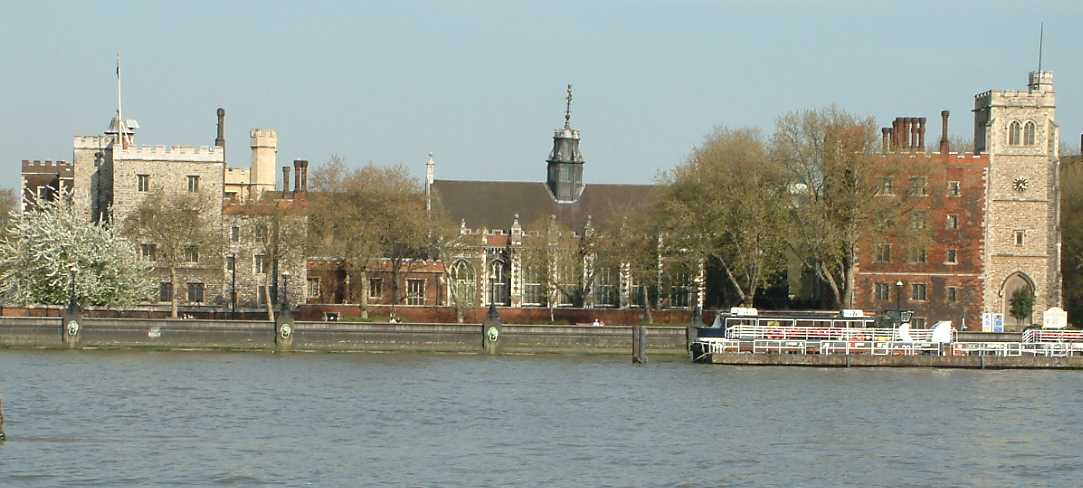
Lambeth Palace is the official London residence of the Archbishop of Canterbury. It is situated in north Lambeth, London, on the south bank of the River Thames, 400 yards (370 metres) south-east of the Palace of Westminster, which houses Parliament, on the opposite bank.
Close to Westminster and the City, the estate was first acquired by the archbishopric for the archbishop (who also has a residence at Old Palace, Canterbury) around 1200.
While the original residence of the archbishop of Canterbury was in his episcopal see, Canterbury, Kent, a site originally called the Manor of Lambeth or Lambeth House was acquired by the diocese around AD 1200 (though Archbishop Anselm had a house there a century earlier) and has since served as the archbishop's London residence. The site was chosen for its convenient proximity to the royal palace and government seat of Westminster, just across the Thames. The site is bounded by Lambeth Palace Road to the west and Lambeth Road to the south, but it is excluded from the parish of North Lambeth which encompasses all other surrounding land. The garden park is listed and resembles Archbishop's Park, a neighbouring public park; however, it was a larger area with a notable orchard until the early 19th century. The former church in front of its entrance has been converted to the Garden Museum. The south bank of the Thames along this reach, not part of historic London, developed slowly because the land was low and sodden: it was called Lambeth Marsh, as far downriver as the present Blackfriars Road. The origins of the name of Lambeth come from its first record in 1062 as Lambehitha, meaning 'landing place for lambs' ('hitha' or 'hithe' referring to a landing on the river): archbishops came and went by water, as did John Wycliffe, who was tried here for heresy in 1378. In the Peasants' Revolt of 1381, the palace was attacked. Cardinal Pole lay in state in the palace for 40 days after he died there in 1558.
The palace was again attacked in May 1640 during a period of popular discontent with the Arminianist theology of the Archbishop, William Laud, in the hope of capturing him. The palace was ransacked and partially demolished by the Parliamentarians in the English Civil War of the 1640s, necessitating major reconstruction, especially of the great hall, in 1660–1663.
New construction was added to the building in 1829–1834 by Edward Blore (1787–1879), who rebuilt much of Buckingham Palace later, in neo-Gothic style and it fronts a spacious quadrangle. Blore's large extensions to house the archbishop meant that the original buildings could be converted to the archdiocese's library, record office and secretariat. The palace was damaged in the Blitz of 1941. The buildings form the home of the archbishop, who is regarded as the first among equals in the Anglican Communion, and is ex officio a member of the House of Lords.
The building is listed in the highest category, Grade I, for its architecture. The palace consists of two main structures: the residence itself, which is built round a cloister, and Morton's Tower, which forms the main entry. The medieval building had three more courtyards, which have since disappeared, as has the moat that surrounded the complex. The unusual inclusion of a cloister may be because Archbishop Hubert Walter initially intended to found a Premonstratensian abbey on the site, before settling on a palace. The original timber cloister, which held the archbishop's library, was replaced by the present structure in 1830. The oldest remaining part of the palace is the 13th-century chapel which was built in the Early English Gothic architectural style. It stands above a vaulted undercroft, which has a central line of columns. This part had to be heavily restored after the Blitz, so most of its fittings are of 1954–55. The medieval great hall, now gone, appears to have been rebuilt following damage in the Peasants' Revolt. The south end of the hall joined the kitchen and offices, while a stair at the north end led to the archbishop's apartments. One 14th-century room of these apartments, now known as the Guard Chamber, still stands, with its original elaborate roof. Further private accommodation was added when the Water or Lollards' Tower, built of Kentish Ragstone with ashlar quoins, was built at the north-west corner in 1434–35. It was extended and heightened later in the century, and again in the early 16th century when Laud's Tower was built next to it. At the top of the stair was the Archbishop's prison, a room also seen at Winchester Palace in Southwark. The massive five-storey brick gatehouse was built by Cardinal John Morton and completed in 1495 and housed eight lodgings for the Archbishop's household. Improvements continued into the 16th century, when Archbishop Cranmer built a brick tower north-east of the chapel to house his study.
The most serious damage done by the Cromwellians in the late 1640s was the demolition of the great hall and the sale of its materials. After the Restoration, it was completely rebuilt by Archbishop William Juxon in 1663 (dated) with a late Gothic hammerbeam roof. The choice of a hammerbeam roof was evocative, as it reflected the High-Church Anglican continuity with the Old Faith (the King's (Charles II) brother was an avowed Catholic) and served as a visual statement that the Interregnum was over. As with some Gothic details on University buildings of the same date, it is debated among architectural historians whether this is "Gothic survival" or an early work of the "Gothic Revival". The diarist Samuel Pepys recognised it as "a new old-fashioned hall". Major work was done by Blore in 1829–1833, with large parts of the medieval palace being rebuilt, and an extensive new wing in Gothic revival style added.
Among the portraits of the archbishops in the palace are works by Hans Holbein, Anthony van Dyck, William Hogarth and Sir Joshua Reynolds.[citation needed]
Hub AI
Lambeth Palace AI simulator
(@Lambeth Palace_simulator)
Lambeth Palace
Lambeth Palace is the official London residence of the Archbishop of Canterbury. It is situated in north Lambeth, London, on the south bank of the River Thames, 400 yards (370 metres) south-east of the Palace of Westminster, which houses Parliament, on the opposite bank.
Close to Westminster and the City, the estate was first acquired by the archbishopric for the archbishop (who also has a residence at Old Palace, Canterbury) around 1200.
While the original residence of the archbishop of Canterbury was in his episcopal see, Canterbury, Kent, a site originally called the Manor of Lambeth or Lambeth House was acquired by the diocese around AD 1200 (though Archbishop Anselm had a house there a century earlier) and has since served as the archbishop's London residence. The site was chosen for its convenient proximity to the royal palace and government seat of Westminster, just across the Thames. The site is bounded by Lambeth Palace Road to the west and Lambeth Road to the south, but it is excluded from the parish of North Lambeth which encompasses all other surrounding land. The garden park is listed and resembles Archbishop's Park, a neighbouring public park; however, it was a larger area with a notable orchard until the early 19th century. The former church in front of its entrance has been converted to the Garden Museum. The south bank of the Thames along this reach, not part of historic London, developed slowly because the land was low and sodden: it was called Lambeth Marsh, as far downriver as the present Blackfriars Road. The origins of the name of Lambeth come from its first record in 1062 as Lambehitha, meaning 'landing place for lambs' ('hitha' or 'hithe' referring to a landing on the river): archbishops came and went by water, as did John Wycliffe, who was tried here for heresy in 1378. In the Peasants' Revolt of 1381, the palace was attacked. Cardinal Pole lay in state in the palace for 40 days after he died there in 1558.
The palace was again attacked in May 1640 during a period of popular discontent with the Arminianist theology of the Archbishop, William Laud, in the hope of capturing him. The palace was ransacked and partially demolished by the Parliamentarians in the English Civil War of the 1640s, necessitating major reconstruction, especially of the great hall, in 1660–1663.
New construction was added to the building in 1829–1834 by Edward Blore (1787–1879), who rebuilt much of Buckingham Palace later, in neo-Gothic style and it fronts a spacious quadrangle. Blore's large extensions to house the archbishop meant that the original buildings could be converted to the archdiocese's library, record office and secretariat. The palace was damaged in the Blitz of 1941. The buildings form the home of the archbishop, who is regarded as the first among equals in the Anglican Communion, and is ex officio a member of the House of Lords.
The building is listed in the highest category, Grade I, for its architecture. The palace consists of two main structures: the residence itself, which is built round a cloister, and Morton's Tower, which forms the main entry. The medieval building had three more courtyards, which have since disappeared, as has the moat that surrounded the complex. The unusual inclusion of a cloister may be because Archbishop Hubert Walter initially intended to found a Premonstratensian abbey on the site, before settling on a palace. The original timber cloister, which held the archbishop's library, was replaced by the present structure in 1830. The oldest remaining part of the palace is the 13th-century chapel which was built in the Early English Gothic architectural style. It stands above a vaulted undercroft, which has a central line of columns. This part had to be heavily restored after the Blitz, so most of its fittings are of 1954–55. The medieval great hall, now gone, appears to have been rebuilt following damage in the Peasants' Revolt. The south end of the hall joined the kitchen and offices, while a stair at the north end led to the archbishop's apartments. One 14th-century room of these apartments, now known as the Guard Chamber, still stands, with its original elaborate roof. Further private accommodation was added when the Water or Lollards' Tower, built of Kentish Ragstone with ashlar quoins, was built at the north-west corner in 1434–35. It was extended and heightened later in the century, and again in the early 16th century when Laud's Tower was built next to it. At the top of the stair was the Archbishop's prison, a room also seen at Winchester Palace in Southwark. The massive five-storey brick gatehouse was built by Cardinal John Morton and completed in 1495 and housed eight lodgings for the Archbishop's household. Improvements continued into the 16th century, when Archbishop Cranmer built a brick tower north-east of the chapel to house his study.
The most serious damage done by the Cromwellians in the late 1640s was the demolition of the great hall and the sale of its materials. After the Restoration, it was completely rebuilt by Archbishop William Juxon in 1663 (dated) with a late Gothic hammerbeam roof. The choice of a hammerbeam roof was evocative, as it reflected the High-Church Anglican continuity with the Old Faith (the King's (Charles II) brother was an avowed Catholic) and served as a visual statement that the Interregnum was over. As with some Gothic details on University buildings of the same date, it is debated among architectural historians whether this is "Gothic survival" or an early work of the "Gothic Revival". The diarist Samuel Pepys recognised it as "a new old-fashioned hall". Major work was done by Blore in 1829–1833, with large parts of the medieval palace being rebuilt, and an extensive new wing in Gothic revival style added.
Among the portraits of the archbishops in the palace are works by Hans Holbein, Anthony van Dyck, William Hogarth and Sir Joshua Reynolds.[citation needed]