
Recent from talks
Lavandula
Knowledge base stats:
Talk channels stats:
Members stats:
Lavandula
Lavandula (common name lavender) is a genus of 47 known species of perennial flowering plants in the sage family, Lamiaceae. It is native to the Old World, primarily found across the drier, warmer regions of the Mediterranean, with an affinity for maritime breezes.
Lavender is found on the Iberian Peninsula and around the entirety of the Mediterranean coastline (including the Adriatic coast, the Balkans, the Levant, and coastal North Africa), in parts of Eastern and Southern Africa and the Middle East, as well as in South Asia and on the Indian subcontinent.
Many members of the genus are cultivated extensively in temperate climates as ornamental plants for garden and landscape use, for use as culinary herbs, and also commercially for the extraction of essential oils. Lavender is used in traditional medicine and as an ingredient in cosmetics.
The genus includes annual or short-lived herbaceous perennial plants and shrub-like perennials, subshrubs or small shrubs.
Leaf shape is diverse across the genus. They are simple in some commonly cultivated species; in other species, they are pinnately toothed, or pinnate, sometimes multiple pinnate and dissected. In most species, the leaves are covered in fine hairs or indumentum, which normally contain essential oils.
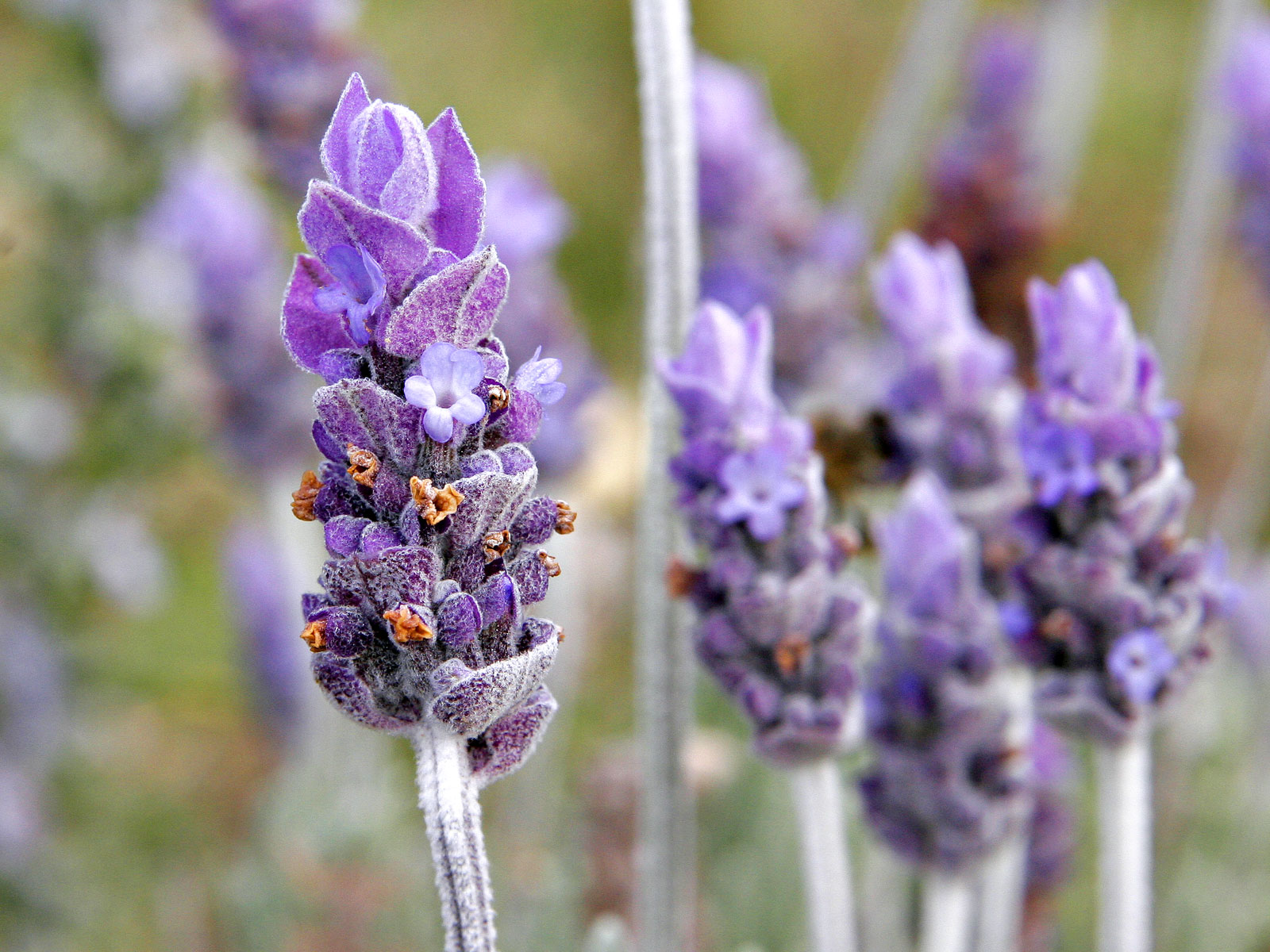
Flowers are contained in whorls, held on spikes rising above the foliage, with the spikes being branched in some species. Some species produce colored bracts at the tips of the inflorescences. The flowers may be blue, violet, or lilac in the wild species, occasionally blackish purple or yellowish. The sepal calyx is tubular. The corolla is also tubular, usually with five lobes (the upper lip often cleft, and the lower lip has two clefts).
Around 93 individual phytochemicals have been identified in lavender oil, including major contents of linalyl acetate (30–55%), linalool (20–35%), tannins (5–10%), and caryophyllene (8%), with lesser amounts of sesquiterpenoids, perillyl alcohols, esters, oxides, ketones, cineole, camphor, beta-ocimene, limonene, caproic acid, and caryophyllene oxide. The relative amounts of these compounds vary considerably among lavender species.
Lavandula stoechas, L. pedunculata, and L. dentata were known in Roman times. From the Middle Ages onwards, the European species were considered two separate groups or genera, Stoechas (L. stoechas, L. pedunculata, L. dentata) and Lavandula (L. spica and L. latifolia), until Carl Linnaeus combined them. He recognised only five species in Species Plantarum (1753), L. multifida and L. dentata (Spain) and L. stoechas and L. spica from Southern Europe. L. pedunculata was included within L. stoechas.
Hub AI
Lavandula AI simulator
(@Lavandula_simulator)
Lavandula
Lavandula (common name lavender) is a genus of 47 known species of perennial flowering plants in the sage family, Lamiaceae. It is native to the Old World, primarily found across the drier, warmer regions of the Mediterranean, with an affinity for maritime breezes.
Lavender is found on the Iberian Peninsula and around the entirety of the Mediterranean coastline (including the Adriatic coast, the Balkans, the Levant, and coastal North Africa), in parts of Eastern and Southern Africa and the Middle East, as well as in South Asia and on the Indian subcontinent.
Many members of the genus are cultivated extensively in temperate climates as ornamental plants for garden and landscape use, for use as culinary herbs, and also commercially for the extraction of essential oils. Lavender is used in traditional medicine and as an ingredient in cosmetics.
The genus includes annual or short-lived herbaceous perennial plants and shrub-like perennials, subshrubs or small shrubs.
Leaf shape is diverse across the genus. They are simple in some commonly cultivated species; in other species, they are pinnately toothed, or pinnate, sometimes multiple pinnate and dissected. In most species, the leaves are covered in fine hairs or indumentum, which normally contain essential oils.
Flowers are contained in whorls, held on spikes rising above the foliage, with the spikes being branched in some species. Some species produce colored bracts at the tips of the inflorescences. The flowers may be blue, violet, or lilac in the wild species, occasionally blackish purple or yellowish. The sepal calyx is tubular. The corolla is also tubular, usually with five lobes (the upper lip often cleft, and the lower lip has two clefts).
Around 93 individual phytochemicals have been identified in lavender oil, including major contents of linalyl acetate (30–55%), linalool (20–35%), tannins (5–10%), and caryophyllene (8%), with lesser amounts of sesquiterpenoids, perillyl alcohols, esters, oxides, ketones, cineole, camphor, beta-ocimene, limonene, caproic acid, and caryophyllene oxide. The relative amounts of these compounds vary considerably among lavender species.
Lavandula stoechas, L. pedunculata, and L. dentata were known in Roman times. From the Middle Ages onwards, the European species were considered two separate groups or genera, Stoechas (L. stoechas, L. pedunculata, L. dentata) and Lavandula (L. spica and L. latifolia), until Carl Linnaeus combined them. He recognised only five species in Species Plantarum (1753), L. multifida and L. dentata (Spain) and L. stoechas and L. spica from Southern Europe. L. pedunculata was included within L. stoechas.
Recent media