Hubbry Logo
Desert kingsnakeDesert kingsnakeMain
Open search
Desert kingsnake
Community hub
Desert kingsnake
logo
8 pages, 0 posts
0 subscribers
Be the first to start a discussion here.
Desert kingsnake
Desert kingsnake
from Wikipedia

Desert kingsnake
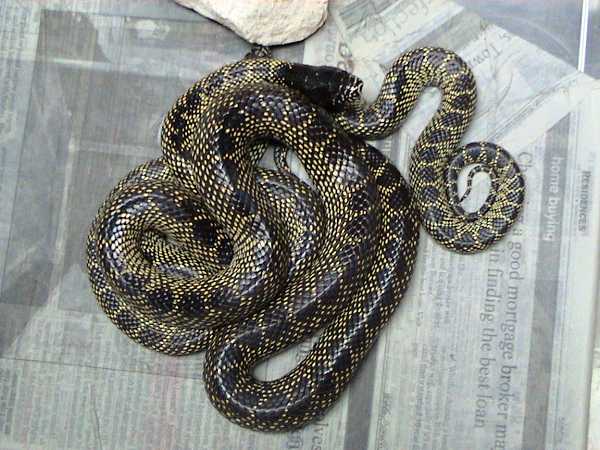
Pair of desert kingsnakes, Lampropeltis splendida
Scientific classification Edit this classification
Kingdom: Animalia
Phylum: Chordata
Class: Reptilia
Order: Squamata
Suborder: Serpentes
Family: Colubridae
Genus: Lampropeltis
Species:
L. splendida
Binomial name
Lampropeltis splendida
(Baird & Girard, 1854)
Synonyms

Ophibolus splendidus Baird & Girard, 1853
Lampropeltis splendida Cope, 1860
Ophibolus getulus splendidus Cope, 1900
Lampropeltis getulus splendida Schmidt & Davis, 1941

The desert kingsnake (Lampropeltis splendida) is a species of kingsnake native to Texas, Arizona, and New Mexico, United States. It is not venomous, colored yellow and black. The desert kingsnake's diet consists of rodents, lizards, and smaller snakes, including rattlesnakes. They normally grow 3–4 ft long, but have been known to grow up to 6.8 ft. They are docile creatures when confronted by humans. If they do not try to escape, often they "play dead" by flipping over onto their backs and lying motionless. Some who domesticate kingsnakes, such as ranchers, do so in the hopes that the kingsnakes will feed on other snakes, which might present more of a threat. It was previously considered a subspecies of the common kingsnake. The desert kingsnake belongs to the Colubridae family, which is the largest family of snakes in the world.[2]

Appearance

[edit]

The snake's glossy dorsum is black or very dark brown colored, finely speckled with off-white or yellow. These pale flecks form dimly defined narrow vertebral crossbands, between which the intervening rectangular areas are black. Pale yellow scales may predominate along the lower sides. The abdomens of both adult and young snakes are mostly black, with white or pale yellow blotches marking the outer ends of the ventral plates. The smooth dorsal scales are arranged in 23 to 25 rows at midbody and the anal plate is undivided.

Family

[edit]

The desert kingsnake belongs to the Colubridae or Colubrid family, the largest family of snakes in the world.

Habitat

[edit]

The desert kingsnake may occur in any rural habitat within its range. Despite its common name, it is most likely to be found in mesic areas, especially near water tanks or within riparian corridors.[3]

Prey

[edit]

This snake is known to be a powerful constrictor; its diet consists of mostly mice if domestic, and other rodents if wild. It also can feed on reptile eggs detected beneath the surface via smell. In part because of its resistance to pitviper venom, the desert kingsnake is able to consume young diamondback rattlesnakes that are common within its range, and at the scent of L. getula even adult western diamondbacks edge hastily backward, shielding their heads with defensive loops.[3]

Reproduction

[edit]

As with most reptiles, L. splendida lays eggs. Courtship and copulation occur between March and June, with clutches of 5 to 12 adhesive-surfaced eggs deposited in late June or July, sometimes buried as deeply as a foot to prevent drying through their moisture-permeable shells. After about 60 days of incubation, the 8- to 10-inch-long hatchlings, weighing about a fifth of an ounce, emerge. Brightly yellow-speckled in vertebral cross-lines, they also exhibit a lateral row of large, dark brown spots, which as they mature, are gradually fragmented by encroaching yellow flecks.[3]

References

[edit]
Revisions and contributorsEdit on WikipediaRead on Wikipedia
from Grokipedia
The Desert kingsnake (Lampropeltis splendida) is a nonvenomous colubrid snake native to the arid and semi-arid regions of the southwestern United States and northern Mexico, distinguished by its glossy black or dark brown dorsal surface finely speckled with yellow or off-white, forming 42–97 narrow crossbands, and a black venter with pale blotches, typically attaining a length of 90–120 cm (3–4 ft), though some individuals exceed 150 cm. This species inhabits a variety of dry habitats, including Chihuahuan Desert scrub, Sonoran Desert grasslands, open woodlands, and riparian corridors up to elevations of about 1,560 m, ranging from southeastern Arizona and southwestern New Mexico through western Texas in the United States, and into northern Mexican states such as Chihuahua, , , , , and . It is a powerful constrictor that preys primarily on small mammals like , as well as , birds, eggs, and other snakes—including venomous rattlesnakes (* spp.)—to which it demonstrates partial physiological resistance through serum-based venom-neutralizing proteins that inhibit hemorrhagic and proteolytic effects. Behaviorally, the Desert kingsnake is primarily diurnal but may shift to crepuscular or nocturnal activity in hotter months, often remaining secretive and hiding under rocks or debris during the day; it is generally docile toward humans, rarely biting unless provoked, and employs defensive tactics such as musking, tail vibration, or feigning death when threatened. is oviparous, with mating occurring from March to May and females laying clutches of 5–12 eggs in or , which incubate for 60–70 days before hatching in late summer; juveniles resemble adults but with more pronounced yellow speckling. The species is assessed as Least Concern (LC) by the as of 2019, owing to its wide distribution, stable population exceeding 10,000 mature individuals, and lack of significant threats, though localized declines may occur due to from agriculture and urbanization.

Taxonomy

Classification

The desert kingsnake, Lampropeltis splendida, is classified within the domain Eukaryota, kingdom Animalia, phylum Chordata, class Reptilia, order Squamata, suborder Serpentes, family Colubridae, subfamily Colubrinae, genus Lampropeltis, and species L. splendida. As a member of the Colubridae family, it is a non-venomous colubrid snake that primarily employs constriction to subdue prey. Prior to 2009, L. splendida was recognized as a subspecies of the common , , specifically L. getula splendida, based on morphological similarities; however, phylogeographic and genetic analyses led to its elevation to full status in a systematic revision by Pyron and Burbrink.

Etymology and history

The genus name Lampropeltis derives from the Greek words lampros (shiny or bright) and peltē (small shield), alluding to the glossy, shield-like scales characteristic of snakes in this . The specific splendida originates from the Latin splendidus, meaning splendid or brilliant, a reference to the ' vivid black ground color accented by narrow yellow or white crossbands that create a striking dorsal pattern. Baird and Girard did not explicitly justify the epithet in their original description, but later herpetologists have consistently interpreted it as highlighting the snake's eye-catching appearance. The desert kingsnake was first scientifically described in 1853 by American naturalists and Charles Frédéric Girard in their Catalogue of North American Reptiles in the Museum of the , Part 1—Serpents. They named it Ophibolus splendidus, with the (USNM 1726) collected by Colonel J.D. Graham from , , between 1848 and 1853. This initial placement reflected the era's limited understanding of colubrid systematics, as Ophibolus was a short-lived for certain New World . Subsequent taxonomic revisions synonymized O. splendidus under various names, including Coronella getulus var. splendida (Jan 1865) and Ophibolus getulus splendidus (Cope ), before its transfer to Lampropeltis as L. getulus splendida by Frank N. Blanchard in 1921. It remained classified as a of the common kingsnake (L. getula) through much of the 20th century, with refinements by authors like Edward H. Taylor (1952), Richard R. Webb (1984), Wilmer W. Tanner (1985), James R. Dixon (2000), and Alan Tennant and R.D. Bartlett (2000). Molecular phylogenetic studies in the early revealed deep genetic divergences within the L. getula complex, supporting the recognition of L. splendida as a distinct separate from L. getula. This elevation was formalized in taxonomic checklists, including Wallach et al. (2014) and Krysko et al. (2017), with further validation through phylogeographic analyses demonstrating its unique lineage. A 2020 review by David M. Hillis in Herpetological Review questioned this split, arguing for recognition as a of L. getula based on nuclear genetic data indicating and intergradation, though L. splendida continues to be accepted as a full by major taxonomic authorities such as the Reptile Database as of 2025.

Description

Morphology

The desert kingsnake (Lampropeltis splendida) possesses a smooth-scaled, cylindrical body typical of colubrid snakes, facilitating efficient movement through arid environments. The dorsal scales are smooth and arranged in 23–25 rows at midbody, while the ventral scales number 199–227 in males and 203–237 in females, with an undivided anal plate. These features contribute to its streamlined form as a non-venomous constrictor. The head is slightly widened but only marginally broader than the neck, lacking heat-sensing pits that distinguish it from vipers. It features round pupils and a used for chemoreception, aiding in prey detection through chemical cues in the environment. Adults typically measure 90–114 cm (36–45 inches) in total length, with a maximum recorded length of 152 cm (60 inches). is minimal, though females tend to attain slightly larger sizes than males. Hatchlings exhibit morphology similar to adults but at a smaller scale, measuring 18–25 cm (7–10 inches) upon emergence.

Coloration and variation

The desert exhibits a distinctive dorsal pattern characterized by a glossy black or dark brown ground color overlaid with heavy or off-white on the lateral and dorsolateral scales. This often coalesces to form 42–97 narrow crossbands or remnant blotches and saddles along the body, which may appear broken into spots rather than continuous bands; a collar-like marking is sometimes evident on the neck. The ventral surface is typically black, marked by irregular pale yellow or white blotches, often at the outer ends of the ventral scales, that may form a checkered or mottled pattern, while the lower sides feature yellow scales edged or tipped in black. Geographic variation in coloration is notable across the species' range. Populations in southeastern display pronounced yellow speckling and more defined crossbands, whereas those in specific regions like the Pajarito-Atascosa Mountains and Altar Valley tend toward a darker "nigrita" form with reduced light markings and a predominantly black or dark gray dorsum. Melanistic forms, nearly uniform black with minimal yellow, occur rarely throughout the range. There is no significant sexual dichromatism in coloration or pattern. Age-related changes are evident, with juveniles showing bolder, more distinct blotches and minimal speckling for enhanced , while adults develop increased yellow stippling and faded, more fragmented patterns as they age.

Distribution and habitat

Geographic range

The desert kingsnake (Lampropeltis splendida) is primarily distributed across the and . In the United States, its range encompasses western , southern Arizona, and southwestern , with isolated records in northern and southern . The occupies the east of the Cochise Filter Barrier, extending from region in to extreme southeastern Arizona via the River valley. In Mexico, the distribution includes northern states such as Chihuahua, Coahuila, Durango, Nuevo León, San Luis Potosí, Sonora, and Tamaulipas, reaching south to the south-central . Within this range, the desert kingsnake is generally confined to lower elevations up to about 1,560 meters, including valleys, bajadas, and montane slopes in the portions of . Specific locales include eastern County, southern Graham and Greenlee Counties, and areas around Tucson and Nogales in Arizona, as well as the Altar Valley and Buenos Aires National Wildlife Refuge. The species' range aligns with arid desert environments, reflecting its adaptation to such conditions. The desert kingsnake's overall distribution has remained stable with no major range contractions documented. However, local extirpations may occur in areas affected by and .

Habitat preferences

The desert kingsnake (Lampropeltis splendida) primarily occupies arid and semi-arid environments across the and , including the Sonoran and Chihuahuan Deserts, where it inhabits desertscrub, semi-desert grasslands, open woodlands, and scrublands. Despite its name, it favors relatively mesic conditions within these dry landscapes, such as riparian corridors, canyon bottoms, and vicinity to perennial water sources like streams or stock tanks, while generally avoiding the most extreme xeric zones with minimal moisture. In terms of microhabitat use, these snakes are largely terrestrial but capable climbers, often found on the ground amid vegetation or debris; they seek refuge under rocks, in rock crevices, hollow logs, burrows, or similar cover to regulate body temperature and evade predators. This preference for sheltered, structurally diverse sites supports their nocturnal or crepuscular activity patterns in warmer months. The species tolerates a broad range of desert climates but is most active at ambient temperatures of 20–35°C (68–95°F), typically from May through September, with records of activity in nearly every month except deep winter. In response to cooler winter conditions and reduced prey availability, desert kingsnakes brumate in underground burrows or other insulated refuges at sites with more stable, lower temperatures. Desert kingsnakes show a notable association with human-modified landscapes, thriving in rural scrublands, agricultural fields, and suburban edges where cover and prey are abundant, though populations decline in intensively urbanized desert areas due to and loss of natural refugia.

Behavior

Activity patterns and defense

The desert kingsnake (Lampropeltis splendida) is primarily diurnal during cooler seasons such as spring and fall, shifting to nocturnal or crepuscular activity during summer months to evade daytime heat. This adaptive activity pattern allows the snake to remain active in favorable conditions while minimizing exposure to extreme and predation risks associated with its environment. During the colder period from to , individuals enter brumation in underground refuges such as burrows or rock crevices, a state that conserves energy amid low temperatures and limited resources. Locomotion in the desert kingsnake typically involves lateral undulation for straight-line crawling across firm substrates, enabling efficient travel through varied terrains like scrub and grasslands. The snake can achieve bursts of speed up to approximately 8 km/h during evasion or pursuit, though sustained travel is slower to conserve energy in its arid habitat. Defense mechanisms of the desert kingsnake reflect its generally docile temperament, with aggression directed primarily toward threats rather than routine interactions. When confronted, it may first attempt escape, but if cornered, the snake coils tightly with its head tucked, hisses audibly, strikes, vibrates its tail to mimic a , and releases a foul-smelling from cloacal glands to deter predators. Bites are rare and non-venomous, delivering only mild if contact occurs, underscoring the species' preference for non-confrontational strategies. The desert kingsnake leads a solitary lifestyle outside of the brief period, showing no evidence of territorial defense or social grouping. Interactions are limited to rituals between males during , involving body twisting and pinning, after which individuals disperse to avoid competition for resources. This asocial behavior aligns with its secretive nature, reducing encounters that could lead to injury or energy expenditure in a resource-scarce desert setting.

Diet and predation

The desert kingsnake (Lampropeltis splendida) is an opportunistic predator that employs an strategy to capture prey, relying on its constrictor nature to coil around victims and suffocate them by restricting breathing and circulation. This feeding approach allows it to tackle a variety of prey sizes without relying on , emphasizing stealth and over active pursuit. Its primary prey includes small mammals such as (e.g., kangaroo rats and pocket mice), reptiles like and smaller snakes—including venomous species such as rattlesnakes—and, less frequently, birds and their eggs. The desert kingsnake exhibits partial immunity to pitviper venoms, such as those from rattlesnakes, due to serum proteins and enzymes that inhibit binding and activity, enabling it to consume these toxic prey without significant harm; however, it lacks specialized duophagic enzymes for enhanced venom digestion. Meals typically comprise 10-20% of the snake's body mass, optimizing energy intake while minimizing risks associated with overly large prey. This dietary flexibility supports its to arid environments, where prey availability fluctuates seasonally.

Reproduction

Mating and egg-laying

The mating season of the desert kingsnake (Lampropeltis splendida) occurs in spring, typically from to May, shortly after the snakes emerge from brumation. During this period, males actively seek out females, often traveling greater distances than usual to locate receptive partners. Male desert kingsnakes compete for access to females through ritualized combat, a behavior common in the genus Lampropeltis. These encounters involve two males twisting and coiling their bodies around each other in a non-lethal wrestling match, with the dominant male attempting to pin the other to the ground using neck-biting and body pressure to establish superiority. The victor gains priority in courting the female. Courtship follows, during which the male trails the female, aligns his body parallel to hers, and stimulates her with rhythmic chin rubs along her dorsum to elicit acceptance. Copulation ensues if the female is receptive, involving the insertion of one . Oviposition takes place in , from late to , approximately 40-60 days after . Females deposit a single clutch of 5-12 elongated, adhesive eggs in concealed nests, such as under rocks, logs, or in burrows, to protect them from predators and . The eggs measure about 3-4 cm in length and are leathery-shelled. No is provided; females abandon the clutch immediately after laying, leaving the eggs to develop independently.

Development and growth

Following oviposition, the eggs undergo embryonic development during an incubation period of 50-70 days at temperatures around 28-30°C. Hatchlings emerge fully formed and independent, measuring 20-25 cm in length and weighing 9-14 g, with an initial coloration pattern similar to adults but featuring brighter yellow speckles for enhanced crypsis in their desert environment. Unlike some viviparous reptiles, there is no parental care, and neonates must immediately forage for small prey such as lizards and insects to support their early metabolism. Juvenile desert kingsnakes reach after 2-3 years. In the wild, their lifespan averages 10-20 years, though growth slows after maturity as energy shifts toward reproduction and survival in harsh desert conditions. Survivorship is particularly low during the juvenile stage due to predation by birds and mammals, as well as in arid habitats lacking sufficient cover. This high attrition rate underscores the species' reliance on large clutch sizes to sustain populations.

Conservation

Status and population

The desert kingsnake (Lampropeltis splendida) is classified as Least Concern on the , with the assessment conducted in 2019. This status reflects its wide distribution across arid and semi-arid regions of the and , where the maintains stable populations estimated to exceed 10,000 mature individuals. No significant global declines have been observed, supported by ongoing observations indicating resilience in suitable habitats. In , the species is generally not considered threatened at the federal level but receives special protection (Pr) under SEMARNAT regulations in states such as , where it is part of the native herpetofauna without reported population declines. Regionally, conservation rankings vary. In , the species is considered Vulnerable (S3) by NatureServe due to limited distribution and potential in its southeastern range. In contrast, it holds a Secure (S5) rank in , reflecting abundant occurrences across much of the state's ecoregion. In , where it is widespread in western and southern areas, the state rank is Not Ranked (SNR), but populations are presumed stable and common based on survey data. Population trends show no overall decline, with local abundances varying by habitat quality but generally maintaining steady levels in mesic and riparian zones within its range. Monitoring efforts, including contributions via and targeted herpetological surveys, provide ongoing data on distribution and relative density, though precise metrics such as individuals per remain sparsely documented. As of 2025, no major updates to the 2019 IUCN assessment have emerged, and populations continue to exhibit stability without evidence of broad-scale reductions.

Threats and protection

The desert kingsnake faces several primary threats, primarily driven by human activities. Habitat loss due to and agricultural expansion has significantly impacted its range, particularly in the region of , where rapid development has converted substantial areas of natural desert into built environments and farmland. mortality is another major concern, as increasing road networks in arid ecosystems fragment habitats and expose snakes to vehicle collisions during dispersal and foraging; studies in the document high rates of snake roadkills, including colubrids like kingsnakes. Illegal collection for the pet trade also poses a risk, though less intense than for rarer , with the ecoregion reporting trade in native reptiles, including kingsnakes, despite regulatory efforts. Secondary threats exacerbate these pressures. is projected to alter suitable habitats for the desert kingsnake, potentially reducing available riparian and mesic areas critical for its survival through shifts in temperature and precipitation patterns. Introduced predators, such as domestic and feral cats, contribute to mortality by preying on snakes and their prey in urbanizing desert fringes, with cats documented as significant reptile predators in the . Additionally, use in agricultural areas can reduce populations of prey, indirectly affecting the 's food availability, as rodenticides have been detected in related species through . Conservation measures aim to mitigate these risks. The desert kingsnake is protected within national parks such as , where all native wildlife is safeguarded from collection, harm, or disturbance under federal regulations. It holds no federal endangered or threatened listing in the United States, reflecting its overall stable status, but state-level protections prohibit commercial collection in areas like . Educational initiatives by organizations like the Phoenix Herpetological Society promote coexistence through public programs on desert reptile and safety, reducing human-snake conflicts. While not requiring reintroduction due to its least concern status, is common in herpetological communities to support ethical pet trade and genetic research. The future outlook for the desert kingsnake remains stable provided ongoing habitat preservation efforts continue, with protected areas and helping to counter pressures. into its natural resistance to venom, derived from serum proteins that neutralize hemorrhagic toxins, holds potential medical applications for development.

References

Add your contribution
Related Hubs
User Avatar
No comments yet.